
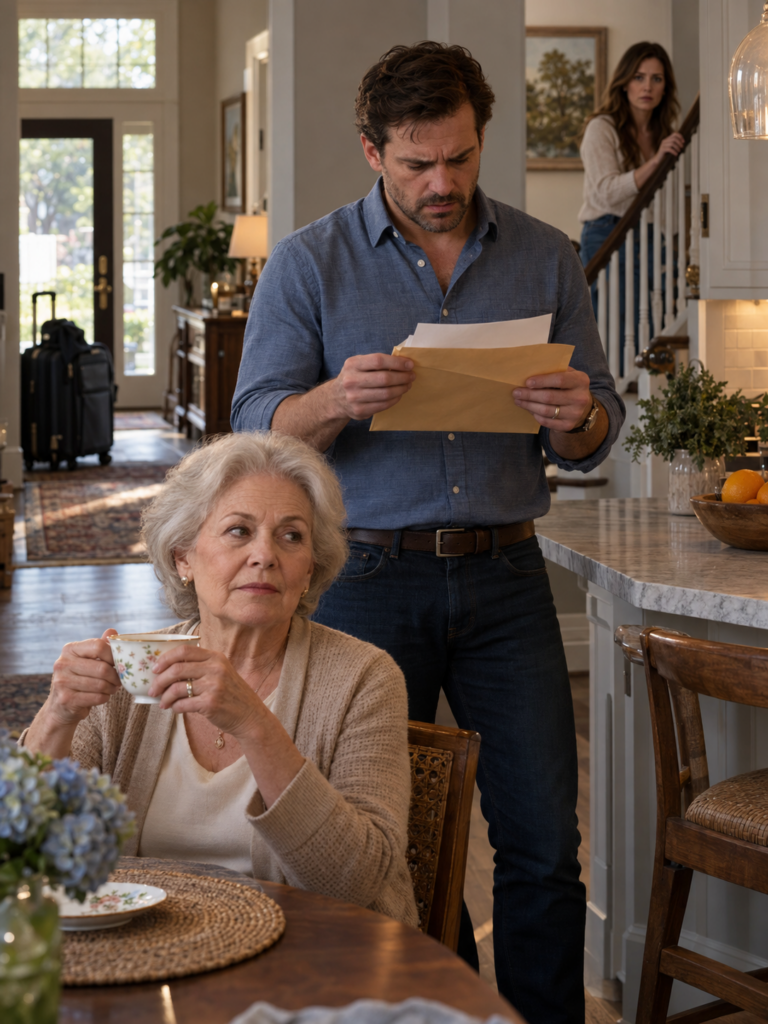
“‘A&M stands for Arthur and Margaret.’”
Colin stopped.
His eyes lifted to mine.
Jessica snatched the page from his hand.
“What does that mean?”
Neither of them moved for several seconds.
The only sound in the kitchen was the low hum of the refrigerator.
I placed my cup carefully on its saucer.
Colin picked up the first document again.
“This says our month-to-month lease terminates in thirty days.”
“Yes.”
“And the house is being sold.”
“Yes.”
Jessica looked furious before she looked confused.
“The property only changed owners a few months ago.”
“That’s correct.”
She stared at me.
Then at the notice.
Then back at me.
Colin’s voice came out quieter.
“Mom…”
I waited.
“Do you own this house?”
“For now, yes.”
Jessica actually laughed.
It was one short, disbelieving sound.
“No.”
I folded my hands.
“Yes.”
She began reading through the papers rapidly.
“This makes no sense.”
“It makes perfect sense.”
“The landlord sold it.”
“Yes.”
“To this company.”
“Yes.”
“A&M Property Holdings.”
“Yes.”
Colin slowly sat down.
“A&M,” he repeated.
I looked at him.
“Arthur and Margaret.”
He leaned back as though something had physically struck him.
For nearly four years, Colin and Jessica had paid rent to the previous owner of the house.
Months earlier, when I learned the owner intended to sell, Richard helped me purchase the property through a holding company I had created.
The lease continued.
The rent continued.
Nothing in their day-to-day lives changed.
They simply never bothered asking who now owned the house.
Why would they?
Their lives worked.
Dinner appeared.
Laundry was folded.
Children were collected from school.
And the older woman downstairs remained useful.
Jessica dropped the document on the island.
“You did this behind our backs?”
Her indignation almost impressed me.
“Yes.”
“You secretly bought the house we live in?”
“Yes.”
“Why?”
I looked at her.
“Because it was available.”
“That’s not what I mean.”
“I know.”
Her face reddened.
Colin rubbed one hand over his forehead.
“Mom, where did you get that kind of money?”
There it was.
The question I knew would come eventually.
I reached for my handbag hanging on the chair beside me.
Jessica watched every movement.
I opened the bag and removed a clear protective sleeve.
Inside was a familiar little rectangle.
Cheap paper.
Bright colors.
A small ticket that had once cost two dollars.
I placed it on the kitchen island.
Jessica stared.
Her expression emptied.
“No.”
Colin leaned closer.
“What is that?”
His wife knew first.
“The scratch-off.”
I nodded.
The ticket looked almost absurd lying beside a property termination notice.
Colin frowned.
“From your birthday?”
“Yes.”
His gaze moved from the ticket to me.
“You said you didn’t win anything.”
“I did.”
“How much?”
I did not answer immediately.
Part of me remembered the kitchen ten months earlier.
The joke about bus fare.
My homemade birthday cake.
Jessica complaining about the frosting.
My son laughing.
Me standing among my own family with a winning ticket in my pocket while nobody noticed my hands were trembling.
Finally, I said, “Eleven million dollars before taxes and the lump-sum adjustment.”
Colin’s face went blank.
Jessica gripped the edge of the counter.
“You won eleven million dollars?”
“That was the advertised prize.”
“And you told nobody?”
“I told Richard.”
“You told an attorney before your own son?”
I looked directly at Colin.
“Yes.”
That hurt him.
I could see it.
For one second, I felt the old reflex to soften everything for him.
Then I remembered the conversation I had overheard.
Your mother is becoming a burden.
What do you want me to do? She’s my mother.
I had replayed that exchange more times than I cared to admit.
Jessica’s words had been cruel.
Colin’s had been worse.
Not because he called me a burden.
He didn’t.
Because when his wife did, he never defended me.
He responded as if the difficulty was not what she had said but the unfortunate fact that biology prevented him from easily disposing of me.
“Why?” he asked.
His voice was soft now.
“Why didn’t you tell me?”
I took a breath.
“Because one evening I was carrying clean towels past the kitchen and heard Jessica say I was becoming a burden.”
Jessica’s eyes flicked toward Colin.
His face changed.
“And I heard you answer her.”
He closed his eyes briefly.
“Mom…”
“You said, ‘What do you want me to do? She’s my mother.’”
He looked down.
I continued.
“You didn’t say I wasn’t a burden. You didn’t say you wanted me here. You didn’t say I was your mother and deserved respect. You spoke as though being related to me was the only reason you were still tolerating me.”
“I didn’t mean it like that.”
“I believe you probably didn’t think very much about what you meant.”
He winced.
That was enough.
I wasn’t interested in hurting him for sport.
I wanted clarity.
Jessica crossed her arms.
“So this is revenge.”
“No.”
“You secretly bought our home, waited until we made one comment you didn’t like, and now you’re evicting us.”
“One comment?”
“You know what I mean.”
“No, Jessica. I don’t.”
She stared at me.
I gestured around the kitchen.
“For four years, I cooked here. Cleaned here. Bought groceries. Folded your laundry. Collected your children. Rearranged my days whenever your household needed something.”
“Nobody forced you.”
“That’s true.”
She seemed surprised I agreed.
“Nobody forced me. And that’s part of what I had to learn.”
Colin looked at me.
I continued.
“I kept stepping in. You kept accepting. Eventually, all three of us acted as though my time belonged to this house.”
Jessica opened her mouth.
I lifted one hand.
“But yesterday you decided my room belonged to this house too.”
“That isn’t fair.”
“You toured a senior facility without me.”
“We thought you’d like it.”
“You chose a room.”
“It was just preliminary.”
“You paid a deposit.”
“Refundable.”
“You picked January first.”
Neither answered.
I looked at Colin.
“You had already made the decision. You only wanted my cooperation.”
He lowered his eyes.
Jessica’s anger sharpened.
“So now you’re throwing your own grandchildren out?”
“No.”
I pushed the termination notice slightly toward her.
“You have thirty days under the lease. Your security deposit will be refunded in full. The house will be sold. You are both employed. You have time to arrange another home.”
“Thirty days before the holidays?”
“You gave me until January first.”
“That was different.”
“Why?”
“Because Oakridge was already arranged.”
I held her gaze.
“So was this.”
Silence.
Colin looked suddenly exhausted.
He picked up the scratch-off again but did not touch it.
“What did you do with the money?”
I almost smiled.
“Secured my future.”
“What does that mean?”
“I bought a home.”
His head snapped up.
“You bought another house?”
“Yes.”
“Where?”
“Near Aunt Helen.”
“Since when?”
“June.”
He stared at me.
June.
Months before the brochure.
Months before this morning.
Months during which I had continued cooking in that kitchen while quietly preparing to live independently.
Jessica looked almost offended by the existence of a life she had not been informed about.
“You’ve had a house since June?”
“Yes.”
“And you’ve been living here?”
“Yes.”
“Why?”
That question was harder.
“Because part of me was still deciding whether this family wanted Margaret here or simply the services Margaret provided.”
Colin flinched.
Jessica looked away.
I picked up the protective sleeve containing the ticket.
“There’s more.”
Colin looked wary now.
“What?”
“I established educational trusts for the children.”
He stared.
“For Lucas and Chloe?”
“Yes.”
“How much?”
“Enough that their education is protected.”
His face softened despite everything.
Jessica leaned forward.
“We should discuss how that money is managed.”
“No.”
Her expression tightened.
I continued.
“The trusts are protected. Neither of you can access the funds for other purposes.”
“Margaret, I’m an attorney. I understand—”
“I know what you do for a living, Jessica.”
She stopped.
“The terms were prepared professionally. The money is for the children’s education. That is all.”
Colin covered his face with both hands.
I watched him for several seconds.
When he lowered them, his eyes were damp.
“You took care of them even after…”
He couldn’t finish.
“After you decided to move me out?”
He nodded.
“They are my grandchildren.”
His mouth tightened.
I stood.
It was 9:05.
“I’m going upstairs.”
“Why?” Colin asked.
“To get my suitcase.”
He looked toward the front hall.
Then realization crossed his face.
“The suitcase by the door?”
“Yes.”
“You’re leaving today?”
“Yes.”
He stood so quickly the chair scraped.
“Mom, wait.”
I continued toward the stairs.
He followed.
“Where are you going?”
“To my house.”
“You can’t just—”
I turned.
“I can.”
The words stopped him.
I had spent most of my adult life explaining my decisions to people I loved.
That morning, two words were enough.
I can.
He followed more slowly to my room.
Most of my personal things were already gone.
Books.
Photographs.
Arthur’s watch.
The quilt Helen had made.
A box of letters.
A handful of things remained because I had wanted my exit to look ordinary until the moment it became real.
Colin stood in the doorway.
“You planned all this.”
“Yes.”
“For months.”
“Yes.”
His eyes traveled around the room.
“Why didn’t you say anything?”
I closed the suitcase.
“Because I wanted to know whether you would ever ask me what I wanted before I told you what I had.”
His face fell.
“You were testing me?”
“No.”
I straightened.
“I was watching.”
That distinction mattered.
I had not created Jessica’s contempt.
I had not made Colin remain silent.
I had not forced them to tour Oakridge or choose January first.
I had simply stopped interrupting their choices long enough to see where those choices led.
When we came downstairs, Jessica was waiting by the kitchen island.
Her eyes were glossy, but her arms were crossed.
“This is going to destroy our family.”
I looked at her.
“No.”
Her jaw tightened.
“What destroys a family is treating a person like domestic help while it’s convenient, then like an obstacle when the arrangement stops suiting you.”
“We never treated you like domestic help.”
I looked toward the laundry room.
Then at the school bags near the door.
Then at the grocery list in my handwriting stuck to the refrigerator.
Jessica followed my gaze.
Her face changed.
I continued quietly.
“I am not taking your children away from you. I am not taking your jobs. I am not leaving you without notice. I am not keeping your security deposit. I am not even keeping this house.”
“Then why sell it?”
“Because I don’t want to be your landlord.”
Colin looked at me.
“And I don’t want my money tied to whether you respect me.”
That silenced them both.
I picked up my coat.
“Every adult in this house now gets to manage their own household.”
Colin looked toward the front window.
“Do you have someone coming?”
“Yes.”
At 9:15, a taxi pulled to the curb.
Colin grabbed my suitcase before I could.
“Let me.”
I allowed him.
We walked outside.
The Austin morning was cool, the sky pale and clear.
The taxi driver opened the trunk.
Colin placed the suitcase inside but did not step away.
For a moment, he looked like the little boy who had once waited for me outside elementary school with one shoelace undone.
Then he hugged me.
Not quickly.
Not politely.
He wrapped both arms around me and held on.
“I’m sorry,” he whispered.
I closed my eyes.
“I don’t know when I stopped seeing you as my mother,” he said, “and started seeing you as someone who was just always there to fix things.”
My throat tightened.
That apology did not undo anything.
But it named something true.
“Neither do I,” I whispered. “But at least you see it now.”
He stepped back.
“What happens to us?”
I looked at him.
“That depends on what you do after I’m gone.”
He nodded slowly.
Behind him, Jessica remained in the doorway.
I got into the taxi.
Colin closed the door.
The driver pulled away.
I did not look back immediately.
Instead, I reached into my handbag and touched the key to my own front door.
My yellow house waited across town.
A porch.
A kitchen with morning sun.
A street near Helen.
A life that had existed quietly for months because I had finally begun planning something around my own needs.
Then my phone buzzed.
I expected Colin.
It was Richard.
One short message.
The sale process could begin whenever I authorized it.
My thumb hovered over the screen.
For years, I had responded immediately whenever someone in my family needed an answer.
This decision belonged only to me.
I looked out the taxi window as Austin moved past.
Then I pressed Richard’s number.
Richard answered before the second ring.
“Margaret?”
“Begin the sale.”
“All right.”
“No delays because Colin is my son.”
“I understand.”
“And return their deposit exactly as the lease requires.”
“Of course.”
I looked down at the brass key in my palm.
“This isn’t punishment, Richard.”
“I know.”
“I need to know that.”
His voice softened.
“Then remember what you told me when we set up A&M. You wanted control of your own housing, your own finances, and your own decisions. Selling the property does exactly that.”
After we hung up, I sat back against the taxi seat.
Control.
For four years after Arthur died, people had mistaken my dependence on family companionship for an inability to manage my own life.
Perhaps I had mistaken it too.
The taxi turned onto the street near Helen’s neighborhood.
My house appeared halfway down the block.
Yellow siding.
White trim.
A small porch.
Two oak trees in front.
Nothing grand.
Nothing I needed to justify.
When I opened the door, morning light poured through the kitchen window.
For the first time in years, there was no pile of someone else’s breakfast dishes waiting for me.
No backpack on a chair.
No request.
No schedule.
I put my suitcase down.
Then I stood in the middle of the kitchen and listened.
Silence.
At first, it felt almost unnatural.
For years, silence had meant I had forgotten something.
A school pickup.
A load of laundry.
A grocery item.
A child who had suddenly become suspiciously quiet.
Now silence meant nobody needed me.
That realization brought a surprising ache.
Being useful had exhausted me.
But it had also become part of how I measured my worth.
I had to learn that being needed and being loved were not the same thing.
Helen arrived before noon carrying soup and a loaf of bread.
She took one look at me and put everything on the counter.
“It happened?”
I nodded.
“They gave me the brochure.”
“And?”
“I agreed.”
Her mouth fell open.
Then she understood.
“Oh, Margaret.”
I laughed for the first time that day.
She huggedged me so tightly my glasses shifted.
“Arthur would have been proud of you.”
That nearly undid me.
I turned toward the kitchen window.
“I wish he were here.”
“So do I.”
We sat at my little table and ate soup.
I told her about the certified envelope.
Colin’s face.
Jessica recognizing the ticket.
The thirty-day notice.
When I finished, Helen stirred her soup.
“Do you feel better?”
I considered the question.
“Yes.”
Then I corrected myself.
“No. I feel free. That isn’t the same as feeling good.”
She nodded.
That distinction carried me through the next month.
Across town, Colin and Jessica had thirty days to relocate.
I did not interfere.
I did not search listings.
I did not call movers.
I did not offer to pack.
Whenever guilt rose, I reminded myself they had intended me to move by January first.
They were capable adults with careers and income.
The only thing that had changed was whose move mattered.
Three weeks after I left, my phone rang on a Tuesday evening.
“Mom?”
Colin sounded tired.
“I’m here.”
“Do you have a minute?”
“I do.”
He exhaled.
“We signed a lease today.”
“That’s good.”
“A townhouse. Same school district. Smaller.”
“That sounds sensible.”
There was a pause.
Then he said, “Jessica and I had a fight.”
I said nothing.
“She was complaining that we’ve been ordering takeout constantly because nobody has time to cook.”
I could hear shame in his voice before he continued.
“And I lost my temper.”
“With her?”
“Yes.”
“What did you say?”
He breathed in.
“I told her you cooked every day for four years while we barely thanked you. I told her she called you a burden while we were eating food you made, wearing clothes you folded, and relying on you to pick up our children.”
My eyes filled.
Not because I wanted Jessica humiliated.
Because my son had finally described my work out loud.
“She didn’t answer,” he said.
I leaned back in my chair.
“Colin, this isn’t only about Jessica.”
“I know.”
He said it immediately.
That mattered.
“I let it happen,” he continued. “It was easier.”
There it was.
The major answer.
Not malice.
Convenience.
He had loved me.
I believed that.
But he had also benefited from staying quiet.
Defending me would have required changing the arrangement.
It might have meant cooking.
Laundry.
School pickups.
Confronting his wife.
Asking whether I was tired.
Wondering whether I wanted a life beyond service.
It had been easier to accept everything I provided and call the arrangement normal.
“I’m sorry,” he said.
My throat tightened.
“I let her make you feel small, and I went along with it because having you there made my life easier.”
“Thank you for saying it clearly.”
“I should’ve said it sooner.”
“Yes.”
He was quiet.
I did not rescue him from that either.
After a moment, he asked, “Can I come see you this weekend?”
I looked toward the porch.
“Just you?”
“Me and the kids.”
I smiled.
“The porch is open.”
Saturday morning, Colin’s car pulled into the driveway.
Lucas and Chloe spilled out before he had completely stopped.
“Grandma!”
They ran toward me.
Whatever had happened between the adults, I had never wanted them to carry it.
Lucas looked around the porch.
“This is your house?”
“It is.”
“It’s cool.”
Chloe peered through the screen door.
“Do you have cookies?”
I laughed.
“Some things haven’t changed.”
Colin climbed the steps more slowly.
He looked tired.
Not ruined.
Not defeated.
Simply like a man who had spent several weeks carrying responsibilities he had once assumed happened automatically.
He handed me a small plant.
“Housewarming gift.”
Lavender.
Arthur’s favorite.
I looked at my son.
“You remembered.”
“Dad used to plant it by the back steps.”
“Yes.”
That afternoon, we sat on the porch while the children explored the house.
Colin looked out at the yard.
“You seem different here.”
“I am different here.”
“Happier?”
“Quieter.”
He nodded.
After a moment he said, “Jessica didn’t want me coming.”
I turned toward him.
“Then why are you here?”
“Because she doesn’t get to decide whether I have a relationship with my mother.”
That sentence landed heavily.
Not because I wanted him to fight with his wife.
I didn’t.
But for years, Colin had hidden behind keeping the peace.
This was the first time I heard him accept that peace purchased by someone else’s humiliation was not really peace.
“I’m not asking you to choose between us,” I told him.
“I know.”
“I mean it.”
“So do I.”
“Your marriage is yours.”
He nodded.
“And my relationship with you is mine.”
“Yes.”
That was enough.
The old relationship between us did not return.
Something more cautious began in its place.
Colin called.
Sometimes he asked about the property sale.
Sometimes the children.
But slowly, he began doing something he had almost forgotten how to do.
He asked about me.
“How’s the house?”
“What did you and Aunt Helen do?”
“Did you find curtains for the sunroom?”
“Are you sleeping better?”
Tiny questions.
Ordinary questions.
But none required a favor.
The former house sold several months later.
Colin and Jessica received their full security deposit.
There was no dramatic collapse.
No homelessness.
No public disgrace.
They moved into their townhouse and reorganized their lives.
Jessica reduced some of the chaos by adjusting her work schedule.
Colin started doing more school pickups.
They learned to divide tasks they had once unconsciously handed to me.
I did not celebrate their difficulty.
The point was never for their lives to become harder.
The point was for my life to stop existing as the cushion that prevented them from noticing the work their household required.
One afternoon, Richard brought me the final documents from the property sale.
When we finished signing, he slid the folder toward me.
“A&M Property Holdings no longer owns the house.”
I traced the initials with one finger.
A&M.
Arthur and Margaret.
Years earlier, those names belonged on utility bills, holiday cards, and the return address on envelopes.
After Arthur died, I had felt as though half of the name disappeared.
But using our initials had never been about pretending he was still alive.
It was about remembering the woman I had been beside him.
Arthur never treated me as invisible.
He thanked me for ordinary things.
Asked my opinion.
Made tea if I was tired.
When we disagreed, I never doubted I was an adult in my own home.
After his death, grief made Colin’s invitation feel like safety.
I had not noticed when safety became dependency.
Richard tapped the folder.
“What will you do now?”
I smiled.
“Nothing dramatic.”
“That sounds healthy.”
“I think I’d like a garden.”
He laughed.
“Then grow one.”
So I did.
I planted herbs first.
Then tomatoes.
Helen gave me rosemary.
The grandchildren helped choose flowers.
And on the wall of my sunroom, beside Arthur’s photograph, I framed the scratch-off ticket.
People might have expected me to display it because eleven million dollars changed my life.
Money certainly gave me options.
I would never pretend otherwise.
But the ticket meant something more complicated.
It began as a joke at my expense.
A two-dollar gesture from a woman who assumed there was nothing valuable in my hands.
Then it became a secret.
Then leverage.
Then protection.
Eventually, it became a reminder.
Not that luck had made me important.
That I had been important before anyone knew I had money.
Spring arrived in Austin with bluebonnets and warm air.
One Saturday, Colin called.
“We’re coming by.”
“We?”
“Me and the kids.”
I looked at the framed ticket on the wall.
“Come over.”
An hour later, a car door slammed outside.
Then Lucas shouted my name.
I went to the porch.
He and Chloe were running toward me while Colin lifted a small wooden crate from the trunk.
When he reached the steps, he set it down.
Inside were tomato seedlings and lavender.
“For the garden,” he said.
I touched one of the lavender leaves.
Arthur again.
My eyes stung.
“Thank you.”
Colin glanced toward the open front door.
“Can we stay for dinner?”
I smiled.
“Yes.”
Then I added, “But you’re helping cook.”
He laughed.
“Fair.”
And for the first time in years, that word felt like it belonged in our family.
Colin stood beside me at the kitchen counter that evening chopping vegetables while Lucas and Chloe argued in the living room about which movie to watch.
The scene would have looked ordinary to anyone passing the window.
To me, it was almost startling.
My son was cooking in my house.
Not waiting to be served.
Not asking where something was every thirty seconds.
Not assuming my presence meant his responsibilities had vanished.
He held up an onion.
“Too big?”
“Much too big.”
“I knew you were going to say that.”
“Then why did you ask?”
He laughed and started chopping again.
I watched him for a moment.
Justice, I had learned, rarely arrives looking like victory in a courtroom or a person begging forgiveness.
Sometimes it looks like an adult son standing beside his mother and finally recognizing that dinner has never appeared by magic.
After we ate, the children settled in front of a movie.
Colin joined me on the porch.
Austin’s evening light turned the sky gold, then violet.
For a while, neither of us spoke.
Then he said, “The trust paperwork came.”
I looked over.
“For the children?”
“Yes.”
“Good.”
He rubbed his palms together.
“I read all of it.”
“I assumed you would.”
“Lucas and Chloe are covered.”
“Yes.”
He swallowed.
“You really thought of everything.”
“Not everything.”
“It feels like everything.”
I shook my head.
“Money can cover tuition. It can’t guarantee who they become.”
“No.”
“That part is yours.”
He nodded.
After a while, he said, “Dad would’ve loved this porch.”
“He would.”
“And the garden.”
“Especially the tomatoes.”
Colin smiled.
Then he looked through the window toward the sunroom wall.
The framed scratch-off ticket was visible beside Arthur’s photograph.
“You kept it.”
“Yes.”
He was quiet.
“Jessica bought that because she thought it was funny.”
“I know.”
“She thought it was worthless.”
“I know that too.”
His jaw tightened.
“I’m sorry I laughed.”
I turned toward him.
“You’ve apologized.”
“I know. I just think about it sometimes.”
“So do I.”
The truth was that the birthday still hurt.
Not because the gift was cheap.
Arthur and I had lived through years when two dollars mattered.
I had treasured handmade cards, picked flowers, grocery-store chocolates, and gifts that cost nothing.
The cruelty had been in the meaning.
Here is something small because you are someone small.
That was what I had heard beneath their laughter.
Winning did not erase that.
It simply gave the object a different ending.
Colin leaned back in his chair.
“Can I ask you something?”
“Yes.”
“If that ticket hadn’t won… would you still have left?”
The question caught me off guard.
I looked across the street.
A dog walker passed beneath the trees.
“I don’t know.”
He nodded slowly.
“That’s honest.”
“The money gave me choices I didn’t know I had.”
“That bothers me.”
“Why?”
“Because it means if you hadn’t won, maybe you would’ve stayed and let us keep treating you that way.”
I considered him carefully.
“Maybe.”
His eyes dropped.
“But Colin, that is also why I need you to understand something.”
He looked up.
“The ticket did not create the problem.”
“I know.”
“It exposed it.”
He nodded.
“And it didn’t create my value.”
His eyes glistened.
“I know that now too.”
I reached into my cardigan pocket.
Hanging from my key ring was a small metal charm shaped like a ticket.
Helen had found it at a little shop near her neighborhood and given it to me as a joke.
I held up the keys.
“That ticket gave me financial freedom.”
Colin watched.
“But this key is the part I care about.”
“My house.”
“My door.”
“My decision about who comes through it.”
He looked down at his hands.
“That sounds like something Dad would say.”
I smiled.
“No. Your father would’ve taken ten minutes to say it.”
Colin laughed.
So did I.
That mattered too.
Boundaries had not destroyed every warm thing between us.
They had simply forced warmth to stop depending on access.
Jessica and I never returned to closeness.
For a while, she communicated with me only through Colin when necessary.
Eventually, we reached a polite distance.
At family events, we spoke.
We exchanged basic courtesies.
She thanked me once for protecting the children’s education.
I told her they deserved a strong beginning.
She never gave me the apology Colin did.
I stopped waiting for one.
Respect does not always mean reconciliation.
Sometimes it means accepting that two people function better when neither has authority over the other.
I never tried to turn Colin against his wife.
He never asked me to.
Their marriage was theirs to repair or reconsider.
My boundary was simpler.
I would no longer serve their household.
When the children visited, they were grandchildren in Grandma’s home—not responsibilities assigned to me by default.
Sometimes they stayed overnight.
Sometimes I said no.
The first time I declined because Helen and I had plans, Colin simply said, “Okay. Another weekend.”
That tiny response nearly meant more than any grand apology.
No guilt.
No sigh.
No reminder of everything he had done for me.
Just acceptance that I had plans.
My life had become real to him again.
And more importantly, it had become real to me.
The yellow house slowly filled with things I chose.
Arthur’s old oak desk went in the sunroom.
Family photographs lined one shelf.
I bought bright curtains because Jessica would have called them old-fashioned.
Then I laughed at myself for even thinking about what Jessica would have called them.
Helen and I spent afternoons on the porch drinking tea.
Some mornings I gardened.
Others I did absolutely nothing.
That took practice.
For four years, sitting down had triggered guilt.
There was always another task waiting.
Now I learned that an unfinished chore was not a moral failure.
I could leave a plate in the sink.
Read a book in the afternoon.
Ignore my phone for an hour.
Let somebody else solve their own problem.
The money remained carefully managed.
Richard continued helping me structure what needed structure.
The educational trusts remained protected.
My own retirement was secure.
I did not become extravagant.
I did not need luxury.
After years of being treated as though I should feel grateful simply for having space in someone else’s house, ownership of ordinary choices felt luxurious enough.
One morning, almost a year after the certified envelope arrived, I baked a cake.
Vanilla.
The same frosting Jessica had criticized on my seventy-third birthday.
Helen came over carrying flowers.
Colin brought the children.
There were cards this time.
Real ones.
Lucas had drawn my yellow house with a crooked porch and enormous tomatoes.
Chloe wrote that she liked sleeping over because my pancakes were better than her dad’s.
Colin handed me a small wrapped box.
I raised an eyebrow.
“No lottery tickets?”
He flushed.
“Absolutely not.”
We both laughed.
Inside was a frame.
Simple wood.
Nothing expensive.
He nodded toward the sunroom.
“For another picture. Not the ticket.”
“What picture?”
“Whatever you want.”
That answer pleased me.
Whatever I wanted.
Later, after everyone left, I carried the frame to Arthur’s desk.
I considered filling it with an old family photograph.
Instead, I left it empty for several weeks.
Then one afternoon, Helen took a picture of me in the garden.
I was wearing an old sun hat.
There was dirt on my hands.
One tomato plant had grown taller than I expected.
I was laughing at something outside the frame.
When she showed me the picture, my first instinct was to complain about my wrinkles.
Then I stopped.
I looked at the woman instead.
Seventy-four now.
Widowed.
A mother.
A grandmother.
A woman who had spent years caring for people she loved.
A woman who had stayed too long in a role that reduced her.
A woman who had accepted help when grief made loneliness frightening.
A woman who had eventually realized gratitude did not require permanent obedience.
I printed the photograph.
Then I put it in Colin’s frame.
The scratch-off remained beside Arthur.
It always would.
But now another image stood beside it.
Me.
Not Arthur’s wife.
Not Colin’s mother.
Not Jessica’s live-in help.
Margaret.
One Sunday evening, Colin stopped by alone.
He noticed the new photograph.
“That’s a good one.”
“I like it.”
He looked surprised.
“You used to hate pictures of yourself.”
“I used to look at photographs and search for everything that had aged.”
“What changed?”
I considered the ticket.
The house.
The months of distance.
The difficult conversations.
“You did.”
He frowned.
“I did?”
“All of you did, in a way.”
He looked uncertain.
“When you treated me like my usefulness was my value, I believed part of it. When the usefulness stopped being appreciated, I thought maybe I had nothing left.”
His face tightened.
“But after I left, I had to discover what remained when nobody needed dinner cooked or laundry folded.”
He looked at the photograph again.
“And?”
I smiled.
“Quite a lot.”
He laughed softly.
Then his expression grew serious.
“I’ll never forget again, Mom.”
I touched his hand.
“I hope not.”
But I no longer needed that promise in order to feel safe.
That was the final change.
My peace did not depend on Colin remembering my value.
It did not depend on Jessica understanding me.
It did not depend on the grandchildren needing me.
It did not even depend on the money remaining impressive.
The money had purchased freedom.
What I did with that freedom was the real story.
I chose my own home.
Protected my grandchildren without handing control to their parents.
Ended a financial relationship that had become tangled with resentment.
Allowed my son to experience consequences without trying to destroy him.
Accepted his apology without pretending the past had vanished.
Kept distance from Jessica without turning bitterness into a second home.
And slowly built days in which usefulness was something I offered, not something other people were entitled to demand.
That spring evening, after Colin left, I stepped onto the porch.
The garden smelled faintly of lavender.
Arthur would have loved it.
Inside, his photograph stood beside the framed scratch-off.
For years, I thought widowhood meant the important part of my life was behind me.
Then I thought moving in with Colin meant security required giving up independence.
Then I thought keeping the peace meant staying useful enough that nobody would resent having me around.
A two-dollar ticket disrupted all of those assumptions.
Not because luck suddenly made me worthy.
I had been worthy while baking my own birthday cake.
Worthy while folding towels.
Worthy when Jessica called me a burden.
Worthy when Colin failed to defend me.
Worthy before the first dollar reached my account.
The ticket merely gave me enough freedom to act on a truth I should never have needed money to prove.
I reached into my pocket and took out my key ring.
The little metal ticket charm caught the porch light.
Then I fitted my key into my own front door.
Behind me, the street was quiet.
Inside were Arthur’s desk, my photographs, tomorrow’s tea with Helen, and two guest rooms where my grandchildren could visit without anyone deciding that my bedroom belonged to somebody else.
I opened the door.
For four years, I had been grateful someone else had made room for me.
Now I had made room for myself.
And that was worth far more than eleven million dollars.


