
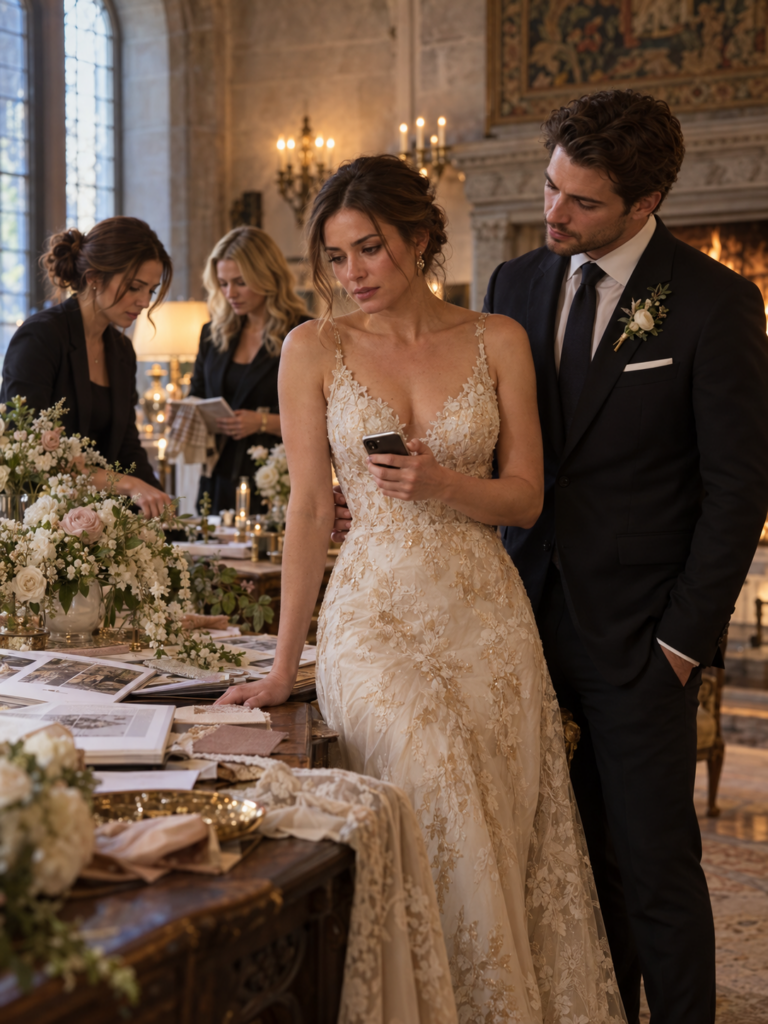
Ryan caught the phone before it reached the edge.
He looked at me.
“You okay?”
I exhaled.
“Yes.”
The answer surprised me.
For years, conflict with my family had left me frantic to repair whatever tension I had supposedly caused.
This time, I felt something cleaner.
They had told me where they stood.
I finally believed them.
The next two days moved at the speed of an event planner’s worst nightmare and favorite dream.
Lighting tests.
Floral deliveries.
Rental confirmations.
Camera rehearsals.
Room assignments.
Transportation changes.
Vendor calls.
Harper arriving with my gown wrapped in enough protective fabric to transport a museum piece.
Ashley stood in the castle ballroom directing technicians while Jenna rebuilt the guest table arrangement after several people changed flights to attend.
That was the unexpected part.
The teaser did not just attract viewers.
It reminded people who loved us that our wedding was happening.
Friends I had assumed couldn’t travel called to say they were coming after all.
Former colleagues rearranged schedules.
Two of Ryan’s college friends booked a car from Manhattan.
A client whose wedding I had planned three years earlier sent flowers with a note saying she hoped someone took care of me as well as I had taken care of her.
None of these people were choosing between my sister and me.
They were simply choosing to show up.
The night before the wedding, Willow Crest looked almost unreal.
Warm gold light washed over the stone exterior.
Lanterns followed the path toward the courtyard.
Inside, candles reflected from glass and brass while the production crew ran final checks.
I stood in the middle of the ballroom while Ashley reviewed place settings.
For once, I was not holding a clipboard.
Jenna walked over.
“Nervous?”
I thought about it.
“No.”
“Really?”
“For the first time in weeks, I feel exactly where I’m supposed to be.”
Her expression softened.
“Good.”
Later, Ryan found me on a small terrace outside our room.
He held up his phone.
“You might want to see this.”
The live-stream waiting room had crossed 2.4 million.
I stared.
“That cannot be real.”
“It appears deeply real.”
“I’ve worked launches that didn’t do this.”
He laughed.
“What did you expect when you mixed a castle, a family controversy people figured out from the comments, and professional wedding production?”
“I expected maybe fifty thousand.”
Ryan whistled.
“Very modest.”
I leaned against him.
Trends are strange.
I knew that professionally.
Millions of impressions do not mean millions of people know you.
Algorithms can turn one image into a phenomenon for forty-eight hours and forget it by Monday.
Still, the number did something unexpected to me.
It did not make me feel victorious.
It made me think about the phone call twelve days earlier.
My family had treated attendance at my wedding as if they were granting value to it.
Yet millions of strangers were interested without being pressured at all.
The contrast was absurd.
At midnight, my phone lit up.
A video message from Madison.
I considered leaving it unopened.
Then I pressed play.
She was wearing a bridal robe.
Hair in rollers.
Mom stood behind her.
Madison leaned toward the camera.
“Lauren, can you stop this? Seriously. This has gone way too far. You’re embarrassing yourself.”
Ryan, brushing his teeth in the bathroom doorway, froze.
Madison continued.
“Nobody wants to watch your small wedding. Just postpone it like a normal person. You’re making tomorrow weird for everyone.”
Mom nodded behind her.
I watched until the clip ended.
Ryan pulled the toothbrush from his mouth.
“Did she just say nobody wants to watch?”
I looked at the waiting count.
More than two million.
Despite everything, I laughed.
Then I switched the camera on.
I did not insult her country club.
I did not mention the view count as proof that my marriage mattered more.
I simply said, “More than two million people are waiting for the stream tomorrow. Small, maybe. But meaningful. And unlike yours, mine isn’t competing with anyone.”
I sent it.
Ryan laughed harder.
“That was meaner than yelling.”
“It wasn’t meant to be.”
“That’s why.”
By morning, sunlight covered the castle towers.
The day began before six.
Hair.
Makeup.
Florals.
Audio.
Cameras.
Guests.
Breakfast I forgot to eat until Jenna shoved half a croissant into my hand.
Then Harper entered the bridal suite carrying the dress.
The room became quiet.
The gown was not enormous.
I had never wanted enormous.
Silk with a soft gold undertone.
Delicate lace sleeves.
A long shimmering train that caught light when it moved.
Harper fastened the last clasp.
“You look unreal.”
I looked at myself in the mirror.
But the dress was not what held my attention.
My face did.
I looked calm.
Not like a daughter waiting to find out whether her parents had changed their minds.
Not like a sister wondering whether she was allowed to have something beautiful on the same day as Madison.
Just a woman about to marry the person she loved.
Ashley glanced at the monitor.
“Stream goes live in thirty.”
I nodded.
My phone was on the table.
No messages from Mom.
No messages from Dad.
No messages from Madison.
For twelve days, some part of me had wondered whether they might arrive anyway.
Maybe that was childish.
Maybe I still imagined one dramatic knock on the door where my parents would say they had realized what they were doing.
It did not happen.
And I discovered I did not need it to.
The countdown reached zero.
The live stream began.
Comments flew across production monitors faster than anybody could read.
I deliberately turned away.
This was the one event in my professional life where I refused to care whether engagement targets were being met.
Then the music started.
Harper opened the suite door.
I stepped into the hallway.
My train followed over the polished floor.
The staircase descended toward the courtyard.
Guests rose as I appeared.
For one brief second, I saw everything.
The stone arches.
The flowers.
The gold light.
Friends smiling.
Cameras moving smoothly along their tracks.
Then I saw Ryan waiting at the far end.
Everything else disappeared.
That was when I understood how wrong my family had been about the scale of a wedding.
A room could hold twenty people or two hundred.
A livestream could have fifty viewers or five million.
The important part was whether the people standing beside you understood what they were witnessing.
Ryan did.
His smile changed when I reached him.
He took both my hands.
“You’re breathtaking.”
I whispered, “So are you.”
He laughed quietly.
Our officiant was one of Ryan’s childhood mentors.
He did not talk about spectacle.
He talked about the life Ryan and I had already built.
The years before the rings.
The hard seasons.
The quiet mornings.
The decision to keep choosing someone after the excitement of being chosen wears off.
A breeze moved through the courtyard and lifted my veil.
For a moment, all I could hear was fabric and birds somewhere above the castle walls.
Then came our vows.
Then the rings.
Then the kiss.
Applause filled the courtyard.
Somebody from production later told me the live chat exploded.
At the time, I barely noticed the cameras.
That was the irony.
I had created the largest event of my own life because my family had dismissed it.
But when the moment actually came, the spectacle became the least important part.
After the ceremony, while Ryan was talking with the videographers, Jenna handed me my phone.
“You’ve got a lot.”
I looked.
Mom.
Dad.
Madison.
Messages stacked over one another.
Mom: Lauren, we didn’t know it would be this big.
Dad: Can we join the live stream? The link isn’t loading for us.
Madison: Did you seriously get 3 million people to watch your wedding? Why?
I stared at the screen.
Three million.
The number should have thrilled the wounded part of me.
I should have wanted to send Madison screenshots.
I should have wanted to point out that the “cute little wedding” had become an event strangers were sharing internationally.
Instead, I felt tired.
Not wedding-day tired.
Old tired.
The kind that comes from realizing you have spent too many years trying to demonstrate your value to people committed to measuring you against somebody else.
Mom’s message bothered me most.
We didn’t know it would be this big.
Not:
We’re sorry we missed it.
Not:
We were wrong to ask you to move your wedding.
Not:
You deserved to have us there.
They regretted underestimating the size.
Not undervaluing the marriage.
I typed one sentence.
My wedding was important, too.
Then I put the phone away.
The reception began.
String lights stretched overhead.
Friends gave speeches that were funny because they contained actual memories rather than ceremonial compliments.
Ashley told the story of the first event we planned together, when rain destroyed an outdoor setup and I reorganized three hundred guests into a warehouse in under two hours.
Ryan’s best friend described the first time Ryan talked about me.
“He said, ‘She scares me a little because she has a backup plan for her backup plans.’”
Everyone laughed.
Ryan looked at me.
“Still true.”
Later, he pulled me away from a group of guests and spun me beneath the lights.
“You did it.”
“We did it.”
He kissed my forehead.
“I’m proud of you.”
That sentence landed in a place millions of views could not reach.
Near midnight, after most guests had left, somebody told us the replay count had crossed 4.6 million.
Ryan and I walked onto the terrace.
The cameras were finally off.
The castle grounds below were nearly dark.
A few lanterns still burned along the path.
He took my hand.
“Do you regret anything?”
I knew what he meant.
Not the flowers.
Not the stream.
My family.
I pictured Mom telling me Madison’s wedding was more sophisticated.
Dad saying everyone had chosen hers.
Madison calling mine cute.
The suggestion that Ryan and I could celebrate later in a backyard as though our marriage could be postponed until it became convenient.
Then I thought about the people who had stood when I entered the courtyard.
“No.”
Ryan squeezed my hand.
We turned toward the doors.
My phone vibrated once more inside my clutch.
This time the message was from Dad.
I almost ignored it.
Then I opened it.
Your mother is upset. Madison thinks you did all of this to embarrass her. We need to talk after the weddings.
I read it twice.
There was still no apology.
Still no acknowledgment that Madison had knowingly taken my date.
Still no recognition that they had chosen her wedding before mine became visible enough to impress them.
Only another request for me to explain the consequences of choices they had already made.
I locked the screen.
Ryan watched my face.
“What is it?”
I handed him the phone.
He read Dad’s message.
Then he gave it back without commenting.
I slipped it into my clutch.
Inside the ballroom, workers were beginning to extinguish candles one by one.
I looked through the open doors at the room we had created.
The flowers would be gone tomorrow.
The lights would come down.
The internet would move on.
And sometime after Madison’s wedding, my parents expected me to sit in a room and discuss why my refusal to disappear had hurt her.
For the first time, I knew exactly what I would not do.
I would not apologize for keeping the date that had been mine first.
I would not apologize because strangers liked the wedding.
And I would not make myself smaller simply because my sister had been promised a bigger place in the family.
I took Ryan’s hand.
Then I walked back inside as the last production monitor went dark.
The last production monitor went dark.
The following morning, Willow Crest looked different.
Without the lighting, music, guests, and camera crews, it was simply an old stone estate sitting quietly beneath a pale sky.
I liked it better that way.
Ryan and I ate breakfast near a window while staff cleared flowers from the courtyard.
My phone remained facedown.
Eventually, Ryan asked, “Are you going to call them?”
“No.”
He nodded.
No pressure.
No lecture about reconciliation.
That was one of the things I loved most about him.
He understood that family conflict did not become less painful simply because the other people were related to me.
By noon, clips from the wedding were everywhere.
Ashley texted that one of the ceremony moments had been reposted by several large wedding accounts.
Harper’s gown was getting attention.
The castle had more inquiries than it could answer.
Our agency email was exploding.
Professionally, the event had become something none of us had expected.
Personally, I wanted silence.
Madison’s country-club ceremony was beginning that afternoon.
I did not watch.
I did not ask for photographs.
I did not search her name.
Her wedding deserved to be her wedding.
That principle mattered to me even if nobody else understood it.
The entire reason I had refused to move my date was because I did not believe one sister’s marriage should erase the other’s.
I was not going to recreate the same cruelty in reverse.
That evening, Mom called six times.
Dad called twice.
Madison sent nothing.
I did not answer.
Two days later, after Ryan and I returned home, Dad appeared at our apartment.
I opened the door.
He looked exhausted.
“Can I come in?”
Ryan was in the kitchen.
I glanced back at him.
He gave me a small nod.
I stepped aside.
Dad sat on the sofa.
For several seconds, nobody spoke.
Finally he said, “Your mother is devastated.”
I almost laughed from disbelief.
“About missing my wedding?”
He looked down.
“About everything.”
“That’s vague.”
He rubbed his palms together.
“Lauren, what happened got completely out of hand.”
“What happened?”
“The whole wedding situation.”
“No. Be specific.”
His face tightened.
I could tell he wanted the older version of me.
The daughter who understood what he meant without making him say uncomfortable things.
I waited.
Finally he said, “The attention around your wedding upset Madison.”
“There was no way for me to control millions of people sharing it.”
“You knew the livestream would draw attention.”
“I hoped it would draw attention. I work in events.”
He looked frustrated.
“You know what I’m saying.”
“I do. But I want you to hear yourself say it.”
Dad looked toward Ryan, then back at me.
“Madison felt like you were trying to compete with her.”
“She booked my wedding date after knowing it for months.”
“She couldn’t get another date at the club.”
“That is not the same as not having another choice.”
He went quiet.
I continued.
“Then you and Mom told me everyone would attend hers.”
“We thought you would move yours.”
“Exactly.”
The sentence landed.
Dad looked away.
“You’ve always been more flexible.”
I smiled without humor.
“There it is.”
“What?”
“You keep describing the reason you chose me to sacrifice as though it makes the choice fair.”
He opened his mouth.
I kept going.
“Because I’m organized, I can replan. Because I work in events, I can move vendors. Because I’m reasonable, I’ll understand. Because Madison gets upset, I should bend.”
“That’s not what I meant.”
“It is exactly what you meant.”
Ryan remained silent in the kitchen.
I appreciated that.
This was my conversation.
Dad leaned forward.
“We didn’t think you wanted some huge wedding.”
“I didn’t.”
He blinked.
That answer surprised him more than anything else.
“I wanted my wedding,” I said. “The one Ryan and I planned. The castle happened after all of you told me mine did not matter enough to attend.”
“So you admit it was a response.”
“Of course it was a response.”
He sat back.
“But not revenge.”
Dad said nothing.
“I was told my wedding was disposable. I stopped planning around the people who believed that.”
His shoulders dropped slightly.
For the first time, the anger went out of his face.
“What were we supposed to do when Madison got the club date?”
“Tell her the truth.”
“What truth?”
“That her sister was already getting married that day.”
He stared at me.
“And then let her decide whether the club mattered more than having her family at both weddings.”
Silence.
That was the major answer I had been waiting for without realizing it.
My parents had acted as though the scheduling conflict had simply happened to them.
But it had not.
Madison had made a choice.
Then they had made theirs.
And instead of asking her to live with the consequence, they asked me to erase mine.
Dad rubbed his forehead.
“She had already put down a deposit.”
“So had I.”
“That club has a two-year waitlist.”
“My marriage still wasn’t less real.”
“I didn’t say it was.”
“You told me to have a backyard dinner later.”
He flinched.
That had been his sentence.
Not Mom’s.
Not Madison’s.
His.
“I shouldn’t have said that.”
“No.”
There was a long pause.
Then he surprised me.
“I’m sorry.”
I studied him.
“For which part?”
He looked uncomfortable.
Good.
“The backyard comment.”
“That part was cruel.”
“I know.”
“And choosing her wedding?”
He hesitated.
There it was.
The limit.
“I don’t know what we were supposed to do.”
I nodded slowly.
“Then you’re not sorry for the choice. You’re sorry the choice hurt me.”
“That’s not fair.”
“It’s accurate.”
Dad stood.
For a moment, I thought he would leave angry.
Instead, he looked around our living room as though he suddenly understood that the wedding had not only changed one day.
Something in our family structure had moved.
“We love you,” he said.
“I know.”
He looked startled.
I continued.
“That’s what makes this harder. I don’t think you’re terrible people. I think you love me and still expected me to accept less because that was easier for everyone.”
He did not answer.
At the door, he paused.
“Your mother wants to talk.”
“She can call when she’s ready to talk about what actually happened.”
He nodded once.
Then left.
Ryan came from the kitchen.
“How are you?”
I thought about it.
“Sad.”
He wrapped his arms around me.
That was the part the viral clips would never show.
People online loved the castle.
The dress.
The millions of views.
The idea that I had somehow defeated the sister who tried to take my day.
Real life was quieter.
I had not defeated anyone.
My parents had missed my wedding.
There was no replay count high enough to undo that.
Three days later, Mom called.
This time, I answered.
She began with, “I wish you had told us what you were planning.”
I almost ended the call.
Instead, I said, “Why?”
“So we could have talked before it got so public.”
“Would you have come?”
Silence.
That was answer enough.
“Mom.”
“We had already committed to Madison.”
“You had already chosen Madison.”
“She’s your sister.”
“So am I her sister.”
“She was devastated.”
“So was I.”
Mom’s voice sharpened.
“You always do this.”
“Do what?”
“Turn everything into some fairness calculation.”
I went very still.
That sentence reached farther back than the wedding.
“What does that mean?”
“It means you’ve always kept score. Who got what birthday. Who got what trip. Who got more attention.”
I remembered things I had spent years telling myself not to count.
Madison’s graduation dinner becoming a three-day family trip.
Mine being moved because Dad had a work conference.
Madison changing colleges twice and receiving help with both moves.
Me being told I was independent enough to handle mine.
Her crises becoming emergencies.
My successes becoming evidence that I did not need support.
“You’re right,” I said.
Mom stopped.
“What?”
“I noticed.”
“That isn’t what I—”
“I noticed the pattern.”
She exhaled sharply.
“Lauren, this is not about your childhood.”
“No. It explains why twelve days before my wedding, telling me to move it felt normal to all of you.”
She became quiet.
Then she said something softer.
“Madison needs more.”
There it was.
Not cruelty.
Not hatred.
The family logic.
Madison needed more.
Therefore Lauren should accept less.
“She may need more help,” I said. “That doesn’t make my milestones less important.”
“No one said they were less important.”
I almost laughed.
“You used those exact words.”
Silence again.
Then Mom said, “I didn’t mean it the way you’re making it sound.”
“How else does ‘her wedding is more important’ sound?”
She had no answer.
I realized I was no longer arguing to convince her.
I was hearing the full structure clearly.
My family had not decided I mattered less because I had failed.
They had decided I required less because I was capable.
Then over years, “requires less” had quietly become “deserves less.”
That was the truth behind the wedding date.
Not that Madison was evil.
Not that my parents did not love me.
They had simply built a family around protecting the child who demanded more and trusting the child who adapted.
And every time I adapted, I taught them the arrangement worked.
“I’m not doing this anymore,” I said.
Mom’s voice changed.
“Doing what?”
“Giving something up automatically because Madison will be more upset if she doesn’t get her way.”
“That is an awful thing to say about your sister.”
“It may be uncomfortable. It isn’t inaccurate.”
Mom was silent.
“I’m not asking you to choose me now,” I continued. “The wedding is over. You chose. I’m asking you to stop pretending no choice was made.”
She started crying.
Not loudly.
That hurt worse.
For a few seconds, I almost did what I had always done.
Backtrack.
Comfort her.
Tell her we would figure it out.
Instead, I stayed quiet.
Finally she said, “I don’t know how to fix this.”
“Neither do I.”
That was the most truthful thing either of us had said.
We ended the call without resolution.
For the next month, I kept my distance.
Not as punishment.
Because I had spent too much emotional energy explaining why my own wedding should have mattered.
Ryan and I went back to ordinary married life.
Laundry.
Grocery lists.
Work deadlines.
Coffee on Saturday mornings.
The viral wedding clips gradually stopped circulating.
The numbers froze.
Then nobody talked about them anymore.
Exactly as I knew they would.
One evening, Ashley showed me our analytics dashboard.
The campaign had generated enormous professional attention.
New venue partnerships.
Client leads.
Two media requests.
I stared at the figures.
A year earlier, success like that would have thrilled me.
Now I simply closed the laptop.
“What?” Ashley asked.
“Nothing.”
“You look weirdly calm.”
“I think I finally learned that attention and importance are different things.”
She smiled.
“Occupational hazard for an event planner.”
I laughed.
That night, Ryan and I unpacked the last box from the wedding.
Inside was my veil.
I lifted it carefully.
For a moment, I pictured the staircase at Willow Crest.
The courtyard.
The guests standing.
Ryan waiting.
No parents in the front row.
No sister.
The absence still hurt.
Maybe it always would.
But pain was no longer proof that I had chosen wrong.
I folded the veil back into its box.
Then my phone buzzed.
Madison.
Her first direct message since our wedding day.
Can we meet?
I stared at the screen.
Ryan looked over.
“You don’t have to.”
“I know.”
That was precisely why I decided to go.
I knew I did not have to meet Madison.
That changed the meeting before it began.
We chose a coffee shop halfway between our homes.
Public enough that neither of us could turn the conversation into a family performance.
Private enough that we could speak honestly.
Madison was already sitting near the back when I arrived.
For once, she did not look polished.
No perfect hair.
No carefully planned outfit.
Just jeans, a sweater, and a coffee she had barely touched.
I sat across from her.
“Hi.”
“Hi.”
Neither of us knew what came next.
Finally she said, “Mom told me you think everyone always chooses me.”
“I think everyone often expected me to adjust for you.”
“That’s not the same thing.”
“No. But it created the same result.”
She looked down.
“You really think I booked the date to hurt you?”
“No.”
That surprised her.
“I think you wanted the country club date.”
She waited.
“And?”
“And you knew it was my wedding date and decided I would probably move.”
Her eyes shifted toward the window.
That was the first admission.
Not verbal.
But enough.
“Did Mom tell you I would?” I asked.
Madison rubbed her thumb against the paper cup.
“She said you were flexible.”
I almost smiled.
Of course she did.
“She said you didn’t care about having some huge traditional thing. She said you’d understand because the club only had that opening.”
“Did you ask me?”
“No.”
“Why?”
Madison’s jaw tightened.
“Because I thought you’d say no.”
There it was.
The complete truth was almost painfully ordinary.
No conspiracy.
No secret cruelty.
Madison knew I would object.
So she did not ask.
Mom believed I would bend.
So she supported Madison.
Dad believed avoiding Madison’s disappointment would be harder than asking me to sacrifice.
So he chose the path of least resistance.
And I had spent years being so reliably reasonable that everyone assumed reasonableness meant surrender.
“I would have said no,” I told her.
“I know.”
“Then why book it?”
Her eyes filled, but she did not cry.
“Because I wanted that venue.”
I nodded.
That honesty, late as it was, mattered more than another excuse.
“You were allowed to want it.”
She looked up.
“You don’t sound angry.”
“I was angry. I’m still hurt.”
“That wedding made me look horrible.”
There it was.
Not quite apology.
I kept my voice even.
“I never mentioned you publicly.”
“People figured it out.”
“I couldn’t control that.”
“Everyone kept sending me clips.”
“I didn’t send them.”
“Mom spent half my reception checking your numbers.”
That stopped me.
“What?”
Madison laughed without humor.
“She kept asking Dad whether your stream had gone over three million.”
For the first time, I saw something I had missed.
The comparison had damaged Madison too.
Different direction.
Same family habit.
Her wedding day had become partly about whether mine was bigger.
Because our parents had spent years arranging us on opposite sides of a scale.
I had always assumed Madison enjoyed being the favored one.
Maybe she often did.
But favoritism is not the same as peace.
“Did you have a good wedding?” I asked.
She looked surprised.
“Yes.”
“Good.”
Her face changed.
“You mean that?”
“Yes.”
“After everything?”
“Your wedding never needed to fail for mine to matter.”
Madison stared at me.
That sentence seemed to reach her.
Slowly.
Painfully.
Then she said, “I thought the castle was revenge.”
“It started because I needed another plan after the family I expected to attend told me they wouldn’t.”
“You could’ve kept the small venue.”
“I could have.”
“So why didn’t you?”
I thought about it.
“Because once Mom said my wedding was less important, I realized I had been planning partly around what would seem acceptable to all of you.”
Madison said nothing.
“I had professional relationships I had never considered using for myself. I spend my career making beautiful things for other people. Ryan asked why I wasn’t allowed to do that for us.”
She looked down at her coffee.
“I hated the livestream.”
“I know.”
“I thought everyone was watching you instead of me.”
“I wasn’t watching you.”
“I know.”
That came out quietly.
Then she said, “I should have asked before taking your date.”
“Yes.”
“I’m sorry.”
No explanation followed.
No “but.”
I waited.
She continued.
“And the text about having a real wedding.”
Her face tightened with embarrassment.
“That was awful.”
“It was.”
“I was angry because you wouldn’t move it.”
“I know.”
“I shouldn’t have said it.”
“Thank you.”
That was as far as I could honestly go.
I was not ready to tell her everything was fine.
Because it was not.
An apology can acknowledge damage.
It cannot reverse a missing seat at a wedding.
We finished our coffee.
Before leaving, Madison asked, “Are we okay?”
I considered the question.
“We’re not where we were.”
Her face fell slightly.
“But I don’t think where we were was very healthy.”
She nodded.
“That’s fair.”
It was the first time fairness between us had not sounded like an accusation.
My relationship with my parents took longer.
Dad called more often.
At first, every conversation carried a carefulness that had never existed before.
He stopped saying things like, “You know how your sister is.”
That sentence had once excused almost anything.
Mom struggled more.
She wanted resolution without having to sit too long inside what created the conflict.
Several months after the weddings, she invited Ryan and me to dinner.
Madison and her husband were there too.
I almost declined.
Then I decided I wanted to see what would happen when nobody had a ceremony to compete over.
Dinner was awkward.
Then normal.
Then awkward again.
At dessert, Mom brought out two photo albums.
Madison’s country-club photographs.
My castle photographs.
She set both on the table.
For a second, I braced myself.
Then she said, “I owe you an apology.”
Nobody moved.
Mom looked at me.
“I told you Madison’s wedding was more important.”
“Yes.”
“I was wrong.”
The room stayed silent.
She swallowed.
“I thought because you were more flexible, asking you to change plans would cause less damage.”
“That doesn’t mean there was less damage.”
“I know that now.”
Madison watched her.
Dad stared at his plate.
Mom continued.
“I have probably done that more than once.”
Probably.
It was not perfect.
But it was the first time she had looked directly at the pattern instead of defending the intention.
“You have,” I said.
She nodded.
No argument.
No tears used to end the conversation.
“I’m sorry.”
I believed she meant it.
Believing an apology did not magically restore what we had.
My parents had still missed my wedding.
I would always remember looking toward the courtyard seats and knowing exactly who was absent.
Forgiveness could not insert them into the photographs.
What changed was access.
I stopped involving them in every decision.
I stopped asking Mom’s opinion before making plans I already knew I wanted.
I stopped assuming family events required automatic attendance if the terms were disrespectful.
And when Madison wanted something that conflicted with me, we started doing something shockingly radical.
We spoke directly.
Sometimes one of us was disappointed.
Nobody died.
A year later, Willow Crest invited Ryan and me back for an anniversary weekend as part of another venue campaign.
We almost declined because the place felt too attached to one enormous moment.
Then Ryan said, “Maybe we should go back without three million people.”
So we did.
No production crew.
No livestream.
No countdown.
Just the two of us.
On our anniversary evening, we walked through the courtyard where we had exchanged vows.
The castle looked smaller than I remembered.
That made me laugh.
“What?” Ryan asked.
“I think the internet made it bigger.”
He smiled.
“Most things look bigger on the internet.”
We sat on the terrace afterward.
The same terrace where, on our wedding night, he had asked whether I regretted anything.
Below us, the lanterns glowed along the path.
I thought about the title people online had given our story.
Bride gets revenge after family chooses sister.
That version was simple.
It was also wrong.
I had not won because my wedding got more views.
Madison had not lost because strangers watched mine.
My parents’ absence was not erased by a viral number.
And four-point-six million views could not tell me whether the marriage itself would last.
The actual victory was quieter.
When Mom said, “Move your wedding,” I finally answered no.
When Dad said everyone had chosen Madison, I stopped begging to be chosen too.
When Madison said hers was the real wedding, I stopped needing her definition of real.
The castle, the dress, the cameras, and the stream were beautiful.
But none of them created the boundary.
The boundary came first.
Twelve days before our wedding, I had been sitting on the edge of my bed holding a veil while my family explained why my plans were easier to sacrifice.
For most of my life, I had treated their approval like an invisible stamp.
If they celebrated something, it counted.
If they minimized it, I questioned whether I was asking for too much.
I mistook being the easy daughter for being the mature daughter.
I mistook self-erasure for flexibility.
And because I rarely demanded equal consideration, everyone slowly forgot that consideration was still owed.
That was the part I had to own.
Not their favoritism.
Not Madison’s decision.
My silence.
My habit of adapting before anyone even asked what I wanted.
The wedding broke that habit.
Months later, Madison and I were able to laugh about one strange part of it.
At a family birthday, she leaned toward me and whispered, “Mom still tells people both weddings were beautiful.”
I looked across the room.
Mom was showing Aunt Jen photographs from both albums.
“Progress,” I whispered.
Madison smiled.
Then she added, “For the record, I still think livestreaming a castle wedding was insane.”
“It was.”
“And slightly obnoxious.”
“Probably.”
She laughed.
I did too.
We were not magically best friends.
We did not rewrite childhood.
But the competition no longer controlled every interaction.
I did not need to lose for her to feel secure.
She did not need to be reduced for me to feel valued.
That was something our family should have understood years earlier.
Maybe now we were learning.
On our second night back at Willow Crest, Ryan and I ate dinner in a small room overlooking the grounds.
No cameras.
No guests.
No event schedule.
I wore jeans.
He wore a sweater.
Afterward, we walked past the ballroom.
Workers were setting up someone else’s wedding.
White flowers.
Silver chairs.
A completely different design.
For one second, professional instinct took over and I started assessing the lighting.
Ryan caught me.
“No.”
“What?”
“You are not working.”
“I was only looking.”
“You were mentally moving their uplights.”
“They’re too close to the draping.”
He took my hand and pulled me away.
I laughed.
At the end of the hallway, one framed promotional photograph from our wedding still hung on the wall.
You could barely see our faces.
Mostly stone arches, warm light, my veil lifting in the wind, and Ryan holding my hands.
I stopped.
Once, I would have seen evidence that millions of people had watched.
Now I saw something else.
Two people keeping a promise.
That was all the wedding had needed to be.
I reached for Ryan’s hand again.
Outside, evening settled over the hills.
My phone was in my bag.
No livestream.
No family group chat demanding a decision.
No numbers climbing on a screen.
Just quiet.
Ryan looked at me.
“Still no regrets?”
I smiled.
“None.”
Then we walked down the stone steps together.
The castle remained behind us.
So did the viral moment.
So did the need to prove that my wedding had been bigger, prettier, more expensive, or more watched than Madison’s.
My family had once treated love like a ranking.
For years, I participated by trying to earn a higher position.
I did not do that anymore.
Madison could have her country club.
I could have my castle.
Neither one determined whose marriage mattered.
Neither one determined which daughter was worthy.
And if my parents ever forgot that again, they now knew something they had not known twelve days before my wedding.
I would not rearrange my life just to make favoritism easier.
The final lesson was not hidden in four-point-six million views.
It had been there before the first camera turned on.
My wedding mattered when it was small.
It mattered when my family refused to attend.
It mattered when strangers became interested.
It mattered after those strangers moved on.
And standing beside Ryan beneath an ordinary evening sky, I finally understood why.
It was mine.


