
Part 1
“You’re in my seat.”
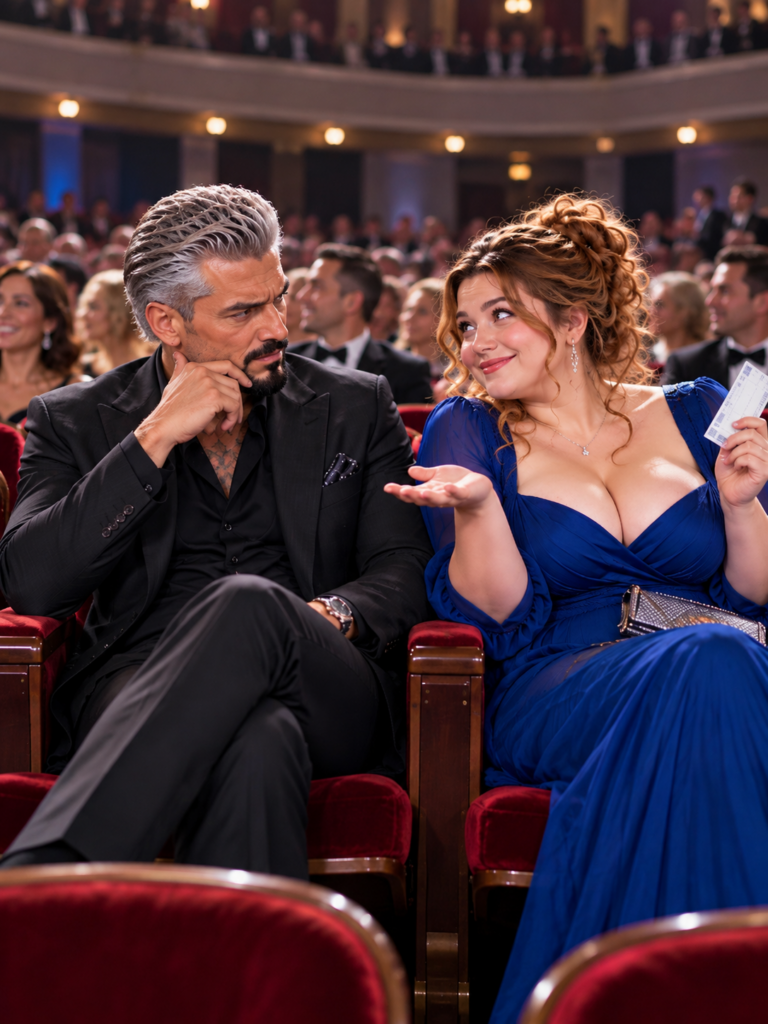
Sophie Carter looked at the man beside her, then at the small brass number fixed to the armrest.
Nine.
She looked back at him.
“No, I’m not. You are.”
The stranger’s expression barely changed.
He was the sort of man who seemed designed for silence: dark suit, precise posture, hands resting calmly in his lap as if nothing in the world required haste. There were two empty seats between him and the aisle, which Sophie had already decided was either ridiculous luck or a sign that classical music audiences had finally developed healthy boundaries.
She tapped the number again.
“Nine.”
He reached into the inside pocket of his jacket and produced a ticket.
Seat nine.
Sophie frowned.
“That proves you own a printer.”
One eyebrow moved.
Not much. Just enough to suggest the possibility that somewhere beneath the stillness, a sense of humor might have been held hostage.
Then he placed two more tickets beside the first.
Seven.
Eight.
Nine.
Sophie stared at them.
“Did you buy an entire section?”
“Three seats.”
“Why?”
“I wanted to be alone.”
She pulled her own ticket from her purse with the confidence of a woman about to defend democracy.
“Row twelve. Seat nine.”
She turned it toward him.
He studied it.
Then her.
“Turn it over.”
Sophie did.
The nine became a six.
“Oh.”
Two men in dark suits were already moving down the aisle toward them.
Not ushers.
Security.
Sophie felt heat crawl up her neck.
She gathered her purse.
“Well. This has been humiliating. Enjoy your three chairs.”
The man raised one hand.
The security men stopped instantly.
And in that small, efficient gesture, recognition struck.
Julian Romano.
Sophie had seen his face in newspapers, business magazines, and the kind of online stories that used words like empire, syndicate, acquisition, influence, and alleged in the same paragraph.
He was wealth with sharp edges.
Power that didn’t need to announce itself.
People lowered their voices when they said his name.
Sophie swallowed.
“You really did buy three seats.”
“Yes.”
“To avoid people.”
“Yes.”
She stood.
“Mission accomplished.”
Julian looked at the empty seat beside him.
Then at her.
“Sit.”
Sophie blinked.
“That seems counterproductive.”
“It does.”
“So we agree this makes no sense.”
“Yes.”
“Good.”
The lights dimmed.
Applause swept through the hall.
Sophie looked toward her actual seat, one row down and several places over.
“I can still move.”
“You’ll interrupt the performance.”
She turned back to Julian.
“So I’m being detained for cultural reasons.”
His expression remained unchanged.
“Sit.”
“Your face doesn’t know that was funny.”
“It knows.”
“Does it?”
“Rarely shows it.”
For a moment she simply stared.
Then she lowered herself into seat eight.
“I’m going to assume that was a joke.”
“Dangerous habit.”
The pianist walked onto the stage.
For almost twelve minutes, neither of them spoke.
That, Sophie discovered, was stranger than sitting beside one of the most intimidating men in the city.
Julian Romano listened.
Completely.
No phone glowing in his hand. No murmured instructions. No security man bending close to report something urgent. No obvious awareness of the people in the room who had already noticed him.
Just music.
Sophie had expected menace to be louder.
Instead, Julian’s attention made silence feel deliberate.
Then her throat tickled.
She fought it for several seconds before admitting defeat and reaching into her purse.
A cough drop.
Perfect.
She began opening it.
Crinkle.
Julian’s eyes shifted toward her.
Sophie froze.
After a moment, she tried again.
Crinkle.
His gaze returned.
She leaned slightly closer.
“I didn’t manufacture the wrapper.”
“You’re losing the argument with it.”
“I’m aware.”
She tucked both hands beneath her purse and tried to tear the plastic quietly.
Crinkle.
Julian looked toward the stage.
“You’re making it worse.”
“Thank you for the support.”
At last the wrapper opened.
Sophie slipped the cough drop into her mouth with the satisfaction of someone who had defused an explosive while preserving civilian life.
Julian glanced at her.
“Crisis contained,” she whispered.
Something happened near the corner of his mouth.
Small.
Brief.
But she saw it.
Sophie leaned closer.
“You smiled.”
“No.”
“You absolutely did.”
“Watch the concert.”
“That’s not a denial.”
Julian looked at her.
Sophie faced forward.
“Your face is very rude.”
Three minutes later, Julian coughed.
Once.
Sophie slowly opened her purse.
He noticed.
She withdrew another cough drop and held it toward him.
“Careful,” she whispered. “They’re aggressive.”
Julian stared at the candy in her palm.
Then he took it.
No smile.
No thank-you.
Only a slight nod.
Sophie nodded back.
It should have felt impersonal.
Instead, somehow, it did not.
The music continued, and the silence between them changed.
It no longer felt like something Julian had purchased.
It felt shared.
Then Arthur Bell returned to the microphone.
The elderly pianist had already played for nearly an hour. His white hair caught the warm stage lights as he settled onto the bench again.
He announced the next piece.
Sophie stopped moving.
Her fingers tightened around the folded program.
Julian noticed.
A few minutes earlier, she had battled a cough-drop wrapper as though it had insulted her family.
Now she barely seemed to breathe.
The first notes began.
Sophie knew them immediately.
She had heard them hundreds of times.
Usually wrong.
Usually interrupted.
Sometimes too fast. Sometimes with a missing note because her father always blamed the piano instead of his fingers.
He would sit in their living room after dinner, determined to master the same opening.
He would begin.
Miss a note.
Mutter something under his breath.
Start over.
Again.
Again.
Again.
Sophie used to complain.
Years later, after he was gone, she realized something that made grief feel absurdly specific.
She didn’t know how the piece ended.
Her father never learned the rest.
The opening lived in her memory like a door to a room she could no longer enter.
So Sophie had bought one ticket.
She had come alone.
Tonight, for the first time, the music moved past the place where her father always stopped.
She didn’t cry.
Instead, her mouth curved into one tiny smile.
Then she listened.
Julian looked at her only once.
He didn’t ask what was wrong.
He didn’t reach for her hand.
He didn’t offer sympathy she had not invited.
He simply turned back toward the stage and let the moment remain hers.
Sophie noticed.
That, perhaps more than anything, stayed with her.
When the final note disappeared into the hall, she exhaled slowly.
Julian said nothing.
She was grateful.
Arthur Bell began telling a story before the next piece.
“When I was teaching,” he said, “I had one student who believed enthusiasm could substitute for rhythm.”
The audience laughed.
Julian shifted.
Sophie turned her head.
Arthur continued.
“He was extremely determined.”
Julian’s jaw set.
“Unfortunately,” Arthur added, “the piano was equally determined.”
More laughter.
Sophie slowly looked at Julian.
He ignored her.
Arthur smiled.
“I won’t embarrass him. He suffered enough.”
Sophie leaned closer.
“You played piano.”
“No.”
“That wasn’t a question.”
Julian kept his eyes on the stage.
“You made the face.”
“What face?”
“The face of a man being personally attacked by scales.”
“I don’t have that face.”
“You have several faces.”
He looked at her.
“Do I?”
“Yes. Most of them are unfriendly.”
Arthur began playing again.
Sophie lowered her voice.
“He taught you.”
A pause.
“Yes.”
Her eyebrows rose.
“How good were you?”
“I wasn’t.”
“How bad?”
“Two years.”
“That is a duration, not a skill level.”
“It answers both questions.”
Sophie covered her mouth before her laugh escaped.
Julian turned back toward the stage.
But this time she saw it clearly.
The corner of his mouth moved.
And something shifted.
Julian Romano—the man whose raised hand could stop two security guards in an aisle, the man surrounded by rumors and money and controlled distance—became harder to fit inside the version Sophie had assumed was true.
After the concert, the audience rose slowly.
Sophie collected her purse.
Julian picked something from between the seats and handed it to her.
The abandoned cough-drop wrapper.
“Evidence,” he said.
Sophie took it.
“Destroy it.”
“I have people for that.”
She laughed.
Then she glanced toward the stage, where Arthur Bell was taking his final bow.
Julian noticed the change in her.
“You came for that piece.”
Sophie looked at him.
“The one where you stopped talking.”
“That could describe several moments tonight.”
“One.”
A joke rose automatically to her lips.
Something easy.
Something small.
Something that would keep him from seeing too much.
For once, she let it pass.
“My father used to play it.”
Julian waited.
“He wasn’t very good.”
“Neither am I.”
“That actually makes this worse.”
A faint smile crossed his face.
Sophie looked toward the empty stage.
“He only knew the beginning. He’d play the same part over and over. For years.”
Julian didn’t interrupt.
“And I wanted…” She folded the program carefully. “I wanted to hear how it ended.”
There was no pity on his face.
No dramatic softening.
He only asked, “Was it worth coming?”
Sophie thought about it.
“Yes.”
Then she looked at the number on the seat she had accidentally claimed.
“And apparently worth occupying a mafia boss’s private exclusion zone.”
“Borrowing.”
Sophie blinked.
“That is surprisingly generous terminology.”
“You returned it.”
“I haven’t moved yet.”
“Then technically the investigation remains open.”
She smiled.
They walked toward the aisle together.
Near the exit, one of Julian’s security men approached.
The strange intimacy around them disappeared almost immediately.
Julian changed.
Not dramatically.
But his shoulders settled differently. His attention widened. People moved aside before he reached them. A man intercepted him near the doors and began speaking in a low voice.
Mr. Romano had returned.
Sophie adjusted her purse.
“Well.”
Julian looked back.
“Good luck keeping seven and nine empty.”
“They served their purpose.”
She smiled.
“Eventually.”
Then she walked away.
No phone number.
No invitation.
No promise.
Julian watched her disappear into the crowd.
A security man stepped beside him.
“Car’s ready.”
Julian nodded.
Then he looked down at his hand.
He was still holding the cough drop Sophie had given him.
For emergencies.
He slipped it into his pocket.
One week later, Sophie found Julian Romano standing between classical music and used vinyl.
She stopped in the aisle of the record store.
He looked up.
For one beat, neither spoke.
Then Sophie glanced at the shelves beside him.
“Oh, good.”
Julian raised an eyebrow.
“Did you buy the two shelves next to you so nobody else could browse?”
“I considered it.”
“Growth.”
She walked closer.
“What are you doing here?”
“Buying music.”
“That explanation was almost insulting.”
Julian looked at the record in her hand.
“You?”
Sophie showed him the cover.
Arthur Bell.
The same piece from the concert.
“I wanted a recording.”
Julian took it from her.
“Not this one.”
She frowned.
“Why?”
“Too fast.”
“You know that from the cover?”
“I know the recording.”
Sophie stared at him.
“You said you were terrible at piano.”
“I was.”
“But you know all this.”
He returned the album and pulled another recording from the shelf.
“Being bad at playing something doesn’t prevent you from listening.”
Sophie considered him.
“That was annoyingly profound.”
“It wasn’t meant to be.”
“Worse.”
He handed her another version.
“This one.”
“You’re sure?”
“Yes.”
“What if I hate it?”
“Then your taste is the problem.”
Sophie smiled.
“There he is.”
“Who?”
“The man who bought three seats to avoid humanity.”
Julian almost smiled.
“Coffee?”
She blinked.
“That was abrupt.”
“Was it?”
“Yes.”
“Do you want coffee?”
Sophie studied him.
“Is this a date?”
Julian didn’t hesitate.
“Do you want it to be?”
She stared.
“That was annoyingly well handled.”
“I have people who prepare me for coffee.”
“No, you don’t.”
“Then we’re in dangerous territory.”
The bookstore had a small café in the back.
Julian carried his own coffee.
Sophie noticed.
“You’re allowed to do that?”
“Do what?”
“Carry things. Drink things yourself.”
“I’ve been trained.”
“By Arthur Bell?”
“He gave up on me.”
They sat.
No security at the table.
No three-seat barrier.
Just two cups, one record, and a conversation neither had expected.
Julian nodded toward the album.
“Why that piece?”
“You already know.”
“I know your father played it.”
Sophie traced one finger around the rim of her cup.
“He played piano when I was growing up.”
“Was he good?”
She smiled.
“Violently bad.”
Julian looked at her.
“He loved it. The piano had different feelings.”
A short laugh escaped him.
Sophie pointed.
“There.”
“What?”
“Your face did it again.”
“It does things without permission.”
“Have you considered discipline?”
“Frequently.”
She laughed.
Then Julian asked, “Why did he never learn the rest?”
The automatic joke rose.
Sophie nearly used it.
“He kept saying he would.”
Julian waited.
“He died before he did.”
Silence settled.
Not uncomfortable.
Just honest.
Sophie looked down at her coffee.
“So I finished it for him.”
Julian nodded once.
No pity.
Again, she liked that more than she wanted to admit.
She changed direction.
“What about you?”
“What about me?”
“You went to your terrible piano teacher’s final concert and bought enough seats to establish a small country.”
Julian looked at his cup.
“Arthur knew me before people cared about my last name.”
Sophie didn’t interrupt.
“He didn’t treat me differently.”
“What did he do?”
“Hit my hand with a pencil.”
Sophie stared.
“I’m beginning to like this man.”
“I was nine.”
“You probably deserved it.”
“I did.”
“That is surprisingly healthy.”
Julian looked at her.
Sophie smiled.
And neither noticed how long they stayed.
When they finally stood, Sophie picked up her record.
“Thank you for preventing a catastrophic musical purchase.”
“You’re welcome.”
She started toward the register.
“Sophie.”
She turned.
Julian held out his phone.
“Your number?”
She looked at it.
“That sounded dangerously close to an order.”
“Give me your number.”
“Worse.”
He exhaled.
“May I have your number?”
Sophie smiled.
“See? Arthur’s lessons weren’t completely wasted.”
She entered it.
Julian texted first.
Two days later, Sophie received a photograph.
A cough drop.
No message.
She smiled at her phone.
Careful. Those are aggressive.
His answer came almost immediately.
I’ve been warned.
Three days later, coffee became breakfast.
Part 2
Sophie stopped beside the diner booth.
Julian was already there.
The seat opposite him was empty.
She pointed.
“Did you buy the whole booth?”
“Not yet.”
“Good. I’m expensive to relocate.”
She sat.
He pushed a cup toward her.
Tea.
Exactly the way she ordered it.
Sophie looked at the cup, then at him.
“You remembered?”
“You complained about the coffee for eleven minutes.”
“It was bad coffee.”
“You still drank mine.”
“I was conducting quality control.”
Julian moved his cup farther away.
Sophie smiled.
Breakfast became occasional texts.
The texts became phone calls.
A terrible movie turned into a forty-minute argument about whether the ending was intentionally bad or simply incompetent.
Another bookstore visit became coffee.
None of it looked important.
That was exactly why it became important.
Sophie learned Julian liked old jazz.
He hated having “Happy Birthday” sung to him.
He owned a piano he had not touched in years.
He ate the crust of a sandwich first, which Sophie regarded as evidence of deep psychological instability.
Julian learned Sophie hated raisins in baked goods.
She read the last page of books before finishing them.
She called her mother every Sunday.
And despite consistently ordering tea, she stole his coffee.
“You have your own drink,” Julian told her one morning.
“Yours tastes better.”
“They came from the same machine.”
“Then yours has had a richer emotional life.”
Julian moved his cup toward her.
She took it.
Neither mentioned that he had started ordering a larger one.
One evening, Sophie arrived at the diner and saw Julian speaking with a man near the counter.
The booth behind him was crowded except for one chair.
A customer moved toward it.
Julian reached out and put one hand on the back.
“Taken.”
The man changed direction.
Sophie stopped.
Julian hadn’t seen her.
There was no performance in the gesture.
No audience.
No reason to impress her.
He had simply expected her.
Then he turned.
His expression shifted so subtly that another person might have missed it.
Sophie didn’t.
She walked over.
“Is someone sitting there?”
“Yes.”
She looked at the empty chair.
“Where are they?”
Julian looked at her standing beside it.
Sophie pressed her lips together.
“That is terrible flirting.”
“Was it flirting?”
“Your face isn’t helping.”
He pulled the chair out.
She sat.
For a man who had once paid to keep the seats beside him empty, Julian Romano had become strangely particular about who filled one.
Three weeks later, Sophie realized something else had changed.
Julian no longer asked whether she was free on Friday.
He asked what time.
She noticed.
She liked it.
She mentioned neither fact.
That Friday, Julian took her to dinner with four people he knew through business.
Not a ballroom.
Not a gala.
A private room in an expensive restaurant where everyone except Sophie appeared to have received a formal education in silverware.
She studied the table.
“There is an alarming amount of cutlery.”
Julian pulled out her chair.
“Start outside.”
“What happens if I start inside?”
“Civilization ends.”
“I knew rich people were fragile.”
He sat beside her.
“You’ll adjust.”
“Your confidence in me is reckless.”
Dinner was easier than Sophie expected.
Julian’s associates were polite.
Sometimes too polite.
The careful kind of politeness that suggested someone had circulated a memo before she arrived.
Everyone, that was, except Vanessa Cole.
Vanessa was married to one of Julian’s longtime business associates.
Her posture was immaculate.
Her smile was warm.
And she possessed the remarkable ability to make curiosity sound like hospitality.
“So, Sophie.”
Sophie looked up.
“How did you and Julian meet?”
“I stole his seat.”
Vanessa laughed.
Sophie didn’t.
“No, literally.”
Across the table, Julian glanced over.
“He’s leaving out the part where he owned three,” Sophie added.
Vanessa blinked.
“Three seats?”
“He was avoiding humanity.”
Julian cut into his dinner.
“It was working.”
“Until I arrived.”
“Yes.”
Sophie smiled.
“Beautiful beginning.”
“Really?”
Julian looked at her.
“I’ve heard worse.”
Something in his tone made Sophie pause.
Then smile for real.
Vanessa noticed.
Later, Julian became involved in a conversation at the far end of the room.
Vanessa moved into the chair beside Sophie.
“You’re very different from the women Julian usually knows.”
Sophie took a sip of water.
“I hope some of them have better table manners. I have used at least two forks incorrectly.”
Vanessa smiled.
“I mean uncomplicated.”
There was nothing openly cruel about the word.
That was what made it land.
Sophie tilted her head.
“You’ve known me forty minutes.”
“I mean it as a compliment.”
“Dangerous opening.”
Vanessa lowered her voice.
“Men with lives like Julian’s are surrounded by demanding people.”
Sophie said nothing.
“It must be relaxing for him to be with someone who doesn’t expect much.”
There it was.
Small.
Polite.
Perfectly aimed.
Vanessa probably didn’t even know she had found a target.
Sophie smiled.
“Wonderful.”
Vanessa seemed pleased.
“I’ve always wanted to be emotionally low-maintenance luggage.”
Vanessa’s smile faltered.
“That isn’t what I meant.”
“Good. Luggage gets terrible seating.”
Vanessa laughed uncertainly.
And Sophie rescued her.
Because Sophie was good at rescuing people from uncomfortable moments, even when they had created them.
By the time Julian returned, she was telling a story about a second grader who had attempted to forge his mother’s signature with green crayon.
Everyone laughed.
Julian did too.
At first.
Then Sophie told another story.
Then another joke.
She made the waiter laugh.
Then herself.
Julian stopped laughing.
On the drive afterward, Sophie was still talking.
“So apparently there are six forks but only one emotional-support spoon. I think restaurants should label things.”
Julian looked at her.
Nothing.
“Soup. Salad. Tiny fork for intimidating women named Vanessa.”
“Sophie.”
She turned.
“Yes?”
“Something happened.”
Her smile stayed in place.
“Several things happened. Dinner. Dessert. I committed crimes against silverware.”
“Something else?”
“No.”
Julian waited.
Sophie looked through the window.
“Your face is doing that thing.”
“What thing?”
“Knowing.”
He said nothing.
She sighed.
“A woman explained my personality to me.”
“Who?”
Sophie looked at him.
“No.”
Julian’s first instinct arrived immediately.
A name.
A problem.
A solution.
He could ask.
He could find out.
He could make certain no one spoke to Sophie that way again.
That was the world he understood.
Problems were identified.
Pressure was applied.
Outcomes changed.
Then he remembered Sophie during the concert.
The way she had gone still.
The way silence had helped more than intervention.
He changed the question.
“Do you want to tell me?”
Sophie looked at him.
The joke she had prepared disappeared.
“Not yet.”
Julian nodded.
“Okay.”
That one word unsettled her more than pressure would have.
They stopped at the diner.
Their diner, somehow.
No one had declared it.
Sophie had simply started thinking of it that way.
Julian took the booth.
The seat beside him was empty.
Sophie sat there without joking.
That was new too.
They ordered fries.
For several minutes, Julian said nothing.
Sophie took one from his plate.
Then another.
Finally, she sighed.
“She said you probably like me because I’m uncomplicated.”
Julian looked at her.
“She said men like you need women who don’t expect much.”
He remained quiet.
Sophie laughed softly.
“Which is impressive, because apparently I spent years developing a personality that can be summarized as convenient.”
“You aren’t convenient.”
She looked at him.
“That may be the most romantic thing you’ve ever said.”
“I wasn’t finished.”
“Terrifying.”
Julian leaned back.
“I don’t think you’re uncomplicated.”
“Keep going. I’m feeling cherished.”
“I think you make things look uncomplicated.”
Sophie’s smile weakened.
“Stop.”
“You joke before anyone can decide something matters.”
She stared at him.
“You notice that?”
“Yes.”
“That’s horrifying.”
“Why?”
“Because now I need a new personality.”
“I like this one.”
Sophie looked down at the fries.
“That sounded suspiciously sincere.”
“It was.”
Silence.
This time she didn’t fill it.
Julian didn’t either.
Finally Sophie said, “If something matters and I make it small first, nobody else gets to.”
Julian watched her.
She shrugged.
“Efficient.”
“No.”
She looked up.
“No?”
“Safe.”
The word landed harder.
Sophie stared at him.
“My father used to say I could joke my way through a house fire.”
“Could you?”
“Depends on the house.”
Julian almost smiled.
She didn’t.
And he understood.
There were two versions of Sophie’s humor.
One invited people closer.
The other kept them exactly where she needed them.
Julian had spent weeks enjoying both.
Tonight was the first time he knew the difference.
Sophie looked at him.
“You’re doing the face again.”
“I know.”
“Very intrusive.”
“I know.”
“You should work on that.”
“No.”
A real laugh escaped her.
Julian waited until it faded.
Then he asked, “Can I kiss you?”
Sophie stared.
For once, no immediate joke came.
Then instinct won by half an inch.
“Are you sure?”
“Yes.”
“I may have the wrong seat.”
Julian looked at the chair beneath her.
“I checked.”
Sophie smiled.
This one was real.
“Then yes.”
Julian kissed her.
No dramatic music.
No audience.
No applause.
Just the diner, cooling fries, and one empty coffee cup between them.
When they separated, Sophie looked at him.
“Your face finally did something useful.”
“What?”
She smiled.
“Never mind.”
This time Julian smiled first.
After their first kiss, nothing became dramatic.
That surprised Sophie.
Julian still texted badly.
She still stole his coffee.
He still saved her a place at the diner.
Sometimes they cooked together.
Neither was gifted.
Once Julian attempted pasta.
Sophie stared into the pot.
“Is it supposed to bend eventually?”
“That’s encouraging.”
“You could help.”
“I am.”
“How?”
“Emotionally.”
Another evening, Sophie found him at the piano in his apartment.
He played six notes.
Stopped.
Started again.
Missed one.
Sophie leaned against the doorway.
“Arthur Bell was a very brave man.”
Julian didn’t turn.
“He’s retired now.”
“You did that?”
“Possibly.”
She laughed.
He tried again.
Still terrible.
She stayed anyway.
A week later, Sophie mentioned the school performance.
“It’s nothing huge.”
Julian looked up.
The words reached Sophie’s ears after she said them.
Nothing huge.
There it was again.
Making the thing smaller before anyone else could.
She stopped.
Started over.
“The school has a community music program.”
Julian waited.
“One of the children is playing at the evening performance.”
“What piece?”
Sophie told him.
Julian understood immediately.
The piece her father had never finished.
The piece she had gone alone to hear.
The music playing the night she sat in the wrong seat.
Sophie nearly smiled.
Nearly said, Come if you’re free.
Instead she put both hands around her tea.
“I want you there.”
No joke.
No escape hatch.
Julian looked at her.
“I’ll be there.”
Sophie nodded.
“Okay.”
That was all.
But saying it felt enormous.
Thursday evening, Sophie arrived early.
The school auditorium was ordinary.
Folding chairs.
Paper programs.
Children whispering too loudly backstage.
Parents holding phones before anything had even begun.
Sophie chose two seats.
One for herself.
One for Julian.
She put her purse on his chair while she helped a nervous child find the music room.
Five minutes before the performance, she moved the purse.
The chair remained empty.
That was fine.
Julian was usually exactly on time.
The lights dimmed.
Still empty.
Sophie checked the door.
Then her phone.
Nothing.
Across the city, Julian stood beside a conference table.
A business problem had surfaced late that afternoon.
Serious.
Expensive.
But not dangerous.
At six-thirty, Julian checked the time.
“I have to leave.”
“One more signature.”
He stayed.
Then a call needed an answer.
Five minutes.
Then a decision could not wait until morning.
Another five.
Julian checked his phone.
Too late.
At the school, the child walked onto the small stage.
Sophie stopped looking at the door.
The first notes began.
She knew them instantly.
Beside her sat one empty chair.
Months earlier, Julian had paid money to keep chairs empty.
Then he had started saving one for her.
Tonight, Sophie had saved one for him.
She had asked him to fill it.
He hadn’t.
The child missed a note.
Recovered.
Kept playing.
Sophie smiled.
She applauded with everyone else.
She didn’t cry.
She didn’t leave.
She stayed for every child.
Helped collect programs.
Found a lost sweater.
Congratulated nervous parents.
By the time Julian arrived, people were stacking chairs.
Sophie was carrying four of them.
He crossed the auditorium.
“Sophie.”
She looked up.
Then smiled brightly.
“Good news.”
Julian stopped.
“Nobody died.”
He knew that smile now.
The wrong one.
“The children survived. Music continues. Civilization remains intact.”
“I’m sorry.”
“It’s fine.”
“No.”
She stopped.
Julian came closer.
“It’s not.”
Her smile sharpened.
“What would you prefer? Property damage?”
“I’d prefer you not tell me something doesn’t matter when it does.”
That silenced her.
She put down the chairs.
Julian didn’t touch her.
Didn’t offer an excuse.
Sophie looked at the empty rows.
“You want to know why I’m angry?”
“Yes.”
“Because I asked you.”
Julian said nothing.
“I didn’t make a joke.”
Her voice became quieter.
“I didn’t say, ‘Come if you’re free.’”
“I know.”
“I didn’t say maybe.”
“I know.”
“I said I wanted you here.”
Julian’s jaw tightened.
“And I said I’d be here.”
Sophie looked at him.
“Yes.”
There it was.
No joke left.
“This time I don’t get to blame myself for expecting someone to read my mind.”
Julian answered immediately.
“No. You don’t.”
Sophie looked away.
“I did what I’m supposed to be learning to do.”
“You did.”
“I told you it mattered.”
“Yes.”
“And you still weren’t here.”
Julian let the truth sit between them.
No defense.
No explanation about money.
No list of consequences prevented.
No attempt to make his emergency compete with her disappointment.
Finally he said, “I was wrong.”
Sophie folded her arms.
“That’s inconvenient.”
“Yes.”
“I’d rather you have a terrible excuse.”
“I don’t.”
“That is even more inconvenient.”
Julian almost smiled.
He didn’t.
Sophie looked at him.
“I’m angry.”
“You should be.”
Her eyes narrowed.
“I don’t want you to agree with me.”
“I know.”
“Stop saying you know.”
Julian paused.
“Okay.”
For one dangerous second, Sophie nearly laughed.
She felt the reflex.
The escape.
She let it die.
“I need to go home.”
“I’ll take you.”
“No.”
Old Julian would have argued.
The man who controlled rooms.
Moved people.
Solved problems.
Changed plans.
Instead, he nodded.
“Okay.”
Sophie picked up her coat.
She walked toward the exit.
Julian didn’t grab her.
Didn’t follow.
Didn’t turn his apology into another demand she would have to manage.
He stood beside the chair she had saved for him.
Only after Sophie was gone did Julian sit in it.
Too late.
Part 3
Three days passed.
Julian didn’t send flowers.
He didn’t donate money to Sophie’s school.
He didn’t arrange a private concert.
He didn’t use money to create a grand gesture large enough to force forgiveness.
For once, he understood something power had never taught him.
Having the ability to fix almost anything did not mean everything could be repaired by force.
On Saturday, he had promised to visit Arthur Bell.
An hour before he was supposed to leave, a business problem landed on his desk.
His associate opened a folder.
“We need you here.”
Julian checked the time.
“Tomorrow.”
“It should be handled tonight.”
“So should my plans.”
“We can move Bell.”
Julian looked up.
“No.”
The man stopped.
Julian closed the folder.
“Move the meeting.”
No one argued.
Julian left.
Sophie never knew.
That was the point.
She was changing too.
Her mother called Sunday morning.
“You sound strange.”
“Thank you.”
“Are you okay?”
The automatic answer reached Sophie’s mouth.
I’m fine.
She stopped it.
“No.”
Her mother went quiet.
Sophie looked down at her tea.
“But I will be.”
The sentence felt uncomfortable.
Almost embarrassingly sincere.
She survived saying it.
A few days later, Sophie saw Vanessa outside the same restaurant where they had first met.
Vanessa smiled.
“I heard you and Julian had a difficult week.”
Sophie briefly wondered how rich people managed to turn privacy into a community newsletter.
“We did.”
Vanessa studied her.
“Men like Julian are always busy.”
“Yes.”
“You have to understand that.”
Sophie looked at her.
“I do.”
Vanessa waited.
Sophie didn’t joke.
“Being busy doesn’t make my time less important.”
Vanessa had no immediate response.
Normally Sophie would have rescued her.
Added a joke.
Softened the edge.
Offered them both a way out.
She didn’t.
She simply said goodbye and walked away.
That evening, Julian texted.
Record store. Seven.
Sophie stared at the message.
Then typed:
Okay.
No joke.
No extra sentence.
At seven, she entered the little store where they had accidentally met for the second time.
Julian was sitting at the listening table in the back.
Two chairs.
One occupied.
One empty.
Sophie stopped beside it.
Julian looked up.
“That’s your seat.”
She looked at the chair.
“Did you check the number twice?”
She sat.
Neither smiled.
Not yet.
Julian spoke first.
“You asked me to show up.”
Sophie listened.
“I said I would.”
He didn’t explain the meeting.
Didn’t tell her how serious it had been.
Didn’t turn his failure into a competition between his responsibilities and her hurt.
“I treated something important to you like something I could fit between things important to me.”
Sophie looked at him.
“That was wrong.”
Silence.
Julian continued.
“I can’t promise I’ll never disappoint you.”
“Probably wise.”
“I can promise I won’t call something unimportant just because it isn’t urgent.”
Sophie looked down.
Then back at him.
“That’s annoyingly good.”
“I practiced with lawyers.”
“No good. They’d charge by the apology.”
Julian smiled.
So did she.
This humor felt different.
Not a wall.
A door opening.
Sophie folded her hands.
“I have something to admit too.”
Julian waited.
“I’ve spent years making people guess what matters to me.”
She exhaled.
“Then getting hurt when they guess wrong.”
“You didn’t do that with me.”
“Not that night.”
“No.”
Sophie nodded.
“Which is why it hurt.”
“I know.”
She pointed at him.
“You are dangerously close to overusing that phrase.”
“I know.”
Sophie laughed.
A real one.
Julian’s expression softened.
Then he asked, “What do you want?”
Old Sophie had dozens of answers.
Something funny.
Something safe.
Something small.
She chose none of them.
“You.”
Julian went still.
Sophie continued before courage changed its mind.
“I want you.”
His eyes stayed on hers.
“I want you to keep a place for me.”
Julian didn’t move.
“And when you can’t, I want you to tell me.”
“I can do that.”
Sophie nodded.
“Good.”
A beat.
“I also want fries.”
Julian looked around the record store.
“They don’t serve fries.”
“This relationship has serious structural problems.”
He smiled.
Then it faded.
Not because anything was wrong.
Because what came next mattered.
“I love you.”
Sophie felt the joke arrive instantly.
Automatic.
Protective.
She let it pass.
“I love you too.”
Julian watched her.
“No joke?”
“I’m trying something new.”
“How is it?”
“Terrifying.”
“Sit with it.”
Sophie stared at him.
“That was terrible.”
“I’ve been spending time with you.”
“There may still be hope for your face.”
After that, rebuilding didn’t happen through a single grand gesture.
It happened in smaller choices.
Julian called when plans changed.
Sophie told him when she was disappointed instead of pretending disappointment was funny.
He learned that keeping a place for someone required more than an empty chair.
She learned that asking for something clearly did not make wanting it dangerous.
Sometimes Julian failed.
Sometimes Sophie retreated behind humor before catching herself halfway through.
Neither transformed neatly.
That, perhaps, was why it worked.
Months later, Sophie arrived at another concert.
This time there were two tickets.
Only two.
No purchased buffer against strangers.
No deliberate empty space.
She checked the numbers.
Then deliberately sat in Julian’s seat.
When he arrived, he stopped beside her.
“You’re in my seat.”
Sophie looked up with manufactured innocence.
“Am I?”
“Yes.”
She turned her ticket upside down.
“Could be six.”
“It’s fourteen.”
“Numbers are complicated.”
“Move.”
“No.”
Julian looked at the empty chair beside her.
Then sat.
Sophie smiled.
“You’ve become very accommodating.”
“Don’t spread it around.”
The lights dimmed.
Conversation softened throughout the hall.
Sophie reached into her purse.
Julian watched her.
She placed a cough drop in his hand.
He looked down at it.
“I’m not coughing.”
“For emergencies.”
His fingers closed around it.
The pianist walked onto the stage.
Applause rose.
Julian leaned slightly toward her.
“I saved your seat.”
Sophie turned.
“I know.”
“How?”
She studied his expression.
Months ago, she would have made the answer into a joke before the truth could become too visible.
Now she simply smiled.
“Your face.”
For once, Julian didn’t hide what was there.
He smiled back.
Sophie touched his hand as the first notes began.
Once, Julian Romano had purchased empty seats so no one could come too close.
Once, Sophie Carter had made everything important sound small so no one could hurt her by failing to understand.
Between them, an accidental seat had become a promise neither of them knew how to make when they first met.
Not that they would never disappoint one another.
Not that power could prevent loss.
Not that love would make either of them easier.
Only this:
A place would be kept.
Importance would be spoken aloud.
And when one of them asked the other to stay, the answer would mean something.
The music began.
Sophie recognized the melody.
She no longer needed to wonder how it ended.
Beside her, Julian’s hand turned beneath hers until their fingers joined.
And this time, neither of them had come alone.


