
Part 1
For nearly a year, Mara had told me I was not going to see her wedding dress before the ceremony.
Not accidentally.
Not in a photograph.
Not because one of her bridesmaids forgot to close a closet door.
Nothing.
“You get one first look,” she kept saying. “At the end of the aisle.”
I liked that idea more than I admitted.
I was thirty-six years old, old enough to understand that marriage had very little to do with one dramatic entrance in a white dress, but there are certain things a man imagines whether he considers himself sentimental or not.
I imagined Mara appearing beneath the wooden arbor at Cedar Hollow Farm outside Columbus, Ohio.
I imagined my mother crying.
I imagined my younger sister, Beth, pretending she wasn’t crying.
I imagined myself keeping it together.
Mostly, though, I imagined my father standing somewhere near me and ruining the entire solemn atmosphere.
Dad had been dead for three years.
His name was Thomas Keane, and solemnity had never been one of his gifts.
He had been the kind of man who whispered inappropriate comments during funerals, argued with GPS directions as if the woman inside the dashboard could hear him, and wore the same battered Cleveland Browns sweatshirt every Sunday no matter how many times my mother threatened to throw it away.
At my wedding, he would have complained about the folding chairs.
He would have told me my tie was crooked even if it wasn’t.
He would have introduced himself to Mara’s relatives by saying, “I’m the reason Ethan knows how not to behave.”
Then at some point, probably after two bourbons, he would have pulled me aside and called me Scout.
No one else called me that.
Dad started when I was six because I spent an entire summer carrying binoculars around the neighborhood and reporting “suspicious activity,” which mostly consisted of Mrs. Landry watering her petunias and the mailman eating lunch in his truck.
The nickname survived elementary school.
Then high school.
Then college.
Then my first real job.
I had asked him to stop exactly once, when I was twenty-two and trying very hard to feel like a grown man.
Dad looked at me and said, “Sure thing, Scout.”
I never bothered again.
After he died, the name died with him.
That was probably why I had never told Mara how much I missed hearing it.
There were a lot of things I hadn’t told her about losing him.
Mara knew the facts.
She knew Dad had collapsed beside his truck in the parking lot of a hardware store on a Saturday morning.
She knew the ambulance had arrived quickly.
She knew it hadn’t mattered.
She knew that my mother had called me from the hospital and said, in a voice so flat I didn’t recognize it, “Your father’s gone.”
She knew I had arrived fourteen minutes too late.
What Mara didn’t know—because I made sure she didn’t—was that I still occasionally reached for my phone when something broke in our house.
Dad knew how to fix everything.
A dripping faucet.
A sticking door.
A lawn mower that refused to start.
A son who had convinced himself he was failing at adulthood.
Three years after his death, I still had moments when my first instinct was to call him.
Then memory arrived half a second later.
That half second was always the worst part.
So when people asked whether planning a wedding without him was hard, I gave the answer men like me often give when we don’t want the room to become uncomfortable.
“I’m okay.”
I said it to Mom.
I said it to Beth.
I said it to Mara.
I said it so many times that eventually everyone stopped asking.
On the morning of the wedding, I woke at 5:12 even though my alarm was set for seven.
I lay in the guest cottage beside the venue staring at the ceiling fan.
My best man, Colin, was asleep on the other bed with one arm hanging toward the floor.
The previous evening he’d insisted I wouldn’t sleep because I was nervous about getting married.
He was wrong.
I wasn’t nervous about marrying Mara.
I was nervous because I knew exactly what the day was going to contain.
Joy, obviously.
But grief had become clever over the years.
It didn’t always appear when something bad happened.
Sometimes it waited for the happiest days.
I got out of bed, dressed quietly, and walked outside.
Cedar Hollow was still covered in pale morning fog.
The ceremony lawn sloped toward a pond bordered by maple trees beginning to turn orange. White chairs had been arranged in neat rows the night before. The arbor stood empty at the far end, wrapped in greenery and small white flowers Mara had chosen because she said roses looked too formal for us.
I walked to the front row.
There were six chairs on my family’s side.
Mom.
Beth and her husband.
My uncle Ray.
My grandmother.
One empty seat.
No sign.
No photograph.
No flower.
Mara had asked whether I wanted a formal memorial chair for Dad.
I said no.
She asked if I wanted his picture near the guest book.
I said no again.
She didn’t argue.
That was one of the reasons I loved her.
Mara could push when pushing mattered.
But she also knew when not to turn somebody’s pain into a project.
Still, when I looked at that empty chair in the early morning, I knew exactly who should have been sitting there.
“Couldn’t sleep?”
I turned.
Mom was walking toward me in slippers and a cardigan over her pajamas.
“You either.”
“At my age, waking up at six isn’t insomnia. It’s a hobby.”
I smiled.
She came beside me and looked at the chairs.
For a while neither of us spoke.
Then she touched my arm.
“He would’ve loved this place.”
“I know.”
“He would’ve complained about the drive.”
“I know.”
“And the drink prices.”
“We’re providing the drinks.”
“That wouldn’t stop him.”
I laughed.
Mom looked at me.
It was the look that bothered me.
Too careful.
Too observant.
The same look Mara had been giving me for months.
“You doing all right?” she asked.
“Mom.”
“That’s not an answer.”
“I’m getting married today. I’m great.”
“You can be great and miss your father.”
I looked toward the pond.
“I know.”
She waited.
When I didn’t say anything else, she let me escape.
By nine, the venue became chaos.
Florists arrived.
The photographer arrived.
Mara’s aunt arrived three hours earlier than necessary and immediately began asking everybody where she should put her purse.
Colin and I got dressed with my uncle and two college friends in the guest cottage.
At eleven thirty, someone brought sandwiches nobody touched.
At noon fifteen, Beth entered without knocking.
“You decent?”
“No,” Colin said.
She ignored him and looked at me.
There was something strange in her expression.
“What?”
“Nothing.”
“Beth.”
She glanced toward the hallway.
“Have you talked to Mara?”
“I’m not supposed to.”
“Right.”
She started to leave.
I caught her elbow.
“What happened?”
“Nothing happened.”
“You’re terrible at this.”
“At what?”
“Lying.”
Her mouth tightened.
Before she could answer, Mara’s maid of honor, Natalie, appeared behind her.
Natalie looked worse.
Not upset.
Panicked.
Her eyes met Beth’s, and something passed between them.
I stepped into the hallway.
“Okay. What is going on?”
Natalie attempted a smile.
“Everything is fine.”
“That sentence has never meant everything is fine.”
She looked over her shoulder.
“It’s just… Mara changed something.”
My stomach tightened.
“What?”
“I can’t tell you.”
“Is she coming?”
Natalie’s face softened immediately.
“Oh. Yes. Ethan, yes. Absolutely.”
That should have comforted me.
Instead it made me more suspicious.
“What did she change?”
Natalie pressed her lips together.
Beth muttered, “You’re going to find out in twenty minutes.”
Then both women escaped.
Colin leaned out of the room holding one cuff link.
“Cold feet?”
“Apparently wardrobe.”
He shrugged.
“Maybe she shaved her head.”
“Helpful.”
“Maybe she dyed it green.”
“Stop.”
“Maybe she got married to somebody else this morning and this is now just the reception.”
I threw a sock at him.
At twelve fifty-five, we walked to the ceremony lawn.
Guests were already seated.
The string quartet was playing.
Mom sat in the front row wearing navy blue.
Her face looked normal.
Beth took her place beside her husband but refused to look at me.
That was when I became genuinely uneasy.
Then I noticed Mara’s mother, Linda.
Linda was seated across the aisle.
She was smiling.
But it was the exhausted smile of a woman who had lost an argument.
I mouthed, “What happened?”
She shook her head.
The music began.
Natalie came down first.
Then Mara’s cousin Erin.
Then another bridesmaid.
All three wore pale green dresses.
Natalie reached the front and gave me a tiny apologetic smile.
I whispered, “Should I be scared?”
She whispered back, “Maybe confused.”
The quartet changed songs.
Everyone stood.
I turned.
At first, my mind couldn’t understand what I was looking at.
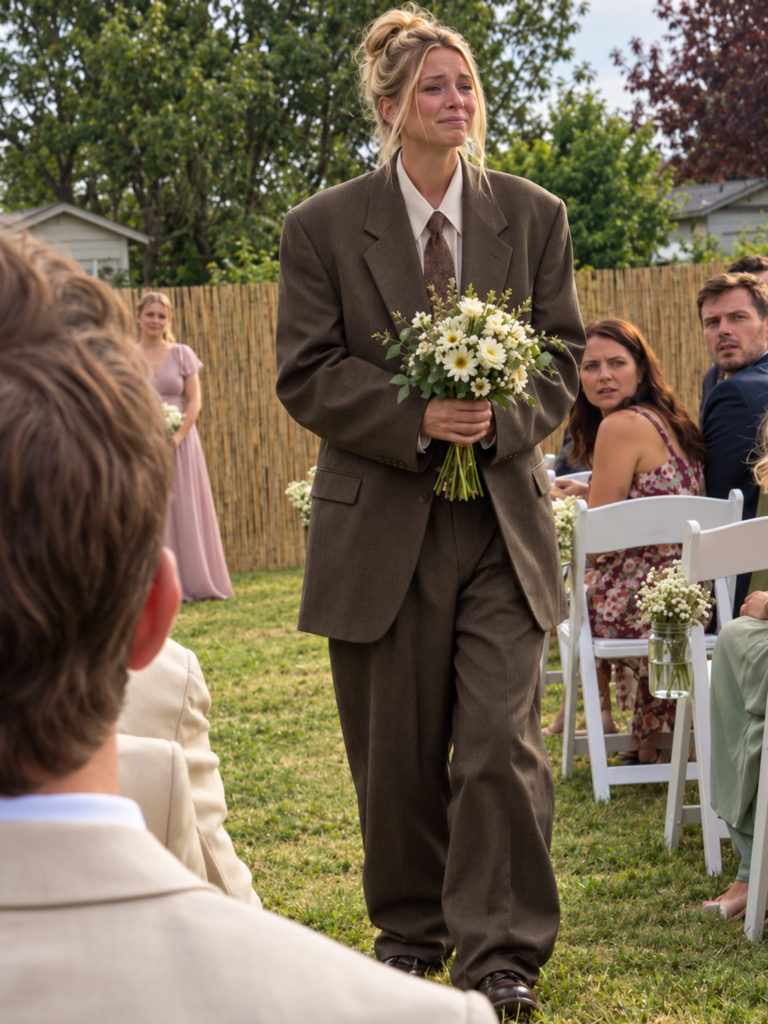
Mara stood beneath the trees.
She held a small bouquet of white flowers in one hand.
Her brown hair was pinned loosely at the back of her neck.
She had the pearl earrings my mother had given her at Christmas.
But there was no white dress.
Mara was wearing a man’s suit.
Not a fashionable woman’s suit.
Not a tailored tuxedo.
A man’s old, oversized, unmistakably outdated charcoal suit.
The jacket hung well below her hips.
The shoulders were too wide.
The sleeves nearly swallowed her hands.
The trousers had been rolled at the ankles, revealing white satin shoes underneath.
Someone behind me whispered, “Oh my God.”
A few people laughed.
Not cruelly.
More like they thought there must be some joke they hadn’t been told yet.
My first emotion was not tenderness.
It wasn’t grief.
It wasn’t understanding.
It was embarrassment.
Hot, immediate embarrassment.
There were ninety people watching.
A photographer crouched ten feet away.
My coworkers were there.
Mara’s family was there.
My grandmother was there.
We had spent almost eleven months planning this ceremony.
Mara had spent thousands of dollars on a wedding dress I knew existed because I’d watched the charge hit our credit card.
And now she was walking toward me dressed like someone’s grandfather at a 1987 insurance convention.
I looked at Natalie.
She stared straight ahead.
I looked at Beth.
Beth’s eyes were wet.
That confused me.
Then I looked at Mom.
Mom was standing completely still.
Her mouth had fallen open.
One hand rose slowly to her chest.
Whatever this was, Mom hadn’t known either.
Mara continued down the aisle.
Her smile trembled slightly.
She could hear the whispers.
I knew she could.
For the first time, I saw uncertainty in her face.
She had committed herself to something she could no longer take back.
By the time she reached me, my heart was pounding.
Linda kissed her daughter’s cheek and sat down.
Mara handed Natalie the bouquet.
I leaned close enough that only she could hear me.
“What are you doing?”
Her eyes met mine.
“Give me ten seconds.”
“Mara—”
“Ten seconds.”
She reached for her left sleeve.
The jacket was so large that she had to pull her hand free before she could roll the cuff back.
Once.
Twice.
Then she turned the inside toward me.
There was a tailor’s label sewn into the lining.
HARRISON & CO.
COLUMBUS, OHIO.
The label had yellowed with age.
Above it, somebody had written in blue ballpoint ink.
Thomas Keane
June 18, 1988
My father’s name.
My parents’ wedding date.
For several seconds, I couldn’t breathe.
I looked from the writing to Mara.
“No.”
She nodded.
My voice came out thin.
“Is that Dad’s?”
“Yes.”
Behind me, Mom made a sound I had never heard from her before.
Half gasp.
Half sob.
But Mara wasn’t finished.
She folded the lining farther back.
Below the old tailor’s mark was a line of new blue stitching.
One word.
Scout.
My vision blurred immediately.
I touched the embroidery with one finger.
“You did this?”
Mara nodded.
I couldn’t speak.
Everything I’d been so aware of thirty seconds earlier disappeared.
The guests.
The camera.
The whispers.
The stupid rolled trouser cuffs.
All I could see was that word.
Scout.
I heard Dad saying it at eighteen when he tossed me the keys to his truck.
At twenty-five when I called him because my furnace stopped working.
At thirty-two, the last birthday I had with him.
Happy birthday, Scout.
I covered my face.
Then the crying started.
Not a dignified tear.
Not misty eyes.
I bent forward with both hands over my mouth while my bride stood beside me wearing my dead father’s wedding suit.
Colin put his hand between my shoulder blades.
Somewhere in the first row, Beth began crying too.
Mara reached for me.
“I wanted him here.”
That made it worse.
I lowered my hands.
“What?”
“I know he can’t be here.” Her own eyes filled. “I know a suit doesn’t change that.”
She swallowed.
“But I thought… maybe something that stood beside your mother when their life started could stand beside you when ours does.”
I stared at her.
Then at Mom.
Mom had both hands over her face.
“You gave her this?” I asked.
Mom shook her head.
“No.”
That surprised me.
Mara glanced toward her.
“She didn’t.”
The officiant, Reverend Morris, wisely said nothing.
I turned back to Mara.
“Then where did you get it?”
Mara hesitated.
“Your sister.”
I looked at Beth.
She wiped her cheeks.
“Before you get mad, Mom, I can explain.”
Mom lowered her hands.
“Elizabeth Keane, that suit was in the cedar chest.”
“I know.”
“You went through my cedar chest?”
“Technically, yes.”
“Beth.”
“It gets worse.”
A few guests laughed softly.
Mom looked torn between crying and strangling her daughter.
Mara squeezed my hand.
“There’s something else you should know.”
My chest tightened again.
“Mara, I’m not sure I can survive something else.”
That earned a little more laughter.
But she wasn’t joking.
“I didn’t decide to wear it because of the label.”
“What do you mean?”
She looked at Beth.
Beth nodded.
Mara reached inside the jacket.
Not the breast pocket.
The lining.
Her fingers found a small opening near one seam.
From it, she pulled a folded piece of paper.
Old paper.
Creased.
Yellow at the edges.
My mother went pale.
“What is that?”
Mara looked at me.
“We found it inside the jacket.”
The entire ceremony seemed to freeze.
I stared at the folded paper between her fingers.
And for the first time that day, I realized the suit had not been the surprise.
The suit was only the beginning.
Part 2
Reverend Morris cleared his throat.
He was seventy-one, had officiated hundreds of weddings, and possessed the calm expression of a man who had probably seen brides faint, grooms vomit, rings disappear, children scream, and divorced parents attempt to destroy each other before the first hymn.
Even he looked uncertain.
“Perhaps,” he said gently, “we should give the family a moment.”
I looked at Mara.
“What is that paper?”
“Not here.”
“You brought it here.”
“I know.”
“Then what is it?”
She lowered her voice.
“It’s something your dad wrote.”
My knees nearly gave out.
Mom stood.
“Thomas wrote that?”
Mara nodded.
“We think so.”
“Think?”
Beth stepped into the aisle.
“I found the suit about six weeks ago.”
Mom stared at her.
“You said you were looking for your grandmother’s tablecloths.”
“I was.”
“In my cedar chest?”
“They were supposed to be there.”
“They’re in the hall closet.”
“I know that now.”
Despite everything, somebody laughed.
Beth walked closer.
“When I opened the chest, I saw Dad’s suit.”
Mom sat slowly.
She looked almost frightened.
Dad’s wedding suit had become one of those possessions nobody mentioned but nobody touched.
After he died, Mom had cleared most of his closet within a year.
His work shirts went to Goodwill.
His winter coat went to Uncle Ray.
I took his socket set and the old radio from his garage.
Beth kept his watch.
But certain things remained.
His Browns sweatshirt.
His Army footlocker.
The wedding suit.
Mom stored it in the cedar chest at the foot of her bed.
She had once told me she couldn’t explain why she kept it.
I understood.
Grief does not apply logic equally to objects.
One man’s shirt is fabric.
Another one is a marriage.
Beth continued.
“Mara had asked me whether Dad owned anything she could use somehow during the ceremony.”
I looked at Mara.
“You asked Beth?”
“I started with your mother.”
Mom frowned.
“You never asked me.”
“I did indirectly.”
“How indirectly?”
“I asked what Ethan’s father used to wear to special occasions.”
Mom stared.
Mara sighed.
“Okay. Apparently too indirectly.”
Even Mom smiled at that.
Mara looked at me.
“I wanted something small. A handkerchief. A tie bar. Something I could pin inside my dress.”
“Why didn’t you tell me?”
“Because every time I mentioned your father and the wedding in the same conversation, you changed the subject.”
That stung because it was true.
“I didn’t change the subject every time.”
Beth gave me a look.
I pointed at her.
“You are already in trouble for burglary.”
She raised both hands.
Mara continued.
“Beth found the suit. She sent me a picture. At first I thought we could take a small piece of lining and sew it into my dress.”
Mom looked horrified.
“You were going to cut his suit?”
“No!”
Beth said, “That was my idea.”
“Of course it was.”
“I said the inside pocket. Nobody would notice.”
“Elizabeth.”
“I didn’t cut it.”
Mara touched Mom’s shoulder.
“The seamstress refused anyway.”
Mom seemed relieved by the existence of this sensible stranger.
“So what happened?”
Mara looked down at herself.
“I put it on.”
I almost laughed.
“You put it on?”
“At Beth’s apartment.”
Beth nodded.
“She looked insane.”
“Thank you.”
“That’s what friends are for.”
“You’re my sister.”
“That too.”
Mara smiled, then became serious again.
“I was trying to see whether there was any other way to use it without damaging it. Maybe wrap the bouquet with the tie. Maybe use one of the pocket squares.”
“There is no pocket square,” Mom said automatically.
“We discovered that.”
Mara touched the jacket near her ribs.
“When I put my hand into this pocket, I felt something strange behind the lining. Like paper crinkling.”
Beth continued.
“We thought it was a dry-cleaning ticket.”
“So I checked the seam,” Mara said. “There was a small opening where the stitching had come loose.”
She held up the folded paper.
“It was inside.”
Mom’s face changed.
Not recognition exactly.
Something older.
“You never opened it?” I asked.
Mara shook her head.
“Not all the way.”
“What does that mean?”
“It means we saw enough to know it was his handwriting.”
I stared at her.
Dad’s handwriting had been terrible.
Tall block letters leaning to the right as though every word were in a hurry.
“What did you read?”
“Only the first line.”
“And?”
Mara’s eyes moved toward my mother.
“It begins, ‘Laura, if I lose my nerve…’”
Mom gasped.
She covered her mouth.
I turned toward her.
“You know what it is?”
For a long moment, she said nothing.
Then she started laughing.
Crying too, but definitely laughing.
“Oh, that idiot.”
“What?”
She wiped beneath her eyes.
“That absolute idiot.”
“Mom?”
She pointed at the paper.
“He told me he lost it.”
“Lost what?”
“A letter.”
The guests had gone completely silent.
I suddenly remembered we were still standing in the middle of our wedding ceremony.
“This is probably not how Reverend Morris planned his afternoon,” I said.
He smiled.
“I’ve had less interesting ceremonies.”
That broke the tension.
Mom looked at Mara.
“You found the letter he wrote me the morning we got married.”
Mara’s eyes widened.
“You knew about it?”
“I knew he wrote one.” Mom shook her head. “I never read it.”
That seemed impossible.
“Why?”
“Because your father misplaced it.”
“On his own body?”
“Apparently.”
Colin muttered, “That’s impressive.”
Mom laughed again.
“He told me at the reception. He said he’d written this very heartfelt letter and intended to send it to my room before the ceremony. Then when he went to find it, it was gone.”
“And it stayed inside the suit for thirty-eight years?”
“Your father was capable of remarkable things.”
There was affection in her voice.
So much affection that my chest hurt.
Mara looked at Mom.
“I didn’t think I had the right to read it.”
“You don’t.”
Mara immediately held it out.
Mom reached for it.
Then stopped.
Her fingers hovered over the paper.
Everyone watched.
Finally Mom closed her hand.
“No.”
I frowned.
“No?”
She looked at Mara.
“You found it.”
“It’s yours.”
“It was supposed to be mine thirty-eight years ago.”
“Exactly.”
Mom looked toward the empty chair beside her.
Then at me.
Then she smiled.
“Maybe it took the scenic route.”
Her voice trembled.
“Finish getting married. Give it to me afterward.”
Mara nodded.
She returned the letter to the inner pocket.
I looked at her.
“You carried a thirty-eight-year-old love letter from my dead father down the aisle and didn’t mention it until now?”
“I’ve had a difficult morning.”
“You?”
“I’ve been wearing these pants for an hour.”
I looked down.
The trousers were rolled four times.
I started laughing.
The sound came out through tears.
Mara laughed too.
Then Mom called from the front row, “Ethan?”
I looked at her.
She pointed toward the altar.
“Marry her before she finds anything else in your father’s pockets.”
The guests erupted.
Even Reverend Morris laughed.
The ceremony resumed.
I wish I could say I regained my composure.
I didn’t.
For the next twenty minutes, I existed somewhere between joy and grief.
Mara stood in front of me with Dad’s jacket hanging off her shoulders.
Every time she moved, I caught a faint smell of cedar.
Mom’s cedar chest.
My childhood home.
Christmas mornings.
Dad coming inside from the garage.
Memory is strange that way.
A scent can bypass every defense you’ve spent years constructing.
When it was time for vows, Mara went first.
She had written hers.
Of course she had.
Mara was a high school English teacher.
She owned three kinds of sticky notes.
She had opinions about commas.
She planned emotional honesty in paragraphs.
She took my hands.
“Ethan,” she began, then stopped.
Her lower lip trembled.
“That was not supposed to happen yet.”
Everybody laughed.
She tried again.
“You’ve spent six years making ordinary life feel safe to me.”
My throat tightened.
“You’re the person who checks my tires before winter and remembers my mother’s birthday without putting it in your phone. You make coffee when you’re still angry with me. You sit through school concerts where you know none of the children. You pretend you don’t like our cat, and then I catch you warming his blanket in the dryer.”
I heard Colin whisper, “Busted.”
Mara smiled.
Then her face softened.
“But you also hide pain when you think sharing it would burden someone else.”
I looked down.
She tightened her hands around mine.
“So my promise isn’t only to love the easy parts of you. I promise to make room for the people you miss, the memories that hurt, the things you don’t know how to say, and every version of you that existed before I came along.”
Her sleeve slipped again.
The embroidered word appeared.
Scout.
“I promise never to ask you to leave your history outside our marriage.”
By then I was crying again.
When my turn came, the vows I’d spent a month writing seemed embarrassingly inadequate.
I took the folded card from my pocket anyway.
I looked at it.
Then at Mara.
Then I put it away.
“Oh no,” she whispered.
I almost laughed.
“I had good vows.”
“You better.”
“Three drafts.”
“I know.”
“You know?”
“You left them beside the printer.”
“That explains why you suddenly became emotional near the office.”
A few people laughed.
I took a breath.
“I spent most of this year thinking I was protecting today.”
Mara tilted her head.
“Protecting it from what?”
“From being sad.”
I looked toward Mom.
“From Dad, I guess.”
Mom’s eyes filled again.
“I thought if I didn’t talk about him too much, nobody would feel obligated to be sad because he wasn’t here.”
My voice shook.
“And what I apparently failed to understand is that everybody was already missing him.”
Beth nodded.
Mom pressed a tissue against her lips.
I looked at Mara.
“You understood that before I did.”
She gave a tiny shrug.
“I had help.”
“From my criminal sister?”
“Mostly.”
Beth whispered, “You’re welcome.”
I smiled.
Then I became serious.
“I love you because you notice people. Not in the big dramatic ways. In the ways that matter.”
I touched the sleeve of Dad’s jacket.
“And today you saw something I spent three years refusing to look at.”
Mara began crying.
“I don’t want a life where I have to be less sad to deserve being happy.”
Her face folded.
I squeezed her hands.
“And I don’t want you to ever think you have to fix me. You didn’t bring Dad back today.”
I looked at the empty chair.
“But you made it okay that I wish he were here.”
For the first time since his funeral, saying that sentence out loud didn’t feel dangerous.
I wish he were here.
Nothing broke.
Nobody collapsed.
The happiness of the day didn’t disappear.
Grief simply took its proper seat beside it.
Reverend Morris pronounced us husband and wife.
I kissed Mara while ninety people applauded.
When we separated, Colin leaned toward me.
“Your father technically got closer to your wife before you did.”
I stared at him.
Mara burst out laughing.
That became one of the photographs.
My favorite one, eventually.
Not the posed portrait beneath the maple trees.
Not the kiss.
Not Mara in her real wedding dress later.
It’s the photograph taken two seconds after Colin’s joke.
Mara is laughing so hard her eyes are closed.
I’m pointing at him.
Mom is in the background crying and laughing simultaneously.
And Dad’s jacket is hanging crookedly from my wife’s shoulders.
But at that moment, we hadn’t yet read his letter.
And none of us understood what he had actually written.
After the ceremony, most guests moved toward the cocktail lawn.
Mara disappeared into the farmhouse with Natalie to change.
Before she did, Mom stopped her.
“Wait.”
Mara turned.
Mom approached slowly.
For the first time, she touched the suit.
Her fingertips ran along the lapel.
Then she looked at Mara.
“You know Thomas would’ve laughed until he couldn’t breathe if he’d seen you in this.”
“I was hoping he wouldn’t be offended.”
“Offended?”
Mom smiled.
“He wore a powder-blue tuxedo to his senior prom.”
“So this is improvement?”
“Enormous improvement.”
They hugged.
Because the jacket was too big, Mom’s cheek ended up pressed against its shoulder.
She closed her eyes.
Watching them nearly undid me again.
Then Beth joined them.
Then me.
Four people stood together wrapped, in one way or another, around one absent man.
Eventually Mara changed into her dress.
It was ivory, simple, fitted through the waist, with small covered buttons down the back.
When she came outside, I finally got the moment I had spent a year imagining.
She walked toward me beneath the maple trees.
No old suit.
No rolled trousers.
No confused guests.
Just my bride in her wedding dress.
She stopped several feet away and turned once.
“Well?”
I stared at her.
“It’s beautiful.”
“Better than the suit?”
“That’s unfair.”
“It’s a wedding dress.”
“The suit made me cry harder.”
She narrowed her eyes.
“I’m going to remember that.”
“I mean emotionally.”
“Still remembering it.”
I kissed her.
The photographer took pictures.
We joined our guests.
We drank champagne.
We ate miniature crab cakes.
For almost an hour, the letter stayed inside Dad’s jacket upstairs in the bridal room.
I nearly forgot about it.
Then, during family photographs, Mom suddenly said, “The letter.”
Everything stopped again.
Beth looked at me.
Mara looked at Mom.
Mom’s expression had changed.
She wasn’t laughing anymore.
“I want to read it before dinner.”
So the four of us went inside.
No photographer.
No friends.
No audience.
Just Mom, Beth, Mara, and me.
Dad’s suit lay over the back of a chair.
Mara removed the folded paper from the lining.
She handed it to Mom.
This time, Mom accepted it.
Her hands shook as she unfolded the page.
The paper had been folded so long the creases looked ready to split.
Dad’s handwriting covered both sides.
Mom stared at the first sentence.
Her face crumpled.
“Do you want us to leave?” I asked.
She shook her head.
“No.”
Then she laughed softly.
“He misspelled ‘beautiful.’”
Beth began crying immediately.
“That sounds like Dad.”
Mom wiped her cheek.
“He wrote ‘beautifull.’ Two L’s.”
We laughed.
Mom read silently for a while.
Then her expression changed again.
She looked at me.
“What?”
She looked back at the page.
“Mom?”
“There is something in here about you.”
My stomach dropped.
“About me?”
“You weren’t born.”
“I understand the timeline.”
“No.” She shook her head. “He wrote about having children.”
Beth moved closer.
Mom read the paragraph again.
Then she handed me the letter.
“Read that.”
I didn’t want to.
I don’t know why.
Maybe because grief trains you to fear unexpected gifts.
I looked down.
Dad had written the letter when he was twenty-seven years old.
Before mortgages.
Before gray hair.
Before children.
Before me.
The paragraph Mom indicated began halfway down the page.
I read it once.
Then again.
Laura,
If we’re lucky enough to have kids someday, I hope they know our house is the place where they can come when they mess up. I don’t care if they’re thirty and think they’re supposed to know everything. I hope they never get too old to call us when they’re scared.
I stopped reading.
The room blurred.
Beth whispered, “Ethan.”
There was more.
I forced myself to continue.
And if we get a boy, please don’t let me raise him to think being a man means swallowing everything that hurts. My father did that to me, and I’ve spent half my life trying to unlearn it.
I lowered the paper.
No one spoke.
Dad had never told me that.
Not once.
My grandfather had been a hard man.
Not cruel.
But distant.
He believed praise made children soft.
Dad loved him anyway.
Or tried to.
I had always thought Dad was simply tougher than I was.
He could fix things.
Handle things.
Carry things.
He cried exactly twice that I remembered.
At his mother’s funeral.
And when our old dog, Murphy, died.
Yet there it was.
Thirty-eight years earlier.
Before I existed.
Dad had worried he might teach his future son to hide pain.
I sat down.
Mom sat beside me.
“He didn’t,” she whispered.
I looked at her.
“What?”
“He didn’t do what his father did.”
I stared at the letter.
“He did some.”
Mom smiled sadly.
“We all repeat something.”
That sounded true enough to hurt.
She touched my hand.
“But your father adored you.”
“I know.”
“He would’ve hated knowing you thought you had to act fine for everybody.”
That sentence hit harder than anything else.
Because for three years, that was exactly what I’d done.
At the funeral.
At Mom’s house when we divided his tools.
At my proposal to Mara.
At every holiday.
During every wedding-planning conversation.
I’m fine.
I’m okay.
Don’t worry about me.
I folded the letter carefully.
Mara stood several feet away.
She looked guilty.
“What?” I asked.
“I didn’t know that was in there.”
“I know.”
“If I’d known—”
“You would’ve still worn the suit?”
She hesitated.
“No.”
I smiled.
“Yes, you would’ve.”
A small smile appeared.
“Maybe.”
I stood.
Then I handed Dad’s letter back to Mom.
She looked surprised.
“Keep it.”
“You sure?”
“It was written to you.”
She touched the edge of the paper.
Then she held it against her chest.
For nearly forty years, Mom had lived without a letter she was supposed to receive on her wedding day.
My father had spent the rest of their marriage believing it was lost.
Now it had arrived on mine.
There are coincidences you can explain.
A weak seam.
An old folded page.
A suit stored untouched for decades.
None of it required magic.
But standing in that room, I also didn’t need to explain it.
Sometimes timing is allowed to be enough.
Part 3
I thought the emotional part of the wedding was over.
I was wrong.
It started at dinner.
Uncle Ray had been drinking.
Not dangerously.
Just enough to become sentimental, which in our family was arguably more dangerous.
After Colin gave his best-man speech, Uncle Ray stood without being invited.
Beth muttered, “Oh no.”
Mom closed her eyes.
“Raymond.”
He raised his glass.
“I’ll be brief.”
“No Keane man has ever been brief,” Mom said.
The room laughed.
Uncle Ray ignored her.
He looked at me.
“Your father would’ve hated all this crying.”
I smiled automatically.
Several relatives laughed.
It was exactly the kind of thing people said about Dad.
Tom wasn’t emotional.
Tom would’ve made a joke.
Tom would’ve told everyone to quit crying.
Then Uncle Ray continued.
“Or at least that’s what he’d want us to think.”
The room quieted.
He rubbed his jaw.
“You know, after Ethan asked Mara to marry him, Tom would’ve been unbearable.”
I frowned.
Dad had died almost two years before I proposed.
Ray caught himself.
“Not because he knew about Mara.”
He looked toward me.
“Because he’d been worried about your wedding since you were nineteen.”
The room laughed again.
I shook my head.
“What?”
Ray grinned.
“You brought that girl from college home for Thanksgiving.”
“Oh God.”
Mara turned toward me.
“Which girl?”
“Ancient history.”
“Name?”
“Not relevant.”
Ray continued mercilessly.
“After she left, Tom told me, ‘That one isn’t it.’”
Mara looked delighted.
“What was wrong with her?”
“Nothing.”
Ray said, “She didn’t laugh at his jokes.”
“Reasonable woman,” Mom muttered.
Ray raised his glass.
“He said Ethan needed somebody who could see when he was pretending.”
My smile faded.
Across the table, Mara’s eyes met mine.
Ray’s voice softened.
“Tom always thought his son was easier to read than Ethan believed.”
That hurt.
In a good way.
“He would have liked you, Mara.”
Mara lowered her eyes.
“He would’ve loved what you did today.”
Uncle Ray looked at me.
“And Scout?”
I froze.
Ray never called me that.
Not once.
He smiled.
“Your old man would’ve been proud.”
I had no defense left.
I bowed my head and cried into my napkin while eighty-something people politely pretended not to watch.
Mara rubbed my back.
“Worst wedding ever,” I whispered.
“Absolutely disastrous.”
“I’ve cried more today than in the previous decade.”
“Healthy.”
“I’m exhausted.”
“You still have to dance.”
“I want an annulment.”
“Denied.”
We laughed.
The rest of the reception became lighter.
Maybe because the hardest thing had finally been allowed into the room.
Dad was dead.
He should have been there.
We missed him.
All three statements could exist beside cake and dancing and champagne.
Nothing had to be protected from anything else.
Mom danced with Uncle Ray.
Beth dragged our grandmother onto the floor.
Colin attempted something that may have been the worm and required medical observation afterward.
Mara’s mother took off her shoes at nine thirty and never put them back on.
Around ten, I found myself standing alone near the edge of the dance floor.
Mara was dancing with her father.
Linda stood beside me.
She watched them for a minute.
Then she said, “She almost didn’t wear it.”
I looked at her.
“The suit?”
Linda nodded.
“She cried this morning.”
“Why?”
“Because I told her it was a terrible idea.”
I laughed.
“At least one person had judgment.”
“I said guests wouldn’t understand. I said you might be upset. I said wedding surprises were supposed to involve songs, not dead relatives’ clothing.”
“That is generally good advice.”
Linda smiled.
“She asked me whether I thought it was disrespectful.”
“What did you say?”
“I said I didn’t know.”
She looked at her daughter.
“Then she said something that made me stop arguing.”
“What?”
Linda hesitated.
“She said, ‘Ethan keeps making his grief smaller so nobody has to step around it. I don’t want our marriage to start that way.’”
I swallowed.
The music seemed suddenly far away.
Linda touched my arm.
“My daughter loves loudly.”
“I’ve noticed.”
“It can be inconvenient.”
“I’ve noticed that too.”
“But she means it.”
“I know.”
When the song ended, Mara walked toward us.
Linda kissed her cheek and left.
I held out my hand.
“Come outside.”
“Am I in trouble?”
“Yes.”
“Finally.”
We went through the side doors onto the terrace.
The October air had turned cold.
Small string lights hung between the trees.
Behind us, music thumped softly through the windows.
Mara leaned against the railing.
“Okay.”
I stood beside her.
“Your mother told me you almost changed your mind.”
She groaned.
“Traitor.”
“Why?”
“Because around eight this morning, the idea stopped feeling meaningful and started feeling insane.”
“It was both.”
“Thank you.”
“You’re welcome.”
She looked toward the dark field.
“I thought maybe I was using your grief to create a moment.”
That surprised me.
“What do you mean?”
“You never asked me to do this.”
“No.”
“And your father wasn’t mine.”
I stayed quiet.
She continued.
“I never met him. Everything I know about him comes from you, Beth, your mom, pictures, stories.”
She rubbed her hands together against the cold.
“I suddenly wondered if I was making myself the center of something that didn’t belong to me.”
That was such a Mara fear.
Other people worried about looking foolish.
Mara worried about taking emotional space she hadn’t earned.
I took off my jacket and put it over her shoulders.
She smiled.
“This one actually fits me.”
“Barely.”
She slipped her arms into it.
“I decided I wouldn’t wear his suit.”
“What changed?”
“Beth.”
“Of course.”
“She got furious.”
“That also sounds right.”
Mara laughed softly.
“She said, ‘My brother has spent three years acting like missing Dad is some embarrassing medical condition. If this makes him finally say his name at his own wedding, wear the stupid suit.’”
I looked through the windows.
Beth was arguing with Colin about something near the cake table.
“I owe her an apology for calling her a criminal.”
“She did steal a suit from your mother’s cedar chest.”
“Temporary criminal.”
Mara looked at me.
“Were you angry?”
I knew exactly what she meant.
“At first.”
Her face changed.
I took her hand.
“I was embarrassed.”
She nodded slowly.
“For how long?”
“Twenty seconds.”
“That long?”
“It was a strong twenty seconds.”
She smiled.
“I looked at you and thought, ‘I am about to marry a woman who has lost her mind.’”
“Fair.”
“I thought everybody was staring.”
“They were.”
“I thought about the pictures.”
“Also fair.”
“I thought about how much the dress cost.”
She winced.
“Let’s not discuss that.”
“Then you showed me the cuff.”
Her expression softened.
“And?”
“And none of that mattered anymore.”
She looked down at our hands.
“I didn’t want to hurt you.”
“You did.”
She looked up quickly.
I squeezed her fingers.
“Not in a bad way.”
“That’s not usually how hurting works.”
“It hurt because Dad is dead.”
I said it plainly.
Three years earlier I couldn’t say those words without feeling like the floor moved.
Now they landed and stayed.
“He’s dead. I hate that. I hated it yesterday. I’ll hate it tomorrow.”
Mara listened.
“You didn’t create that pain.”
I touched her cheek.
“You just stopped helping me pretend it wasn’t there.”
Her eyes filled.
I smiled.
“So yes, I was blindsided.”
“I’m sorry.”
“Don’t be.”
“That’s easy for you to say now.”
“True.”
She gave me a suspicious look.
“If you had hated it?”
“I would’ve told you.”
“After the ceremony?”
“Definitely after.”
“You would’ve married me first?”
“Probably.”
“How romantic.”
“I had already paid the caterer.”
She punched my arm.
I pulled her against me.
For a while, we stood there quietly.
Then she said, “Your dad’s letter scared me.”
“Me too.”
“That part about a son.”
“I know.”
“I keep thinking about the fact that he wrote it before you existed.”
“Me too.”
She rested her head against my shoulder.
“Do you think he became the father he wanted to be?”
That was a harder question than it sounded.
Dad wasn’t perfect.
He yelled sometimes.
He could be stubborn for sport.
When I quit baseball at fourteen, he barely spoke to me for two days because he thought I was giving up too easily.
When I moved to Chicago after college, he told me I was wasting money on rent.
When I moved home four years later, he helped unload every box and never once said, I told you so.
He was complicated.
Like fathers are.
Like sons eventually become.
“I think he tried,” I said.
Mara nodded.
“I think that’s probably the best anybody does.”
Through the window, Beth spotted us and pointed aggressively toward the dance floor.
I sighed.
“We’re being summoned.”
“Your sister scares me.”
“You stole a suit with her.”
“Temporary lapse in judgment.”
We went back inside.
At eleven thirty, the band announced the final dance.
Most guests formed a loose circle around us.
Mara rested both arms around my neck.
I held her waist.
Halfway through the song, I looked past her shoulder.
Mom was sitting alone at a table.
Dad’s letter rested beside her purse.
She wasn’t crying.
She was smiling.
That image stayed with me.
Not the empty chair.
Not Mom at the altar with her hands over her face.
That.
My mother sitting at her son’s wedding with a letter from her husband that had taken thirty-eight years to reach her.
After the reception, we returned to the farmhouse to collect our things.
Dad’s suit was still draped over the chair.
Mom lifted it carefully.
“I suppose I should take this home.”
I looked at Mara.
Then I looked at Mom.
“Maybe not.”
Mom paused.
“What?”
I touched the sleeve.
“Can we keep it?”
Her face changed.
“You want it?”
“Yeah.”
“For what?”
“I don’t know.”
That was the truth.
I didn’t plan to wear it.
It didn’t fit me anyway. Dad had been broader through the chest and two inches shorter.
I simply wasn’t ready to put it back in a cedar chest and close the lid.
Mom understood.
“Of course.”
She handed it to me.
Beth pointed at the inside seam.
“Someone should fix that before another historical document falls out.”
Mom glared at her.
“You are never opening anything in my bedroom again.”
“Fair.”
“Ever.”
“Understood.”
“I mean it.”
“Mom, there’s like a fifty-fifty chance you don’t remember this conversation tomorrow.”
Mom raised one finger.
“I have forgiven the theft because it produced a beautiful moment. Do not test the limits of grace.”
Mara burst out laughing.
We left the venue shortly after midnight.
Dad’s suit traveled with us in a garment bag.
Two days later, after Mara and I returned from a short honeymoon in Michigan, I took it to a tailor.
Not to alter it.
Just to repair the torn lining.
The tailor was an older Vietnamese man named Mr. Nguyen who had worked in the same shop for more than thirty years.
He examined the fabric.
“Good suit,” he said.
“It survived a while.”
He turned the cuff.
His finger stopped at the embroidery.
“Scout?”
“My dad’s nickname for me.”
He nodded.
“You want that removed?”
“No.”
He looked up.
“Good.”
That was the entire conversation.
A week later, I picked up the suit and brought it home.
Instead of storing it away, Mara suggested we hang it in the back of the guest-room closet.
“Why there?” I asked.
“Because you’ll see it.”
She was right.
For several months, every time I opened that closet for extra towels or wrapping paper, I saw the gray garment bag.
And gradually, something changed.
I started talking about Dad again.
Not dramatically.
Not every day.
Just naturally.
I told Mara about the time he accidentally backed our fishing boat into the mailbox.
I told her how he used to fall asleep during every movie and insist he had only been “resting his eyes.”
I told her that he secretly cried during Field of Dreams and denied it until the day he died.
I called Uncle Ray more often.
I asked Mom questions I had never thought to ask when Dad was alive.
How had they met?
What had their first apartment looked like?
Why had Dad written that line about his own father?
Mom told me things.
Not all of them flattering.
That helped.
Grief had turned Dad into a statue in my mind.
Stories made him human again.
One Sunday afternoon in January, Mom came over carrying a small frame.
Inside was Dad’s letter.
Not the original.
A copy.
At the bottom, she had placed a photograph from my parents’ wedding.
Dad stood beside her in the charcoal suit.
He was twenty-seven.
His hair was thick.
His tie was crooked.
Mom was laughing at something outside the frame.
I stared at him.
The suit looked completely different on him.
Actually fitted.
Actually stylish for 1988.
“You don’t have to display it,” Mom said.
“I will.”
She pointed to one line in the copied letter.
The sentence about a son never becoming too old to call home when he was scared.
“I wanted you to have that part.”
I hugged her.
Mom stiffened for half a second.
We were not historically an extended-hug family.
Then her arms went around me.
I said, “I miss him.”
She whispered, “I know.”
For once, I didn’t follow it with I’m okay.
Almost a year after the wedding, Mara and I received a large envelope from our photographer.
We had already downloaded the digital pictures months earlier, but our package included twenty professionally printed photographs.
Mara spread them across the dining-room table.
There was the first kiss.
The cake cutting.
Mom dancing with Ray.
Beth making a face during a toast.
Mara in her wedding dress beneath the maple trees.
All beautiful.
Then I found the photograph Colin’s joke had caused.
Mara in Dad’s suit.
Laughing.
Me pointing toward Colin.
Mom crying behind us.
The cuff folded just enough that a tiny strip of blue embroidery was visible.
You couldn’t read the word unless you already knew what it said.
Scout.
I picked up the photograph.
“This one.”
Mara looked over my shoulder.
“For the album?”
“For the wall.”
She laughed.
“Seriously?”
“Absolutely.”
“I spent four months choosing that dress.”
“The dress pictures are beautiful.”
“And?”
“This one’s us.”
She studied it.
I watched her smile change.
“Okay.”
We framed it.
It hangs in our hallway now.
People who don’t know the story always ask the same question.
“Why were you wearing that suit?”
Mara usually looks at me before answering.
She lets me decide how much I want to tell.
Sometimes I give the short version.
“My father’s.”
Sometimes I explain everything.
The tailor’s label.
The nickname.
The hidden letter.
The thirty-eight years it spent inside the lining.
The sentence Dad wrote before I was born about hoping his future son wouldn’t grow up thinking pain had to be swallowed.
Sometimes people say it was fate.
Sometimes coincidence.
Mom says Dad shoved the letter into the wrong pocket because he was nervous and forgot about it, which is the most realistic explanation.
Beth insists she was “guided” to the cedar chest.
Mom tells her she was guided by nosiness.
Mara never argues for any version.
Neither do I.
I know only what happened.
My wife arrived at our wedding wearing something that looked ridiculous.
For twenty seconds, I was embarrassed.
Then she turned back one cuff and showed me a word I thought I would never see addressed to me again.
Scout.
That day didn’t bring my father back.
It didn’t heal grief.
I don’t think grief works that way.
It did something quieter.
It gave me permission to stop treating his absence as a problem I was supposed to solve before I could fully enjoy my life.
Dad missed my wedding.
That’s true.
I hate that.
Also true.
I married Mara beneath maple trees turning orange, cried in front of everyone I knew, laughed harder than I had in months, danced badly, ate too much lemon cake, and went home happier than I had ever been.
Also true.
All of it fits.
The suit still hangs in our guest-room closet.
We never cut it.
Never altered it.
The repaired lining hides no more letters as far as we know, although Beth has volunteered to conduct another search and remains permanently banned by my mother from doing so.
Every June, Mom takes Dad’s original letter from the small box where she keeps it and reads it on their anniversary.
Last year, she told me she’d finally stopped being angry that she never received it when he was alive.
“Why?” I asked.
She smiled.
“Because apparently it wasn’t finished doing its job.”
I understood what she meant.
Dad wrote that letter for his bride.
Thirty-eight years later, my bride found it.
And somehow, across all that time, one sentence reached the son he hadn’t met yet.
There are moments from my wedding I remember as photographs.
Mara in white.
Mom raising her glass.
Beth barefoot on the dance floor.
There are others I remember as sound.
Laughter.
Music.
My mother’s voice saying Thomas would have loved this.
But the memory that returns most often is still the first one.
Mara standing at the far end of the aisle beneath the trees.
That absurd jacket nearly swallowing her hands.
Guests whispering.
My stomach dropping because I thought something had gone terribly wrong.
Then her reaching me.
Rolling back the cuff.
Turning the lining toward my face.
And giving me back, in blue thread, one small word I hadn’t realized I was still waiting to hear.


