
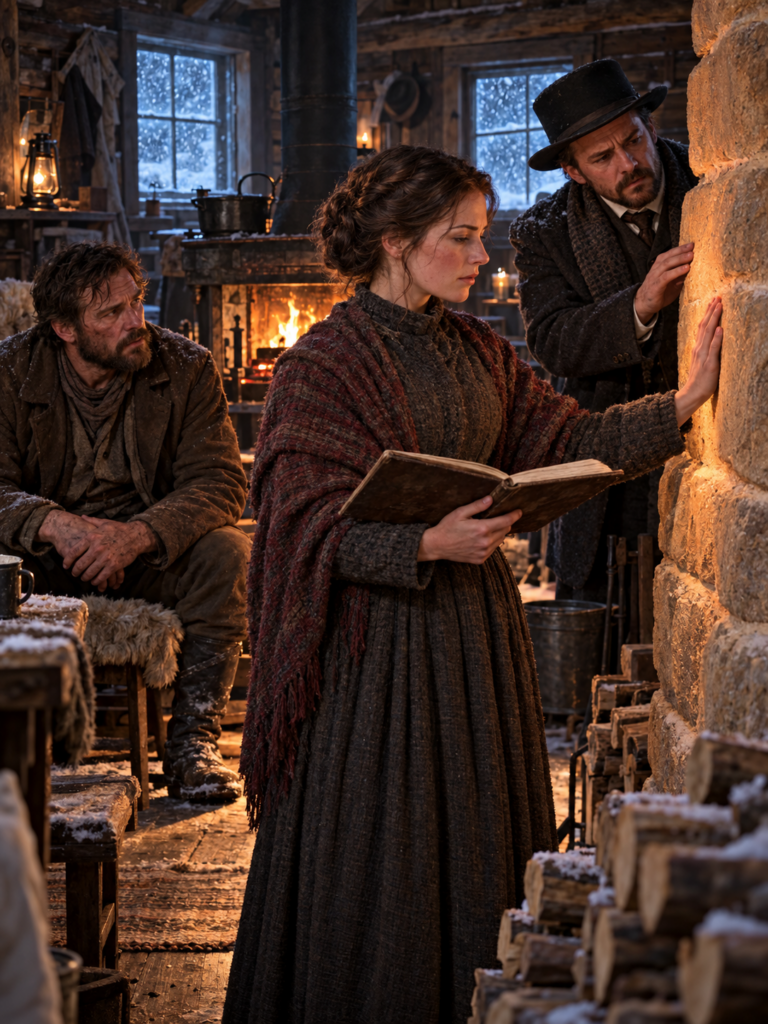
Harrow caught the ledger before it reached the edge of the table and began turning pages with fingers still stiff from the cold.
Elowen did not explain the figures for him.
She had learned something during the months of building: evidence became weaker when the person presenting it sounded desperate for belief.
So she let him read.
Fuel loads.
Draft adjustments.
Ventilation changes.
Cleanout dates.
The damp corner.
Temperatures.
The beginning of the storm.
Harrow stopped.
His finger returned to one entry.
Then another.
“You recorded every firing?”
“Every one I was awake for. Caleb recorded the others.”
Caleb nodded from the doorway.
Harrow glanced at Virgil.
Virgil said nothing.
That surprised Elowen almost as much as the numbers had.
In October, her husband would have explained the whole design before the examiner finished asking the question.
Now he waited.
Harrow turned another page.
“Show me the wood.”
Virgil reached for his coat.
“I’ll take you.”
“No.”
Elowen’s voice made both men turn.
Harrow raised an eyebrow.
“The windward entry is drifting shut,” she said. “You nearly froze reaching us. Nobody goes outside alone.”
Virgil started to object.
She looked at him.
He stopped.
Then Caleb reached for his own coat.
“Three of us.”
“That’s better.”
They used the protected entry, crossing only the short distance necessary to inspect the remaining stack. When they returned, Harrow’s face had changed again.
There was still wood.
Not much by ordinary autumn standards.
But after four days of brutal cold, there was far more than he had expected.
He went directly to the central chamber.
“Open the lower cleanout.”
Virgil did.
Clear.
“Last serviced?”
Elowen answered with the date before Virgil could.
Harrow checked the masonry.
“Moisture?”
“Controlled,” she said. “Not eliminated.”
“Where?”
She took him to the corner she had first discovered.
The plaster felt dry enough now, but Elowen would not pretend it had vanished permanently.
“We air the cabins briefly each day when conditions allow. Wet clothing stays away from the exterior corners.”
“Whose change?”
“Mine.”
Harrow looked at Virgil.
“His system.”
Elowen folded her arms.
“Our house.”
Virgil’s eyes met hers.
No wounded pride.
No correction.
“Her change,” he said.
The words were quiet.
They mattered anyway.
Harrow returned to the central chamber and pressed his palm against the stone.
The fire behind the iron door was modest.
That was the strangest part.
Below them, families were forcing their stoves harder and harder because the cold kept stealing whatever heat the iron produced.
Here, the flame had grown small, but yesterday’s warmth had not completely disappeared.
Harrow looked toward the thermometer again.
Then at Owen’s boots hanging from wooden pegs.
He took one down.
Bent the leather.
Dry.
Soft.
Elowen remembered holding those same boots beside the stove the winter before, turning them in her hands while her son waited beneath blankets because the leather had frozen stiff overnight.
Virgil remembered too.
She could tell from his face.
Harrow returned the boot to its peg.
“This doesn’t prove replication is safe.”
Virgil’s mouth opened.
Elowen touched two fingers against his wrist.
He closed it.
“No,” she answered. “It proves these three cabins have held through four days. Nothing more.”
Harrow studied her.
Then he pulled out his pencil.
Outside, the storm struck the roof like thrown gravel.
Inside, everyone seemed to hear the scratch of graphite.
Harrow recorded the outside conditions.
The temperature indoors.
The condition of the fire.
The cleanout.
The fuel remaining.
The absence of smoke backup.
Then he opened his earlier inspection page.
Elowen could see the warning he had written before they moved in.
He did not cross it out.
She respected him for that.
The warning had been right when he made it.
Instead, he wrote beneath it.
Virgil leaned forward, trying to read.
Elowen stopped him with one hand against his chest.
“Let him finish.”
He looked down at her hand.
Then at her face.
For months, their marriage had been caught inside the same question as the walls: could something built with good intentions survive pressure without becoming rigid?
Virgil stepped back.
Harrow completed the entry.
Closed the ledger.
And finally looked at the builder.
“I was inspecting a chimney fire below town when the weather trapped me up here.”
Virgil’s expression tightened.
“Anyone hurt?”
“No. But they were burning too hard. Pipe overheated near the roof.”
The room went still.
The fact landed heavily because no enemy had caused it.
No sabotage.
No foolish stranger.
Only cold.
Need.
And the old answer Raven Spur had always trusted: when winter became worse, make the fire bigger.
Harrow looked toward the small flame inside Virgil’s chamber.
“The storm isn’t finished.”
Elowen glanced at their remaining wood.
Neither was the test.
She picked up her ledger, tore a narrow strip from a blank scrap tucked inside its cover, and began dividing the remaining fuel into measured firing allotments.
Virgil watched her pencil move.
“You’re rationing it.”
“I’m making sure fear doesn’t burn tomorrow’s wood tonight.”
Then she handed the first allotment figure to Caleb and looked directly at her husband.
“No one changes this without telling the others.”
Virgil took a long breath.
Once, he would have called the fire his responsibility.
Now three families were depending on it.
He nodded.
“Agreed.”
Elowen turned toward the central chamber just as a hard gust struck the compound and the flame behind the iron door bent sharply sideways.
Every face in the room snapped toward it.
Virgil was already moving.
So was Elowen.
Elowen reached the inspection opening at the same moment Virgil dropped to one knee beside the fire chamber.
The flame bent again.
Not backward.
Sideways.
Virgil held out his hand.
“Lamp.”
She gave it to him.
Harrow moved closer but did not interfere.
Outside, the gust passed.
The flame straightened.
Nobody relaxed.
Virgil opened the first inspection point and watched a thread of smoke Elowen held nearby.
It drew inward.
He checked the second.
Inward again.
The third pulled more weakly, but it pulled.
“Not reversal,” he said.
“Then what?” Jonas asked from behind them.
“Pressure change at the chimney cap, maybe.”
Elowen crouched beside Virgil.
“Maybe isn’t enough.”
“I know.”
He checked again.
The draft steadied as the wind shifted.
Harrow spoke quietly.
“If smoke enters any cabin, you shut it down.”
Virgil’s shoulders went rigid.
Elowen heard the old resistance in his silence.
Turning off the core in weather like this would mean allowing all three cabins to cool while they sought another arrangement.
But Harrow was not threatening Virgil’s pride.
He was naming the limit that kept confidence from turning into recklessness.
Elowen looked at her husband.
“You agreed.”
His eyes stayed on the smoke trail.
“I remember.”
“Say it.”
He finally turned toward her.
“If smoke enters an occupied room, we shut the system down.”
Jonas exhaled.
Harrow gave a small nod.
Then Virgil surprised Elowen.
“And if the draft weakens again, we don’t wait for smoke. We reduce the fire first.”
That was not Harrow’s rule.
It was stricter.
Elowen’s grip on the lamp loosened.
“All right,” she said.
For the next hour they watched the system rather than trusting it.
The gust did not repeat.
The smoke pulled cleanly.
The masonry remained warm.
When the others drifted back toward their cabins, Virgil stayed beside the fire.
Elowen remained with him.
“You should sleep,” he said.
“So should you.”
“I’m watching the draft.”
“And I’m watching the man watching the draft.”
He gave her a tired look.
“That sounds insulting.”
“It is partly affectionate.”
The corner of his mouth moved.
Months of work had roughened his hands. Mortar had left cracks across his knuckles that no amount of animal fat completely softened. Elowen had spent the same months wondering whether the compound would become the proof of his best idea or the monument to his stubbornness.
She sat on the low bench beside him.
“When you first drew this,” she said, “you already believed it would work.”
“I believed the principle would.”
“That isn’t what I said.”
Virgil stared into the small fire.
After a while, he admitted, “Yes.”
“And when Jonas questioned the draft?”
“I thought he was right to.”
“You were angry.”
“I was angry that he might be right.”
That answer was honest enough to hurt.
Elowen folded her hands between her knees.
“Last winter, I used to wake before you fed the stove.”
Virgil turned.
“You never said that.”
“You were already getting up. What would telling you have changed?”
“I don’t know.”
“I would lie there counting the seconds between the room becoming cold and you leaving the blankets. Then I’d hear the iron door open. Every night I wondered how long we could keep doing it.”
Virgil looked toward Owen’s cabin wall.
“I saw his breath that morning.”
“So did I.”
“That was when I decided.”
“No,” Elowen said. “That was when you decided what to build. I decided whether our son would live inside it.”
His face tightened.
She continued before he could retreat behind guilt.
“I said yes because I trusted your skill. Not because I promised never to question you.”
“I know that now.”
“Do you?”
Virgil met her eyes.
“Yes.”
Outside, the storm screamed along the roofline.
Inside, the central wall held its slow heat.
“Then hear the next part,” she said. “When winter ends, if anyone builds another one of these, you do not hand them a pretty idea and walk away.”
“I wouldn’t.”
“You show them the bad first firing. The damp wall. The ash. The maintenance. Harrow’s warning.”
Virgil frowned.
“Merritt will think that makes it harder to convince people.”
“I don’t care what Merritt thinks.”
This time Virgil did smile.
Neither did she.
“If people copy only the part they admire,” Elowen said, “someone will get hurt.”
The smile disappeared.
Virgil looked toward Harrow, who was sleeping in a chair across the passage with his coat rolled beneath his head.
“You’re right.”
“And the records go with the design.”
“Our records?”
“My records.”
He looked at her sharply.
Elowen held his gaze.
Then Virgil nodded.
“Your records.”
It was such a small thing that nobody in Raven Spur would ever understand why her throat tightened.
For months, people had called it Virgil’s experiment.
Virgil’s wall.
Virgil’s fire.
Yet she had lived inside every result.
So had Ruth.
So had Hannah.
The design did not end where his mortar did.
It continued through air, wet clothes, children’s bedding, fuel use, doors, habits, and mistakes.
A house was not only something a man built.
It was something people had to survive using.
The wind eased slightly before dawn.
By morning, Harrow was awake and asking more questions.
He inspected all three cabins again.
He asked Ruth whether smoke had ever entered hers.
Never.
Hannah whether moisture remained troublesome.
Improving.
Caleb how often the cleanout needed attention.
He produced his notes.
Jonas described the first uneven firing without softening the failure.
Virgil did not interrupt him.
Then Harrow turned to Elowen.
“Why keep fuel records this closely?”
She glanced toward Virgil.
“Because memory becomes generous when pride is involved.”
Jonas coughed into his fist to hide a laugh.
Even Harrow’s mouth twitched.
Virgil merely said, “She’s right.”
Something changed in the room then.
Not Harrow’s verdict.
Not yet.
Something between Elowen and Virgil.
He had stopped treating disagreement as doubt in him.
She had stopped needing to sharpen every question so he would take it seriously.
By the fifth day, the storm finally began to weaken.
Light returned strangely.
Not sunlight at first, but a pale thinning of the white darkness outside.
Caleb opened the protected outer door and found the wind no longer trying to wrench it from his hands.
Peter shouted.
Owen came running.
Soon three doors opened onto a world remade by snow.
Raven Spur lay buried.
Chimneys smoked below.
Paths had disappeared.
Roof edges carried heavy white shelves.
People emerged slowly, checking sheds, animals, neighbors, woodpiles.
The Mercers’ pile still held fuel.
Elowen counted it once.
Then again.
She looked at Caleb.
“Your number?”
He told her.
They matched.
Virgil stood nearby, hands tucked beneath his arms against the cold.
“You don’t trust either of us?”
“I trust numbers that agree.”
He laughed—a real laugh this time.
It startled her.
For weeks every sound from him had seemed tied to tension: trowel against stone, boot against snow, ash shovel, fire door, the tired sigh of a man waiting for his work to answer for him.
Now, for one brief moment, he sounded like the man she had married.
She closed the ledger.
“Don’t celebrate yet.”
“I wouldn’t dare.”
Harrow came outside behind them.
His inspection book was tucked beneath his coat.
“Good,” he said. “Because I’m not approving copies.”
Virgil’s laughter ended.
Harrow stepped into the snow.
“This compound remained stable through the storm. That matters. It doesn’t prove every mason in Colorado can build one.”
Virgil nodded slowly.
Elowen watched him.
No argument.
Harrow continued.
“The passages have to balance. The draft has to be maintained. The cleanout matters. Ventilation matters. Someone has to understand the whole system.”
“Merritt understands construction,” Jonas said.
“Merritt understands ordinary construction,” Harrow replied.
Virgil looked toward the buried town.
“What would satisfy you?”
“Documentation.”
Elowen almost smiled.
Virgil glanced at her ledger.
Harrow noticed.
“That,” he said.
Virgil’s expression changed.
Elowen recognized it immediately.
Not possessiveness.
Fear.
“That’s household notes,” he said. “Not plans.”
“They’re evidence,” Harrow answered. “Better evidence than half the builders I inspect ever keep.”
Virgil looked at Elowen.
For the first time since the storm began, she understood that the next decision frightened him more than Harrow’s judgment.
Because the notes were hers.
He could ask.
He could not assume.
“You said they go with the design,” he said quietly.
“I said people should know the failures.”
“Yes.”
“But?”
He shifted his weight.
“But I don’t want Harrow taking your book.”
Harrow raised both hands.
“I didn’t ask to.”
Elowen nearly laughed.
Virgil rubbed the back of his neck.
“I meant—”
“I know what you meant.”
She stepped closer.
“You wanted to protect it.”
“Yes.”
“By deciding for me.”
Virgil shut his eyes briefly.
“Damn.”
Harrow turned away with great interest toward the chimney.
Elowen lowered her voice.
“This is what we were talking about.”
“I know.”
“My record. My choice.”
“Yes.”
She waited.
Virgil made himself say the rest.
“Will you let him copy the measurements he needs?”
The difference between taking and asking fit inside one sentence.
It still changed everything.
Elowen looked toward Harrow.
“You may copy the technical entries. Fuel, temperatures, ventilation, maintenance. Not personal notes.”
Harrow faced her again.
“Agreed.”
“And Virgil reviews the construction details with you so nobody mistakes my numbers for instructions.”
Harrow nodded.
Virgil did too.
Then Elowen held out the ledger herself.
Harrow did not take it immediately.
“You’re sure?”
“Yes.”
He accepted it.
Down the slope, movement caught their attention.
Merritt Cole was climbing toward them through the snow.
The carpenter who had once stood watching three foundations rise around a fire that did not yet exist now carried a brick hammer, a plumb line, and a notebook.
He stopped beside the central masonry and looked up at it for a long time.
No apology.
No speech.
He simply turned to Virgil.
“How did you balance the return?”
Virgil glanced first at Elowen.
Then at Harrow’s borrowed pages.
Then back at the man who had once doubted the whole arrangement.
And instead of answering with a boast, Virgil opened the cleanout door.
“Start with where it failed.”
Merritt crouched beside the opening.
For several seconds, nobody spoke.
Then Virgil took a piece of charcoal and drew three rough lines across a scrap board.
“This branch pulled too freely during the first firing,” he said. “That one barely pulled at all.”
Merritt frowned.
“So you increased the weak side?”
“No. I reduced the imbalance.”
He explained how he had opened finished work, corrected one connection, resealed a place where air had entered unevenly, then fired the system again at low heat.
Merritt scribbled notes.
“How large a fire?”
“Small.”
“How long before full heat?”
“Hours.”
Merritt looked surprised.
Virgil tapped the masonry with one knuckle.
“If you want fast heat, build an iron stove. This isn’t fast.”
Elowen stood a few feet away with her arms folded against the cold.
That distinction had become the heart of everything.
The compound had not defeated winter.
It had not made January pleasant.
It had not turned one log into three.
The cabins had remained in the low-to-middle fifties during weather severe enough to force families below them into one-room survival.
What the walls had done was less dramatic and more valuable.
They had lost heat slowly.
Merritt followed Virgil inside.
Harrow joined them with copied figures tucked into his ledger.
Ruth, Hannah, Jonas, and Caleb came too.
What began as a conversation between two builders became something larger.
Virgil explained draft.
Jonas described the weak first branch.
Caleb explained the ash buildup.
Hannah described where they dried wet mittens.
Ruth described removing an extra blanket from her daughter’s bed after the walls began holding heat.
Then Elowen showed Merritt the damp corner.
He touched the plaster.
“This was from snow?”
“No,” she said.
“Cooking?”
“Cooking. Breathing. Wet clothing. Warm interior air meeting a colder outer surface. Probably all of it.”
Merritt looked toward Virgil.
Virgil pointed at her.
“Ask Elowen.”
So Merritt did.
And Elowen explained the shortened firing cycles, controlled airing, and moving wet items away from cold corners.
The carpenter wrote as carefully as he had when Virgil discussed masonry.
That mattered to her.
Not because she needed credit for noticing a wet blanket.
Because the survival of the design depended on people understanding that the invisible parts counted too.
Air.
Moisture.
Ash.
Habits.
Maintenance.
The things rarely celebrated when a wall looked beautiful.
By afternoon, Harrow had filled several pages.
Finally he closed his ledger.
“I’m changing my determination.”
Every conversation stopped.
Virgil stood beside the central chamber.
Elowen could see his fingers tighten once against his trouser seam.
Harrow reopened the page he had carried unfinished since autumn.
He read his earlier warning first.
“All three occupied structures dependent upon a common draft. Failure may affect every household.”
Nobody objected.
He had been right.
Then he read the line he had written during the blizzard.
“System remained stable under sustained high-wind operation. Further inspection recommended before replication.”
Merritt looked impatient.
Harrow ignored him.
Then he wrote beneath the blank heading that had waited all winter.
“Approved for continued occupancy under documented maintenance and operating conditions.”
Virgil breathed out.
It was not triumph.
Not permission to reproduce the compound carelessly.
Not proof that every variation would be safe.
It was something harder earned.
The right to keep living in what they had built.
Harrow handed the book to Virgil so he could read the entry.
Virgil looked at it.
Then passed it to Elowen.
“You first.”
She read every word.
Only then did she give it back.
Harrow put on his coat.
At the outer door he paused.
“You were right about one thing, Mercer.”
Virgil lifted an eyebrow.
“Which thing?”
“The system had to pass the test.”
Virgil glanced toward Elowen.
“No,” he said. “We were right about that.”
Harrow looked between them once.
Then left.
Merritt remained.
“So,” he said, “if a man wanted to build a smaller version down in town—”
“No.”
Merritt stared at Virgil.
Elowen did too.
The carpenter’s expression hardened.
“You just spent months proving it works.”
“I proved this one works.”
“You explained the principle.”
“That isn’t a blueprint.”
Merritt folded his arms.
“What are you afraid of?”
Virgil looked toward Owen, who was helping Peter clear snow away from the protected entry.
“Someone building only the part that sounds clever.”
Elowen felt the answer settle through her.
This was the man she had wanted him to become—not less confident, but more exact about where confidence ended.
Merritt followed his gaze.
Then nodded.
“So what do I do?”
Virgil pointed toward the table.
“You sit down.”
For the next several hours, the compound became a classroom with no teacher willing to pretend he knew everything.
Virgil sketched principles.
Harrow’s copied observations supplied limits.
Caleb brought his maintenance notes.
Elowen opened her ledger again.
This time, nobody had to ask whether it belonged there.
They documented the first failed firing.
The correction.
The moisture.
The ventilation.
The ash restriction.
The blizzard.
Fuel consumption.
The need for regular observation.
When Merritt finally closed his notebook, evening had settled over Raven Spur.
“One question,” he said.
Virgil looked tired enough to sleep standing.
“Only one?”
Merritt ignored that.
“Why three?”
Virgil glanced around the central chamber.
Three entries.
Three households.
One core.
“Because I couldn’t learn what shared heat meant by building it only for myself.”
Jonas snorted.
“That sounds noble now. You begged us to take a chance on it.”
“I remember.”
“You said my cabin would be warmer.”
“It was.”
“You did not mention I’d spend November hauling half a mountain uphill.”
Virgil smiled.
“That part was implied.”
Laughter moved through the room.
Even Elowen joined it.
It felt different from the laughter that had drifted down from the ridge in October.
That laughter had stood outside the work and judged it.
This belonged to people who had lifted stone, watched smoke, wiped damp plaster, cleared ash, counted wood, and endured five days of storm together.
Later, after everyone returned to their own cabins, Elowen found Virgil alone beside the central wall.
The fire had dropped to embers.
He rested his palm against the stone.
She came beside him.
“Still warm?”
“Yes.”
“You check it like you expect it to betray you.”
“I check it because it can.”
Elowen considered that.
“Better answer.”
He looked at her.
“You’re grading me now?”
“I have a ledger.”
“That thing has made you dangerous.”
“It made me correct.”
He smiled.
Then the smile faded.
“I owe you an apology.”
“For which part?”
Virgil’s face said he deserved that.
Elowen waited.
“When I started,” he said, “I thought my job was to build something strong enough that you wouldn’t have to worry.”
“That was ambitious.”
“I thought if I solved the heat problem, everything else would follow.”
“But houses have people in them.”
“Yes.”
“And people make moisture.”
He laughed quietly.
“That too.”
She leaned one shoulder against the wall.
Virgil looked at his hands.
“When Harrow wanted your records today, my first thought was to keep them here.”
“I noticed.”
“I told myself it was because they were personal. Because you had worked on them. Because I didn’t want someone carrying them away.”
“All partly true.”
“But the real reason was that I still had that old impulse.”
“To decide.”
“To protect first and ask later.”
Elowen said nothing.
He had learned that silence was not permission to escape difficult sentences.
Virgil continued.
“I don’t want to do that to you.”
“Wanting is easy.”
“I know.”
“What changes?”
He thought before answering.
That was new too.
“I ask.”
“And?”
“I give you information before I make decisions that affect you.”
“And?”
“I accept that you may say no.”
Elowen studied him.
“Even if you think you’re right?”
He made a pained face.
“Apparently especially then.”
Her mouth softened.
That was closer.
Virgil looked toward the adjoining wall, beyond which Owen was already asleep.
“I spent last winter believing I’d failed you both every time I got out of bed to feed that stove.”
“You didn’t fail us because the cabin was cold.”
“It felt like it.”
“You were trying to fight a bad building with more fire.”
“I know that now.”
“And this winter?”
He touched the masonry.
“I almost fought doubt the same way.”
She understood.
More certainty.
More explanation.
More insistence.
As if enough force could make fear disappear.
“What stopped you?” she asked.
“You.”
Elowen shook her head.
“No.”
Virgil frowned.
“You stopped because you chose to listen.”
For a long moment, he looked at her.
Then he nodded.
The distinction mattered.
She would not become the woman responsible for managing his character.
Love did not require that.
Partnership did not mean becoming someone else’s conscience.
He reached for her hand but stopped before touching it.
A tiny hesitation.
A question.
Elowen closed the distance herself and threaded her fingers through his.
His palm was rough.
Warm.
The same hand that had laid stone all autumn now held hers without pulling her anywhere.
“I was frightened during the first firing,” he admitted.
“I knew.”
“No. I mean frightened enough that I thought I might tear the entire core apart before anyone saw it fail again.”
She turned toward him.
“You never told me.”
“I thought you needed confidence.”
“I needed truth.”
“I know.”
“Why didn’t you tell me?”
His eyes dropped.
“Because you had already trusted me enough to move Owen into something nobody else understood. I thought if you saw how uncertain I was—”
“I’d leave?”
“Maybe.”
Elowen considered what the admission cost him.
“Would you have let me?”
Virgil answered immediately.
“Yes.”
She believed him.
That was the difference between fear and control.
He might hate her choice.
He might argue.
He might grieve it.
But the choice would remain hers.
“I might have,” she said.
Pain moved across his face, quiet and unhidden.
She squeezed his hand.
“But I didn’t.”
“Why?”
“Because you opened the wall after the first firing.”
Virgil blinked.
Of all the reasons he had expected, that was not one.
“You had spent weeks building it,” she said. “You could have fed the fire harder and pretended the colder cabin would eventually catch up. Instead you admitted the path was wrong and broke into your own finished work.”
“That impressed you?”
“It told me more about whether I could live here than the successful firing did.”
Virgil looked at the stones.
“I thought that morning was proof I had failed.”
“It was proof you could correct yourself.”
They stood together until the embers settled lower.
Weeks passed.
Raven Spur resumed the ordinary labor of winter.
The freight road reopened.
Fresh wood came through the pass.
Children returned to their routines.
Iron stoves below town still burned.
No revolution swept Colorado because of Virgil Mercer’s masonry core.
But the idea traveled.
A family in lower Raven Spur asked Merritt about a smaller version.
This time Merritt did not begin with praise.
He began with conditions.
Proper draft.
Appropriate masonry.
Inspection access.
Ventilation.
Maintenance.
A plan for ash.
A willingness to test at low fire before full operation.
And records.
When Virgil heard that, he laughed.
Elowen did not.
“Good,” she said.
By February, Harrow returned once more.
Not because anything had failed.
Because he had said further inspection was necessary.
He checked everything again.
The draft.
The cleanout.
The moisture-prone corner.
The entries.
The chimney.
Then he asked for the fuel ledger.
Elowen handed it over.
He compared January totals with the period before the storm.
“You’re still using less than the old cabin?”
“Yes.”
“How much?”
She told him.
Harrow checked Caleb’s separate notes.
Again the figures agreed.
Virgil stood across the room, wisely silent.
Harrow finally closed the ledger.
“You planning to keep doing this?”
Elowen took it back.
“Yes.”
“For how long?”
“As long as we live with the system.”
Harrow nodded.
“That may be the best safety device in the place.”
Virgil looked offended.
Elowen smiled sweetly.
“I’ll record that.”
By March, sunlight lingered later over the ridge.
Snow shrank from south-facing walls.
The three families began opening doors during warm afternoons.
One evening, Elowen carried the last of the winter figures to the table.
Virgil was drawing again.
She stopped.
“What is that?”
He covered the page with one hand.
Her expression changed.
His hand immediately lifted.
“Habit.”
“Bad one.”
“I know.”
She stepped closer.
The drawing was not another compound.
It was their cabin.
A small addition extended from the outer wall.
Elowen looked at him.
“What is it?”
“A room.”
“For?”
“You.”
She stiffened.
Virgil saw it.
“No. That came out wrong.”
“It usually does when a husband designs a room for his wife without asking.”
“I haven’t designed it.”
“You drew it.”
“I drew a box.”
“That is how this all began.”
He laughed despite himself.
Then pushed the page toward her.
“I thought you might want a place for the records. A proper table. Shelves. Maybe a window facing south.”
Elowen studied the sketch.
“And if I don’t?”
“Then I use the paper to light the fire.”
Her eyes lifted.
No argument.
No persuasion.
Just an offer.
She took the pencil.
Virgil stepped back.
Elowen changed the window.
Moved the door.
Widened the table.
Then drew a second desk opposite the first.
Virgil leaned over her shoulder.
“Who’s that for?”
“You.”
“I already have a table.”
“You have three families using your table.”
He considered.
“Fair.”
“And the shelves are shared.”
“For records?”
“For records, plans, Harrow’s inspections, Caleb’s maintenance notes, anything someone needs before they decides to copy this place.”
Virgil smiled slowly.
“So not your room.”
“Our workroom.”
Elowen put down the pencil.
“Only if we both agree before you lay one stone.”
He held out his hand.
“Agreed.”
She shook it with exaggerated formality.
Then he did not release her.
Neither did she.
Their kiss was quiet.
Not a reward.
Not a cure.
Nothing about that winter could be solved by a kiss.
But there was something different in the way he waited for her to lean closer too.
By spring, construction began.
Not on another heating core.
On the workroom.
Virgil and Merritt set the framing.
Elowen chose the window.
Caleb brought lumber.
Ruth helped plan shelving.
Hannah insisted on a place for household observations, because she said men wrote down chimney dimensions and forgot things like where wet mittens actually dried.
Harrow visited once, shook his head at all of them, and stayed long enough to drink coffee.
When the room was finished, Elowen placed the winter ledger on the first shelf.
Beside it went Virgil’s original drawings.
Then Caleb’s maintenance notes.
Then Harrow’s copied inspections.
No single record told the whole story.
Together they did.
Years later, people in Raven Spur would remember the great blizzard differently.
Some remembered snow reaching windowsills.
Some remembered the freight road vanishing.
Some remembered feeding iron stoves until their arms ached.
Some remembered the chimney fire Harrow stopped before it spread.
But three families remembered something quieter.
A wall that remained warm after the flame fell low.
A dry pair of boots.
A washbasin without ice.
A child sleeping without curling his knees toward his chest.
A husband learning that protecting his family did not give him the right to decide alone.
A wife whose measurements proved that domestic knowledge was not separate from engineering simply because nobody had named it engineering.
And a town that had laughed at three cabins built around one fire until winter asked the only question that mattered.
Not whether the design looked foolish.
Not whether its builder sounded confident.
Not whether tradition approved.
Only whether it worked when the wind came.
One late autumn evening the following year, the first hard cold returned to Raven Spur.
Virgil lit the central chamber.
He kept the fire low.
Elowen opened a fresh ledger at the shared worktable.
Owen came running in from outside with red cheeks and muddy boots.
“Ma, Pa—snow.”
Virgil glanced toward the window.
A few flakes drifted over the ridge.
Nothing like the blizzard.
Not yet.
He looked at Elowen.
“Think we need more wood on?”
She looked toward the warm masonry wall.
Then toward the small steady flame.
Then at the man who had once believed the strongest answer was always to build, burn, or argue harder.
“No,” she said.
Virgil nodded and shut the firebox door.
He did not add another log.
Outside, winter gathered itself over the mountains.
Inside, the warmth already stored in the stone continued moving quietly through the house.
And this time, neither of them needed the fire to prove anything.


