
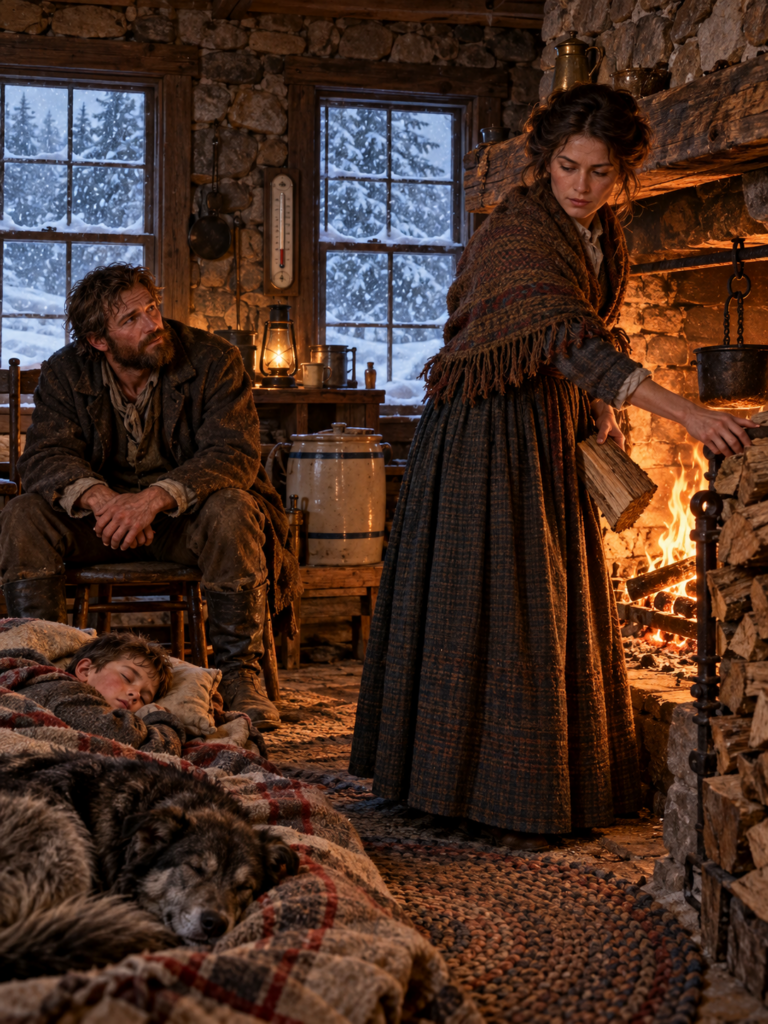
Bennett let the log remain where it was and crouched beside Eli’s thermometer instead.
The room felt strange without the familiar urgency of a frontier winter night.
In their old cabin, a weakening fire demanded action. Someone rose. Someone opened the stove. Someone crossed to the woodpile. Someone calculated how many pieces remained before morning.
Here, the coals dimmed.
Nothing terrible happened.
Adeline moved to the water crock and touched its side.
Still liquid.
She glanced at the lower doorway.
No frost.
Near dawn, the outside temperature reached about nine degrees.
Eli woke when Bennett lit the lamp.
“What is it?”
Bennett read the first thermometer.
Then the second.
He seemed almost reluctant to speak.
“Forty-six by the door.”
Adeline leaned toward the warmer side.
“Forty-eight here.”
Eli sat upright.
Moss did not.
The dog remained stretched several feet from the hearth.
For Adeline, that mattered almost as much as the numbers.
She found Eli’s record sheet and wrote the morning temperatures herself.
Bennett watched her.
“You believe it now?”
She set down the pencil.
“I believe this night.”
His mouth moved as though he might argue.
She stopped him with a look.
“One mild cold night does not get to decide January.”
Bennett looked toward the thick walls.
Months earlier, that answer might have stung his pride.
Now he nodded.
“No.”
Adeline tapped the record sheet.
“So we keep testing.”
That became their rule.
Through November and December, the stone house was no longer Bennett’s experiment alone.
Eli counted logs.
Bennett recorded outside temperatures.
Adeline checked the dawn readings, watched where frost formed, tracked the water crock, and compared how quickly the interior cooled after the flames settled.
When Bennett wanted to make a change, she asked what problem it was meant to solve.
When one night seemed unusually good, she refused to let him count it without comparing the weather.
Slowly, the numbers began telling a story.
On comparable cold nights, the stone house used roughly twenty-eight to thirty-one percent less firewood than their plank cabin had required.
Bennett did not carry those figures into Mave Hollis’s store.
Orin Pike could keep calling the place Rock’s Stone Burrow.
Judson Vale could keep reminding anyone who listened that most settlers did not possess an abandoned fort with twenty-inch walls.
Adeline cared less about winning an argument than she did about the shrinking woodpile.
Amos Ren cared about something else.
When the master carpenter studied Bennett’s records one afternoon, he tapped the coldest entry.
“Nine above.”
Bennett waited.
Amos closed the book.
“Nine above isn’t January.”
Adeline, standing near the table, saw Bennett’s jaw tighten.
She also saw him control the answer.
“No.”
That was all.
After Amos left, Bennett stood at the deep window while snow began dusting the basin.
“You think he’s right,” he said.
“I think winter doesn’t care which man wins an argument.”
He turned.
“And if the house fails?”
Adeline did not soften the answer for him.
“Then we use what it taught us and keep our family warm another way.”
The words landed heavily because Bennett knew she meant them.
She loved him.
She had worked beside him.
She believed the fort had earned more trust than it had possessed in October.
But none of that made the house sacred.
Their family came first.
Bennett crossed the room and took her hand.
“I needed you to say that.”
“No. You needed to know I would.”
Outside, the wind shifted northwest.
Moss lifted his head.
Adeline felt the pressure change before she heard the first hard grains of snow strike the deep-set window.
By nightfall, Cinder Mesa had disappeared beneath blowing white.
The thermometer dropped through zero.
Then lower.
And as Bennett went to add another log, Adeline looked at the woodpile, looked at the thick stone wall behind the hearth, and said the same word that had saved them from trusting the house too soon.
“Wait.”
Bennett stopped with his hand inches above the wood.
Outside, wind struck the western wall with a low, continuous pressure.
Inside, the hearth held only a modest flame.
“What are you waiting for?” he asked.
Adeline pointed toward the thermometer.
“Not us. The house.”
The temperature outside had fallen below ten degrees under zero.
Then fifteen.
The cold was deeper than anything they had tested since moving into the fort.
Bennett straightened.
His instincts told him to feed the fire harder.
Every winter he had lived through had trained him to do exactly that.
Cold increased.
Fuel increased.
That was survival.
Yet the entire purpose of the stone house was to break that immediate relationship.
The masonry had been warming since afternoon.
If he kept driving the hearth hotter whenever fear rose, they would never learn whether the walls could carry them through the long decline after the flame weakened.
Adeline had understood that before he did.
“Half an hour,” Bennett said.
She nodded.
“If the room starts falling too quickly, we feed it.”
Eli sat at the table, pencil ready.
The boy had transformed their winter nights into columns.
Outside temperature.
Inside temperature.
Logs burned.
Time.
What had begun as his father’s unusual house had become a question he could measure.
At the half hour, the room had cooled only slightly.
Bennett waited again.
The wind grew stronger.
Snow drove against the fort, collecting beneath the roof edge and along the windward wall.
Adeline checked the door.
No low draft.
That mattered.
The October failure had frightened Bennett because it proved thick stone could not compensate for a careless opening.
The correction had been small compared with the walls.
Wool packing.
A reset threshold.
A better overlap on the inner door.
But without those small details, the large idea would have failed.
Another hour passed.
Bennett added one log.
Not three.
One.
Adeline watched the flame catch.
Neither said anything.
There was intimacy in the restraint now.
All summer, Bennett’s love for his family had looked like labor.
Lifting stone.
Mixing mortar.
Cutting drainage.
Setting rafters.
Building a hearth.
But during their first winter in the plank cabin, his love had often looked like exhaustion.
He rose before anyone else because the stove needed him.
He stayed awake because he feared the room cooling around Adeline and Eli.
He carried the burden as though protection meant answering every problem personally and immediately.
The fort was teaching him something Adeline had tried to tell him in other ways.
A home should not survive only because one exhausted person refuses to sleep.
Near midnight, the storm intensified.
The temperature outside reached twenty-one below.
Eli stared at the number.
“I’ve never seen that.”
“You have,” Adeline said. “You were just asleep.”
Bennett almost smiled.
The boy did not.
“What if it goes lower?”
Bennett looked at his son, then at Adeline.
Earlier in the year he might have answered with certainty he did not possess.
Instead he said, “Then we watch what happens.”
Eli considered that.
“And if it gets bad?”
“We act.”
It was a better promise than everything will be fine.
The night deepened.
The windlock took the pressure of each entrance and exit, though no one intended to go outside unless absolutely necessary.
The hearth drew steadily.
The flue Bennett had rebuilt instead of trusting the fort’s cracked old chimney did not hesitate when gusts struck the roof.
That, too, had once seemed like an unnecessary delay to people watching the project from the road.
Now every delay had become part of the answer.
Around one in the morning, Bennett inspected the western side.
No moisture darkened the base.
The drainage channel he had cut after the August rain had guided runoff away long before the ground froze.
He remembered that rain clearly.
The fresh mortar near the southwest corner had softened.
Nothing had collapsed.
But the water had exposed a mistake.
Amos had arrived, seen the wet mark, and said only, “Water found you early.”
Bennett had answered, “Better now than January.”
Tonight, in the coldest storm of the year, he understood how much mercy there had been in that August rain.
Adeline joined him.
“You’re checking the drainage in a blizzard?”
“The wall.”
“It’s still there.”
He glanced at her.
“I know.”
“Then come sit down.”
He obeyed.
That made her smile.
Months before, he would have continued checking until she physically pulled him away.
Now he sat beside her at the table.
For several minutes they listened to the wind.
Eli had fallen asleep under a blanket on the bench.
Moss lay near the center of the room.
Adeline’s sewing rested untouched in her lap.
“You really would have gone back to the cabin,” Bennett said quietly.
“If this place hadn’t earned us?”
“Yes.”
“Even after everything I put into it.”
“Especially then.”
He looked at her.
She met his eyes without apology.
“If all that work made you unable to admit the house wasn’t safe, then the work would own you.”
His gaze dropped to their joined hands.
“And if it works?”
“Then we live here.”
“That simple?”
“No.”
A gust struck hard enough to make Eli stir.
Adeline waited until he settled again.
Then she said, “If it works, you admit you didn’t build it alone.”
Bennett looked up.
There was no anger in her face.
That made the words sharper.
He thought of how people in town spoke.
Bennett’s fort.
Bennett’s experiment.
Bennett’s walls.
Even Amos addressed most questions to him.
Yet Adeline had carried water.
Cleared construction debris.
Tested drafts.
Packed the sill.
Recorded temperatures.
Protected their option to leave.
She had been the one person willing to make Bennett’s idea prove itself before pride put their child inside it.
“You’re right,” he said.
She waited.
No defense came after it.
Bennett squeezed her hand.
“I kept thinking the risk was mine because the idea was mine.”
“The risk was ours.”
“I know that now.”
“Good.”
Outside, the temperature reached thirty-one below.
They both turned toward the thermometer as though it had spoken.
The indoor reading remained in the upper forties.
Bennett stood.
Adeline’s expression changed.
“What?”
“Nothing. I want to see the hearth.”
“That is not nothing.”
He smiled then, tired and genuine.
“I want to see the hearth. I am not feeding it unless the room tells us to.”
“Better.”
At the masonry, he laid his palm against the broad surface behind the fire.
Warm.
Not hot.
Warm.
Farther from the hearth, the stone was cooler but not icy.
The energy had spread into the mass exactly as he had hoped during those July evenings when the old fort walls held the day after sunlight disappeared.
Yet now he understood the difference.
The twenty-inch walls were only one part of the system.
Dry foundation.
Sound mortar.
Protected roof.
Tight sill.
Offset entrance.
Steady flue.
Slow fire.
Time.
And people willing to notice when he was wrong.
At thirty-four below, Bennett burned another log.
At thirty-six, he did not.
The room continued its slow decline.
Adeline poured water from the crock.
Clear.
No ice.
The sight affected Bennett more deeply than the thermometer.
He remembered the old cabin.
The ring of ice around the crock in the morning.
Adeline asleep upright beside the failing stove.
His own hands reaching for wood in darkness.
Thirty-seven below.
Eli woke again.
“Is this January enough for Mr. Ren?”
Bennett laughed under his breath.
Adeline said, “Let the weather finish before you tease Amos.”
Then the outside thermometer reached thirty-eight degrees below zero.
No one spoke.
The number had crossed from cold into something almost abstract.
Beyond the stone, the basin was dangerous.
Every opened door mattered.
Every exposed hand mattered.
Every armload of fuel taken from an outdoor stack cost heat and strength.
Inside the fort, the temperature near the doorway remained in the upper forties.
Closer to the warmed masonry, it hovered near fifty.
Not summer.
Not comfort without effort.
But stable.
The water crock remained liquid.
Moss slept far from the hearth.
And the interior woodpile was still larger than Adeline had expected it to be.
She stood.
Bennett watched her cross to the stack.
She picked up one split log.
For months, every test had ended with another decision about whether to burn.
This one felt different.
The storm was at its coldest.
The fire had weakened.
The room had every excuse to demand more.
Adeline held the log between both hands.
She looked toward Eli.
He wore no coat.
She looked at Moss.
Still sleeping away from the hearth.
She looked at the water crock.
Then the thermometer.
Finally she looked at Bennett.
He did not tell her what to do.
That mattered too.
Adeline turned and placed the split log back on the stack.
The sound of wood touching wood was small.
Bennett felt it like a verdict.
The house had earned them.
For the first time in years, the flame could weaken without commanding the entire family to rise.
Adeline crossed back to Bennett.
He reached for her, then stopped before touching her.
She closed the remaining distance herself.
His forehead rested against hers.
“I thought I was building walls,” he said.
“You were.”
“No. Not only.”
She understood.
He had wanted to build a house that protected them from winter.
Instead, they had built a house that asked less of all three of them.
That distinction mattered.
A home was not safer because one man worked himself empty defending it.
It was safer because the burden had been designed differently.
A violent gust struck the entrance.
Moss woke.
Then came another sound.
Not wind.
A heavy knock against the outer door.
Bennett lifted his head.
Adeline was already moving.
“Someone’s outside.”
At thirty-eight below zero, anyone standing beyond that door had very little time.
Bennett crossed the room.
Adeline followed with a blanket.
He opened the inner door first.
Cold waited beyond it, trapped by the little windlock.
Then he opened the outer door.
Amos Ren nearly fell inside.
Adeline caught Amos by the sleeve while Bennett pulled the outer door shut behind him.
A second man followed, shoulders crusted with snow.
The wind vanished the instant the door closed.
Not the cold completely.
But the violence of it.
“Wagon runner,” Amos said, breathing hard. “Split in a drift.”
Bennett opened the inner door.
“Get inside.”
They entered the main room.
Amos stopped.
That hesitation lasted only a second, but Adeline saw it.
He had expected relief.
What surprised him was the kind of relief.
No roaring fire.
No blistering stove heat.
No chairs crowded close to the hearth.
No wind sliding across the floor.
Moss had risen to inspect the visitors but remained several feet from the coals.
Eli pulled another blanket from the bench.
Adeline wrapped it around the neighbor’s shoulders while Bennett checked both men for frostbite.
Only then did Amos begin looking around.
His gaze moved first to the hearth.
Then the water crock.
Then the deep windows.
Then the interior stack of wood.
Finally, the thermometers.
“What’s the outside reading?”
“Thirty-eight below,” Eli answered before anyone else could.
Amos looked at Bennett.
Bennett handed him the record sheet.
No speech.
No triumph.
That was important.
Months ago, Bennett might have wanted this moment too much.
He might have explained every wall.
Every repair.
Every decision.
But winter had already done the explaining.
Amos studied the sheet.
He checked the time.
Counted the marks beside the logs burned.
Read the indoor temperatures twice.
Then he glanced toward the pile.
“How much since sundown?”
Eli told him.
Amos looked at the pile again.
The wood Bennett had not burned interested him more than the thermometer.
Adeline noticed.
So did Bennett.
Amos walked toward the doorway and crouched near the threshold where he had once found frost.
He put his fingertips against the lower joint.
“No leak.”
“Not anymore,” Bennett said.
Amos looked toward Adeline.
“You found that?”
She nodded.
“With smoke.”
A faint smile touched the carpenter’s mouth.
“Better instrument than pride.”
Bennett laughed.
“So I learned.”
That answer changed the room.
Adeline had seen men defend mistakes because admitting them felt like surrendering authority.
Bennett had done some of that too, especially when the fort was still an idea everyone mocked.
But somewhere between the August rain and the October frost, his relationship to being wrong had changed.
At first, each flaw threatened the whole dream.
Now a flaw was information.
Something to fix.
Something to learn from.
Something another person might notice first.
Amos stood and pressed one palm against the masonry behind the hearth.
His face grew thoughtful.
“Warm.”
“Since afternoon,” Bennett said.
“You kept the fire steady?”
“Yes.”
“Not hard?”
“No.”
Amos moved farther along the wall.
The stone cooled gradually beneath his hand.
Now his eyes changed.
Adeline recognized the moment when skepticism became understanding.
Not agreement with everything Bennett had ever believed.
Something better.
A clearer question.
“The wall isn’t fighting the cold by itself,” Amos said.
“No.”
“The hearth loads heat into it.”
“Yes.”
“And the windlock stops the doorway from dumping the room every time it opens.”
“Yes.”
Amos looked toward the deep-set windows, then back at the threshold.
“And if your base were wet?”
“I think we’d be having a very different night.”
Amos nodded.
The August rain.
The drainage swale.
The gravel apron.
The lowered outlet.
The months of drying before winter.
Suddenly every boring correction was present in the room.
The fort had not succeeded because thick stone possessed some miraculous power.
It had succeeded because one idea had survived enough criticism to become a system.
Adeline felt something inside her settle.
This was the truth she had been waiting for.
Not that Bennett had been right.
That would have been too simple.
Bennett had been partly right.
Amos had been partly right.
She had been right to insist on proof.
The failed test had been necessary.
The rain had been useful.
The cold had exposed what summer could not.
Nothing important had come from certainty alone.
Amos turned to Bennett.
“The weather measured your wall better than I did.”
Eli looked delighted.
Bennett only shook his head.
“No.”
Amos raised a brow.
“The weather measured the whole house.”
He pointed toward the sill.
“That leaked.”
Then toward the wall.
“That was too wet.”
Then the hearth.
“I fired that wrong the first night.”
His gaze shifted to Adeline.
“She found half of what I was too busy defending to see.”
Adeline had not expected him to say it in front of Amos.
The admission warmed her more than praise would have.
Amos followed Bennett’s gaze.
“So this is not Rock’s Stone Burrow.”
“Don’t tell Orin,” Adeline said. “He’ll be heartbroken.”
The men laughed.
Outside, the storm remained murderous.
Inside, the house stopped feeling like an argument.
For the next several hours, the broken wagon stayed where the drift had trapped it.
No one was foolish enough to repair it in that wind.
Adeline heated food.
Bennett found dry gloves.
Eli surrendered his bench.
The two visitors rested while the storm weakened by degrees.
More than once Amos studied the room.
Not the walls alone.
The routines.
How the outer door closed before the inner opened.
How Bennett added fuel before the fire disappeared entirely but did not build it into a roaring furnace.
How the masonry radiated a quieter warmth.
How Moss chose the center of the floor.
Near daylight, Amos asked to see the western drainage once the storm passed.
“Not today,” Adeline said.
Amos gave her a look.
She crossed her arms.
“At thirty-eight below, no man is crawling around my foundation to satisfy his curiosity.”
Bennett said, “She’s right.”
Amos sighed.
“Everyone in this house is becoming difficult.”
“That may be why we’re warm,” Adeline said.
By late morning, the temperature began to rise.
Only slightly.
But enough.
The wind eased first.
Then visibility improved across the basin.
Bennett and Amos repaired the broken runner after the danger passed.
Adeline watched from the doorway until both men were safely moving again.
Before Amos left, he rested a gloved hand against the fort’s outer wall.
The masonry was bitterly cold.
It should have been.
No summer heat remained in it now.
Yet the cold surface did not tell the whole story any more than the warm July wall had.
Inside, another part of the masonry still held what the hearth had given it.
The same stone could be cold on one side and useful on the other.
Adeline thought that might be true of people too.
A few days later, the storm released Cinder Mesa.
People emerged carrying winter’s evidence with them.
Frozen hinges.
Damaged flues.
Wood stacks burned down faster than expected.
Frost where nobody wanted it.
At Mave Hollis’s store, Orin Pike eventually tried the old joke again.
“Stone Burrow survive?”
A few people smiled.
Almost nobody laughed.
Amos entered while the question still hung there.
Judson Vale looked up.
“You were out there.”
Amos removed his gloves.
“I was.”
Someone asked whether stone had beaten timber.
Amos’s expression sharpened.
“That isn’t what happened.”
The store quieted.
Adeline was not there.
Neither was Bennett.
Perhaps that was why Amos’s explanation mattered so much.
No one could mistake it for politeness.
“Stone alone didn’t save anything,” he said. “Rock kept water away from the base. Let the repaired walls dry. Fixed his low drafts. Carried the roof properly. Built the flue clean. Put enough masonry behind the hearth to take heat instead of making the fire warm air and lose it.”
Judson leaned against his counter.
“So you’re recommending forts now?”
“No.”
A laugh moved through the room.
Amos continued.
“I’m recommending people pay attention to where their heat goes.”
That was how the argument ended.
Not with Bennett declared a genius.
Not with timber declared obsolete.
Not with every family in Cinder Mesa rebuilding their homes from stone.
Most settlers did not own the ruins of an old supply fort.
They did not have twenty-inch walls waiting to be repaired.
They did not have Bennett’s exact slope, roof, hearth, or summer.
But they could understand the reasoning.
That spring, one rancher banked earth against an exposed northern wall while carefully keeping runoff away from the base.
Another household built heavier masonry behind a stove so some heat would remain after the flame weakened.
A builder shortened an exposed entry and added an offset enclosure to keep wind from opening directly into the living space.
Amos still built with timber.
Judson still sold lumber.
But the conversations changed.
People asked where drafts entered.
How moisture left.
What material could hold heat.
Whether a doorway faced the worst wind.
Mave began selling more lime, packing fiber, and masonry hardware.
The idea spread not as a blueprint but as questions.
Bennett liked that.
He had never intended to prove every house should look like theirs.
He had wanted his own family to sleep without serving a stove all night.
By the following winter, something else had changed.
Bennett no longer kept the records alone.
He and Adeline reviewed them together.
If he planned a repair, he told her what he believed it would change.
If she disagreed, they tested before deciding.
The habit moved beyond the house.
He stopped treating responsibility as something that gave him the right to make every decision first.
Adeline stopped waiting until his plans were finished before challenging them.
Their marriage had always contained affection.
Now it contained more room.
Not distance.
Room.
Room for her judgment.
Room for his uncertainty.
Room for either of them to say, I think you missed something.
Once, late that winter, Bennett found Adeline sitting beside the hearth after Eli had gone to bed.
She held the old tally sheet from their first successful test.
Nine degrees outside.
Forty-six near the entrance.
Forty-eight by the masonry.
“What are you doing with that?” he asked.
“Remembering.”
He sat beside her.
“The night you stopped me from burning our entire woodpile?”
“The night you finally learned to listen to your wife.”
“That was a very expensive lesson.”
She smiled.
“You got a house with it.”
He leaned back against the bench.
For a while they listened to the small sounds of the room.
The settling roof.
A faint crackle in the coals.
Moss breathing near the center of the floor.
Bennett looked toward the water crock.
“No ice.”
“No.”
“I hated that crock in the old cabin.”
“I know.”
“Every morning I saw ice on it, I thought I’d failed you.”
Adeline turned toward him.
“You thought being a good husband meant never letting the fire fall.”
“What else was I supposed to think?”
“That perhaps your wife did not marry a stove tender.”
He laughed softly.
Then she became serious.
“I never needed you to defeat winter.”
Bennett looked down at his hands.
“What did you need?”
“To know I wasn’t alone in it.”
That silenced him.
Because she had not been accusing him of laziness.
Quite the opposite.
He had worked so hard at carrying everything that he sometimes left no space for anyone to carry it with him.
Bennett reached for her hand.
This time there was no crisis.
No draft.
No failed test.
No thermometer demanding attention.
“I’m sorry,” he said.
Adeline studied his face.
“For what?”
“For believing protection and partnership were the same thing.”
Her fingers closed around his.
“They can be.”
“If both people get a say.”
“Yes.”
He nodded.
That was enough.
She rested her shoulder against him.
They watched the coals dim.
Neither rose immediately.
The room cooled.
Slowly.
Exactly as it should.
Two winters passed.
The old joke disappeared before the house did.
People stopped calling it the Stone Burrow except when telling the story of how wrong they had once expected Bennett to be.
Even then, the story changed depending on who told it.
Some remembered the walls.
Some remembered the thirty-eight-below night.
Some remembered Amos’s verdict.
Eli remembered the numbers.
Adeline remembered the log she did not burn.
Bennett remembered something earlier.
A summer evening when Moss had stretched beside sun-warmed stone long after the ridge swallowed the light.
That was when the idea began.
But it was not when the house became a home.
The house became a home when the idea survived being wrong.
When rain found the foundation.
When frost found the sill.
When Adeline found the draft.
When Bennett stopped hearing correction as opposition.
When both of them agreed that no amount of work, pride, or ridicule would force their family to trust walls that had not earned it.
One late winter afternoon, Bennett worked fresh mortar into a hairline crack.
Nothing dramatic.
Just maintenance.
Nearby, Eli checked the western drainage channel without being asked.
Moss slept in a patch of sunlight against the southern masonry.
Adeline approached carrying a small bundle from town.
She entered the windlock.
Closed the outer door behind her.
Only then did she open the inner one.
The motion had become automatic.
Years before, people had laughed at that little offset entrance.
Now Adeline barely thought about it.
Bennett came inside a few minutes later and brushed mortar dust from his hands.
“How’s the channel?” he asked Eli.
“Clear.”
“Wall?”
“Dry.”
Adeline set her bundle on the table.
Bennett glanced toward the wood stack.
There was still more left than they would have expected in the old cabin.
He smiled.
“What?”
Adeline asked.
He looked toward the hearth.
“Nothing.”
“That face is not nothing.”
He crossed to her.
“I was thinking about thirty-eight below.”
She followed his gaze to the stack.
Then she understood.
The log.
That single split piece of wood she had lifted during the worst cold of their first winter in the fort.
At the time, not burning it had felt almost reckless.
Now it represented the opposite.
Proof.
Not proof that winter had been defeated.
Winter remained winter.
At thirty-eight below, the basin had still been lethal beyond their door.
Stone had not become magic.
Firewood had not become unnecessary.
Bennett had not discovered some secret that made hardship disappear.
He had simply built a house that did not instantly follow every rise and fall of the flame.
And Adeline had helped turn that house from one man’s stubborn experiment into a family’s shared judgment.
She stepped closer to Bennett.
“Do you know what I remember?”
“What?”
“You almost put it on the fire.”
He looked offended.
“I showed remarkable restraint.”
“You showed my hand on your wrist.”
He laughed.
“That too.”
She took his hand now.
Warm.
Rough from mortar.
Familiar.
“Would you build it again?” she asked.
Bennett considered the question.
Not because he doubted the answer.
Because he no longer answered important questions before thinking.
“Yes.”
Adeline raised one brow.
He continued.
“But not the same way.”
“What would you change?”
“I’d fix the drainage before the first rain.”
“Good.”
“I’d give the mortar longer to dry.”
“Better.”
“I’d seal the threshold properly the first time.”
“Excellent.”
“And I’d ask you to test everything before October.”
Her expression softened.
“That took you long enough.”
He lifted her hand and kissed her knuckles.
Outside, winter pressed against twenty inches of old frontier stone.
Inside, the hearth burned low.
Eli worked at the table.
Moss slept far from the fire.
The water crock stood clear and unfrozen.
No one watched it anxiously anymore.
Adeline looked once toward the woodpile.
Several split logs remained exactly where she had left them.
She thought of the old plank cabin and the nights measured by how many times Bennett had to rise.
Then she looked at the man beside her.
Their life had not become easier because he had learned how to control everything.
It had become steadier because he had stopped trying.
The house held heat slowly.
Trust had formed much the same way.
Not in one dramatic moment.
Not because Bennett had been right from the beginning.
Not because Adeline had surrendered her doubts.
It had accumulated through correction, admission, work, patience, and the freedom to say no.
Stone did not hurry to give back what it took.
Neither, Adeline thought, did a good marriage.
The hearth settled into coals.
Bennett glanced toward the stack out of old habit.
Then toward her.
He waited.
Adeline smiled and shook her head.
“Leave it.”
So he did.


