
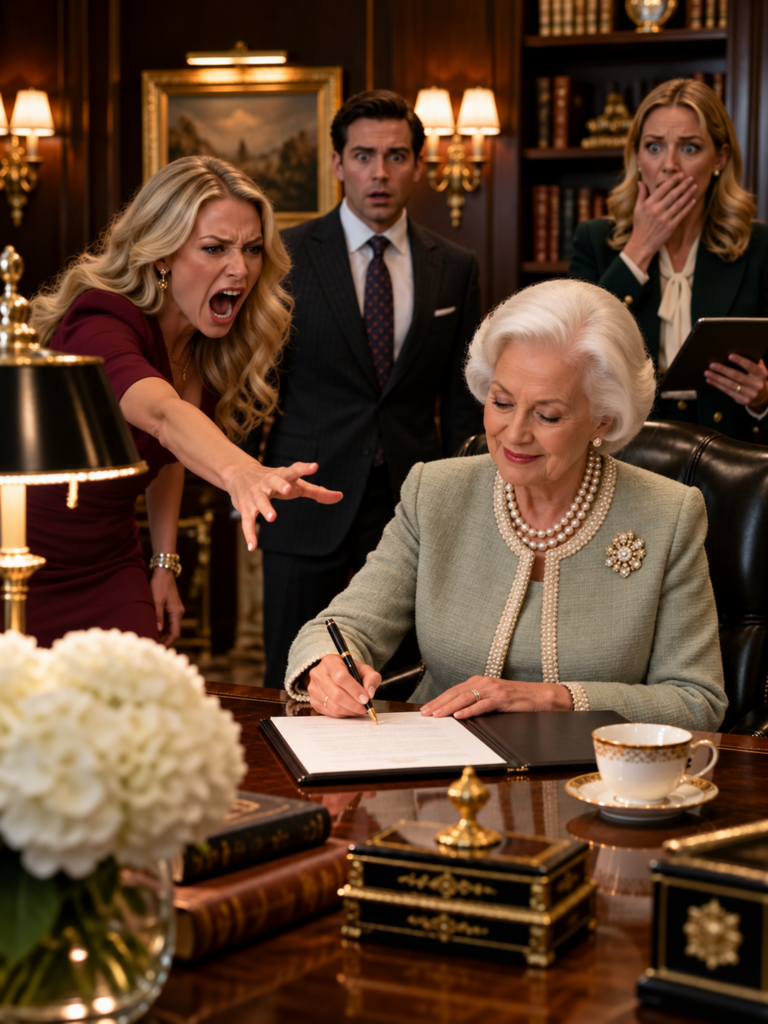
Part 1
I was seventy-seven years old, and until that evening, I had believed humiliation became easier with age.
It does not.
You simply become better at hiding what it does to you.
I had been dressed for nearly an hour already. The navy dress hung a little looser on me than it had when I bought it the previous Christmas, and I had spent twenty minutes deciding whether the pearl earrings were too formal for a family dinner.
The invitation had come from Benjamin himself.
“Seven o’clock, Mom. Genevieve’s parents will be there. A few people from the club too. Wear something nice.”
I smiled when he said it.
“Do I usually embarrass you?”
He had laughed, but too quickly.
“You know what I mean.”
I did know.
Genevieve liked a room to look a certain way.
Her house had cream-colored furniture nobody seemed permitted to sit on comfortably, fresh orchids replaced before they wilted, and art she could explain by price rather than beauty. Even the family photographs in the hallway looked selected by a committee.
I had never fit the arrangement.
My husband Thomas used to say I entered elegant rooms like somebody opening a kitchen window.
“Fresh air,” he would tell me. “Some people appreciate it. Some start complaining about the draft.”
Thomas had been gone six years.
That night, I would have given almost anything to hear him say it again.
Instead, my phone buzzed.
Benjamin.
I expected something ordinary.
Bring the pie.
Come fifteen minutes later.
Genevieve’s father was running behind.
Instead, I read:
Mom, plans changed. Genevieve thinks it would be better if you stayed home tonight. Please don’t make this difficult.
For several seconds, I stood without moving.
The ridiculous thing was that a casserole was cooling on my kitchen counter.
Benjamin had specifically asked for my chicken-and-wild-rice casserole because Clara liked it.
Clara was nine, and my only granddaughter.
I looked at myself in the mirror.
Pearls.
Lipstick.
A small silver bracelet Thomas had bought me in Savannah.
I looked like a woman waiting for someone to pick her up for an anniversary dinner.
Not a woman who had just been dismissed by her own son.
I called Benjamin.
He did not answer.
I called again.
He answered on the fourth ring.
“Mom.”
His voice was low.
There were people talking behind him.
“Why am I not coming?”
A pause.
Then, “Please. Not tonight.”
“What happened between this afternoon and now?”
“Nothing happened.”
“Then why am I suddenly not welcome?”
Another pause.
I heard Genevieve’s voice somewhere nearby.
I could not distinguish the words, only the tone.
Sharp.
Impatient.
Benjamin moved away from whoever was near him.
“Genevieve’s stressed.”
“About me?”
“She has a lot riding on tonight.”
“So do I, apparently.”
“Mom.”
The warning in his voice surprised me.
Not anger exactly.
Embarrassment.
The kind a parent usually hears from a fourteen-year-old in a shopping mall.
I lowered myself onto the edge of my bed.
“Did I do something?”
“No.”
“Did I say something?”
“No.”
“Then explain it.”
Benjamin sighed.
“Her father has people coming who may be involved in a business opportunity. Genevieve doesn’t want any awkward conversations.”
I stared toward Thomas’s empty side of the room.
“What awkward conversations do I cause?”
“Please don’t make me spell this out.”
That hurt more than the message.
“Spell it out.”
He was silent.
Then Genevieve’s voice became clearer in the background.
“Benjamin, they’re here.”
He covered the phone, though not well enough.
“I’m dealing with it.”
Dealing with it.
That was me.
His seventy-seven-year-old mother, dressed in pearls with a casserole on the kitchen counter.
Something to be dealt with.
He came back on the line.
“Mom, I’ll call you tomorrow.”
“No.”
He hesitated.
“No?”
“You’ll answer me now.”
His voice hardened.
“Genevieve thinks you sometimes make comments about money that make people uncomfortable.”
For a moment, I genuinely could not understand what he meant.
Then I did.
Three weeks earlier, Genevieve had complained at lunch that the contractor remodeling their wine room had raised his estimate again.
I had said, lightly, “Perhaps the wine can sleep in the old room another year.”
Clara had giggled.
Genevieve had not.
That was apparently an awkward conversation.
I asked, “Does Genevieve find it awkward when I pay those contractors?”
Benjamin said nothing.
That silence answered me.
I closed my eyes.
Only twelve days earlier I had transferred $18,000 to cover what Benjamin called a temporary cash-flow problem.
Before that, I had paid the quarterly premium on Genevieve’s luxury SUV because their automatic withdrawal had bounced.
I covered Clara’s private school tuition.
Their property taxes.
Their landscaper.
A portion of their mortgage.
The club initiation fee.
Then the monthly dues.
Two vacations Benjamin insisted were important for networking.
Emergency repairs on a rental property they owned.
The salary of a part-time assistant for Genevieve during what she called a difficult season.
That year alone, I had transferred $93,600.
I knew the number because Rebecca, my banker, had mentioned it gently during our last review.
“At some point,” she had said, “you may want to decide whether these are gifts or obligations.”
I had laughed.
“They’re family.”
Rebecca had not laughed.
She had known something I was refusing to know.
Now, sitting alone in my bedroom, I finally understood her question.
“Benjamin,” I said, “have I ever asked to be introduced to your business associates?”
“No.”
“Have I ever embarrassed you in front of your friends?”
“That isn’t what I said.”
“Have I?”
“No.”
“Have I ever demanded recognition for helping you?”
His voice changed then.
Softer.
“Mom, nobody’s saying you haven’t helped.”
Nobody’s saying you haven’t helped.
As if my fifteen years of assistance were an old favor everybody had respectfully acknowledged before moving on.
I swallowed.
“Is Clara expecting me?”
Another silence.
That was the one that broke something.
He finally said, “Genevieve told her you weren’t feeling well.”
I stood.
“You lied to her?”
“It was easier.”
“For whom?”
“Mom.”
“For whom was that easier?”
Genevieve spoke again in the background.
This time I heard her clearly.
“Hang up.”
Benjamin lowered his voice.
“I have to go.”
I looked down at the casserole dish through the bedroom doorway.
Steam had fogged the glass lid.
“All right,” I said.
He sounded relieved.
“Thank you.”
“No, Benjamin. Don’t thank me yet.”
He went quiet.
I ended the call.
Then I removed the pearl earrings Thomas had given me.
I did not cry immediately.
First, I changed into my robe.
I wrapped the casserole and put it in the refrigerator.
I washed the lipstick from my mouth.
I made tea I never drank.
Only then did I sit at the kitchen table and look around the room where Thomas and I had spent forty-eight years making ordinary decisions together.
The kitchen still carried him in small ways.
A groove on the wooden table where he used to tap his wedding ring.
A cabinet hinge he repaired twice and refused to replace because, according to him, surrendering to a hinge set a dangerous precedent.
A pencil mark inside the pantry showing Benjamin’s height at thirteen.
I touched that mark.
Benjamin had not always been this man.
That was important for me to remember.
He had been a shy little boy who hated thunderstorms.
A teenager who worked Saturdays at Thomas’s hardware store.
A young father who cried the first time I placed Clara in his arms.
Entitlement had not arrived all at once.
It had grown gradually, nourished by my excuses.
The first time he needed help, it had made sense.
He and Genevieve were newly married.
A house purchase had stretched them.
Then Clara was born.
Then Benjamin left a stable job to start a consulting company.
Then there was a failed investment.
Then a second mortgage.
Then a school they could not quite afford.
Every crisis had sounded temporary.
Every check had carried the same private promise.
This will help them get steady.
They never got steady.
They simply got more expensive.
Around eleven, I opened the drawer where I kept household statements.
I took out a yellow legal pad.
Mortgage contribution.
School tuition.
Insurance.
Vehicle lease.
Club.
Utilities on their lake house.
Landscaping.
Property management.
Streaming accounts, because somewhere along the way even those had found their way onto one of my cards.
I laughed when I reached that line.
Not because it was funny.
Because I suddenly understood the absurdity.
My son had just excluded me from a dinner in a house whose security system I was paying for.
By midnight I had filled three pages.
The next morning, I was waiting outside First Heritage Bank ten minutes before the doors opened.
Rebecca saw me through the glass.
She came out herself.
“Eleanor?”
I must have looked unusual because she did not ask whether I had an appointment.
“I want everything stopped.”
She studied me.
“What happened?”
“Nothing that didn’t happen gradually.”
We went into her office.
Rebecca was fifty-two, practical and calm, with silver beginning at her temples and a habit of removing her glasses when she needed somebody to listen carefully.
She removed them.
“What does everything mean?”
“Every automatic payment. Every standing authorization. Every transfer. Every credit line where Benjamin or Genevieve benefits from my accounts.”
Rebecca did not move for several seconds.
“Are you sure?”
“Yes.”
“Some of these arrangements have been in place for years.”
“I know.”
“Several payments are due this week.”
“I know.”
“You may want an attorney involved.”
“I probably should have wanted one years ago.”
She gave me a long look.
Then she turned to her computer.
What followed took nearly two hours.
I had expected perhaps twenty accounts.
There were far more.
Some were small recurring charges.
Others were formal authorizations established when Benjamin’s company struggled eight years earlier.
Rebecca called in two employees from the private banking department.
Documents appeared.
So did records I had forgotten signing.
By the time they finished compiling everything, there were 174 active or recurring payments, authorizations, linked transfers, guarantees, automatic drafts, and financial arrangements connected directly or indirectly to Benjamin’s household or business interests.
I stared at the number.
“One hundred seventy-four?”
Rebecca nodded.
“Some are sub-authorizations under larger accounts.”
I sat back.
“How much have I given them?”
Rebecca hesitated.
“I asked for a historical estimate while we were reviewing this.”
She turned her monitor slightly.
Numbers filled the screen.
Transfers.
Checks.
Direct payments.
Debt assistance.
Business infusions.
Tuition.
Taxes.
She said, “Excluding gifts that cannot be clearly categorized, approximately seven hundred and forty thousand dollars over fifteen years.”
My hands became cold.
Three quarters of a million dollars.
Thomas and I had not been born wealthy.
We had worked.
He built a regional building-supply company from one store.
I taught elementary school for thirty-two years.
We saved.
We invested.
We bought our house before the neighborhood became fashionable and never left it.
Thomas used to say wealth should make your life steadier, not louder.
Benjamin had somehow learned the opposite lesson.
“Stop it,” I said.
Rebecca nodded.
“All of it?”
“All of it.”
I signed until my wrist ached.
At 10:47 that morning, Rebecca placed the last document in a folder.
“It’s done.”
I expected guilt.
Instead I felt something almost unfamiliar.
Quiet.
Not happiness.
Not triumph.
Just the silence that comes after a machine has been turned off.
The first call came twenty-seven minutes later.
Benjamin.
I let it ring.
Then again.
Then Genevieve.
Then Benjamin.
At noon, my doorbell rang.
I looked through the side window.
Benjamin stood on the porch.
Genevieve was beside him in a camel-colored coat, her jaw rigid.
And Clara stood slightly behind them holding her father’s hand.
I opened the door because of Clara.
She rushed to me.
“Grandma!”
I bent and hugged her.
She whispered, “You weren’t sick.”
“No, sweetheart.”
She looked back at her parents.
“I told them.”
Genevieve stepped inside without being invited.
“What did you do?”
Benjamin said, “Genevieve.”
“No.” She pointed toward me. “Do you have any idea what happened this morning?”
“Yes.”
“Our mortgage payment failed.”
“I know.”
“The school payment failed.”
“I know.”
“Our insurance draft was rejected.”
“I know.”
Her face reddened.
“You did this deliberately?”
I closed the door.
“Yes.”
Benjamin rubbed both hands over his face.
“Mom, can we sit down?”
Clara went toward the kitchen.
I stopped her gently.
“Honey, there are muffins in the sunroom. Take one and read for a little while.”
She looked at the three of us.
Children know when adults are pretending.
Still, she went.
Genevieve stayed standing.
Benjamin sat.
I placed Rebecca’s summary on the coffee table.
“What’s that?” he asked.
“Your life.”
He frowned.
“Excuse me?”
“Or at least the portion of it I’ve been financing.”
Genevieve picked up the paper.
Her eyes moved down the totals.
For one second, I saw something on her face that was not anger.
Fear.
Then it vanished.
She dropped the pages.
“You created this.”
I almost smiled.
“I created what?”
“This dependency.”
Benjamin looked at her.
“Genevieve.”
“No. She did. Every time we had a problem, she offered money. Every time you tried to stand on your own, she inserted herself.”
I stared at her.
It was so audacious I needed a moment to absorb it.
“I inserted myself?”
“You liked being necessary.”
I looked at Benjamin.
He did not defend me.
That hurt, but not as much as it would have the night before.
Something inside me had shifted.
“What did you need from me last night?” I asked.
Benjamin looked up sharply.
“What?”
“The dinner. Why was I invited before Genevieve decided I was socially inconvenient?”
Genevieve folded her arms.
“This has nothing to do with that.”
“It has everything to do with that.”
Benjamin stood.
“Mom, there’s an investment opportunity.”
Genevieve closed her eyes briefly.
“Benjamin.”
He ignored her.
“If I can meet the capital requirement by Friday, I become a full partner in Harcourt Development.”
Harcourt.
Genevieve’s father’s family company.
“How much?”
Benjamin did not answer.
“How much, Benjamin?”
“Two hundred fifty thousand.”
I laughed once.
His face tightened.
“You were going to ask me for a quarter of a million dollars?”
“It isn’t a handout.”
“Was I supposed to pay it before dessert or after?”
“Mom.”
“At the dinner I was eventually forbidden to attend?”
His expression collapsed.
“I didn’t know Genevieve was going to change the plans.”
Genevieve said, “My father wanted serious investors there.”
I turned toward her.
“And I’m not serious?”
“That isn’t what I meant.”
“I have three quarters of a million dollars of evidence suggesting your family has taken my money quite seriously.”
She stepped closer.
“You have always looked down on us.”
That almost took my breath away.
Before I could answer, a small voice came from the doorway.
“Mom said Grandma would fix it.”
Clara stood there with half a muffin in her hand.
Everyone froze.
She looked at Benjamin.
“You said Grandma fixes the money mistakes.”
Benjamin’s face went white.
Genevieve said sharply, “Clara, go back to the sunroom.”
“But Dad said—”
“Now.”
I walked to Clara.
“No one is angry with you.”
She looked uncertain.
“Are you mad at Daddy?”
I glanced at my son.
“Yes,” I said. “But adults can be angry and still love each other.”
Clara nodded slowly.
Then the doorbell rang again.
Rebecca was outside.
She was not alone.
A tall man in a charcoal suit stood beside her carrying a leather folder.
Rebecca’s expression told me this visit had nothing to do with comforting an old woman after a family argument.
“Eleanor,” she said, “we need to speak privately.”
Genevieve moved toward the door.
“We were just leaving.”
The man stepped slightly aside, blocking no one but somehow making it clear the conversation would continue.
Rebecca said, “Actually, Mrs. Mercer, this concerns you and your husband as well.”
Benjamin stared at her.
“What is this?”
Rebecca introduced the man.
“Daniel Stone. He handles security investigations for the bank.”
The room changed.
It was almost physical.
Like pressure dropping before a storm.
Daniel opened his folder.
“Mrs. Whitmore, while your authorizations were being terminated this morning, our review identified a trust guarantee connected to a commercial line of credit.”
I frowned.
“What trust guarantee?”
Benjamin stopped breathing.
I saw it.
So did Rebecca.
Daniel placed a photocopy on the table.
At the bottom was my name.
Eleanor Whitmore.
My signature.
Except it was not my signature.
It was close.
Very close.
Close enough that twenty years earlier, I might not have noticed immediately.
But Thomas would have.
After my minor stroke nine years ago, my handwriting changed slightly. My fingers stiffened for several months.
Thomas had turned rehabilitation into a game.
“Make your t’s stubborn,” he would say.
He taught me to cross them with a short upward hook because it forced my hand to move with intention.
I kept doing it even after my strength returned.
Every signature since had that small upward stroke.
The signature on the trust guarantee did not.
I touched the page.
“I did not sign this.”
Benjamin whispered, “Mom.”
Genevieve stepped forward.
“She did.”
Everyone looked at her.
She opened her handbag.
From inside, she removed a document sealed in a plastic sleeve.
“I knew something like this might happen.”
She laid it on the table.
“This is the original authorization. Notarized.”
Daniel did not touch it immediately.
Rebecca looked at me.
I looked at the signature.
Perfect cursive.
My name.
No upward cross.
Thomas had once joked that stubborn little mark might save me someday.
I had thought he meant from losing my handwriting.
I looked at Genevieve.
“No,” I said. “It isn’t original.”
Her confidence faltered.
I pointed to the signature.
“My husband taught me to cross every t differently after my stroke.”
Benjamin bent over the page.
I showed him.
“The person who copied my signature copied the old one.”
He stared.
For the first time that day, Genevieve said nothing.
Then Clara screamed from the front window.
“Grandma! There’s a man in your flowers!”
We ran toward her.
Outside, beyond the glass, a man in a dark jacket was kneeling beside the lavender border Thomas had planted twenty-three years earlier.
He was digging with both hands.
Daniel reached the door first.
The man looked up.
Then ran.
By the time Daniel reached the sidewalk, he had disappeared between two neighboring houses.
We stood staring at the torn earth beside the lavender.
Benjamin looked at his wife.
“Genevieve,” he whispered, “what is happening?”
She did not answer.
I looked down at the place where the stranger had been digging.
And suddenly, in a voice so clear it felt like Thomas was standing beside me, I remembered something he had told me shortly before he died.
If anything in this family ever stops making sense, Ellie, look at the things I was too stubborn to finish.
The lavender bed had been one of Thomas’s unfinished projects.
And for the first time since his death, I wondered whether unfinished was exactly what he had intended.
Part 2
Daniel insisted nobody touch the garden until he had contacted the local police.
Genevieve objected.
Not loudly.
That frightened me more.
She became calm in a way she had not been all morning.
“I don’t know anything about a man in the garden,” she said. “And if Eleanor is accusing me—”
“I haven’t accused you of anything,” I said.
Her eyes narrowed.
“Not yet.”
Benjamin sat on my sofa with both elbows on his knees.
He looked older than forty-eight.
Clara had been moved upstairs with a cartoon and strict instructions not to look out the window.
Rebecca remained beside me.
Daniel made phone calls.
The forged trust document lay between us like a dead thing nobody wanted to claim.
Finally Benjamin said, “What was the credit line for?”
Daniel answered.
“Three hundred eighty thousand dollars.”
Benjamin looked up.
“What?”
Genevieve said, “It was temporary financing.”
His head turned slowly toward her.
“You knew?”
Her expression hardened.
“We discussed expanding your partnership position.”
“We discussed two hundred fifty.”
“And this made the deal possible.”
Benjamin stood.
“With Mom’s trust?”
“With family assets.”
“They aren’t our assets.”
Genevieve laughed under her breath.
“Oh, please. Your mother has been funding us for years.”
Benjamin flinched.
I almost did too.
Because it was ugly.
And because, in a way, it was true.
Not legally.
Not morally.
But habit can become its own kind of permission if nobody has the courage to stop it.
A police officer took the initial report about the trespasser. There was little to go on besides a description from Daniel and me.
When the officer left, my attorney arrived.
Clara Bell had been my lawyer for twelve years.
The fact that she shared my granddaughter’s first name had delighted Clara when she was little.
“Two Claras means double protection,” she used to say.
Attorney Clara was sixty, with cropped gray hair and the kind of patient expression that made nervous people confess things accidentally.
She read the trust document.
Then she looked at Genevieve.
“Where did you obtain this original?”
Genevieve leaned back.
“Our attorney prepared it.”
“Name?”
She hesitated.
“Hugh Mercer.”
Benjamin stared at her.
“Your cousin?”
“He handles some family matters.”
Clara Bell wrote something down.
“Where was it notarized?”
“I don’t remember.”
“The stamp is from Marlowe County.”
“So?”
“So Eleanor has not been in Marlowe County in at least four years.”
Genevieve shrugged.
“Documents can travel.”
“Notarizations generally require people.”
Benjamin covered his mouth.
I watched him realize, piece by piece, that this was no longer about his mother refusing to rescue him.
This was about whether his wife had used my identity as collateral.
Around two that afternoon, Daniel received a call.
He stepped into the hall.
When he returned, he asked to speak with Clara Bell and me privately.
Benjamin stood.
“I want to hear it.”
Daniel looked at me.
I nodded.
Genevieve said, “This is ridiculous.”
Nobody answered her.
Daniel opened his folder.
“The credit line was drawn down in stages. Several payments were routed through companies affiliated with the Harcourt family.”
Benjamin frowned.
“My company?”
“No.”
Daniel named three limited liability companies.
Benjamin recognized none of them.
Genevieve recognized all three.
I could tell.
Daniel continued.
“One of those companies made recurring payments to an account under the name Rachel Harcourt.”
Genevieve stood so fast the chair legs scraped the floor.
“That has nothing to do with this.”
Benjamin looked at her.
“Who is Rachel?”
No one spoke.
He repeated it.
“Genevieve. Who is Rachel?”
She picked up her handbag.
“I’m leaving.”
Clara Bell said, “I wouldn’t destroy any records if I were you.”
Genevieve’s mouth tightened.
“Is that a threat?”
“No. It’s professional courtesy.”
Genevieve walked toward the door.
Benjamin followed.
“Who is Rachel?”
She turned on him.
“Not now.”
“When?”
“When you stop behaving like a frightened child every time your mother looks disappointed in you.”
The cruelty of that sentence surprised even me.
Benjamin stepped back.
Genevieve left.
The door closed.
For several seconds, he simply stood there.
Then he said, almost to himself, “Who is Rachel?”
I did not know.
But Thomas had.
I was suddenly certain of it.
I went upstairs to my bedroom and took the old brass key from the back of my jewelry drawer.
I had found it years before after Thomas died.
I never knew what it opened.
It was too heavy for a desk drawer and too old for any lock currently in the house.
Thomas had kept dozens of odd keys.
I had almost thrown it away twice.
I walked downstairs to his study.
Nothing there had changed much.
His books.
His old brass reading lamp.
A framed photograph of him and Benjamin fishing when Benjamin was eleven.
And along the far wall, a walnut cabinet Thomas had built himself.
The lower door had never opened.
I assumed the lock had broken.
Thomas had called it “one of my stubborn improvements.”
My hands trembled as I inserted the brass key.
It turned.
The door opened.
Inside were three document boxes.
Benjamin stood behind me.
“What is that?”
“I don’t know yet.”
The first box contained business records.
The second contained property documents.
The third contained envelopes labeled in Thomas’s handwriting.
One bore my name.
ELLIE — IF BENJAMIN’S LIFE EVER STOPS ADDING UP.
My knees weakened.
I sat in Thomas’s old chair.
Benjamin whispered, “Dad wrote that?”
I opened the envelope.
My dear Ellie,
If you are reading this, then either I worried for nothing or I waited too long to tell you something that may hurt our boy.
I stopped.
Benjamin turned away.
“Read it.”
I looked at him.
“Are you sure?”
“No,” he said. “Read it anyway.”
Thomas’s letter explained what he had begun noticing eight years before his death.
Benjamin’s finances did not match his income.
Genevieve repeatedly asked him about trust structures, beneficiary protections, and signatures needed for emergency loans.
Harcourt family companies shifted money between entities with no obvious business purpose.
Thomas had confronted Benjamin once.
Benjamin dismissed him.
“You always think Genevieve’s family is trying to cheat somebody.”
Thomas wrote that the accusation wounded him badly enough that he stopped pushing.
But he did not stop investigating.
Then he found Rachel.
Genevieve’s younger sister.
Benjamin sat down.
“She told me she was an only child.”
I continued reading.
Rachel had apparently broken with the Harcourt family years earlier.
Thomas did not know every detail.
What he knew was disturbing enough.
Rachel had worked in bookkeeping for one of her father’s companies.
She discovered funds being moved through shell businesses and loans secured using misleading documentation.
When she objected, the family portrayed her as unstable.
According to Thomas, she had been pressured to sign a settlement, leave the company, and stay silent.
She was raising a son alone.
Noah.
Thomas had begun sending Rachel money.
Not to buy silence.
To help her stay away.
There were copies of transfers.
Rent payments.
Legal fees.
School assistance.
At the bottom of the box was a photograph.
Rachel stood beside Thomas in the parking lot of a diner.
She was perhaps thirty.
Beside her stood a boy of five or six.
Thomas had one hand on the boy’s shoulder.
On the back he had written:
Rachel and Noah. He deserves to know decent family exists.
Benjamin sat so still I became frightened.
“Dad knew?”
“Yes.”
“And he never told me?”
I kept reading.
Thomas explained why.
He had hoped to collect enough documentation that Benjamin would be forced to confront the truth.
Then Thomas became ill.
Cancer moved faster than his plan.
He made me promise during his illness not to worry about business matters.
He told me everything was handled.
In some ways, he had protected me too well.
The final paragraph was for me.
Ellie, if Benjamin has chosen appearances over judgment, do not save him from every consequence. We spent our lives teaching him to stand. Money can become a chair a man refuses to leave. Love him enough to make him use his legs.
I put down the letter.
Benjamin began to cry.
Not dramatically.
No sound at first.
Just tears falling while he looked at his father’s handwriting.
“I thought Dad hated her family because they had more money than us.”
I almost laughed.
“Your father never envied anyone who needed six bathrooms.”
Benjamin covered his face.
“What did I do?”
I wanted to comfort him.
Every instinct I had trained for forty-eight years of motherhood told me to cross the room.
Touch his shoulder.
Say it would be all right.
But Thomas’s words were in my lap.
Do not save him from every consequence.
So I stayed where I was.
“You stopped asking questions,” I said.
Benjamin lowered his hands.
“You liked the life.”
He nodded.
“You liked the clubs. The house. The people who called you successful.”
Another nod.
“And when the numbers didn’t work, I made them work.”
His eyes met mine.
“I let you.”
“Yes.”
He looked toward the photograph of himself fishing with Thomas.
“I’m sorry.”
“I believe you feel sorry.”
His face tightened.
“That isn’t the same thing?”
“No.”
That hurt him.
It was supposed to.
“Sorry is a feeling,” I said. “Responsibility is what you do after the feeling.”
At six that evening, the doorbell rang.
I assumed it was Clara Bell returning.
Instead, when I opened the door, a woman stood on my porch with a teenage boy.
She was thinner than in Thomas’s photograph.
Older.
But unmistakable.
Rachel.
She looked at me and began crying before she spoke.
“Mrs. Whitmore?”
“Yes.”
“My name is Rachel Harcourt.”
The boy beside her held a backpack and one small suitcase.
“This is Noah.”
I opened the door.
Rachel stepped inside and saw Benjamin.
She stopped.
He stared at her.
“You’re Genevieve’s sister.”
Rachel nodded.
Benjamin looked at Noah.
“How old are you?”
“Fourteen,” the boy said.
Benjamin swallowed.
“My wife told me you didn’t exist.”
Rachel gave a sad smile.
“Your wife tells people a lot of things.”
We sat in the kitchen until after midnight.
Rachel filled in the blanks Thomas had left.
The Harcourt family business had been struggling for years beneath its polished reputation.
Debt had been hidden.
Loans moved.
Losses disguised as investments.
Rachel discovered some of it while working in accounts payable.
When she confronted her father, he told her she misunderstood corporate finance.
When she persisted, Genevieve intervened.
At first, Genevieve begged her to stay quiet.
Then threatened her.
Rachel had been going through a custody dispute with Noah’s father at the time.
The family implied they could make her look unstable.
“They had doctors who knew doctors,” Rachel said. “Lawyers who knew judges. At least that’s what they wanted me to believe.”
Thomas met Rachel by accident after following a questionable vendor address that led to the office of an attorney.
“He believed me before anyone else did,” she said.
My throat tightened.
“That sounds like Thomas.”
“He helped me find a lawyer outside the county. He paid my rent for almost a year.”
Benjamin looked at me.
I shook my head.
“I didn’t know.”
Rachel reached into her bag.
“Your husband told me if anything happened to him, I should contact you only if Genevieve started using Eleanor’s assets.”
Benjamin flinched when she used my first name.
“How did you know she had?”
Rachel looked frightened.
“Because Genevieve called me yesterday.”
“What did she say?”
“She wanted documents Thomas had given me.”
“What documents?”
Rachel unzipped her bag.
She removed a thick envelope.
Inside were photocopies of ledgers, emails, corporate filings, and two handwritten notes from Genevieve.
One line in an email made Benjamin stand abruptly.
When Eleanor eventually signs the trust expansion, the liquidity problem disappears.
The email was dated three years earlier.
I had never been asked to sign a trust expansion.
Rachel said, “Your husband believed Genevieve’s family planned to use your estate as a financial backstop. He just didn’t know whether Benjamin understood.”
We all looked at him.
He became pale.
“I didn’t.”
Rachel’s expression showed no sympathy.
“You benefited.”
He nodded.
“I know.”
Noah had been quiet most of the evening.
Then he asked me, “Did Mr. Thomas really plant the lavender?”
“Yes.”
“He told me about it.”
I stared.
“You knew my husband?”
Noah smiled shyly.
“He used to come to my baseball games sometimes.”
That nearly undid me.
Thomas had been a grandfather to a boy I never knew existed.
Not by blood.
By choice.
Or so I thought then.
I looked at Noah again.
Something about the shape of his eyes bothered me.
Familiar.
Not Thomas.
Someone else.
I dismissed it as exhaustion.
At ten the next morning, Clara Bell called.
“The forged trust document may be only the beginning.”
My stomach dropped.
She continued.
“Eleanor, Thomas left an amended property schedule attached to your estate plan. There’s a parcel listed separately from the main house.”
“What parcel?”
“The rear acreage behind your garden. About eleven acres.”
I frowned.
“That’s just woods.”
“Not anymore. Zoning changed four years ago. Developers have been assembling nearby land.”
I thought of Harcourt Development.
Clara said, “Your parcel is strategically important.”
I understood.
“They weren’t only after cash.”
“No.”
“Then what?”
“Control.”
At that moment, Daniel called Rebecca on the other line.
The man seen digging in my garden had been identified from a neighbor’s security camera.
He was a contract courier who had performed work for a private investigations company.
That company had been paid by one of the Harcourt entities.
The following hour, police returned with permission to examine the disturbed ground near the lavender.
Six inches below the soil, they found a waterproof document tube.
I knew the handwriting on the label immediately.
Thomas.
Inside was a deed.
An original deed.
And a short note.
Ellie will know what to do with this when the right people finally come home.
I stared at the property description.
The eleven acres.
Thomas had transferred them years earlier into a separate family preservation trust.
The beneficiary designation was strange.
Not Benjamin.
Not Clara.
It named me as controlling trustee, followed by a contingent provision I did not understand.
Clara Bell read it twice.
Then she looked up.
“This is why somebody was digging.”
“What does it mean?”
“It means the rear acreage cannot be pledged, sold, or developed without your direct consent.”
Benjamin exhaled.
“And after Mom?”
Clara looked at him.
“That is where this gets complicated.”
She pointed to the contingent beneficiary clause.
The land would pass to Thomas’s biological descendants through a line not fully identified in the document.
I frowned.
“Biological descendants?”
Benjamin said, “That means me and Clara.”
Clara Bell did not answer.
I thought of Noah’s eyes.
Then of Thomas attending his baseball games.
Rachel had gone very still.
I turned to her.
“What haven’t you told me?”
She began to cry.
Benjamin stood.
“Rachel.”
She shook her head.
“Thomas told me never to say anything unless the land documents surfaced.”
My heart began pounding.
Noah looked confused.
“Mom?”
Rachel took his hand.
Then she looked at Benjamin.
“Noah isn’t Thomas’s son or anything like that. Please don’t misunderstand.”
Nobody breathed.
She continued.
“Noah’s father was David.”
Benjamin’s face changed.
“David who?”
Rachel looked at him.
“David Whitmore.”
The room seemed to tilt.
My husband had one brother.
David.
He died twenty years earlier after years of estrangement, alcoholism, and drifting from state to state.
He had never married.
At least, as far as we knew.
Rachel whispered, “I met him when I was twenty-two.”
Noah looked at her.
“Mom?”
She squeezed his hand.
“He died before I knew I was pregnant.”
I pressed my palm to my mouth.
Thomas had not merely been helping Rachel.
He had discovered his brother had left a son.
Noah was Thomas’s nephew.
Benjamin’s first cousin.
Clara’s family.
And the hidden deed had preserved something for him too.
Benjamin sank into a chair.
Genevieve’s family had not merely hidden Rachel.
By doing so, they had hidden a Whitmore heir from the Whitmores.
And now the Harcourts wanted the one piece of land Thomas had made impossible for them to touch without exposing the truth.
Part 3
Genevieve returned that afternoon.
She came with her father.
Arthur Harcourt was seventy-three, immaculate, silver-haired, and accustomed to entering rooms as if they already belonged to him.
He shook nobody’s hand.
“I believe there has been a misunderstanding.”
Clara Bell almost smiled.
“That’s one word for it.”
Arthur ignored her.
He looked at me.
“Eleanor, families sometimes make arrangements that outsiders might misinterpret.”
“Which outsiders?”
“The bank. Attorneys. People who don’t understand the history.”
Rachel stood in the doorway to the dining room.
Arthur saw her.
Everything in his face changed.
Not shock.
Rage.
“You.”
Noah moved closer to his mother.
Arthur pointed at Rachel.
“You have no business here.”
I stood.
“She has more business here than you do.”
Genevieve looked at Benjamin.
“Can we speak privately?”
“No.”
His answer surprised everyone.
Including him.
She softened her voice.
“Benjamin.”
“No.”
He stood beside me.
Not in front of me.
Beside me.
A small distinction.
A meaningful one.
Genevieve glanced toward Rachel.
“She has been poisoning this family for years.”
Rachel laughed bitterly.
“I barely knew this family existed.”
Arthur said, “You stole proprietary records.”
Rachel’s hands shook.
Thomas had written that shame was the Harcourts’ favorite weapon.
Watching Arthur, I understood why.
He could make accusation sound like verdict.
I moved between him and Rachel.
“Your daughter used my forged signature to secure a credit line.”
“That has not been established.”
Daniel, who had arrived minutes earlier with Rebecca, opened his folder.
“The notary listed on the trust document died eighteen months before the notarization date.”
Silence.
Genevieve closed her eyes.
Arthur looked at her.
For the first time, he seemed uncertain.
Daniel continued.
“The bank has frozen the disputed credit line pending investigation. Relevant records have been preserved.”
Arthur’s voice remained measured.
“Then let the lawyers handle it.”
Clara Bell nodded.
“They will.”
Genevieve looked at Benjamin.
“You’re really doing this?”
He stared at her.
“Doing what?”
“Choosing them.”
His expression broke.
“My mother?”
“She wants control.”
“No.”
He shook his head.
“For fifteen years she gave me everything I asked for. That wasn’t control. If anything, she gave me too much freedom from consequences.”
I felt that sentence.
Not because it excused him.
Because it was the first honest thing he had said about us.
Genevieve stepped closer.
“We built a life.”
“No,” Benjamin said. “We built bills.”
Her face hardened.
“You loved that house.”
“Yes.”
“The club.”
“Yes.”
“The vacations.”
“Yes.”
“You liked my family name.”
Benjamin swallowed.
“Yes.”
Each answer cost him something.
He kept going.
“And I let all of that become more important than whether any of it was real.”
Arthur interrupted.
“This melodrama is unnecessary.”
Benjamin turned toward him.
“Did you know the signature was forged?”
Arthur said nothing.
That silence was enough.
Genevieve whispered, “Dad?”
His eyes moved toward her.
And in that instant I understood something about Genevieve I had resisted seeing.
She was not merely cruel.
She had been trained.
Raised in a family where survival meant keeping appearances intact and where affection depended on usefulness.
That did not absolve her.
But it made her recognizable.
She had spent years doing to Benjamin what Arthur had likely done to her.
Measure worth.
Hide weakness.
Use money as proof of love.
Use shame as discipline.
For one fleeting second, I pitied her.
Then Clara came downstairs.
My granddaughter stopped halfway down.
“Mom?”
Genevieve turned.
Clara held the stair rail.
“Are we going home?”
Nobody knew what to say.
Finally Benjamin walked to her.
“Our house might change.”
Clara frowned.
“Why?”
“Because your mom and I made some mistakes.”
Genevieve said sharply, “Benjamin.”
He ignored her.
Clara looked frightened.
“Are we poor?”
The question was so innocent that even Arthur looked away.
Benjamin crouched.
“No. We’re not poor.”
“Then why is everybody mad about money?”
Benjamin looked at me.
Then at his daughter.
“Because I acted like money could fix things it can’t.”
Clara considered this.
“Like what?”
“Being honest.”
She nodded as if this made more sense than anything else adults had said all day.
Then she walked toward me.
“Can I stay with Grandma tonight?”
Genevieve’s face tightened.
Benjamin answered.
“If Grandma says yes.”
“I say yes.”
That ended the confrontation more effectively than any legal argument could have.
Arthur left first.
Genevieve followed after telling Benjamin he would regret humiliating her.
He did not answer.
Within forty-eight hours, the Harcourt partnership offer disappeared.
So did the illusion that Benjamin owned anything outright.
The house had two mortgages.
The lake property carried debt.
Two vehicles were leased.
Several investment accounts had been pledged against business loans.
When my payments stopped, the architecture collapsed quickly.
Benjamin called me four days later.
I saw his name and nearly ignored it.
Then I answered.
“Mom.”
“Yes.”
“I’m going to sell the house.”
“All right.”
“I thought you’d say I told you so.”
“I don’t need to. The house seems to be saying it quite loudly.”
He laughed.
It was the first genuine laugh I had heard from him in weeks.
Then he became quiet.
“I found an apartment.”
“Good.”
“It’s above a bakery.”
“That sounds dangerous.”
“The cinnamon rolls are a serious problem.”
Another silence.
Then he said, “I got a job.”
I sat down.
Benjamin had not worked for someone outside his own ventures in twelve years.
“Doing what?”
“Operations manager for a commercial supply company.”
I smiled despite myself.
“Your father would appreciate the irony.”
“I know.”
“Are you taking it?”
“Yes.”
“Good.”
He waited.
I did not offer money for furniture.
I did not ask about his deposits.
I did not volunteer to cover Clara’s school.
It was one of the hardest conversations of my life.
Because helping had become my addiction too.
A week later, he called again.
“Mom?”
“Yes?”
“I’m short for the apartment deposit.”
My heart tightened.
There it was.
The old door.
All I had to do was open it.
“How short?”
“Eight hundred.”
I closed my eyes.
I could send it in seconds.
Instead, I asked, “What are you going to do?”
He was silent a long time.
Then he sighed.
“I listed my watch.”
Thomas had given him that watch when Benjamin graduated college.
My first impulse was horror.
“Not your father’s watch.”
Then I stopped myself.
It belonged to Benjamin.
So did the consequence.
He said, “I never wear it. I keep it in a safe because it’s valuable.”
“Your father wore a sixty-dollar watch from the drugstore for twenty years.”
Benjamin laughed quietly.
“You’re right.”
The next morning he sold two designer jackets instead.
He kept the watch.
That mattered to me more than the eight hundred dollars.
Genevieve moved into a condominium owned by her father while the legal investigation continued.
She and Benjamin separated.
Their divorce became formal six months later.
The forged trust guarantee resulted in criminal charges tied to falsified documentation and financial fraud. Her attorneys negotiated, argued, delayed, and disputed nearly everything.
I did not attend every proceeding.
There comes a point where justice belongs to paperwork and patience.
Rebecca once told me, “Most people think financial wrongdoing ends with a dramatic confession.”
“What does it end with?”
“Usually a spreadsheet.”
She was right.
Genevieve eventually accepted legal responsibility for participating in the fraudulent guarantee and other unauthorized representations connected to the loan.
Her father’s companies faced separate civil actions.
Several lenders began asking questions Rachel had first asked more than a decade earlier.
The mighty Harcourt reputation did not vanish overnight.
It simply stopped protecting them from arithmetic.
Benjamin was not charged with forging my signature.
But he did not escape consequences.
He lost the house.
The lake property.
His consulting company folded.
He moved into the apartment above the bakery.
For the first two months, Clara slept there every other weekend on a fold-out sofa because he could only afford one bedroom.
She loved it.
There was a fire escape outside the kitchen window and the bakery workers let her shape leftover dough on Sunday mornings.
One Saturday she called me.
“Grandma, Dad made eggs.”
“That’s promising.”
“They were bad.”
“That sounds accurate.”
“He ate them anyway.”
That told me more about Benjamin’s progress than any apology could have.
Rachel rented a small house four blocks from mine.
At first she insisted on paying every expense herself.
I understood why.
Help frightened her.
Dependence frightened me.
We had both learned the wrong lesson from different directions.
So instead of giving her money, I gave her time.
Noah came over after school.
We cooked.
He helped me repair the loose gate Thomas had complained about for years.
I showed him Thomas’s study.
The first time Noah sat in Thomas’s chair, I had to leave the room.
Not because he looked exactly like him.
He did not.
But he tilted his head the same way when concentrating.
David had done that too.
Thomas’s brother.
The brother we lost long before he died.
One afternoon Noah found an old photograph of Thomas and David as boys.
He touched David’s face.
“That’s my dad?”
“Yes.”
“I look like him.”
“You do.”
He kept staring.
“What was he like?”
It would have been easy to make David into something prettier than truth.
A lost man redeemed by the son he never knew.
But Noah deserved honesty.
“He could be funny,” I said. “Very funny. He could also be difficult. He drank too much. He disappeared when people needed him.”
Noah looked down.
“Was he bad?”
“No.”
I sat beside him.
“He was a person who made some bad choices and never had enough time to make better ones.”
Noah nodded.
Then he looked at Thomas.
“Uncle Thomas helped us.”
“Yes.”
“Why?”
“Because your father was his brother.”
Noah thought about that.
“And because I was a kid?”
I smiled.
“Especially because you were a kid.”
That spring, Clara Bell finished examining the preservation trust.
The eleven acres behind my home belonged under my control for the rest of my life.
After that, its benefits would pass among Thomas’s biological family line according to provisions protecting both Benjamin’s descendants and David’s.
But something else was buried in the deed language.
Thomas had included an option permitting the land to be placed permanently into a community trust instead of being sold.
I walked the property one morning with Benjamin, Rachel, Noah, and Clara.
The woods had grown thick.
There was an old equipment shed near the far boundary and a field Thomas once talked about clearing.
Clara ran ahead.
“We should make a park.”
Noah said, “A baseball field.”
Rachel laughed.
“You say that about every empty piece of land.”
Benjamin looked at me.
“What are you thinking?”
I remembered Thomas’s note.
Ellie will know what to do with this when the right people finally come home.
“I think your father already told me.”
We created the Whitmore Community Garden the following summer.
Not all eleven acres.
Most stayed wooded under a conservation agreement.
But the field nearest the house became raised garden beds, a small teaching pavilion, fruit trees, and long wooden tables.
Benjamin built the tables himself.
The first one wobbled.
Thomas would have mocked him mercilessly.
Benjamin fixed it.
Rebecca helped organize monthly financial literacy evenings at the pavilion.
Nothing fancy.
Household budgets.
Predatory loans.
Understanding signatures.
How to read account authorizations.
How to help adult children without financing their adulthood.
That last session filled every chair.
I stood in the back listening to Rebecca speak.
At one point she said, “Generosity needs boundaries or it stops being generosity and becomes a system.”
Benjamin, sitting two rows ahead of me, turned around.
Our eyes met.
He smiled.
No shame.
Not anymore.
A year after the night I had been uninvited, we held our weekly neighborhood supper in the garden.
There were forty-three people.
Children chased each other between the raised beds.
Rachel brought potato salad.
Noah grilled burgers with Benjamin.
Clara had painted signs for the herb section and misspelled rosemary.
I refused to let anyone correct it.
The sun dropped behind the trees around seven.
I was carrying lemonade when Benjamin approached.
He wore jeans and a blue work shirt with his company logo stitched above the pocket.
No designer jacket.
No expensive shoes.
He looked more like Thomas than he had in twenty years.
“Mom.”
“Yes?”
He took the pitcher from me.
“I know what tonight is.”
I did too.
One year.
He looked toward the tables.
“I’ve wanted to say something without making a speech.”
“Then don’t make a speech.”
He laughed.
“I’m serious.”
“So am I.”
He leaned against the pavilion post.
“I thought being successful meant never needing anyone to see me struggle.”
I waited.
“So I hid every mistake. Then I let you pay for them. Then I convinced myself your help meant I wasn’t failing.”
I looked toward Clara.
She was showing Noah her crooked rosemary sign.
Benjamin followed my gaze.
“I almost taught her the same thing.”
“You have time.”
He nodded.
“I know.”
Then his eyes filled.
“I’m sorry I didn’t want you at that dinner.”
I swallowed.
He continued.
“I’m sorry I let Genevieve make you feel like you were embarrassing us.”
“That hurt.”
“I know.”
“No, I don’t think you did.”
He looked at me.
So I told him.
“I was dressed already.”
His face changed.
“I had your father’s pearls on.”
“Mom.”
“I made Clara’s casserole.”
He lowered his head.
“That was the moment I finally understood that I had become more useful to you than loved by you.”
He closed his eyes.
I let him feel it.
Then he said, “I did love you.”
“I know.”
“I just behaved as though loving me required you to finance the version of myself I wanted everyone else to see.”
That was the apology.
Not I’m sorry you were hurt.
Not I was under pressure.
Not Genevieve made me.
Truth.
Plain and ugly and finally useful.
I touched his cheek.
“Your father would be proud of you.”
Benjamin’s mouth trembled.
“Really?”
“He would also ask why that table took you three attempts to level.”
Benjamin laughed through his tears.
“That sounds more believable.”
Clara came running toward us.
“Grandma! We saved you a seat!”
I looked at the long table.
Neighbors.
Friends.
Rachel.
Noah.
Rebecca.
Clara Bell.
Benjamin.
People who had arrived in my life through betrayal and somehow remained through truth.
For fifteen years, I had confused paying with protecting.
Benjamin had confused receiving with being loved.
Genevieve had confused appearances with safety.
Thomas, stubborn man that he was, had understood something none of us did.
Family was not the people whose mistakes you erased.
It was the people you allowed to face the truth without abandoning them.
I sat between Clara and Noah.
Benjamin brought the casserole from my kitchen.
The same recipe I had prepared one year earlier for a dinner where I was not wanted.
This time, when he placed it on the table, he bent and kissed my forehead.
“Glad you came, Mom.”
I looked around the garden Thomas had protected with a hidden deed, at the lavender blooming along the fence, at the family we had nearly lost beneath money, pride, silence, and fear.
“So am I.”
And for the first time in many years, nobody at the table owed me anything.


