
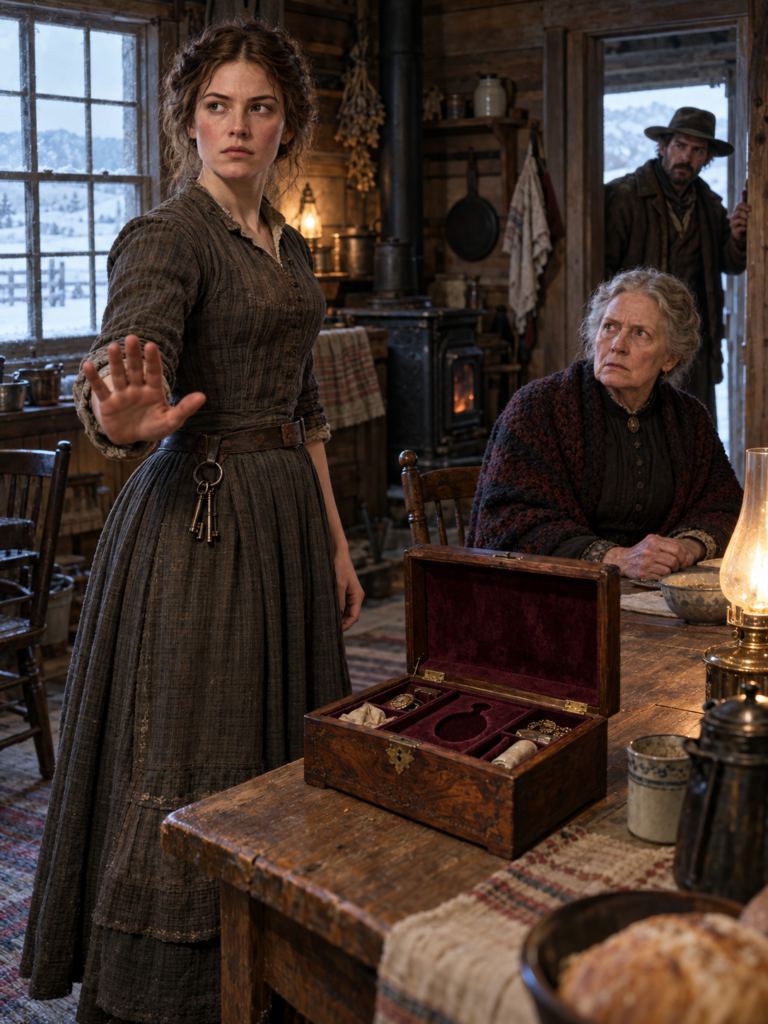
Bee stepped from the porch into the cold, Copper already moving at her left boot.
She did not go directly to Tessa Reed.
First she rode to Arthur Penrose.
By the time the schoolmaster understood what had happened, the winter light was thinning.
“You believe Miss Reed took it?”
“I believe she was in the house.”
“That is not the same thing.”
“No.”
Arthur studied Bee.
“That distinction may save you trouble.”
“It may save her more.”
They found Tessa in a small rented room behind a seamstress’s house.
When she opened the door and saw Arthur beside Bee, color left her face.
Bee noticed.
She did not mistake fear for guilt.
“I need to ask about something missing from Willow Bend.”
“I didn’t take anything.”
“I haven’t told you what it is.”
Tessa froze.
Arthur said nothing.
Bee waited.
Finally she said, “Isaac Calder’s brass watch is gone.”
Tessa’s hands tightened in her skirt.
“I never saw it.”
Bee could have pressed harder.
She did not.
“The watch has not been found in my room.”
Tessa’s eyes lifted.
“No one has accused me publicly,” Bee continued. “No one has searched my belongings. I came with Mr. Penrose because whatever happens next should have a witness.”
Tessa looked past them toward the street.
“Why are you telling me that?”
“Because if somebody asked you to put that watch somewhere, the plan hasn’t worked yet.”
Tessa stopped breathing.
Arthur’s attention sharpened.
Bee knew then.
Not everything.
Enough.
“Tessa.”
The younger woman’s eyes filled.
“He said nobody would be hurt.”
“Who?”
Tessa looked down.
Bee did not move closer.
“If you still have the watch, give it back.”
Several seconds passed.
Then Tessa walked to the bed.
She knelt.
From beneath a loose floorboard she removed a cloth bundle.
Inside lay the brass pocket watch.
Bee felt relief first.
Then anger.
Not at Tessa.
At whoever had understood exactly what that object could do if it appeared in Bee’s trunk.
Arthur said quietly, “Who paid you?”
Tessa began to cry.
“Nolan Calder.”
Bee closed her eyes briefly.
When she opened them, Tessa was talking.
Nolan had approached her.
He knew she needed money.
He told her to remove the watch from Hester’s walnut box.
Then hide it among Bee’s belongings.
Later, somebody would discover it.
A young stranger inheriting Willow Bend would become a thief in a single afternoon.
Except Copper had blocked the hallway.
Not attacked.
Not bitten.
Simply stood in Bee’s doorway and growled until Tessa lost her nerve.
So she left with the watch.
The plan remained unfinished.
Bee wrapped it again.
“You’re coming with us.”
Tessa recoiled.
“To jail?”
“No.”
Bee looked at Arthur.
“To tell the truth where it matters.”
They returned to Willow Bend after dark.
Rufus stood beside Hester at the table when Bee placed Isaac’s watch in front of her.
Hester did not touch it immediately.
Tessa told the story.
Every part.
Nolan had paid her.
Nolan wanted the watch planted.
Nolan told her the accusation would merely force Bee to leave.
Then Bee asked the question that mattered.
“Was it his idea?”
Tessa hesitated.
“No.”
Hester’s face became still.
“Whose?”
Tessa whispered, “Victor’s.”
The room changed.
Rufus swore under his breath.
Arthur looked away.
Hester finally picked up the watch.
Her thumb passed over the worn brass case the same way Bee had seen it move weeks earlier.
“Send for Nolan.”
They found him before midnight.
When he entered the kitchen and saw Tessa seated beside Arthur, he understood.
Nobody needed to threaten him.
His lies collapsed one by one.
Victor had suggested making Bee appear dishonest.
Nolan had found Tessa.
He had paid her.
He had explained where the watch was kept.
He had intended to make sure it was later “discovered.”
Hester listened without interrupting.
When he finished, Nolan said, “Ma—”
“No.”
The word stopped him.
“You will pay Tessa what you promised her.”
His eyes widened.
Hester continued.
“Then you’ll repay whatever harm this brought her.”
Tessa looked up.
“You will tell anyone you spoke to about Bee that the story was false.”
Nolan swallowed.
“Yes.”
“And you will not call what you feel tonight an apology.”
He looked confused.
Hester placed the watch back into the walnut box.
“An apology begins with what you do after being caught.”
Nolan stood silent.
Finally he asked the thing Bee wished he had not.
“Do you think you’ll forgive me?”
Hester closed the lid.
“That depends on what you do after today.”
Nolan left before dawn.
The truth traveled through Painted Creek more slowly than the accusation had.
But it traveled.
Lenora restored Willow Bend’s store credit.
A grain delivery suddenly arrived on schedule.
A wagon hauler became available again.
Nobody admitted much.
Bee expected that.
She did not need confessions from an entire settlement.
She needed winter feed.
Wood.
Water.
Working doors.
And the storm coming down from the north.
As the weather turned, Rufus found Bee beside the barn studying the sky.
“Bad one.”
“How bad?”
“Bad enough we stop worrying about Victor.”
Bee nodded.
They began preparing.
Emergency feed moved to the sheltered side.
Wood was divided between two locations.
Troughs filled.
Marker poles checked.
Barn vents cleared.
Drainage reopened.
The corrected wind screen inspected.
Nolan appeared during the work.
He said nothing about forgiveness.
He picked up a shovel.
Rufus looked at Bee.
Bee looked at Hester.
Hester did not send her son away.
But she did not welcome him back either.
“South gate needs bracing,” Bee said.
Nolan went.
That night the temperature fell hard.
Hester sat with Bee over the ranch inventory.
When they finished, Bee unclipped the small ring of keys from her belt.
The accusations, the will, the watch, the pressure—suddenly the iron felt heavier than responsibility alone.
She set the keys beside Hester’s hand.
Hester closed Bee’s fingers around them.
Outside, Copper lifted his head.
The windows rattled.
The northwest wind arrived.
And before dawn, Willow Bend disappeared inside the worst storm Bee had yet seen.
Willow Bend disappeared inside the worst storm Bee had yet seen.
By sunrise, snow moved sideways past the windows.
The wind struck hard enough to make the house timbers complain.
Bee pulled on her patched gloves.
Rufus was already at the door.
Nolan stood behind him in borrowed wool.
Hester remained at the kitchen table, one hand around a coffee cup.
Nobody needed to make a speech.
They had spent weeks creating options.
Now the weather would decide whether those options were real.
The first trip was to the barn.
Bee pushed into the wind and immediately felt what the screen changed.
Beyond its protection, the gust pressed against her chest.
Behind it, the force dropped enough that she could walk without turning sideways.
Snow still moved through.
That was important.
The screen was not a wall.
The gaps Bee and Rufus had left allowed some air through instead of forcing everything upward and over.
The barn door shook.
But it did not rip from her grip.
Inside, the animals were restless but dry.
Rufus checked the vents.
“Leave them.”
Nolan looked toward the openings.
“You don’t want to close those?”
“Not unless you want damp air sitting on everything breathing in here.”
Bee checked the horses.
Then cattle.
Then feed.
The shifted access on the lee side remained open.
One small improvement.
Nothing miraculous.
But every bucket of grain that did not require crossing the full force of the wind saved strength.
By midday the road vanished.
Willow Bend became an island.
Hester could no longer do much outside.
That did not make her useless.
She kept the house.
Counted stores.
Dried gloves.
Watched the stove.
Tracked who had been gone how long.
Bee came inside once with ice forming along her scarf.
Hester handed her warm milk.
“North lot?”
“Watered.”
“Wood?”
“Two piles.”
“Feed?”
“Still reachable.”
Hester nodded.
No praise.
Bee smiled despite herself.
The second day, drifts developed exactly where Rufus had expected.
Not exactly where Bee had once expected.
That distinction mattered.
The first version of the wind screen would have buried the milk-room approach.
The corrected version moved the deepest deposition farther out.
Bee stood beside the barn, looking through flying snow toward the line where she had first planted those posts eleven feet away.
She remembered saying, I put it wrong.
Those four words had felt like failure.
Now she understood they might have been the most important thing she had brought to Willow Bend.
Not the plan.
The willingness to dismantle it.
By the third day, the southern relief began filling faster than anticipated.
Bee saw the ridge rising.
“Rufus.”
He came beside her.
“Too much.”
“Yep.”
“We clear it now.”
He did not argue.
They took shovels.
Nolan joined them.
The three worked in shifts because exposed skin hurt within minutes.
They had opened half the passage when Copper began barking from the cattle side.
Not his warning bark at strangers.
Sharp.
Repeated.
Bee threw down the shovel.
They found a frightened heifer forcing against a fence panel that had shifted under snow pressure.
Another hard shove could open the corner.
Rufus and Nolan braced the panel.
Bee cleared snow away from the footing.
Wind slammed into her back.
The keys beneath her coat struck together.
Iron against iron.
A small sound under a very large one.
For a moment she thought about the first night at Willow Bend.
Her canvas bag.
Her boots beside the sewing-room bed.
Copper across the doorway.
She had slept dressed because she assumed she might have to leave quickly.
Now a fence was trying to fail in a storm, and she was calculating leverage.
The ranch had changed.
So had she.
“Bee!”
Rufus shouted.
She moved.
Together they secured the panel.
No cattle escaped.
No one celebrated.
There were still hours of daylight and too much weather.
By the fourth day, exhaustion became its own danger.
Bee watched Rufus stumble once near the springhouse.
“Inside.”
“I’m fine.”
“No.”
His face hardened.
She stepped between him and the next chore.
“That isn’t a question.”
Rufus stared at her.
Months earlier, he might have laughed.
Now he handed Nolan the shovel.
“Twenty minutes.”
“Thirty.”
Rufus grunted.
Bee considered that agreement.
The springhouse throat had turned slick, but the cobble gave boots enough purchase.
Not perfect footing.
Usable footing.
That became the measure of the whole ranch.
Not safe.
Safer.
Not easy.
Possible.
Not comfortable.
Manageable.
At night, Bee compared wood usage to her tally.
Hester sat across from her.
“We have margin.”
“How much?”
“Enough if the weather breaks when Asa said it would.”
“And if it doesn’t?”
Bee looked at the figures again.
“We start closing rooms in the house.”
Hester nodded.
“What else?”
“Reduce stove hours before we reduce feed access.”
“What else?”
Bee thought.
“Bring more hay into the barn before the outer stack becomes unreachable.”
Hester took a sip of coffee.
“Good.”
Bee looked at her.
It might have been the first direct praise Hester had ever given her.
She treasured it more because there had been so little of it.
The storm broke after four days.
Not dramatically.
The wind simply lost strength.
Snow continued.
Then stopped.
By the following morning, the basin emerged in pieces.
Fence tops.
Rooflines.
Cottonwoods.
A road where somebody remembered one should be.
Asa Boone reached Willow Bend with several men once travel became possible.
They expected damage.
They found it.
One broken fence rail.
Roof shingles gone.
A southern passage requiring digging.
Ice where Bee did not want ice.
A drift where she had hoped there would be none.
But the barn worked.
The feed remained accessible.
The springhouse remained usable.
No animal had been lost.
The water source had not frozen.
The wood reserve had not been exhausted.
Nobody had needed to push the stove dangerously hard.
One rancher stood beside the wind screen.
“How far from the barn?”
Rufus reached for his folding rule.
Then stopped.
He handed it to Bee.
“Eighteen feet.”
The rancher studied the gaps between the willow slats.
“Why not solid?”
“Because I’m not trying to stop the wind.”
Bee pointed toward the snow deposition beyond them.
“Just take enough strength out of it.”
Another man looked at the marker poles.
“They aren’t straight.”
“They aren’t decoration.”
Bee followed the route with one gloved hand.
“They show the next safe direction when you can’t see the building.”
The questions continued.
Bee answered what she knew.
When she did not know something, she said so.
That impressed Rufus more than any certainty could have.
Later, Victor arrived.
He walked the ranch slowly.
He saw the wind screen.
The sheltered lane.
The stocked feed.
The marks of drifting where Bee’s first design would have failed.
At last he looked at Hester.
“It held.”
Hester shook her head.
“It was corrected until it could.”
Victor looked at Bee.
Something had altered in him.
Not affection.
Not surrender.
Perhaps only the uncomfortable discovery that his simplest explanation no longer worked.
Bee was not a manipulative stranger who had charmed an aging widow.
She was a worker.
A fallible one.
A stubborn one.
A woman who had built something incorrectly, admitted it, rebuilt it, and then trusted the correction enough to stand behind it during a Wyoming storm.
Victor said, “I heard about Nolan.”
Bee did not answer.
His mouth tightened.
“I didn’t tell him to hire Tessa.”
“But you told him what outcome you wanted.”
“Yes.”
Hester watched her oldest son.
Victor turned toward her.
“I thought I was protecting the ranch.”
Hester’s eyes narrowed.
“From me?”
“No.”
“Then from whom?”
Victor glanced at Bee.
Bee held his gaze.
“From change,” he admitted.
Hester sat very still.
Victor continued.
“Father built this place.”
“So did I.”
“I know.”
“No. You know his name is on things.”
The words landed quietly.
Hester looked toward the barn.
“I carried water before you were born. I kept accounts when crops failed. I sold my mother’s silver one winter so we could buy feed.”
Victor’s expression changed.
“You did?”
“You never asked.”
Silence.
Hester looked at him again.
“You remember inheritance because you arrived after the hardest building was done.”
Victor had no answer.
Bee felt suddenly like an intruder.
Not because Hester made her one.
Because this grief belonged to a mother and son.
She stepped away.
Victor stopped her.
“Miss Mercer.”
Bee turned.
He took off his gloves.
“I said things about you.”
“Yes.”
“I believed some of them.”
“I know.”
“I don’t anymore.”
Bee waited.
Victor seemed to expect something.
Forgiveness, perhaps.
Relief.
She gave him neither.
“What are you going to do about the things you said?”
He frowned.
“What?”
“Nolan was told an apology begins with what he does after being caught.”
Victor glanced toward Hester.
Hester’s expression did not rescue him.
Victor looked back at Bee.
“I’ll correct them.”
“With whom?”
“The store. The freight people. Anyone I spoke to.”
Bee nodded.
“That’s a start.”
He accepted the answer.
It was not reconciliation.
It did not need to be.
Spring returned slowly.
Nolan kept appearing at Willow Bend.
At first he arrived with the posture of a man serving punishment.
Then something changed.
He stopped watching to see who noticed.
He repaired fence.
Moved stone.
Hauled feed.
Stood knee-deep in cold mud beside Rufus.
Nobody paid him.
Nobody praised him.
Hester did not forgive him aloud.
But one evening Bee saw Hester look through the kitchen window at Nolan finishing a gate repair.
She opened the cupboard.
Took down another plate.
Set it on the table.
Bee said nothing.
That summer, Victor corrected the worst of the rumors.
Lenora Fitch mentioned it indirectly while filling a sugar order.
“Funny how people can be wrong.”
Bee looked at her.
“People usually are about something.”
Lenora almost smiled.
The ranch settled.
Not into peace.
Into work.
That was more reliable.
Then one afternoon the following year, Hester called Bee onto the porch.
Copper slept beneath the steps.
The wind screen stood beyond the barn with several replacement slats visible in the sun.
Hester looked older.
Not suddenly.
Honestly.
Her hands had begun shaking.
She removed the heavy key ring from her belt.
“My fingers don’t like this anymore.”
Bee stared at it.
“The papers still say Willow Bend is yours.”
“Paper tells who owns it.”
Hester held out the ring.
“Work tells who keeps it.”
Bee did not take the keys immediately.
“What if you want them back?”
“Then you hand them back.”
“And if I decide something you don’t like?”
“Then I tell you.”
“And if I’m wrong?”
Hester glanced toward the corrected wind screen.
“Move the posts.”
Bee laughed.
Hester’s mouth twitched.
Bee finally extended her hand.
The heavy ring dropped into her palm.
The weight surprised her.
So did the fear.
“Hester.”
“Yes?”
“I don’t know if I can keep all of this.”
Hester looked toward the barn.
“Good.”
Bee frowned.
“Good?”
“People who are certain they can carry everything usually drop more than they notice.”
She leaned back in her chair.
“You don’t have to know whether you can keep Willow Bend for twenty years.”
Her gaze moved toward the north lot.
“You have to know whether the cattle have water tonight.”
Bee looked at the keys.
Then toward the trough.
“I’ll check.”
She rose.
Hester watched her cross the yard.
Neither woman knew yet how little time remained.
Neither woman knew yet how little time remained.
Hester’s decline was not dramatic.
There was no single morning when Willow Bend understood that its owner was dying.
Her strength simply withdrew in small amounts.
First she stopped carrying buckets.
Then she stopped walking to the springhouse.
Later she needed Bee’s arm to reach the porch.
Her mind remained clear.
That mattered to Hester.
It mattered to Bee more.
The will stayed where Edwin Marlow had sealed and stored it.
Hester never changed it.
Bee asked once.
Not because she wanted reassurance.
Because she wanted Hester to remember that she still could.
“You want me to rewrite it?”
“If you want to.”
Hester studied her from the kitchen chair.
“You trying to give the ranch back to Victor?”
“No.”
“Nolan?”
“No.”
“Then quit fussing.”
Bee laughed despite the ache in her chest.
Hester did not become sentimental simply because death was approaching.
She still cared whether the milk pail had been rinsed properly.
Still complained about wasting lamp oil.
Still asked about calves before asking whether Bee had slept.
But something between them had changed.
The first night, Bee had sat at the edge of Hester’s table as though afraid to occupy too much space.
Now her papers spread across half of it.
Feed tallies.
Fence repairs.
Supply orders.
Notes about a heifer that needed watching.
Hester’s old account book lay beside them.
One evening Bee found Hester turning pages backward through years of entries.
“Looking for something?”
“My mistakes.”
Bee sat across from her.
“Find any?”
“Plenty.”
Hester tapped the ledger.
“Bad hay purchase in ’71. Put too many cattle on the north pasture in ’76. Trusted a man with a wagon in ’80 who deserved less trust than the wagon.”
Bee smiled.
“You survived.”
“Survival doesn’t make every decision wise.”
Her gaze drifted toward the window.
“People like to tell stories backward. Once something works, they pretend every step toward it was obvious.”
Bee thought of the wind screen.
Eleven feet.
Eighteen feet.
Snow packed against the milk-room door.
Posts torn out with sore hands.
“No,” she said. “It wasn’t obvious.”
“That’s why I trusted you.”
Bee looked up.
Hester rarely explained herself.
“Because I was wrong?”
“Because you didn’t waste time protecting your pride after you knew it.”
Bee felt her throat tighten.
Hester looked annoyed by the emotion in the room.
“Don’t start leaking on my table.”
Bee laughed and wiped one eye.
“Yes, ma’am.”
Nolan continued coming.
Months of labor became a year.
He never asked again whether Hester had forgiven him.
Perhaps that was one reason forgiveness became possible.
Not complete.
Not clean.
But real enough that Hester began giving him ordinary instructions again.
“Fix that hinge.”
“Bring in wood.”
“Your coat’s too thin.”
The day she told him his coat was too thin, Nolan went outside and cried behind the barn where he thought nobody could see him.
Bee saw.
She said nothing.
Victor remained more distant.
But he came.
That mattered.
He stopped discussing acreage value.
Stopped asking how many cattle could be sold.
Once, he brought Hester a replacement hinge for the walnut box.
She refused it.
“There’s nothing wrong with the old one.”
Victor smiled faintly.
“Of course there isn’t.”
Camille visited too.
She and Bee never became close.
They became respectful.
Sometimes that was the more honest achievement.
Copper aged beside all of them.
His muzzle grayed.
He slept more deeply.
He still followed Bee on morning rounds until the distance became too much.
Then he would walk halfway to the barn, stop, and watch her finish without him.
Bee began slowing her pace so they reached the halfway point together.
Hester noticed that too.
She noticed everything until almost the end.
One autumn morning, years after Bee first came through the gate, Hester asked to sit outside.
Bee wrapped her in a shawl.
Her mother’s shawl.
One of the few things Bee had carried into Willow Bend in that original canvas bag.
The same bag still sat in the sewing-room wardrobe.
Not packed.
Not ready.
Just stored.
Hester rested beneath the shawl and looked across the ranch.
The wind screen stood patched in three places.
The feed access had been improved again.
The springhouse diversion had widened.
Nothing remained untouched.
Everything remained recognizable.
“You kept changing it,” Hester said.
“Had to.”
“Good.”
Bee sat beside her.
Hester placed one hand over Bee’s.
“Do you remember what I told you about keys?”
“If I carry one, I answer for what’s behind the door.”
“That too.”
Bee looked over.
Hester’s eyes held a faint challenge.
Bee searched her memory.
“A key lets you open something. It doesn’t make you right.”
“There.”
Hester squeezed her fingers weakly.
“Remember that part.”
“I will.”
“No, you won’t.”
Bee blinked.
Hester almost smiled.
“Nobody remembers anything every day. That’s why you keep people around who’ll tell you when you forget.”
Bee looked toward the barn.
Rufus was arguing with Nolan over a wheel rim.
Both men were probably wrong in different ways.
She smiled.
“I have a few.”
Hester nodded.
“Good.”
That night she slept badly.
Two days later she did not wake.
There was grief.
But not the kind Bee had once expected death to bring.
Hester did not leave Bee feeling abandoned.
She left her instructed.
Not through speeches.
Through habits.
Count before winter.
Correct mistakes early.
Do not mistake ownership for competence.
Do not mistake family for labor.
Do not mistake work for love either.
And never let a key convince you the door belongs only to you.
The will was opened formally.
Victor attended.
So did Nolan.
Neither contested it.
Hester’s instructions stood exactly as written.
Specific possessions went to each son.
Isaac’s brass watch went to Nolan.
When Edwin read that line, Nolan closed his eyes.
Bee looked at him.
For a long moment, he could not speak.
Later he found Bee outside.
“I don’t deserve it.”
“That wasn’t what she decided.”
He held the watch in his palm.
“She knew what I tried to do with it.”
“Yes.”
“Why give it to me?”
Bee considered the question.
“Maybe because remembering what you did is part of being trusted not to do it again.”
Nolan looked down.
“She forgave me?”
Bee shook her head.
“Hester never treated forgiveness like a prize somebody wins.”
He waited.
“She gave you responsibility.”
Nolan closed his fingers around the watch.
That answer stayed with him.
Victor received family papers and several pieces that had belonged to Isaac.
He stood beside Bee after the reading.
“So this is yours now.”
Bee looked around the kitchen.
For years she had imagined ownership might feel like a door finally shutting behind her.
No more road.
No more uncertainty.
Instead it felt like another gate opening onto work.
“The papers say it is.”
Victor smiled faintly.
“My mother would approve of that answer.”
Bee looked at him.
“She might complain it took me too long to make it.”
Victor laughed.
It was the first easy sound they had ever shared.
Years passed.
Willow Bend remained a ranch.
Bee refused to turn Hester’s choice into a monument.
Cattle still calved at inconvenient hours.
Fence posts still rotted.
Spring runoff still found new routes despite everybody’s confidence.
The wind screen required repair almost every year.
Bee liked that.
New hands sometimes suggested replacing it with something permanent.
She always asked the same question.
“Permanent against what?”
Wind changed.
Snow changed.
Stock numbers changed.
Routes changed.
The ranch survived by adapting.
Eventually Rufus stopped working full days.
He pretended the decision was temporary for almost two years.
Bee let him pretend.
Nolan became the person who showed up when something heavy needed moving.
He never asked for part of Willow Bend.
Victor remained in Cheyenne but visited more often.
Sometimes the brothers argued.
Sometimes Bee disagreed with both.
Nobody confused disagreement with betrayal anymore.
That was another inheritance Hester had left them.
The gate at Willow Bend also developed a reputation.
Not as a charity.
Bee would have hated that description.
As a place where someone between lives could ask for work.
A widowed woman whose wagon axle broke.
A freighter trapped ahead of weather.
A ranch hand dismissed after an owner sold out.
A boy old enough to work but too proud to admit he was hungry.
Bee asked practical questions.
“What can you do?”
If they did not know, she asked another.
“What are you willing to learn?”
Sometimes the answer earned supper.
Sometimes a week.
Sometimes a season.
Nobody received a key the first day.
Bee understood what keys meant now.
Trust was not kindness.
It was responsibility shared carefully.
One winter afternoon, a young woman arrived at Willow Bend after walking several miles.
Not unlike Bee once had.
She was clearly exhausted and trying not to show it.
A small dog followed her.
Bee stood on the porch.
The woman looked toward the barn, then the house.
“I heard you might have work.”
“What kind?”
“Anything.”
Bee almost smiled.
She remembered saying the same word.
Anything.
As though desperation made a person universally capable.
Instead of embarrassing her, Bee asked, “Can you milk?”
“Yes.”
“Mend harness?”
“A little.”
“Cook?”
“If you don’t expect miracles.”
“Good. Miracles are unreliable.”
The young woman blinked.
Bee opened the gate.
“Work can be discussed after supper.”
The words surprised her.
Not because she had forgotten them.
Because she had never intended to repeat them.
That evening the young woman sat at the edge of Hester’s old table.
Bee placed another coffee cup near her.
No ceremony.
No speech.
Outside, the northwest wind began rising.
The repaired screen softened its first hard push.
Bee heard it.
She always heard the wind now.
Later she walked the ranch with the heavy Calder key ring beneath her coat.
The original small four-key ring Hester had first given her hung on a peg by the kitchen.
Bee kept it there deliberately.
A reminder.
Those first keys had never meant the ranch belonged to her.
They meant four doors had been placed in her care.
That difference had shaped everything afterward.
Copper was gone.
Another dog slept beneath the porch.
Rufus’s folding rule remained in the tack room because he claimed Bee was forever misplacing her own.
Nolan still carried Isaac’s brass watch.
Victor still wrote before visiting, although Bee had told him for years he did not need permission.
Hester’s walnut box remained in the house.
Not locked anymore.
There was nothing inside it that required protection.
The important things had already escaped it.
Lessons.
Mistakes.
Trust.
Work.
One March morning Bee walked past the wind screen and noticed a cracked willow slat.
She stopped.
The structure had survived storms that destroyed stronger-looking things.
But it had never survived by remaining unchanged.
That afternoon she and two hired hands removed the broken piece.
One of them, a young man new to Willow Bend, studied the screen.
“Seems like you’re always fixing this thing.”
“Yes.”
“Wouldn’t it be easier to build something that lasts?”
Bee looked toward the barn.
Snow from the latest storm lay exactly where the corrected design allowed it to settle.
“Nothing out here lasts because nobody touches it.”
She fitted the new slat.
“It lasts because somebody notices when it needs work.”
The young man considered that.
Bee smiled.
“Same with most things.”
Years earlier, Painted Creek had looked at a homeless woman carrying a canvas bag and decided she had nothing.
Later, some had looked at her keys and decided she had taken too much.
Both judgments had measured possession.
Neither had measured what Hester measured.
Whether Bee worked when nobody watched.
Whether she admitted being wrong.
Whether she guarded another person’s right to change her mind.
Whether she protected truth even when accusation would have been easier.
Whether she carried responsibility before she ever inherited property.
By late afternoon, the repaired wind screen stood ready again.
Bee crossed the yard toward the house.
At the porch she stopped and looked over Willow Bend.
The barn.
The springhouse.
The sheltered lane.
The cattle lots.
The gate where one hungry young woman had once stood asking only for supper and somewhere dry.
Nothing about that gate had changed.
Everything behind it had.
Bee reached into her coat and closed one hand around the heavy ring of keys.
Then she opened the kitchen door.
Not because the ranch was finally hers.
Because, as Hester had taught her, ownership was only paper.
Keeping something was work.


