
Part 1
The photograph came through at 7:18 on a Sunday night.
I remember the exact time because I was standing over the stove trying to keep tomato soup from burning while my daughter slept against my chest.
Her name was Nora.
She was six days old.
Her cheek was tucked beneath my collarbone, warm and impossibly soft, and every few seconds she made one of those tiny newborn noises that sounded like a question.
My body hurt everywhere.
I had slept perhaps four hours total since bringing her home.
There was milk on my shirt, dried blood beneath the edge of the hospital bracelet I still hadn’t cut off, and three dirty bottles sitting beside the sink because I hadn’t managed to wash them.
My husband, Ethan, had left twenty minutes earlier.
He had stood in the hallway wearing a clean blue shirt and the loafers his mother had bought him for Christmas.
“My mom just wants a quiet family dinner before she leaves for Charleston,” he’d said.
I looked at him.
“Then we’ll get ready.”
His expression changed.
Not much.
Just enough.
“Claire, I think you should stay home.”
I actually laughed because I thought he was joking.
“Stay home?”
“You need rest.”
“I can rest at your sister’s house.”
“It’ll be crowded.”
“Nora can sleep in her carrier.”
He rubbed his forehead.
“Please. Don’t turn this into something.”
Those words.
I can still hear them exactly as he said them.
Don’t turn this into something.
As though there wasn’t already something standing between us.
As though that something hadn’t been growing for five years.
Then he picked up my keys.
His truck was at the dealership after a transmission failure, so he had been driving my Honda all week.
The infant-seat base was locked into the back.
The diaper bag was there too.
So was the folded stroller.
“You’re taking my car?”
“I’ll be back in a few hours.”
“With the car seat?”
“You’re not going anywhere.”
The casualness of it hurt more than anger would have.
He kissed the top of Nora’s head.
He didn’t kiss me.
Then the door closed.
Twenty minutes later, his mother texted.
I hope you use the evening to settle yourself. Ethan deserves one peaceful night.
I read it twice.
I did not answer.
Then Ethan’s sister, Marcy, posted the photograph in their family message thread.
Their mother, Diane, sat at the center of the table.
Ethan was beside her.
Marcy and her husband were there.
Two aunts.
An uncle.
A cousin home from college.
Eight wineglasses.
Eight dinner plates.
No empty chair.
The caption said:
Everybody who matters is finally here.
Maybe Marcy didn’t mean me to see it.
Maybe she did.
At that point, I no longer cared.
Something inside me simply stopped arguing.
For years, I had tried to explain to Ethan that his mother didn’t tease me.
She diminished me.
There was a difference.
Diane called me “our little schoolteacher” even though I was thirty-four years old.
She corrected the way I folded napkins.
The way I seasoned food.
The kind of curtains I bought.
The fact that I wore flats to Thanksgiving.
Once, while standing in my own living room, she told a neighbor that Ethan had “married beneath his opportunities but followed his heart.”
Ethan heard her.
He laughed.
Later, when I told him it hurt, he said, “You know Mom. She talks.”
That became the explanation for everything.
Mom talks.
Mom worries.
Mom means well.
Mom is old-fashioned.
Mom had a difficult marriage.
Mom lost Dad young.
Mom only wants to help.
There was always a reason Diane behaved badly.
There was never a reason I was allowed to be hurt.
Nora shifted against me.
I looked down.
Her fist had opened against my shirt.
Five tiny fingers.
I turned off the stove.
Then I carried her upstairs.
I laid her in the bassinet beside our bed and pulled a canvas overnight bag from the closet.
I packed six diapers.
Wipes.
Two bottles.
Formula.
My pump.
Three onesies.
Socks.
My toothbrush.
Sweatpants.
A sweater.
A yellow baby blanket my mother had sewn before she died.
I hesitated before packing that blanket.
Diane hated it.
She had brought over the lace christening shawl Ethan had worn as a baby and announced that Nora would use “something with history.”
The yellow blanket did have history.
Just not Diane’s.
My mother had made it by hand while undergoing chemotherapy.
She had stitched tiny blue birds along one edge.
She died when I was seventeen.
I placed the blanket carefully over everything else.
Then I sat beside Nora and opened my contacts.
There was a number I knew by memory despite rarely calling it.
Dad.
I stared at it.
My father’s name was Arthur Whitmore.
If you lived in North Carolina, you might have heard of Whitmore Building Supply.
Hardware stores.
Lumber yards.
Commercial construction materials.
Trucks with a green W painted on the doors.
My father had inherited one struggling store from his uncle in the late seventies and turned it into a regional company worth more money than I had ever wanted to understand.
I grew up outside Charlotte in a stone house with six bedrooms and a circular driveway.
There had been a housekeeper, a groundskeeper and, for several years, a driver named Samuel Reed.
But almost none of that mattered to me after my mother died.
What mattered was that my father hadn’t been there.
Mom’s cancer had spread quickly.
One February afternoon, the doctors said she probably had several days.
Dad was in Dallas negotiating the purchase of a chain of lumber yards.
Samuel called him.
Then the doctor called him.
Then I called him.
Dad said he was trying to get a flight.
Mom died before midnight.
He arrived the following afternoon.
I remember staring at his suitcase in the hospice hallway.
That suitcase became the symbol of everything I hated about him.
He had always provided.
Always paid.
Always built.
But whenever something mattered, there seemed to be a meeting somewhere else.
After Mom died, I left home emotionally long before I left physically.
I went to college.
Became an elementary school teacher.
Refused a position in his company.
Refused the condo he offered to buy me.
Refused his money.
Eventually I refused most of his calls.
When I married Ethan, Dad promised he would attend.
Then a supplier crisis sent him to Vancouver.
He missed the wedding.
Samuel attended instead.
Diane asked me afterward whether the “older Black gentleman” was a relative.
“He worked for my father,” I said.
That was all.
Diane assumed my father had been some small contractor who employed one man.
I let her.
By then I had learned that money altered people.
I liked living where nobody knew the Whitmore name.
When Ethan and I were dating, I told him my father owned a building-supply company.
Technically true.
I never explained the scale.
By our third year of marriage, Ethan knew I had grown up comfortably, but he had no idea my father’s company employed more than four thousand people.
I didn’t hide it because I was playing some test.
At least not at first.
I hid it because the distance between my father and me mattered more than his balance sheet.
Then, two years earlier, we had our final argument.
Dad had offered to establish a trust for any future grandchildren.
I accused him of trying to buy children who didn’t exist yet.
He went silent.
Then he said, “Claire, I don’t know how else to help you.”
I answered, “That’s the problem. You think money and help are the same thing.”
We didn’t speak after that.
Until Nora was born.
I had sent him a photograph from the hospital.
No message.
Just Nora.
Seven minutes later he replied.
She’s beautiful.
Then:
How are you feeling?
Not How is the baby?
How are you feeling?
That question stayed with me.
Now, six days later, I pressed his name.
He answered before the second ring.
“Claire?”
I opened my mouth.
Nothing came out.
His voice changed immediately.
“Are you hurt?”
“No.”
“The baby?”
“She’s okay.”
A pause.
“What happened?”
I looked at the packed bag.
“Dad, can you come get us?”
Silence.
For one terrible second, I thought I had asked too much after giving him nothing for years.
Then I heard movement.
“Where is Ethan?”
“At his mother’s.”
“Does he know you’re leaving?”
“No.”
“Do you feel unsafe?”
“No. I just…”
My voice cracked.
“I don’t want to be here when he comes back.”
“All right.”
No lecture.
No I told you so.
No questions about our marriage.
He said, “Samuel is closer to you than I am. He’ll be there first. I’m leaving now.”
“Samuel still works for you?”
“Not really.”
“What does that mean?”
“It means he retired four years ago and refuses to behave like it.”
Despite everything, I almost smiled.
Dad continued.
“Don’t carry the bag downstairs. You just had a baby.”
“I’m capable of carrying—”
“Claire.”
His tone was gentle but firm.
“Please let someone take care of you for ten minutes.”
That sentence undid me.
I covered my mouth.
Dad waited.
Then he said quietly, “I’m glad you called.”
Forty-two minutes later, headlights moved across the front window.
A dark SUV pulled into the driveway.
Samuel Reed stepped out.
He was seventy now.
His shoulders were more rounded than I remembered, and his hair had gone completely silver.
But he still wore a pressed jacket.
Still moved calmly.
Still looked at a situation before speaking.
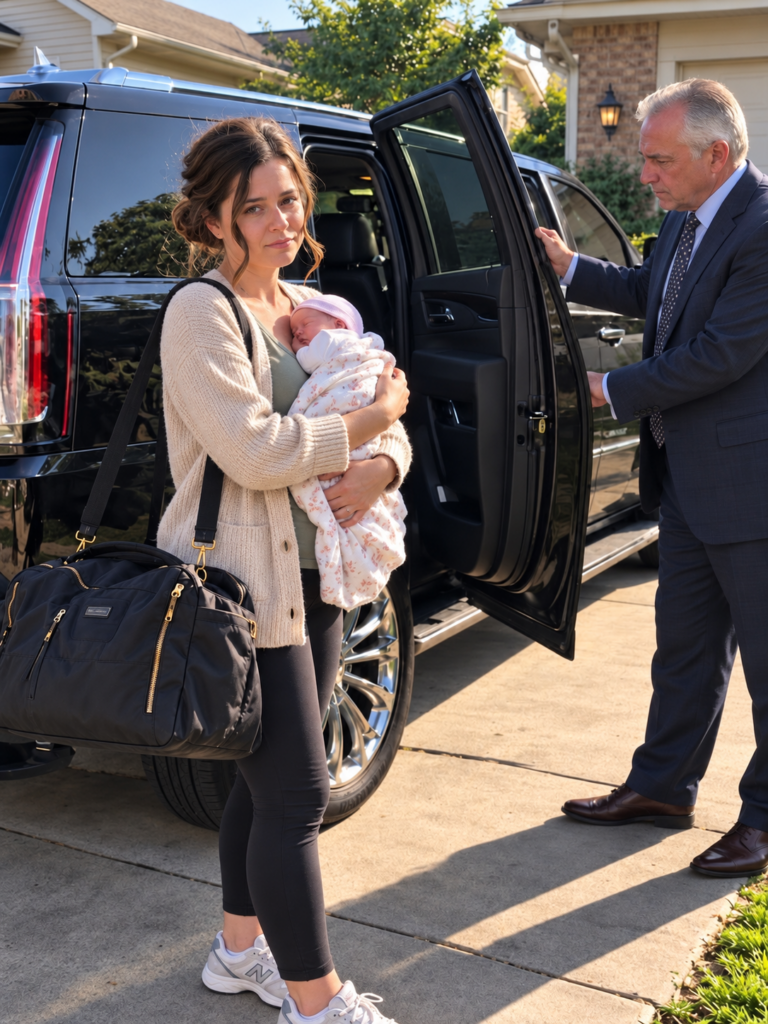
I opened the door with Nora against my chest.
Samuel stopped halfway up the walk.
His eyes went immediately to her.
“Well,” he said softly. “There she is.”
“Hi, Samuel.”
He looked at me.
Not my messy hair.
Not the milk stain.
Not the hospital bracelet.
Me.
“Hello, Claire.”
I began crying before he even reached the porch.
He didn’t pretend not to notice.
He simply took my bag.
“Your father said there’s an infant seat in the back of your husband’s car.”
I nodded.
Samuel gestured toward the SUV.
“Your father apparently believes children did not survive automobile travel before twenty-twenty-six, so he ordered one delivered to my house three days ago.”
I stared at him.
“Three days ago?”
Samuel smiled faintly.
“He has been preparing for emergencies that nobody invited him to.”
He installed the seat.
I went into the kitchen and wrote Ethan a note.
Nora and I are safe.
I need space.
Your mother said you deserved a peaceful night away from me.
You agreed when you walked out with the only car seat.
I’m staying somewhere we both count as family.
Please do not come tonight.
Claire.
I put my house key beside it.
Then Samuel drove us toward Charlotte.
My phone began ringing before we reached the interstate.
Ethan.
I ignored the first call.
And the second.
On the third, I answered.
“Where are you?”
“Leaving.”
“What does that mean?”
“It means Nora and I won’t be home tonight.”
“Claire, come on. You’re upset.”
“Yes.”
“You’re postpartum. Everything feels huge right now.”
I closed my eyes.
There it was.
Not I was wrong.
Not I shouldn’t have left.
Not Mom crossed a line.
My hormones.
My emotions.
My distorted perception.
“Who picked you up?”
“Samuel.”
“Who’s Samuel?”
“My father’s former driver.”
Silence.
“Your father had a driver?”
“Yes.”
Another silence.
“Where exactly are you going?”
“To my father’s house.”
“You haven’t spoken to him in years.”
“That should tell you how badly I didn’t want to stay.”
His breathing changed.
“Claire, my mother didn’t mean—”
I hung up.
Samuel said nothing.
We drove another twenty minutes.
Then he asked, “Would you like me to turn your phone off?”
I handed it to him.
“Yes.”
When we reached my childhood home, the iron gates were open.
Every downstairs light seemed to be on.
The house looked smaller than it had when I was seventeen.
That surprised me.
Grief had made it enormous in my memory.
Samuel parked beneath the portico.
The front door opened before he could come around.
My father walked out.
Arthur Whitmore was seventy-three.
He had always seemed indestructible to me.
That night he looked old.
His hair was almost white.
He wore gray slacks and a cardigan instead of a suit.
And when he saw me standing beside Samuel with Nora in my arms, his face tightened as though he were trying not to cry.
He stopped several feet away.
“Hi.”
“Hi.”
His eyes moved to Nora.
Then back to me.
“I made up your old room.”
“Okay.”
“And the room beside it.”
I frowned.
“What room?”
He stepped aside.
“You’ll see.”
Upstairs, my bedroom still had the window seat overlooking Mom’s garden.
The furniture had changed, but the shelves remained.
My childhood copy of The Secret Garden sat between two bookends.
A framed photograph of Mom and me stood on the dresser.
Then I saw the connecting door.
The old guest room had become a nursery.
Not a designer showroom.
Not an expensive monument.
A nursery.
Soft cream walls.
A simple crib.
A rocking chair.
Books stacked in baskets.
Diapers in three sizes.
Burp cloths.
Bottles.
A night-light shaped like the moon.
Above the crib hung a wooden mobile.
Five small blue birds.
I walked toward it.
My throat tightened.
“Why birds?”
Dad stood in the doorway.
He looked embarrassed.
“You sent me one photograph from the hospital. She was wrapped in that blanket.”
I looked down at my bag.
“My mother’s blanket.”
“I recognized it.”
He put his hands in his pockets.
“I asked Samuel if he remembered what kind of birds your mother embroidered. Neither of us did, so I took the blanket pattern to a woman in Matthews who makes wooden toys.”
“You did all this after I sent the picture?”
He shook his head.
“No.”
“When?”
His gaze dropped.
“June.”
I stared at him.
Nora had been born in October.
“You knew I was pregnant?”
“Your cousin Rachel told me.”
“You built a nursery four months ago?”
“I had the room painted.”
He looked around.
“The rest accumulated.”
“Why?”
His answer took a long time.
“Because if you ever called, I didn’t want the first thing I said to be, Give me a few days.”
That was when I understood.
My father, the man I had spent half my life accusing of never being there, had built a room for a granddaughter he wasn’t sure he would ever meet.
Not to lure me back.
Not to show me.
He had never sent a photograph.
Never mentioned it.
He had simply made himself ready.
Dad moved toward the doorway.
“You should sleep.”
“Dad.”
He turned.
“Thank you.”
For a moment, he couldn’t answer.
Then he nodded.
“I’m downstairs.”
He paused.
“If you need me.”
That night, at 2:47, Nora woke crying.
I carried her to the rocking chair.
Five minutes later, someone tapped softly on the open door.
Dad stood there holding a glass of water.
“I thought you might be thirsty.”
“I am.”
He set it down.
Then stared at Nora.
“Is she supposed to make that noise?”
“What noise?”
“That little squeak.”
“Yes.”
“Okay.”
He sat on the floor.
Not in a chair.
On the floor beside the crib.
I laughed.
“What are you doing?”
“I don’t know where I’m permitted to sit.”
“You own the house.”
“That hasn’t helped me much with you.”
The humor disappeared between us.
I looked down at Nora.
Dad folded his hands.
“I was wrong, Claire.”
I felt myself stiffen.
“I don’t mean about Ethan. I don’t know enough yet.”
He looked toward the blue birds.
“I mean about your mother.”
My hand stopped against Nora’s back.
“I should have left Dallas when Samuel called the first time.”
I said nothing.
“I told myself I would close the deal and take the midnight flight.”
His voice roughened.
“I kept believing there would be time because I needed there to be time.”
“Mom asked for you.”
His eyes closed.
“I know.”
“She asked three times.”
“I know.”
Anger rose so suddenly I was seventeen again.
“You weren’t there.”
“No.”
“I was.”
“Yes.”
“And then after she died, you sent Samuel everywhere.”
“Yes.”
“Graduation. College. My first apartment.”
“Yes.”
“Because you were working.”
He shook his head.
“No.”
That stopped me.
“What?”
“I told you I was working.”
He looked directly at me.
“The truth was worse.”
He took a breath.
“I was ashamed.”
I said nothing.
“Every time I saw you, I saw her last day. I saw what I had failed to do. And instead of facing that, I stayed away.”
“You missed my wedding.”
His face folded.
“I did.”
“For work.”
“No.”
My heart began pounding.
“I was in Charlotte.”
I stared at him.
Dad’s eyes filled.
“I drove to the church.”
I could barely speak.
“You were there?”
“In the parking lot.”
“Why didn’t you come inside?”
“Because I convinced myself you didn’t really want me there.”
“I sent you an invitation.”
“I know.”
“With a note.”
“I still have it.”
My anger was so sharp I had to place Nora carefully against my shoulder.
“You let me think you were in Vancouver.”
“Yes.”
“Why?”
“Cowardice.”
No excuse.
No polished explanation.
One word.
Cowardice.
He looked seventy-three then.
Not powerful.
Not wealthy.
Just tired.
“I had spent so many years missing your life that I thought showing up suddenly would make your wedding about me.”
His mouth trembled.
“I was wrong again.”
I looked at the man on the floor and realized that for years I had believed he chose business over me every single time.
The truth was not kinder.
But it was different.
After Mom died, he hadn’t only been absent.
He had been hiding.
And now, somehow, we were sitting in a nursery he had prepared before knowing whether I would ever forgive him.
Nora stirred.
Dad looked at her.
“May I?”
I hesitated.
Then handed him his granddaughter.
His arms went rigid.
“Support her head,” I said.
“I am.”
“Not like she’s a box of glassware.”
“I know how to hold glassware.”
I laughed despite myself.
Nora settled against him.
Dad stared down at her.
“Hello,” he whispered.
Her eyes remained closed.
“I’m your grandfather.”
He swallowed.
“I have a history of being late.”
My eyes burned.
He touched one finger lightly to her hand.
“I’m trying something different.”
Part 2
Ethan arrived the next afternoon.
Not at the house.
At the gate.
Dad’s security system sent a message to the kitchen.
Samuel looked at me.
“Do you want him turned away?”
I almost said yes.
Then I remembered my father sitting in a church parking lot too afraid to enter.
“Let him in.”
Ethan’s face when he stepped into the foyer would have been funny under different circumstances.
He looked at the staircase.
The paintings.
The library doors.
Then at Samuel.
“You work here?”
Samuel raised one eyebrow.
“I worked for Mr. Whitmore for thirty-two years.”
Ethan turned toward me.
“Whitmore?”
I watched the recognition arrive slowly.
“Whitmore Building Supply?”
“Yes.”
“Your father is Arthur Whitmore?”
“Yes.”
He looked stunned.
I hated how much that mattered to him.
“You never told me.”
“I told you he owned a building-supply company.”
“That’s like saying the Pope works at a church.”
“Maybe.”
“Claire, this is insane.”
“No. What happened yesterday was insane.”
He stopped.
Dad was somewhere upstairs with Nora and had agreed not to join us unless I wanted him.
Ethan and I went into the sunroom.
For several seconds he just stared through the windows.
Then he said, “Mom didn’t know.”
“About what?”
“This.”
He gestured toward the house.
“There is no this in our problem.”
“You know what I mean.”
“Yes. I do.”
And that was precisely the problem.
I showed him Diane’s message.
Then Marcy’s photograph.
His shoulders slumped.
“I didn’t know Mom sent that.”
“You knew you were taking the only car seat.”
“I was coming back.”
“You knew there were eight people at dinner.”
He said nothing.
“Were there eight plates when you got there?”
“Yes.”
“So when exactly did you realize there wasn’t a place for your wife?”
His jaw tightened.
“Claire—”
“When?”
“Right away.”
“And you stayed.”
“Yes.”
“Did you ask why I hadn’t been invited?”
A long silence.
“No.”
That answer hurt more than anything else.
Not because it surprised me.
Because it didn’t.
I nodded.
“That’s what I needed to know.”
He leaned forward.
“I screwed up.”
“This isn’t one night, Ethan.”
“I know.”
“No, you don’t. Your mother came into the delivery room and took Nora off my chest before I’d held her ten minutes.”
“She was excited.”
I stared at him.
He froze.
Then closed his eyes.
“God.”
“You did it again.”
“I know.”
“No. You defended her before you even thought.”
He covered his face with both hands.
For five years, every conflict had followed the same shape.
Diane hurt me.
I objected.
Ethan explained Diane.
Eventually I became the person creating tension by refusing to pretend nothing had happened.
My husband had never screamed at me.
Never threatened me.
Never called me names.
That had made the damage harder to describe.
He simply abandoned me in inches.
A joke here.
A holiday decision there.
A dismissive look across a table.
A mother whose comfort always outranked his wife’s dignity.
I could survive being disliked by Diane.
I could not keep being unprotected by Ethan.
“I want you to leave,” I said.
His eyes widened.
“Are you ending our marriage?”
“I don’t know.”
“Claire.”
“I just had a baby.”
My voice shook for the first time.
“I am six days postpartum, sleeping in the room I grew up in because my husband decided disappointing his mother was harder than leaving his wife without transportation.”
He looked down.
“I need time.”
He whispered, “Okay.”
At the doorway he stopped.
“Can I see Nora?”
“Yes.”
Dad brought her down.
Ethan stiffened when he saw him.
Arthur Whitmore, even in a cardigan, had a way of filling a room.
Ethan stood.
“Mr. Whitmore.”
Dad handed me Nora.
Then he looked at Ethan.
“I assume Claire has said everything that needs saying.”
“Yes, sir.”
Dad nodded.
“Good.”
That was it.
No threat.
No speech.
No wealthy father intimidating the disappointing husband.
Later I asked why he hadn’t said more.
Dad looked surprised.
“Because you aren’t seventeen.”
That answer mattered.
Diane began messaging the following morning.
At first, her texts were defensive.
This has been blown completely out of proportion.
Then conciliatory.
I never meant to make you feel excluded.
Then, after Ethan apparently told her who my father was:
Claire, I wish you had trusted us enough to tell us the truth about your family. So much misunderstanding could have been avoided.
I read that one aloud at breakfast.
Dad lowered his coffee.
“What misunderstanding?”
“Apparently all of it.”
He took my phone.
His expression hardened.
“She wishes she knew you came from money.”
“That’s what it sounds like.”
“Then she isn’t sorry she mistreated you.”
He handed the phone back.
“She’s sorry she miscalculated.”
The word stayed with me.
Miscalculated.
Two days later, Ethan called and asked whether we could meet without either of our parents.
We chose a coffee shop.
He looked terrible.
Unshaven.
Wrinkled shirt.
For once, I felt no urge to rescue him from his discomfort.
“I made an appointment with a therapist,” he said.
“For us?”
“For me.”
I looked up.
“She asked why I keep protecting Mom from consequences.”
“And?”
“I told her because Dad died when I was twenty-three.”
I knew that.
Diane’s husband, Peter, had died suddenly of an aneurysm.
Afterward Ethan became the emotional center of her life.
He handled bills.
Home repairs.
Doctor visits.
Holiday plans.
Marcy moved to Florida for several years, so much of it fell to him.
“I always thought taking care of Mom meant being a good son.”
“That isn’t the problem.”
“I know.”
He rubbed the cardboard sleeve around his coffee.
“The therapist asked when taking care of Mom started meaning nobody could upset her.”
I waited.
“I didn’t have an answer.”
Then he said something I hadn’t expected.
“Mom called me before dinner.”
“When?”
“About an hour before I left.”
My stomach tightened.
“What did she say?”
“That you had been difficult all week.”
I almost laughed.
“Difficult how?”
“You corrected her when she told you how to hold Nora. You wouldn’t let her reorganize the nursery. You got upset when she suggested you wash your hair before visitors came.”
I stared at him.
“And she said everyone needed a break from the tension.”
“The tension being me?”
“Yes.”
He looked ashamed.
“She said I should come alone.”
“You agreed.”
“Yes.”
“Why didn’t you tell me?”
“Because I knew how it would sound.”
That was perhaps the most honest thing Ethan had ever said about his mother.
He hadn’t been oblivious.
He had known.
He simply wanted the easier evening.
His phone buzzed on the table.
He looked at it.
Diane.
He declined the call.
It rang again.
He turned the phone facedown.
A small action.
Not redemption.
But different.
For the next three weeks, Ethan saw Nora at my father’s house every other afternoon.
At first, I remained in the room.
Then, gradually, I began leaving him alone with her while I showered or slept.
Dad never interfered.
Samuel adored watching the entire situation from the kitchen.
One afternoon I walked in and found Dad teaching Ethan how to test bottle temperature against his wrist.
“You’re both doing it wrong,” I said.
They looked up simultaneously.
Ethan laughed.
Dad looked offended.
“I watched three videos.”
“Congratulations.”
For a moment, we almost seemed like a family.
Then my phone rang.
Diane.
I ignored it.
A minute later, another message appeared.
Please call me. There is something you should know about Ethan.
I almost deleted it.
Then another message arrived.
It concerns your marriage, and I should have told you years ago.
My body went cold.
I showed Ethan.
His face changed.
“What?”
“I don’t know.”
“You look like you know.”
“I don’t.”
“Then why are you pale?”
“Because when Mom says she has something to tell someone, she usually wants control.”
I called her.
Diane answered immediately.
Her voice was shaky.
“I’d rather speak in person.”
“No.”
“Claire—”
“You said it concerns my marriage. Tell me.”
She exhaled.
“Before your wedding, Ethan almost ended the engagement.”
I looked across the room at him.
He closed his eyes.
So he did know something.
“You knew?”
“Not exactly.”
“What does that mean?”
Diane continued before he could answer.
“He came to me about six weeks before the wedding. He was worried.”
“About what?”
“Your family. Your debts. Whether you were being fully honest.”
I stared at Ethan.
“We didn’t have debt.”
“I know,” he said.
Diane kept talking.
“I hired someone.”
Dad, seated near the window, turned sharply.
“You did what?” I asked.
“A private investigator.”
The room went completely still.
Diane hurried on.
“I was trying to protect my son.”
“From me?”
“You were vague about your background. You said your mother was dead. Your father never visited. There was no family around you. I thought perhaps there was something you were hiding.”
My mouth went dry.
“What did the investigator find?”
A pause.
“That your father was Arthur Whitmore.”
Ethan stood.
“Mom.”
Diane’s voice cracked.
“I never told you.”
The entire room seemed to tilt.
I gripped the edge of the table.
“You knew?”
“For five years?” Dad asked.
Diane went silent.
“You knew who my father was before Ethan and I married?”
“Yes.”
I could barely process it.
All those years.
All those jokes about my bargain clothes.
All those comments about my “modest upbringing.”
The Christmas book about entertaining cheaply.
The little smiles when she said I was lucky Ethan had given me stability.
She had known.
The humiliation had not come from ignorance.
It had been deliberate.
“Why?” I whispered.
Diane began crying.
“I was ashamed.”
“Of what?”
“Of myself.”
That wasn’t an answer.
Then she told me.
The investigator had not only found my father.
He had found newspaper photographs.
Company biographies.
Fundraising-event pictures showing me as a teenager beside my parents.
He had found the house.
The company.
The wealth.
Diane had seen everything.
And it terrified her.
“I thought if Ethan knew,” she said, “your family would swallow him.”
I laughed once.
It sounded ugly.
“My father didn’t even come to our wedding.”
“I didn’t know that then.”
“So you decided to make sure Ethan believed your family was all he had?”
Silence.
Ethan looked sick.
“Mom, did you ever tell Marcy?”
“No.”
“Did Dad know?”
“No.”
He sat down slowly.
Diane continued.
“You have to understand what happened to me when I married Peter.”
Her husband’s family had owned several dry-cleaning stores.
Diane had been a waitress.
Peter’s mother called her “the waitress” for years.
At holidays.
At church.
Even after Ethan was born.
“She made me feel like I had crawled into their family through the kitchen door,” Diane said.
“So you did the same thing to me.”
“No.”
“Yes.”
“I didn’t mean—”
“You knew exactly who I was.”
Her crying stopped.
And there it was.
The second truth.
Not only had she known.
She had needed me to believe she didn’t.
Because my supposed inferiority gave her power.
For five years, Diane had been reenacting her own humiliation from the opposite chair.
Except I had never been poor.
And that somehow made the cruelty worse.
Not because wealth should have protected me.
Because she believed poverty justified contempt.
Ethan stood.
“I need to go.”
His mother called his name.
He ended the call.
Then turned to me.
“I didn’t know.”
This time, I believed him.
But for the first time I understood something else too.
Not knowing everything did not make him innocent of everything.
He had still laughed.
Still looked away.
Still chosen the easier chair.
That night I sat with Dad on the back porch.
Mom’s garden was dark beyond the steps.
“I spent years thinking people treated me differently because of our name,” I said.
Dad nodded.
“So I hid it.”
“Yes.”
“I thought that made things simpler.”
“Did it?”
“No.”
He looked toward the house.
“Money reveals people, Claire.”
I expected him to say something smug.
Instead he added, “So does the lack of it.”
I looked at him.
“I spent most of my life thinking providing was enough because I grew up without anything.”
He rubbed his hands together.
“My father disappeared when I was nine. My mother cleaned motel rooms. There were weeks when we ate toast for dinner.”
I knew parts of this.
Not all.
“When I became successful, I thought if my family had every material thing, then I had solved the problem.”
He gave a tired smile.
“I solved my childhood. Not yours.”
That line stayed with me.
Perhaps that was what families did when they weren’t careful.
They tried to repair their old wounds using other people’s lives.
Dad used money to protect us from the poverty he remembered.
Diane used control to protect herself from the humiliation she remembered.
Ethan used appeasement to protect himself from seeing his mother grieve.
And I used distance to protect myself from being disappointed again.
None of us had actually escaped the past.
We had simply built prettier rooms around it.
Part 3
Diane asked to see me two weeks later.
I agreed on three conditions.
Public place.
Ethan would be there.
Nora would stay with Dad.
We met at a quiet restaurant at three in the afternoon.
Diane looked different without her usual polish.
No pearls.
No lipstick.
Her hair was pulled back.
When I sat down, she did not reach for me.
That was the first respectful thing she had done in years.
“I’m sorry,” she said.
I waited.
She took a folded sheet of paper from her purse.
“I wrote everything down because Ethan said if I started explaining myself, he would leave.”
Ethan sat beside me.
Not beside her.
She unfolded the paper.
“I investigated you before the wedding. I learned who your father was. I concealed that information from Ethan. I encouraged him to think of me as the person whose judgment he should trust most. I belittled your work, your clothes, your home and your family because doing that made me feel less frightened by you.”
Her voice shook.
“I told myself I was testing whether you loved him for himself.”
She looked up.
“That was a lie.”
I said nothing.
“I was afraid that one day Ethan would discover your world and prefer it to ours.”
A sad smile crossed her face.
“So I made yours small before he could see it.”
For five years, I had wanted Diane to admit what she was doing.
Now that she had, I felt no triumph.
Just exhaustion.
She continued.
“The night you had Nora, I took her from you without asking.”
My throat tightened.
“I knew you wanted her back.”
Tears appeared in Diane’s eyes.
“I saw your face.”
That admission hurt more than denial would have.
“Why didn’t you give her back?”
“Because I wanted to be the grandmother in charge.”
Her mouth trembled.
“I wanted the nurses to see that I mattered.”
She wiped her cheek.
“And six days later, I told my son he deserved a peaceful evening away from his wife who had just given birth.”
She folded the paper.
“I cannot defend that.”
Ethan stared at the table.
Diane looked at me.
“I don’t expect forgiveness.”
“Good.”
She flinched.
I wasn’t trying to hurt her.
I simply refused to comfort her.
“I need you to understand something,” I said. “The fact that my father has money changes nothing.”
“I know.”
“No. I need to hear you say what changes.”
She swallowed.
“Nothing about how I should have treated you.”
“Exactly.”
“If your father had driven a delivery truck instead of owning thousands of them, I would still have been wrong.”
“Yes.”
“If you had grown up with nothing, I would still have been wrong.”
“Yes.”
She nodded.
“I understand.”
Maybe she did.
Maybe understanding would take longer.
But at least, finally, we were speaking about the real wound.
Not the money.
Not the dinner.
Not even the private investigator.
Power.
Diane had spent years arranging the family so that everyone orbited her.
Ethan had helped her do it.
And I had accepted an outer seat because arguing over every insult became exhausting.
The dinner photograph had only made the arrangement visible.
Eight plates.
One center.
Two people erased.
Ethan and I started marriage counseling the following week.
It was not romantic.
It was not a montage of apologies and flowers.
Some sessions were ugly.
I told him there were times I had hated him while sitting three feet away at his mother’s table.
He admitted that he often knew she was insulting me but pretended not to notice because defending me would create “a whole thing.”
“What did you think your silence created for Claire?” our therapist asked.
He looked at me.
“A whole thing.”
“Yes.”
One evening, our therapist asked us to draw our families as they felt to us.
I thought the exercise was ridiculous.
Ethan did too.
We drew anyway.
His picture placed Diane in the center.
Marcy beside her.
His deceased father above them.
Then himself.
Then, near the edge, me.
Nora was between us but closer to him.
He stared at the page for almost a minute.
Then he turned it toward me.
“I didn’t do that on purpose.”
“I know.”
That was why it mattered.
He began crying.
Not dramatically.
Just tears slipping down his face while he stared at a sheet of printer paper covered in badly drawn circles.
“I put you on the outside.”
“Yes.”
“I thought I was choosing peace.”
“For whom?”
“Myself.”
There it was.
No mother to blame.
No childhood tragedy.
No excuse.
Himself.
He had sacrificed my comfort to avoid his discomfort.
Once he understood that, our marriage had something real to work with.
I stayed at Dad’s house for seven weeks.
During that time, Dad changed too.
He canceled meetings to spend afternoons with Nora.
The first time he did it, I accused him of performing.
He smiled sadly.
“That is fair.”
Then he canceled another.
And another.
He learned to change diapers.
Badly.
He pushed Nora through the garden in her stroller.
He read picture books with no rhythm whatsoever.
He asked Samuel to stop coming every day.
“Samuel has spent half his life doing my showing up,” Dad said. “He’s retired.”
Samuel disagreed.
“You don’t tell retired people what to do.”
Dad started driving himself.
One Sunday, I found him kneeling in Mom’s old rose garden wearing a straw hat.
The sight stopped me on the path.
Mom had worn one almost exactly like it.
Dad noticed me.
“What?”
“That hat.”
He touched the brim.
“Too much?”
“It’s Mom’s.”
His face softened.
“I found it in the mudroom closet.”
He looked toward the roses.
“I thought somebody should embarrass the gardeners again.”
I laughed so hard I cried.
That was how reconciliation happened with my father.
Not in one apology.
Not because of the nursery.
Not because I suddenly forgot Dallas or my wedding.
It happened in small repetitions.
He said he would come Sunday.
He came Sunday.
He said he would watch Nora while I slept.
He watched Nora.
He said he would stop offering money as the first solution.
He did.
He learned to ask, “What do you need?”
And sometimes I answered.
Sometimes I said, “Nothing.”
He learned that nothing was also an answer.
Ethan eventually sold our old house.
I hadn’t asked him to.
He said he no longer wanted to rebuild our marriage inside rooms where I remembered being silenced.
We rented a smaller place near my school.
Two stories.
Three bedrooms.
A crooked maple tree in the yard.
The kitchen cabinets were ugly.
I loved them.
The first weekend we moved in, Ethan handed me three paint samples.
Then he stopped.
“No.”
“What?”
“You pick.”
“Why?”
“Because my mother picked the walls in our last house.”
I stared at him.
“You remember that?”
“I remember a lot more now.”
I chose green.
He hated it.
We painted the kitchen green.
Diane did not visit until Nora was almost four months old.
She waited until I invited her.
When she arrived, she carried no baby clothes.
No advice books.
No heirlooms.
Just soup.
She stood inside the door with both hands wrapped around the container.
“May I come in?”
“Yes.”
She looked toward Nora, who was lying on a blanket.
“May I see her?”
“Yes.”
She walked over but did not touch.
Nora kicked both legs.
Diane smiled.
“She’s gotten so big.”
“Would you like to hold her?”
Diane looked at me first.
Not Ethan.
Me.
“Yes. If you’re comfortable.”
I lifted my daughter.
Then I placed her in Diane’s arms.
The difference seemed small.
It wasn’t.
The first time, Diane had taken my newborn from my chest because she believed wanting access was enough.
This time she waited to be given what was not hers to claim.
Her eyes filled.
“Hello, sweetheart.”
Nora grabbed one of her fingers.
Diane cried quietly.
I did not tell her everything was forgiven.
It wasn’t.
But I made coffee.
We sat for forty minutes.
That was enough.
Six months after the night I left, Ethan brought home another family drawing from therapy.
He had improved artistically only slightly.
There was a long rectangular table.
He sat on one side.
I sat beside him.
Nora’s high chair was between us.
Diane sat across from us.
Marcy and her husband were there.
Samuel.
Dad.
My cousin Rachel.
At the far end, Ethan had drawn an empty chair with a blue bird on the seat.
“What’s that?” I asked.
He looked embarrassed.
“For your mom.”
I touched the paper.
“She never met you.”
“No.”
“She might not have liked you.”
“That seems increasingly possible.”
I laughed.
Then he became serious.
“But Nora’s middle name is Elise because of her.”
My mother had been Margaret Elise Whitmore.
“I thought she should have a place.”
I looked again.
Something bothered me.
Then I realized what it was.
“There’s no head of the table.”
Ethan nodded.
“I know.”
“Why?”
“Because I don’t think our family needs one.”
That was when I knew we might actually survive.
Not because he had become perfect.
Not because Diane had changed completely.
Not because my father’s house could shelter us whenever life went wrong.
We might survive because Ethan had finally understood that a family table was not supposed to have a throne.
A year after Nora’s birth, we held her first birthday party in our backyard.
Nothing elaborate.
Paper lanterns.
Hamburgers.
Cupcakes.
Children running through the grass.
Dad arrived twenty minutes early carrying a gift wrapped so badly it looked as though Nora had wrapped it herself.
Samuel came ten minutes later and loudly announced that Arthur had refused professional assistance.
Diane brought potato salad.
She asked where I wanted it.
Marcy brought ice.
At one point I stood in the kitchen doorway and looked outside.
Ethan was crouched beside Nora near the maple tree.
Dad and Samuel were arguing over how to assemble a plastic wagon.
Diane was laughing with my neighbor.
For years, I had imagined justice as some dramatic moment when the people who hurt me would finally understand exactly what they had done.
But standing there, I realized justice sometimes looked quieter.
A boundary respected.
An apology that did not demand absolution.
A husband learning that loyalty required action.
A father arriving early because he had spent too many years arriving late.
Later that afternoon, Dad found me alone on the back steps.
Nora was asleep inside.
He lowered himself beside me with the stiffness of a seventy-four-year-old man who had spent too much time gardening.
“You happy?” he asked.
“Today?”
He nodded.
“Yes.”
He looked relieved.
Then he said, “I have something for you.”
“Dad, you already brought a present.”
“This isn’t for Nora.”
He reached into his pocket.
A small brass key lay in his palm.
I recognized it immediately.
My old bedroom key.
I laughed.
“Where did you find that?”
“In your mother’s desk.”
A faded paper tag was tied around it.
Claire’s room.
Mom’s handwriting.
My chest tightened.
Dad placed it in my hand.
“The room stays yours.”
“You know I have a house.”
“I know.”
“And a husband.”
“I’m aware.”
I smiled.
“Then why do I need a key?”
“You don’t.”
He closed my fingers around it.
“That’s the point.”
I looked at him.
“You never have to use it. You never have to move back. You never have to ask permission.”
His voice became quiet.
“But I want you to know there will always be somewhere you can arrive without explaining why.”
I could not speak for several seconds.
Then I leaned my head against his shoulder.
He went completely still.
My father still wasn’t naturally good at affection.
After a second, he carefully put his arm around me.
“I’m sorry I was late so many times,” he said.
“I know.”
“I can’t fix that.”
“No.”
“But I can be early now.”
I laughed through my tears.
“That sounds like something from one of your management seminars.”
“It probably is.”
We sat there until Nora woke.
A little while later, Dad carried her into the yard.
She had recently learned to point.
Everything received one enthusiastic finger.
Tree.
Balloon.
Dog.
Samuel.
Then a small brown bird landed on the back fence.
Nora pointed.
“Ba!”
Dad looked at me.
“What kind is that?”
I narrowed my eyes.
“Probably a Carolina wren.”
His face brightened.
“You’re sure?”
“No.”
“Claire.”
“What?”
“I spent six months putting wooden birds all over a nursery. I’d like to know whether I accidentally chose sparrows.”
I started laughing.
Ethan looked over from the grill.
Diane turned.
Samuel shook his head.
And my father stood beneath the maple tree holding my daughter while the little brown bird bounced along the fence.
For most of my life, I thought family was defined by who was present in the photograph.
Who had the right last name.
Who sat at the head of the table.
Who belonged automatically.
I know better now.
Family is the person who asks whether you are okay when everyone else is admiring the baby.
It is the person who admits that keeping the peace sometimes means betraying the quietest person in the room.
It is someone learning to wait before reaching for a child.
It is a key you may never need.
A chair nobody claims.
A father who finally understands that love is not the house he built for you.
It is being there when the door opens.
Dad looked again at the bird.
“Wren?”
I smiled.
“Yes.”
This time I decided not to tease him.
“That one really is a wren.”
He nodded with ridiculous satisfaction.
“Good.”
Then he kissed the top of Nora’s head.
“For once,” he said, “I wanted to get there before it flew away.”


