
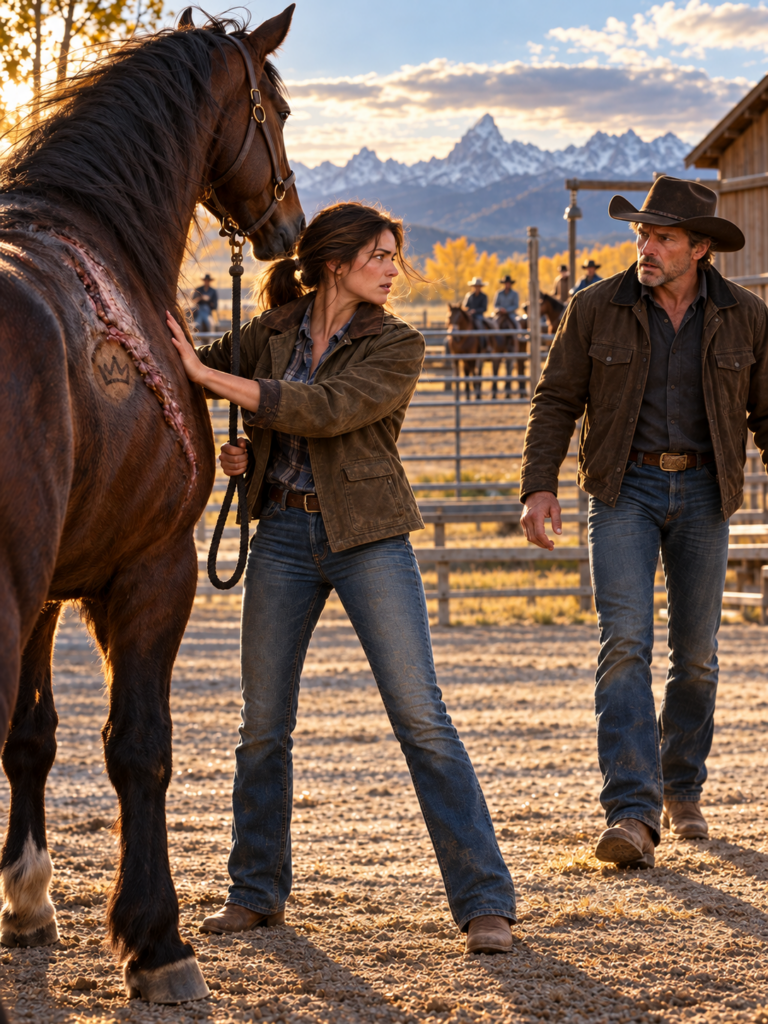
Sterling Blackwood crossed the gravel without once looking at Cinder.
That frightened Tessa more than if he had stared.
A man who had offered twenty-five thousand dollars for a horse supposedly worth nothing should have been curious to see what Grant Hollis had discovered.
Instead, Sterling looked only at Grant.
“You’re a long way from Lander.”
Grant’s face went still.
“So is this horse.”
Sterling smiled.
It was the same courteous smile Tessa remembered from the veterinary clinic weeks earlier, when he had looked at Cinder as though the animal were broken equipment.
“Miss Rowan,” he said, “I assume my people explained our offer.”
“They explained the amount.”
“I’m prepared to honor it.”
Grant turned toward Tessa.
“Offer?”
“Twenty-five thousand.”
Something flickered across Grant’s face.
That was enough.
Tessa asked, “What?”
Grant hesitated.
She stepped between both men.
“No. I’m tired of men deciding which information I’m ready for. What?”
Grant looked at Sterling.
“Twenty-five thousand isn’t what Crown Meridian horses change hands for.”
Sterling’s expression did not move.
“Crown Meridian no longer exists.”
“The mark does.”
Sterling’s eyes finally shifted toward Cinder.
Only for a second.
Then away.
That second told Tessa more than his words.
“You recognized him before today,” she said.
“No.”
“You sent someone to my house before Grant ever saw him.”
“I was told you had an interesting rehabilitation case.”
“By whom?”
Sterling said nothing.
Tessa’s pulse beat harder.
Grant stepped toward the horse, watching the ruined mark.
“How many Crown Meridian stallions were ever unregistered?”
Sterling’s jaw tightened.
Tessa saw it.
So did Grant.
“There weren’t supposed to be any,” Sterling said.
Supposed to be.
Not weren’t.
Tessa caught the difference immediately.
She pulled out her phone.
Sterling noticed.
“What are you doing?”
“Writing down what you just said.”
His polite expression disappeared.
“Tessa.”
It was the first time he had used her first name.
She kept typing.
“You said there weren’t supposed to be any unregistered Crown Meridian stallions.”
Grant gave her a quick approving glance.
Sterling exhaled.
“You’re building a story out of fragments you don’t understand.”
“Then explain them.”
“This isn’t the place.”
“My farm?”
“No.”
“Your office?”
Silence.
“That’s what I thought.”
She put the phone away.
Sterling lowered his voice.
“You have a son.”
Every muscle in Tessa’s body went rigid.
Grant moved forward instantly.
Sterling raised one hand.
“That was not a threat.”
“Then don’t use my child to make your argument.”
Tessa’s voice was quieter than either man’s.
That made Sterling stop.
“You know my financial position,” she said. “You know I have a son. You know twenty-five thousand dollars matters to me. And you still won’t tell me what you’re buying.”
Sterling looked toward the highway.
“What I’m trying to buy is an end to speculation.”
“Then you do know something.”
“I know enough to understand what public accusations can do to people who have nothing to do with old mistakes.”
Grant said, “Whose mistakes?”
Sterling’s stare hardened.
Tessa tightened her grip on Cinder’s rope.
The stallion stood quietly now.
For the first time since Sterling arrived, she understood that Cinder was not the unstable thing in the yard.
Sterling was.
Not because he was shouting.
Because he was measuring every word.
Grant turned to her.
“There’s one way to start separating fact from rumor.”
Tessa knew before he finished.
“DNA.”
Grant nodded.
“Midnight Valor’s genetic profile is archived with the registry.”
Sterling’s face changed.
Barely.
But enough.
Tessa saw it.
And suddenly she no longer wanted to prove Cinder was Midnight Valor.
She wanted to know why Sterling feared the question.
“We test him,” she said.
Sterling’s reply came too fast.
“You’ll regret that.”
Grant went silent.
Tessa felt the warning settle between them.
“Why?”
Sterling looked at Cinder at last.
The stallion stood with the scarred side turned toward him.
For one strange second, Sterling’s expression held something Tessa had not expected.
Not anger.
Recognition.
And something close to grief.
Then it vanished.
“You think finding a famous name under that scar is going to make your life easier,” Sterling said. “It won’t.”
“I never asked for a famous name.”
“No. You asked why I wanted him.”
Sterling stepped backward.
“You’re closer to the answer than you were this morning.”
Tessa’s fingers closed around the lead rope.
“That’s not good enough.”
“It’s all you’re getting from me.”
He walked toward his truck.
Grant called after him.
“Sterling.”
Sterling stopped.
“If the DNA matches Valor, what happens?”
Sterling stood with his back to them.
“It won’t.”
Then he climbed into his truck and drove away.
Tessa watched the dust settle.
Grant said, “He sounded very certain.”
“He did.”
She looked at Cinder.
“But he also looked scared.”
Grant nodded.
Tessa made the decision before fear had time to argue.
“Call the registry.”
Grant reached for his phone.
Tessa stopped him.
“No. My veterinarian collects the samples. We document everything. Two sets. Separate storage. Chain of custody.”
Grant studied her.
Then a faint, humorless smile appeared.
“You’ve done this kind of thing before?”
“Nine years in a veterinary clinic teaches you that evidence is only useful if nobody can argue about where it came from.”
For the first time that afternoon, Grant looked at her not as the woman who had accidentally bought a mystery.
He looked at her as someone he intended to listen to.
They collected the samples three days later.
Twenty-two days after that, Grant called.
Tessa answered in her hallway.
His first word told her something had gone wrong.
“Tessa.”
She lowered herself to the floor.
“Tell me.”
“The DNA doesn’t match Midnight Valor.”
The world became very quiet.
Grant continued.
“But that isn’t the strange part.”
Tessa closed her eyes.
“What is?”
“The lab flagged his maternal markers.”
Grant shuffled papers.
“He isn’t Valor.”
A pause.
“But whoever Cinder is, he is very closely related to the horse Crown Meridian says was the only surviving colt his mother ever produced.”
Tessa opened her eyes.
Across the window, Cinder grazed beneath the gray Wyoming sky.
One registered colt.
One supposedly dead champion.
And one scarred stallion who officially should not exist.
Tessa got to her feet.
“Then we stop trying to prove who he is.”
Grant understood immediately.
“And start proving who he isn’t supposed to be.”
“And start proving who he isn’t supposed to be.”
Tessa took Grant’s paperwork to the kitchen table and spread every page beneath the yellow light.
The answer should have made everything simpler.
Cinder was not Midnight Valor.
Sterling Blackwood had been technically correct.
But the maternal markers created a new problem.
According to Crown Meridian’s archived production records, Midnight Valor’s dam had produced only one surviving colt.
Valor.
Yet Cinder stood outside Tessa’s kitchen window.
Grant traced the relevant genetic lines with a pencil.
“Same maternal family. Very close.”
“Half brother?”
“That would be the easy answer.”
“Why isn’t it?”
Grant turned another sheet toward her.
“Because there’s no recorded second colt.”
Tessa leaned back.
“So somebody forgot to register him.”
“At a backyard farm? Maybe. Not Crown Meridian.”
That was the first major answer.
Cinder had not been mistaken for the famous dead stallion.
He belonged to the same tightly controlled breeding program.
And somebody had removed him from its history.
Sterling did not wait long to exploit the failed Valor test.
Within a week, Blackwood Crown Ranch released a statement expressing sympathy for everyone misled by an unfounded identification.
Then Sterling spoke at a Ranchers Association supper.
Tessa was not there.
She heard his sentence the next morning at the feed store.
A scarred horse doesn’t become a legend just because its owner needs money.
That hurt in a place she hated admitting existed.
Red Mesa had watched her struggle after her marriage ended.
They knew she boarded layup horses.
They knew she picked up weekend feed-store shifts.
They knew her truck was old and her barn roof leaked.
Now every fact of her life could be used as proof that she was trying to manufacture a fortune.
Dale Cormack caught her carrying feed to her truck.
“He’s still a decent horse,” he said. “Doesn’t have to be famous.”
Tessa loaded the bag into the bed.
“I never said he did.”
“People got excited.”
“You mean people enjoyed watching me be wrong.”
Dale looked uncomfortable.
“Tessa—”
She shut the tailgate.
“I bought him because he was scared. That was true before anybody knew about a crown, and it’s true now.”
That evening Grant came by.
“I’m sorry.”
“For the test?”
“For dragging Valor’s name into it before we had enough.”
Tessa studied him.
Grant Hollis had spent decades in an industry where reputation functioned like currency.
Admitting error did not come naturally to men who had survived that world.
“You believed what you saw,” she said.
“I wanted to believe it.”
“That’s different.”
“Yes.”
His willingness to say it restored more of her trust than a perfect explanation would have.
He set down a legal pad.
“There may be another way.”
Grant had remembered a former Crown Meridian stable manager named Walter Keen.
Walter had left the program abruptly six years earlier.
The same year Midnight Valor supposedly died.
Grant had called him three times.
Walter refused to speak.
Tessa asked for his address.
Grant frowned.
“What are you going to do?”
“Not call him.”
Four hours of driving separated Red Mesa from Walter’s place outside Sheridan.
Instead of showing up uninvited, Tessa mailed one photograph.
Not the scar.
Not the broken crown.
Cinder standing square in morning light.
His right hind leg visible.
The tiny nickel-sized patch of white hair above the heel easy to miss unless someone already knew it was there.
Walter called forty-eight hours later.
He did not say hello.
“Is he sound?”
Tessa gripped the phone.
“Mostly.”
A long silence followed.
“The right hind?”
“Stiff in cold weather.”
Walter breathed out.
“When can you come?”
Two days later Tessa and Grant stood inside Walter’s workshop beside a cardboard box that had been waiting six years to be opened.
Photographs covered the bench.
Vaccination logs.
Stall sheets.
Handwritten breeding notes.
Walter touched one photograph.
Two dark young horses stood behind a fence.
“Embryo transfer.”
Grant went still.
Walter explained.
Midnight Valor’s dam had become too valuable to carry her own foals.
Crown Meridian flushed embryos and transferred them into recipient mares.
One season, two embryos developed.
Different sires.
Different recipient mares.
Two colts born four months apart.
The first became Midnight Valor.
The second became a paperwork problem.
A partnership connected to the embryo rights collapsed into a legal dispute.
Ownership of the second transfer became tangled.
Registration documents were prepared but never finalized.
Then deaths, resignations, and money problems buried the dispute.
“On paper,” Walter said, “the second colt never existed.”
Tessa looked toward the photograph.
“What did you call him?”
Walter’s mouth tightened.
“Cinder Crown.”
The name hit harder than Midnight Valor ever had.
Tessa reached for the edge of the workbench.
She had named her horse Cinder because of his color.
Pure coincidence.
Yet the forgotten animal had once carried the same name.
Grant asked, “Which colt was better?”
Walter remained silent for several seconds.
“Valor was exceptional.”
“That wasn’t my question.”
Walter looked at the photograph.
“When they were three, we put both colts through the same work for a month.”
His eyes moved to Tessa.
“Everyone on the place knew.”
“Knew what?”
“The unregistered horse was better.”
Tessa thought of the barrels beside her driveway.
The effortless side-pass.
The perfect stillness beneath a saddle.
“The better horse had no papers,” she said.
Walter nodded.
“And a horse without papers can’t build a breeding empire.”
“What happened to him?”
“That fall he was loaded onto a trailer. I was told he’d been sold to Nebraska.”
“What color was the trailer?”
Walter’s face changed.
“White.”
Tessa felt cold.
“Do you remember the latch?”
He stared at her.
“What?”
“Never mind.”
Walter put both hands on the bench.
“I asked twice where the horse went. The second time, Theodore Blackwood told me I had worked for his family long enough to understand when something stopped being my concern.”
“Sterling’s father?”
“Yes.”
“And Sterling?”
“Wasn’t running the operation then.”
That distinction mattered.
Tessa refused to turn Sterling into the author of things he had not done.
He had pressured her.
He had publicly damaged her credibility.
He had tried to buy Cinder quietly.
Those choices belonged to him.
But whatever happened six years earlier might not.
“What happened after Cinder left?” she asked.
Walter closed his eyes briefly.
“Eleven days later Midnight Valor died in that hauling-rig fire.”
The room went quiet.
Grant leaned forward.
“You think the two events were connected?”
“I don’t know.”
Walter looked at Tessa.
“And I won’t give you certainty I don’t have.”
That answer made Tessa trust him more.
“What do you have?”
Walter opened the box again.
“A date.”
That date gave them somewhere to begin.
What followed was not cinematic.
No masked men.
No secret warehouse.
No midnight chase.
Just paperwork.
Tessa, Grant, and Layla spent weeks following Cinder backward through the systems people ignore because systems look boring.
County records.
Veterinary files.
Brand-inspection offices.
Old invoices.
Sale-yard receipts.
One document led to another.
Cinder had been transferred through four owners under four different barn names.
A hauling invoice placed an unregistered bay stallion leaving Crown Meridian eleven days before Valor’s fatal fire.
Three months later, a Nebraska veterinary clinic treated a five-year-old bay stallion for a severe laceration across the left shoulder and chest.
The approximate age matched.
The white hind marking matched.
The treatment date fit.
Then Layla noticed the language describing the wound.
She drove to Tessa’s farm with copies.
Cinder stood quietly as she examined the scar.
Layla worked slowly over the shoulder.
Then she stopped.
“The original injury was real.”
Tessa nodded.
“I assumed that.”
“But part of the scarring wasn’t.”
“What do you mean?”
Layla touched the lower quadrant.
“The tissue here healed wider than the injury pattern above it predicts.”
Tessa’s eyes dropped toward the remains of the crown.
Layla saw the realization.
“Someone manipulated the wound margins.”
Grant said, “To destroy the mark?”
Layla removed her glasses.
“I can’t prove intent from scar tissue.”
“But?”
“The heaviest distortion sits directly over the identification mark.”
Tessa felt sick.
For months, people had looked at Cinder’s scar and seen proof that he was damaged.
But the scar had served another purpose.
It had hidden who he was.
The thing that made him look worthless had protected the secret that made him dangerous to someone else’s story.
The paper trail eventually connected Crown Meridian to Theodore Blackwood.
After Theodore’s death, the operation had been absorbed into Blackwood Crown Ranch.
Sterling’s ranch.
Sterling arrived at Tessa’s farm alone on a Saturday afternoon in March.
No assistant.
No lawyer.
No polished representative.
He handed her a folded page.
Seven hundred fifty thousand dollars.
Tessa read the number twice.
“You told everyone he was nothing.”
“I said he wasn’t Midnight Valor.”
“That isn’t the same thing.”
“No.”
For once, Sterling did not hide behind perfect wording.
He looked tired.
“You could fix everything with this.”
“My roof?”
“Yes.”
“My son’s education?”
“Yes.”
“My debts?”
“Yes.”
“And what do you get?”
“The horse.”
“No.”
Sterling’s composure cracked.
“Tessa.”
“No.”
“You don’t understand what’s attached to this.”
“Then explain it.”
“I have forty-one mares booked this season. Contracts. Partnerships. People whose retirement money is tied to breeding rights and bloodline representations.”
Tessa stared at him.
“And Cinder changes those representations.”
Sterling said nothing.
“You don’t want my horse because he’s valuable.”
Still nothing.
“You want him because he’s evidence.”
Sterling looked toward her barn roof.
“You won.”
“That isn’t an answer.”
“Take the money.”
“No.”
His gaze finally sharpened.
“You’re risking stability for a principle.”
“My stability?”
“Yes.”
“That’s convenient coming from the man who used my lack of money to discredit me.”
Sterling looked away.
Tessa continued.
“You don’t get to wound my reputation and then call money a remedy.”
He absorbed that.
No defense.
No excuse.
That mattered too.
Finally Sterling said, “I found out years after the decisions were made.”
Tessa’s heart accelerated.
“What decisions?”
He stopped himself.
The old habit returned.
Control the information.
Control the consequences.
Tessa stepped back.
“Leave.”
Sterling blinked.
“I came here to keep this from becoming uglier.”
“No. You came here to decide what I should know because you’re afraid of what I’ll do with it.”
“Tessa—”
“Leave.”
He did.
That surprised her.
No threat.
No final offer.
No attempt to force his way through the conversation.
He climbed into his truck and drove away.
At 9:40 that night Grant called.
“Tessa, I found something.”
She stood at her kitchen sink staring into darkness.
“What?”
“The registry archives kept incomplete submissions.”
Her pulse started climbing.
“I asked for applications received but never processed.”
“And?”
“Cinder Crown’s registration application exists.”
Tessa gripped the counter.
“Signed?”
“Yes.”
“By Theodore?”
“No.”
Grant inhaled.
“By Evelyn Blackwood.”
Sterling’s mother.
The woman whose name had barely appeared in the public history of Crown Meridian.
Tessa closed her eyes.
“Grant.”
“Yes?”
“If she owned the registration rights, then this isn’t only about a horse.”
“No.”
“What is it about?”
Paper moved on his end of the line.
“A trust.”
Tessa opened her eyes.
“What trust?”
“The one Evelyn created before she died.”
Grant’s voice dropped.
“And if I’m reading this correctly, Cinder was never supposed to belong to Blackwood Crown Ranch at all.”
Grant arrived before sunrise carrying copies of Evelyn Blackwood’s will, the incomplete registration application, and enough notes to cover half Tessa’s kitchen table.
The complete truth emerged slowly.
Evelyn had built Crown Meridian’s breeding program.
The money had come through the Blackwood family, but the crosses, mare selections, performance criteria, and distinctive broken-crown identification mark were hers.
She had planned both embryo transfers that produced Midnight Valor and Cinder Crown.
Valor became the marketable horse.
Registered.
Shown.
Photographed.
Promoted.
Cinder became the better horse with the worse paperwork.
And Evelyn had known exactly what she had.
Her will placed the unregistered colt and the future registration rights connected to him into an independent breeding trust.
Not Blackwood Crown Ranch.
Not Theodore.
Not Sterling.
A separate trust designed to preserve the Crown Meridian genetic program beyond family control.
Then Evelyn died.
The paperwork remained unfinished.
Theodore inherited the operating ranch but not clean ownership of the colt.
The colt disappeared.
Years later, Theodore died too.
Sterling inherited Blackwood Crown Ranch.
And somewhere in his father’s files, Sterling discovered the truth.
Tessa read the documents twice before she called him.
He answered immediately.
“You found the will.”
Not a question.
“Yes.”
Sterling was quiet.
Tessa said, “Come here.”
He arrived an hour later.
This time Tessa did not meet him in the driveway.
She made him sit at her kitchen table.
Grant remained.
So did Layla.
Tessa wanted witnesses because she had learned what happened when powerful people were allowed to control which version of a conversation survived.
She placed Evelyn’s will between them.
“When did you know?”
Sterling stared at the signature.
“Four years after the horse disappeared.”
“When you inherited the ranch?”
“Yes.”
“What did you do?”
“Nothing.”
The simplicity of the answer angered Tessa more than denial would have.
“Nothing?”
“I searched privately.”
“For Cinder?”
“For any sign the second colt still existed.”
“And when you found none?”
“I convinced myself he was dead.”
“Convenient.”
“Yes.”
Sterling did not fight the word.
Grant asked, “Did you know your father moved him?”
“I suspected it after I found the hauling invoice.”
“Did you know about the scar?”
“No.”
“Did you know someone altered the injury over the identification mark?”
“No.”
Tessa watched him carefully.
She believed those answers.
Not because Sterling deserved the benefit of every doubt.
Because the documentary timeline supported him.
He had not created the original disappearance.
But he had inherited knowledge of it.
And he had chosen silence.
“What happened when you saw Cinder at Layla’s clinic?” Tessa asked.
Sterling’s gaze lowered.
“I noticed his body before I noticed the scar.”
Grant looked at him.
“You recognized the type.”
“My mother bred toward a particular structure. Once you know it, it’s hard not to see.”
“And the old groom?” Tessa asked.
Sterling frowned.
“At your clinic. He saw Cinder and nearly dropped what he was holding.”
“Martin Hale. He worked at Crown Meridian.”
“So your people recognized the horse.”
“Possibly.”
“Then you sent me twenty-five thousand dollars.”
“I sent you an offer.”
Tessa’s eyes hardened.
Sterling corrected himself.
“Yes. I sent you twenty-five thousand dollars because I wanted the horse removed from public view before anyone traced him.”
There it was.
No polished sentence.
No excuse.
Just truth.
“You knew what losing control of him could do.”
“To the ranch. To breeding contracts. To prior representations. To ownership claims.”
“To you.”
“Yes.”
Tessa folded her arms.
“And instead of telling me any of that, you used my poverty against me.”
Sterling looked at her.
“Yes.”
“You told people I was trying to turn a scarred horse into a legend because I needed money.”
“Yes.”
“You made me look dishonest because the truth threatened you.”
“Yes.”
Each admission cost him something.
Tessa made him pay it fully.
“You offered me seven hundred fifty thousand dollars after that.”
“I thought money could limit the damage.”
“To your operation.”
“Yes.”
“Not to me.”
“No.”
Silence settled over the kitchen.
Outside, Cinder moved along the fence.
Tessa could hear the faint scrape of a hoof against frozen ground.
Sterling said, “I was wrong.”
Tessa did not answer.
An apology mattered.
But apology without consequence was only sound.
“What happens now?” she asked.
Sterling straightened.
“That is no longer solely mine to decide.”
That was the first real evidence he understood what she required.
The registry review began weeks later.
It lasted eleven weeks.
No dramatic courtroom.
No screaming confrontation.
Just specialists, lawyers, genetic reports, old contracts, veterinary records, sworn statements, and uncomfortable questions in a conference room with stained carpet.
Tessa attended every session involving Cinder.
She refused to let Grant speak for her unless she asked.
She refused to let Blackwood attorneys frame her as a lucky purchaser seeking a payout.
When one lawyer suggested that the horse’s lack of registration weakened her position, Tessa slid Evelyn’s original application across the table.
“The horse didn’t fail to exist because people failed him on paper.”
Nobody used that argument again.
The registry had what it needed.
Genetics confirmed the maternal relationship and excluded Midnight Valor.
Recipient-mare veterinary records supported the second embryo transfer.
Walter provided his stall assignments and sworn testimony.
The original registration application carried Evelyn Blackwood’s signature and an old receipt stamp proving it had reached the registry.
Transfer records traced the unregistered bay through Nebraska, Cheyenne, Torrington, and finally the Halvorson estate sale.
Layla’s scar assessment was supported by a university veterinarian.
And Cinder himself stood in a Douglas barn aisle while specialists examined the surviving portion of the Crown Meridian mark beneath his damaged shoulder.
Eventually the registry issued its decision.
Cinder Crown.
Registered at twelve years old.
Correct sire.
Correct dam.
Correct foaling year.
A record acknowledging delayed filing.
The entry looked almost insultingly ordinary.
A handful of lines in a database.
Yet those lines changed ownership claims, breeding rights, old contracts, and public statements that Blackwood Crown Ranch had made for years.
The trust Evelyn created became active.
Cinder was one of its central assets.
Sterling did not lose his ranch.
Nobody went to prison.
Theodore was dead.
The people who had physically moved Cinder years earlier were mostly gone, unreachable, or protected by too much time and too little direct evidence.
Sterling faced consequences of a different kind.
Civil claims.
Corrected registry representations.
Angry mare owners.
Contract disputes.
And reputation damage.
He had not created the original deception.
But everyone now knew that once he discovered enough of the truth, he had chosen preservation of his institution over disclosure.
Tessa understood why.
She did not excuse it.
That difference mattered.
In June, Dale Cormack approached her outside the feed store.
He removed his hat.
“Well,” he said, “looks like you knew what you were buying.”
Tessa almost laughed.
Eleven months earlier, that sentence would have sounded like vindication.
Now it sounded false.
“No.”
Dale blinked.
“No?”
“I didn’t know what I was buying.”
She loaded a bag of pellets into her truck.
“I just knew you didn’t know what you were throwing away.”
Dale considered that.
Then he grinned.
“Fair enough.”
The offers came quickly after the registry ruling.
Two million.
More than two million.
Complicated breeding syndicates with percentages and shares.
A fund that wanted Cinder moved east and professionally managed.
People who had never cared whether he could walk onto a white trailer now cared enormously about what his offspring might earn.
Grant sat at Tessa’s kitchen table and explained each proposal.
He also told her something harder.
“With careful conditioning, I think he could compete again.”
Tessa looked toward the pasture.
“How well?”
Grant smiled faintly.
“Well enough that people would remember the day.”
She imagined it.
Cinder under arena lights.
Crowds.
Magazine photographs.
A comeback story powerful enough to erase Rowan’s wreck forever.
For a few minutes, she wanted it.
Not the money.
The vindication.
She wanted everyone who had laughed to see what they missed.
Then she remembered the white trailer.
The metal latch.
The horse trembling so violently his shoulder struck a post.
She remembered the hauling invoice dated eleven days before a famous horse burned.
She remembered the scar deliberately widened over the mark.
Every terrible thing that happened to Cinder had happened because somebody understood his value.
His bloodline.
His ability.
His market potential.
His usefulness.
Not one hour of his suffering had been caused by being ordinary.
It had come from people discovering he was extraordinary and deciding that entitled them to control him.
“No,” Tessa said.
Grant’s eyebrows lifted.
“No competition.”
“You’re sure?”
“Yes.”
Grant studied her.
“What about the offers?”
“No.”
“All of them?”
“All of them.”
He leaned back.
“You could change your life.”
Tessa looked around the kitchen.
Bad window.
Old cabinets.
A ceiling fan that clicked every third rotation.
“My life needs changing.”
She looked back at him.
“But not by making the same mistake everybody else made with him.”
Grant’s expression softened.
“And breeding?”
“Small book. Six mares maximum. Annual soundness examination. If Layla says no, the answer is no. If Cinder tells us no, the answer is no.”
Grant nodded slowly.
“That won’t maximize his value.”
“I’m not maximizing him.”
Tessa smiled.
“I’m keeping him.”
That became the rule.
The trust provided real money, but Tessa refused to turn Cinder into an industrial breeding asset.
The majority of the trust’s annual proceeds funded something else.
Horses coming out of sale yards.
Unregistered horses.
Injured horses.
Animals whose histories had been lost or deliberately ignored.
Tessa converted part of her property into a rehabilitation and rehoming program.
Grant volunteered to evaluate horses.
Layla handled veterinary protocols.
Tessa ran everything else.
The sign at the end of the driveway eventually read Rowan Second Chance Ranch.
She was not suddenly rich.
That surprised people.
The farmhouse remained hers.
The old truck remained hers.
The kitchen window still stuck in wet weather.
But the barn roof stopped leaking.
The north fence was replaced.
Her son had an education account she did not need to borrow against.
And Tessa stopped taking feed-store shifts because the ranch work finally paid for itself.
Sterling visited once more.
Months after the registry decision.
He stood outside the new barn while Tessa finished checking a mare.
Cinder grazed beyond the fence.
Sterling did not ask to see him.
Tessa appreciated that.
“I came to tell you the trust review is complete,” he said.
“I know.”
“I signed the corrective filings.”
“I know that too.”
He nodded.
Neither moved.
Then Sterling said, “I owe you an apology that doesn’t ask you to make me feel better about it.”
Tessa waited.
“I used your financial situation to undermine your credibility. I let people believe you were dishonest because it protected me. Then I tried to use money to make the consequences disappear.”
His mouth tightened.
“I told myself I was protecting employees, clients, contracts, and my mother’s work.”
“You were protecting some of those things.”
“Yes.”
“And yourself.”
“Yes.”
Tessa crossed her arms.
Sterling looked toward the fence but not at Cinder.
“I can’t undo what I said.”
“No.”
“I can correct it.”
“You already have.”
Publicly, Sterling had issued a statement acknowledging that Tessa had presented the horse’s history accurately, that Blackwood Crown’s earlier comments about her motives had been unjustified, and that the ranch would cooperate with all registry and trust corrections.
It did not repair everything.
But it cost him something.
That made it real.
Sterling said, “Your program is good work.”
Tessa’s expression cooled slightly.
“I don’t need your approval.”
“I know.”
That answer surprised her.
Sterling gave a small nod.
“Take care of him.”
Tessa looked across the pasture.
“That part was never the problem.”
Sterling accepted the rebuke.
Then he left.
By late October the cottonwoods along the irrigation ditch had gone gold.
Grant came by one afternoon as the light thinned over the mesa.
They leaned on the pasture gate.
Cinder stood in the middle of the field with his winter coat coming thick.
His right hind still stiffened on cold mornings.
The shoulder scar had not changed.
Tessa had been asked more than once why she never clipped the coat carefully enough to make the broken crown easier to display.
Collectors wanted photographs of it.
Breeders wanted documentation.
Visitors wanted to see the famous mark.
Tessa refused.
The mark did not need to become another attraction carved out of the horse.
Grant watched Cinder graze.
“You know something strange?”
“What?”
“If he hadn’t had the scar, I would’ve walked past him.”
Tessa turned.
Grant shrugged.
“That afternoon at the clinic. Bay stallion tied in the shade. I had an arena full of horses waiting.”
“You did walk past him.”
“For four steps.”
He smiled.
“Then the wind moved the hair around that scar.”
They watched Cinder lift his head.
“The thing somebody used to hide him became the reason you found him,” Tessa said.
Grant nodded.
“Funny how that works.”
“No.”
Tessa looked at the scar.
“Not funny.”
Grant’s smile disappeared.
“You’re right.”
That was something she had come to respect about him.
He corrected himself without turning correction into humiliation.
Cinder began walking toward them.
Unhurried.
No rope.
Tessa reached for the gate latch.
Eleven months earlier, a metallic double click could send him into blind panic.
She had spent an entire winter teaching him otherwise.
Click.
Cinder stopped.
His head rose.
Tessa left the gate open.
She did not call him.
Did not pull.
Did not bribe him with grain.
Beyond him lay the pasture.
Beyond her lay the barn.
And between them stood an open gate.
Grant remained still.
Cinder looked toward the field behind him.
Then toward Tessa.
The scarred stallion stepped through.
He stopped beside her and pressed his nose lightly against her sleeve.
Tessa felt his breath warm through the fabric.
For a moment she remembered the auction yard.
Two empty pens around him.
A card containing almost nothing.
Bay stallion.
Approximately nine years.
Two hundred seventy-five dollars.
Mean.
Lame.
Worthless.
All the conclusions people had built from what they could see.
She thought of herself then too.
Divorced.
Broke.
Single mother.
Feed-store shifts.
Leaking roof.
People had taken a handful of true facts about her and mistaken them for the whole truth.
Maybe that was why she had recognized fear in Cinder when everyone else saw aggression.
Maybe people who had been reduced to a description learned to distrust descriptions.
Grant opened the barn door.
Tessa did not take Cinder’s halter.
She simply turned toward the building.
The stallion followed.
Three feet from her elbow.
No lead rope.
No pressure.
No command.
Behind him, the pasture gate remained open.
He could have turned back.
That was the part Tessa valued most.
Not that Cinder came with her.
That he had somewhere else to go.
Choice was what made following mean something.
The last orange light settled over the Wyoming mesa as horse and woman crossed the yard together.
The world had once decided Cinder’s scar proved what he was worth.
Then other people learned what was hidden beneath it and tried to decide his worth all over again.
Tessa rejected both judgments.
Cinder was not valuable because strangers would pay millions for him.
He had not been worthless when nobody would pay three hundred.
His value had never moved.
Only people’s ability to recognize it had.
At the barn entrance, Cinder paused.
Metal shifted softly as the door moved.
His ears flicked.
Then relaxed.
Tessa waited.
Cinder stepped inside because he chose to.
And this time, nobody closed the door behind him until he was ready.


