
Part 1
The knock came at 8:17 on a cold November evening, exactly one year and three days after I buried my best friend, Caleb Morgan.
I almost ignored it.
There had been a time when I opened my door without thinking. Caleb never knocked properly anyway. He had a habit of rapping twice, trying the handle, then shouting something through the wood if I took more than five seconds.
After he died, nobody came by without calling first.
Maybe people thought grief needed an appointment.
Maybe I had trained them to think that.
For twelve months, I had learned to live inside the strange quiet his death left behind. It was there in unanswered messages I still hadn’t deleted from my phone. In the empty chair across from me at Sunday breakfast. In the ridiculous instinct to turn toward the passenger seat whenever something funny happened on the radio, already halfway to saying, You hear that?
Then I would remember.
That evening, I stood in my living room listening to the second knock.
My old heating system clicked somewhere in the wall.
I considered staying where I was.
Then whoever stood outside knocked once more, softer this time.
I opened the door.
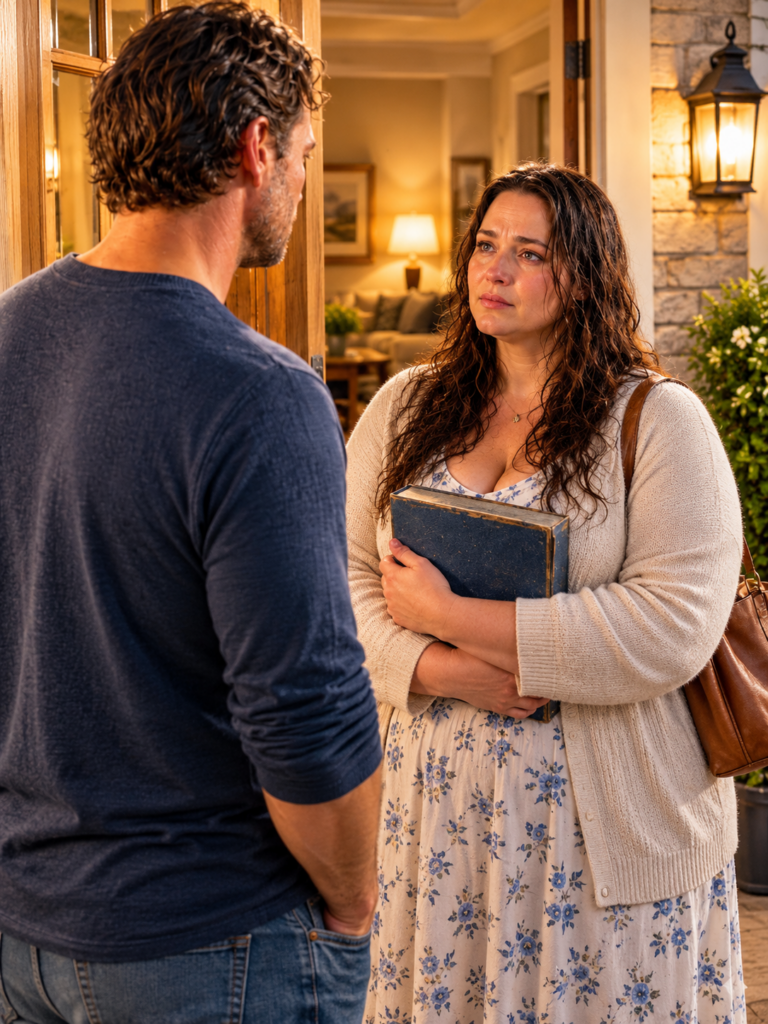
Rebecca stood beneath the porch light.
For a few seconds, neither of us spoke.
I had known her for years. I had watched Caleb fall in love with her, had stood beside him when they married, had helped the two of them paint their first living room outside Asheville. Rebecca had always possessed a kind of easy warmth. She noticed people. That was the best way I knew to describe it. At a crowded party, she somehow found whoever was standing alone.
That night she looked cold despite her coat.
Her eyes were swollen.
And pressed against her chest was a weathered blue envelope.
I looked at it, then at her.
“Rebecca?”
“Can I come in?”
“Of course.”
She stepped past me.
I shut the door against the November wind.
For one uncomfortable second, we stood in the entryway like acquaintances who had accidentally arrived at the same funeral.
That thought hit too close.
“Coffee?” I asked.
She nodded, though neither of us wanted coffee.
I made it because making coffee gave my hands something to do.
By the time I carried two mugs into the living room, Rebecca had taken off her coat and sat on the edge of my couch. The blue envelope remained in her lap beneath both hands.
I set a mug in front of her.
“Thanks.”
She didn’t touch it.
Neither did I.
The heater clicked again.
Rebecca looked toward the wall.
Something almost like a smile moved across her face.
“He hated that sound.”
I stared at her.
Then the memory came.
Caleb standing in my kitchen two winters earlier, pointing toward the vent while the system rattled itself awake.
Your house sounds like an old ship trying to survive a storm.
I’d told him that was rich coming from a man who had once driven a truck for six months with duct tape holding up one of the mirrors.
The memory should have been funny.
Instead, my throat closed.
Rebecca lowered her gaze.
“I almost didn’t come tonight.”
“You didn’t have to.”
“Yes.” Her fingers tightened around the envelope. “I did.”
There was something in her voice that made me stop trying to make the evening easier.
She took a breath.
“Caleb left this for you.”
For a moment, I couldn’t understand the sentence.
Then my eyes went back to the envelope.
“What?”
“He gave it to me before he died. He told me…” She stopped, swallowed, then started again. “He told me that if anything happened to him, I wasn’t supposed to give it to you right away.”
The room seemed to sharpen around us.
The lamp beside the couch.
Steam lifting from untouched coffee.
Rebecca’s thumb rubbing the frayed edge of the envelope.
“He said to wait a full year.”
My lungs forgot what they were doing.
“Why?”
“I don’t know all of it.”
“Rebecca.”
“I don’t.”
Her eyes met mine.
There was grief there, but something else too. Exhaustion, maybe. The particular exhaustion of carrying out a dead person’s instructions when every part of you wanted to argue with them.
“He made me promise.”
I sat across from her.
For a year I had thought the worst thing about death was its finality.
There would be no last conversation. No explanation. No chance to tell Caleb that he had been more of a brother to me than anyone sharing blood ever managed to be.
Now, somehow, he had reached across twelve months of silence and put a sealed envelope in Rebecca’s hands.
“I was angry with him,” she said quietly.
The confession surprised me.
“For leaving this?”
“For leaving anything unfinished.”
Her mouth tightened.
“I know that’s unreasonable.”
“No.”
“I was angry about stupid things. His shoes by the back door. A coffee mug he’d left on his desk. A grocery list in his handwriting.” She gave a short, humorless laugh. “For weeks I was furious every time I found something that proved he expected to come home.”
I stared into my coffee.
“I still have his last voicemail.”
Rebecca’s eyes lifted.
“I’ve never listened to it all the way through.”
She didn’t tell me I should.
That was one of the things I had always respected about her. Rebecca rarely forced people toward feelings because she thought they would be good for them.
She simply sat there.
After a moment, she held out the envelope.
My name was written across the front.
I knew Caleb’s handwriting immediately.
I didn’t take it.
Not at first.
Rebecca waited.
Finally, I reached across the space between us.
Our fingers touched briefly on the paper.
It was nothing.
An accident.
Yet both of us withdrew too quickly.
Maybe because grief made every touch feel more intimate than it was.
Maybe because for the past year we had existed mostly as reminders of the same person.
Caleb’s widow.
Caleb’s best friend.
Neither of us quite knew who we were to each other without him standing between us.
I opened the envelope.
Inside was one folded sheet of paper.
And a small brass key tied to a piece of red string.
I knew that string too.
Caleb used it for everything. Tool tags. Spare keys. Rolled-up drawings. Once, absurdly, to keep his suitcase closed after the zipper broke on a college road trip.
My vision blurred before I read the first line.
My name.
Just my name.
Then Caleb’s voice took over in my head.
He wrote that he had noticed me pulling away during the last months of his life.
My hands began to shake.
I read on.
He knew about the business.
Not everything, apparently, but enough.
The venture I had spent years building had failed in slow motion. First one lost contract. Then another. Bills I told myself I’d catch up on. Calls from creditors I stopped answering. Eventually, I had spent more energy hiding the damage than trying to repair it.
Caleb had asked me more than once if I was okay.
Every time, I had lied.
Fine.
Just tired.
Busy.
The usual vocabulary of a person who wanted help and couldn’t bear to be seen needing it.
I stopped reading.
Rebecca was watching me.
“He knew?”
“More than you thought.”
I laughed once, bitterly.
“Of course he did.”
“He worried about you.”
“I didn’t need him worrying about me.”
“I know.”
The words came without judgment.
That made them harder to hear.
I looked back at the letter.
Caleb wrote that he wasn’t trying to rescue me. He didn’t pity me. He simply believed I had forgotten something important about myself.
I had built things before.
Not furniture.
A life. A business. Friendships. Plans.
Things could fail without proving the person who made them was a failure.
I read that sentence twice.
Then came the instruction.
The key belonged to a workshop Caleb had rented outside town.
I looked up.
“What workshop?”
Rebecca finally lifted her coffee, although it had probably gone cold.
“He started renting it a while before he died.”
“For work?”
“Not exactly.”
“I never heard about it.”
“You weren’t supposed to.”
“Why?”
She gave me a tired look.
“Because my husband could turn secrecy into a hobby.”
Despite myself, I laughed.
It came out rough and unfamiliar.
Rebecca smiled.
For one second she looked like herself again.
Then both of us seemed to realize we had laughed in a room where Caleb was dead.
The smile faded.
I hated that.
Not the laughter.
The guilt afterward.
“Tell me,” I said.
So she did.
Caleb had been using the building on weekends. He had bought tools, made drawings, collected scraps of wood and donated materials. Rebecca knew pieces of it, though apparently even she hadn’t understood the full shape of what he intended.
“He said you’d understand when you saw it.”
“That sounds like him.”
“He also said you’d probably be angry.”
“That also sounds like him.”
This time, her smile lasted a little longer.
“We can go tomorrow,” she said.
I looked down at the brass key.
Part of me wanted to hand it back.
A dead man’s secret had weight. I hadn’t expected that.
“I don’t know if I want to.”
Rebecca nodded.
“Okay.”
That answer surprised me.
“Okay?”
“You don’t have to decide tonight.”
“But you waited a year to give it to me.”
“Because I promised him I would. That doesn’t mean you owe him the rest.”
I studied her face.
There was something almost fierce in the statement.
It occurred to me that she had spent a year living beneath Caleb’s absence too. A year being expected to honor him, miss him, preserve him, answer questions about him.
People made saints out of the dead because saints were easier to grieve than complicated human beings.
Rebecca, more than anyone, had known the complicated man.
“You’ve been carrying this for a year,” I said.
Her gaze dropped to the envelope.
“Yes.”
“You could have given it to me early.”
“I could have.”
“But you didn’t.”
“I promised.”
The answer was simple.
Still, something shifted in how I saw her.
Not as Caleb’s widow.
Rebecca.
A woman who had spent twelve months keeping a promise nobody alive could have forced her to keep.
“Tomorrow,” I said.
She looked up.
“I’ll go.”
At eight the next morning, she pulled into my driveway.
The sky was pale and overcast, the mountains blurred at their edges by low clouds.
I climbed into her car.
There was a travel mug in the cup holder beside me.
“For you,” she said.
I picked it up.
“Coffee?”
“Don’t sound so suspicious.”
“I’ve had your coffee.”
“You drank two cups last night.”
“Because I made it.”
Her mouth curved.
Something warm moved through me, so faint I almost missed it.
Then I saw Caleb’s old knit cap on the back seat.
The feeling vanished beneath guilt.
Rebecca noticed where I was looking.
She didn’t explain the hat.
She simply started driving.
We left Asheville behind and followed a quieter road toward the edge of town. Bare trees climbed the hillsides. Fallen leaves lay wet in the ditches.
Neither of us spoke much.
At one point Rebecca turned down the radio when a song Caleb had loved came on.
“You don’t have to do that,” I said.
“I know.”
She turned it off anyway.
The workshop stood behind an old farmhouse.
Small.
Peeling white paint.
Crooked sign above the door.
I got out of the car and stared.
“This?”
“This.”
“You’ve been here before?”
“A few times.”
“Why does that feel like another betrayal?”
Rebecca closed her door.
“Because Caleb knew how to make normal information sound like a conspiracy.”
I glanced at her.
She was trying to help.
Not with comforting words.
With the truth.
I walked to the door.
The brass key stuck halfway into the lock.
I muttered something under my breath.
Behind me, Rebecca said, “Lift the handle.”
I looked back.
“He never fixed it?”
“He said the door had character.”
“That’s Caleb-language for broken.”
“Usually.”
I lifted the handle.
The key turned.
The door opened.
And I forgot how to move.
Shelves filled the walls.
Woodworking tools hung from hooks in careful rows. Architectural drawings were rolled into tubes. Half-finished chairs and cabinets stood beneath cloth covers. Jars of screws and nails lined one shelf beside stacks of notebooks.
At the center of the room stood a workbench scarred from use.
Several small wooden toys rested on top.
A truck.
A horse.
A little house with crooked windows.
I picked up the house.
One corner was marked in pencil.
Caleb’s handwriting.
A measurement.
“He made these?”
Rebecca nodded.
I set the toy down carefully.
Nearby lay drawings for bookshelves, benches, desks and simple cabinets.
Not luxury furniture.
Useful things.
Human-scale things.
“What was he doing?”
Rebecca moved to the workbench.
“He wanted to make things for people who couldn’t afford to replace them. Families starting over. Shelters. Churches. Community centers.”
I looked around.
“He never told me.”
“He was still figuring it out.”
She paused.
“There’s more.”
Of course there was.
She crossed to a cardboard box in the corner.
Inside were handwritten notes.
Dozens of them.
Names.
Stories.
Small instructions.
Repair table.
Call about groceries.
Bookshelf for children’s room.
Utility bill? Ask Nathan.
Possible work.
I recognized a few names.
Most were strangers.
Caleb had apparently been quietly collecting people’s needs the way other men collected business cards.
I sat down on the workshop floor.
Rebecca lowered herself beside me.
For a while, neither of us spoke.
“I thought I knew him,” I said.
“You did.”
“Not this.”
“No one knows every room in another person.”
I looked at her.
She was staring at the box.
“Did you?”
“Did I what?”
“Know every room?”
Rebecca smiled sadly.
“No.”
That answer stayed with me.
I had spent a year imagining her grief as somehow more complete than mine because she had been his wife. As though marriage granted perfect access to another human being.
But she had been surprised too.
Left behind too.
I turned back to the box.
“So what did he want me to do?”
Rebecca took a slow breath.
“This is the part you’re going to hate.”
“Excellent.”
“He wanted you to take over the workshop.”
I laughed.
She didn’t.
My laughter stopped.
“No.”
“He didn’t mean as a business.”
“Rebecca, I don’t know how to build furniture.”
“I told him that.”
“I don’t know how to run a charity.”
“I told him that too.”
“My last business collapsed.”
“I know.”
That stung, though she hadn’t meant it cruelly.
I stood.
“Then you know how insane this is.”
She rose as well.
“I didn’t say it made sense.”
“He wanted me to finish this?”
“Yes.”
“I can barely fix a cabinet hinge.”
“I know.”
“Would you stop saying that?”
Her eyebrows lifted.
“Would you rather I pretend you’re secretly a master carpenter?”
Despite my anger, a laugh nearly escaped.
I turned away.
“I can’t be him.”
Rebecca’s answer came softly.
“No.”
I looked back.
Her eyes were wet.
“But he never asked you to be.”
Something in me went still.
“He wanted you to become yourself again.”
That was when I nearly walked away.
Not from Rebecca.
From the workshop.
From the key.
From the dead man who had apparently believed in a version of me I no longer recognized.
I left twenty minutes later.
For four days, I did not go back.
Every night, however, Caleb’s letter sat on my kitchen table.
And every night, one sentence waited for me.
Sometimes the person who saves us isn’t the person who carries us out of the darkness.
Sometimes it’s the person who reminds us we still have the strength to walk.
On the fifth morning, I put the brass key in my pocket.
And returned.
Part 2
The first board I measured was too short.
The second was also too short.
By noon, I had ruined a cabinet door and developed a personal hatred for a belt sander.
I stood in the workshop staring at the damage.
“You’ve been dead a year,” I muttered toward the ceiling, “and you’re still giving me terrible ideas.”
“Talking to him?”
I nearly dropped the tool.
Rebecca stood in the doorway holding two paper bags.
“Do people knock anymore?”
“You left the door open.”
“I could’ve been using something dangerous.”
“You were.”
She looked at the cabinet door.
“Apparently.”
I gave her a glare.
She held up the bags.
“I brought lunch.”
“You don’t have to keep checking on me.”
“I know.”
That answer again.
I set down the sander.
“Then why are you?”
For a second, something uncertain crossed her face.
She walked to the workbench and began unpacking sandwiches.
“Because I wanted to.”
I had no reply to that.
We ate sitting on mismatched stools.
The workshop was cold despite a small space heater near the wall. Rebecca kept her coat on and wrapped both hands around her coffee.
I noticed she looked tired.
Not ordinary tired.
The kind that settled beneath a person’s eyes.
“You sleeping?”
She glanced at me.
“Sometimes.”
“That’s not an answer.”
“It’s the answer you gave Caleb for six months.”
Fair.
I tore off a piece of sandwich.
“Still.”
She looked toward the window.
“Some nights are better.”
I waited.
Eventually she said, “The quiet is worse now than it was at first.”
I understood immediately.
At first there had been logistics.
Funeral arrangements. Paperwork. Food appearing on the porch. People calling.
Then everyone went back to their lives.
Grief remained.
“I keep expecting him to walk in while I’m doing ordinary things,” she said. “That’s the part nobody tells you.”
“The ordinary things?”
She nodded.
“I was folding towels last week, and for some reason I thought I heard him opening the garage door.”
Her voice thinned.
“I knew he wasn’t. I knew it. But for half a second…”
She stopped.
I looked down at my hands.
“Passenger seat,” I said.
“What?”
“When something funny happens on the radio.”
Rebecca looked at me.
“I still turn to tell him.”
Her expression changed.
Not relief exactly.
Recognition.
It was the first time I understood that shared grief wasn’t simply two people talking about the dead.
Sometimes it was one person saying, This strange thing happens to me.
And another answering, Me too.
After that, Rebecca began stopping by the workshop more often.
Not every day.
Never on a schedule we acknowledged.
Sometimes she brought coffee.
Sometimes paperwork Caleb had left behind.
Once she showed up with three boxes of old hardware from their garage.
“You’re donating all this?”
“I’m reclaiming the ability to park.”
“You could sell it.”
She gave me a look.
“Have you met my garage?”
“I helped paint your house.”
“That was before Caleb discovered clamps.”
I laughed.
The guilt arrived afterward, but less sharply now.
Rebecca must have seen it.
“You know we’re allowed to do that.”
“What?”
“Laugh.”
“I know.”
“No. You know intellectually.”
She set a box down.
“He laughed after people died.”
“That’s a terrible defense.”
“It’s what he’d use.”
She was right.
So I let myself smile.
A week later, Harold appeared.
He was a retired carpenter with hands that looked capable of intimidating lumber into cooperation.
Rebecca had mentioned the workshop to him.
He inspected my cabinet door in silence.
Finally he said, “You do this on purpose?”
“No.”
“Pity.”
“Why?”
“Would’ve been impressive.”
Then he showed me what I’d done wrong.
Grace, a local teacher, arrived with leftover classroom supplies.
Nathan from a nearby church began bringing sandwiches on Saturday mornings.
The workshop accumulated people the way Caleb had apparently intended.
With people came work.
And with work came reasons to get out of bed.
Rebecca became good at identifying what we needed before I admitted we needed it.
“You need a system,” she said one Saturday, surveying the notes scattered across Caleb’s workbench.
“I have a system.”
“You have piles.”
“Organized piles.”
“One of them is on the floor.”
“Overflow.”
She stared at me.
“Move.”
For two hours we sorted requests into categories.
Repairs.
New builds.
Community projects.
Immediate needs.
Things we couldn’t do but might know someone who could.
At one point our shoulders brushed as we reached for the same note.
Rebecca pulled back.
So did I.
Too quickly again.
The silence that followed wasn’t like the silence from that first night.
This one had awareness inside it.
I hated myself for noticing.
Caleb’s photograph stood on a shelf ten feet away.
I got up.
“Coffee.”
Rebecca’s expression went neutral.
“Sure.”
I walked outside instead.
Cold air hit my face.
I stayed there longer than necessary.
When I returned, she was still sorting notes.
Neither of us mentioned what had happened.
Nothing had happened.
That was the problem.
Months passed.
The workshop slowly became something alive.
Teresa came in carrying a photograph of a damaged dining table.
“It belonged to my parents,” she explained.
Her husband had lost his job. Money was tight. One leg had split and the tabletop had warped enough that she had planned to throw it away.
Harold inspected it.
“We can fix it.”
Teresa immediately asked the price.
I looked at Harold.
He looked at me.
I heard Caleb’s voice in my head.
“Nothing,” I said.
Her face changed.
“I can’t let you—”
“Then don’t let us. Bring cookies.”
She blinked.
“Cookies?”
“Harold’s expensive.”
Behind me Harold said, “Chocolate chip.”
Teresa laughed.
So did Rebecca.
We fixed the table.
Not perfectly.
But well.
When Teresa returned, she ran her palm over the restored surface.
Then she began to cry.
“This is where my mother taught my daughter to bake,” she whispered.
Nobody knew what to say.
So we didn’t say anything.
Teresa hugged me.
After she left, I stood alone for several minutes staring at the place where the table had been.
Rebecca came to stand beside me.
“Caleb knew,” I said.
“Knew what?”
“Why this mattered.”
She looked toward the empty space.
“Yes.”
“I thought he was trying to save people.”
“Maybe he was trying to remind them.”
I glanced at her.
“Of what?”
“That something damaged can still be worth keeping.”
The words landed between us.
Rebecca seemed to realize it too.
Her eyes met mine.
Neither of us moved.
Then Harold yelled from the back room, “If you two are done philosophizing, I’ve got a shelf that’s losing an argument with gravity.”
Rebecca laughed first.
I followed.
But later that night, alone in bed, I remembered the way she’d looked at me.
That frightened me more than the workshop ever had.
I began measuring my days partly by whether Rebecca came through the door.
I told myself that was normal.
She was connected to the project.
She knew Caleb’s notes.
She understood why the place mattered.
Then one Tuesday she didn’t come.
I noticed at ten.
At noon.
At three.
By five, I was angry with myself for counting.
The next morning she arrived carrying paint samples.
“Where were you yesterday?”
The question came out before I could stop it.
Rebecca paused.
“At home.”
“Oh.”
“Why?”
“No reason.”
Her eyes narrowed slightly.
“Did you need something?”
“No.”
A beat passed.
Then she set the samples on the table.
“Okay.”
I spent the next hour sanding a desk with unnecessary aggression.
Later, she handed me a bottle of water.
“You missed me.”
I nearly choked.
“I needed the paint samples.”
“Of course.”
“You said you’d bring them Monday.”
“It was Tuesday.”
“Exactly.”
A smile tugged at her mouth.
I pointed the water bottle at her.
“You’re enjoying this.”
“A little.”
I wanted to say something clever.
Instead I looked at her and became abruptly aware of how dangerous ordinary affection could be.
Not desire.
That would almost have been easier.
This was worse.
I knew how Rebecca took her coffee.
She knew when my shoulder hurt before I admitted it.
I could tell when she’d had a bad night because she tied her hair back instead of leaving it loose.
She knew I hated asking volunteers for help and quietly did it before I could exhaust myself.
We had accumulated knowledge of each other.
Small, domestic facts.
The kind that created attachment without permission.
And underneath all of it stood Caleb.
One evening, after everyone else had left, Rebecca found me replacing a blade on a saw.
“You’ve been avoiding me.”
“No.”
“You’ve been extremely polite for nine days.”
“I’m always polite.”
She stared.
“That’s how I knew.”
I set the tool down.
“I don’t know what you want me to say.”
“The truth would be new.”
I laughed without humor.
“That’s unfair.”
“Probably.”
She folded her arms.
“I’ve spent a year being careful around everyone. People look at me like I’m made of glass. I don’t need it from you too.”
“I’m not treating you like glass.”
“Then what are you doing?”
I turned away.
The workshop suddenly felt too small.
“I don’t know what this is.”
Her voice softened.
“What what is?”
“This.”
I gestured between us.
Silence.
There it was.
The thing we had both refused to name.
Rebecca looked toward Caleb’s workbench.
“I don’t know either.”
“He’s my best friend.”
“I know.”
“Was.”
The word hurt.
Rebecca closed her eyes briefly.
When she opened them, I wished I could take the sentence back.
“I’m sorry.”
“No. He’s still your best friend.”
I stared at her.
She swallowed.
“And he’s still my husband in ways I don’t know how to explain.”
That should have ended the conversation.
Instead it made me step closer.
Not touching.
Just closer.
“I would never ask you to stop loving him.”
Her face crumpled for half a second before she steadied it.
“I know.”
“And I don’t want whatever this is to turn him into something we’re ashamed of.”
She looked at me then.
Fully.
“You think I don’t worry about that?”
I had no answer.
She rubbed her palms together as if they were cold.
“I’ve wondered whether every time I laugh here, I’m betraying him. Every time I look forward to coming here. Every time I drive home and realize the worst part of my day was leaving.”
The last sentence struck somewhere deep.
“Rebecca.”
“I know.”
“No, I don’t think you do.”
She laughed quietly, painfully.
“There it is again.”
“What?”
“You trying to protect me from something I’m already standing inside.”
I looked away.
She crossed the distance between us, not enough to touch.
Enough that I could smell sawdust on her coat.
“This can’t be something either of us uses to escape grief,” she said.
“It isn’t.”
“You don’t know that.”
“Neither do you.”
“Exactly.”
That was why she was Rebecca.
Even now, when every selfish part of me wanted reassurance, she refused to give us an easy lie.
“So what do we do?”
“We don’t force it.”
I nodded.
“And we don’t pretend it isn’t there.”
That was harder.
But I nodded again.
She reached toward me.
For one breath, I thought she might take my hand.
Instead she picked a splinter of wood from my sleeve.
Such a small thing.
My entire body went still.
Her fingers lingered near my arm.
Then fell.
“I should go.”
“Probably.”
Neither of us moved.
Finally she stepped back.
“Good night.”
“Good night, Rebecca.”
She reached the door.
“Hey.”
She turned.
I almost said something reckless.
Instead: “Drive carefully.”
Her expression softened.
“You too.”
“I’m not driving.”
“I know.”
She left smiling.
I stood alone in the workshop and laughed into my hands.
Caleb would have found the whole thing hilarious.
That thought no longer felt entirely like guilt.
A strange tenderness lived beside it now.
The months kept moving.
We built desks for children who needed somewhere to study.
Shelves for community rooms.
Wooden toys.
Benches.
We repaired chairs whose owners could have bought cheap replacements but couldn’t replace the memories attached to them.
Nobody paid if they couldn’t.
People who could afford to contribute sometimes covered materials for strangers they would never meet.
The workshop became a chain of small kindnesses.
My life changed with it.
The failed business stopped being the first fact I remembered about myself every morning.
I slept.
Not perfectly.
But enough.
I laughed more.
Rebecca and I began sharing meals sometimes after closing.
Nothing that resembled a date.
We were very careful about that.
Too careful, perhaps.
One rainy evening, we sat beneath the workshop awning eating takeout from cartons balanced on our knees.
Rebecca nudged my shoe with hers.
“You realize everyone thinks we’re together.”
I nearly dropped my fork.
“Who?”
“Everyone.”
“Harold?”
“Especially Harold.”
“Harold thinks anyone under seventy is together.”
“Grace asked me.”
“What did you say?”
Rebecca stared out at the rain.
“The truth.”
Which was?
I waited.
Finally she said, “I told her I didn’t know.”
I looked at her profile.
“Did she ask if you wanted to know?”
Rebecca turned.
“Yes.”
The rain filled the pause.
“And?”
She gave me a small smile.
“I told her that was none of her business.”
I laughed.
Then she did.
Our shoulders rested together beneath the awning.
Neither of us moved away.
That was all.
At the time, it felt like everything.
Part 3
Spring reached Asheville slowly.
The trees brightened first.
Then the mornings.
One day I realized I could work with the workshop door open without freezing.
Almost six months after I had returned to Caleb’s workshop, Rebecca arrived carrying another envelope.
The sight of it stopped me cold.
She saw my expression.
“It’s not what you think.”
“That’s exactly what you said last time.”
“I did not.”
“You had mysterious-widow energy.”
“Mysterious-widow energy?”
“You showed up after dark with a dead man’s letter.”
Despite herself, she laughed.
Then her face softened.
“I found something.”
She handed me the envelope.
Inside was a photograph.
The three of us at a summer barbecue years earlier.
Caleb stood between Rebecca and me, laughing with his head thrown back.
I remembered the day.
Caleb had burned the first batch of burgers and insisted the grill was defective.
Rebecca had told him a grill could not be personally offended by him.
He’d disagreed.
I ran my thumb along the photograph’s edge.
“I haven’t seen this in years.”
“It was behind an old cabinet.”
I turned it over.
There was writing on the back.
Caleb’s.
I read it once.
Then again.
A good life, he had written, was never measured by how long someone stayed, but by how much kindness they left behind.
My vision blurred.
I looked away.
For so long I had cried because Caleb was gone.
That morning I cried because he had been here.
Because he had lived.
Because he had noticed people.
Because he had noticed me when I was twenty years old and sitting alone outside a college library in the rain, too proud to admit I hadn’t eaten since the day before.
He had sat down.
Split his sandwich.
Never asked me to explain.
A hand touched mine.
Rebecca.
Not accidentally this time.
Her fingers closed around mine.
I let them.
We stood together beside the workbench where Caleb’s drawings still lay beneath sheets of clear plastic.
“I miss him,” I said.
“I know.”
“I think I always will.”
“So will I.”
I looked down at our hands.
Rebecca didn’t pull away.
“What are we doing?”
Her thumb moved once across my knuckle.
“Living, I think.”
The answer broke something open in me.
I turned toward her.
She was close enough that I could see the tiny crease between her eyebrows when she was trying not to cry.
I wanted to kiss her.
The realization came without drama.
No thunder.
No sudden music.
Just certainty.
And because I wanted it, I stepped back.
Rebecca’s hand slipped from mine.
Pain crossed her face.
“I can’t,” I said.
She went still.
I hated myself immediately.
“Not like this,” I added.
Her eyes searched mine.
“I don’t want our first real choice to happen while we’re both crying over him.”
Something changed in her expression.
Not disappointment.
Understanding.
Maybe even relief.
“You’ve thought about our first choice?”
I let out a breath.
“Unfortunately.”
Her mouth curved.
“Good.”
“Good?”
“I was beginning to think I imagined the last six months.”
“You absolutely did not.”
She laughed through tears.
Then she picked up the photograph.
“Come on.”
“Where?”
“We need a frame.”
“For this?”
“For him.”
So we drove into town.
It was absurdly ordinary.
We argued over frames.
She chose simple wood.
I claimed Caleb would have selected something pretentious and architectural.
She said he would have called it “structurally expressive.”
I almost laughed in the aisle of a hardware store until I couldn’t breathe.
A year earlier, I would have hated myself for that.
That day, I didn’t.
We put the photograph above the workbench.
Afterward, things between Rebecca and me became easier because we’d finally admitted they were difficult.
We stopped pretending there was nothing there.
We also stopped demanding that it become something immediately.
Sometimes she came to the workshop and touched my shoulder in passing.
Sometimes I walked her to her car.
Once, when she was exhausted, she fell asleep in an old chair while I finished sanding a tabletop. I draped my jacket over her and kept working.
She woke forty minutes later.
“You should have woken me.”
“You needed sleep.”
Her eyes lingered on the jacket.
“Thank you.”
Two words.
They stayed with me all night.
What grew between us wasn’t a replacement.
That mattered.
Caleb did not shrink as Rebecca became more important to me.
He didn’t have to.
Love, I slowly understood, wasn’t a room with limited chairs.
The heart could hold grief and gratitude.
Memory and desire.
Loyalty to what had been and hope for what might still be.
A year after Rebecca first came to my door, the workshop held its first community gathering.
We didn’t call it an anniversary.
That felt too formal.
People brought food.
Harold complained about everybody touching his tools.
Grace brought students who had helped paint a set of bookshelves.
Nathan arrived carrying enough sandwiches for twice the number of guests.
Teresa came with her husband.
Families we had helped stood beside volunteers who had never met Caleb.
Children played with wooden toys modeled after the originals he had left on the workbench.
His photograph hung above them.
No monument.
No plaque.
Nothing grand.
Just Caleb laughing in a photograph while ordinary people filled the room with noise.
At one point I found Rebecca standing near the doorway watching everything.
I went to her.
“You okay?”
She nodded.
“Just looking.”
“At what?”
“This.”
Her eyes traveled across the room.
“He would’ve loved it.”
“Yeah.”
“He would’ve complained about the organization.”
“Absolutely.”
“And that crooked shelf.”
“That shelf is structurally expressive.”
Rebecca turned toward me.
For a second she simply stared.
Then she laughed.
Not carefully.
Not apologetically.
Her whole face changed.
I loved her in that moment.
There was no sensible way around the word anymore.
That frightened me.
But not enough to make me run.
Later, as people began leaving, Rebecca and I stood beside the workbench.
She looked up at Caleb’s photograph.
“He’d be proud of you.”
I shook my head.
“Us.”
“What?”
“He’d be proud of us.”
Her eyes met mine.
I meant the workshop.
I meant the volunteers.
I meant every repaired chair and donated shelf.
But something else existed inside the word too.
Us.
Rebecca heard it.
I could tell.
The last guests said goodbye.
Harold locked the supply cabinet with exaggerated suspicion.
Nathan carried trash bags outside.
Then the workshop emptied.
Rebecca helped me stack the remaining chairs.
Neither of us spoke about what came next.
I didn’t know if there was supposed to be a moment.
Maybe years of friendship with Caleb had trained me to expect important things to arrive disguised as ordinary ones.
When everything was put away, we stepped outside.
The mountains were dark in the distance.
The air smelled like rain.
I locked the workshop.
For a moment I imagined Caleb beside me.
Not as a ghost.
Just a memory so familiar it felt physical.
He would have looked at the door, looked at me, then made some insulting comment about my woodworking.
I smiled.
“What?” Rebecca asked.
“Nothing.”
“You’re smiling at nothing.”
“I was thinking about what Caleb would say.”
“About tonight?”
“About my carpentry.”
She considered.
“Probably that your measurements remain emotionally ambitious.”
I laughed.
“That’s exactly the kind of nonsense he’d say.”
The porch light cast a warm circle around us.
I put my hand in my pocket.
The brass key was still there, tied to the same faded red string.
I had carried it almost every day for a year.
For so long, I had thought the key opened a door to something Caleb wanted me to finish.
That night I finally understood.
The workshop was not the secret.
The secret was that Caleb had still believed my life contained usefulness when I couldn’t see it.
He had left me work worth doing.
People worth showing up for.
A reason to begin.
Rebecca was watching me.
“Where’d you go?”
“Nowhere.”
“You do that.”
“What?”
“Disappear into your head.”
“You notice too much.”
“So did he.”
I looked at her.
“Yeah.”
The old guilt did not rise this time.
Only affection.
For Caleb.
For her.
For the strange, painful road connecting all three of us.
“Rebecca.”
Her expression changed slightly.
She knew.
Maybe she’d known before I did.
I stepped closer.
“I’m not asking you to leave him behind.”
She inhaled slowly.
“I couldn’t.”
“I know.”
“And I’m not asking you to.”
“I’m not.”
Her eyes shone beneath the porch light.
I continued before fear could turn my words into something safer.
“I don’t know what the rules are for this.”
“Neither do I.”
“I don’t want to be the person you chose because you were lonely.”
“You’re not.”
“I don’t want you to be the person I chose because you were part of him.”
“I’m not that either.”
The certainty in her voice quieted me.
Rebecca stepped closer.
“I loved Caleb.”
“I know.”
“I still love Caleb.”
“I know.”
“And somewhere in the middle of missing him, I started looking for your truck when I drove up this road.”
My breath caught.
She smiled nervously.
“I started saving things to tell you.”
I knew exactly what she meant.
The ordinary things.
Funny signs.
Annoying people.
A story from the grocery store.
The things that seemed insignificant until there was one particular person you wanted to tell.
“I started doing that too,” I admitted.
“That’s what scared me.”
“Me too.”
“And then you got annoyingly respectful.”
I laughed.
“I thought I was helping.”
“You made me want to shake you.”
“Harold would’ve volunteered.”
“Harold threatened to lock us in the supply room.”
“He what?”
“I told him absolutely not.”
“Thank you.”
“He said we were wasting everyone’s time.”
“That sounds like Harold.”
Rebecca’s smile faded into something softer.
“I’m not looking for permission from Caleb.”
Neither was I.
That realization mattered.
For months, part of me had imagined there had to be some invisible verdict.
Would Caleb approve?
Would he be hurt?
Would loving Rebecca make every year of my friendship with him dishonest in retrospect?
But the dead could not make the choices of the living.
And Caleb, more than anyone I knew, had believed people deserved the dignity of choosing their own lives.
So I looked at Rebecca.
Not Caleb’s widow.
Not the woman who had brought me an envelope.
Rebecca.
The woman who kept promises.
Who showed up with coffee.
Who could organize a room full of chaos in ten minutes.
Who understood that grief sometimes sounded like a garage door that would never open.
Who had learned my silences well enough to challenge the wrong ones.
“If I kiss you,” I said, “I need it to be because we’re choosing something. Not because tonight was emotional.”
Her eyes held mine.
“It took you a year to get here.”
“I’ve never been accused of efficiency.”
“No.”
She stepped closer.
“You haven’t.”
I waited.
I needed her choice to be unmistakable.
Rebecca understood that too.
She closed the last inches herself.
The kiss was gentle.
Brief.
Nothing like the kind of kiss people wrote songs about.
Better, somehow.
Because when we separated, nobody vanished.
No revelation changed the world.
No grief disappeared.
Caleb was still dead.
We still missed him.
The workshop still needed repairs.
I still had more healing to do.
Rebecca did too.
But her hand remained in mine.
“Okay?” I asked.
She smiled.
“Ask me tomorrow.”
My stomach dropped.
Then she squeezed my fingers.
“And the day after that.”
I understood.
Not a promise that nothing would hurt.
Not a demand for certainty.
A choice made again.
Tomorrow.
Then again.
That was enough.
Rebecca looked toward the workshop door.
“What are you thinking?”
I took the brass key from my pocket.
“A year ago I thought this opened something he wanted me to finish.”
“And now?”
I turned it over in my palm.
The red string was frayed almost white in places.
“Now I think it opened the door back to my life.”
Rebecca’s eyes filled.
She leaned her head lightly against my shoulder.
We stood beneath the porch light without speaking.
The mountains disappeared into darkness beyond the road.
Somewhere in the trees, rain began moving toward us.
For a long time I had believed grief meant carrying the shape of someone’s absence forever.
Maybe it did.
But that wasn’t all it meant.
Sometimes the people we loved left pieces of themselves inside the lives they changed.
A habit.
A joke.
A promise.
A workshop.
A ridiculous brass key.
Caleb had left kindness scattered everywhere.
Rebecca and I were not the ending of his story.
We were two people still living because his life had crossed ours.
And loving each other would not erase him.
It would not replace him.
It would not turn loss into something beautiful just because beauty grew afterward.
Loss was still loss.
But life, stubbornly, kept asking to be lived.
Rebecca lifted her head when the first drop of rain struck the porch roof.
“We should go.”
“In a minute.”
She looked at me.
“Why?”
I smiled.
Because for once I wasn’t in a hurry to escape a memory.
Because the woman beside me wasn’t only connected to everything I had lost.
She had become part of what I was choosing.
Because somewhere between a broken table, a box of handwritten notes, cold coffee, badly measured boards, and a promise kept for a year, I had stopped believing my life was over.
I put the key back into my pocket.
Then I took Rebecca’s hand.
And together we stood there a little longer, beneath the porch light Caleb had led us to without ever knowing exactly what we would find.
A year earlier, I had opened my front door and thought my dead best friend had somehow found a way to knock.
I understood now that he had.
But he hadn’t come back to ask me to live in the past.
He had come to remind me that there was still a door in front of me.
And that I was allowed to walk through it.


