
Her sneaker found the first narrow wooden step, and Beatrice pulled the hidden panel shut behind her.
Darkness swallowed everything.
She descended sideways, one hand gripping the rail and the other protecting her stomach.
Every board seemed loud enough to expose her.
Every breath sounded criminal.
Halfway down, pain tightened across her lower back.
Beatrice froze.
Not labor.
Please not labor.
She waited until the pressure eased, then continued.
At the basement landing, she found the duffel exactly where it had fallen.
That tiny success nearly broke her.
She wanted to sit down and cry.
Instead she lifted the bag.
Survival first.
Grief later.
The underground garage was brighter than the stairwell and far more dangerous.
Rows of Gabriel’s vehicles gleamed beneath fluorescent lights.
Mercedes.
Range Rovers.
A Bentley Chloe had begged to drive.
Beatrice ignored all of them.
Every luxury car carried tracking hardware.
Gabriel knew where they were before the engines cooled.
She moved toward the far corner.
There.
Hector’s old Ford pickup.
Faded paint.
Rust around the wheel wells.
A cracked plastic toolbox behind the cab.
Gabriel would never voluntarily sit inside it.
Which made it perfect.
Two days earlier, Hector had mentioned that he planned to leave the truck at the estate during the holiday because the battery was unreliable.
He had also complained that he kept losing his spare key, so he finally started leaving it in the utility drawer.
Beatrice crossed to the fuse box.
Opened the drawer.
Nothing.
Her stomach dropped.
She searched again.
Screws.
Electrical tape.
A flashlight.
No key.
Footsteps sounded somewhere above.
Beatrice closed her eyes.
Think.
Hector hated clutter.
He labeled everything.
Her fingers searched the back of the drawer and found a small metal hook beneath the flashlight.
Keys.
Beatrice nearly laughed.
She took them and moved.
The truck unlocked with a protesting squeak.
She climbed behind the wheel and pushed the duffel onto the passenger seat.
For the first time since seeing Gabriel kiss Chloe, she allowed herself one full breath.
Then she turned the key.
The engine coughed.
Stopped.
“No.”
She tried again.
A grinding choke answered.
Above the garage, a door slammed.
Beatrice’s pulse surged.
A third turn.
The old engine roared awake.
The sound exploded through the concrete space.
There was no more hiding.
Beatrice shifted into drive.
Headlights swept across polished black cars.
At the far end of the garage, a security door opened.
A guard stepped through.
He stared at the truck.
Then at Beatrice.
Recognition spread across his face.
“Mrs. Rossi?”
She hit the accelerator.
The Ford surged toward the service ramp.
The guard reached for his radio.
Beatrice lowered the window just enough to shout.
“Don’t.”
He hesitated.
That hesitation saved her.
The truck climbed the ramp.
The secondary service gate stood partly open for catering deliveries.
Beatrice drove straight through.
Cold air slapped the windshield.
Fireworks still flashed behind the mansion.
She reached the road.
For one unbearable second, the estate filled her rearview mirror—stone walls, iron gates, glowing windows, the bedroom where Gabriel expected her to be crying.
Then a bend in the road swallowed it.
Beatrice kept driving.
She did not take the highway.
She did not call anyone.
She did not use Gabriel’s money except the cash she had already converted months before.
Her first destination was not freedom.
It was uncertainty.
And uncertainty was the only place Gabriel Rossi had never imagined his wife could live.
By sunrise, he would discover the empty bedroom.
By breakfast, he would know which passage she had used.
By noon, he would have men searching highways, airports, train stations, bakeries, hotels, hospitals, relatives, and every town where her name had ever appeared.
Beatrice knew all of that.
So when the first pale line of dawn appeared over the frozen river, she did something harder than escaping.
She stopped thinking like Beatrice Rossi.
She turned off the road Gabriel would expect.
She drove west.
And while her husband began tearing apart everything connected to her old life, the woman he had called too dependent to survive drove toward a life he did not know existed.
She drove toward that unknown life until exhaustion blurred the road into gray ribbons beneath the headlights.
Beatrice avoided major highways whenever she could.
She paid cash.
She slept in the truck twice and in anonymous roadside motels when the cold became dangerous.
She bought food at small grocery stores, chose places without obvious cameras near the entrances, and never stayed long enough to become memorable.
The farther west she went, the less the world resembled Gabriel’s.
That helped.
It also frightened her.
Freedom was not warm.
It was not cinematic.
It did not arrive with triumphant music and sunlight.
Freedom, at first, was a stiff neck from sleeping upright, swollen feet inside damp sneakers, canned soup eaten with a plastic spoon, and fear every time headlights remained behind her too long.
But every miserable mile belonged to her.
Six weeks after New Year’s Eve, snow buried Traverse City, Michigan.
Beatrice Rossi disappeared there.
Bethany Reed took her place.
It was not an elegant identity.
That was intentional.
Bethany rented a cramped room above an old hardware store whose pipes groaned at night.
She worked for cash in the kitchen of Ruth’s Diner.
Ruth was a silver-haired woman with a stare sharp enough to peel paint.
On Beatrice’s first morning, Ruth looked at her belly, her exhausted face, and the cheap duffel carrying everything she owned.
“You running from someone?”
Beatrice went still.
Ruth shrugged.
“You don’t have to tell me who.”
“Then why ask?”
“So I know whether to call the police if somebody comes looking.”
Beatrice lowered her eyes.
“No police.”
Ruth studied her another second.
“All right.”
That was all.
No interrogation.
No pity.
No demand for gratitude.
Ruth gave her kitchen work, cash at the end of each shift, and an emergency key to the diner.
The simplicity of it felt almost luxurious.
Back in New Jersey, Gabriel was dismantling his own world searching for her.
Beatrice did not know the details.
But she knew him.
She knew his first instinct would be force.
His second, money.
His third, humiliation.
He would question staff.
Threaten drivers.
Pull traffic footage.
Lean on officials.
Search every bakery she had ever visited.
What he would not do—what his pride would resist—was imagine her living poor by choice.
Gabriel understood deprivation as punishment.
Beatrice had learned to see it as camouflage.
She wore secondhand sweatshirts.
Stopped coloring her hair.
Kept her head down.
And every night, after swollen feet and an aching back forced her into the rocking chair beside her drafty window, she reviewed the one thing Gabriel did not know she carried.
A tiny encrypted drive.
The files on it had begun as curiosity.
Months before New Year’s Eve, while managing household expenses, Beatrice had noticed transfers that did not fit.
Amounts too large to be ordinary.
Descriptions too vague to be legitimate.
Gabriel kept his criminal world away from her whenever convenient, but he had also underestimated how much passed through the mansion.
Invoices.
Private ledgers.
Payment schedules.
Copies left briefly inside folders before disappearing into his office.
Beatrice had started photographing pages.
At first, she told herself she wanted insurance.
Then the evidence grew.
Offshore accounts.
Bribes.
Payments that made even her limited understanding of Gabriel’s operations turn cold.
She copied everything she could without changing the originals.
She never confronted him.
That restraint had once felt cowardly.
Now she understood it differently.
She had known, somewhere deep inside, that information was the only leverage he could not physically take from her without knowing it existed.
One Tuesday evening, Ruth found Beatrice gripping a diner counter with both hands.
“You okay?”
Beatrice tried to answer.
Then another contraction folded through her.
Warm fluid soaked through her leggings.
Ruth dropped the rag she was holding.
“Oh, hell.”
“I’m early.”
“You’re in labor.”
“I can’t go to the hospital.”
“You can and you will.”
“No records.”
Ruth’s expression sharpened.
“Bethany.”
Beatrice looked at her.
“My name isn’t Bethany.”
Silence stretched between them.
Then Ruth grabbed her coat.
“Tell me in the car.”
Fourteen hours later, Beatrice held her son.
He had thick dark hair.
A furious cry.
Ten tiny fingers that curled around one of hers with impossible strength.
For months, Gabriel had called the baby his heir.
His son.
His blood.
Sitting beneath fluorescent clinic lights, Beatrice looked at the child and understood how thoroughly that language had erased her.
She had carried him.
Protected him.
Run for him.
Bled bringing him into the world.
She named him Leo.
Not Gabriel.
Not after any Rossi ancestor.
Leo.
His own beginning.
For three days, Beatrice allowed herself to believe she had done it.
Then fear returned.
The evidence drive could protect them only if Gabriel knew destroying her would destroy him too.
That required a dead-man switch.
She could not build a sophisticated system from a burner phone.
She needed a public computer.
It was the first gamble she had taken since arriving.
At the library, she kept the session short.
Encrypted account.
Delayed distribution.
Multiple recipients.
Federal authorities.
Financial investigators.
And, because Gabriel feared rivals nearly as much as prison, selected syndicate addresses copied from information she had seen in his records.
Her protection did not depend on anyone believing she was innocent.
It depended on everyone believing the evidence was valuable.
She uploaded the archive.
Set the trigger system.
Disconnected.
Less than seven minutes.
Too long.
Three nights later, Beatrice sat in the rocking chair beside Leo’s bassinet while a storm hammered snow against the windows.
The streetlight outside went dark.
She stopped rocking.
Another light vanished.
Then another.
Not the power.
The building still hummed.
Only the street.
Beatrice stood.
Her body was still healing from childbirth, and the movement hurt.
She ignored it.
She carried Leo to the bassinet nearest the radiator and wrapped him tighter.
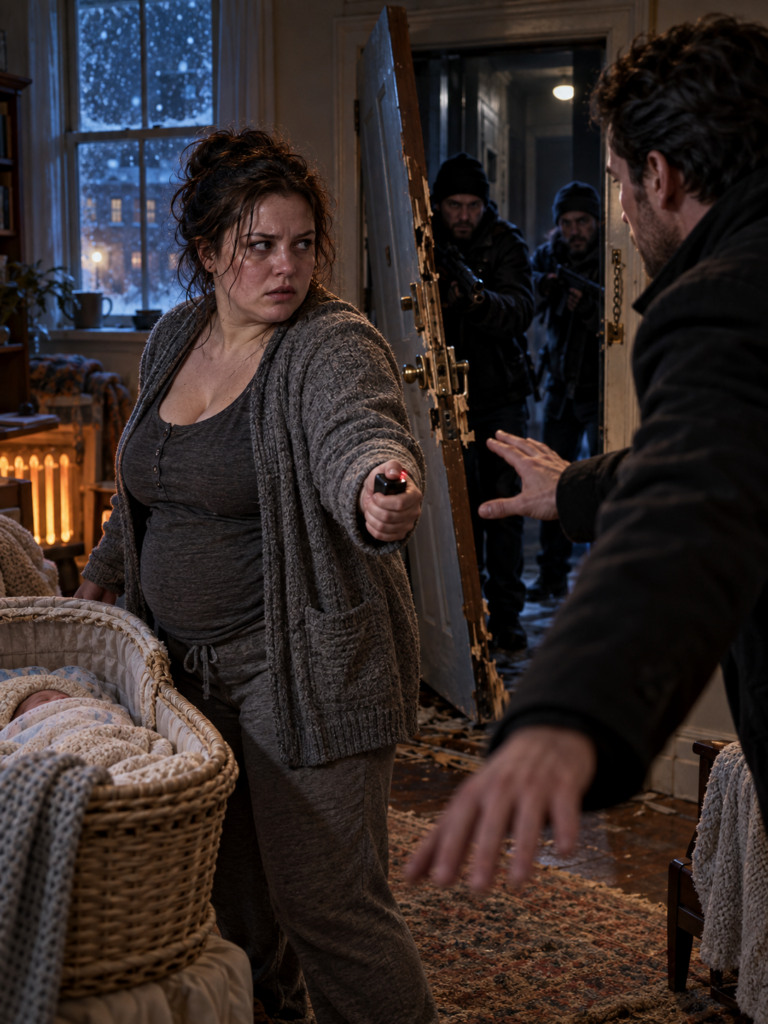
Then she opened the drawer beside the chair.
Inside waited a small black remote.
It looked dramatic.
Its purpose was simple.
As long as she kept pressure on its button during an active emergency session, the release remained paused.
If pressure disappeared after activation, the system sent the files.
She activated it.
A sound came from the stairwell.
Heavy.
Controlled.
Not one person.
Several.
Beatrice’s fear became strangely quiet.
For six weeks she had imagined this moment.
In every version, Gabriel arrived enormous in her mind.
Untouchable.
The center of gravity.
But now, standing in a rented apartment with peeling paint and her newborn son breathing behind her, something had changed.
Gabriel had found her.
That meant running was over.
Now came negotiation.
The door exploded inward.
Wood splintered across the floor.
Cold air rushed through the apartment.
Gabriel stepped inside.
Two men appeared behind him.
Both armed.
He raised one hand.
They remained in the hallway.
His gaze found Beatrice.
For several seconds, neither spoke.
Gabriel looked thinner.
Harder.
Something in his face had sharpened during the weeks she was gone.
But the old certainty returned when he saw Leo.
His eyes moved past her.
The bassinet.
The dark hair.
The tiny sleeping face.
Triumph transformed him.
“You had my son.”
Beatrice’s grip tightened on the remote.
“No.”
Gabriel looked at her.
“I gave birth to my son.”
His eyes narrowed.
“You led me across half the country.”
“I didn’t lead you anywhere.”
“I tore New York apart.”
“That sounds like your choice.”
He stepped forward.
Beatrice did not move.
Gabriel stopped.
There was no sofa between them.
No guard.
No marble hallway.
Nothing except air and the difference between the woman he remembered and the woman standing in front of him.
He looked at her worn clothes.
The small apartment.
The chipped furniture.
“You lived like this?”
Beatrice almost smiled.
There it was.
Not concern.
Disbelief.
He could imagine her dying before he could imagine her adapting.
“Yes.”
“You could have called me.”
“For what?”
His jaw moved.
“For anything.”
“You locked me in a bedroom.”
“You were pregnant and hysterical.”
“I was leaving.”
“You weren’t safe.”
“With you?”
That landed.
Gabriel’s eyes shifted.
Only slightly.
But Beatrice saw it.
He tried another path.
“Come home.”
“No.”
“Beatrice.”
“No.”
“Leo needs—”
“Don’t say his name like you earned it.”
The hallway men looked away.
Gabriel’s face hardened.
He stepped closer.
“I am his father.”
“And I am the woman you threatened to confine until she gave birth.”
“I was angry.”
“You were honest.”
His silence told her she had struck deeper than any accusation.
Beatrice continued.
“You told me exactly what you believed. You believed pregnancy made me property. You believed money made me dependent. You believed fear would keep me obedient.”
Gabriel’s eyes dropped to the black remote.
“What is that?”
Beatrice raised it slightly.
“Proof that you were wrong about one more thing.”
“Put it down.”
“No.”
“Beatrice.”
“You always hated when I handled household books.”
“I didn’t hate it.”
“You called it busywork.”
Gabriel’s expression changed.
A faint tension appeared around his eyes.
Beatrice saw recognition beginning.
She pressed.
“You put financial folders on the breakfast table because you assumed I didn’t understand them. You discussed transfers in front of me because you assumed I was thinking about menus and nursery paint.”
“Stop.”
“You left ledgers unlocked.”
“Stop talking.”
Now she knew.
He understood.
“I photographed them.”
Gabriel went completely still.
“Every page I could.”
His voice lowered.
“What pages?”
“Cayman transfers.”
Nothing.
“Payments routed through shell companies.”
His nostrils flared.
“Judge Caldwell.”
That broke him.
Not visibly to anyone who did not know Gabriel Rossi.
But Beatrice knew.
His breathing changed.
One half-step backward.
That was all.
It was enough.
She had spent years watching men fear him.
Now she watched him calculate whether she could ruin him.
“What did you do?” he asked.
“What you taught me.”
“I taught you nothing.”
“You taught me never to trust power without leverage.”
Gabriel looked toward Leo.
Beatrice moved sideways immediately, placing herself between them.
His gaze returned to her.
“If my thumb comes off this button after I’ve armed the release, the archive goes out.”
“To whom?”
“People you don’t want reading it.”
“You’re bluffing.”
“Then take the remote.”
Neither moved.
Gabriel’s men remained silent in the hallway.
The storm drove snow through the broken doorway.
Leo made a small sound behind Beatrice.
Every instinct in her body screamed to turn toward him.
She did not.
Gabriel looked at the child again.
This time triumph was gone.
Something else had replaced it.
Loss.
Real enough to hurt her despite everything.
That frightened Beatrice more than rage.
Because loss could become remorse.
And remorse, if she wanted badly enough to believe it, could become another trap.
Gabriel spoke quietly.
“What do you want?”
Beatrice had rehearsed the answer for weeks.
But saying it while looking at him was harder.
“I want you to leave.”
“That isn’t happening.”
“Then the files go.”
“You would destroy Leo’s father.”
“You threatened to take him from me.”
“I said that because—”
“Because you believed you could.”
Gabriel stopped.
There was no defense that helped him.
Beatrice took one step forward.
“I want a ghost life. You go back to New York. You tell your people I died after giving birth. Tell them the baby died too. Tell them whatever protects your pride.”
Gabriel stared at her.
“And I never see my son?”
“You forfeited the right to make demands when you threatened to take him and leave me alone.”
Pain flashed across his face.
She refused to comfort him.
That was new too.
“If one of your cars appears on my street,” she continued, “the files go. If someone follows me, the files go. If Chloe contacts me because you sent her, the files go. If you send money, gifts, lawyers, threats, protection, anything I did not ask for—the files go.”
His voice came rougher.
“You expect me to pretend my child is dead?”
“I expect you to live with one consequence you cannot purchase your way out of.”
The room fell silent.
Gabriel looked older than he had six weeks earlier.
For the first time since she had known him, he had no command that could repair the situation.
He could seize her.
But the evidence might release.
He could kill her.
The evidence would release.
He could threaten Leo.
And become exactly the man she already believed him to be.
His empire had reduced his options until the only path that preserved it required respecting a boundary he had spent their marriage insisting she had no right to draw.
Beatrice watched that realization arrive.
His hand slowly lowered.
Then Leo cried.
Gabriel turned his head.
Only for a second.
But in that second, Beatrice saw the father he might have been.
And the man he had chosen to become.
Gabriel took one step toward the bassinet.
Beatrice moved immediately into his path.
“No.”
He stopped.
Not because she was stronger.
Because she had finally forced him to understand that strength was not the only power in the room.
His eyes met hers.
Then Gabriel did something Beatrice had never seen him do willingly.
He stepped back.
Gabriel’s heel crossed the threshold of the broken doorway.
Snow swirled behind him.
Neither of his men spoke.
Beatrice kept her thumb pressed to the remote.
One step was not surrender.
She had learned too much to mistake a pause for change.
Gabriel’s gaze remained fixed on her.
“You planned this before New Year’s.”
It was not a question.
Beatrice answered anyway.
“Yes.”
Something wounded moved across his face.
“How long?”
“Eight months.”
“Eight months.”
“You were controlling my cards before I knew I was pregnant.”
“I was protecting you.”
“You were monitoring me.”
“Because of who I am.”
“Exactly.”
Gabriel’s jaw tightened.
Beatrice had spent their marriage hearing that sentence as justification.
Because of who I am.
Because of my enemies.
Because of my business.
Because you’re my wife.
Every road always ended at the same place: his life dictated the rules, and hers adjusted around them.
Gabriel looked down the narrow staircase.
Then back at her.
“You stole money from the household accounts.”
“I took money from a household I was legally part of.”
“You hid it.”
“So I could leave.”
“You could have told me you were unhappy.”
Beatrice almost laughed.
“I did.”
“When?”
“Every time I said I missed the bakery and you told me I didn’t need one. Every time I asked why a driver reported where I went and you called it security. Every time I wanted to visit someone alone and you arranged an escort anyway.”
“That was protection.”
“No. Protection lets the protected person speak.”
Gabriel flinched.
It was tiny, but visible.
She continued.
“Protection asks what I need. Control decides for me.”
He looked past her toward Leo again.
“What about Chloe?”
The name hurt more quietly now.
“I don’t know.”
“You don’t want to know?”
Beatrice thought of her sister’s lipstick.
Her hands on Gabriel’s tuxedo.
The absence of guilt.
“No.”
Gabriel said, “She means nothing to me.”
“That’s worse.”
His eyes returned to hers.
“You understand that, don’t you?”
He said nothing.
“If she meant something, then at least you destroyed us for something real. But you’re telling me you betrayed me with my own sister because you were bored.”
His expression hardened with shame disguised as irritation.
“It was a mistake.”
“A mistake is forgetting an anniversary. You made a choice.”
He breathed through his nose.
“Once.”
Beatrice stared at him.
Gabriel went still.
The word hung between them.
Once.
Too quick.
Too defensive.
Her stomach turned.
“Was it?”
He did not answer.
That was an answer.
For one second, grief struck so hard she nearly lost focus.
The room blurred.
Beatrice tightened her grip on the remote.
Not now.
Gabriel saw the change in her face.
“Beatrice—”
“Don’t.”
He stopped.
Good.
A boundary.
Respected only because consequences stood behind it, perhaps.
But respected.
That mattered without becoming forgiveness.
“Was New Year’s the first time you kissed her?”
Silence.
“No.”
The honesty was almost crueler than another lie.
Beatrice swallowed.
“How long?”
“Not long.”
“How long?”
“A few weeks.”
She closed her eyes.
Several details rearranged themselves.
Chloe staying late after dinner.
Gabriel claiming he had calls.
The new dresses.
The glances Beatrice had dismissed because she loved them both.
The betrayal had not happened in a single reckless minute.
It had grown under her roof.
While she carried his child.
When Beatrice opened her eyes, Gabriel looked genuinely afraid.
Not of the evidence.
Of what he had just done to the final piece of their marriage.
“You want honesty,” he said.
“I wanted it before I had to threaten you for it.”
He accepted that without argument.
Another first.
Outside, one of the men shifted against the cold.
Gabriel looked toward him.
“Go downstairs.”
The man hesitated.
“Boss—”
“Both of you.”
They disappeared.
Gabriel remained alone in the doorway.
Beatrice noticed what he had done.
Removed force from the room.
It did not earn trust.
But it changed the shape of the confrontation.
He took off his gloves slowly and set them on the splintered doorframe.
Empty hands.
“I won’t touch you.”
Beatrice said nothing.
“I won’t touch him.”
Still nothing.
His gaze dropped.
“I should not have threatened you.”
“No.”
“I should not have locked that door.”
“No.”
“I thought if I stopped you from leaving long enough, you would calm down.”
“You thought my decision wasn’t real.”
“Yes.”
The admission settled between them.
Gabriel seemed to struggle with the next words.
“I thought I knew what was best.”
“For everyone.”
“For you.”
“That is not better.”
“No.”
He looked at the floor.
The mighty Gabriel Rossi, a man who could terrify rooms into silence, could barely force out an apology without sounding as if language itself resisted him.
“I was wrong.”
Beatrice felt nothing miraculous.
No release.
No melting.
Just exhaustion.
Maybe that was what real accountability looked like at first.
Not healing.
Only the end of denial.
Gabriel raised his eyes.
“When I couldn’t find you…”
He stopped.
Beatrice waited.
“I thought you were dead.”
“You threatened to hunt me.”
“I did hunt you.”
“That isn’t devotion.”
His mouth tightened.
“I know that now.”
“Do you?”
“Yes.”
“Because I have leverage?”
That struck.
He looked at the remote.
Then back at her.
“Partly.”
The answer surprised her.
Gabriel continued before she could respond.
“Without that device, I would have taken you home tonight.”
Beatrice’s blood cooled.
He did not soften it.
“I would have told myself you were exhausted, frightened, postpartum, unable to make a rational decision.”
Her disgust must have shown.
“I know.”
“Do you?”
“I am telling you what I would have done.”
“And now?”
“Now I know you built an escape under my nose. Crossed states without my network finding you. Gave birth without me. Built leverage from documents I never imagined you understood.”
“Because you never imagined much about me beyond what you needed me to be.”
Gabriel closed his eyes briefly.
“Yes.”
Beatrice’s throat tightened.
Not from tenderness.
From the strange pain of finally hearing the truth she had spent years trying to name.
Gabriel had loved something about her.
Her warmth.
Her softness.
Her kitchen.
Her ability to make his brutal world feel human.
But he had loved those qualities as possessions.
Comfort he could return to.
Gentleness that would never oppose him.
He had loved the sanctuary and overlooked the woman maintaining it.
Maybe that was why Chloe had been possible.
He had assumed Beatrice would remain.
As permanent as the walls of his house.
Gabriel opened his eyes.
“Is there any version of this where I see Leo someday?”
Beatrice looked toward the bassinet.
Her son had quieted.
One tiny fist rested beside his cheek.
She wanted to answer from anger.
Never.
The word waited.
But Leo would someday ask questions.
And Beatrice refused to make permanent promises based solely on tonight’s pain.
So she gave Gabriel the truth.
“Not now.”
Hope appeared immediately.
She cut it off.
“That is not an invitation.”
His face stilled.
“I am not promising later. I am saying I won’t make Leo’s entire future in the same room where you broke down my door.”
Gabriel glanced at the ruined frame.
Shame moved through his expression.
“You’re right.”
Beatrice almost hated how much harder honesty made this.
She had prepared for a monster.
A monster was easy to leave.
A man capable of regret was more dangerous to her heart.
That did not mean she owed him access.
“What happens next is my decision,” she said.
Gabriel nodded.
“And if I ever decide Leo should know you, it will happen under conditions I choose.”
Another nod.
“No guards.”
“Yes.”
“No threats.”
“Yes.”
“No telling him I kept him from you because I was cruel.”
Gabriel’s face tightened.
“I won’t.”
“No teaching him that Rossi men own women.”
Something close to pain broke across Gabriel’s face.
“I won’t.”
“And if you ever make me believe you might take him—ever—you lose the possibility permanently.”
Gabriel swallowed.
“I understand.”
Beatrice studied him.
“For the first time, I think maybe you do.”
Wind pushed snow through the doorway again.
Gabriel looked toward the hall.
“I’ll have the door repaired.”
“No.”
He looked back.
“I broke it.”
“And I will decide who enters this apartment.”
The old Gabriel surfaced for a fraction of a second.
Instinctive resistance.
Then it disappeared.
“All right.”
That mattered more than the apology.
Changed behavior, immediate and small.
Beatrice filed it away without rewarding it.
“You need to go.”
Gabriel did not move.
“Now.”
His eyes went once more to Leo.
“Can I look at him?”
“You’re looking.”
“Closer.”
“No.”
Pain.
Acceptance.
Gabriel nodded.
He stepped backward.
Then stopped.
“Your dead-man switch.”
“What about it?”
“If you release that button once I leave—”
“The emergency session can be disarmed manually.”
“You built that?”
“I adapted it.”
“You taught yourself?”
“I had six weeks.”
A faint, broken smile touched his mouth.
Not amusement.
Recognition.
“I really knew nothing about you.”
Beatrice shook her head.
“You knew what was convenient.”
He absorbed that.
Then Gabriel reached inside his coat.
Beatrice stiffened.
He froze immediately.
Slowly, carefully, he withdrew a phone.
Placed it on the floor.
Slid it across the threshold.
“Why?”
“It contains the direct numbers for three people in my organization who can reach me without going through anyone else.”
“I don’t want them.”
“Then destroy it.”
Beatrice did not touch the phone.
Gabriel understood.
He picked it back up.
No argument.
No wounded pride.
He put it away.
“I’m leaving.”
“Yes.”
He turned.
Beatrice spoke before she could stop herself.
“Gabriel.”
He looked back.
She had not planned the question.
“What happened to Chloe?”
His face closed.
Beatrice almost regretted asking.
Then he answered.
“She’s at the estate.”
“By choice?”
The pause was too long.
Beatrice’s hand tightened around the remote.
“Gabriel.”
“She wanted to stay.”
“That wasn’t my question.”
His expression shifted.
“No.”
Cold anger moved through Beatrice.
“You locked her in too.”
“She betrayed you.”
“And that gave you ownership of her?”
Gabriel stared.
The hypocrisy arrived slowly.
He had punished Chloe for participating in the same betrayal he had committed.
Worse, perhaps, because Chloe was Beatrice’s sister.
But Gabriel had converted guilt into imprisonment.
Exactly as he had tried to do with Beatrice.
“Let her go.”
His eyes narrowed.
“She hurt you.”
“So did you.”
He had no answer.
Beatrice stepped closer to the threshold.
“You want to prove you understood anything tonight? Start there.”
“Beatrice—”
“Let her go.”
“She’ll sell stories, go to rivals, do something stupid.”
“Those are consequences of her choices.”
“She could be in danger.”
“Then offer help.”
Beatrice held his gaze.
“Offer. Don’t imprison.”
Gabriel looked at her for a long time.
Then nodded.
“I’ll release her.”
“Tonight.”
“Yes.”
“And if she wants money to leave?”
“I’ll provide it.”
“Without conditions.”
His mouth twisted.
“You really have thought about this.”
“I had a long drive.”
Something almost human passed between them.
Not affection.
Not forgiveness.
Recognition.
Gabriel turned again.
This time he walked down the stairs.
Beatrice remained standing until she heard the building door open below.
Then close.
She crossed carefully to the window.
Dark vehicles waited along the snow-choked street.
Gabriel emerged first.
His men surrounded him automatically.
He paused beside the rear door of the lead SUV.
Looked up.
For one second, his gaze found Beatrice behind the frosted glass.
He did not wave.
Did not point.
Did not make some final possessive gesture.
He simply got inside.
The vehicles pulled away.
Beatrice watched until their taillights disappeared into the storm.
Only then did she disarm the emergency session.
Her hand began shaking the moment the screen confirmed it.
She set the remote down.
Then she sat on the floor.
Not gracefully.
Not victoriously.
She sat because her legs no longer held her.
The apartment was freezing from the broken door.
Leo began crying.
Beatrice crawled toward the bassinet, lifted him, and held him against her chest.
“I know,” she whispered.
He quieted slowly.
She cried then.
Not for Gabriel alone.
For Chloe.
For the bakery she had abandoned when marriage made it seem unnecessary.
For the version of herself who had believed being cherished meant being safe.
For every moment she had mistaken comfort for freedom.
Morning came pale and blue over the snow.
Ruth arrived with coffee, took one look at the destroyed doorway, and said, “He found you.”
“Yes.”
“You staying?”
Beatrice looked around the little apartment.
Yesterday, it had felt like sanctuary.
Now it felt exposed.
“No.”
Ruth nodded once.
“Good.”
Beatrice blinked.
“You’re not going to ask what happened?”
“If you want to tell me, you will.”
Again, choice.
Such a small thing.
Such a profound one.
Beatrice looked down at Leo.
“I need a new town.”
“You need more than that.”
“What?”
“A plan that isn’t built entirely around hiding.”
The words stayed with Beatrice.
For six weeks, survival had been her only future.
Hide.
Work.
Feed Leo.
Avoid cameras.
Check windows.
Keep evidence ready.
But Ruth was right.
Gabriel leaving did not automatically make Beatrice free.
Freedom required something to move toward.
Not merely someone to escape.
Three days later, Beatrice left Traverse City.
This time she did not sleep in the truck.
She did not travel like prey.
She had documents arranged under legal counsel contacted through a women’s advocacy organization Ruth trusted. She began the process of establishing her own identity again rather than living indefinitely under a false one.
Beatrice also secured the evidence archive with instructions that did not depend on a dramatic button in her pocket.
If Gabriel violated the terms she had set, the material would still move.
Leverage became structure.
Structure became distance.
Weeks passed.
Then months.
Gabriel did not contact her.
No dark SUVs appeared.
No unexplained shadows waited outside stores.
No money arrived.
No men followed her.
Beatrice learned through an indirect legal channel that Chloe had left the Alpine estate the same night Gabriel returned.
He had given her access to her belongings and funds without requiring her to remain.
Chloe did not contact Beatrice.
Beatrice did not reach out.
Some betrayals needed distance before they could become anything other than wounds.
Maybe someday.
Maybe never.
She allowed herself not to decide.
That, too, was freedom.
Almost a year after the New Year’s Eve gala, Beatrice stood inside a narrow storefront several states away from New Jersey.
The walls needed paint.
The oven was secondhand.
The front window had a crack near one corner.
It was perfect.
Leo sat in a playpen behind the counter, banging a wooden spoon against a plastic bowl.
Beatrice rolled dough across a stainless-steel table.
Flour covered her hands.
For a moment, memory folded.
Hoboken.
Her old bakery.
Gabriel entering for the first time in a dark coat.
His surprise when she offered him coffee without appearing impressed by him.
Back then, he had said, “You don’t know who I am.”
Beatrice had smiled.
“I know you haven’t paid for that cannoli.”
She had loved the way he laughed.
A part of her always would.
Love, she had learned, could survive without being obeyed.
It could exist beside anger.
Beside grief.
Beside boundaries.
It did not require reunion to be real.
A knock sounded against the glass.
Beatrice looked up.
The mail carrier stood outside holding an envelope.
For one wild second, fear surged.
Then Beatrice breathed through it.
She opened the door.
The envelope came from her attorney.
Inside was confirmation of the final financial separation from assets legally connected to her marriage.
No handwritten message.
No gift.
No condition.
Only paperwork.
Gabriel had signed everything requested.
Beatrice read the documents twice.
Then set them beneath the counter.
Months earlier, she might have interpreted the signature as an attempt to win her back.
Now she understood something more complicated.
Sometimes change did not deserve romance as a reward.
Sometimes change was simply what a person owed after causing harm.
Gabriel respecting her freedom did not entitle him to share it.
The distinction brought peace.
That winter afternoon, Beatrice turned the sign in her bakery window for the first time.
OPEN.
Customers arrived slowly.
A nurse from the clinic across the street.
Two construction workers.
An elderly couple who argued gently over muffins.
A mother with a sleepy toddler.
Ordinary people.
Ordinary life.
Beatrice had once believed ordinary meant small.
Gabriel’s world had been enormous—estates, armored cars, men with weapons, political favors, money moving through countries.
Yet nothing in that world had felt as powerful as standing behind a counter she owned while her son laughed nearby.
Near closing time, Leo began fussing.
Beatrice picked him up.
He pressed a floury hand against her cheek.
She laughed.
Outside, snow began falling.
For a second she remembered another storm.
Gabriel in her broken doorway.
His hand reaching.
Her refusal.
Then an older memory returned.
A hidden staircase.
One sneaker on the first dark step.
The moment she had decided that fear did not get to make the next choice.
Beatrice carried Leo toward the front window.
Lights glowed along the quiet street.
Her reflection appeared faintly in the glass.
A plus-size woman holding her child.
No emerald gown.
No mansion.
No armed guards.
No husband declaring that her body, her child, or her future belonged to him.
She looked tired.
She looked older.
She looked like herself.
Leo touched the glass.
Beatrice kissed the top of his head.
Behind her, the little bakery smelled of cinnamon, yeast, and coffee.
Her own money sat in the register.
Her own keys rested in her pocket.
Her own name was printed on the lease.
And her own choice waited every morning when she unlocked the door.
Gabriel had once told her she could not disappear.
In the end, he had been right about one thing.
Beatrice had not disappeared.
She had done something far more dangerous to the life he built around her.
She had become visible to herself again.


