
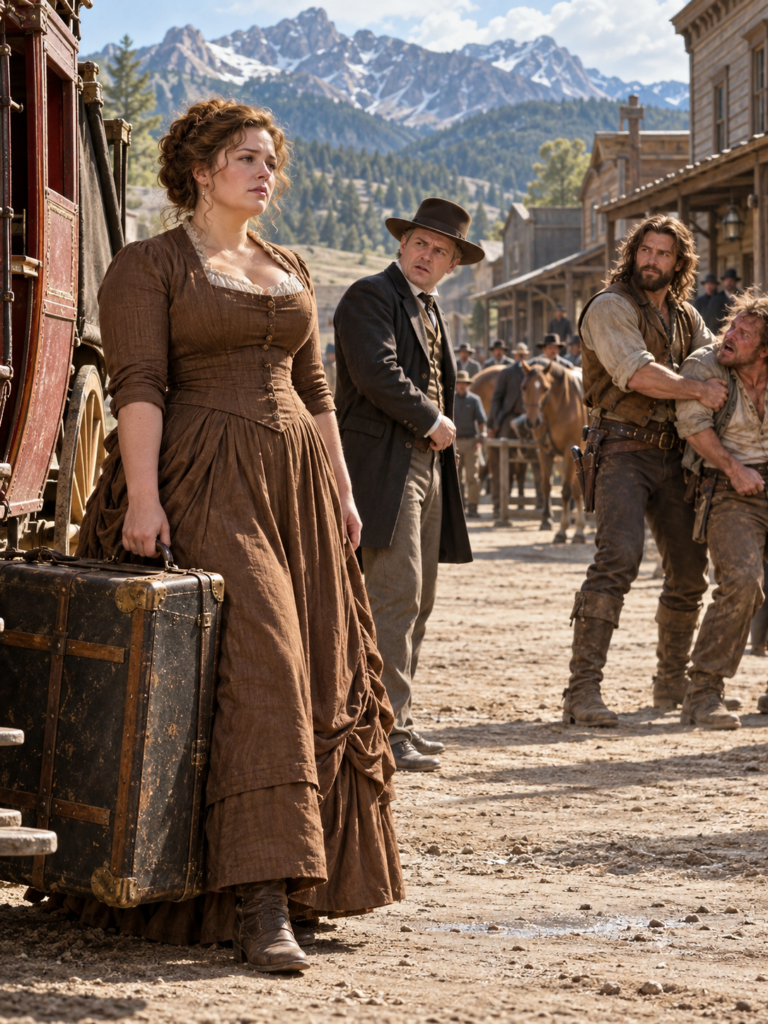
Then Beatrice turned, climbed the narrow stairs, and pulled her trunk from beneath the bed.
The lid struck the wall hard enough to shake dust from the window frame.
Beatrice opened it and began folding without care.
Two dresses.
Three books.
Her mother’s sewing box.
A spare pair of shoes.
Seven months of letters tied with blue thread.
She stopped when she reached those.
Chester’s handwriting filled the top page.
You sound like a woman who values steadiness over appearances.
Beatrice almost laughed.
Instead she sat on the bed.
A knock came.
“Beatrice?”
Martha Jenkins entered before permission arrived, carrying a covered loaf under one arm.
The baker was sixty, broad-faced, flour-dusted, and incapable of pretending ignorance.
“I heard.”
“Of course you did.”
“This town has twelve streets and no secrets.”
Beatrice wiped her cheek angrily.
“I am leaving tomorrow.”
Martha set the bread down.
“Good.”
Beatrice blinked.
“You agree?”
“I agree you should go wherever you are treated with respect.”
That was not the pity Beatrice had expected.
Martha sat beside her.
“But you are eating supper with Samuel and me tonight.”
“No.”
“Yes.”
“I am packing.”
“You can pack hungry tomorrow.”
Beatrice almost protested again.
Then exhaustion defeated pride.
“All right.”
At seven, she walked to the small house behind the bakery.
Martha opened the door.
Beatrice stepped inside.
Then stopped.
Four plates sat on the table.
Martha.
Samuel.
Beatrice.
And Caleb Stone.
Caleb stood so quickly his chair scraped the floor.
“Miss Sullivan.”
Beatrice looked at Martha.
“You neglected a detail.”
“I neglected several. Sit down.”
Caleb cleared his throat.
“I can leave.”
Beatrice turned toward him.
For reasons she did not fully understand, the idea disappointed her.
“No.”
He waited.
She added, “There is no need.”
Dinner began with painful politeness.
Then Samuel asked Caleb about the high trails.
Caleb described elk moving toward summer grazing and snowmelt feeding the northern creek.
He never made himself the hero of any story.
When Martha asked about his cabin, Beatrice expected a rough shack.
Instead Caleb mentioned a stone fireplace, shelves of books, potatoes, onions, and medicinal herbs planted behind the kitchen wall.
“You read?” she asked before she could stop herself.
Caleb’s eyebrow lifted.
“On good days I even understand the words.”
Beatrice flushed.
“I deserved that.”
“Yes.”
Samuel laughed.
To Beatrice’s surprise, so did she.
It was the first laugh that had escaped her since arriving.
Caleb looked at her then.
Not at her waist.
Not at her dress.
At her face.
After supper, Martha and Samuel discovered a suspiciously urgent need to wash dishes together.
Beatrice stepped onto the porch.
Caleb followed only after she left the door open behind her.
The mountains were turning violet.
“I heard you’re leaving,” he said.
“Tomorrow.”
He nodded.
“That all you have to say?”
“What would you like me to say?”
“I don’t know.”
Caleb rested his forearms on the porch rail.
Beatrice studied him.
“Do you think I should leave?”
“I think you should go where you’re treated well.”
“That sounds remarkably like Martha.”
“She’s usually right.”
Beatrice looked toward the street.
“Do you want me to leave?”
His jaw tightened.
“No.”
The answer came without hesitation.
She turned.
“Why?”
Caleb looked at her for a long moment.
“When you stepped off that stage, Halloway looked at you.”
Heat crawled up her neck.
“I would rather not discuss that.”
“I watched you afterward.”
She said nothing.
“You apologized to him.”
Beatrice’s throat tightened.
“For not being what he expected.”
“That bothered me.”
“Why?”
Caleb straightened.
“Because you had done nothing wrong.”
The words landed with shocking force.
Beatrice looked away before he could see her eyes fill.
Caleb did not move closer.
He did not touch her.
“A woman who traveled that far deserves to choose what happens next,” he said.
Then he stepped down from the porch.
“Good night, Miss Sullivan.”
“Good night.”
At dawn, Beatrice carried her trunk toward the stage stop.
Samuel intercepted her in the road.
“No coach.”
She stared.
“Why?”
“Bridge north of town washed out.”
Beatrice turned toward the river road.
“How long?”
“Could be days.”
Behind her, Chester emerged from his store.
“You may keep the upstairs room.”
Beatrice faced him.
“No.”
“Beatrice—”
“No.”
She lifted the trunk handle.
Martha came out of the bakery, seized the other side, and said, “She stays with me.”
Beatrice looked toward the mountains beyond Silver Creek.
The road east was closed.
The man she had crossed the country to marry had failed her.
And the only place offering her shelter belonged to a woman who expected nothing in return.
Beatrice tightened her grip on the trunk.
“Then I work for my room,” she said.
Martha snorted.
“You can argue wages after breakfast.”
Together they carried the trunk toward the bakery.
Together they carried the trunk toward the bakery.
By noon, Beatrice had made herself useful.
Martha discovered quickly that her new guest could total a column of figures faster than Samuel could find his spectacles.
Beatrice discovered something more important.
Martha paid her.
Not charity.
Not a favor disguised as kindness.
Wages.
“You are working,” Martha said when Beatrice protested. “People who work here get paid here.”
The distinction settled something inside Beatrice.
The washed-out bridge took longer to repair than expected.
Three days became six.
Then nine.
Beatrice stopped counting.
She rose before dawn and helped shape bread.
After breakfast she balanced the bakery’s accounts.
On the seventh morning she found a discrepancy.
“Martha.”
The older woman looked up from kneading dough.
“You paid Porter Freight twice in April.”
“I most certainly did not.”
“You did according to this invoice.”
Samuel examined the book.
“Maybe I copied something wrong.”
Beatrice checked the supplier bill.
Then another.
“No.”
She pointed to the numbers.
“You were billed twice.”
The following day, Samuel brought three months of older accounts from a box beneath their bed.
Beatrice found two more mistakes.
By the end of the week, she had saved the Jenkins family enough money to cover several months of flour.
Word traveled.
Mrs. Palmer from the boardinghouse arrived carrying her own books.
Then the blacksmith.
Then the livery owner.
Beatrice began spending afternoons at a little desk near the bakery window, sorting receipts, checking totals, and discovering that she was very good at something Silver Creek needed.
People stopped calling her Chester’s bride.
They began saying, “Ask Miss Sullivan.”
The first time Beatrice heard it, she nearly cried.
Caleb came into town five days after their dinner.
He entered the bakery and bought six loaves.
Martha watched him stack them into a sack.
“You feeding a logging camp?”
“No.”
“Then either you have developed a dangerous appetite or you’re courting badly.”
Caleb nearly dropped the bread.
Beatrice hid a smile behind an account book.
He left without defending himself.
The next time he came, he carried something beneath one arm.
He placed it on Beatrice’s desk.
A worn novel.
She looked at the cover.
“Jane Eyre.”
“Found it years ago.”
“You’re giving it to me?”
“Loaning.”
“Oh.”
Caleb shifted his weight.
“So you have to return it.”
Beatrice looked up.
His ears had gone red.
“That is remarkably cunning, Mr. Stone.”
“I surprise myself.”
He began visiting more often.
Never daily.
Never enough to create obligation.
Sometimes he brought accounts from trading partners and asked Beatrice to check them.
Sometimes he bought coffee.
Once he brought nothing at all, realized that fact halfway through the bakery, and purchased a pie he clearly did not want.
Martha enjoyed that for three days.
Chester noticed too.
His behavior changed.
He began appearing near the bakery.
He sent flowers.
He apologized.
One afternoon he waited until Beatrice was alone at her desk.
“I was foolish.”
She looked up.
“Yes.”
He blinked.
“I expected more argument.”
“I have no reason to argue with the truth.”
Chester clasped his hands.
“I would like to resume our arrangement.”
Beatrice stared.
“You mean marriage.”
“Yes.”
The answer that once would have felt like salvation now felt hollow.
“What changed?”
His hesitation told her everything.
She was no longer a stranger everyone pitied.
People respected her.
Businesses sought her advice.
Caleb Stone looked at her as if her presence mattered.
Chester wanted what the town had taught him to value.
“No.”
His face tightened.
“Consider carefully.”
“I have.”
“You came west for me.”
“I came west for the man in your letters.”
“I am that man.”
Beatrice closed the ledger.
“No. The man in those letters valued steadiness over appearances.”
Chester looked away.
She continued.
“You valued my appearance so much you made me wait four days while you decided whether I embarrassed you.”
“I was surprised.”
“You were cruel.”
His jaw hardened.
“I gave you shelter.”
“And I worked for it.”
“You owe me some consideration.”
Beatrice stood.
“No.”
The word no longer frightened her.
“I owe you nothing beyond what we agreed. I am finished apologizing for taking up more room than somebody expected.”
Chester left without another word.
Two nights later, a rock came through the bakery window.
Glass exploded across the floor.
Martha screamed.
Samuel ran downstairs carrying a shotgun he did not need.
Wrapped around the stone was a piece of paper.
LEAVE SILVER CREEK.
Beatrice stared at the words.
Her first thought was Chester.
That frightened her because she did not want suspicion to become certainty without evidence.
Samuel sent a rider toward Caleb’s cabin before dawn.
Caleb arrived while the street was still gray.
He did not storm into Chester’s store.
He did not threaten anyone.
He crouched outside the broken window.
“What happened?”
Beatrice told him.
He examined the frame and found a strip of dark green cloth snagged on a nail.
“Chester has a green coat,” Martha whispered.
“So do several men in town,” Beatrice said.
Caleb looked at her.
“Agreed.”
She had expected fury.
Instead he folded the cloth.
“Keep this.”
“You don’t think it was Chester?”
“I think possibilities are not proof.”
Something in Beatrice eased.
For a week nothing else happened.
Then the real danger revealed itself through arithmetic.
Beatrice was reviewing three years of Jenkins invoices when a pattern emerged.
Tiny additions.
A few cents on coffee.
A little extra charged for flour.
A second crate listed where only one had been delivered.
All merchandise purchased through Halloway’s general store.
She checked Mrs. Palmer’s accounts.
The same pattern.
Then the blacksmith’s.
Then the livery stable’s.
The amounts were small enough to escape notice.
Together, they were not small at all.
Samuel stared at the figures.
“He’s been stealing.”
“For years,” Beatrice said.
Martha went pale.
Now Beatrice understood Chester’s return.
He had not suddenly discovered love.
He had discovered fear.
The woman he had rejected had become the one person in Silver Creek capable of exposing what he had done.
The town council assembled in the church.
Beatrice stood before people who, weeks earlier, had watched her humiliation from windows and porches.
Her hands shook.
She kept them on the ledgers.
Chester stood opposite.
“These are clerical mistakes.”
“Hundreds of them?”
“She is angry because I refused her.”
The old shame surged.
Beatrice felt it rise from her stomach into her throat.
Then Martha stood.
“She did not create your numbers.”
Samuel stood beside her.
Mrs. Palmer followed.
Then the blacksmith.
The stable owner.
One by one, the room changed.
Chester’s face drained.
The church door opened.
Caleb entered with the sheriff.
In the sheriff’s hands was a small leather ledger.
Chester lunged half a step forward.
“Where did you get that?”
“Under a loose floorboard in your storeroom,” the sheriff said.
Chester looked at Caleb.
“You entered my property?”
“No.”
Caleb remained near the door.
“He did.”
The sheriff opened the ledger.
Names.
Dates.
Amounts.
Every fraudulent charge recorded.
Chester collapsed into the nearest chair.
Beatrice looked at him.
Once she had believed marrying this man would rescue her from uncertainty.
Now he looked smaller than ever.
As the sheriff led him toward the door, Chester stopped.
His eyes found Caleb.
“Ask your mountain man why he was in town the day your stage arrived.”
Beatrice turned.
Caleb’s expression changed.
Only slightly.
But she saw it.
Chester smiled bitterly.
“He didn’t come for flour.”
Then the sheriff pushed him outside.
Whispers filled the church.
Beatrice looked at Caleb.
“What did he mean?”
Caleb’s jaw tightened.
“Not here.”
He walked outside.
Beatrice followed.
They did not stop until the town had fallen behind them and the river filled the silence.
Caleb faced the water.
“I knew your stage was coming.”
Beatrice went still.
“How?”
“Halloway talked about you at the saloon weeks before you arrived.”
Her stomach tightened.
“What did he say?”
Caleb did not answer quickly enough.
“Caleb.”
“He showed men part of one of your letters.”
Humiliation struck with almost physical force.
“The one where I described myself?”
“Yes.”
Beatrice turned away.
Caleb’s voice roughened.
“He laughed.”
She closed her eyes.
“I nearly hit him.”
“You didn’t know me.”
“No.”
“Then why?”
Caleb struggled visibly.
“My mother was built like you.”
Beatrice turned back.
“She raised four boys after my father died. Worked logging camps, cooked, kept books, patched wounds, buried one son, and never asked a man’s permission to be strong.”
His eyes hardened.
“People mocked her weight sometimes.”
He looked at Beatrice.
“I learned young that cruelty toward a woman says more about the speaker than the woman.”
Beatrice’s throat tightened.
“But that is not all,” Caleb said.
He reached inside his coat.
A folded page appeared in his hand.
Beatrice recognized the writing.
Her own.
“How do you have that?”
“Halloway dropped it in the saloon.”
“You read it?”
“After I picked it up.”
Her hands trembled as she unfolded it.
Near the bottom she had written:
I do not need fine things. I think I would be happy somewhere quiet, perhaps near mountains, with books in winter and someone glad when I come through the door.
Beatrice looked up.
“You kept this.”
“Yes.”
“Why?”
Caleb swallowed.
“Because I could not stop thinking about the woman who wrote it.”
The river moved steadily beside them.
“So when my stage came…”
“I came down early.”
“To see me.”
“Yes.”
Beatrice almost laughed from the strangeness of it.
“You saw me before Chester did?”
“From the ridge road.”
“And what did you think?”
Caleb looked directly at her.
“That Halloway was the luckiest fool in Montana.”
Beatrice’s eyes filled.
Caleb remained several feet away.
He did not reach for her.
Did not assume anything had changed.
That restraint decided something she had not been ready to name.
Beatrice stepped forward.
She held out her hand.
Caleb looked at it.
Then at her.
Slowly, he took it.
His fingers closed carefully around hers.
“Would you like me to stay in Silver Creek?” she asked.
“Yes.”
“That is still an inadequate answer.”
His mouth twitched.
“I’m not good at adequate.”
“Then practice.”
He drew a breath.
“I have a cabin two hours north.”
Beatrice waited.
“Roof leaks over the pantry.”
“Promising.”
“Stove smokes when the wind turns east.”
“Excellent.”
“Twelve acres that pretend to be farmland.”
She smiled.
“And?”
“More books than shelves.”
Her smile softened.
Caleb’s expression became serious.
“I am not asking because Halloway refused you.”
Beatrice stopped breathing.
“I am asking because I want you.”
The river seemed louder.
Caleb released her hand.
Not because he wanted distance.
Because he wanted the next choice to be hers.
“Come see the cabin,” he said. “Not as my bride. As Beatrice Sullivan. If you hate it, I’ll bring you back.”
She studied him.
“That is not a proposal.”
“No.”
“Good.”
He almost smiled.
Beatrice looked toward the mountains.
Then back at the town where she had discovered that she could make a living without marrying anyone.
“I will come see it,” she said.
Caleb nodded.
“And after that, Mr. Stone, I decide what happens next.”
His eyes held hers.
“That is exactly what I hoped you would say.”
“That is exactly what I hoped you would say.”
Two mornings later, Beatrice rode north with Caleb.
Not behind him.
Beside him.
She had borrowed a steady bay mare from the livery and refused his offer to lead the reins through the steepest sections.
“I can ride.”
“I see that.”
“You sound surprised.”
“I am learning not to make that mistake.”
The trail climbed through lodgepole pine, crossed two narrow streams, and eventually opened onto a high meadow.
Caleb’s cabin sat near the tree line.
Beatrice pulled the mare to a stop.
It was not grand.
It was barely symmetrical.
One wall was stone, three timber. A chimney leaned slightly. A woodpile stood beneath a crude shed. Behind the house, neat rows of onions and potatoes cut dark lines through the earth.
And there were windows.
Three of them.
All facing the mountains.
Caleb dismounted.
Beatrice did the same.
He did not rush to explain or apologize.
He unlocked the door and stepped aside.
“You first.”
Inside, the cabin smelled of pine, coffee, leather, and old paper.
Books filled every available shelf.
More were stacked on a table.
A narrow bed stood behind a partial wall at the rear. Two chairs faced the fireplace.
Two.
Beatrice touched the back of one.
“You expect company?”
“No.”
“Then why two chairs?”
“My father made them.”
She nodded.
Caleb showed her the pantry roof.
It did, indeed, leak.
The stove smoked when he lit it.
She laughed so hard he opened the door and stood fanning smoke outside with his hat.
“You were not exaggerating.”
“I try not to.”
They ate beans, bread, and dried venison at the table.
Then Caleb took her outside.
He showed her the garden.
The spring.
The small barn.
The trail leading to his traplines.
He explained what winter was like without romanticizing it.
Snow sometimes blocked the road for days.
A doctor could be hours away.
Supplies had to be stored carefully.
Beatrice listened.
Then she asked the question that mattered.
“If I lived here, how would I earn money?”
Caleb stopped.
“You wouldn’t have to.”
Her expression hardened.
He understood immediately.
“That was poorly said.”
“Yes.”
He tried again.
“You could keep doing accounts in town. I go down twice a month in winter when the road allows. More often when weather is good.”
“Twice a week.”
“That’s a lot of riding.”
“I know.”
“I could build an office room.”
Beatrice blinked.
“What?”
“On the south wall.”
“You would add a room because I want work?”
“You would need somewhere to do it.”
She studied him.
“You are dangerous.”
His brow furrowed.
“That sounded like an insult.”
“It was not.”
She looked toward the meadow.
“You make reasonable things sound possible.”
They returned to Silver Creek before dusk.
Beatrice did not move to the cabin.
Not yet.
She kept Martha’s spare room.
She continued working.
Caleb continued visiting.
They courted awkwardly and honestly.
Sometimes he walked beside her after church.
Sometimes she rode north for the day and returned before dark.
He built the office room anyway.
Not for marriage.
For possibility.
When Beatrice saw it the first time, she stood in the doorway speechless.
There was a desk beneath the window.
Two shelves.
A small iron stove.
And one entire wall left empty.
“For more shelves,” Caleb explained.
“You assume I have many books.”
“I saw your trunk.”
She laughed.
Their first kiss happened three weeks later beside the river.
Caleb had walked her home after a town supper.
They stopped where the cottonwoods thinned.
He looked at her.
Then looked away.
Beatrice waited.
Finally he said, “I want to kiss you.”
Her pulse changed.
“That sounds almost like a confession.”
“It feels worse.”
She smiled.
“Then perhaps you should ask.”
Caleb’s gaze returned to hers.
“May I?”
Beatrice nodded.
“Yes.”
His hand touched her cheek.
Nothing about the kiss was hurried.
He gave her time to lean away.
She did not.
When they parted, Caleb looked dazed.
Beatrice rested one hand against his chest.
“That was better than your proposal.”
“I have not proposed.”
“Exactly.”
Six days later, he did.
They were in the bakery because Martha had discovered subtlety was exhausting and had deliberately left them alone.
Caleb stood beside Beatrice’s account desk.
“I have been thinking.”
“That seems ominous.”
He ignored that.
“You already have work.”
“Yes.”
“You have friends.”
“Yes.”
“You can support yourself.”
Beatrice slowly set down her pencil.
“Yes.”
“You do not need me.”
Her heart tightened.
“No.”
Caleb nodded.
“Good.”
He reached into his coat.
Beatrice stared.
“What are you doing?”
“I had a speech.”
“Oh dear.”
“I forgot it.”
She laughed.
Then he looked at her with such vulnerable seriousness that the laugh died.
“I want you at the cabin when there is nothing dramatic happening.”
Beatrice listened.
“I want you complaining about smoke from the stove.”
His mouth curved.
“I want your books on the shelves. I want you riding into town because people trust your arithmetic. I want to hear you argue with me about garden rows.”
He swallowed.
“And I want to be glad every time you come through the door.”
The line from her old letter.
Beatrice’s eyes burned.
Caleb did not kneel.
Did not corner her.
Did not hold out a ring as if metal could answer for her.
He simply asked.
“Will you marry me?”
Beatrice looked at the man who had never once required her to become smaller in order to make him comfortable.
Then she thought of something important.
“If I say no?”
His face tightened with pain.
But he answered.
“I take you home.”
“To Martha’s?”
“Yes.”
“And afterward?”
“I keep buying too much bread until I learn better.”
Tears escaped Beatrice before she could stop them.
She laughed.
“Yes.”
Caleb blinked.
“Yes?”
“Yes.”
He stood utterly still.
“You appear surprised.”
“I prepared for no.”
“Well, you will have to endure disappointment.”
His laugh came out rough and relieved.
Then he asked, “May I kiss you?”
She stepped closer.
“You may.”
They married six weeks later.
No grand spectacle.
No wealthy relations.
No attempt to impress anyone.
Martha baked the cake.
Samuel walked Beatrice to the front of the church.
Mrs. Palmer altered her dress so beautifully that Beatrice cried when she saw herself.
The sheriff lent Caleb a black coat after three others failed across the shoulders.
When Beatrice entered the church, Caleb forgot whatever Samuel had just said to him.
His entire face changed.
Not astonishment.
Recognition.
Beatrice understood the difference.
Afterward they rode north.
Marriage did not turn the cabin into paradise.
The pantry still leaked until Caleb repaired the roof.
The stove continued smoking until Beatrice discovered the chimney needed another section of pipe.
The garden produced onions enthusiastically and nearly nothing else.
They argued about money twice in the first month.
Beatrice insisted she would keep her bookkeeping income separate.
Caleb agreed.
Then asked her advice about his trapping accounts.
She discovered he was losing money to middlemen.
“You are terrible at business.”
“I catch animals.”
“Apparently the animals negotiate better than you.”
With Beatrice’s help, Caleb began selling hides directly to merchants farther south.
His profits improved.
So did her reputation.
Twice each week she rode into Silver Creek and kept accounts for local businesses.
Eventually she rented a little room beside the bakery as an office.
Caleb built shelves there too.
Autumn came.
Then winter.
One snowy evening, Martha arrived by wagon carrying a letter from Helena.
Chester Halloway had pleaded guilty.
The general store and most of his remaining property would be sold to repay what he had stolen.
There was a second envelope.
Beatrice recognized the handwriting.
Chester.
She held it over the stove.
Caleb sat across the room sharpening a knife.
“Read it if you want.”
“What would you do?”
“Doesn’t matter.”
She lowered the envelope.
“Why not?”
“Because he wrote to you.”
Beatrice opened it.
The apology was imperfect.
Chester admitted that he had been ashamed when she arrived because she did not resemble the woman he had created in his imagination.
He wrote that seeing Caleb look at her with admiration had angered him.
Watching Silver Creek respect her had angered him more.
Only after losing his store did he understand why.
The problem had never been Beatrice.
It had been the way he measured people.
She read the final sentence twice.
I mistook your willingness to come west for desperation and believed that meant I could decide your value.
Beatrice folded the page.
Caleb waited.
“Anything you need to answer?”
“No.”
She fed the letter to the flames.
Paper curled black.
For once, Beatrice did not feel anger.
Only distance.
Winter deepened.
One night Caleb entered carrying firewood and stopped beside the hearth.
Beatrice was sewing a curtain.
“What?”
“Nothing.”
“You are staring.”
“Yes.”
She narrowed her eyes.
“Should I worry?”
“Probably not.”
He set down the logs and crouched beside her.
“You happy?”
Beatrice looked around.
Books.
Soup simmering.
Ledger on the table.
Caleb’s wet gloves drying by the stove.
Snow filling the dark outside.
“Yes.”
“Good.”
He kissed her forehead and began to stand.
Beatrice caught his sleeve.
“Caleb.”
He sat again.
“When I got off that stage, I thought Chester might ask the driver to take me straight back.”
Caleb’s face hardened.
“I know.”
“I thought I had crossed all that distance and failed before I had spoken ten words.”
“You didn’t.”
“I know that now.”
She looked at their joined hands.
“But I did not know it then.”
Caleb remained quiet.
Beatrice smiled faintly.
“I thought being wanted would make me valuable.”
“And now?”
“Now I think value was never the thing being offered.”
She looked at him.
“A place was.”
His fingers tightened gently around hers.
“And I had to decide whether I wanted that place.”
Caleb nodded.
“Yes.”
Spring returned.
Then summer.
Nearly one year after Beatrice first arrived in Silver Creek, the Halloway store went to auction.
Beatrice did not attend.
Caleb did.
That made her suspicious.
Two days later Martha arrived at the cabin.
“You need to come to town.”
“Why?”
“Emergency.”
“What emergency?”
“Business.”
“That is not an emergency.”
“It is when Samuel is involved.”
Beatrice rode down with her.
At the edge of town she saw a crowd outside the old general store.
Her stomach tightened.
“What is happening?”
Martha smiled.
“Walk.”
Beatrice dismounted.
Caleb stood in the doorway.
Samuel beside him.
The sheriff.
Mrs. Palmer.
The blacksmith.
Half the town.
Beatrice stopped.
“No.”
Caleb looked cautious.
“That depends.”
“On what?”
“Whether you hate the idea.”
She crossed the road.
“What idea?”
He handed her a key.
Beatrice stared at it.
“The building went cheap,” Caleb said.
Her eyes widened.
“You bought Chester’s store?”
“We bought it.”
“I did not buy anything.”
“You had money in the blue tin.”
Beatrice froze.
“You knew about that?”
“You hide money badly.”
“You touched my savings?”
“No.”
“Then how—”
“I used mine.”
She stared.
Caleb raised one hand.
“Before you kill me, listen.”
Beatrice folded her arms.
“You have ten seconds.”
“I bought the building. Not for you.”
That was unexpected.
“For what, then?”
“To lease.”
“To whom?”
“You, if you want it.”
The anger drained from her face.
Caleb continued.
“Fair rent. Written agreement. If you hate the idea, someone else takes it.”
Beatrice looked toward the storefront.
The same counter remained inside.
The same shelves.
The very place where she had stood while Chester decided whether she deserved marriage.
Martha moved closer.
“Silver Creek needs a general store.”
Samuel added, “One run by someone who understands numbers.”
Mrs. Palmer called from the street, “And honesty!”
The blacksmith shouted, “Mostly the honesty!”
Laughter spread through the crowd.
Beatrice looked at Caleb.
“You planned this?”
“I offered a possibility.”
Her throat tightened.
A possibility.
Not a gift she could never repay.
Not a rescue.
A door.
Beatrice took the key.
Then walked inside.
Dust floated in the sunlight.
She moved behind the counter.
Her fingers touched the scarred wood.
She remembered herself standing there eleven months earlier.
Apologizing.
Trying to be agreeable.
Trying not to appear wounded.
Trying desperately to remain wanted.
Caleb entered but stayed near the door.
He did not crowd the moment.
Beatrice looked around.
“I want the lease in writing.”
A smile spread slowly across his face.
“I expected that.”
“I set my own prices.”
“Yes.”
“I keep the account office.”
“Yes.”
“And you do not receive free coffee merely because you are my husband.”
“That seems unreasonable.”
“Then pay.”
Martha laughed from outside.
Beatrice looked at the little box of ribbons still sitting near the end of one shelf.
She opened it.
A blue ribbon lay inside.
She picked it up.
Caleb noticed.
“That color suits you.”
“You never bought one.”
“No.”
“You touched it the first day you came into the shop.”
His face reddened slightly.
Beatrice smiled.
“Why?”
“I thought about giving it to you.”
“What stopped you?”
“You barely knew me.”
“That has never prevented men from giving foolish gifts.”
“I was trying not to be foolish.”
She stepped around the counter.
“You failed eventually.”
“Marriage does that.”
Beatrice laughed.
Then something occurred to Caleb.
“There is one thing I never told you.”
She groaned.
“Another secret?”
“Not a bad one.”
He walked to his saddlebag outside and returned with an old newspaper.
He unfolded it.
A matrimonial advertisement had been circled.
Beatrice read it.
Then looked at him.
“What is this?”
“I saw it before Halloway placed his own.”
“You were looking at marriage advertisements?”
Caleb appeared defensive.
“I lived alone.”
“You still know how to write?”
“I regret teaching you sarcasm.”
She studied the paper.
Along the margin, three lines had been written in Caleb’s handwriting.
I have no grand home.
Only work, quiet mountains, books, and a place where no woman will be mocked beneath my roof.
If that is enough, perhaps we might write.
Beatrice read it again.
“You wrote this?”
“Yes.”
“You never sent it.”
“No.”
“Why?”
Caleb shrugged.
“Couldn’t ask a woman to come two thousand miles to live with a stranger in a leaking cabin.”
Beatrice looked at him.
Then began laughing.
“What?”
“You realize what this means.”
“I am afraid to ask.”
“If you had mailed this…”
Caleb waited.
“I might have answered you instead.”
He considered that.
Then nodded solemnly.
“So Halloway cost us nearly a year.”
“Do not give him that much credit.”
Beatrice folded the newspaper.
She looked around the store.
Outside, Silver Creek moved through an ordinary summer afternoon.
A wagon rattled past.
A child chased a dog.
Martha argued with Samuel about flour.
The church bell struck noon.
Another stagecoach rolled slowly into town.
Beatrice watched it stop.
For one fleeting second, she saw herself again.
A frightened woman stepping into the dust beside a heavy trunk.
Waiting for a stranger’s face to tell her whether she was acceptable.
She wished she could reach backward through time.
Not to warn herself about Chester.
Not even to tell herself about Caleb.
Only to say:
Do not apologize.
Do not shrink.
Do not confuse someone’s rejection with a verdict.
Caleb came beside her.
“What are you thinking?”
Beatrice looked at him.
“That I crossed half the country believing a man had to choose me before my life could begin.”
“And now?”
She held up the key to the store.
“Now I choose.”
He smiled.
Beatrice slipped the key into her pocket.
Then she returned behind the counter.
The brass bell sat where it always had.
She picked it up and rang it once.
Everyone outside cheered.
Caleb leaned against the counter.
“Mrs. Stone?”
“Yes?”
“Are you happy?”
Beatrice looked at the bakery.
At Silver Creek.
At the mountains.
At the man who loved her without asking her to become smaller.
Then at the counter where she had once stood in silence while another man measured her worth.
“Completely.”
Caleb reached across the counter.
He offered his hand.
Beatrice took it.
A year earlier she had arrived thinking Chester Halloway’s acceptance would decide whether her journey had been a success.
She knew better now.
His rejection had hurt.
Caleb’s love had helped heal what came afterward.
But neither man had created Beatrice Sullivan’s worth.
That had belonged to her before the stage ever left Boston.
It belonged to her when Chester looked disappointed.
It belonged to her when Caleb first looked impressed.
It belonged to her when she chose work over pity.
When she uncovered theft.
When she said no.
When she said yes.
When she rode to the mountains.
When she returned to town.
When she married.
And when she unlocked the door to a business carrying her own name.
Outside, another passenger stepped from the stagecoach uncertainly and looked around Silver Creek.
Beatrice smiled.
Then she turned back to Caleb.
He squeezed her hand once.
This time, when laughter filled the store where she had once swallowed humiliation in silence, Beatrice did not feel rescued.
She felt exactly where she had chosen to stand.

