
She Warned the Rancher She Came With Four Sons—His Answer Left Her Speechless
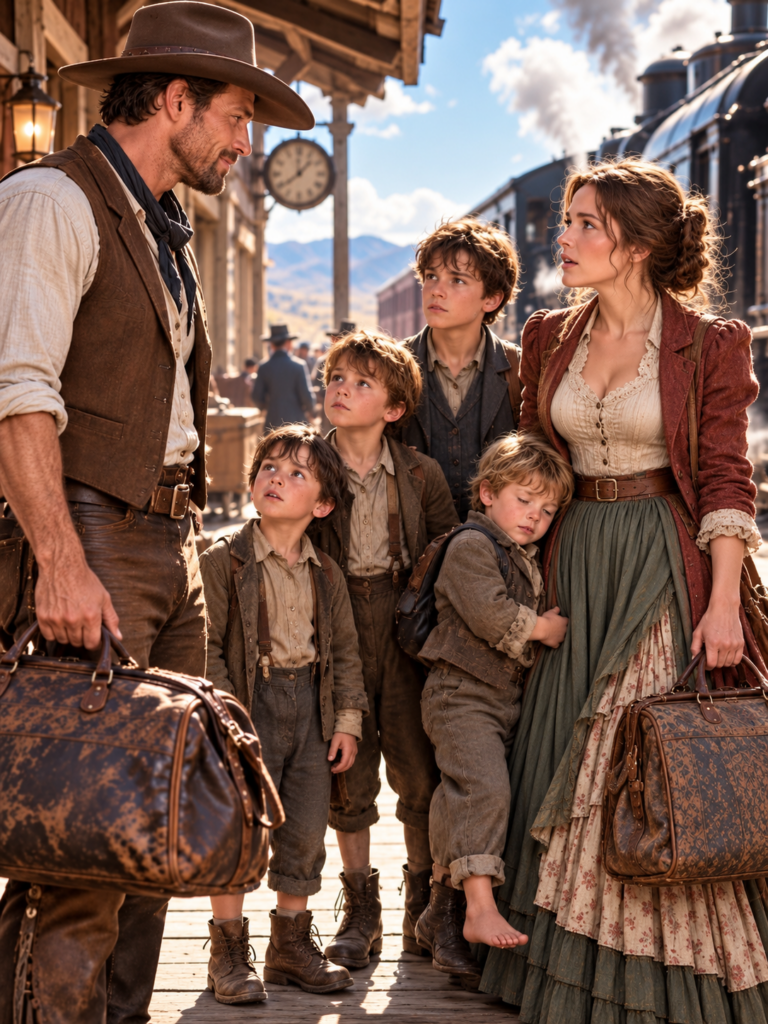
“I have four sons,” Sarah Mercer warned before Amos Bell could even properly introduce himself.
The rancher looked past her at the four boys standing on the Cheyenne platform, then calmly picked up her heaviest bag.
“Good,” he said.
“I was expecting one worker.
Looks like I got five.”
Sarah had told him about her children before telling him her name.
It seemed safer.
The train had barely stopped beneath the Cheyenne depot clock when she spotted Amos waiting with his hat in both hands.
He was around forty, tall and lean, with sun-browned skin and a narrow scar beneath his chin.
He looked more comfortable facing Wyoming weather than greeting the woman he had invited west.
Amos had written only three letters.
None contained romance.
That was precisely why Sarah had answered.
“I need a woman capable of keeping accounts, feeding a working household, and telling me when I am making a mistake.”
She had read that sentence six times.
Her late husband had never appreciated being told he was wrong.
Amos Bell apparently considered honesty a qualification.
But the matrimonial agency had omitted one important detail.
Sarah came with four boys.
Samuel, fourteen, stepped down behind her, already tall and deeply suspicious of unfamiliar men.
Henry, eleven, followed.
He could dismantle almost anything mechanical and occasionally put it back together.
Luke, eight, considered silence an illness requiring immediate treatment.
And Benji, five, was half asleep against Henry’s shoulder.
He was also missing one shoe.
Amos studied them.
Sarah tightened her grip around her carpetbag.
“If four sons change your offer, Mr.
Bell, tell me now.”
Amos frowned thoughtfully.
“What can they do?”
Sarah blinked.
“My sons?”
“Yes.”
“Samuel handles horses.
Henry repairs tools.
Luke reads well and keeps figures.”
Amos glanced toward Benji.
“And him?”
Benji opened one sleepy eye.
“My shoe fell.”
Sarah sighed.
“Benji can apparently lose footwear in every state between Missouri and Wyoming.”
Amos’s mouth almost became a smile.
Then he looked at Sarah.
“What can you do?”
“Cook.
Keep accounts.
Preserve food.
Sew.
Teach reading.
And deliver calves, provided the calf cooperates.”
“Do they?”
“Rarely.”
This time, Amos definitely smiled.
He lifted Sarah’s heaviest bag.
“Good.”
Samuel immediately stiffened.
“We aren’t hired hands.”
Amos turned toward him.
“No?”
“No, sir.”
“Good.”
Samuel looked confused.
Amos studied the boy for a moment.
“A young man who knows what he isn’t is usually closer to discovering what he is.”
For once, Samuel had nothing to say.
“Ranch is seventeen miles north,” Amos said, turning toward his wagon.
Sarah remained where she stood.
“You haven’t explained the arrangement.”
“You run the house.”
“And my sons?”
“They eat.”
“I assumed that.”
“They sleep in the house.”
That surprised her.
“Work if they want wages,” Amos continued.
“School?”
“Town is too far once winter comes.”
“I teach them myself.”
“Then keep teaching them.”
Finally Sarah asked the question that mattered most.
“And if you decide four boys are too much?”
Amos became completely serious.
“Mrs…?”
“Mercer.
Sarah Mercer.”
“Mrs.
Mercer, four boys are not weather.”
She frowned.
“What does that mean?”
“If I agree to them today, I don’t get to complain tomorrow that they exist.”
Sarah said nothing.
Those words frightened her more than rejection would have.
Because she wanted to believe him.
And believing men had cost her dearly before.
Still, she climbed into the wagon.
Samuel helped Henry with Benji.
Luke squeezed between them and immediately began asking Amos whether the ranch had wolves.
Amos flicked the reins.
“Yes.”
“Bears?”
“Sometimes.”
“Outlaws?”
“Not recently.”
Luke considered that disappointing.
As the wagon rolled away from Cheyenne, the open Wyoming country stretched farther than Sarah had imagined possible—dry grass, cottonwoods following a narrow creek, and distant ridges already white with snow.
For the first time in months, she allowed herself to wonder whether they might have found somewhere they could stay.
Then Samuel suddenly leaned forward.
“Mr.
Bell.”
Amos looked toward him.
Samuel pointed across the prairie.
A rider was galloping hard toward them from the direction of the ranch.
Even from a distance, Sarah could see something was wrong.
The horse was covered in foam.
The rider reached them, pulled sharply alongside the wagon, and gasped—
“Amos, you need to get back.
Now.”
Amos’s entire expression changed.
“Why?”
The ranch hand looked at Sarah and her four sons before answering.
“The north barn is burning.”

Amos didn’t shout, curse, or jerk the reins.
He simply looked at the rider, his jaw tightening so hard the narrow scar beneath his chin turned white.
“Who was on the north ridge?”
Amos asked, his voice deathly quiet.
“Cowan,” the hand panted, wiping grease and dust from his eyes.
“He brought three men from the syndicate.
Said the lease ran out yesterday, Amos.
They fired the cedar shingles before anyone could haul the grain out.”
Sarah felt her stomach drop into her shoes. The syndicate. She knew that word from Missouri—it meant land speculators, rail developers, and men with enough money to buy judges by the dozen.
Beside her, Samuel’s hands balled into tight fists.
He reached down, instinctively placing himself between his younger brothers and the rider.
Amos didn’t look back at Sarah.
He turned his eyes to the horizon, where a thin, black finger of smoke was beginning to coil into the cold Wyoming sky, seven miles north.
“Eli,” Amos said to the hand.
“Take the horses from my team.
Unhitch the wagon.”
“Amos, there’s four of ’em with Winchesters—”
“Unhitch the team, Eli,” Amos repeated.
He reached beneath the wagon seat, pulled out a long scabbard wrapped in oilcloth, and slid out a gleaming lever-action rifle.
He didn’t look like a quiet rancher anymore.
The stillness about him suddenly felt less like shyness and more like the heavy silence before a thunderhead ruptures.
Sarah stepped out of the wagon before he could climb down.
“You’re going alone?” she asked, stepping directly into his path as he unhooked the harness traces.
Amos looked down at her.
“It’s my ranch, Mrs.
Mercer.
Cowan’s been trying to starve me out since August.
If he burns the grain, the stock won’t survive till January.”
“Then you’ll need water,” Sarah said instantly.
Her tone was sharp, devoid of panic, forged by years of surviving her late husband’s reckless messes.
“And hands to carry it.”
Amos hesitated.
“You have four boys.”
“I have four boys who know how to put out a fire,” Sarah countered.
She turned to her sons.
“Samuel, get the water barrels out of the wagon bed.
Henry, hand me the wet sacks from the floorboards.
Luke, stay with Benji in the lee of the ditch until we call for you.”
The boys didn’t hesitate.
Years of necessity had trained them to jump when Sarah gave an order.
In thirty seconds, Samuel had unstrapped two wooden pails, and Henry was already pulling a heavy brass wrench from his coat pocket, eyeing the wagon harness.
Amos watched them move.
The tension in his shoulders didn’t disappear, but something shifted in his eyes—a quiet spark of sheer, hard-bitten respect.
“Eli,” Amos said, his voice lowering.
“Ride ahead to the south ditch.
Draw Cowan’s eyes to the ridge.
Don’t shoot unless they shoot first.”
“And us?”
Samuel asked, stepping beside Amos, a heavy iron crowbar gripped in his young, calloused hands.
Amos looked at the fourteen-year-old.
He didn’t tell him to go hide.
He didn’t treat him like a child.
“You stay behind me, Samuel,” Amos said softly.
“You watch my back, and I’ll watch yours.
We save the timber first.
We deal with Cowan second.”
Amos swung himself onto the lead draft horse, taking the reins in one hand and his rifle in the other.
He reached down toward Sarah.
“Can you ride double, Mrs.
Mercer?”
Sarah looked at the horse, then up into the dark, steady eyes of the rancher who had promised four boys they would not be treated like weather.
She took his hand and swung up behind him without a single word.
They crested the southern ridge ten minutes later, the wind carrying the bitter, pungent stench of burning cedar and dry rye.
The north barn was fully engulfed at the rear eaves, orange flames licking up the grey weathered planking.
Down in the yard, three armed men sat on horseback, watching the blaze with casual indifference, while a heavy-set man in a bowler hat—Cowan—stood by the main gate, holding a pocket watch.
“Ten minutes more, boys!”
Cowan yelled over the crackle of the fire.
“Then we head for the homestead house!
Let’s see how Bell likes sleeping under the stars!”
Amos didn’t scream a battle cry.
He didn’t ride down the hill like a cavalry officer.
He rode his horse straight down the slope at a steady, bone-jarring trot, stopping ten feet from the front gate.
Sarah slid off the horse instantly, bucket in hand, her boys tumbling down the slope behind her like a disciplined unit.
Cowan turned, his eyes widening in surprise as he saw Amos—and the sudden arrival of a woman and four boys charging past him toward the burning wall without paying him the slightest mind.
“Bell!”
Cowan bellowed, reaching for his sidearm.
“You’re trespassing on foreclosed property!
By order of the county sheriff—”
Amos didn’t even rack his rifle.
He drove the butt of his Winchester straight into Cowan’s sternum with the force of a battering ram.
The heavy man went down into the dirt with a wheezing gasp, his bowler hat rolling into the horse trough.
The three riders drew their carbines, but before they could level them, Eli’s rifle cracked from the high ridge, kicking up dirt right between the horses’ hooves.
“Drop ’em!”
Eli’s voice echoed down the canyon.
“Next one goes through your boots!”
The three hired guns hesitated, looking from Eli’s high perch on the ridge down to Amos Bell, who was standing over their boss, levering a fresh shell into the chamber with an unblinking, lethal calm.
“Get off my land,” Amos said to the riders.
His voice wasn’t raised, but it carried across the yard clearer than a church bell.
“Take Cowan with you.
If I see any of you south of the creek after sundown, I won’t bring a rifle.
I’ll bring a shovel.”
The riders didn’t argue.
They dismounted frantically, hauled the gasping Cowan onto his saddle, and galloped south into the dust, leaving the yard dead silent except for the roar of the fire.
Amos turned immediately toward the barn.
Sarah, Samuel, and Henry were already working in a synchronized rhythm that looked like it had been rehearsed for years.
Samuel was hauling pails from the trough; Henry was beating at the low grass flames with soaked burlap; and Sarah was dumping cold water directly onto the support beams, keeping the fire from spreading to the grain loft.
Even little Luke was dragging small dry cedar logs away from the walls so the embers wouldn’t catch.
Amos dropped his rifle into the dirt, grabbed a heavy wooden shovel, and threw himself into the fight alongside them.
For forty minutes, nobody spoke.
They worked until their faces were smeared with black soot, their lungs burned from the acrid smoke, and their arms trembled with exhaustion.
Finally, with a heavy hiss of steam and a shower of grey ash, the last stubborn ember died out against the damp timber.
The main structure of the barn stood solid.
The grain was safe.
The sun was dipping low over the distant, snow-capped Big Horn mountains, painting the prairie in long streaks of bronze and purple.
Sarah sat on an overturned grain barrel near the barn door, her skirts blackened at the hem, rubbing her sore wrists.
Her four boys were scattered across the grass nearby—Samuel leaning against the fence post, Henry examining an old iron pulley he’d found in the ash, Luke chattering softly to a farm dog that had crept out from under the porch, and Benji fast asleep in a pile of clean hay, still missing his left shoe.
Amos walked over from the trough, carrying a wet towel.
He handed it to Sarah without a word.
She took it, wiping the soot from her cheeks and forehead.
“They won’t come back,” Sarah said quietly, looking out toward the south road.
“Men like Cowan don’t quit after one bloody nose.
They come back with lawyers or sheriffs.”
Amos leaned against the barn doorframe, looking out over his land—the dry grass, the cottonwoods, the black timber frame that had almost been lost.
“Let them come,” Amos said simply.
“The land is paid for in full.
I have the land office receipt in the floorboards under my bed.
Cowan was betting I’d run when he set the fire.”
He looked down at Sarah.
For the first time all day, the hard, grim lines around his mouth softened completely.
“He didn’t know I brought help.”
Sarah looked over at her four boys.
Samuel was watching Amos from the fence line, his eyes no longer suspicious, but assessing—measuring the man against the standard he had kept in his head for years.
Amos walked over to the fence, stopping right beside Samuel.
He didn’t pat the boy on the back or make a grand speech.
He just looked at the burn marks on the wooden wall.
“Good work with the crowbar, son,” Amos said, his voice quiet.
“You kept the support beam from buckling.”
Samuel’s chin lifted a fraction of an inch.
He cleared his throat, trying hard to sound older than fourteen.
“It needed doing, sir.”
“Name’s Amos,” the rancher said, turning to head toward the main house.
“Come on inside.
Mrs.
Mercer, house has four rooms and a decent stove.
Smoke’s clearing out.
I reckon it’s time we saw about supper.”
Sarah stood up, dusting off her apron.
She looked at the vast, open Wyoming prairie surrounding them, the wind whispering through the tall grass, cold and wild and free.
It was a hard country.
It was dangerous, lonely, and unforgiving.
But as she watched Amos open the heavy oak door of the homestead and step aside so her four sons could walk in ahead of him, Sarah Mercer felt something she hadn’t felt in a very long time.
She felt safe.

