
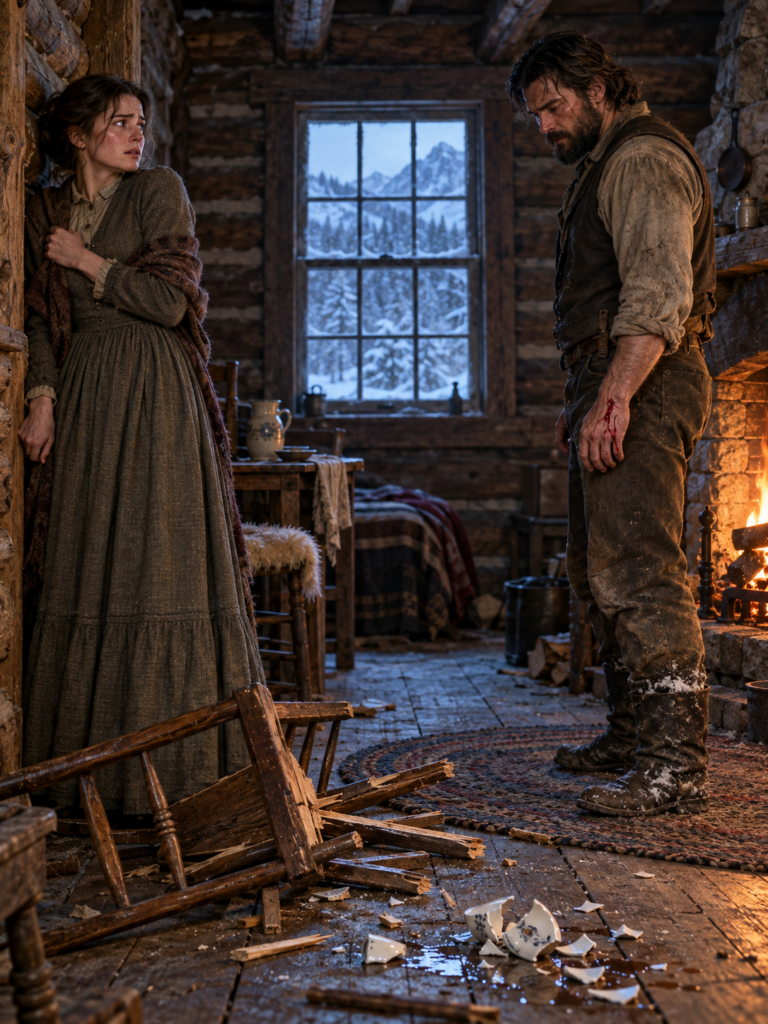
Elias crossed the threshold only after Cora moved aside, carrying the new chair brace in his uninjured hand.
He left the door partly open behind him.
Cold air spilled across the floor, but Cora understood the gesture.
A door she could reach.
A way out he had not blocked.
Elias knelt beside the damaged chair.
“I should have walked outside before I lost my temper.”
Cora folded her arms.
“What happened?”
“The awl slipped.”
“That caused all this?”
“No.”
At least he did not lie.
He fitted the brace against the split wood.
“The trap line has been poor. Snow covered two markers. One packhorse threw a shoe yesterday. Then I drove that awl through the wrong piece of leather and cut myself.”
“So you broke a cup.”
“And a chair.”
“You forgot the chair?”
“I was hoping you had.”
Cora nearly smiled.
Instead she watched his hands.
“Did you fight often in Oak Haven?”
The brace stopped beneath his fingers.
“Enough.”
That answer disturbed her more than denial would have.
“Men?”
“Yes.”
“Women?”
His head came up immediately.
“No.”
Cora held his gaze.
Elias did not look away.
“I never struck a woman.”
“That does not mean you never frightened one.”
His expression changed.
“No.”
The single word carried no defense.
Only acceptance.
Cora sat at the table.
“Then if I am to remain here, there will be no throwing cups. No kicking furniture. No punching walls to prove you are angry at something else.”
Elias listened without interrupting.
“If you need to shout, go outside.”
A faint line appeared between his brows.
“Outside.”
“Yes.”
“In January.”
“You have a coat.”
For several seconds he stared.
Then he nodded.
“Fair.”
Cora had expected argument.
Instead she received agreement.
That frightened her in a different way because it left nowhere for old habits to hide.
Elias returned to the chair.
After a while, he said, “Your brother knew you feared that.”
Cora’s body stiffened.
“What?”
“He knew your father struck you.”
Her hands went cold.
“How would you know anything about Henry?”
Elias drove a wooden peg through the brace.
“I don’t.”
“You just said—”
“I meant a brother living in the same house would know.”
Cora studied him.
There had been something odd in the hesitation.
She filed it away.
Not enough to accuse him.
Enough to remember.
Over the following weeks, snow buried the wagon road and made leaving impossible anyway.
Yet Cora’s world strangely widened.
Elias asked before moving her belongings.
He never entered the sleeping room without knocking.
At night he climbed into the loft.
They divided chores according to ability rather than custom. Cora cooked because she was better at it. Elias chopped most wood because he could split twice as much before breakfast. She mended shirts. He washed pans when she baked.
She discovered he read slowly but enjoyed newspapers weeks out of date.
He discovered she despised mice but could walk through wolf tracks without trembling.
One evening, while snow brushed softly against the glass, Cora finally asked the question that had bothered her since Missouri.
“Why did you choose me?”
Elias stopped sharpening his knife.
“Your letter.”
“There were other women.”
“Yes.”
“Younger women.”
“Yes.”
“Prettier women.”
His eyes narrowed.
“Who told you that?”
Cora gave him a dry look.
“Mirrors are not rare east of the Mississippi.”
“So are fools.”
She blinked.
Elias set down the whetstone.
“I wrote to three women before you.”
Something unpleasant tightened unexpectedly beneath Cora’s ribs.
“What happened?”
“One asked how many servants I employed.”
Cora looked around the one-room cabin.
“That was unfortunate.”
“I told her none.”
“And she vanished.”
“Yes.”
“The second?”
“Wanted to know how often the stage passed.”
“And the third?”
“Asked whether I owned a piano.”
Cora stared at him.
“What did you say?”
“I told her I owned an axe.”
Her laugh burst out before she could stop it.
Elias smiled.
Then he leaned his forearms on his knees.
“You asked whether the pump froze.”
Cora’s laughter faded.
“You asked how much flour I stored. Whether the roof leaked. Whether a woman could keep a garden this high.”
“I remember.”
“You wrote that you could preserve meat, sew, handle chickens, milk a cow, and carry a fifty-pound flour sack.”
Cora looked down.
“Those were not qualities men praised in Missouri.”
“They should have been.”
His certainty silenced her.
“I wasn’t looking for decoration,” Elias said. “I was asking someone to build a life.”
The words settled between them.
Cora felt something dangerous and warm open inside her.
Then Elias added, almost too casually, “Your brother made it harder than it needed to be.”
Cora’s head snapped up.
“What did Henry have to do with your choosing me?”
Elias went motionless.
For the first time since the broken chair, Cora saw something in him more troubling than anger.
Fear.
Elias’s fear did not disappear when Cora stood.
It deepened.
She placed both hands on the table.
“What did Henry have to do with it?”
“Cora—”
“No.”
The word came harder than she intended.
Elias immediately stopped.
Outside, wind moved through the pines.
Cora forced herself to lower her voice.
“You asked me to tell you what I needed if I stayed here.”
“Yes.”
“I need the truth.”
His jaw worked once.
“The agency required a male relative to approve your travel arrangement.”
Cora’s mouth tightened.
“I remember signing papers.”
“Your brother had papers too.”
“And?”
“He delayed.”
“Why?”
Elias looked toward the fire.
“He said he would lose labor if you left.”
Cora laughed once without humor.
“That sounds like Henry.”
“He wanted compensation.”
Something cold moved through her.
“What compensation?”
Elias’s answer came after too long a pause.
“I paid the agency additional money.”
“How much?”
“Cora.”
“How much?”
“Seventy-five dollars.”
The cabin seemed to tilt.
She stared at him.
“For what?”
“To get the papers signed.”
“To get me.”
“No.”
“Did Henry receive it?”
Elias did not answer quickly enough.
Cora stepped away from the table.
“He did.”
“Yes.”
Her stomach turned.
All those weeks before departure, Henry had complained about the cost of sending her west.
The ticket.
The freight.
The trouble.
He had acted like a martyr for paying twenty dollars to be rid of the sister he called too large, too plain, too opinionated, too difficult to marry.
And Elias had known.
“You paid my brother.”
“Yes.”
“For his permission to send me here.”
“Yes.”
“You never thought I should know that?”
“I thought you should.”
“But you did not tell me.”
“No.”
“Why?”
“Because I knew exactly what it would sound like.”
“It sounds as though you bought me.”
Elias flinched.
The movement shocked her.
“I did not.”
“The result is the same.”
“No.”
Cora grabbed her shawl.
“Move.”
He stepped aside instantly.
That obedience only made her angrier.
She opened the door.
Snow swept across the threshold.
“Where are you going?”
“Outside.”
“It’s below freezing.”
“You advised me to take a coat when angry.”
Despite everything, the line nearly broke him into a smile.
It died before reaching his mouth.
Cora walked into the snow.
Elias did not follow.
That mattered.
She circled behind the cabin, past the shed, and stood where the ridge fell away toward white timber and distant mountains.
Seventy-five dollars.
She had spent half her life feeling expensive because she ate, because dresses required more cloth, because she occupied space.
Now she discovered her brother had assigned an actual price to getting rid of her.
Elias had paid it.
She hated Henry.
But Elias was the one standing here.
The one who had hidden it.
After nearly half an hour, Cora returned.
Elias sat near the door rather than the fire.
He had left her chair untouched.
“Explain all of it.”
He stood but remained several steps away.
“When your letter arrived, I knew I wanted to answer.”
“Why?”
“You were practical.”
“That is what everyone says when they cannot say pretty.”
“That is not what I mean.”
“Then explain.”
“You wrote that you did not expect affection.”
Cora remembered.
“You said you only wanted a household where useful work was respected and where no one mocked you for the room you occupied.”
Her throat tightened.
She had written that sentence at midnight and nearly burned it.
“How do you remember that exactly?”
Elias crossed to an old chest.
He opened it and removed a folded piece of paper.
Her letter.
The edges had softened from handling.
“You kept it.”
“Yes.”
“Why?”
He looked almost embarrassed.
“Because I understood it.”
Cora said nothing.
Elias sat on the bench.
“When I came back from the logging camps after the accident, I was mean.”
“The scars.”
“Yes.”
He touched the side of his neck.
“A falling spar caught me. I lived. Took months before I could work normally.”
“And Oak Haven began calling you the Mountain Devil.”
“Not immediately.”
He stared at his hands.
“I drank. Fought. Broke things. Made sure anyone who already thought me dangerous had evidence.”
“Did you hurt people?”
“Yes.”
The answer came without excuse.
“Men who were willing to fight?”
“Mostly.”
“Mostly?”
“One man was too drunk to know when to stop.”
Cora’s stomach tightened.
“I put him down hard anyway.”
Elias met her eyes.
“I am not asking you to believe every story about me is false.”
That honesty hurt less than an easy denial.
“What changed?”
“I got tired of becoming exactly what people expected.”
The broken cup came back to her.
The chair.
His face when he saw her fear.
“I quit drinking hard liquor. Left town. Built this place. Learned to leave before anger chose for me.”
“You forgot four mornings after I arrived.”
“Yes.”
“And you corrected it.”
“I am trying.”
Cora looked at the letter.
“And my brother?”
“When the agency contacted him, he refused to authorize anything unless he was paid for losing your work.”
“One hundred dollars?”
Elias looked surprised.
“How did you know?”
“That is what Henry would ask.”
“I told him seventy-five or nothing.”
For one terrible second, Cora wanted to laugh.
She did not.
“You should have written and told me.”
“Yes.”
“You should have let me decide whether I still came.”
“Yes.”
“You robbed me of that choice.”
Elias closed his eyes briefly.
“Yes.”
No defense.
No argument.
Nothing for her anger to strike except the truth.
Cora paced once across the cabin.
“If the road were clear, I might leave.”
Elias’s face changed.
But he said, “I know.”
“And you would let me.”
“Yes.”
“Just like that?”
“No.”
His voice went rough.
“Not just like that.”
He swallowed.
“I would hate it. I would probably spend the rest of my life hating that I caused it. But I would hitch the wagon myself.”
Cora stopped.
“Why?”
He looked almost confused.
“Because you are not livestock.”
The bluntness of it struck something deep.
Winter eased slowly.
By spring, the road reopened.
Cora stayed.
Not because the snow trapped her anymore.
Because she had not yet decided what leaving would solve.
She made that distinction clear.
“I am not forgiving you because the weather changed.”
“I know.”
“I am still angry.”
“I know.”
“I may remain angry.”
“I figured.”
“You may stop saying that.”
“All right.”
Their life continued with a new fracture running through it.
Oddly, honesty grew around the crack.
Elias stopped pretending he had chosen perfectly.
Cora stopped pretending she felt nothing for him.
They rode to Oak Haven for supplies after the thaw.
The stationmaster, Davis, leaned against his usual post and grinned when he saw her.
“Well, Boone didn’t eat you.”
Cora felt Elias change beside her.
Not toward violence.
Toward readiness.
She touched his sleeve.
“I have this.”
Elias stepped back.
Davis smirked.
“Mountain life treating you well, Mrs. Boone?”
“Very.”
“Boone feeding you?”
Several men nearby heard the insult.
Cora smiled.
“Actually, I feed him.”
A few men laughed.
Davis colored.
Cora continued.
“And considering Elias hauled six hundred pounds of winter stores up that ridge while you appear to have spent the season leaning against the same post, I believe we are both contributing.”
The laughter doubled.
Elias waited until they had reached the wagon.
“I was going to threaten him.”
“I know.”
“Your method was better.”
“I know.”
He laughed all the way to the mercantile.
By May, Cora planted vegetables.
By June, she hung curtains.
Elias objected that curtains had little practical value.
Cora pointed out that he polished his rifle stock twice a week.
The curtains remained.
Then in July, Elias failed to return from the northern creek.
Cora waited through sunset.
At full dark she saddled the mare.
She found his horse first.
Then him.
A fallen pine limb had pinned his leg.
“Cora.”
She dismounted.
“Can you move?”
“Not the leg.”
She tested the limb.
It barely shifted.
Elias saw her look toward the axe.
“Don’t.”
“Why?”
“You’ll exhaust yourself.”
“You are under a tree.”
“Limb.”
“I apologize. That changes everything.”
For nearly forty minutes she chopped.
Her palms blistered.
Her shoulders burned.
Finally she weakened the branch enough to wedge a smaller log beneath it.
“Pull when I lift.”
“Cora—”
“Now.”
The branch rose barely enough.
Elias dragged himself free.
They collapsed together in the dirt.
He looked at her as though seeing her for the first time.
“You moved it.”
“I told you I could carry flour.”
Despite the pain, he laughed.
It took three hours to reach home.
His leg was badly bruised but not broken.
For nearly two weeks Cora managed everything.
Horses.
Garden.
Water.
Wood.
Meals.
Bandages.
Each time Elias apologized, she told him to stop.
On the sixth evening he caught her hand as she adjusted a blanket.
Cora froze.
His fingers loosened immediately.
She did not pull away.
“You saved my life,” he said.
“You would have done the same.”
“Yes.”
“Then we are even.”
“No.”
She frowned.
Elias looked at their hands.
“You saved it before the tree.”
Cora’s throat tightened.
He slowly raised her hand.
Then stopped.
Waiting.
Cora understood.
She nodded.
His lips touched her knuckles.
Nothing more.
Yet no kiss had ever felt more intimate.
Months later, when their marriage finally became a marriage in more than law, it happened only because Cora crossed the distance herself.
Another winter passed.
Then, in March, a rider arrived carrying a summons from Oak Haven.
The magistrate wanted both of them.
Two days later Samuel Pike placed a letter on his desk.
Cora recognized Henry’s handwriting.
Her brother claimed Elias had obtained the marriage through fraud.
Then Cora reached the final line.
Henry demanded two hundred dollars in compensation.
She read it twice.
“He does not want me returned.”
Pike’s silence answered.
“He wants money.”
Elias’s voice became dangerously quiet.
“How much did he get the first time?”
Pike frowned.
“What do you mean?”
Cora looked at the magistrate.
“Henry claimed he paid twenty dollars to send me west.”
Pike slowly opened an older ledger.
“No, Mrs. Boone.”
He turned it toward her.
“Your brother did not pay anything.”
Beside Henry Miller’s name appeared a payment entry.
Seventy-five dollars received.
The truth Cora already knew became official ink.
But underneath it was something she had not known.
The source of the money.
Prospective husband.
Cora looked at Elias.
His face went still.
“You paid him directly.”
Elias did not lie.
“Yes.”
And for the first time since choosing to remain on Boone Ridge, Cora realized there was still one decision he had made for her that had never truly been repaired.
Cora closed the ledger.
The sound was quiet.
It frightened Elias more than shouting would have.
“Take me home.”
He nodded.
The wagon ride to Boone Ridge passed in complete silence.
A year earlier, they had made nearly the same journey as strangers.
Then Cora had wondered whether the man beside her might become cruel.
Now she knew he could be gentle.
That made the betrayal harder rather than easier.
At the cabin she went inside.
Elias remained in the yard.
One hour passed.
Then another.
Cora finally opened the door.
Snow had begun falling.
He sat on the chopping block with his coat collar turned up.
“You will freeze.”
“I’ve been colder.”
She almost shut the door.
Instead she stepped back.
“Come explain.”
Elias entered but stopped beside the threshold.
He did not approach the fire.
Cora sat near it.
“The agency ledger says you paid Henry.”
“Yes.”
“Not merely that the agency charged you.”
“No.”
“You knew the money would go to him.”
“Yes.”
“And you knew what he was demanding payment for.”
Elias looked sick.
“Yes.”
Cora’s voice shook.
“He sold my labor.”
“He tried to.”
“You paid.”
“I did.”
She stood.
“Do you understand why there is no difference in my mind?”
“Yes.”
“No, you understand the words. Do you understand what it means?”
He waited.
Cora pressed a hand against her chest.
“My father told me I cost too much to feed.”
Elias went still.
“Henry told me no man would want the trouble of a woman built like me.”
Her voice roughened.
“When my dresses needed extra cloth, they joked about it. When I ate after working all day, they watched my plate. When I remained unmarried, Henry called me dead weight.”
Elias’s jaw clenched.
“Then I came west thinking, whatever else this arrangement was, I had chosen it.”
She pointed toward him.
“And now I find out my brother demanded a price to release me and you paid it.”
Elias took the words without moving.
“I cannot undo that.”
“No.”
“I cannot make it harmless.”
“No.”
“I should have told you before you boarded the train.”
“Yes.”
His breathing deepened.
Then he walked toward the old chest.
Cora’s body tightened.
He saw it.
Stopped.
“May I?”
She nodded.
Elias opened the chest and removed her original letter.
Beneath it sat a small metal box.
He brought the box to the table but left several feet between them.
From inside he counted bills and coins.
Seventy-five dollars.
He placed them on the wood.
Cora stared.
“What is that?”
“Yours.”
Her eyes snapped up.
“That changes nothing.”
“I know.”
“You cannot buy forgiveness with the money you used to buy me.”
“I am not trying.”
“Then why?”
Elias pushed the money slightly toward her.
“Because if money changed hands for your release from Henry, then the money belonged to you from the beginning.”
Cora almost laughed from anger.
“You think returning the exact amount makes us equal?”
“No.”
“What does?”
“Nothing I can do alone.”
That silenced her.
Elias looked toward the door.
“I can only give back every choice I should have left in your hands.”
He crossed the cabin and took another folded document from the shelf above the stove.
“This too.”
Cora unfolded it.
A deed filing.
Her name appeared beside his.
She stared.
“What is this?”
“The cabin and north pasture.”
“You put my name on them?”
“Last autumn.”
“When were you planning to tell me?”
He hesitated.
Cora’s eyes narrowed.
“I had not decided.”
A shocked laugh escaped her.
“You concealed my ownership because you had not decided when mentioning it would be convenient?”
“When you say it like that, it sounds poor.”
“It is poor.”
“Yes.”
The laughter disappeared as quickly as it came.
Cora looked again at the deed.
“Why did you do this?”
“Because if something happens to me, I do not want anyone in Oak Haven telling you to pack.”
“You could have said so.”
“I should have.”
“You could have asked whether I wanted my name on it.”
Elias looked startled.
Cora shook her head.
“There. That is the thing you still do not understand.”
“I thought—”
“I know you thought it was generous.”
He stopped.
Cora held up the deed.
“And perhaps it was. But you keep making decisions intended to protect me without asking whether I want the protection arranged that way.”
The words struck him hard.
For several seconds, the only sound was the fire.
Then Elias nodded.
“You’re right.”
Cora had expected resistance.
She should have learned by now that his best quality was not never being wrong.
It was his willingness, once he saw the wrong clearly, to stop defending it.
“So what happens now?” he asked.
She looked at the money.
“At this moment?”
“Yes.”
“I do not know.”
“All right.”
“If I take the seventy-five dollars and leave?”
His face changed.
Pain crossed it so plainly that Cora nearly looked away.
But he answered.
“I drive you to the station.”
“If I never come back?”
“The cabin is still half yours.”
“That deed was filed already?”
“Yes.”
“You would not contest it?”
“No.”
“What if I sold my share to Davis just to make you miserable?”
Elias’s expression darkened in genuine alarm.
“That would be cruel.”
Cora almost smiled.
“But?”
“I would deserve the inconvenience.”
Her eyes filled before she could stop them.
There it was.
Not perfection.
Choice.
Her father had told her what she was worth.
Henry had told her what space she was permitted to occupy.
The agency had treated her future like a transaction.
Even Elias, in trying to free her from Henry, had made a decision over her head.
But now the cost of correcting that mistake was no longer theoretical.
If she left, Elias would lose her.
Possibly the land.
Possibly half the life they had built.
And he was still opening the door.
Cora picked up the seventy-five dollars.
Elias’s face went pale.
She folded the bills.
Then walked toward him.
“Tomorrow we are going to Oak Haven.”
He swallowed.
“All right.”
“We are buying chickens.”
His brow furrowed.
“Chickens.”
“And a milk cow.”
“With seventy-five dollars?”
“Not only with seventy-five dollars. Have you seen livestock prices?”
“Yes.”
“Then stop asking foolish questions.”
For several seconds he stared.
Then understanding appeared.
“Does that mean you are staying?”
Cora looked at him.
“I have not decided.”
He nodded gravely.
“Fair.”
“I may require another twenty or thirty years.”
“I can wait.”
She stepped closer.
Elias remained still.
Cora put her arms around him.
He did not immediately seize her.
He waited.
Then she tightened her hold.
Only then did his arms come around her.
Gentle.
Careful.
Not claiming.
Holding.
The following morning they rode to Oak Haven.
Cora spent part of the seventy-five dollars on hens.
Another portion went toward a milk cow she selected herself after rejecting two animals the seller tried to praise past obvious faults.
With the final dollars she bought blue cloth.
Elias looked at it.
“What for?”
“Curtains.”
“We have curtains.”
“For the bedroom.”
“We already have bedroom curtains.”
“Those are old.”
“They are six months old.”
Cora turned toward him.
Elias raised both hands.
“New curtains.”
“Good.”
She paid with the money Henry had taken for releasing her.
That mattered.
The dollars that had once represented the price of her absence became chickens, milk, cloth, and things she had chosen.
By summer, Cora began selling butter and preserved fruit in Oak Haven.
At first she used a corner of the mercantile.
Demand grew.
Within a year she rented a narrow room beside it.
Elias built the shelves.
Poorly.
Cora inspected the first one and shook it once.
It leaned.
“Again.”
“It is sturdy.”
“It is crooked.”
“Crooked things can be sturdy.”
“I married one. I do not need another.”
He stared.
Then laughed so loudly the shopkeeper came through the adjoining door.
Elias rebuilt the shelf.
Straight.
Cora’s business became hers.
Not an extension of Elias’s trapping.
Not payment for staying.
Not a favor granted by a husband.
Her name went above the account book, though no painted sign was necessary for everyone in Oak Haven to know who ran the place.
Davis eventually came in for pie.
He looked around.
“Boone finally reinforce these floorboards for you?”
Cora handed him the plate.
“These boards have survived Elias, stacked flour, a cast-iron stove, and your personality. I believe they will manage.”
The room erupted.
Even Davis laughed eventually.
Years passed.
Boone Ridge changed.
The cabin received a second room.
Then a larger shed.
Travelers learned that Elias knew the mountain roads better than anyone for miles.
The same men who had once called him the Mountain Devil began seeking him when snow closed trails or stock went missing near the ridge.
His temper did not disappear.
Neither did Cora expect magic.
He learned routines.
When anger rose, he put down whatever was in his hands.
He walked outside.
He split wood.
He shouted at trees occasionally.
He returned when he was again capable of choosing what came next.
Cora never praised him as though basic restraint deserved worship.
She simply trusted the evidence accumulated over years.
He did the same for her.
When Cora wanted to expand the shop, Elias did not say no because he worried about the wagon ride.
He asked what she needed.
When she decided to hire a girl from town to help during preserving season, he did not assume the money was his to approve.
He asked whether the books supported it.
“They do,” Cora said.
“Then why are you asking me?”
“I am not.”
“Good.”
That became one of their favorite arguments.
Their marriage deepened gradually.
Not because a minister had once joined their names.
Not because isolation forced affection.
Not because Elias had rescued Cora.
He had not.
She had rescued him from the fallen pine limb.
He had offered her shelter.
She had turned the shelter into a home.
He knew the mountains.
She knew accounts and food stores and trade.
He could build nearly anything if she was willing to inspect it afterward.
She could organize nearly anything except Elias’s workbench, which she eventually declared beyond salvation.
They became useful to one another without ever turning usefulness into obligation.
Many winters after Cora first came west, she stood at the stove making hotcakes while Elias repaired a harness at the table.
His hair had gone gray at the temples.
The scar along his neck had faded.
The chair he had broken on her fourth morning still sat near the fireplace.
Elias had repaired the leg decades earlier.
The brace remained slightly crooked.
Cora could have replaced it.
She never did.
The awl slipped.
It pricked Elias’s finger.
He stared down at the tiny bead of blood.
Then looked across the room.
Cora raised one eyebrow.
Very carefully, Elias placed the awl flat on the table.
He stood.
Pulled on his coat.
Walked outside.
The door closed.
Cora waited.
From somewhere beyond the window came Elias’s enormous voice.
“USELESS, ROTTEN SON OF A BITCH!”
Then came the crack of an axe splitting wood.
Cora laughed so hard she had to hold the stove.
Five minutes later Elias returned carrying three pieces of firewood.
He placed them beside the hearth.
“Better?”
“Yes.”
“Furniture?”
“Safe.”
“Excellent.”
Cora slid a hotcake onto his plate.
He ate standing beside her.
Then his gaze moved around the cabin.
The blue curtains.
The photographs.
The polished table.
The extra rooms beyond.
The old chair.
“You know,” he said, “some people still call me the devil of the ridge.”
“Some people still call me a large woman.”
Elias looked at her.
“You are.”
Cora turned slowly.
His face changed instantly.
“I meant—”
She began laughing.
Elias groaned.
“That was badly said.”
“Very.”
“I meant strong.”
“Too late.”
“Cora.”
“You may sleep in the loft.”
“I am too old for the loft.”
“You should have considered that.”
He shook his head.
She crossed the kitchen until she stood before him.
“You asked for a sturdy woman.”
“I did.”
“You received one.”
“I did.”
“And?”
“And I have spent thirty years being grateful for my excellent judgment.”
She poked his chest.
“Your excellent judgment once involved paying my brother seventy-five dollars without telling me.”
“That part was poor.”
“Very.”
“I have admitted it.”
“Repeatedly.”
“Will you continue mentioning it forever?”
“Yes.”
“Fair.”
Her smile faded into something softer.
“Was I worth seventy-five dollars?”
Elias’s expression changed.
“No.”
She narrowed her eyes.
Then he reached for her hands and stopped just short of taking them.
Even now.
Waiting.
Cora placed her palms into his.
“There is not enough money in Wyoming,” he said.
Simple words.
No grand speech.
That was Elias.
A scarred mountain man with an imperfect temper, an old reputation, heavy hands, and a lifelong habit of trying to become better than the worst thing he had once done.
Cora kissed him.
Outside, snow moved across the ridge.
Inside, the repaired chair remained beside the fire.
Years before, her brother had taken money to send her away.
Oak Haven had warned her she had married a monster.
People had expected two unwanted people to make each other miserable.
Instead, they had built a life in which neither needed to shrink.
Elias had never needed a woman small enough to stand behind him.
He had wanted someone strong enough to stand beside him.
Cora had never needed a man to rescue her from being large, plain, practical, or unmarried.
She had needed distance from people who taught her those things made her a burden.
Most of all, she had needed the right to decide for herself what came next.
Elias failed her once in exactly that way.
He had made a decision on her behalf because he believed the result would be good.
The difference between the man he had been and the husband he became was not that he never failed again.
It was that he learned love could not repair a stolen choice by replacing it with another one.
So he stopped choosing for her.
Cora stayed anyway.
That was what made the staying matter.
Visitors sometimes noticed the old chair and asked why one leg had such an ugly brace.
Elias always muttered, “Old mistake.”
Cora corrected him every time.
“No.”
Then she would run her fingers along the crooked repair.
“That was the morning I learned the difference between a frightening man and a cruel one.”
Elias would look at her from across the room.
He never argued.
Cora remembered exactly how she had stood against the cabin wall that morning, eyes closed, already certain she knew what happened after a man broke something.
She had expected footsteps.
A raised hand.
Pain.
Instead, Elias had looked at her fear and backed away.
He had not become gentle in one miraculous instant.
Trust had taken years.
So had honesty.
So had forgiveness.
But the first thing he did after frightening her was make space.
And in the end, that was what Boone Ridge became.
Space for Elias to be more than the worst stories told about him.
Space for Cora to be more than the burden her family had named her.
Space for anger without cruelty.
Work without servitude.
Marriage without ownership.
Strength without fear.
Love without a price.
The chair remained crooked beside the fire long after nobody in Oak Haven remembered exactly when people had first begun calling Elias Boone the Mountain Devil.
Cora remembered.
She also remembered the day the name stopped mattering.
It was not the day he married her.
Not the day he kissed her.
Not the day she pulled him from beneath the pine.
Not even the day he offered to drive her away knowing she might never return.
It was that fourth morning.
The cup shattered.
The chair broke.
Cora closed her eyes and waited for the world she had always known.
Then the world did something different.
A man stepped backward.
And for the first time in her life, Cora discovered that what happened next could belong to her.

