
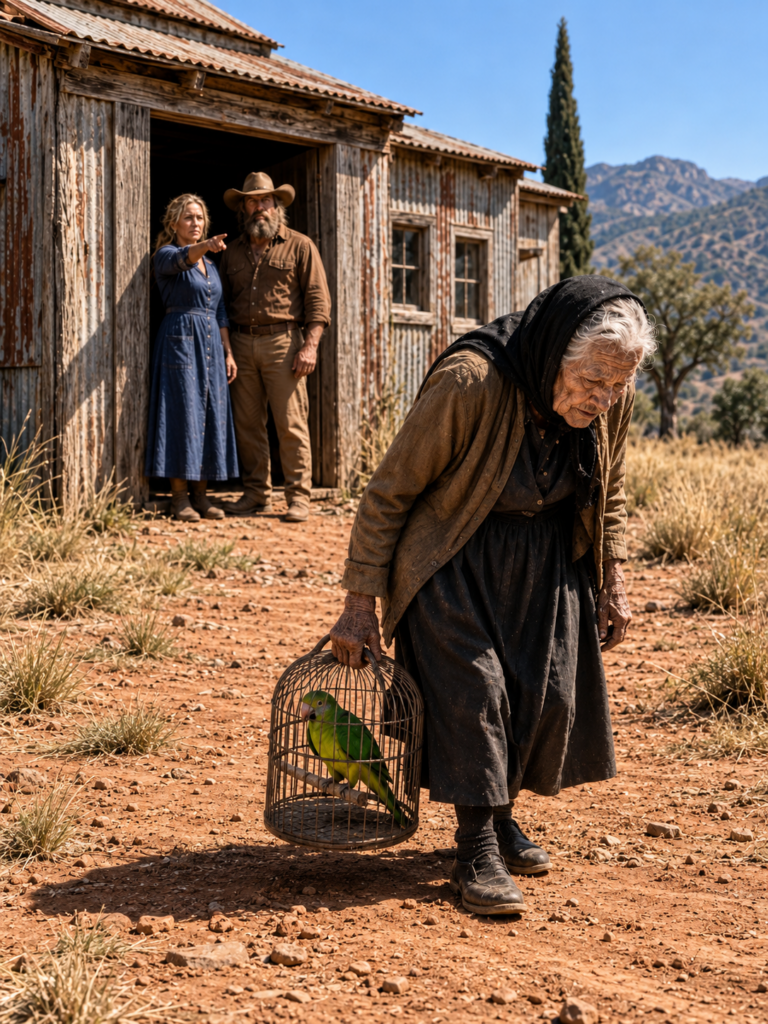
after fifty years of serving one ranch, they threw her out with an old parrot—then the bird repeated the secret that proved the land was hers
Part 1
At eighty-two years old, Margaret Hale owned everything she could carry in two hands.
A brown suitcase with a broken clasp.
And an old white cockatoo named Moses in a wire cage.
Logan McIntyre stood on the front steps of the biggest ranch house in Cedar County, Oklahoma, and watched her leave as though he were waiting for a delivery truck to clear the driveway.
“You’ve got everything?”
Margaret looked down at the suitcase.
Three dresses.
Two sweaters.
A Bible she could not read but had carried since her mother died.
A photograph of her daughter, Ruth.
Two pairs of stockings.
A hairbrush.
Fifty years of life reduced to what fit around them.
“Yes, sir.”
Logan reached into his pocket and held out two twenty-dollar bills.
Margaret stared at them.
“What is that?”
“Something for the road.”
For one strange second she thought he was joking.
Then she saw his face.
At forty-three, Logan had inherited his grandfather’s height, his father’s dark eyes, and almost none of their capacity for embarrassment.
Margaret had watched him grow from a red-faced infant into the man standing before her.
She had heated his bottles.
Washed mud from his school clothes.
Sat beside his bed during a fever when his parents were at a cattle auction in Texas.
She had once carried him almost half a mile after he fell from a pony and split his chin.
Now he held forty dollars toward her like payment to someone who had swept a porch.
“I don’t need that.”
“Take it.”
“No.”
His mouth tightened.
“Margaret, don’t make this difficult.”
She almost laughed.
Difficult.
Her hands had butchered chickens in February cold.
She had carried water when pipes froze.
She had cooked for twenty ranch hands during branding season.
She had held his grandfather’s hand while the old man died.
She had buried her own daughter.
She had worked through arthritis, influenza, drought, tornado warnings, and the slow humiliation of becoming an old woman in a house where everybody remained younger than she was.
And Logan McIntyre thought declining forty dollars was making things difficult.
He pushed the money into the outer pocket of her suitcase.
“There.”
Margaret said nothing.
Behind him stood his wife, Bethany, arms folded.
Bethany had grown up in Tulsa and had never liked the ranch. She disliked dust, flies, livestock smells, muddy boots, old furniture, and especially Margaret’s presence in the rear bedroom off the kitchen.
For years Bethany had referred to that room as “Margaret’s room.”
Six months earlier, she had begun calling it “the downstairs guest room.”
Margaret had noticed.
Old women noticed many things because people stopped believing they were worth hiding things from.
Logan glanced toward the cage.
“You’re taking that bird?”
Margaret looked at Moses.
The cockatoo was nearly fifty years old himself, feathered in white except for pale yellow beneath his wings. Age had roughened his feet and thinned feathers along his chest. His black beak was chipped.
He cocked his head at Logan.
“Damn fool,” Moses said.
Bethany gasped.
Margaret almost smiled.
Logan did not.
“That thing has been saying nonsense for forty years.”
“He won’t bother you anymore.”
“Good.”
Moses leaned toward the bars.
“Greg knows.”
Logan frowned.
“What?”
The bird clicked his beak.
“Greg knows. Greg knows.”
Margaret lifted the cage.
“He says things.”
She had said that sentence thousands of times.
Moses copied doors squeaking, trucks starting, screen doors slamming, names, curses, bits of hymns, weather reports, cattle prices, and phrases nobody remembered teaching him.
Nobody paid much attention anymore.
That would prove to be the McIntyre family’s greatest mistake.
Margaret stepped from the porch.
Gravel shifted beneath her old shoes.
Her left knee hurt badly that morning.
Four miles separated the ranch from Willow Creek, the nearest town.
Logan did not offer her a ride.
A young ranch hand named Eli came from the equipment shed.
“You want me to take Mrs. Hale into town?”
Logan turned.
“She’ll manage.”
Eli looked at Margaret.
Margaret shook her head before the young man could argue.
Pride was not always useful.
But sometimes it was the only thing a person had left.
She started down the road.
The iron gate stood half a mile from the house.
Cottonwoods lined the drive.
Margaret remembered when they were saplings.
She remembered planting three of them herself.
She remembered old Arthur McIntyre standing beside the windmill, saying they would never grow because the soil there was too dry.
Two of those trees were now taller than the ranch house.
The third had been struck by lightning.
Fifty years.
Margaret had entered that house at thirty-two.
Her daughter Ruth had been seven.
Margaret had recently been widowed—or what she told people was widowed, because explaining Ruth’s father had always been too complicated and too painful.
She could not read beyond recognizing a few names.
School had ended for her at eight after her mother became ill and Margaret started picking cotton with relatives.
Life had never offered her a second chance at letters.
Arthur McIntyre offered something else.
Work.
A room.
Meals.
Enough wages to raise Ruth.
Arthur owned eleven hundred acres then, mostly cattle ground with wheat fields along the creek.
His wife had died.
His nephews, Greg and Brian, visited only when they needed money.
Arthur was difficult, private, and often impatient.
But he paid when he promised.
And he never spoke to Margaret as though she were stupid.
That alone had mattered.
The ranch grew.
Ruth grew.
Margaret stayed.
And when Arthur became sick, Margaret became the person who knew his medication schedule, which soup he could tolerate, where extra blankets were kept, and when he was pretending not to be in pain.
Fifty-two years earlier, Arthur called an attorney named Everett Abernathy to the ranch.
Margaret remembered the brown leather briefcase.
She remembered bringing coffee.
She remembered Arthur telling her to shut the bedroom door when she left.
She had not known what they discussed.
Five days later, Greg arrived with another lawyer.
A city man named Charles Vance.
They found Margaret in the kitchen.
Greg smiled too much that afternoon.
She remembered that now.
“Uncle Arthur wants his affairs kept orderly,” Greg told her.
Arthur was asleep upstairs.
“He asked us to take care of a small piece of paperwork.”
Margaret wiped flour from her hands.
“What paperwork?”
“Nothing you need to worry about.”
Vance placed several pages on the kitchen table.
Margaret looked down.
Rows of black letters meant little to her.
She could recognize Arthur.
McIntyre.
Maybe her own first name if it was written clearly.
She hated admitting that.
Illiteracy created small humiliations every day.
Reading medicine labels.
Bank slips.
Menus.
Church notices.
People assumed an adult who could not read was unintelligent.
Margaret had spent her whole life proving otherwise while hiding the one weakness greedy men eventually used against her.
“What does it say?”
Vance adjusted his tie.
“It protects the property during probate.”
“Shouldn’t Mr. Arthur see it?”
Greg answered immediately.
“He has.”
That was a lie.
Margaret did not know.
“Where do I sign?”
Vance placed a pen in her hand.
“Right there.”
Margaret could sign neither first nor last name.
So she made the mark she had used all her adult life.
A cross.
One line down.
One line across.
Greg watched her.
She remembered the expression now.
Not gratitude.
Relief.
Five days later, Arthur died.
Margaret stayed beside him until his breathing stopped.
Near midnight the evening before, he woke unexpectedly lucid.
Moonlight came through the window.
Moses, young then, sat on a wooden perch near Arthur’s bed.
Arthur looked at Margaret.
“What belongs to you is yours.”
Margaret squeezed his hand.
“Don’t worry about anything.”
“Listen to me.”
“You need rest.”
“What belongs to you is yours.”
She assumed fever and medication had confused him.
Arthur turned his head toward the bird.
Then, strangely, he repeated four words twice.
Slowly.
Moses watched.
Margaret barely heard.
Her attention remained on the dying man.
She would remember the moment only much later.
After Arthur’s funeral, Greg and Brian arrived with papers.
They informed Margaret the ranch belonged to them as Arthur’s closest blood relatives.
She asked about the lawyer with the brown briefcase.
Greg told her Arthur’s will changed nothing.
“He took care of us,” Greg said.
“And you can stay.”
Margaret had nowhere else to go.
Ruth was grown but struggling to support two children after a divorce.
Margaret kept working.
Years became decades.
Brian sold his interest to Greg.
Greg expanded the ranch.
New barns appeared.
More acreage was purchased.
Oil leases brought money.
A highway interchange raised nearby property values.
The McIntyre name gained influence.
Margaret’s wages barely changed.
She never complained.
She had housing.
Food.
A place she understood.
When Ruth became ill, Greg allowed Margaret three weeks away to care for her.
Margaret thought that generosity.
Ruth died twelve years before Margaret was finally dismissed.
Cancer.
Fifty-eight years old.
After Ruth’s funeral, Margaret returned to the McIntyre kitchen because grief without work was unbearable.
By then Greg had become old.
His son was dead.
His grandson Logan was being prepared to inherit.
At night Greg often sat on the back porch with bourbon.
And Moses sat three feet away.
Greg talked.
People talked around animals the way they talked around furniture.
Names.
Money.
Regrets.
Old sins.
The bird listened.
Greg died four years before Margaret’s dismissal.
Logan took control.
He modernized the cattle operation.
Installed security cameras.
Replaced bookkeeping systems.
Hired a young housekeeper.
Then one Tuesday morning, he told Margaret she had become an unnecessary expense.
The walk to Willow Creek took nearly two hours.
Heat rose from the road.
Margaret stopped twice.
Her ankles swelled.
Moses remained unusually quiet.
At the edge of town stood Mae Patterson’s roadside café.
Mae and Margaret had known each other since they were young women, though fifty years on the ranch had turned their friendship mostly into Christmas cards dictated to other people and rare conversations after church.
Mae was sweeping outside when she saw Margaret.
She stopped.
Her eyes moved from the suitcase to the cage.
Then to Margaret’s face.
“What happened?”
Margaret said, “I don’t work at McIntyre anymore.”
Mae leaned the broom against the wall.
“Come inside.”
“I don’t have money.”
“Did I ask?”
Mae gave her chicken soup, cornbread, and iced tea.
Margaret ate slowly.
Only after the bowl was empty did Mae sit across from her.
“Now tell me.”
Margaret did.
No dramatics.
She was too tired.
Mae’s mouth tightened with every sentence.
When Margaret mentioned the forty dollars, Mae said something about Logan that would have made the church ladies blush.
“I have a little room in back.”
“I can’t pay.”
“Then don’t.”
“Mae.”
“Margaret, you’ve spent fifty years taking orders. Try taking one more.”
Margaret looked at her old friend.
“Stay.”
So she did.
For the first time since she was thirty-two, Margaret slept in a building that did not belong to the McIntyre family.
Moses’s cage sat beside the window.
Around two in the morning, Margaret woke.
The bird shifted.
Then spoke in Greg McIntyre’s gravelly imitation.
“Vance got five thousand.”
Margaret stared into darkness.
Moses clicked his beak.
“Couldn’t read it.”
He laughed.
Not the bird’s laugh.
Greg’s.
Margaret sat slowly upright.
“Moses?”
Silence.
“Vance got five thousand,” the bird repeated.
Then:
“Cross on the paper.”
Margaret felt cold despite the warm room.
For fifty years, she had assumed the paper she marked with a cross had protected Arthur’s estate.
For the first time in her life, she wondered whether it had stolen it.
Part 2
Mae heard Moses two days later.
She was slicing tomatoes behind the café counter when the bird called from the back hallway.
“Vance got five thousand.”
Mae froze.
The knife remained above the cutting board.
“Cross on the paper.”
Then another name.
“O’Reilly.”
Mae put down the knife.
Margaret sat outside shelling peas.
Mae carried the cage into the kitchen.
“What did he say?”
Margaret looked up.
“Who?”
“The bird.”
“He talks all day.”
“He said O’Reilly.”
Margaret shrugged.
“Could’ve heard it on television.”
“This bird lived at that ranch before there was much television worth watching.”
Mae sat down.
“Maggie, who is Vance?”
Margaret’s hands stopped.
“A lawyer.”
Mae waited.
Margaret told her about the papers.
For the first time she described the cross.
Mae listened.
“Why have you never told anybody this?”
“Nothing to tell.”
“You signed a paper you couldn’t read.”
“I’ve signed many things I couldn’t read.”
Mae closed her eyes.
“That is not comforting.”
“People explained them.”
“Greg McIntyre explained this one.”
Margaret looked down.
Mae’s son Liam arrived the following Tuesday.
He was forty-one, a property attorney in Oklahoma City who specialized in land-title disputes, elder exploitation, and fraudulent transfers.
Margaret had met him as a boy.
She remembered skinned knees and a cowlick.
The man entering the café carried a laptop bag and wore glasses.
He hugged Mae.
Then greeted Margaret with careful kindness.
His interest in Moses was much less respectful.
“My mother says your bird knows a fifty-year-old crime.”
Mae put coffee in front of him.
“I said come listen.”
“That sounded crazier, so I improved it.”
Margaret liked him immediately.
They placed the cage beside the table.
Moses stared at Liam.
Liam stared back.
Five minutes passed.
Nothing.
Ten.
Liam drank coffee.
“I charge two hundred eighty dollars an hour for this kind of silence.”
Mae slapped his shoulder.
Then Moses lifted his crest.
“Vance got five thousand.”
Liam stopped.
The bird continued.
“Couldn’t read it.”
A pause.
“Greg knows.”
Another pause.
Then:
“O’Reilly stopped asking.”
The coffee cup remained halfway to Liam’s mouth.
He lowered it very slowly.
“What did he say?”
Mae looked at him.
“You heard.”
“No.”
His face had gone pale.
“Say the name again.”
As though responding, Moses said:
“O’Reilly.”
Liam stood.
He walked to the window.
Margaret watched him remove his glasses and clean them.
“Who is O’Reilly?” she asked.
Liam turned.
“My father.”
Mae sat quietly.
Margaret looked between them.
Mae had never spoken much about Liam’s father.
Only that he disappeared when Liam was young.
Liam came back to the table.
“Frank O’Reilly was an investigative researcher.”
“What kind?”
“He looked at land records. Fraud. Property taken from farmers, widows, people who couldn’t afford lawyers.”
Margaret stared at him.
“He came here?”
“When I was five.”
Liam’s voice remained controlled.
“He was investigating several suspicious transfers in western Oklahoma. He called my mother from Willow Creek. Said he’d found a pattern.”
“What happened?”
“He vanished.”
Margaret put a hand over her mouth.
“No body. No car. Nothing useful enough for charges.”
Liam looked at the bird.
“My mother eventually left. Grandma Mae raised me.”
Mae’s expression hardened at old memories.
Liam continued.
“I became a lawyer because of him.”
Mae muttered, “He’ll deny that if you ask him on Christmas.”
“I deny many things on Christmas.”
He looked back at Margaret.
“How long was Moses around Greg?”
“Almost forty years.”
“Where?”
“Back porch mostly.”
“Did Greg sit there?”
“Every night.”
“Drink?”
“Yes.”
“Talk?”
“All the time.”
“To who?”
“Himself. The bird. Anybody nearby. Sometimes nobody.”
Liam took a recorder from his bag.
“What this bird says is not courtroom evidence.”
Margaret nodded, though she did not fully understand.
“But it can tell us where to look.”
For four days, Liam recorded Moses.
Most of what the bird produced was useless.
“Close the gate.”
“Storm coming.”
“Get those calves north.”
“Where’s Brian?”
Profanity.
A commercial jingle from twenty years earlier.
Arthur’s cough.
Greg’s laugh.
Margaret crying once when Ruth was sick.
Then came fragments that mattered.
“Vance got five thousand.”
“Cross is enough.”
“Abernathy copy.”
“Frank asked the clerk.”
“O’Reilly stopped asking.”
“Mayor knows.”
“Burn that one.”
Liam filled pages.
On the fifth day he sat with Margaret.
“I need everything you remember.”
“I’ve told you.”
“No. You’ve told me the story the way you’ve told it to yourself. I need details.”
So Margaret started again.
What color was Vance’s car?
She did not know.
Which room?
Kitchen.
Where did Greg stand?
Near the pantry door.
Brian?
At the sink.
Arthur awake?
Upstairs.
What did Vance say?
That the paper was a formality.
What did Greg say?
Arthur wanted things orderly.
Did anybody read the document aloud?
No.
Did anybody tell Margaret she surrendered inheritance rights?
No.
Did she know Arthur planned to leave her property?
No.
Liam stopped writing.
“You never knew?”
“Why would he leave me the ranch?”
“You cared for him.”
“That isn’t the same as family.”
Liam studied her.
“What did Arthur tell you before he died?”
Margaret remembered.
“What belongs to you is yours.”
Liam’s pen stopped.
“Exact words?”
“As close as I can remember.”
“Anything else?”
“He spoke to Moses.”
“What did he say?”
“I don’t remember.”
Moses, across the room, scraped his beak against the perch.
Liam turned toward him.
“Useful time to cooperate, bird.”
Moses said, “Damn fool.”
Mae laughed so hard she had to sit down.
The records search began the following week.
The Cedar County courthouse stored older documents in a basement that smelled of dust, mildew, and old cardboard.
Liam found the McIntyre file after three hours.
There it was.
Margaret’s cross.
The document purported to waive and assign any future inheritance interest she might receive from Arthur McIntyre to Greg and Brian McIntyre.
Liam read it twice.
Then a third time.
Several defects jumped out.
Margaret could not read, yet the document contained no certification that it had been read and explained to her.
The listed witnesses were unfamiliar.
The notarization raised questions.
Most importantly, Margaret signed before Arthur died.
At that moment she had no present ownership to convey.
A sophisticated opposing lawyer could argue various theories.
But the document was far from untouchable.
Then Liam found something better.
A probate reference to an instrument submitted by Everett Abernathy.
The instrument itself was missing from the county file.
Liam photographed everything.
He traced Charles Vance.
Dead twenty-nine years.
A disciplinary archive showed allegations of improper real-estate transactions before Vance surrendered his license.
No criminal conviction.
But a pattern.
Liam searched for Everett Abernathy.
Dead eleven years.
One surviving son.
Mark Abernathy.
Before pursuing him, Liam returned to Willow Creek.
He found Margaret mending a café apron.
“There may have been another will.”
Margaret’s hands stopped.
“Arthur’s?”
“Yes.”
“Leaving what to who?”
“I don’t know yet.”
Margaret studied his face.
“You think me.”
“I think Greg was afraid of something.”
She returned to sewing.
“Then why let me work there fifty years?”
Liam did not answer immediately.
“Because people who steal something often prefer the person they stole it from never realize there was a theft.”
The needle slipped.
Margaret pricked her finger.
A bead of blood appeared.
Mae reached for a towel.
Margaret stared at the blood.
“I cooked their meals.”
Nobody answered.
“I raised their children.”
Her voice remained quiet.
“I washed Ruth’s clothes beside theirs. When Greg’s wife died, I sat with him every night because he couldn’t sleep.”
Liam leaned forward.
“Margaret—”
“They knew?”
“We don’t know who knew what.”
“Greg knew.”
“Yes.”
She looked toward Moses.
“Fifty years.”
For the first time since Logan expelled her, Margaret cried.
Not loudly.
That made it worse.
Mae sat beside her.
Margaret pressed both hands against her face.
“They let me thank them.”
“For what?” Liam asked softly.
“For letting me stay.”
Silence filled the room.
All those years Margaret believed the McIntyres gave her shelter.
If Liam was right, they had been charging gratitude as rent on a house that belonged to her.
The cruelty of that realization reached deeper than money.
She had spent her life feeling indebted to thieves.
Liam waited until her breathing calmed.
“We don’t know enough yet.”
Margaret lowered her hands.
“Then find enough.”
It was the first order Liam ever heard her give.
He nodded.
“I will.”
Two days later the mayor called.
Calvin Pierce had been mayor of Willow Creek for eight years.
His voice was friendly in the particular way powerful men became friendly when they wanted someone to stop.
“Mr. O’Reilly, I hear you’ve been stirring through some ancient records.”
“Public records.”
“Of course.”
“Is there a problem?”
“Not a problem.”
A pause.
“The McIntyres are important to this county.”
Liam smiled without humor.
“Property law doesn’t have an important-family exception.”
“I only mean livelihoods are connected to that ranch.”
“Then those livelihoods deserve a ranch with clean title.”
Mayor Pierce’s voice cooled.
“Your client is eighty-two.”
“Yes.”
“Memory gets uncertain.”
“You’re a doctor now?”
“Don’t be childish.”
“Then don’t diagnose my client.”
The mayor exhaled.
“You’re not from here anymore, Liam.”
“I grew up three blocks from your office.”
“You’ve been in Oklahoma City twenty years.”
“And deeds still mean the same thing.”
Pierce became silent.
Then he said:
“Some ground looks firm until you step on it.”
Liam wrote the sentence down after hanging up.
Two mornings later, his rear window was smashed.
Nothing stolen.
Three days after that, a man approached him outside the courthouse with an envelope.
“There’s interest in resolving your client’s situation privately.”
“Whose interest?”
“You know.”
“How much?”
The man named a figure large enough to buy Margaret a comfortable home for the rest of her life.
“And what does she sign?”
“Confidential settlement. Releases.”
“Take it back.”
“You haven’t asked your client.”
“I don’t need to.”
The man smiled.
“Everybody needs money.”
Liam thought of his father disappearing thirty-five years earlier.
“No,” he said. “Everybody needs something. That’s not always the same thing.”
That evening he considered withdrawing.
Not because of the window.
Not because of the offer.
Because a witness named Silas Moore suddenly left town after agreeing to discuss Greg McIntyre’s old land transactions.
Liam found him eventually at his daughter’s house two counties away.
Silas refused to talk.
“I got grandchildren.”
“I understand.”
“No, son, you don’t.”
Maybe he did.
That night Mae found Liam sitting alone in the café after midnight.
Papers covered the table.
“You look like Frank.”
Liam did not look up.
“That’s not always a compliment.”
“I didn’t mean his face.”
“I know.”
Mae sat.
“He couldn’t leave a bad thing alone either.”
“And look how that ended.”
Mae flinched.
Liam regretted it instantly.
“I’m sorry.”
“No. You’re right.”
She looked toward the hallway.
Margaret’s door was closed.
“She deserves to know the risk.”
“I told her.”
“All of it?”
“Enough.”
Mae got up.
She knocked gently.
Margaret came out wearing a robe.
“What happened?”
Liam explained the window.
The money.
Silas.
The possibility that the case could become worse before it became better.
“If you want to stop,” he said, “I’ll understand.”
Margaret stared at him.
“You’re frightened.”
“Yes.”
That answer seemed to matter.
Margaret sat.
“I spent fifty years in a house believing I owned nothing.”
Liam waited.
“They threw me outside at eighty-two. I walked four miles carrying a bird because nobody thought I was worth driving.”
Her eyes sharpened.
“What exactly do you think they can take now?”
Liam said nothing.
Margaret continued.
“You’re looking for your father too.”
“Yes.”
“Then we keep going.”
From the hallway Moses suddenly said:
“Abernathy kept one.”
Everyone turned.
The bird lifted his crest.
“Abernathy kept one.”
Liam stood so fast his chair fell over.
“What did you say?”
Moses stared at him.
Then, in a voice unlike Greg’s—older, weaker, slower—he said:
“Everett will keep it safe.”
Margaret stopped breathing.
Arthur’s voice.
She knew it instantly.
Not because it sounded perfect.
Because after fifty-two years, some sounds lived deeper than memory.
“That was him,” she whispered.
“Arthur?”
Margaret nodded.
Liam grabbed his phone.
The dead had just given them an address.
Part 3
Mark Abernathy lived ninety miles away in a small house outside Enid.
He was sixty-three and suspicious before Liam finished introducing himself.
“My father is dead.”
“I know.”
“Then why are you asking about his clients?”
“One client.”
Liam said the name.
“Arthur McIntyre.”
Mark’s expression changed.
He did not invite Liam inside immediately.
Instead he stood behind the screen door looking at him for nearly a minute.
“Who are you representing?”
“Margaret Hale.”
Mark shut his eyes.
Then opened the door.
“Come in.”
The old office remained almost untouched.
Metal file cabinets.
Shelves.
Cardboard boxes.
A desk lamp from the 1970s.
Mark stood in the doorway.
“My father talked about that case near the end.”
“What did he say?”
“That he failed somebody.”
Liam felt his pulse rise.
“Margaret?”
“He never used her name with me until the final conversation.”
Mark crossed the room.
“He prepared a will for Arthur McIntyre. Clear will. Two witnesses.”
“Do you have it?”
Mark looked at him.
“My father believed the original disappeared from probate.”
“Do you have a copy?”
Mark reached toward a high shelf.
He took down a metal lockbox.
Inside was a large yellowed envelope sealed with brittle wax.
Everett Abernathy’s handwriting crossed the front.
PRIVATE COPY — ARTHUR McINTYRE ESTATE.
Liam did not touch it immediately.
“Why keep this?”
“Dad said Arthur made him promise.”
“To do what?”
“Keep a duplicate somewhere the nephews couldn’t reach.”
Liam swallowed.
Mark handed him the envelope.
“Dad told me if anybody ever came asking in Margaret Hale’s name, I was to give it to them.”
Liam looked at him.
“Why didn’t he go to Margaret himself?”
Mark’s face tightened.
“Cowardice.”
The word landed heavily.
“He had a wife. Four kids. Greg McIntyre threatened his practice. There were judges involved, county people. Dad convinced himself Margaret could still stay on the ranch, so at least she wasn’t homeless.”
Mark looked ashamed for a dead man’s choice.
“Later, he understood what that reasoning meant.”
Liam thought of Silas.
Of the smashed car window.
Fear made compromises sound practical.
“What happened to the original will?”
“Dad never knew.”
Liam returned to Willow Creek with the envelope unopened.
He wanted Margaret present.
Mae closed the café early.
Margaret sat at the table.
Moses’s cage stood nearby.
Liam broke the old seal carefully.
Inside were six folded sheets.
The first line identified Arthur William McIntyre.
The signatures were faded but visible.
Everett Abernathy.
Two witnesses.
Arthur McIntyre.
Liam read.
Margaret sat utterly still.
Arthur left the ranch house, all land then held under McIntyre Ranch, livestock, equipment, mineral interests, and residual estate to Margaret Elaine Hale.
Not to Greg.
Not to Brian.
Margaret.
There was a smaller trust provision for Ruth.
Margaret’s hands began shaking.
“What does it say?”
Liam read it aloud again.
Every word.
She listened.
When he finished, Margaret asked:
“Can I hold it?”
He placed the will into her hands.
Margaret stared at paper she could not read.
For fifty years, words had been used as walls around her.
Now those same words opened a door.
She touched Arthur’s signature.
“That says his name?”
“Yes.”
“And mine?”
Liam pointed.
“That.”
Margaret traced the letters with one finger.
M-A-R-G-A-R-E-T.
She knew the shape but not the sound of each symbol.
“Read that line again.”
Liam did.
She asked again.
He read it a third time.
Mae cried openly.
Margaret did not.
Not yet.
“Then it was mine.”
“Yes.”
“The whole time.”
“If the will is authenticated and the fraudulent waiver set aside, yes.”
Margaret stared at him.
“I scrubbed my own floors for them.”
Nobody had an answer.
Liam filed suit the next morning.
The McIntyre lawyers responded immediately.
Logan denied knowledge of fraud.
He claimed Margaret’s allegations emerged only after she became angry over legitimate termination of her employment.
The family attacked the will’s chain of custody.
They questioned Margaret’s memory.
They argued delay.
They argued reliance.
They argued that generations of McIntyres had invested enormous sums into the property.
They described Margaret as confused.
That word angered her more than thief ever could.
Confused.
As though eighty-two years had erased her.
Liam hired two document experts.
Paper.
Ink.
Handwriting.
Notary seals.
Both concluded the will was consistent with its claimed age and with authenticated Abernathy documents from the same period.
Then they found one surviving witness.
Walter Jennings.
Ninety-one years old.
Living with his daughter in Amarillo.
He remembered Arthur.
He remembered Abernathy.
And he remembered signing the will.
“I asked Arthur if he knew what he was doing,” Walter told Liam.
“What did he say?”
“He said, ‘For the first time in years.’”
Walter agreed to testify.
The case drew attention.
Willow Creek split.
Some residents supported Margaret.
Others worried what would happen if McIntyre Ranch changed hands.
Hundreds of cattle.
Dozens of jobs.
Leases.
Businesses.
Logan used those fears.
At a town meeting, he called Margaret’s lawsuit “an attack on a family enterprise that has supported this county for generations.”
Mae read the quote aloud.
Margaret sat at a café table peeling apples.
“Supported.”
Mae looked over the newspaper.
“That’s what it says.”
Margaret cut another apple.
“People say funny things when they mean controlled.”
One person who did not laugh was Victoria McIntyre.
Logan’s younger sister lived in Dallas and taught elementary school.
She had grown up on the ranch.
Unlike Logan, Victoria loved Margaret.
Margaret had taught her to knead biscuit dough.
Wrapped her ankle after she fell from the hayloft.
Slept on the floor beside her bed during a childhood thunderstorm.
Victoria learned about the lawsuit from the mayor’s wife at a charity luncheon.
She called Logan that night.
“Is there a will?”
“Don’t start.”
“Answer me.”
“There is a document.”
“Leaving the ranch to Margaret?”
“Supposedly.”
“Is it real?”
“Our lawyers are dealing with it.”
“That isn’t what I asked.”
Logan became quiet.
“You live in Dallas, Vic. You don’t understand what this means.”
“I understand Margaret is eighty-two and living in Mae Patterson’s back room because you threw her out.”
“She couldn’t work.”
“She worked for our family fifty years.”
“She’s not family.”
Victoria hung up.
Two days later Logan invited her to the ranch.
He wanted “family unity.”
Victoria drove north.
Before entering the house, she turned on the recorder on her phone.
She did not fully know why.
Maybe because part of her already knew her brother.
They sat in the living room.
Logan poured coffee.
“I need you out of this.”
“I haven’t done anything.”
“Good.”
He leaned forward.
“If somebody asks about Dad or Grandpa Greg, you don’t remember anything.”
“I don’t remember anything.”
“Exactly.”
“What if the will is real?”
Logan’s eyes hardened.
“It doesn’t matter.”
“How can it not matter?”
“Because that ranch is ours.”
“Legally?”
“Don’t start talking like a lawyer.”
“I’m talking like an adult.”
He stood.
“Margaret didn’t build what we have now.”
“Did Greg own it legally?”
Silence.
Victoria felt cold.
“Logan.”
“Our attorneys say possession and investment matter.”
“That isn’t an answer.”
Logan paced.
“Grandpa handled whatever happened fifty years ago.”
“You knew there was a problem.”
“I knew there were old papers.”
“And you still threw her out.”
“Because she was useless.”
Victoria stared at him.
“You actually believe that.”
“Believe what?”
“That a person stops mattering when they stop being useful to you.”
Logan swore.
Then, in anger, he said more than he intended.
He referred to payments.
The mayor.
Keeping county staff “friendly.”
Making sure old witnesses understood what reopening the matter could cost them.
Victoria sat quietly while the phone recorded.
After forty-six minutes, she left.
She drove directly to Willow Creek.
Liam listened to the recording twice.
Then he looked at Victoria.
“If we use this, your brother will know you gave it to us.”
“I know.”
“You may lose whatever inheritance you think you have.”
“If Margaret wins, it wasn’t mine.”
“That is legally complicated.”
“Morally it isn’t.”
Liam studied her.
“Why?”
Victoria’s eyes filled.
“When I was eight, I tore my ankle open on barbed wire. My father yelled because I’d scared a horse.”
She swallowed.
“Margaret sat with me while the doctor stitched it. Held my hand the whole time.”
Victoria looked toward the back room where Margaret rested.
“Nobody paid her to make me feel safe.”
She placed the phone on the table.
“I owe her the truth.”
Margaret came out later.
Victoria stood.
For several seconds neither spoke.
Then Victoria crossed the room.
“I’m sorry.”
Margaret shook her head.
“You didn’t do it.”
“My family did.”
“That’s not the same thing.”
Victoria began crying.
Margaret put her arms around her.
Liam watched.
Justice, he thought, was stranger than courtrooms made it seem.
It did not move neatly through families.
Guilt was not inherited.
Neither was courage.
That night, Logan called Victoria.
His tone shifted from pleading to anger.
“You betrayed us.”
“No.”
“You gave a lawyer private family conversations.”
“I gave him evidence.”
“If you testify, you’re done.”
“Done with what?”
“This family.”
Victoria became quiet.
Then she said:
“Margaret never had the surname, and she was more family to me than you have been in years.”
Logan threatened to make life difficult.
Victoria let him finish.
Then she said:
“I’m recording this call too.”
He hung up.
Two days later, somebody followed Liam from the courthouse.
Nothing happened.
But he saw the same pickup twice.
His fear returned.
That evening Margaret found him outside Mae’s café.
“You thinking of stopping again?”
Liam smiled tiredly.
“You’re getting good at reading lawyers.”
“I can’t read much else.”
“Don’t joke about that.”
“Why?”
“Because what they did to you because you couldn’t read—”
Margaret interrupted.
“Being unable to read did not make me foolish.”
“I know.”
“No.”
She touched his arm.
“You know now.”
That distinction stayed with him.
Margaret continued.
“I trusted the wrong men. Educated people do that every day.”
Liam nodded.
“Fair.”
“You find your father?”
“Not yet.”
“You will.”
He looked toward the street.
“I don’t know if I want to know anymore.”
Margaret understood better than he expected.
“Truth doesn’t ask whether you want it.”
No.
It did not.
The hearing began in March.
Logan arrived with three attorneys.
Margaret arrived with Liam, Mae, and a cane.
People filled the courtroom.
The McIntyre lawyers attacked her memory first.
“Mrs. Hale, you cannot read. Correct?”
“No, sir.”
“So you cannot personally verify the wording of the alleged will.”
“I heard it read.”
“By your lawyer.”
“Yes.”
“The same lawyer whose case benefits from your belief?”
Liam objected.
The judge sustained.
The attorney tried another route.
“Mrs. Hale, how can you be certain events you describe happened fifty-two years ago?”
Margaret looked at him.
“I don’t remember what I ate Tuesday.”
A few people smiled.
“But I remember the day a man put a pen in my hand and told me to mark paper I could not read.”
The attorney paused.
Margaret continued.
“I remember because I was ashamed.”
Silence.
“People remember shame.”
The first week belonged to documents.
The second belonged to witnesses.
Walter Jennings entered court using a walker.
He identified Arthur’s signature.
Abernathy’s.
His own.
“Was Arthur McIntyre mentally competent?”
“Yes.”
“Did he state his wishes?”
“Very clearly.”
“What were they?”
“To leave the ranch to Margaret Hale.”
Logan stared at the table.
Then Walter added something nobody expected.
“There is another reason Arthur did it.”
Liam looked up.
The judge asked Walter to explain only what he personally knew.
Walter’s voice became quieter.
“Ruth Hale was Arthur’s daughter.”
Margaret stopped moving.
Every sound vanished from the courtroom.
Walter continued.
Arthur had confessed it years earlier.
Margaret and Arthur had been close briefly after Arthur’s wife became ill and before Margaret understood the position she was in.
Margaret had always told Ruth her father was a traveling worker who left before she was born.
Arthur never publicly claimed Ruth.
Cowardice.
Reputation.
Shame.
Walter said Arthur regretted it.
The will was partly an attempt to repair what he had refused to acknowledge.
Margaret’s hands tightened.
Ruth.
Her daughter.
Dead twelve years.
Gone without ever knowing.
Margaret stared at the wall.
She remembered Arthur looking at Ruth when the girl was ten.
Paying for a doctor after pneumonia.
Buying school shoes but pretending it came from Christmas wages.
The resemblance she had refused to see.
The anger arrived before tears.
Not because Arthur had left the ranch to her.
Because he had let his daughter grow up inside her father’s house as a servant’s child.
Justice had just delivered Margaret another wound.
After court, she asked Liam to take her back to Mae’s.
She stayed in her room for two days.
On the second evening Mae entered.
Margaret sat beside Moses.
“I thought Ruth was the one thing in my life that had nothing to do with that ranch.”
Mae sat beside her.
Margaret’s eyes were red.
“Now even that belongs to the story.”
“No.”
Margaret looked at her.
“Ruth belonged to you.”
“Arthur was her father.”
“That tells you where half her blood came from.”
Mae took her hand.
“It does not tell you who raised her.”
Margaret cried then.
For Ruth.
For herself.
Even for Arthur, though she hated herself slightly for that.
On the third morning she dressed.
Liam waited outside.
“You sure?”
“No.”
“Good enough?”
Margaret picked up her cane.
“It’ll have to be.”
Part 4
The McIntyre case began collapsing slowly.
Then all at once.
Experts authenticated Arthur’s will.
The document Margaret had marked with a cross contained procedural defects severe enough to raise fraud questions.
One listed witness had been living in Arizona on the date he supposedly watched Margaret sign.
Another appeared to have been a former employee of attorney Charles Vance.
Bank records from Vance’s archived disciplinary file showed a large payment from a company controlled by Greg McIntyre shortly after Arthur’s death.
Victoria’s recording gave context.
Then came the mayor.
Liam’s team traced payments from a ranch-related consulting account to a business controlled by Mayor Calvin Pierce’s brother.
The amounts began shortly after Liam filed his case.
Pierce claimed they were consulting fees.
Nobody could identify consulting work.
The prosecutor became interested.
Logan panicked.
His worst mistake followed.
Two days before the judge was expected to rule on several key motions, someone called a courthouse clerk and offered money to create a procedural problem with Walter Jennings’s testimony.
The clerk had worked for Judge Ellen Barrett for fourteen years.
He documented the call.
Then walked into her chambers.
The obstruction investigation became public the same afternoon.
Logan’s attorneys stopped smiling.
Margaret saw it happen from the courtroom.
For months Logan had appeared irritated.
Then angry.
Then confident.
Now he looked frightened.
She felt no pleasure.
That surprised her.
For weeks she imagined that watching him lose would restore something.
It did not.
An old woman could not eat revenge for supper.
It did not bring Ruth back.
It did not return fifty years.
It did not straighten Margaret’s spine or remove arthritis from her hands.
All it could do was place truth where the lie had been.
Maybe that was enough.
Victoria testified during the final hearing.
Logan called her name once from the defense table.
“Victoria.”
Just that.
The sound carried years of sibling history.
Childhood.
Christmas.
Shared parents.
Shared secrets.
Victoria looked at him.
Then at the judge.
She continued.
Margaret understood what it cost her.
During a recess, Victoria sat beside Margaret.
“I keep remembering him when we were children.”
“Logan?”
“Yes.”
“He wasn’t always like this.”
“People usually aren’t.”
“Does that make it worse?”
Margaret considered.
“Sometimes.”
“What if I never speak to him again?”
“Then grieve that.”
Victoria looked at her.
“You make everything sound simple.”
“No.”
Margaret smiled sadly.
“I make simple sentences. That’s different.”
The verdict came on a Thursday morning.
Rain had fallen overnight.
Margaret wore a navy dress Mae pressed twice because her hands shook the first time.
She polished Margaret’s old shoes.
Liam met them outside court.
“You don’t have to understand every legal word,” he told Margaret.
“I haven’t understood legal words for fifty years. Hasn’t stopped them affecting me.”
The courtroom filled.
Judge Barrett entered.
Everyone rose.
Then sat.
She read for almost forty minutes.
She found Arthur McIntyre’s will authentic and valid.
She found the purported waiver signed by Margaret legally defective and obtained through material misrepresentation.
She found evidence of fraud sufficient to invalidate the transfer by which Greg and Brian claimed Margaret’s inherited interest.
She ordered title proceedings necessary to restore ownership.
The ranch.
The original acreage.
Subsequent property traceable to ranch assets, subject to additional accounting.
Mineral interests.
Certain proceeds.
Margaret heard words without feeling them.
Then Judge Barrett said:
“Margaret Elaine Hale is recognized as Arthur William McIntyre’s lawful devisee and rightful successor in interest.”
Liam touched Margaret’s arm.
“You won.”
Margaret looked at him.
“They have to give it back?”
“Yes.”
“The house?”
“Yes.”
“The pasture?”
“Yes.”
“All of it?”
“What can legally be traced, yes. There will be accounting issues, but the core ranch is yours.”
Margaret looked down at her hands.
Hands swollen at the knuckles.
Scar near her thumb from a butcher knife in 1981.
Burn mark on her wrist from taking biscuits out of Arthur’s oven.
Those hands had scrubbed floors.
Raised Ruth.
Buttoned children’s coats.
Held Arthur when he died.
Made a cross on paper because nobody taught her letters.
“They gave me my house back.”
Liam crouched beside her.
“They recognized it was always your house.”
That was different.
Outside, reporters waited.
Margaret refused to speak.
Mae took one arm.
Liam the other.
They walked through sunlight.
At the courthouse steps, Margaret stopped.
“What happens to Logan?”
“Separate proceedings.”
“And Mayor Pierce?”
“Separate.”
“And your father?”
Liam’s expression changed.
The investigation into Frank O’Reilly had reopened.
The bird’s phrases were not evidence.
But they pointed Liam toward land records, old phone logs, and correspondence.
His father’s notebook was eventually found in a box belonging to a retired county clerk.
Frank had discovered the same McIntyre transaction.
He had planned to interview Greg again.
Then someone close to Frank leaked his plans.
The leak came from Liam’s biological mother, Denise.
She had been frightened.
Greg’s people threatened Liam.
Five years old.
A child.
Denise told them where Frank was going, believing they only intended to scare him away.
Frank disappeared that night.
Denise left Oklahoma months later and spent the rest of her life refusing to discuss it.
“What will you do?” Margaret asked.
Liam looked tired.
“I don’t know.”
“Good.”
He frowned.
“Good?”
“Means you haven’t lied to yourself yet.”
He smiled.
“No.”
They sat on a hallway bench after the courtroom emptied.
Margaret told him something then.
“I don’t know if I want the ranch.”
Liam did not act surprised.
“I thought I did.”
“It’s yours. Wanting it and owning it aren’t the same question.”
“I spent fifty years there.”
“Yes.”
“I don’t know if I have another fifty minutes I want to give it.”
“Then don’t.”
Margaret looked at him.
“People will think I’m ungrateful.”
“To who?”
She almost laughed.
Liam continued.
“Sell it. Lease it. Give it away. Live there. Burn the curtains. Plant roses. The important part is that now you decide.”
Choice.
Margaret had worked eighty-two years before understanding how valuable that word was.
That afternoon Victoria came to Mae’s café.
No flowers.
No speeches.
She stood before Margaret.
“I don’t expect forgiveness for my family.”
Margaret said nothing.
“I just wanted you to know that whatever decent thing I learned in that house, I learned mostly from you.”
Margaret’s eyes filled.
Victoria continued.
“I don’t know what you want to do next. If there’s any way I can help, I’d like permission.”
Margaret held out her hand.
Victoria took it.
Moses watched from his cage.
“Damn fool,” he said.
Everyone laughed.
The laughter released something.
For one minute, the café contained no lawyers, inheritance, fraud, disappeared investigators, or fifty lost years.
Only four tired people and an old bird with bad manners.
The next day Moses said something new.
Margaret sat near the window.
Liam worked on his laptop.
Mae washed dishes.
Moses had been quiet for almost an hour.
Then, in Arthur’s old voice, he said:
“It’s yours, Maggie.”
Margaret froze.
Mae stepped from the kitchen.
Moses repeated:
“It’s yours, Maggie.”
Four words.
Margaret remembered the final night.
Arthur turning toward the bird.
Teaching him something.
Slowly.
Clearly.
She closed her eyes.
For fifty-two years those words lived inside a bird nobody respected enough to listen to.
Margaret began crying.
Not because Arthur’s message absolved him.
It did not.
He had failed Ruth.
Failed Margaret in ways a will could not erase.
But in his last hours, he had known danger existed around the papers.
He had tried, in one strange desperate way, to leave a message somewhere greed would not think to destroy it.
A bird.
Mae held Margaret.
Liam turned away to give her privacy.
Moses settled onto his perch.
His work, if an animal could have such a thing, seemed finished.
Three days later Margaret returned to McIntyre Ranch.
Liam drove.
Moses rode beside her.
At the iron gate, Margaret asked Liam to stop.
“You’re not coming?”
“No.”
“You sure?”
“Yes.”
“I’ll wait.”
Margaret climbed out.
She carried the cage.
The road felt longer than she remembered.
Nobody stopped her.
A court-appointed manager remained on site during the ownership transition, but Margaret had requested privacy that afternoon.
She walked past the cottonwoods.
Past the tank where she had washed work clothes.
Past the barn where Ruth once hid kittens.
She entered the house.
Everything looked familiar.
That was almost painful.
The kitchen table.
Pantry door.
Stair rail polished by generations of hands.
She did not stay.
Margaret continued to the back porch.
Greg’s chair remained there.
She sat in it.
Placed Moses on the table.
For decades Greg had drunk bourbon in that chair and laughed about how easy it was to fool a woman who could not read.
Now the woman sat where he had sat.
The ranch belonged to her.
Margaret looked toward pasture rolling beneath the afternoon sun.
Cattle moved along a fence.
Windmill turning.
Cottonwood leaves flashing silver-green.
She waited for triumph.
None came.
Instead there was quiet.
Real quiet.
Not the quiet of being ignored.
Not the quiet of servants moving carefully.
Not the quiet of swallowing anger because somebody else owned the roof over you.
Her quiet.
Margaret touched the porch arm.
“For the first time,” she whispered.
Moses shifted.
“It’s yours, Maggie.”
Margaret smiled.
“I know.”
Part 5
Margaret did not move back into the ranch house.
That surprised everybody.
Mae assumed she would.
Victoria hoped she might.
Reporters expected photographs of an eighty-two-year-old woman reclaiming the mansion where she had once worked.
Margaret stayed in Mae’s little back room.
“Why?” Mae finally asked.
Margaret sat at a café table sorting buttons.
“Because I sleep well here.”
“You own a six-bedroom house.”
“I know.”
“With three bathrooms.”
“I only use one at a time.”
Mae laughed.
“What are you going to do with the place?”
“Thinking.”
For fifty years Margaret’s days belonged to somebody else’s needs.
Breakfast at six.
Laundry.
Beds.
Lunch.
Ranch hands.
Dinner.
Children.
Sickness.
Guests.
Cleaning.
Always something.
Now people constantly asked what she wanted.
The question exhausted her.
Liam handled the legal accounting.
The numbers became extraordinary.
Land values had multiplied.
Mineral leases existed.
Cattle sales.
Rental income.
Investment accounts funded through ranch operations.
Not all could be recovered.
Some assets were too removed.
Some claims were barred.
Some money was gone.
Margaret did not care.
“How much do you need?” Liam asked one afternoon.
“For what?”
“To live.”
Margaret laughed.
“I have forty dollars Logan gave me.”
“He will be delighted to know that remains your retirement plan.”
She smiled.
Liam placed a sheet before her.
Then remembered.
“Sorry.”
“Read it.”
He did.
Even after fees, taxes, settlements, and unresolved accounting, Margaret possessed more money than she could have imagined.
She listened without visible reaction.
“That much?”
“Yes.”
“For dirt?”
“For land, mineral rights, cattle, and a very inconvenient amount of legal history.”
Margaret looked out the café window.
“What would Ruth have done?”
Liam could not answer.
Margaret knew.
Ruth had spent years working as a nursing aide.
Raised two children.
Rented her house.
Died with medical bills.
The bitterness of that truth remained.
Arthur’s will could have changed Ruth’s life.
Greg stole not only from Margaret.
He stole decades from a woman who never knew she was his cousin.
Margaret could not fix the past.
But perhaps she could decide what the past paid for.
Her first decision concerned the ranch employees.
Logan’s lawyers warned Margaret that labor costs were too high.
Several employees expected termination.
Margaret called them to the equipment shed.
Twelve men and four women gathered.
Eli stood near the back.
He was the young hand who had offered her a ride the morning Logan expelled her.
Margaret used a cane now.
She stood before them.
“Anybody here help throw me out?”
The group looked uncomfortable.
Eli shook his head.
“No, ma’am.”
“Anybody here know the ranch wasn’t McIntyre property?”
Nobody did.
“Then you’re not responsible.”
A few shoulders relaxed.
“The ranch needs workers.”
She pointed toward Liam.
“He tells me I am the owner.”
Someone smiled.
“I don’t know anything about managing eleven hundred acres at eighty-two.”
More smiles.
“So if you know your jobs and do them honestly, keep doing them.”
Eli raised a hand like a schoolboy.
“What about management?”
Margaret looked at him.
“You want it?”
His eyes widened.
“No, ma’am.”
“Smart boy.”
They hired an experienced ranch manager through an independent agricultural firm.
No McIntyre.
No local political connection.
Books open to audit.
Employees received written contracts.
For the first time, Margaret insisted somebody read every page aloud to her.
Not only summaries.
Every page.
Liam spent hours doing it.
One evening he became hoarse.
Margaret poured him tea.
“Tired?”
“Yes.”
“Good.”
“Why good?”
“You lawyers should suffer for making documents this long.”
The next decision involved education.
Margaret had carried illiteracy as private shame for seventy-four years.
She no longer intended to.
At eighty-two she walked into the Willow Creek adult-learning center.
The volunteer teacher, a retired woman named Susan Hall, assumed Margaret wanted information for somebody else.
“I want to read.”
Susan hesitated.
“All right.”
“You think I’m too old.”
“No.”
“You’re a poor liar.”
Susan smiled.
“I think it’ll be hard.”
“I’ve done hard.”
They started with letters.
A.
B.
C.
Margaret hated it.
Her fingers cramped holding a pencil.
Sounds refused to stay where Susan put them.
Some days Margaret confused letters she had learned the day before.
She became angry.
Embarrassed.
Once she nearly quit.
Then she remembered the cross.
One line down.
One line across.
She went back the next morning.
Six months later, Margaret wrote her name.
MARGARET HALE.
The letters leaned drunkenly.
The G looked questionable.
The T was too tall.
Margaret stared at it.
Susan said nothing.
Margaret wrote it again.
Better.
Then she cried.
She brought the paper to Mae’s café.
Mae framed it.
Liam saw it on the wall.
“What is that?”
“My signature.”
He stood looking.
“I’ve seen your signature.”
“No.”
Margaret pointed.
“You saw my cross.”
She smiled.
“This is my name.”
Liam hugged her.
Moses screamed until they separated.
Margaret’s biggest decision came the following spring.
She called a meeting at the ranch.
Liam.
Victoria.
The ranch manager.
Mae.
A representative from the county community college.
A nonprofit literacy director.
And an agricultural legal-aid organization.
Margaret sat at the head of Arthur’s old dining table.
That seat felt strange.
“I don’t need this house,” she said.
Nobody interrupted.
“I don’t need eleven hundred acres.”
The ranch manager looked alarmed.
Margaret continued.
“I do need the ranch to keep paying for itself.”
He relaxed slightly.
She explained.
The cattle operation would remain commercial.
Most acreage would stay in production.
But profits above a sustainable reserve would help fund three things.
Adult literacy in rural counties.
Legal assistance for elderly people facing property fraud.
Scholarships for rural women who wanted agricultural training.
Liam stared at her.
“You’ve been planning this.”
“Yes.”
Mae grinned.
“Look at you.”
Margaret shrugged.
“Had time.”
Victoria wiped her eyes.
Margaret pointed at her.
“Don’t start.”
“Sorry.”
“The main house?”
Liam asked.
Margaret looked around.
Fifty years of her labor remained in those walls.
She could still identify scratches she had tried to remove.
A burn mark behind the stove.
The place Ruth measured her children’s heights.
The room where Arthur died.
“The house becomes part of the program.”
“How?”
“Training. Offices. Temporary rooms.”
“For who?”
Margaret thought of the day Logan shut the door.
“People with nowhere else to go while somebody decides whether they matter.”
Mae looked down quickly.
Margaret continued.
“And nobody sleeps in my old room.”
“Why?” Victoria asked.
“Too small.”
People laughed.
The plan took almost a year.
McIntyre Ranch received a new legal name.
Not Hale Ranch.
Margaret refused.
Too much history already revolved around surnames.
Instead it became Willow House Farm & Learning Center.
Cattle continued grazing.
Hay continued growing.
The main house held legal clinics twice a month.
One room became a literacy classroom.
Another became temporary housing for elderly residents facing eviction or financial abuse.
The back porch remained mostly unchanged.
Greg’s old chair stayed there.
Margaret visited every Sunday.
Moses came with her.
Logan never returned.
His obstruction case ended in a negotiated sentence involving probation, fines, and restrictions following additional proceedings. Other fraud investigations continued beyond Margaret’s civil case.
Mayor Pierce resigned.
For months people asked Margaret whether she felt justice had been served.
She disliked the question.
Justice sounded like a meal delivered hot.
What happened to Margaret was more like repairing an old farmhouse after fifty years of rot.
You could replace boards.
Straighten foundations.
Stop rain entering.
But the water stains remained.
Frank O’Reilly’s case produced answers more slowly.
Investigators eventually concluded that Frank had likely been confronted after meeting with a registry employee.
A witness, dying of cancer, admitted helping Greg’s associates move Frank’s abandoned car across state lines.
He claimed Frank himself was already gone.
No body was recovered.
No murder conviction followed.
It was not the answer Liam wanted.
It was more than he had possessed before.
The hardest discovery remained his mother’s role.
Margaret noticed him withdrawing.
One Sunday she found him on the ranch porch.
“You talked to her?”
“No.”
“She alive?”
“Yes.”
“Going to?”
“I don’t know.”
Margaret sat beside him.
Moses climbed along his perch.
“My daughter died not knowing Arthur was her father.”
Liam looked over.
“I know.”
“If I could give her truth back, even painful truth, I would.”
“What if the truth only hurts?”
“It already hurts.”
He stared toward the pasture.
“My mother gave them Dad’s location.”
“She thought they would kill him?”
“No.”
“Then she made a terrible choice because she was frightened.”
“That’s supposed to make it better?”
“No.”
Margaret’s answer surprised him.
“It makes it true.”
Weeks later, Liam traveled to Arizona to meet Denise.
He never told Margaret every detail.
Only that the conversation happened.
His mother apologized.
He did not forgive immediately.
Margaret approved.
“Forgiveness shouldn’t be counterfeit.”
Liam laughed.
“Where do you get these sentences?”
“Eighty-three years.”
At eighty-four, Margaret’s health began slowing her.
Walking became harder.
Her heart gave trouble.
Moses also weakened.
The old bird slept more.
His vocabulary shrank.
Sometimes he repeated Arthur.
Sometimes Greg.
Sometimes sounds from Ruth’s childhood.
Margaret no longer found it eerie.
Moses carried a house full of voices because everyone around him assumed memory belonged only to humans.
One October afternoon, Margaret sat on the back porch while children from the literacy program toured the farm.
An elderly man practiced writing his address inside.
A forty-seven-year-old woman who had hidden her reading difficulties from her employer sounded out a newspaper headline.
Margaret could hear them through the window.
Mae sat beside her.
“You realize none of this happens without that bird.”
Margaret looked at Moses.
“He didn’t know what he was doing.”
“Neither do most people.”
Moses lifted his head.
“It’s yours, Maggie.”
Mae smiled.
Margaret answered.
“Not anymore.”
That was true.
The ranch belonged legally to a trust Margaret created.
Its purpose was larger than her.
For the first time, giving something away did not feel like theft.
Because she chose.
Choice made all the difference.
Victoria visited often.
Her relationship with Logan never recovered.
That loss hurt her.
Margaret never told her it shouldn’t.
Instead, they cooked.
Victoria read aloud when Margaret became tired.
Margaret taught her Arthur’s old beef-stew recipe.
One evening Victoria found her staring at Ruth’s photograph.
“I wish I’d known her better.”
“She’d have liked you.”
“How do you know?”
“She liked difficult people.”
Victoria laughed.
“Runs in the family.”
Margaret looked at her.
Family.
The word no longer meant blood alone.
Arthur shared blood with Ruth and failed her.
Greg shared blood with Arthur and betrayed him.
Victoria betrayed a brother to protect a woman unrelated by name.
Mae gave Margaret shelter without asking for a dollar.
Liam risked his safety for a client who began as a stranger and became something closer.
Family, Margaret concluded, was not a tree.
It was a set of choices repeated until somebody could trust them.
Moses died in winter.
Margaret found him one morning resting quietly at the bottom of the cage.
She knew immediately.
She sat beside him for almost an hour.
Mae offered to call someone.
“No.”
Margaret wrapped Moses in one of Arthur’s old linen towels preserved at the ranch.
They buried him beneath the cottonwood near the back porch.
Liam made a marker.
MOSES
A VERY LOUD WITNESS
Margaret laughed when she saw it.
“He’d approve.”
Spring came.
Margaret turned eighty-five.
Walking required a wheeled walker now.
Her reading improved slowly.
One Sunday afternoon, Susan brought her a simple book.
Margaret opened it.
Read a paragraph.
Not quickly.
Not perfectly.
But alone.
Nobody supplied the words.
She reached the end.
Closed the book.
Then sat silently.
“What?” Susan asked.
Margaret touched the cover.
“All those years.”
Susan understood.
The world had contained written doors everywhere.
Margaret had spent a lifetime waiting for others to tell her what stood behind them.
Now one had opened.
A month later, Liam brought a copy of Arthur’s will printed in large type.
“What is this?”
“Homework.”
“Cruel man.”
“Read what you can.”
Margaret started.
The legal language remained difficult.
But she found her name.
By herself.
Margaret Elaine Hale.
She traced it.
Then another word she recognized.
Ranch.
Then daughter.
Then property.
She could not read the whole will.
She did not need to.
The document no longer frightened her.
One warm evening, Margaret asked Victoria to drive her to Willow House.
The cottonwoods were fully leafed.
Cattle moved slowly beyond the fence.
They entered through the iron gate.
Margaret remembered walking out carrying a cage.
Forty dollars.
Two swollen feet.
No home.
Now a sign near the gate read:
WILLOW HOUSE
RURAL LEGAL AID • ADULT LITERACY • FARM FAMILY SUPPORT
Victoria parked.
“Need help?”
“In a minute.”
Margaret sat looking at the house.
A group of adults left the classroom laughing.
One elderly woman waved.
Margaret waved back.
When the yard emptied, Victoria helped her to the back porch.
Margaret sat in Greg’s old chair.
No cage beside her now.
Only evening light.
She thought about Arthur.
He had tried to repair injustice too late.
Greg had spent a lifetime protecting theft.
Logan inherited the lie without ever asking whether possession made it true.
Frank O’Reilly disappeared chasing facts.
Liam followed them home.
Moses remembered what humans chose to forget.
And Margaret?
Margaret survived.
For many years, she thought survival meant endurance.
Get up.
Cook.
Clean.
Work.
Obey.
Swallow pain.
Keep moving.
Now she understood survival could also mean choosing what came after suffering.
Not becoming cruel.
Not making another person small because somebody once made you small.
Not confusing property with dignity.
Not believing late justice was worthless merely because it was late.
Victoria sat beside her.
“Do you regret not selling?”
“No.”
“Do you regret giving most of it to the trust?”
“No.”
“What do you regret?”
Margaret looked toward the cottonwoods.
“Ruth.”
Victoria waited.
“I regret she didn’t know.”
“About Arthur?”
“About all of it.”
Margaret’s voice softened.
“That she belonged nowhere less than anybody else.”
Victoria reached for her hand.
Margaret let her.
After a while, Victoria said:
“You know that too, right?”
“What?”
“That you never belonged less.”
Margaret looked at her.
For most of her life, nobody had said that.
Maybe nobody needed to now.
But it felt good anyway.
“Yes,” Margaret said.
“I know.”
The sun lowered.
Light stretched over pasture.
A screen door opened behind them.
Someone inside laughed.
A pencil scratched across paper.
A teacher sounded out a word.
Life continued in rooms Margaret once scrubbed for other people’s comfort.
Only now the people inside were learning how not to be fooled by the same things that had trapped her.
Margaret smiled.
At eighty-five, she could write her name.
She had a home wherever she chose.
And nobody would ever again place a paper before her and tell her where to make a cross.
As evening settled over Willow House, Margaret closed her eyes.
For an instant, she could almost hear the old cockatoo behind her.
Arthur’s tired voice.
Four words preserved across half a century.
It’s yours, Maggie.
Margaret opened her eyes and looked at the classrooms, the pastures, the people moving inside the house.
Then she answered the silence.
“No.”
She smiled.
“Now it’s theirs.”


