
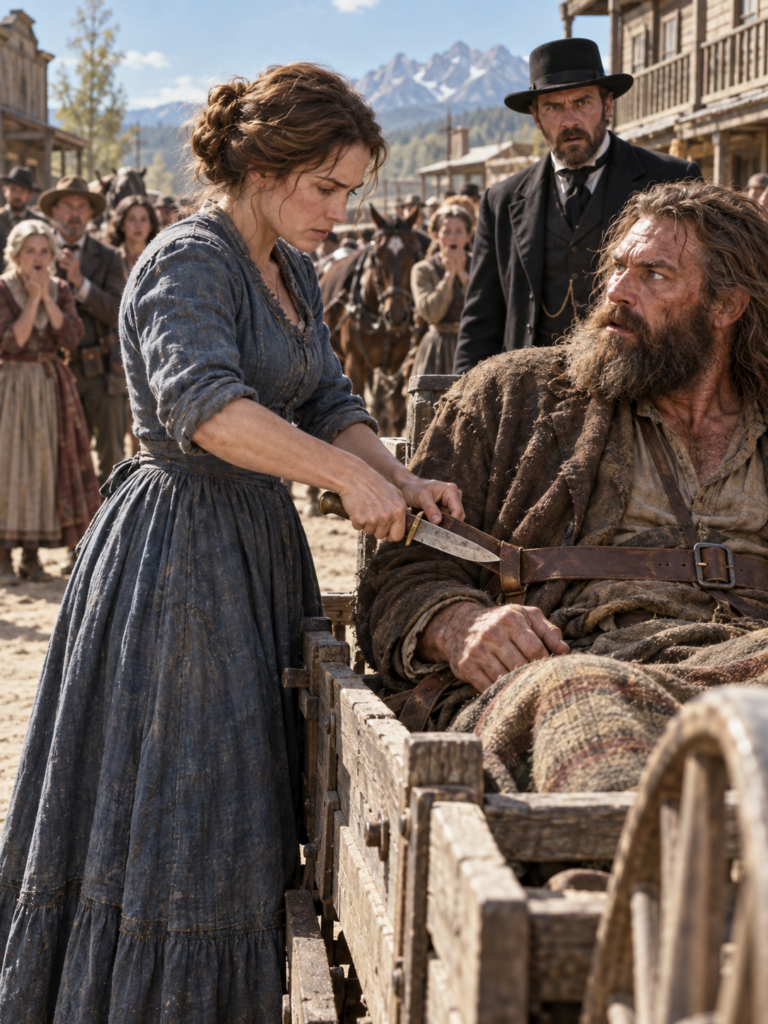
Maggie snapped the reins before Silas Mercer reached the wagon, and the gelding lurched forward hard enough to throw Cal’s shoulder against the sideboard.
He caught himself with both hands.
Behind them Mercer shouted her name.
Maggie did not turn.
Neither did Cal.
The wagon rattled off the square and onto the west road, Founder’s Day bunting shrinking behind them until the only sounds were iron rims striking ruts and Cal’s strained breathing.
After a quarter mile, Maggie slowed.
“You all right?”
“No.”
She looked back.
Cal’s face had gone gray.
“But I’d rather be unwell moving away from Mercer than comfortable beside him.”
She almost smiled.
Then she noticed blood darkening the cuff of his buckskin coat where the rough transfer had torn skin along his wrist.
Maggie pulled the wagon beneath a cottonwood.
“I have clean cloth.”
“I’ve had worse.”
“That wasn’t my question.”
His gaze settled on her.
Then he gave one reluctant nod.
She climbed into the wagon bed and opened the small supply box beneath the seat. Cal watched while she poured a little water over a folded strip of cloth.
“I can do it,” he said.
Maggie handed him the cloth immediately.
Something in his expression eased.
Not gratitude.
Respect, perhaps.
He cleaned the scrape himself.
Maggie sat opposite him.
“Tell me what you heard.”
Cal glanced toward the road behind them before answering.
“My room was behind the livery because Mercer owns the building. Men assume a fellow who cannot walk also cannot listen.”
“Who was talking?”
“Mercer’s freight clerk. Another man I never saw clearly.”
“When?”
“Twice this month.”
“What did they say?”
“That Harper charges had to be separated from regular accounts. That some loads were to be marked delivered whether the wagon went south or not.”
Maggie felt a slow coldness spread through her that had nothing to do with the season.
“Did they say what was in those loads?”
“Feed once. Fence wire another time.”
Both were items she had supposedly received.
Both were items she had paid for.
She looked across the brown grass rolling toward her ranch.
“I thought I was losing my mind.”
Cal’s voice changed.
“Don’t give Mercer that much credit.”
Maggie met his eyes.
“He kept showing me figures. Dates. Luke’s old orders mixed with mine. Every time I challenged one, there was another.”
“That confusion works best when a person is tired.”
“You sound familiar with it.”
For the first time, Cal looked away.
There was an answer behind that silence, but he did not offer it, and Maggie did not pry.
Instead she said, “You should know something before we reach my place.”
He waited.
“I truly cannot pay you wages beyond what I put down at that auction.”
“I don’t want wages for work I haven’t done.”
“You also don’t owe me labor because I cut those straps.”
His head turned back sharply.
Maggie held his gaze.
“You come to my ranch because you choose to. If tomorrow you want me to take you back to town, I will.”
“Back to Mercer’s livery?”
“Anywhere in town you choose.”
“And if I stay?”
“You tell me what you can do. I tell you what needs doing. We see whether those two lists meet.”
Cal rested his forearms on the wagon rail.
“The south fence?”
“Nearly forty yards down.”
“Posts?”
“Some split. Some pulled.”
“Wire?”
“Loose in three places.”
“Cattle shed?”
“West brace is going. Roof leaks near the back.”
He thought for several seconds.
“I can mend harness. Sharpen tools. Set wire if the work comes to me. Shape replacement braces if you can handle the saw cuts I mark. Might rig a low bench.”
Maggie blinked.
“That sounds like work.”
“That usually is what work sounds like.”
This time she did smile.
It vanished when the ranch came into view.
One of the south pasture gates stood open.
Maggie had latched it before leaving at dawn.
She pulled the wagon to a stop.
Cal followed her stare.
“How many cattle in that pasture?”
“Eleven.”
“How many should be visible from here?”
“Most of them.”
Only seven grazed near the slope.
Maggie climbed down.
“Stay here.”
Cal’s hand closed around the sideboard.
“No.”
She turned.
His tone remained level.
“I’m not ordering you. I’m telling you an open gate after what you just told me is not something you investigate without another pair of eyes.”
“You cannot cross that field.”
“No.”
The admission cost him something.
Maggie could see it.
Then he pointed toward the wagon floor.
“But you can put me where I can see the fence line.”
She looked from him to the open gate.
Two legitimate dangers stood before her: lose daylight searching alone, or spend precious time moving a man who could not walk into a position where he might help.
Cal reached for the heavy length of rope coiled beneath the wagon seat.
“If you mean what you said about deciding what work I can do, Mrs. Harper, let me decide.”
Maggie took the rope.
Together they lowered him from the wagon onto a folded blanket near the gatepost.
Cal braced himself upright.
Maggie placed Luke’s knife beside him.
“Only because you need something sharp.”
Cal looked at the knife, then at her.
“I’ll give it back.”
“I expect you to.”
She turned toward the pasture.
Cal suddenly caught the gate itself and dragged it closer.
Fresh wood showed beneath the latch.
Not weathered damage.
A deliberate cut.
“Maggie.”
She stopped.
Cal ran one thumb across the pale notch.
“This gate didn’t fail.”
Beyond the rise, a cow bawled.
Then another answered farther south.
Maggie tightened her grip on the rope and started toward the sound while Cal, unable to follow, planted both hands against the earth and began dragging himself toward the damaged latch.
Cal had moved less than three feet when Maggie looked back and saw what he was doing.
“Stop.”
He stopped.
Not because she had commanded him.
Because he heard the fear in her voice.
Maggie crossed the distance between them quickly.
“The ground will tear your hands apart.”
“They’ve survived worse.”
“I don’t care.”
That silenced him.
Maggie crouched beside the gate.
Cal looked from her face to his palms, already reddened from the dry earth.
After a moment he said, “Fair enough.”
She slid the folded blanket beneath him more securely.
“You said you needed to see the fence line. From here you can.”
“And you?”
“I need to find four cattle.”
Cal studied the pasture.
The land dropped southward toward a shallow draw before rising again to the broken stretch of fence. Cottonwoods marked the spring farther west.
“Take the bay,” he said. “Not the gelding.”
Maggie frowned.
“My bay shies at loose wire.”
“Exactly. If somebody cut fence down there, she’ll warn you before you ride into it.”
It was practical advice.
Not an order.
Maggie nodded.
Ten minutes later she rode south while Cal remained at the gate with Luke’s knife, a length of rope, and nothing below his waist he could command.
The fact troubled her more with every yard.
She found the first missing cow near the draw.
The second and third stood farther west beside the spring.
The fourth had crossed through the broken fence and wandered into scrub beyond the Harper boundary.
Maggie brought the animals back slowly, using the bay mare’s body to turn them north.
At the broken fence, she dismounted.
Two strands of wire lay slack.
One post had been sawn almost through before being shoved until it snapped.
Maggie stared at the clean cuts.
There was no pretending now.
When she returned to the gate, Cal knew from her face.
“Sawed?”
“Yes.”
He looked toward the house.
“Anybody else on the ranch?”
“No.”
“Neighbors close?”
“Closest place is two miles east.”
“You have a rifle?”
“In the house.”
“Good.”
Maggie’s jaw tightened.
Cal noticed immediately.
“I’m not telling you to fetch it.”
“Sounded like you were.”
“I’m telling you I’m glad you own one.”
That difference mattered.
More than Maggie wanted it to.
They closed the gate temporarily with rope and brought the cattle into the smaller north pasture before dark.
Moving Cal to the house took nearly half an hour.
The Harper cabin was modest: kitchen and main room below, a narrow sleeping room Maggie had used alone since Luke’s death, and a small back room once used for storage.
Maggie had cleared the back room months earlier but rarely entered it.
She opened the door.
“There’s a bed frame.”
Cal looked inside.
“And a door.”
“Yes.”
“That closes?”
“Yes.”
He glanced at her.
“You thought of that before we arrived?”
“I thought you might prefer not sleeping in my kitchen.”
The corner of his mouth moved.
“A powerful luxury.”
She helped him transfer from the wagon onto a sturdy chair, but only after he told her where to brace the chair and exactly how much help he wanted.
Then, using his arms and the chair backs she placed within reach, Cal worked himself toward the back room.
It was slow.
Ugly work.
Nothing like the stories Maggie remembered hearing about Cal Boone moving through mountain passes as if rock and snow had made room for him.
But she also saw something those stories had probably missed.
Patience.
He did not curse his legs.
He did not strike furniture.
He did not demand that she carry what he could still move himself.
When he finally sat on the bed, sweat darkened his collar.
Maggie set a basin of water nearby.
“Supper in an hour.”
“You don’t need to wait on me.”
“I’m cooking for myself.”
“Then I withdraw the complaint.”
She closed the door halfway behind her.
Not all the way.
His choice.
The next morning, Cal asked to see the tools.
Maggie brought the tool chest to the porch.
He examined Luke’s drawknife, brace, auger, hammer, files, and saw.
“You keep these sharp.”
“Luke taught me.”
“He taught you well.”
“He taught me enough to know when someone is trying to flatter me.”
Cal looked offended.
“I reserve flattery for people who make better coffee.”
She stared at him.
Then laughed before she could stop herself.
It was the first full laugh she had heard come out of her own mouth in months.
Cal heard that too.
Neither mentioned it.
They spent the morning building him a work station.
Maggie cut two short timber lengths according to his measurements. Cal shaped the top with Luke’s plane while seated on the porch floor, his useless legs stretched before him.
He showed her how to brace the low bench so it would not rock beneath the force of his arms.
She showed him where Luke had stored square nails in a tin beneath the porch.
By midday, the bench stood solid.
By afternoon, Cal had repaired two sections of harness and shaped a hardwood block for a new gate latch.
It was not the work Maggie had imagined buying at Founder’s Day.
It was better.
Not because Cal was extraordinary.
Because the work fit the man who existed now rather than the man Dry Timber remembered.
On the second day, Maggie hauled the damaged gate to the porch.
Cal examined the cut.
“Same blade pattern as the south post?”
“You can tell that?”
“Can tell the kerf width is close. Doesn’t prove the same saw.”
Maggie crouched opposite him.
“You keep refusing to make things simpler than they are.”
“I used to guide men through mountains.”
“What does that have to do with fences?”
“Men die when a guide tells them what he wishes were true.”
Something passed behind his eyes.
Maggie remembered the rockslide.
She waited.
Cal ran his thumb along the cut wood.
“Three months ago, the Fremont cut came down while I was guiding two men across the lower shelf. I saw loose stone above us and thought we had time.”
His voice remained steady.
“We didn’t.”
Maggie said nothing.
“One man got clear. I didn’t.”
He looked toward his legs.
“The doctor told me walking might return. Then he stopped telling me that.”
“Is that why Mercer took over your care?”
“No.”
Cal’s expression hardened.
“I had money.”
Maggie waited again.
“Not much. Enough to pay for a room and food while I figured out what came next. Mercer offered the back room cheap.”
“And then?”
“The account grew faster than I could understand. Meals I never ate. Laundry I never sent. Doctor charges the doctor swore he hadn’t made. By the time I challenged it, Mercer said I owed him nearly everything I had.”
Maggie felt her stomach twist.
The pattern was too familiar.
“Why didn’t you leave?”
Cal looked at her directly.
“Go where?”
The question was not self-pitying.
That made it worse.
“A man who cannot get himself from a bed to a wagon without help has fewer choices than he likes admitting.”
Maggie thought of the cart.
The straps.
Mercer smiling.
“You still had choices.”
“Yes.”
Cal’s eyes dropped to the gate.
“I chose badly for a while. I stopped arguing. Stopped asking what I was being charged. Figured if the mountain had taken the part of me that mattered, there wasn’t much reason to fight over the remains.”
Maggie’s voice turned sharp.
“Don’t say that.”
Cal looked up.
“You think I’m wrong?”
“I think Mercer wants both of us to believe usefulness is the same thing as worth.”
Silence settled between them.
Cal looked toward the pasture where Maggie’s cattle moved along the spring grass.
“And you?”
“What about me?”
“When did you stop believing him?”
Maggie looked at the house.
“At Founder’s Day.”
“That late?”
A reluctant smile tugged at her.
“Possibly when I saw how much I disliked his face.”
“That is often where moral courage begins.”
She laughed again.
Later that afternoon they rode to Dry Timber.
Maggie drove.
Cal sat beside her rather than lying in the wagon bed. They had built a broad seat support and fastened a strap around his waist—not to restrain him, but because he had asked for it to steady himself over ruts.
That distinction mattered to both of them.
At the mercantile, Mercer saw them through the front window.
His face changed.
Maggie entered first.
“I want copies of every Harper account for the last two years.”
Mercer folded his hands on the counter.
“You have already seen your balance.”
“I asked for the account.”
“You owe forty-three dollars and eighty cents.”
Cal entered behind her in a narrow wheeled chair Maggie had borrowed from the doctor.
Mercer’s eyes flicked downward.
Cal ignored him.
Maggie placed three receipts on the counter.
“These are mine. Feed on May sixth. Wire on June second. Salt on June twenty-third.”
Mercer looked bored.
“And?”
“All three appear again in your totals under different dates.”
The store went quiet.
Two customers turned slightly.
Mercer picked up one receipt.
“Bookkeeping errors happen.”
“Three times?”
“Your husband kept loose records.”
Maggie’s spine stiffened.
Cal said nothing.
He did not rescue her from the accusation.
He let her answer it.
“Luke has been dead fourteen months. Two of these duplicate charges were made after his death.”
Mercer’s fingers stopped moving.
One of the customers, an elderly farmer named Emmett Price, cleared his throat.
“I had a doubled freight line last spring.”
Mercer turned.
“Your account was corrected.”
“After I asked four times.”
The other customer looked suddenly interested in the floor.
Maggie saw the opening.
Not proof of everything.
But enough.
“I’m taking these records to the mayor.”
Mercer laughed once.
“The mayor cannot erase a legitimate debt.”
“Then you have nothing to fear.”
He leaned across the counter.
“You should think carefully about accusing a businessman publicly, Mrs. Harper.”
Maggie leaned forward too.
“I am thinking carefully.”
Behind her, one wheel of Cal’s chair creaked.
Mercer’s gaze shifted toward him.
“And what exactly are you now? Her witness?”
Cal’s answer came quietly.
“No.”
Maggie looked back.
Cal met her eyes before continuing.
“I’m the man who heard your clerk discussing deliveries that never arrived.”
Every sound in the store stopped.
Mercer’s face emptied.
For one dangerous second, Maggie wondered whether Cal had revealed too much too soon.
Then Mercer recovered.
“A half-dead man hearing voices through a wall?”
Cal rested both hands on the wheels of his chair.
“You strapped me to a cart because you thought I was helpless.”
His voice never rose.
“That was your mistake.”
Mercer looked at Maggie.
“You bring those accusations to the mayor and every cent you owe becomes due immediately.”
There it was.
The threat beneath all the politeness.
Maggie felt fear.
Real fear.
Forty-three dollars might as well have been four hundred before winter.
But Cal did not speak for her.
He waited.
Maggie picked up her receipts.
“Then make your demand in writing.”
Mercer’s eyes narrowed.
She turned toward the door.
Outside, Cal rolled beside her until they reached the wagon.
“You realize,” he said, “he may actually do it.”
“I know.”
“He may refuse feed, freight, stable service.”
“I know.”
“And you still want to push?”
Maggie looked toward the road home.
“No.”
Cal waited.
She gave him a tired smile.
“I’m terrified.”
“That wasn’t the question.”
Maggie looked back at Mercer’s windows.
“Yes,” she said. “I still want to push.”
Cal nodded.
“Then there’s something else you should know.”
She turned.
He took a long breath.
“Before the rockslide, I guided freight survey parties as well as prospectors. I can read route tallies, load marks, and mileage books.”
Maggie stared.
Cal continued.
“If Mercer falsified freight to your ranch, his own ledgers may show more than he realizes.”
“You could prove it?”
“I could help you understand it.”
Help.
Not save.
The word settled differently.
Maggie held out her hand.
“Then come home and help me.”
Cal looked at it.
Then up at her.
“For the week?”
Maggie thought of the auction.
The five dollars.
The cart.
“No.”
His expression changed.
She continued.
“For as long as we are both choosing the arrangement. You get the back room, meals, and a share of whatever work we can make useful here. When the ranch can pay cash, we settle wages. If you decide to leave, I help you go. If I decide this no longer works, I tell you plainly.”
Cal studied her face for several seconds.
“And if people talk?”
“They already do.”
“And if Mercer makes it worse?”
“He already has.”
A faint wind moved dust along the street between them.
Cal put his hand in hers.
Not like a man claiming something.
Like a man accepting terms.
“Then yes,” he said.
Across the street, Silas Mercer stood behind the mercantile glass, watching Maggie Harper and Cal Boone shake hands.
Silas Mercer was still watching when Maggie released Cal’s hand.
Neither of them pretended not to notice.
Cal shifted his weight in the wheeled chair.
“He wanted you isolated.”
Maggie looked across the street.
“He nearly had me that way.”
“Then we should assume he’ll try harder.”
“We?”
Cal glanced at her.
“You offered terms.”
“I did.”
“I accepted them.”
Something warm and frightening moved through Maggie’s chest.
She turned toward the wagon before he could see too much of it.
“Then help me get you aboard, partner.”
The word stopped him.
Only for a second.
Then Cal reached for the transfer board they had built that morning.
“Partner,” he repeated.
By sunset, the word had become work.
They spread Maggie’s receipts across the kitchen table beside the statements Mercer had delivered over the past year.
Cal read slowly.
Not because he lacked understanding.
Because he refused to guess.
He made Maggie separate what she knew from what she suspected.
“This charge?”
“Feed.”
“Did you receive it?”
“Yes.”
“This second feed entry six days later?”
“No.”
“You certain?”
“I kept grain tallies after Luke died.”
“Bring them.”
She did.
For three hours they compared dates.
A pattern emerged.
Small charges first.
A sack of salt.
A coil of wire.
A freight handling fee.
Then larger ones.
Feed deliveries duplicated.
Repair materials never ordered.
Transport fees for wagons Maggie had never seen.
Nothing enormous by itself.
That was the cleverness of it.
Enough to exhaust a widow.
Not enough to shock a town.
Cal leaned back in his chair.
“He never expected you to compare everything at once.”
“I never had time.”
“That was part of it.”
Maggie looked around the kitchen.
There had always been work.
Cattle.
Fence.
Roof.
Accounts.
Cooking.
Hauling water.
Mending tack.
Each problem stole attention from the next.
Mercer had not needed to break the ranch in one blow.
He had only needed to keep her tired.
She pressed her palms flat against the table.
“I hate that I almost believed him.”
Cal’s answer came immediately.
“Believed what?”
“That I couldn’t manage it.”
“You were managing sabotage and grief at the same time.”
Maggie looked up.
“You make that sound easier.”
“No.”
His gray eyes held hers.
“I’m making it sound accurate.”
She stared at him longer than she intended.
Then Cal reached for another page.
“Accuracy is useful.”
“So is sleeping.”
“I remember hearing of it.”
She stood.
“You take the back room. I’m putting these away.”
Cal hesitated.
“Maggie.”
“Yes?”
“I meant what I said in town.”
“About the ledgers?”
“About choosing this arrangement.”
Her hand paused over the papers.
“If staying here puts the ranch at greater risk, you can tell me.”
She frowned.
“Is that what you want?”
“No.”
The answer was so plain that both of them went still.
Cal looked down at his hands.
“But I know what dependence feels like now. I won’t turn mine into an obligation for you.”
Maggie moved around the table.
She stopped several feet away.
Close enough that he did not have to wonder whether she had heard.
Far enough that neither could mistake the distance as accidental.
“You’re not my obligation.”
His eyes rose.
“You are also not Luke’s replacement, not a hired hand I purchased, and not a debt I owe because you heard something useful behind Mercer’s livery.”
Cal’s jaw shifted.
“What am I?”
Maggie considered the question.
“At present?”
“Yes.”
“A difficult man who has taken possession of half my kitchen table.”
His mouth twitched.
“And after that?”
“My partner, if you keep earning the word.”
That time he smiled.
A real smile.
It changed his entire face.
Maggie went to bed remembering it.
The next several days altered the ranch by inches.
Cal designed a low work platform beneath the porch roof.
Maggie built it under his direction, then changed one brace when she saw a sturdier way.
He inspected the change.
“You improved it.”
“You sound wounded.”
“I was preparing to take credit.”
She began bringing damaged fence sections to him instead of hauling him out to each one.
He repaired what could be repaired, shaped pegs, sharpened tools, reworked harness fittings, and showed Maggie how to tension wire using leverage she could manage without exhausting herself.
Maggie handled the cattle, riding, cutting, lifting, and field work.
She also brought him ranch decisions instead of merely tasks.
“North pasture or south after the repair?”
“North until the gate holds.”
“Sell the older cow before winter?”
“Your cow.”
“Our feed problem.”
He looked at her.
Then nodded.
“Our feed problem.”
The second chair at Maggie’s kitchen table stopped being used only at meals.
It became Cal’s place for accounts.
A shelf in the back room filled with his few belongings from town.
On the porch, Maggie built a narrow ramp.
She did not surprise him with it.
She asked first.
“Would that help?”
“Yes.”
“Then tell me the grade you need.”
He did.
It took two attempts.
The first was too steep.
Cal nearly tipped backward, swore, and then laughed when Maggie sat down in the dirt beside him and laughed harder.
The second worked.
By the end of the week he could move from the back room to the porch without her lifting him.
The freedom was small enough that another person might have missed its importance.
Maggie did not.
Neither did Cal.
On the eighth morning, Mayor Howard rode out to the ranch.
He dismounted slowly.
“I brought something.”
Maggie stood on the porch.
Cal remained at his workbench.
The mayor produced a folded packet.
“Copies of Mercer’s freight pages. I told him I needed them for municipal tax review.”
Maggie stared.
“You lied to him?”
Howard looked miserable.
“I prefer to think I delayed telling the truth.”
Cal snorted.
The mayor gave him a pained look.
Then his face sobered.
“I should have stopped that business at Founder’s Day.”
Cal said nothing.
Howard swallowed.
“We told ourselves Mercer was arranging care. We told ourselves nobody else had room, money, or time.”
“And the straps?” Cal asked.
The mayor looked at the ground.
“There’s no good answer.”
“No.”
Howard raised his eyes.
“No, there isn’t.”
He handed the pages to Maggie.
“I can’t undo it. But I can stop helping him pretend it didn’t happen.”
That mattered too.
Not redemption.
Accountability.
They worked through the freight pages all afternoon.
Cal found the first inconsistency before supper.
A wagon supposedly sent to Harper Ranch had also been recorded delivering goods north of town on the same day.
The distances made both trips impossible.
Then another.
Then three more.
Maggie brought out her grain tallies.
The numbers matched what she had actually received, not what Mercer had charged.
By evening, they had enough to show a pattern.
Not enough for some grand courtroom victory.
Enough for Dry Timber.
Enough for customers to ask questions.
Enough for the mayor to refuse to certify Mercer’s demands without review.
Enough to make the threat of immediate collection look less like legitimate business and more like pressure.
Mercer came to the ranch the next morning.
He arrived alone.
Maggie saw him from the cattle shed and walked toward the house before he could reach the porch.
Cal was already there.
He had positioned his chair at the top of the ramp.
Not blocking the door.
Not beside a weapon.
Simply present.
Mercer removed his hat.
“Mrs. Harper.”
“Mr. Mercer.”
His gaze went to Cal.
“Boone.”
Cal nodded once.
Mercer held out a paper.
“Your account.”
Maggie did not take it.
“Set it on the table.”
His lips thinned.
“I came to settle this privately.”
“You had fourteen months for that.”
“Maggie—”
“Mrs. Harper.”
Cal’s eyes shifted toward her.
Mercer saw it.
That was when Maggie understood something important.
Silas had expected Cal to become her protector in the simplest possible way.
A large man.
A threat.
A replacement for Luke.
Something Mercer could mock or provoke.
But Cal remained silent.
Maggie did not need him to speak.
She stepped onto the porch.
“I have my receipts. My tallies. Copies of your freight pages. The mayor has seen them.”
Mercer’s face changed.
“You stole private business records?”
“The mayor obtained records relevant to disputed town freight charges.”
Mercer looked at Cal.
“This is your doing.”
“No,” Cal said.
Just one word.
Mercer frowned.
Cal continued.
“She did this.”
The statement should not have affected Maggie as deeply as it did.
But she had spent fourteen months hearing what she could not do.
Could not manage accounts.
Could not maintain a ranch.
Could not negotiate freight.
Could not stand alone forever.
Cal Boone, who had every reason to seize credit for the pattern he had recognized, simply placed the truth where it belonged.
Mercer turned back to Maggie.
“Suppose I revise the account.”
“Correct it.”
“Suppose I forgive the balance.”
“No.”
That surprised him.
Maggie took one step closer.
“You don’t forgive money I do not owe.”
Silence.
Cal’s hands tightened once on his chair rims.
Not from anger.
Maggie knew him well enough now to recognize restraint.
Mercer looked toward the spring in the distance.
“You could avoid all of this. I made you a fair offer for the ranch.”
“You made me an offer after spending months making the ranch harder to keep.”
“You cannot prove every broken post was mine.”
“No.”
“Or the gate.”
“No.”
“Then be careful what you accuse me of.”
Maggie nodded.
“I am.”
That unsettled him more than anger would have.
She continued.
“I can prove duplicate charges. I can prove freight conflicts. I can prove you threatened immediate collection after I challenged them. So those are the things I will say.”
Mercer studied her.
“And the ranch?”
“Not for sale.”
His gaze shifted toward Cal.
“You think this arrangement lasts?”
Maggie felt Cal go still behind her.
Mercer saw the wound and pressed it.
“He cannot ride your boundary. Cannot bring cattle in during weather. Cannot climb your roof. Cannot even cross your yard without that chair.”
Cal’s face emptied.
Maggie had seen that emptiness before.
Founder’s Day.
The expression of a man refusing to let strangers watch him bleed.
She wanted to turn and reassure him.
She did not.
Not yet.
Instead she answered Mercer.
“Cal knows what he cannot do.”
Mercer smiled.
Maggie continued.
“So do I.”
The smile faded.
“That is why we divide the work.”
She pointed toward the repaired gate leaning against the porch.
“He rebuilt the latch.”
Toward the harness hanging beside the door.
“He repaired that.”
Toward the papers inside.
“He found errors I missed.”
Then she touched her own chest.
“I ride the fence. I handle the cattle. I haul what needs hauling. I make the decisions that belong to me.”
She looked toward Cal.
“And the decisions that belong to both of us, we make together.”
Mercer stared at her.
Maggie felt the weight of what she had just said.
So did Cal.
She had not planned it.
That made it truer.
Mercer put his hat back on.
“You’ll regret tying your future to a man who cannot stand.”
Cal’s voice came from behind her.
“Maybe.”
Maggie turned.
He looked at Mercer without heat.
“But it’ll be her regret to choose.”
Mercer left.
They watched him ride away.
Only when the sound of his horse faded did Maggie turn fully toward Cal.
He was looking at the yard.
Not at her.
“What?” she asked.
“Nothing.”
“Liar.”
His jaw shifted.
She waited.
Finally he said, “You didn’t have to say those things.”
“Yes, I did.”
“No. You could have defended the arrangement without making it sound permanent.”
Maggie’s pulse quickened.
“I said decisions belonging to both of us are made together.”
“I heard you.”
“Then what troubles you?”
Cal looked toward the ramp she had built.
“When Mercer said I cannot stand, part of me wanted to put my hands on that rail and prove him wrong.”
“You cannot.”
“No.”
The word scraped.
Maggie stepped closer.
Cal kept going.
“And some days I still hate it enough that I don’t know what to do with the hate.”
There it was.
Not the calm guide.
Not the sharp-eyed partner.
The man beneath both.
“I wake up and forget for half a second,” he said. “Then I try to move my foot.”
Maggie said nothing.
“It doesn’t move.”
His voice dropped.
“I used to wake before daylight because I wanted the trail. Now daylight sometimes feels like another twelve hours of measuring what I cannot reach.”
He looked at his hands.
“I didn’t tell you that because I thought gratitude required cheerfulness.”
Maggie crouched in front of him.
“Gratitude?”
“For the room. The work. This.”
He gestured toward the porch, the ranch, perhaps her.
Maggie’s expression hardened.
“Then you have not listened to me at all.”
Cal looked startled.
“You do not owe me cheerfulness.”
“Maggie—”
“You do not owe me being easy to live with. You owe me honesty. You owe me the work you agree to do. You owe me respect for the ranch and for my choices.”
Her voice softened.
“And I owe you the same.”
Cal swallowed.
“What if honesty is that I may never stop wanting my legs back?”
“Why should you?”
“What if I never become content with this?”
She looked at the chair.
Then at him.
“I never asked you to be content with what happened.”
Cal’s eyes darkened.
“I asked whether you could build something from what remained.”
The words settled between them.
His voice became rough.
“And if I can?”
Maggie knew then that the question was no longer about fences.
She stood.
“If you can, you decide whether you want to.”
He looked up at her.
“And if what I want is here?”
Maggie’s breath caught.
She could have answered quickly.
A month earlier, perhaps she would have.
Loneliness could make almost any offer sound like rescue.
But she had learned to distrust rescue that required surrender.
So she took her time.
“What do you mean by here?”
Cal understood.
Not the house.
Not the ranch.
Not merely shelter.
He placed both hands flat on his knees.
“I mean the work. The table. Arguing about braces. Your terrible coffee.”
“My coffee is better than yours.”
“I have never made coffee here.”
“Exactly.”
A smile came and went.
Then he sobered.
“I mean waking somewhere I am expected to make decisions instead of receive them. I mean being useful where usefulness is not the price of being allowed to stay.”
Maggie’s eyes burned.
Cal continued.
“And I mean you.”
There it was.
Plain.
No claim.
No demand.
“I don’t know what shape that takes,” he said. “I’m not asking you to decide today. I’m not asking because I need a roof.”
He looked toward the road.
“If you told me tomorrow this arrangement should remain only work, I would still honor it.”
Maggie believed him.
That was what made answering dangerous.
She reached into the pocket of her faded blue dress.
Luke’s hunting knife rested there.
She had carried it every day since Founder’s Day.
Maggie drew it.
Cal’s eyes followed the blade.
She placed it across his palms.
“You said you’d give this back.”
His fingers curled around the worn handle.
“I remember.”
“Do you know why I carried it that day?”
“Protection?”
“Partly.”
She sat on the porch step.
“After Luke died, I carried it because it was one thing of his that still felt useful. Not framed. Not folded away. Not something people expected me to cry over.”
Cal listened.
“I used to think keeping everything exactly as he left it meant I was keeping faith.”
She looked toward the ranch.
“But Luke is still dead whether the knife stays in my pocket or not.”
Cal said nothing.
Maggie touched the handle once.
“And I am still alive.”
She closed his fingers around it.
“I want you to keep it at your workbench.”
Cal frowned.
“Maggie—”
“Not because it becomes yours.”
He waited.
“Because tools ought to be used.”
Understanding moved slowly across his face.
“And if you ever leave,” she said, “you give it back.”
Cal held her gaze.
“So there is still a road out.”
“There will always be a road out.”
“For both of us?”
“Yes.”
His thumb moved across the knife’s worn wooden scale.
“Then I’ll keep it sharp.”
Autumn deepened.
Dry Timber did not transform overnight.
Some people still avoided Maggie’s eyes.
Others suddenly became eager to say they had always distrusted Mercer.
Maggie believed neither performance.
She preferred what people did.
Emmett Price brought two freight receipts of his own.
A widow from the east road found charges for lamp oil she had never received.
The mayor called a public review of disputed mercantile accounts.
Mercer did not lose his entire business.
Life was rarely that clean.
But he lost something he valued more than one account.
Automatic belief.
Customers began asking for itemized records.
Freighters demanded signatures at delivery.
The mayor required charity-auction participants to consent before their names could be entered again.
Nobody called that rule the Boone rule.
They did not need to.
Mercer corrected Maggie’s account.
Twenty-eight dollars and sixty cents disappeared from what he claimed she owed.
Another portion was suspended until he could produce supporting receipts.
He never produced them.
The Harper ranch remained difficult.
Winter preparation did not become easy because justice had improved.
Maggie and Cal replaced south fence sections together.
She cut and set the posts.
He prepared braces, measured wire, repaired tools, and devised a wooden winding handle that let her tension long stretches without ruining her shoulders.
They reinforced the cattle shed.
Maggie climbed the ladder.
Cal remained below, calling measurements and passing up smaller tools through a rope basket they rigged between them.
When Maggie misjudged a brace and had to cut it twice, Cal wisely waited until she laughed before he did.
The first hard freeze came with clear skies.
No dramatic storm.
No disaster.
Just cold settling honestly into the boards and grass.
Maggie woke before dawn and found Cal already on the porch wrapped in his coat, watching frost silver the pasture.
She carried out two cups.
He accepted one.
“Better coffee,” he said.
“You lie beautifully.”
“I’ve been practicing.”
They sat without speaking for a while.
The silence no longer felt empty.
That surprised Maggie most.
Months earlier silence had been where Luke’s absence lived.
Now sometimes silence simply meant two people had nothing they needed to prove.
Cal took a drink.
“The week is over.”
Maggie turned.
“It ended some time ago.”
“I know.”
“You planning to demand your five dollars?”
“One of them is still yours.”
She remembered the coin he had pressed back into her palm on Founder’s Day.
It remained in the kitchen drawer.
“No,” she said. “I think I’ll keep that one.”
“Why?”
“To remember I once paid four dollars for the most argumentative partner in Wyoming.”
He looked offended.
“Five. Mercer kept the rest.”
“That worsens the bargain.”
Cal smiled.
Then his expression changed.
“Maggie.”
She waited.
“I want to stay through winter.”
Her heart tightened.
He continued before she could answer.
“If the terms still stand.”
“Which terms?”
“Back room remains mine. Work is divided. Decisions are spoken plainly. Either of us can end the arrangement.”
“Yes.”
“And if spring comes and we still want this?”
Maggie looked at the frosted pasture.
“Then we decide again.”
He nodded.
No grand vow.
No promise pretending people could know every season in advance.
Just another choice.
Maggie found she trusted that more.
Winter passed by work.
The ranch survived.
So did they.
By spring, Cal’s legs had not recovered.
There was no miracle.
No morning when he rose and crossed the porch.
He remained paralyzed.
What changed was the world they built around the fact without pretending the fact itself had changed.
They widened the back doorway.
Lowered one section of the kitchen work surface.
Built a sturdier chair with larger wheels for the packed yard.
Cal learned to transfer onto the wagon seat without Maggie lifting him.
Maggie learned to ask for help before exhaustion turned simple jobs dangerous.
He handled more of the accounts.
She negotiated a new freight arrangement with a hauler outside Mercer’s contracts.
They sold two older cattle before feed ran short.
They planted a small garden near the spring.
Cal planned the rows.
Maggie accused him of believing beans obeyed military discipline.
He informed her that beans had more sense than prospectors.
By the next Founder’s Day, Dry Timber’s charity auction looked different.
Participants sat beneath an awning beside the platform.
Each person was asked publicly whether he or she wished to offer work.
No straps.
No surprises.
No jokes about broken people.
Maggie stood at the edge of the square in another blue dress—not faded this time, though plainly made.
Cal sat beside her in the chair they had built over winter.
Luke’s hunting knife hung at his work belt.
Not hidden.
Not displayed.
Simply used.
Mayor Howard opened the auction.
When he reached Cal’s name, he hesitated.
Cal raised one hand.
“I’m offering three days of tool repair. Work comes to the Harper place.”
Someone in the crowd called, “What’ll you charge for sharpening a plow blade?”
Cal answered, “More if you keep abusing it.”
Laughter moved across the square.
This laughter was different.
Cal knew it.
Maggie knew it.
He looked at her.
“One year.”
“Nearly.”
“Still regret the bargain?”
“Constantly.”
“Good.”
Maggie reached into her pocket.
She took out the old dollar coin.
The one Cal had returned.
She placed it in his palm.
“What’s this?”
“My bid.”
“For three days?”
“No.”
He looked at her carefully.
Maggie felt nervous.
More nervous than when she had raised a knife before the entire town.
Because this choice could not be blamed on danger, grief, Mercer, winter, money, or necessity.
The ranch was steady enough now.
Cal had earned enough repairing tools, harness, wagon parts, and keeping freight accounts for neighboring farms that he had money of his own.
If he wished, he could rent a room elsewhere.
Maggie could run Harper Ranch without him.
It would be harder.
But she could.
That mattered.
They were standing at last where love had to be chosen without rescue confusing the answer.
Maggie closed his fingers around the coin.
“I’m bidding on tomorrow.”
Cal stared at her.
“That sounds expensive.”
“It is.”
“What does the work involve?”
“Breakfast. Accounts. Fence arguments. Probably coffee complaints.”
“Severe conditions.”
“And I thought we might stop renewing the arrangement one season at a time.”
His expression stilled.
Maggie continued.
“Not because you need somewhere to live.”
“I don’t.”
“Not because I need a man to save the ranch.”
“You don’t.”
“Not because I owe you anything.”
“You don’t.”
“And not because either of us is trapped.”
Cal’s gray eyes held hers.
“No.”
Maggie swallowed.
“I want a life with you.”
The square seemed to disappear.
Cal looked down at the coin.
Then toward the old Founder’s Day platform where a year earlier men had strapped him to a board and called humiliation charity.
When he looked back, his eyes were bright.
“I want that too.”
Maggie smiled.
“Good.”
“That all?”
“What were you expecting?”
“I carried men through mountain passes. I expected grandeur.”
“You also complain about coffee.”
“I contain contradictions.”
She laughed.
Then Cal reached for her hand.
He did not pull her closer.
He waited.
Maggie stepped toward him herself.
She bent and kissed him.
Not because he had rescued her.
Not because she had rescued him.
Not because grief demanded replacement or loneliness demanded surrender.
Because over one hard year they had learned the shape of each other’s choices.
When they separated, Cal touched the knife at his belt.
“You still want this back if I leave?”
“Yes.”
“And if I don’t?”
Maggie looked toward the west road leading out of Dry Timber, then toward the ranch road heading home.
“The road stays open anyway.”
Cal smiled.
“That sounds right.”
They returned to Harper Ranch before dusk.
The south gate stood straight.
The cattle shed held firm.
Water ran from the spring exactly as it had through Luke’s life, through Maggie’s widowhood, through Mercer’s pressure, through Cal’s first uncertain winter.
On the porch sat two chairs.
Not because two chairs made a family.
Not because a house became a home the moment a man and woman chose one another.
But because both chairs had been built, placed, moved, argued over, and used.
Cal rolled to his workbench and set Luke’s knife beside a length of leather waiting to be cut.
Maggie stopped in the doorway.
“You keeping it sharp?”
He looked up.
“Always.”
She nodded toward the pasture.
“North fence tomorrow.”
“Needs two posts.”
“Three.”
“Two.”
“Cal.”
“Maggie.”
She smiled.
Then she crossed the porch, opened the ranch ledger, and placed it between them.
Cal moved his chair closer.
Outside, the spring kept running.
Inside, neither of them belonged to the other.
They belonged to the life they had freely decided to keep building together.


