At 82, He Bought an Abandoned House for $100—Then He Found a Hidden Staircase Under the Floor
Part 1
Harold Turner learned that his home was being emptied while he was sitting beside a narrow window in a room that had never felt like his.
The call came from an old neighbor.
“Harold,” she said, and from the way she spoke his name, he knew before she finished that something was wrong. “I thought you should know. There are people carrying furniture out of your house.”
Harold tightened his grip on the phone.
“What furniture?”
There was a pause.
His dining table was gone.
Margaret’s antique dresser was gone.
Boxes from the garage had been loaded into a truck. Even the rocking chair where his wife had spent her final summer had disappeared from the porch.
Harold listened without interrupting.
Eleven months earlier, his son Michael had promised that none of this would happen.
Harold had fallen on the back steps of the little brick house where he and Margaret had spent nearly half a century together. The fall had frightened Michael more than it had injured Harold. Michael had insisted that his father stay temporarily at an assisted living facility while he recovered.
“Just until you’re stronger, Dad.”
Susan had agreed. There would be meals, people nearby, medication reminders, somebody to help if Harold fell again.
Harold hadn’t liked the idea. But Michael had taken his hand and promised him something simple.
The house would be waiting.
So Harold had packed clothes for a few weeks.
A few weeks became two months.
Then four.
Then six.
Every time Harold asked when he could go home, Michael found another reason to wait.
The doctor wanted more time.
The roads were bad.
The house needed repairs.
Winter was coming.
Winter had passed.
And now strangers were carrying Margaret’s furniture out the door.
Harold called his son.
Michael didn’t deny it.
“The house is too much for you, Dad.”
“That wasn’t your decision.”
“I’m trying to be realistic.”
“You sold your mother’s dresser.”
Michael sighed.
Harold hated that sigh. It carried the weary patience of someone speaking to a child.
“They’re just things.”
Harold stared at the rain sliding down the window.
On the other end of the line, Michael kept talking. He said Harold was safe where he was. He said the house had become a burden. He said maintaining it didn’t make sense anymore.
Then he said the words Harold would remember long after the rest of the conversation blurred together.
“You’re better off where you are, Dad.”
Harold didn’t argue.
He hung up.
For most of his life, he had been good with words. He had taught history at the same Kentucky high school for forty-three years. Thousands of students had passed through his classroom. Former students still stopped him in grocery stores and parking lots, sometimes gray-haired themselves, to remind him of lessons he barely remembered giving.
He had spent decades telling young people to defend an argument, examine evidence, ask who benefited from a decision.
Yet when his own son quietly took control of his life, Harold had not recognized what was happening until almost everything was gone.
That night, he sat beside the window and looked at his hands.
They were thinner now. Veins rose beneath the skin. The knuckles had stiffened.
But they were still his hands.
They had held Michael when he was an infant.
They had graded thousands of essays.
They had repaired faucets, planted tomatoes beside Margaret, turned the pages of history books, fixed bicycles, carried groceries, and rested over Margaret’s fingers while she took her final breath.
The hands were old.
They were not useless.
And whatever time Harold Turner had left still belonged to him.
The next morning, he opened the bottom drawer of his desk.
Behind a stack of papers was a small envelope containing cash Michael knew nothing about.
Harold counted it twice.
Then he began looking for a place to live.
He wasn’t searching for comfort.
He wasn’t looking for anything grand.
He wanted a front door whose key belonged to him.
Three weeks later, an advertisement caught his attention.
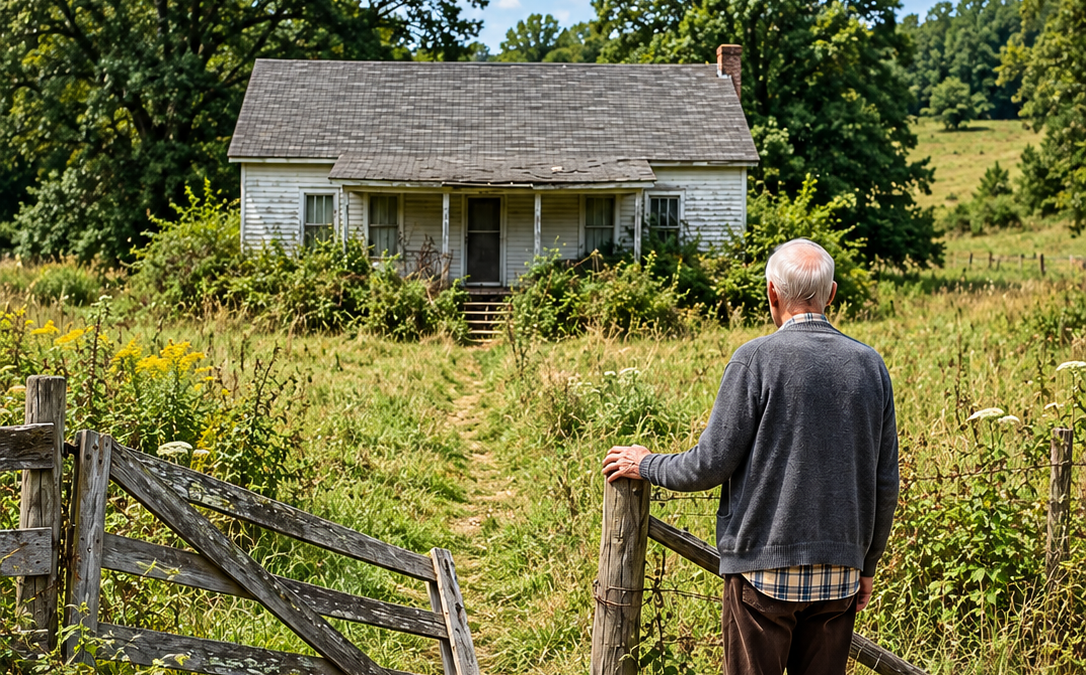
The photograph showed an abandoned house several miles outside a small Kentucky town. The porch sagged. Paint peeled from the siding in long curls. Weeds reached nearly to the windows.
At the bottom of the listing were two words and a number.
Cash sale.
$100.
Harold stared at the photograph.
A sensible man would have closed the page.
An eighty-two-year-old man with a bad hip and no interest in being sensible on other people’s terms picked up the phone.
Three days later, he sat across from the woman handling the sale.
She slid paperwork over a scratched desk without much conversation.
“The property is sold exactly as it stands.”
“I understand.”
“No repairs.”
“I understand.”
“No guarantees.”
“I heard you the first time.”
She finally looked at him.
Harold took five twenty-dollar bills from his wallet and placed them on the desk.
For the first time in eleven months, something belonged to him again.
He left the assisted living facility on Friday morning carrying one suitcase, a cardboard box, and a photograph of Margaret.
Nobody came to see him off.
Michael didn’t call.
Harold told himself that didn’t matter.
He knew he was lying.
On the drive toward the house, he stopped at a general store for bread, instant coffee, batteries, canned soup, and enough food to get through the first few days.
The cashier made small talk until she asked where he was staying.
Harold gave her the address.
Her smile disappeared.
“You bought the Turner place?”
Harold frowned at the coincidence of the name.
“I suppose I did.”
An elderly man near the coffee machine turned his head.
For several seconds, nobody spoke.
Then the man lowered his eyes to his cup.
Harold looked from him to the cashier.
“What?”
She rearranged something beside the register.
“Nothing.”
“That didn’t look like nothing.”
“That house has just been empty a long time.”
“How long?”
The woman hesitated.
“Long enough.”
Harold had spent forty-three years teaching teenagers. He knew evasiveness when he heard it.
But he was tired of warnings disguised as concern.
He thanked her, picked up his groceries, and drove on.
The house looked worse than the advertisement.
The porch dipped near one corner. White paint peeled from the siding. Weeds had swallowed most of the walkway, and the fence leaned toward the road as if waiting for one strong wind to finish the job.
Harold stood at the gate.
At eighty-two, he understood what people saw when they looked at something old and worn.
They noticed the damage first.
They calculated the cost of keeping it.
They wondered when it would finally give out.
Few people asked what was still strong.
Harold smiled.
“Well,” he murmured, “I suppose that makes two of us.”
Inside, the place smelled of dust, damp timber, and years of closed windows.
There was one bedroom, a little kitchen, a bathroom with a rust-stained sink, and a living room covered in faded wallpaper.
The electricity worked in some rooms. The plumbing complained whenever he opened a faucet. The kitchen cabinets tilted slightly.
But it was quiet.
That evening, Harold sat on the porch with instant coffee while the light faded through the Kentucky trees.
No dinner bell rang.
No staff member checked a schedule.
Nobody told him when to take a shower or when he ought to go to bed.
For the first time in almost a year, Harold did not feel like a guest in his own life.
He slept deeply.
The second night, something woke him.
Harold opened his eyes.
Darkness filled the room.
He listened.
Tap.
Silence.
Tap.
Tap.
He reached for the clock.
2:17.
Harold waited.
Nothing.
By morning, he had decided it was plumbing.
Old houses made noises. Pipes knocked. Wood contracted. Mice moved inside walls.
He had lived long enough to know that darkness could turn ordinary sounds into warnings.
The following night, he woke again.
This time the sound was heavier.
Something shifted beneath the living room.
Harold sat upright.
A few seconds passed.
Then came a scrape.
Slow.
Deliberate.
Wood against something hard.
He picked up his flashlight.
“Hello?”
His voice sounded too small inside the dark hallway.
He entered the living room and swept the beam across the walls.
Nothing.
Then cold air brushed his ankles.
Harold stopped.
The windows were shut.
The front door was locked.
The draft came again.
From below.
He lowered the flashlight.
The floorboards looked ordinary.
Then something struck beneath them.
Thump.
Harold stepped backward.
By daylight, he nearly laughed at himself.
But after breakfast, he carried his cane into the living room and began tapping the boards.
Solid.
Solid.
Solid.
Hollow.
Harold stopped.
He tapped again.
Hollow.
Slowly, he lowered himself onto one knee.
His hip sent a sharp complaint through his side.
“Don’t you dare give out on me now.”
He ran his fingers along the old wood.
At first he found nothing.
Then his fingertip touched metal.
Harold brushed away dirt.
An iron ring had been fitted almost perfectly into one board.
Not dropped there.
Not nailed over it.
Hidden.
He hooked his fingers through the ring and pulled.
Nothing happened.
He pulled harder.
The board moved.
A dark line appeared around its edges.
Cold air streamed upward.
Harold sat back.
For the first time, instinct told him to leave the thing alone.
There were probably rules about what an eighty-two-year-old man should not do by himself.
Opening mysterious sections of floor in an abandoned house was surely near the top of the list.
Harold thought of Michael.
You’re better off where you are, Dad.
He went to the shed and found an old pry bar.
It took him almost twenty minutes.
Twice he had to stop because his hands were shaking from effort.
Finally, the hidden section of flooring lifted with a long groan.
Harold stared into the opening.
Stone steps descended into darkness.
Not a shallow crawl space.
A staircase.
A real staircase.
He aimed the flashlight downward.
The beam vanished before it reached the bottom.
For a moment Harold thought of calling Michael.
The instinct hurt more than he expected.
For decades, when something important happened, family had been the first place he turned.
But Harold’s hand never reached for his phone.
Instead, he looked at Margaret’s photograph on the shelf.
He could imagine the expression she would have worn—the one that meant she already knew exactly what he intended to do and considered it pointless for him to pretend otherwise.
Harold almost smiled.
“All right, Maggie. Just a look.”
He stepped onto the first stone stair.
Then the second.
By the sixth, the air had changed.
The smell of the house disappeared, replaced by damp earth, stone, and old timber.
Harold counted.
Nine.
Ten.
Eleven.
At the bottom was a narrow passage supported by heavy wooden beams darkened with age.
Harold swept the flashlight across the ground.
Then he stopped.
There was a footprint in the dust.
A shoe print.
Most of the passage lay beneath a thick gray layer untouched by time.
But the print looked sharper.
Newer.
Harold straightened slowly.
At the end of the passage stood a wooden door reinforced with rusted iron.
He approached.
His common sense, which had remained remarkably patient until then, offered one final objection.
Go upstairs.
Close the floor.
Call somebody.
Instead, Harold heard a sound beyond the door.
Click.
He stopped.
“Hello?”
No answer.
He reached for the iron latch.
The hinges protested when he pushed.
The door opened a few inches.
His flashlight found the edge of a wooden table.
Then shelves.
He pushed the door farther.
Books.
Wooden chests.
Rolled maps.
Bundles of paper tied with faded string.
Glass cases.
Metal objects beneath decades of dust.
The chamber continued beyond the flashlight’s reach.
Harold stood motionless.
For forty-three years, he had told students that history was not merely a collection of dates.
History was evidence that people had lived.
That they had chosen.
Hidden.
Run.
Loved.
Feared.
Protected.
Lost.
Now, beneath an abandoned house he had purchased for one hundred dollars, Harold Turner was looking at a room someone had gone to extraordinary lengths to conceal.
On the nearest table lay a leather-bound book.
He brushed dust from its cover.
A date had been stamped into the leather.
Harold leaned closer.
“That can’t be right.”
A scraping noise came from somewhere beyond the shelves.
Harold turned.
The sound came again.
Closer.
His flashlight trembled.
“Who’s there?”
Something moved near a broken cabinet.
Harold took one step backward.
A gray field mouse darted into the beam, paused, then vanished into a crack.
Harold released a breath.
“You nearly killed an old man.”
A nervous laugh escaped him.
Then he turned back to the book.
The pages were brittle and brown at the edges.
Names filled the first sheets.
Beside them were dates, locations, crosses, circles.
Some entries contained only a single word.
Safe.
Harold’s smile disappeared.
He found a rolled map nearby.
Thin lines crossed sections of Kentucky and surrounding territory. Farms had been marked. Churches. River crossings. Wooded areas. Some place names were familiar to him. Others had disappeared from modern maps generations earlier.
Harold forced himself not to assume too much.
One document could suggest a story.
It could not prove one.
But someone had hidden all of this deliberately.
Letters sealed with cracked wax.
Journals.
Ledgers.
Old coins.
A rusted lantern.
A child’s wooden toy missing a wheel.
Then Harold saw a pair of iron restraints on a lower shelf.
They were small.
Far too small for the wrists of a grown man.
He reached toward them.
His hand stopped.
The chamber no longer felt like treasure.
It felt inhabited by absence.
By people whose names had nearly vanished.
Harold lowered himself into an old chair.
Michael’s voice returned to him.
They’re just things.
No, Harold thought.
Sometimes a thing was the only part of a person that survived.
A letter.
A chair.
A toy.
A name in the margin of a book.
Margaret’s blue coffee mug.
Her gardening gloves.
Her rocking chair.
Harold removed his glasses and wiped his eyes.
“I don’t know who you were,” he said into the underground silence. “But I won’t throw you away.”
He hadn’t known he was making a promise until he heard himself say it.
And for the first time since Margaret died, Harold felt something stronger than grief or anger.
He felt needed.
Near the back of the chamber, he found several wooden chests and a thick bundle of letters tied with dark blue ribbon.
Harold lifted the first envelope.
Two names had been written across the front.
He brought the flashlight closer.
His breath caught.
One of those names was familiar.
He had seen it decades earlier inside a family Bible that belonged to Margaret’s family.
Harold stared at the faded writing.
The room beneath the abandoned house had just stopped being somebody else’s history.
Part 2
Harold carried the bundle upstairs as carefully as if the letters could feel his hands.
He closed the hidden floor and set the papers on the kitchen table.
For nearly an hour, he did nothing.
He stared at the name.
Eleanor Witam.
Thirty years earlier, after Margaret’s mother died, family members had gathered to sort through belongings. Margaret had opened an old Bible containing handwritten generations of names.
Eleanor Witkim had been among them.
Margaret had laughed.
“Sounds like someone who would scare children out of an apple orchard.”
Harold could hear the line now as clearly as if she were standing beside the kitchen sink.
His eyes filled.
“Oh, Maggie. What have I found?”
But memory was not evidence.
Harold knew that better than most.
Coincidence could seduce people into believing stories they wanted to be true. He had spent decades warning students against exactly that.
He needed expertise.
And after what Michael had done, he needed someone he could trust.
Two days later, Harold called Dr. Robert Langley, a university historian whose articles on nineteenth-century migration routes and hidden community networks Harold had read years earlier.
Harold revealed almost nothing over the phone.
“I have some old letters,” he said. “A ledger. Maps.”
There was a pause.
“Where did you get them, Mr. Turner?”
“I’d rather show you.”
Langley arrived the next afternoon carrying a leather satchel.
He was in his early sixties, tall and slightly stooped, with silver hair.
Harold did not immediately show him the floor.
Trust had become something that had to be earned in stages.
Instead, he placed one letter on the kitchen table.
One.
Langley put on thin gloves.
He examined the paper, handwriting, and ink through a small magnifying lens.
His expression changed.
“Do you have more?”
Harold ignored the question.
“How old?”
“I can’t authenticate something like this at a kitchen table. But the materials are consistent with the mid-nineteenth century.”
Harold watched him carefully.
Langley pointed toward the name.
“Does this mean something to you?”
“My wife’s family.”
That changed the historian’s posture.
Harold considered him another few seconds.
Then he stood.
“There’s something else.”
He led Langley into the living room.
When Harold lifted the hidden section of floor, Robert Langley stopped talking.
Harold descended first.
The historian followed.
When Langley entered the underground chamber, he stood beneath the beams and moved his flashlight slowly across the shelves.
“My God.”
For two hours, he barely looked up.
He examined ledgers without removing them.
He studied maps.
He photographed symbols carved into stone.
He inspected paper, bindings, boxes and shelves, moving with the care of someone entering a place where every careless touch could destroy information.
The longer he worked, the quieter he became.
Finally Harold asked, “Well?”
Langley removed his glasses.
“Harold, I need to be careful about what I say.”
“I’m eighty-two. I’ve survived cautious language.”
A brief smile crossed Langley’s face.
Then it disappeared.
“If these materials are authentic—and I believe many of them may be—this is not simply a collection of antiques.”
He looked around the chamber.
“This could be an archive.”
Harold waited.
Langley pointed toward the ledgers.
“Some of these records appear to document names, family movements, meeting places and routes from a period when people often had very powerful reasons to hide information.”
“How valuable?”
“That depends what kind of value you mean.”
“Both kinds.”
“Some material could be historically significant. Some could have monetary value. But until we have authentication, preservation work and provenance research, anyone claiming to know exactly what this is would be guessing.”
Harold nodded slowly.
That answer made him trust Langley more, not less.
He had heard enough salesmen in his life to recognize the difference between excitement and certainty.
Then Langley unfolded one of the maps.
“Come here.”
Harold stepped closer.
A surname had been written beside one of the markings.
Witcom.
Harold gripped the edge of the table.
The same family line.
Margaret’s family.
For months after her death, Harold had lived among the physical remains of their life together—a coffee mug, gardening gloves, furniture, photographs—until Michael decided most of it could be sold.
Now, beneath a house Harold had bought only because he had nowhere else to go, a thread from Margaret’s past seemed to reach through generations toward him.
Harold turned away.
Langley gave him a moment.
Then he asked quietly, “Who else knows this room exists?”
“No one.”
“Your son?”
Harold shook his head.
“Neighbors?”
“No.”
“Good.”
Something in Langley’s voice changed.
Harold looked at him.
“What is it?”
The historian glanced toward the staircase.
“Until we know what you have, don’t tell anyone.”
“Why?”
“Because history has value.”
Langley folded the map.
“And not everyone values it for the same reason.”
That night, Harold sat at the kitchen table with Margaret’s photograph beside him.
He imagined what might happen if the collection proved genuine.
Researchers could study it.
Names could be restored to the record.
The house everybody else had considered worthless might matter.
The thought came before Harold could stop it.
Maybe he could matter again, too.
Headlights appeared beyond the kitchen window.
A dark vehicle had stopped near the road outside his fence.
The engine kept running.
Harold stood behind the curtain.
Nobody got out.
After almost a minute, the headlights went dark.
The vehicle remained.
Harold watched until it eventually drove away.
Someone lost, he told himself.
Someone checking directions.
Someone making a phone call.
He believed none of those explanations.
In the morning, fresh tire tracks cut through the soft earth near the road.
Three days later, an envelope arrived without a return address.
Inside was cream-colored paper and a phone number.
The message said the writer represented a private collector interested in historical material recently discovered in the area.
Harold read it twice.
Then he called Langley.
“I didn’t tell anyone where you live,” the historian said immediately.
“Did you tell anyone what you saw?”
Silence.
“I contacted a preservation specialist.”
Harold closed his eyes.
Langley continued.
“No address. No names. Nothing that should have led anyone to you.”
Eleven months earlier, Harold might have accepted the explanation because it was easier than questioning someone.
Now trust came slowly.
“I need some time, Robert.”
More letters followed.
Then phone calls.
One man offered Harold more money than he had seen in years if he would permit a private inspection.
Another talked about auction values.
Harold refused.
Then a caller mentioned Margaret’s family name.
Harold went still.
“How do you know that?”
The line disconnected.
That night, he carried a chair into the living room and placed it above the hidden entrance.
His old shotgun sat nearby.
Unloaded.
Harold had no desire to shoot anybody. He wanted the comfort of an object from a time when he had felt more capable of defending what belonged to him.
At 1:46 in the morning, gravel shifted outside.
Harold turned off the lamp.
Headlights crossed the wall.
A car stopped.
One door opened.
Then another.
Footsteps approached the fence.
Harold’s heart pounded.
He hated how frightened he felt.
Not because fear embarrassed him.
Because the feeling reminded him of the assisted living facility.
Waiting.
Depending.
Hearing other people decide what was best.
He had promised himself he would not live that way again.
Harold stood.
His knees hurt.
His hands were not steady.
He walked to the porch and switched on the outside light.
“Can I help you?”
The footsteps stopped.
Nobody answered.
Seconds passed.
A car door slammed.
The engine started.
The vehicle disappeared down the road.
Harold remained outside until the taillights vanished.
Only then did he notice his hands trembling.
In daylight, he found scratches around the lock on the back door.
The metal was bent.
Someone had tried to get inside.
Harold sat at his kitchen table.
Margaret’s photograph stood in front of him.
Beside it lay an offer from one of the collectors.
The amount of money was enough to change what remained of his life.
He could leave the leaking house.
Buy a comfortable apartment.
Pay other people to worry about roofs and furnaces.
Never wonder whether the refrigerator would fail or whether winter would be too hard on the pipes.
All he had to do was sell.
For a few minutes, Harold imagined it.
Then he thought of the small iron restraints beneath the floor.
The ledger entries marked safe.
The child’s toy.
The letters tied with blue ribbon.
And Michael telling him Margaret’s belongings were just things.
The sentence had wounded Harold because it was wrong in a way Michael had never understood.
Objects were not automatically precious.
But sometimes an object was the last remaining witness.
Proof that someone had lived.
Had loved.
Had suffered.
Had mattered to another human being.
Harold picked up the offer.
He tore it in half.
Then into quarters.
Then smaller pieces.
“No.”
It was the first time the word felt less like refusal than ownership.
He called Robert Langley.
“I’ll work with you.”
Langley released a breath.
“What do you want to do?”
“Document everything.”
“All right.”
“Protect the originals. Find out whose stories these are. Find out what has historical importance and what has financial value.”
“Yes.”
“If something eventually needs to be sold to protect the rest, we discuss it.”
“Of course.”
Harold looked toward the living room floor.
“But nobody tears that room apart because they have the biggest checkbook.”
There was a short silence.
Then Langley said, “Your house. Your decision.”
Harold closed his eyes.
Your decision.
Two ordinary words.
They meant more to him than the stranger on the phone could understand.
Over the following weeks, a small group of preservation specialists began working discreetly with Harold.
They photographed every shelf before touching anything.
Documents were cataloged.
Fragile pages went into protective containers.
Items removed for examination were logged.
Nothing left the property unless Harold knew what it was, where it was going and why.
He kept a notebook.
At first, the professionals humored him.
Then they realized Harold’s records were often better organized than theirs.
Forty-three years of teaching had trained him to keep dates, names, references and questions in order.
He woke early now.
Not because a facility schedule required it.
Because there was work waiting.
He compared surnames.
He copied locations.
He checked notes twice.
He asked questions that sometimes sent Langley back to his own references.
At eighty-two years old, Harold Turner became a student again.
And with each morning, some part of him that had been dormant began to return.
One afternoon Langley came through the door carrying a folder.
He did not remove his coat.
“Harold.”
Something in his expression brought Harold to his feet.
“We received the first authentication results.”
Langley placed the folder on the table.
“Some of these materials may be far more significant than we thought.”
Harold looked down at the report.
Then, unexpectedly, he looked at Margaret’s photograph.
For the first time since finding the chamber, the question in his mind was not what the collection was worth.
It was what he was going to do with it.
Part 3
The first page of the report contained laboratory notes, dates, handwriting comparisons and preliminary assessments from several specialists.
Harold read slowly.
Then he went back and read sections again.
Many of the documents were authentic.
Some dated back more than a century and a half.
Several letters appeared to belong to families whose movements had never been fully documented. The maps contained routes and locations researchers wanted to examine more closely. Ledgers preserved names that had disappeared from official records.
And the connection to Margaret’s family was real.
Harold set the report down.
He had imagined that confirmation would feel like winning something.
Instead, he felt the weight of responsibility.
Langley seemed to understand.
“There are still questions,” he said. “A lot of them. Understanding the full collection could take years.”
“But it matters.”
“Yes.”
“The room matters.”
“Yes.”
Harold leaned back.
“So what happens now?”
Langley smiled.
“That depends on you.”
Harold almost laughed.
There it was again.
Not: Here is what we have decided.
Not: At your age, this would be easier.
Not: You’re better off letting someone else handle it.
Depends on you.
Offers arrived quickly once word spread within professional and collecting circles.
Private collectors wanted individual letters.
A dealer wanted the coins and certain artifacts.
One buyer made a staggering offer for a small group of documents before research on them was even complete.
Harold could have sold everything.
The irony was almost absurd.
He had paid one hundred dollars for the house because it was the only property he could afford.
Now people with more money than Harold had ever possessed wanted what had been beneath his feet.
But every time an offer arrived, Harold asked the same question.
“What happens to the collection?”
The answers usually sounded impressive without saying much.
Private stewardship.
Selective placement.
Long-term preservation.
Important hands.
Harold had taught enough essay writing to recognize paragraphs built to avoid a direct answer.
“No.”
He worked with Langley and the preservation specialists on another plan.
The historically important material would be protected and made available for serious research.
The heart of the collection would stay together.
If, after proper study, certain objects proved to have financial value but no essential connection to the integrity of the archive, some might eventually be sold to fund preservation and repairs.
But the room would not be stripped and scattered.
Harold wanted the names remembered.
He wanted researchers to be able to follow one letter to another, one map to a ledger, one family to another family.
History, he knew, did not survive well when its pieces were separated from their context.
And he wanted the house to survive, too.
The roof came first.
Workers removed rotten sections and repaired leaks that had probably been ignored for years.
Then came the porch.
New supports straightened the corner that had sagged when Harold first arrived.
Broken windows were replaced.
The old white siding received fresh paint.
When a carpenter suggested replacing several weathered boards, Harold shook his head.
“Leave a few.”
The carpenter looked at him.
“They’re ugly.”
“So am I before coffee.”
The man laughed.
Harold touched one of the old boards.
“Let the house keep a few wrinkles. I’ve kept mine.”
By spring, flowers grew along the walkway.
Harold planted yellow ones beneath the kitchen window.
Margaret had loved yellow flowers.
He was kneeling in the soil one afternoon when he realized he had gone several hours without thinking of the assisted living facility.
Not because he had forgotten what happened.
Because his life had grown larger than the injury.
The first chapter after betrayal had been escape.
The next had become work.
Then, one Saturday morning, a familiar car turned into the driveway.
Harold stopped on the porch.
Michael stepped out.
Susan remained in the passenger seat.
His son stood by the gate and stared at the repaired house.
Months had passed since they had spoken.
“I’ve been trying to call you,” Michael said.
“I know.”
Michael looked older.
Harold wondered whether that was real or whether he had simply stopped seeing his son as the young father and boy layered beneath the adult man.
“Can we talk?”
Harold considered refusing.
A year earlier, he might have prayed for this moment.
He might have accepted almost any apology if it meant getting his son back.
Now he understood that reconciliation purchased with silence was another form of surrender.
He opened the gate.
Michael joined him on the porch.
Neither spoke for a while.
Birds moved through the trees.
The new porch boards were pale beside the old ones Harold had insisted on keeping.
Finally Michael looked at his hands.
“I thought I was doing what was best for you.”
Harold watched him.
“You sold your mother’s rocking chair.”
Michael swallowed.
“I know.”
“You sold her dresser.”
“I know.”
“You emptied the house after promising it would be waiting.”
Michael stared toward the road.
Harold continued.
“You told me I was better off somewhere I never chose to live.”
Michael’s eyes filled.
“I was scared, Dad.”
“So was I.”
“After you fell, I thought… I thought you couldn’t manage anymore.”
Harold had imagined this conversation many times.
In some versions, he shouted.
In others, Michael begged.
Harold delivered speeches so devastating that his son could do nothing but admit every wrong.
But real anger was heavier and less elegant than imagined anger.
Sitting beside Michael, Harold realized he no longer needed to punish him with words.
“You confused protecting me with controlling me.”
Michael bowed his head.
Harold looked at the yellow flowers.
“Maybe you were scared. Maybe some part of you really did think you were helping.”
Michael wiped his face.
“But you stopped asking what I wanted.”
“I’m sorry.”
The words did not restore Margaret’s rocking chair.
They did not return eleven months.
They did not change the loneliness of leaving the facility with one suitcase while nobody came to see him off.
Forgiveness, Harold discovered, did not arrive like lightning.
It was not a magical disappearance of injury.
And it was not permission to repeat the injury.
“You can come back,” Harold said.
Michael looked at him.
“But things will be different.”
“They have to be.”
Harold held out his hand.
Michael took it.
It was not a perfect ending.
Harold had spent too many years studying human beings to believe in perfect endings.
It was simply a beginning.
And beginnings, he had learned, were sometimes enough.
Months later, a small gathering filled the restored living room.
Researchers stood near local residents who had heard fragments of the story. Robert Langley moved between them, answering questions.
The hidden entrance in the floor had been preserved.
People could see where Harold first discovered the iron ring.
Nobody entered the chamber casually.
The materials below were handled according to the preservation plan Harold and the specialists had developed.
At one point Langley tapped a glass gently with a spoon.
“Harold ought to say something.”
Harold shook his head.
“No.”
Several people laughed.
“You taught for forty-three years,” Langley said. “You can manage five minutes.”
Harold looked around.
He had not prepared a speech.
That surprised him. Once, he would have written notes and revised them three times.
Instead, he walked to the center of the room and looked down at the floorboards.
“When I bought this house,” he began, “people thought I had lost my mind.”
A few chuckles.
“Maybe I thought so, too.”
He glanced toward the window.
Margaret’s photograph rested on a nearby shelf.
“I paid one hundred dollars because I needed somewhere to go.”
The room quieted.
“I didn’t come here looking for history. I wasn’t looking for treasure. I wasn’t even looking for a new life.”
Harold rested one hand on his cane.
“I thought I was buying a place where I could spend whatever time I had left without being a burden to anybody.”
The word burden caught in his throat.
He waited until it passed.
“This house gave me something I didn’t know I was looking for.”
He glanced at Margaret.
“A reason to get up tomorrow.”
No one laughed now.
Harold studied his hands.
“People talk about what we lose when we get old. Strength. Time. People we love.”
He thought of Margaret’s blue mug.
Her gardening gloves.
The empty place beside him in bed.
He thought of Michael carrying him mentally from the category of father into the category of responsibility.
He thought of the small restraints downstairs.
The names in the ledger.
The word safe written beside people who might otherwise have disappeared from memory.
Harold lifted his head.
“But as long as we’re still here, we can still choose what we do with what’s left.”
Later, after everyone had gone, Harold sat on the porch.
The evening air moved through the trees.
Yellow flowers nodded beneath the kitchen window.
For a while, he listened to nothing but insects and the occasional settling noise of the house.
Those sounds no longer frightened him.
The first nights here, every tap had seemed like a warning.
Now the old building had become familiar enough that Harold could tell the ordinary complaints of timber from the unusual ones.
He thought about the strange path that had brought him here.
His wife had died.
He had fallen.
His son had tried to protect him and, in doing so, had taken away his choices.
His belongings had been sold.
His home had vanished.
Harold had arrived at this broken place with one suitcase, one box, Margaret’s photograph and five twenty-dollar bills fewer than he had possessed a few days before.
Everybody else had abandoned the house.
Perhaps that was why Harold had understood it.
Both of them had been assessed by age.
Both had been judged according to damage.
Both had been considered burdens.
Both had almost been discarded.
Harold looked through the open doorway toward the living room.
Beneath those boards rested old letters, maps, journals, ledgers, coins, a broken toy and other objects that had survived because somebody, generations earlier, had believed they were worth protecting.
For weeks after the discovery, people had talked about value.
Collectors meant money.
Historians meant information.
Preservationists meant context.
Harold understood all three.
But none of them described the greatest thing the house had given him.
It had returned a future.
For almost a year, Harold had lived as though his story had already happened.
Marriage.
Fatherhood.
Teaching.
Retirement.
Margaret.
Loss.
Everything meaningful seemed to sit behind him.
The assisted living facility had reinforced the feeling. Meals arrived according to a schedule. Days were measured by routines designed to keep people safe.
Harold had begun thinking of time as something to endure.
Then he found the iron ring in the floor.
A hidden staircase led downward.
And somehow the way down had become the way forward.
Now there were documents that might take years to understand.
Questions he might not live long enough to answer.
That no longer bothered him.
A teacher never expected to see the end of every lesson he began.
Sometimes the work continued in other hands.
Robert Langley would continue it.
Researchers would continue it.
Perhaps young students would one day read names that would otherwise have been lost.
Michael might come back again.
Maybe their relationship would heal further.
Maybe some things would always remain difficult.
Harold no longer required certainty before allowing himself hope.
He reached for the cup beside his chair.
The coffee had gone cold.
Margaret would have teased him for forgetting it.
“I know,” he said softly.
The yard answered with crickets.
Harold smiled.
At eighty-two, he had not become young again.
His hip still hurt.
Some mornings his fingers were stiff.
He sometimes needed help carrying things he once would have lifted without thinking.
Independence had turned out not to mean refusing every form of help.
It meant being part of the decision.
Knowing what was happening.
Being asked.
Being respected.
Choosing what assistance to accept and what responsibility to carry.
That lesson had cost him almost everything he once called home.
But the home he had now was his.
The work beneath it was his responsibility.
And the years ahead—however many or few—were his to spend.
Harold watched the final light disappear behind the trees.
Inside the house, beneath weathered boards that people once considered worthless, a hidden record of human lives waited for another morning.
Harold Turner would be there to meet it.
You Might Also Enjoy

He Came Home With Another Woman’s Perfume—His Nurse Wife and Newborn Daughter Were Already Gone