Single Dad Inherited a Cabin Sealed Since 1959—Then He Found a Second Front Door
Part 1
By the time Brendan Hayes saw the chains around the front door, he had already decided the cabin had to save him.
There was no room left in his life for sentimental attachments to dead relatives or romantic ideas about starting over in the Montana mountains. At thirty-four, Brendan was a widower, a father, an auto mechanic, and a man whose mailbox had become a place he dreaded opening.
His wife had been gone for two years.
Leukemia had taken her slowly enough for the family to understand exactly what was happening and quickly enough to leave Brendan unprepared for the silence afterward. He had watched hospital bills accumulate while spending nights beside her bed and mornings trying to keep his job at the repair shop in Spokane. When the treatments stopped working, there had been funeral expenses. When the funeral was over, the bills remained.
So did Harper.
Their seven-year-old daughter still woke some mornings and forgot for a few seconds that her mother was gone. Brendan knew because he could see the realization return to her face.
Those were the mornings that hurt worst.
He worked every hour the shop would give him. He changed transmissions, rebuilt brake systems, replaced alternators, and came home with grease under his fingernails and pain between his shoulder blades. He learned which grocery-store brands Harper would eat without complaint and how to braid hair badly enough that she eventually learned to do it herself.
Still, the numbers never worked.
The foreclosure notices began politely.
Then they stopped being polite.
By early fall, the bank was days away from taking their modest Spokane house.
That was when the certified letter arrived from Ross and Abernathy, a law firm in Missoula, Montana.
Brendan almost threw it away.
He had never hired a lawyer in Montana. He owed enough money already without discovering some forgotten legal problem.
Then he read the name Winston Carmichael.
His great-uncle.
Brendan remembered Winston only in fragments. An elderly man at family gatherings when Brendan was young. Sharp eyes. Few words. A reputation for keeping to himself until, eventually, he stopped attending family gatherings altogether.
Mitchell Ross, a senior partner at the firm, explained the rest over the phone.
Winston had died at ninety-eight in a state-run care facility.
There was no meaningful bank account, no investment portfolio, no pile of cash waiting for Brendan.
But there was property.
Twenty acres in the Bitterroot Mountains and a large timber cabin that county records listed as abandoned since 1959.
Brendan had stared at the foreclosure notice lying on his kitchen table while Ross spoke.
“Why me?”
“You’re the sole beneficiary named through the surviving family line,” Ross told him. “As far as the estate records indicate, you are the last living male relative.”
Brendan looked across the kitchen.
Harper was sitting on the floor with her stuffed rabbit, drawing with three broken crayons.
“How much is it worth?”
Ross couldn’t tell him without an inspection.
That was enough.
Brendan packed their lives into his beat-up Ford F-150.
His plan was simple because it had to be simple. Drive to Montana. Inspect the cabin. Clean it up enough to make it marketable. Sell the twenty acres and whatever structure still stood on them. Use the money to pay what he could, escape foreclosure, and find a smaller place where he and Harper could begin again.
He did not call it an inheritance.
He called it their last chance.
The drive along Route 93 into the Bitterroot Valley almost made him understand why Winston had disappeared there. Mountains rose around them beneath an immense autumn sky. Pines crowded the slopes. Harper pressed her face to the passenger window whenever the road curved toward another view.
For the first time in weeks, Brendan felt his chest loosen.
Then he left the pavement.
The logging road was barely a road anymore.
Branches scraped both sides of the truck. Brush grew between the tire tracks. Several times Brendan had to stop, climb out, and drag fallen limbs aside. The farther they traveled, the weaker the radio signal became until static swallowed the last station.
Nearly eight miles from the highway, the forest opened.
Brendan stopped the truck.
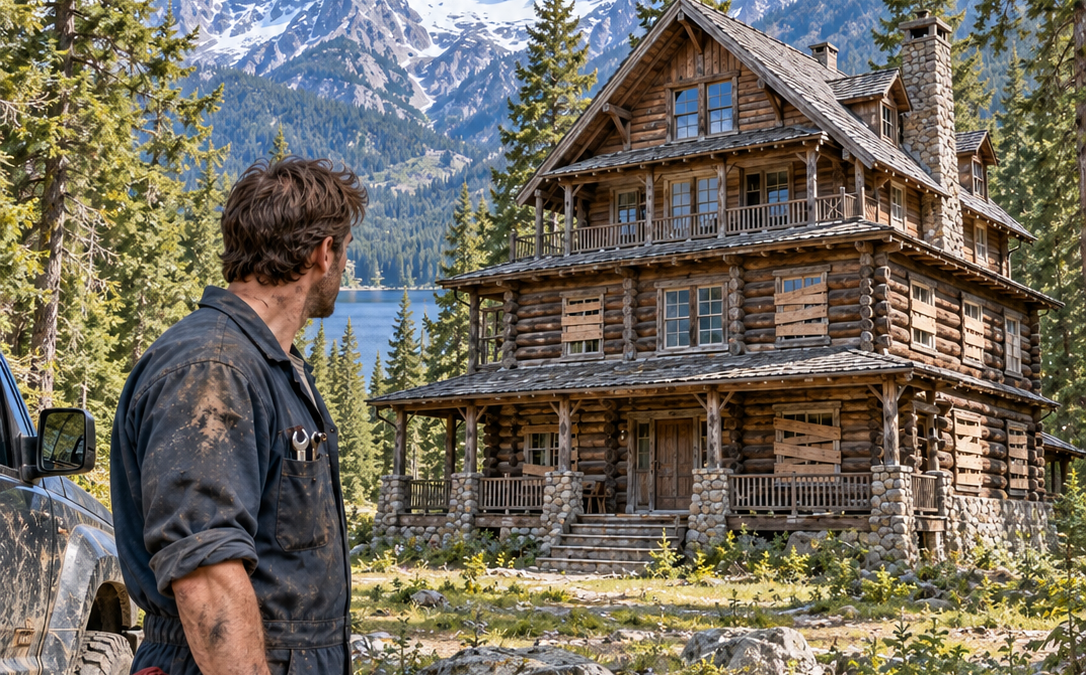
The cabin stood in a shadowed clearing.
It was larger than he expected, built from thick hand-hewn logs darkened by age. The roofline remained mostly straight. The porch sagged in places, but the building had the heavy proportions of something constructed to survive brutal winters.
For half a second Brendan felt hope.
Then he noticed the door.
The oak front door was wrapped in logging chains.
Not a single chain looped casually through the handle. Several lengths of heavy, rusted iron had been wound around the door and porch supports and secured with an industrial padlock thick enough to make Brendan think of a bank vault.
The ground-floor windows had been boarded shut from outside. Two-by-fours crossed the frames, held by nails driven so hard and deep that the surrounding wood had splintered.
Harper leaned forward.
“Is this our new house, Daddy?”
She held her rabbit against her chest.
Brendan looked at the boarded windows, then at the chains.
“Just for a little while, sweetie.”
She studied the cabin.
“It looks scary.”
“It looks neglected.”
“What does that mean?”
“It means it needs somebody with tools.”
That answer satisfied her more than it satisfied him.
Brendan took thirty-six-inch bolt cutters from the truck.
The porch complained beneath his boots as he approached the door. Pine needles had accumulated against the steps. Rust streaked the chains.
He fitted the cutters over the padlock.
Even with both hands and his full weight, the steel resisted. Brendan repositioned the jaws, planted one boot, and forced the handles together until the lock broke with a sharp metallic crack.
The sound traveled into the trees.
Harper jumped.
Brendan glanced back.
“It’s okay.”
The chains hit the porch in a heavy coil.
When Brendan pushed the door, the hinges gave a drawn-out shriek.
Cold, stale air escaped.
He stood on the threshold with his Maglite in one hand.
The beam revealed a room preserved beneath decades of dust.
A boxy Zenith television sat in a corner. An old floral sofa faced a massive stone fireplace. Shelves held books softened by damp and time. Everything wore the same gray coating, thick enough that Brendan’s first footprints appeared sharply behind him.
He moved deeper inside.
On the dining table stood a ceramic coffee mug with a rusted spoon resting inside. Beside it was a folded newspaper.
Brendan brushed the dust from the top.
The Missoulian.
October 14, 1959.
He read the date twice.
The scene around him stopped looking merely abandoned.
It looked interrupted.
Someone had drunk coffee here. Someone had read that paper. Someone had left the mug sitting beside it and walked away.
Then someone had chained the building shut from outside.
For sixty-eight years, almost nothing inside had moved.
Harper appeared in the doorway.
“Can I come in?”
“Stay where I can see you.”
“Is there electricity?”
“Not yet.”
“Water?”
“Working on it.”
“Bathroom?”
He looked toward the dark hallway.
“Also working on it.”
She made the disappointed face of a child learning that adventure frequently meant inconvenience.
That evening they made camp in the living room with sleeping bags, Coleman lanterns, food from the truck, and Harper’s pop-up tent. Brendan chose the center of the room because nothing could fall on her there if part of the ceiling failed.
The first night, he slept badly.
Every old building had noises. Brendan knew that.
Boards expanded and contracted. Wind found loose seams. Small animals got into crawl spaces.
But the cabin seemed to have different temperatures in different parts of the same room. Near the fireplace, the air was merely cold. Near the eastern wall, it felt like standing beside an open freezer.
By daylight, practicality took over.
Brendan removed the boards from the windows.
Sunlight entered in hard golden rectangles, exposing dust that drifted through the rooms. He hauled moldy mattresses into the yard, swept floors, checked roof leaks, and inspected as much of the structure as he could without tearing into walls.
Harper helped where he allowed her.
She wiped table legs with an old rag. She sorted objects into piles marked KEEP, TRASH, and MAYBE SELL. Every few minutes she asked whether some worthless artifact could be worth hundreds of dollars.
“Old spoon?”
“No.”
“Old lamp?”
“Maybe twenty bucks.”
“Old TV?”
“Depends who wants it.”
“Stuffed squirrel?”
Brendan looked at the moth-eaten taxidermy animal she had discovered on a shelf.
“Put that outside.”
On the third day he got the kitchen pump working.
The cast-iron handle resisted until he disassembled the linkage, cleaned it, and persuaded the old mechanism to move again. Water finally came from the deep well in uneven spurts.
It was freezing.
It tasted faintly metallic.
But it was water.
That should have felt like progress.
Instead, Brendan became increasingly aware that something about the cabin did not fit.
He had worked construction in his twenties before becoming a mechanic. Years of framing rooms had taught him to notice proportions without consciously measuring them.
The main hallway bothered him first.
Walking from the kitchen toward the living room, his boots struck solid flooring.
Then, for several steps, the sound changed.
Thud.
Thud.
Boom.
Boom.
Then solid again.
He stopped and walked backward.
The same thing happened.
There was open space somewhere below or beside him.
More troubling was the eastern wall.
Cold drafts seeped from it although Brendan could not find a gap to the outside. The air carried a faint smell of metal and damp soil.
On the fourth evening, the weather changed.
Clouds lowered over the Bitterroot Valley until the mountaintops disappeared. Wind shook the pines. By nightfall, rain hammered the roof.
Harper slept in the pop-up tent while Brendan sat in an old rocking chair with a kerosene lantern burning beside him.
He took a swallow of whiskey from a flask.
Lightning turned the windows white.
Thunder followed hard enough to shake dust from the rafters.
Brendan’s eyes settled on the eastern wall.
Floor-to-ceiling oak bookshelves covered almost all of it.
During the day they had looked impressive despite the ruined books. At night, in the lantern light, they looked too deliberate.
He studied the fireplace on the northern wall.
Then the bookshelf.
Then the position of the southern window.
He stood.
Something was wrong with the geometry.
Brendan crossed to the window and looked toward the porch edge. He tried to picture the exterior corner of the building.
Then he looked back across the room.
“No.”
He went to the truck in the rain and returned with his one-hundred-foot Stanley tape measure.
Harper stirred inside the tent.
“Daddy?”
“Go back to sleep. Just measuring something.”
He hooked the tape against the western interior wall and stretched it to the bookshelves.
Thirty-two feet.
Brendan stared at the number.
He went outside.
Rain soaked his shirt before he reached the corner.
He measured the cabin’s exterior width.
Forty-seven feet.
He stood beneath the storm with the tape in his hand.
Thirty-two inside.
Forty-seven outside.
He measured again.
Same result.
Fifteen feet were missing.
That was not insulation.
That was not log thickness.
That was a room.
Brendan returned inside with rain streaming from his hair.
He looked at the bookshelves.
For three days he had been trying to restore the cabin so he could sell it.
Now he understood that the cabin itself was lying to him.
He began removing books.
Mildewed encyclopedias hit the floor. Farming almanacs broke apart in his hands. Dust filled the flashlight beam.
Behind the books was dark oak paneling.
Brendan knocked against it.
The answer came back hollow.
He retrieved a crowbar and framing hammer.
For a moment he hesitated.
Every board he destroyed might lower the property’s value.
He imagined a buyer walking through a restored room with built-in shelves instead of a wall hacked apart by a desperate man chasing a suspicion.
Then a cold draft touched his face.
Brendan wedged the crowbar into a seam.
The wood cracked.
He pried harder.
Rusted nails screamed from their holes.
Behind the oak backing was thick gray plaster.
He swung the hammer.
The first blow left a crater.
The second opened a hole.
The third sent a large section crashing inward.
Brendan coughed and waved dust from his face.
Then he lifted the Maglite.
His arm stopped.
Behind the plaster was not insulation.
It was not framing.
It was cedar siding.
Exterior siding.
Weathered boards painted long ago and preserved inside the walls of the structure surrounding them.
Brendan leaned through the opening.
His flashlight traveled along the boards.
“What the hell?”
The answer was impossible, yet the evidence was directly in front of him.
The cabin did not contain a hidden room.
The cabin contained another building.
Winston Carmichael had built an outer shell around an older structure and erased it from view.
Brendan spent the next hour widening the opening.
He removed more bookshelf backing and smashed away plaster until enough space existed for him to see the concealed wall clearly.
Then his flashlight found the door.
It was painted a dark hunter green.
Not wood.
Steel.
The door belonged on a bunker.
Three heavy deadbolts ran along one side. A large brass knocker, nearly black with oxidation, sat in the center.
Brendan squeezed through the broken wall into the fifteen-foot space separating the outer cabin from the hidden structure.
The temperature dropped immediately.
His breath appeared.
The metallic smell was stronger here, mixed with damp earth.
He approached the green door.
Near the bottom were deep scratches.
Not scuffs.
Not accidental marks.
Something had gouged through the green paint hard enough to expose steel beneath.
Brendan crouched.
The direction of the scratches troubled him more than their depth.
They seemed to have been made from the other side.
By someone trying to get out.
Thunder rolled overhead.
Brendan stood and placed his hand on the brass knob.
He expected resistance.
The knob turned.
A heavy mechanism clicked.
The deadbolts were disengaged.
The green steel door drifted inward.
Brendan raised the Maglite and shone it into darkness.
He had expected a bedroom, storage chamber, workshop, perhaps some kind of root cellar.
Instead, the beam revealed reel-to-reel recording machines.
Metal filing cabinets.
A steel desk.
A rotary telephone.
A vintage ham radio with glass vacuum tubes.
And across the desk, beside loose cartridges and manila folders, lay a loaded Winchester Model 70 rifle.
Brendan stepped inside.
The floor was concrete.
Then he saw the far wall.
Hundreds of black-and-white photographs had been pinned across it.
Red yarn connected them.
Every image showed the surrounding forest at night, caught in the violent white glare of a camera flash.
And in photograph after photograph, tall blurred figures stood among the trees.
Watching the cabin.
Brendan moved closer.
The people were distant enough to lose their faces, but not their intent.
Some stood alone.
Others appeared in groups.
Almost all were positioned just beyond the clearing.
On the desk rested a leather-bound journal.
Brendan picked it up.
Across the cover, written in jagged handwriting, were six words:
They only come when it rains.
Thunder exploded above him.
At the same moment, something moved beneath the concrete floor.
A deep metallic latch turned somewhere underground.
Part 2
Brendan did not move.
For several seconds he stood in the hidden room with Winston’s journal in one hand and the flashlight in the other, listening.
The sound came again.
Metal under strain.
Not footsteps.
Not an animal beneath the floorboards.
Machinery.
Something heavy was shifting beneath the concrete.
Brendan’s attention went to the rifle.
He set down the journal, picked up the Winchester, and worked the action enough to confirm what he already suspected.
A brass cartridge gleamed in the chamber.
The weapon had been left ready.
Outside, rain battered the cabin.
Inside, the mechanical noise seemed to travel upward through Brendan’s boots.
He moved around the desk.
A thick woven rug covered part of the floor.
He kicked it aside.
A three-foot-square steel hatch was set directly into the concrete.
At its center was a circular iron wheel like something from a submarine.
Brendan aimed the rifle at it.
The wheel moved.
One notch.
Clack.
Another.
Clack.
Brendan backed away.
The mechanism continued turning without anyone touching it.
When the wheel completed its rotation, a heavy internal lock released.
Stale air hissed through the seal.
Nothing came up.
The hatch remained closed.
Brendan lowered the rifle slightly.
His fear had not disappeared, but it had changed shape.
Whatever Winston had hidden beneath the cabin was mechanical.
Which meant there might be an explanation.
He returned to the desk and opened the journal.
The first pages were difficult to follow. Winston’s writing had been cramped even when careful, and later entries wandered into hurried fragments. Dates appeared irregularly. Names repeated. Certain sentences had been underlined so deeply that the pen had nearly cut through the paper.
But the story emerged.
Winston Carmichael had not always been a mountain hermit.
Decades earlier, he had worked as chief accountant for Harrison Bradley, an industrialist with enormous influence in the regional copper and silver trade.
Bradley’s public enterprises were only part of his operation.
According to Winston, substantial profits from the mines never appeared in official books. Money moved through shadow ledgers. Physical assets disappeared before taxes or partners could claim them. Winston had been trusted to make the numbers work because he understood where every hidden dollar came from and where it went.
Then he learned Bradley intended to sacrifice him.
Federal investigators were closing in on a massive tax-evasion scheme.
Winston was going to become the explanation.
If Bradley’s plan succeeded, the accountant would take responsibility for crimes designed by other men.
Winston believed prison would not protect him.
Bradley had money.
Bradley had influence.
And, Winston wrote, Bradley had access to a rogue faction connected to the Pinkerton National Detective Agency—men who worked less like investigators than private enforcers.
Brendan read faster.
In the winter of 1958, Winston struck first.
He siphoned away a staggering amount of Bradley’s untraceable physical wealth.
Then he disappeared into the Montana wilderness.
The photographs on the wall suddenly made sense.
The figures in the trees were not supernatural creatures.
They were men.
Hired guns.
Searchers.
Mercenaries moving through the mountains looking for the accountant who had taken something their employer considered his.
Winston had already owned or acquired the isolated structure hidden inside the cabin.
Then he built around it.
The visible cabin became camouflage.
To anyone approaching through the clearing, it looked like the fortified home of a paranoid recluse. Winston reinforced doors, boarded windows, and created an exterior shell while living within a protected inner structure that could remain invisible even if intruders entered the outer rooms.
The scratches on the green door still disturbed Brendan, but he understood the larger design now.
Winston had spent years preparing to survive men he believed would never stop hunting him.
Brendan turned another page.
They only come when it rains.
He had misunderstood the sentence.
The word they did not refer to Bradley’s men.
It referred to the mechanism beneath the floor.
Winston had designed a hydromechanical locking system connected to the property’s well and watershed. During ordinary dry conditions, the subterranean vault stayed sealed.
Only sustained heavy rain created enough hydrostatic pressure to drive a buried mechanism.
The storm activated the lock.
The sound Brendan had heard was the vault system waking after decades of silence.
He looked at the hatch.
The iron wheel had stopped.
The seal was open.
For sixty-eight years, the cabin had waited for the right storm and the right person to be standing above that floor.
Brendan closed the journal.
His first thought should have been to leave.
He had Harper sleeping less than fifty feet away.
The cabin was isolated. The weather was worsening. He had no cell service, no electricity, and no idea what condition the underground structure might be in.
Instead, he thought of the bank.
He thought of hospital bills.
He remembered sitting in a plastic chair beside his wife while a billing representative quietly explained a new charge. He remembered promising her that Harper would be okay.
He remembered nodding because his wife needed to believe him.
Since then, Brendan had spent two years discovering that love did not change arithmetic.
He set the journal inside his jacket, slung the rifle over his shoulder, and took the Maglite.
Then he grasped the hatch wheel.
The steel door was heavier than he expected.
It opened slowly, revealing an iron staircase spiraling downward.
A rush of damp air rose from below.
Brendan aimed the light into the shaft.
He could hear water.
A lot of water.
He descended.
The stairwell dropped roughly twenty feet before ending in a reinforced concrete tunnel.
A huge iron pipe ran along one side.
Storm runoff thundered through it.
Farther down, water passed a heavy turbine that turned with a deep grinding rhythm, transferring force into the locking mechanism above.
Winston’s design was crude compared with modern systems but astonishingly effective.
Brendan stood ankle-deep in water.
At the opposite end of the short corridor was a vault.
Its door was open.
He approached slowly.
The Maglite beam entered first.
Yellow metal reflected the light.
Brendan stopped breathing for a second.
Shelves lined the ten-by-ten-foot room.
On them rested rows of dull yellow bars.
He stepped inside and reached for one.
The weight nearly pulled it from his hand.
An insignia had been stamped into its surface.
Homestake Mining Company.
Gold.
Not jewelry.
Not collectible coins.
Bullion.
Solid bars stacked in quantities Brendan could not immediately count.
Below them sat waxed canvas bags.
He opened one with his pocketknife.
Silver Morgan dollars spilled onto the wet floor.
Another bundle contained banded stacks of old gold certificates from the 1920s.
Brendan stared.
For four days he had been sleeping in the outer shell of a fortune.
Winston had not died merely as an impoverished old recluse in a state facility.
His journal explained what the family never knew.
Age had caught him eventually.
Then dementia.
Memory disappeared in pieces.
By the time Winston entered institutional care, the location and meaning of what he had built in the mountains were lost inside a failing mind.
The treasure remained.
The accountant forgot.
The cabin waited.
Brendan stood beneath the earth surrounded by wealth large enough to make his debts seem ridiculous.
He imagined paying the hospital accounts.
The mortgage.
Every bill.
He imagined Harper sleeping in a bedroom where rain did not enter through the roof and where he did not check the bank balance before buying groceries.
He imagined working because he wanted to, not because one missed shift could wreck the month.
For the first time since his wife died, the future seemed to contain space.
Then metal screamed in the corridor.
Brendan turned.
The turbine was spinning faster.
The storm had intensified.
Water pushed through the underground system with increasing violence. What Winston had designed to unlock the vault during heavy rain was being overwhelmed by an exceptional deluge.
The water around Brendan’s boots climbed.
Ankle.
Shin.
Knee.
The drain could not keep up.
The iron pipe groaned.
Brendan looked toward the vault door.
It moved.
Only an inch.
But it moved.
The massive door had been balanced on a weighted hydraulic hinge, and changing water pressure was pushing it toward the frame.
Brendan grabbed the edge and tried to stop it.
The door barely noticed his strength.
If it closed, he would be inside.
He looked at the gold.
There was too much.
Even if the vault remained dry, he could not have carried more than a few bars up the narrow staircase. With water rising and the door closing, trying to save the fortune could kill him.
He heard Harper’s voice in his head.
Is this our new house, Daddy?
“No.”
The word left his mouth.
No amount of gold mattered if Harper woke upstairs without him.
He dropped the rifle against a shelf and stripped off his canvas mechanic’s jacket.
Working quickly, he knotted the sleeves together and turned the coat into a rough sack.
He shoved in handfuls of Morgan dollars.
Then the banded certificates.
The water climbed to his thighs.
The vault door moved farther.
Brendan grabbed three of the smaller bullion bars.
Even those nearly made the jacket impossible to lift.
He considered leaving them.
Then he pictured the foreclosure notice again.
He tightened the knot and hauled the makeshift sack over his shoulder.
The pipe outside gave a violent metallic groan.
Brendan grabbed the Maglite.
The vault door had narrowed the exit.
He lunged.
Freezing water surged against his legs as something in the drainage system ruptured.
He forced himself through the shrinking opening.
The heavy vault door slammed shut behind him.
The impact struck the tunnel like an explosion.
Brendan staggered.
For half a second he imagined the alternate version of the moment—the one where his boot caught or his shoulder arrived a second later.
He did not allow himself to think about it again.
Water had reached his waist.
He pushed toward the stairs.
The improvised sack pulled brutally at his shoulder.
Every step required lifting not only his body but the dead weight of gold and silver while the current tried to knock him sideways.
At the iron staircase, he grabbed the railing.
Then he climbed.
His wet boots slipped on the grating.
He struck one knee.
The jacket sack swung into the rail and nearly dragged him backward.
Brendan tightened his grip.
“Come on.”
He climbed another step.
Then another.
Below him, the tunnel vanished beneath muddy water.
The turbine disappeared in churning runoff.
Brendan’s arms burned.
His shoulders shook.
He remembered carrying Harper from the hospital parking lot after one of the last visits with her mother. She had fallen asleep against his chest. His wife had been too weak to come home.
Harper had felt impossibly light then.
The treasure felt impossibly heavy now.
He climbed anyway.
When Brendan finally dragged himself through the hatch, he collapsed onto the concrete floor of the hidden command center.
Water streamed from his clothes.
He lay flat for two breaths.
Then the cabin moved.
Not a vibration from thunder.
A structural shift.
Something beneath the floor gave a deep cracking groan.
Brendan pushed himself upright.
The flood was undermining the old foundation.
He grabbed the sack.
The rifle remained behind.
There was no time for it.
He ran through the green door and squeezed through the jagged opening he had smashed in the bookshelf wall.
The living room had changed.
Lightning flashed through the unboarded windows.
Wind forced rain through gaps around the frames.
The floor shuddered.
“Harper!”
Her head appeared from the tent.
She clutched the stuffed rabbit so tightly that one ear folded under her fist.
“Daddy?”
Brendan crossed the room.
“Shoes. Now.”
“What’s happening?”
“We have to go.”
“Is the house breaking?”
“Yes.”
He did not soften the answer.
Harper scrambled out of the tent.
Another cracking sound came from beneath the eastern side of the cabin.
Brendan dropped the treasure near the front door, picked up his daughter, and carried her across the room.
She wrapped one arm around his neck.
“Daddy, your clothes are wet.”
“I know.”
“Where were you?”
“I’ll tell you in the truck.”
He grabbed the sack with his free hand.
The cabin shifted again.
This time Harper screamed.
Brendan kicked open the front door and ran into the storm.
Part 3
The rain hit Brendan like thrown gravel.
He crossed the clearing with Harper in one arm and Winston Carmichael’s hidden fortune dragging from the other.
Mud sucked at his boots.
The Ford sat where he had parked it, dark beneath the pines.
Brendan yanked open the passenger door.
He threw the heavy sack inside first.
The suspension dipped beneath the weight.
Then he lifted Harper into the middle seat.
“Buckle.”
Her hands were shaking.
“Daddy—”
“Harper. Seat belt.”
She obeyed.
Brendan climbed behind the wheel and turned the key.
For one awful fraction of a second, his mind produced the sound he feared most: a starter clicking against a dead battery.
Instead, the engine roared alive immediately.
He could have laughed.
He slammed the transmission into reverse.
The rear tires spun.
Mud sprayed.
The truck moved two feet and bogged.
“No, no, no.”
Brendan eased off, turned the wheel, then fed the throttle more carefully.
The tires caught.
The F-150 lurched backward.
Harper grabbed the dashboard.
Lightning flashed.
For an instant the cabin stood fully illuminated behind them.
Then came a crack louder than anything Brendan had heard that night.
The eastern wall failed.
The outer structure buckled inward as the ground beneath it shifted. Part of the roof sagged. Logs separated.
And through the collapsing shell, dark green steel appeared.
The hidden inner structure Winston had concealed for more than six decades was exposed to the night.
Harper stared.
“There was another house inside?”
Brendan shifted into drive.
“Yes.”
“Why?”
“I don’t know all of it yet.”
The answer was true enough.
He knew facts.
He knew Winston had worked for Harrison Bradley. He knew about the illicit mining profits, the planned federal tax-evasion frame-up, the hired men in the forest, and the stolen physical assets.
He knew why Winston had needed secrecy.
What Brendan did not know was what living with that secrecy had cost him.
A man could survive his enemies and still lose the rest of his life to them.
Winston had built an elaborate shelter because he feared being found.
Then he had lived long enough to forget the shelter existed.
Brendan accelerated toward the logging road.
The headlights bounced across trees and standing water.
The road that had been difficult in dry weather was becoming dangerous.
Rain had transformed ruts into channels. Mud pushed the truck sideways on turns. Branches bent low over the track.
Harper was crying quietly.
Brendan kept both hands on the wheel.
“I need you to do something for me.”
“What?”
“Keep talking.”
“About what?”
“Anything.”
She sniffed.
“My rabbit is wet.”
“Okay.”
“He hates being wet.”
“I didn’t know that.”
“He never told you.”
“That explains it.”
A pause.
“Daddy?”
“Yeah?”
“Are we still selling the cabin?”
Brendan almost laughed again, but this time the sound caught somewhere behind his ribs.
The cabin might not exist by morning.
“We’ll figure that out later.”
“Did you find treasure?”
His eyes flicked toward the canvas jacket beside her.
One gold bar had pushed partially through a fold. Lightning reflected briefly from the metal.
Harper followed his gaze.
“Is that gold?”
“You know what gold looks like?”
“In cartoons.”
Despite everything, Brendan smiled.
“Then cartoons got something right.”
“Are we rich?”
There it was.
The question was so simple that Brendan wanted to answer it the way Harper expected.
Yes.
They had gold.
They had silver.
They had old certificates.
There was far more still buried beneath the cabin if the vault survived the flood.
But Brendan had spent enough of the past two years learning that possession and security were not the same thing.
The treasure came from Winston.
Winston had taken it from Harrison Bradley’s hidden assets.
Its legal history was a mess Brendan did not understand.
The source might have been criminal.
The ownership might be disputed.
The old mining company stamp could create questions.
The journal could create more.
None of that changed the weight of what sat beside him, but Brendan was no longer desperate enough to mistake discovery for certainty.
“I don’t know yet,” he said.
Harper considered that.
“Can we still get pancakes?”
“When?”
“Tomorrow.”
Brendan stared through the windshield at the muddy road.
Tomorrow.
For months, tomorrow had meant another bill, another call, another deadline, another problem arriving faster than he could fix the previous one.
Now his daughter said the word and meant breakfast.
“If we get down this mountain,” he told her, “you can have all the pancakes you want.”
“That’s too many pancakes.”
“Then a reasonable amount.”
The logging road descended.
Behind them, thunder rolled through the Bitterroots.
Brendan drove slowly when he had to and fast when the ground allowed it. Twice he got out in the rain to move branches. Once he nearly lost the truck when the right wheels dropped into a washout, but the old Ford crawled free.
By the time they reached pavement, the worst part of the storm had shifted north.
Brendan pulled to the shoulder.
For several seconds he did nothing.
The windshield wipers continued moving.
Harper had stopped crying.
He looked at her.
She looked exhausted and small beneath the seat belt, soaked hair clinging to her forehead, rabbit tucked beneath one arm.
“You okay?”
“Yes.”
“Anything hurt?”
“No.”
“Cold?”
“A little.”
He reached behind the seat for a blanket and wrapped it around her.
Then he looked at the jacket sack.
During the escape, he had treated it as dead weight.
Now, under the dim truck light, he understood what he had actually carried out.
He loosened the knot.
Silver dollars glimmered among old paper bands.
The gold bars were muddy.
One bore the Homestake insignia clearly.
Harper touched a Morgan dollar.
“Can I hold one?”
“Just one.”
She lifted it.
“It’s heavy.”
“Yeah.”
“Was all this under the house?”
“There’s a lot more under the house.”
“How much?”
Brendan thought of the shelves disappearing into darkness.
“I don’t know.”
“More than the truck?”
“In weight? Maybe.”
She looked delighted by the concept.
Brendan closed the jacket.
He took Winston’s journal from inside his soaked shirt.
The leather was damp but intact.
He turned to the first page he could read beneath the cab light.
The handwriting belonged to a man who had spent decades preparing for the arrival of enemies.
Names.
Dates.
Descriptions of vehicles.
Photographs taken from concealed positions.
References to Bradley.
Accounts of men moving through the forest.
Then, later, fewer references to pursuers and more attention to the vault machinery.
Maintenance dates.
Water levels.
Pressure readings.
Notes about the outer cabin.
The writings became lonelier as the years progressed.
Brendan read one entry twice.
Winston described hearing a vehicle far down the mountain and sitting awake with the rifle until sunrise.
Nothing came.
Another entry mentioned seeing movement beyond the trees.
It turned out to be deer.
Years after the original threat, Winston had continued living as if Bradley’s men might appear during the next storm.
Fear had become architecture.
It was in the steel door.
The photographs.
The boarded windows.
The command center.
The weapons.
Even the outer cabin itself existed because Winston believed a normal home was too dangerous.
Brendan looked at Harper.
She had fallen asleep with the silver dollar still in her palm.
He gently removed it and placed it back in the jacket.
Then he drove.
By the time they reached a place with enough signal to contact anyone, dawn was beginning to lighten the eastern horizon.
Brendan’s first call was not to the bank.
It was not to an appraiser.
It was not to someone who bought gold.
He called Mitchell Ross.
The attorney answered with the weary confusion of a man who had been awakened before sunrise.
“Brendan?”
“I found something on Winston’s property.”
A pause.
“What kind of something?”
Brendan looked at the old gold bar on the passenger seat.
“A second building.”
Silence.
“Inside the cabin.”
Another silence.
“And a vault.”
Ross’s voice changed.
“A vault containing what?”
“Gold. Silver. Old certificates. Records. A journal. I don’t know how much because the lower tunnel flooded.”
This silence lasted longest.
Finally Ross said, “Do not sell anything.”
“I wasn’t planning to.”
“Do not give anything away. Do not clean the markings off the bars. Preserve the journal. Preserve everything exactly as you found it.”
Brendan looked at the mud smeared across the gold.
“That might be difficult.”
“What happened?”
“The cabin may have partially collapsed.”
Ross exhaled.
“Where are you now?”
“Off the mountain.”
“Good. Stay off the property until we know whether it’s structurally safe.”
Brendan glanced at Harper.
“That was already the plan.”
“Brendan, listen carefully. Finding assets on inherited property does not automatically answer every ownership question, especially if the assets have a complicated history. We need to document this correctly.”
“I figured.”
“We’ll work through it.”
Brendan looked down the highway.
For once, the phrase did not sound like a polite way of delaying disaster.
“All right.”
He ended the call.
Harper woke when they stopped for breakfast.
The restaurant was ordinary.
That was what Brendan loved about it.
Fluorescent lights.
Vinyl booths.
Coffee.
A laminated menu.
People who had no idea that he had spent the night inside a hidden Cold War-era command room or climbed from a flooding vault with gold on his shoulder.
Harper ordered pancakes.
A reasonable amount.
Brendan ordered coffee and eggs but barely touched the food.
He kept Winston’s journal beside him in a plastic bag and the makeshift treasure sack locked out of sight in the truck.
Harper drowned her pancakes in syrup.
“You said all the pancakes I wanted.”
“I remember.”
“I only wanted three.”
“Good financial discipline.”
“What’s that?”
“Something your father is learning late.”
She chewed thoughtfully.
“Are we going home?”
The question was harder than it sounded.
Their Spokane house was still facing foreclosure.
Their belongings were packed in the truck.
Winston’s cabin was damaged.
Brendan had no immediate destination that felt permanent.
But the same uncertainty no longer felt like a wall closing around him.
“We’re going somewhere safe first.”
“And then?”
“Then we figure things out.”
“Together?”
“Always.”
Harper accepted that.
Brendan looked through the restaurant window.
Rain still streaked the glass, though the storm had weakened.
For years, Winston Carmichael had treated rain as a signal.
Pressure built.
Gears turned.
Locks released.
Something hidden became accessible.
Brendan understood the logic differently now.
The storm had not created the fortune.
It had only opened what had been waiting beneath the ground.
The weeks that followed were complicated.
There was no magical moment when Brendan walked into a bank carrying a gold bar and emerged debt-free.
The property had to be inspected.
The damaged cabin had to be documented.
The journal had to be preserved.
Old records had to be examined.
Questions surrounding Winston’s estate and the origin of Bradley’s assets could not simply be ignored because everyone originally involved was dead.
But the essential fact remained.
Winston’s hidden holdings were real.
The gold was real.
The silver was real.
The certificates were real.
And Brendan was Winston Carmichael’s sole beneficiary.
For the first time since the attorney’s original letter, Brendan began to appreciate what the word inheritance could mean.
Not simply money.
Not simply property.
Inheritance could mean consequences passed down by people who had died before explaining them.
Winston left Brendan a cabin because he no longer remembered what the cabin contained.
Inside it, he left evidence of the life he had hidden from his family.
He left fear.
He left ingenuity.
He left stolen wealth.
He left a mystery that Brendan would spend months untangling.
But Brendan also understood something simpler.
He had gone to Montana believing the cabin was the answer to his financial problems.
Then he had nearly died trying to carry part of that answer out.
Standing waist-deep in freezing water while the vault door closed, the numbers had stopped mattering.
He had not thought about his mortgage.
He had thought about Harper upstairs.
That realization stayed with him.
The fortune could improve their lives.
It could not become their lives.
When Brendan eventually returned to the property under safer conditions, the clearing looked different in daylight.
Part of the eastern outer wall had collapsed exactly as he remembered. The roof sagged inward. Broken logs and plaster lay scattered in wet debris.
For the first time since 1959, the dark hunter-green steel door of the hidden structure could be seen from outside.
Brendan stood at the edge of the clearing.
He pictured Winston watching the tree line.
He pictured hired men in rain-dark coats moving among the pines.
He pictured an accountant building one wall after another between himself and the world.
Harper stood beside Brendan holding his hand.
“Is the treasure still down there?”
“Most of it.”
“Can we go see?”
“No.”
“Why?”
“Because the last time I went down there, it tried to drown me.”
She considered this sensible.
They walked no closer.
The state of the vault, the mechanics beneath the foundation, and the damaged cabin would be left to people with proper equipment.
Brendan had already tested his luck once.
He did not intend to test it again.
He looked toward the outer front porch.
The severed padlock and rusted chains were still where he had dropped them during his first arrival.
That seemed like another lifetime.
He remembered standing there with bolt cutters, believing the hardest part would be cleaning the cabin well enough to sell.
He remembered Harper asking whether it was their new house.
In a way, the cabin had never been a house.
Not for Winston.
It had been camouflage.
A defense.
A sealed container for a life nobody else understood.
For Brendan, it became something different.
A door out.
Not because the gold erased the years behind him.
Nothing could return his wife.
Nothing could give Harper back her mother.
Money could not transform grief into something fair.
But it could remove the constant emergency surrounding that grief.
It could give Brendan time to be a father without every decision being controlled by overdue bills.
It could give Harper stability.
It could allow them to remember the woman they lost without attaching every memory of her illness to another collection notice.
One evening, after the legal and estate process was underway and the immediate danger of foreclosure no longer dictated every conversation, Brendan and Harper sat together in the truck.
The stuffed rabbit was wedged between them.
Harper looked out at the mountains.
“Do you think Uncle Winston was scared?”
“Great-uncle Winston.”
“Do you think Great-Uncle Winston was scared?”
Brendan thought about the photographs.
The red yarn.
The loaded rifle.
The steel door.
The decades of notes.
“Yeah,” he said. “I think he was.”
“For his whole life?”
“I hope not.”
“Why did he hide everything?”
“He thought dangerous people were coming for him.”
“Were they?”
“For a while, probably.”
“What happened to them?”
“Time happened.”
Harper frowned.
“That doesn’t make sense.”
“It will someday.”
She turned the stuffed rabbit in her hands.
“Are dangerous people coming for us?”
Brendan answered immediately.
“No.”
He could not promise Harper that nothing bad would ever happen.
He had learned too much to make promises like that.
But Winston’s enemies belonged to another era, and Brendan refused to inherit the old man’s paranoia along with his property.
The treasure would be handled in daylight.
With records.
With attorneys.
With witnesses.
No secret rooms.
No hidden walls.
No waiting beside a rifle whenever rain touched the roof.
Harper leaned against him.
Brendan watched clouds drift above the Bitterroots.
He thought of the night they escaped.
The storm.
The collapsing cabin.
The impossible weight of the makeshift sack.
The Ford’s tires catching in the mud.
He remembered looking at Harper once they were on the road and realizing that, whatever happened legally with Winston’s fortune, they had survived.
That had been the first victory.
Everything afterward was simply what they would build from it.
The desperate life Brendan had known in Spokane—the foreclosure notices, the medical debt, the nights spent calculating whether one bill could be delayed long enough to pay another—was finally loosening its grip.
Not vanishing.
Not forgotten.
But ending.
For years, he had measured the future in days until the next payment was due.
Now he looked at his daughter and could imagine years.
School years.
Birthdays.
Ordinary breakfasts.
A home chosen because they wanted to live there, not because it was the cheapest place they could survive.
Work that ended at a reasonable hour.
Evenings when Brendan could sit with Harper instead of falling asleep in his clothes after another shift.
Winston Carmichael had spent much of his life sealing himself away.
Brendan intended to do the opposite.
He would use what survived of the old man’s hidden fortune to open their lives again.
Before leaving the mountain that day, Harper looked once more at the wrecked cabin.
“Daddy?”
“Yeah?”
“I’m glad we didn’t live there.”
Brendan laughed.
“So am I.”
They climbed into the Ford.
He started the engine.
This time there was no thunder behind them and no vault flooding under the ground. Sunlight reached the clearing between the pines.
Brendan turned the truck toward the road.
As the cabin disappeared in the rearview mirror, he did not feel that he was abandoning something valuable.
The valuable thing was beside him.
Harper hummed quietly to herself, rabbit in her lap, watching the trees pass outside the window.
Brendan drove down the mountain.
For the first time in years, tomorrow did not feel like a threat.
It felt like somewhere they were finally allowed to go.
You Might Also Enjoy

He Came Home With Another Woman’s Perfume—His Nurse Wife and Newborn Daughter Were Already Gone