
Caleb turned the pickup east, and Grace watched Prairie Junction shrink in the side mirror until the church steeple disappeared behind cottonwoods.
Seven miles later, Morgan Ranch opened around them: broad pasture, Black Baldy cattle resting in the heat, horses near a creek reduced by the dry summer, a white house on a low rise, red barn beyond it, and mountains blue beneath wildfire haze.
Grace climbed out before Caleb could circle the truck.
A silver-haired woman came through the screen door.
“You must be Grace Harper.”
“Yes, ma’am.”
“I’m Margaret Morgan.”
Margaret hugged her with such uncomplicated warmth that Grace stiffened before remembering to return it.
Over Grace’s shoulder Margaret called, “Five minutes is not notice, Caleb.”
“I telephoned.”
“You said you were bringing somebody.”
“I did.”
“You neglected the somebody’s name.”
From inside the house a man called, “Is that the bookkeeping woman?”
Margaret sighed.
“That would be Henry.”
Grace entered the dining room and stopped.
The table had disappeared beneath three ledgers, torn bank envelopes, loose receipts, pencils, statements—and six coffee cans arranged in a line.
She slowly faced Caleb.
“You were serious.”
“I told you.”
Henry Morgan, broad-shouldered despite his seventy-some years, adjusted his spectacles.
“My books are perfectly organized.”
Margaret passed behind him carrying coffee.
“The accountant threatened retirement in February.”
“He was joking.”
“He was not.”
Grace set down her handbag.
Work had always steadied her. Columns did not pity her. Numbers did not lower their voices because a bridegroom had fled.
She opened the first ledger.
Within two minutes she found thirty-five cattle entered beneath “miscellaneous.”
“You sold thirty-five head.”
Henry nodded.
“For nearly twenty-two thousand dollars.”
“That sounds right.”
“And recorded it under miscellaneous.”
“They were assorted cattle.”
Behind Grace, Caleb turned toward the window.
His shoulders shook.
Grace covered her mouth.
By late afternoon she had found duplicate cooperative invoices, a fuel payment posted twice, and insurance premiums still being paid on a tractor Henry had sold four years earlier.
Henry looked personally offended.
“It was a good tractor.”
“That does not make it your tractor.”
Margaret laughed so hard she put down the coffeepot.
Grace joined her.
Only afterward did she realize three hours had passed without Richard Langley entering her thoughts.
That evening she carried her coffee onto the porch.
The ranch lay quiet below her.
No sympathetic church women.
No whispered speculation.
Only cattle settling, the slow windmill, and evening cooling the boards beneath her shoes.
Caleb came from the barn.
“You survived.”
“Barely. Your father may owe me damages.”
He leaned against the porch rail, leaving comfortable space between them.
“You were right about one thing,” Grace said.
“One?”
“The quiet.”
“I thought you might need it.”
She turned.
“You thought about what I needed?”
His gaze remained on the pasture.
“You looked like somebody who needed one place where nobody was watching her.”
That landed more deeply than Grace wanted.
She changed the subject.
“Which horse is yours?”
“The bay.”
“And the chestnut mare?”
“Rosie.”
“She’s beautiful.”
“You ride?”
“I used to.”
“Tomorrow morning?”
“I have work.”
“The coffee cans have survived thirty years.”
“Barely.”
“One hour.”
Grace looked toward Rosie.
“Seven.”
“Seven.”
Caleb pushed away from the rail.
“Caleb.”
He turned.
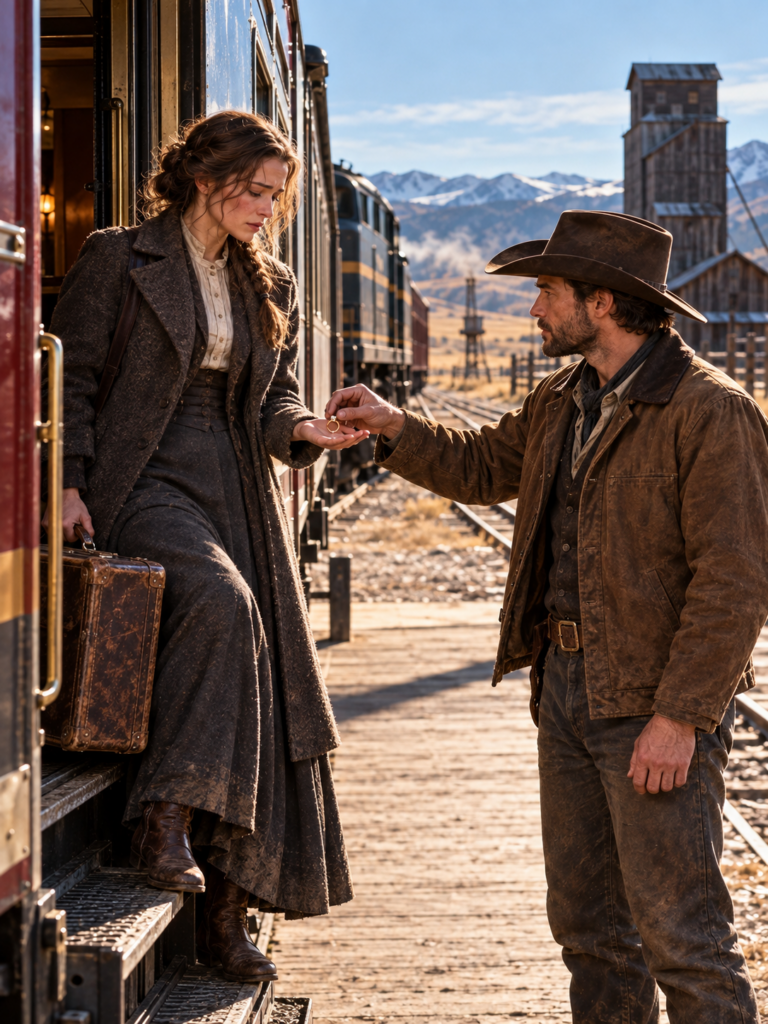
Grace had taken the old engagement ring from her handbag. It caught the last amber light between her fingers.
“What did you expect me to do with this?”
“Whatever you decide.”
“That is not an answer.”
“It’s the only honest one I have.”
Grace studied him.
Richard always had answers before she finished asking questions.
Caleb had none he considered his right to supply.
She lowered the ring.
“Thursday morning.”
“I remember.”
“And if I decide to board?”
“I’ll carry your suitcase only if you ask.”
Despite herself, Grace smiled.
Caleb started across the yard.
“Seven o’clock,” he called.
Grace watched him go, then looked again at the ring.
For the first time, she understood that keeping it did not mean keeping Richard.
Throwing it away would not erase Saturday.
And letting another person decide what she ought to do with it would merely repeat the oldest mistake.
She closed her fingers around the gold and went inside.
At seven the next morning, Grace would climb onto Rosie for the first time in sixteen years.
Before noon, she would admit aloud that she no longer knew whether Richard had been wrong about one thing: perhaps she had mistaken safety for contentment.
And before the following afternoon ended, Richard himself would drive up Morgan Ranch’s dusty lane asking for the future he had abandoned.
Grace would have to decide whether saying no to him meant she was finally choosing Caleb—or finally choosing herself.
At seven the next morning Grace stood beside Rosie with one hand pressed against the mare’s warm neck and tried to remember how nineteen-year-old Grace Harper had climbed into a saddle without considering all the ways a thirty-five-year-old body might object.
Caleb tightened the cinch, shortened one stirrup, and stepped back.
“Ready?”
“No.”
“That’s encouraging.”
“You’re enjoying this.”
“Possibly.”
Grace mounted.
For the first several minutes everything felt wrong—her hands, heels, shoulders, even the distance between herself and the ground.
Then they passed the second gate.
Rosie settled into an easy rhythm.
Grace’s body remembered before her mind did.
Her shoulders loosened.
The morning opened around them.
They rode beyond the barns and cattle pens, through pasture still damp enough to darken Rosie’s hooves, then climbed the long hill behind the ranch.
When they reached the top, Grace stopped breathing for a moment.
Morgan Ranch stretched beneath them in fences, hayfields, cattle, white house, red barn, and distant railroad track cutting a straight line across the valley.
“It’s beautiful.”
“My grandfather started with eighty acres,” Caleb said.
“And now?”
“About sixteen hundred.”
Grace glanced at him.
“You built all that?”
“My family did. I mostly try not to ruin it.”
She smiled.
For a time neither spoke.
Then Grace surprised herself.
“Richard wanted California.”
Caleb did not change expression.
“He said staying in Prairie Junction meant I was afraid.”
“What do you think?”
“I don’t know anymore.”
She looked toward the mountains.
“I always thought contentment was something respectable. He made it sound like another word for cowardice. Like I accepted too little because I lacked imagination.”
Caleb rested his hands on the saddle horn.
“What do you want?”
Grace opened her mouth.
Nothing came.
His voice softened.
“You don’t know.”
“No.”
“That’s all right.”
“It doesn’t feel all right.”
“You were left at the church four days ago.”
He winced slightly.
“Sorry.”
“Don’t be. Everybody else talks around it like it’s a hole in the floor.”
“Four days isn’t much time to decide the rest of your life because one man changed his.”
Grace looked down at Rosie’s mane.
People had offered her plenty of kindness.
Poor Grace.
You’ll find someone else.
Everything happens for a reason.
None of it had helped.
This did.
Caleb nodded toward the valley.
“Don’t decide today.”
They rode back.
Near the lower fence a chestnut foal stood against its mother, watching them with solemn curiosity.
“What’s her name?” Grace asked.
“Doesn’t have one.”
“Why?”
“My father rejects every suggestion.”
“What did you suggest?”
“Ruby.”
Grace grimaced.
“That’s terrible.”
Caleb laughed.
“Offer something better.”
Grace studied the foal.
“Sunday.”
“Sunday?”
“She looks peaceful, and it’s a fine morning.”
Caleb gave the matter absurdly serious consideration.
“I like it.”
“That quickly?”
“Don’t grow accustomed to it.”
By the time they returned, their promised hour had become nearly two.
Grace looked at her watch.
“You cheated.”
“You were smiling.”
“That is not a defense.”
“It worked.”
She dismounted and discovered every muscle below her waist had opinions.
Still smiling, she carried her own saddle blanket into the barn.
For those two hours she had not been the abandoned bride of Prairie Junction.
She had simply been Grace.
That feeling lasted until Wednesday afternoon.
Margaret looked from the kitchen window.
“Grace, do you know that car?”
Grace knew it before her mind accepted the answer.
Dark-blue sedan.
Richard.
Her stomach tightened.
He stepped out in a gray suit despite the heat, polished and composed exactly as he had always been.
Across the yard Caleb was unloading feed sacks.
He saw the car.
He set the sacks down.
Then he stayed where he was.
Margaret touched Grace’s arm.
“You don’t have to talk to him.”
Grace turned toward her.
Something settled inside her.
“I know.”
Those two words mattered.
She walked onto the porch.
Richard climbed the steps.
“Grace.”
“Richard.”
His eyes moved past her toward the ranch.
“You’re staying here?”
“For two days.”
“With the Morgans.”
“Yes.”
“I need to speak with you privately.”
“No.”
His face changed.
Grace folded her arms.
“You may say what you came to say here.”
Richard lowered his voice anyway.
“The California job fell through.”
Grace waited.
“The company changed direction.”
Still she waited.
“I made a mistake.”
For three nights Grace had imagined those words.
She had imagined them while washing dishes, while lying awake, while passing the church where white flowers had already been removed.
Now they sounded surprisingly small.
“We can still marry,” Richard said.
Grace stared at him.
He stepped closer.
“I was angry.”
“You left me in a church.”
“I know.”
“Forty-seven people watched me wait.”
“I know.”
“My uncle had to dismiss them.”
“Grace, I said I’m sorry.”
Perhaps he meant it.
That was what surprised her.
But regret did not rebuild trust merely by being sincere.
“Why now?”
Richard frowned.
“What?”
“Why are you here now? Because you discovered you were wrong about me—or because Sacramento disappeared?”
“That isn’t fair.”
“No. It’s exact.”
His jaw tightened.
“Six days ago you had California. You would not give me one month to close my work, talk to my uncle, or decide whether I wanted the life you had chosen.”
“I wanted us together.”
“You wanted me to come.”
“Yes.”
“That is not the same thing.”
He reached toward her.
“Grace, you belong with me.”
There it was.
Not love.
Not partnership.
Belonging, as though marriage meant being fitted into somebody else’s plan.
Grace stepped back.
“No.”
Richard stared.
“No?”
“I’m not marrying you.”
His gaze shifted across the yard toward Caleb.
“Is this because of him?”
Grace looked too.
Caleb had not moved.
He had left the entire porch, the conversation, and the decision to her.
“No,” she said.
Richard looked almost relieved.
Then Grace continued.
“This is because of me.”
He said nothing.
“I thought we were building something together. We weren’t. You were building it and asking me to live inside it.”
“That’s ridiculous.”
“Maybe. But it’s my decision.”
Richard looked at her for a long moment.
“I hope you know what you’re doing.”
Grace surprised herself by answering honestly.
“I don’t.”
That unsettled him more than anything else.
“But at least I’m the one deciding.”
Richard left without shouting.
The sedan rolled down the ranch lane until the dust settled behind it.
Only then did Caleb cross the yard.
“You all right?”
“Yes.”
He nodded.
Nothing more.
Grace waited.
“Aren’t you going to ask?”
“Ask what?”
“What he wanted.”
“You’ll tell me if you want me to know.”
Grace stared at him.
“He wanted me back.”
A muscle moved near Caleb’s jaw.
“And?”
“I said no.”
A smile appeared.
Grace pointed at him.
“You’re smiling.”
“No.”
“You are.”
“Maybe a little.”
She laughed.
Then looked down the empty road.
“I expected saying no to feel bigger.”
“Maybe the bigger decision happened before he arrived.”
“What decision?”
“Knowing you meant it.”
That evening Grace packed for Thursday’s train.
Morning arrived.
Margaret fed her too much breakfast.
Henry complained she had not reorganized August.
“It isn’t August.”
“It will be.”
In two days Grace had emptied six coffee cans, sorted twenty-nine months of receipts, found hundreds of dollars in duplicated charges, and written Henry a simple monthly system on the back of a feed-store calendar.
At nine-thirty Caleb drove her to the station.
The same platform waited.
The same tracks.
The same clock.
Grace felt like another woman standing inside her own coat.
The train would arrive in fifteen minutes.
Caleb placed her suitcase beside the bench.
“Well,” he said.
“Well.”
Silence stretched.
Grace finally said, “Thank you.”
“For the work?”
“For all of it.”
He nodded toward the tracks.
“You’ll do fine in Oregon.”
Grace studied him.
“Do you truly think I should go?”
Caleb took his time.
“I think you should do what you want.”
“That is becoming irritating.”
“I’ve heard that.”
A horn sounded beyond the grain elevator.
Grace’s pulse quickened.
“Caleb.”
“Yes?”
“If I asked what you want—not what I ought to do—what would you say?”
He looked genuinely startled.
Then simply honest.
“I want you to stay.”
Grace swallowed.
“But I don’t want you staying because I asked.”
The train appeared beyond the elevator.
Caleb turned his hat slowly in his hands.
“One man told you last week where you were going to spend your life. Another stood on my porch yesterday and told you who you belonged to.”
He looked at her.
“I’d make a poor third version of that.”
The train braked beside the platform.
The door opened.
Grace picked up her suitcase.
Caleb did not stop her.
She walked toward the carriage.
One step.
Two.
Three.
Then she stopped.
She turned.
Caleb remained where she had left him, hat in both hands.
Grace walked back.
His expression changed.
“Forget something?”
“Yes.”
“What?”
“To decide what I actually want.”
The conductor called boarding.
Grace did not look back.
“I don’t want Portland.”
Caleb remained quiet.
“I never wanted Portland. I wanted away. Portland happened to be where the tracks went.”
“All right.”
“And I don’t know if I want Prairie Junction forever either.”
“All right.”
“I need time.”
“You have it.”
Grace planted her suitcase between them.
“One month. I rent my own place in town.”
Caleb nodded.
“I work three days a week at the ranch, for wages we agree on beforehand and put in writing.”
At that, he almost smiled.
“My father will be delighted.”
“No, he won’t.”
“No. He really won’t.”
The train began moving.
Caleb looked at it.
“You missed another train.”
Grace lifted her own suitcase.
“No.”
She watched the cars gather speed toward the western horizon.
“This one I chose not to take.”
Then she walked toward Caleb’s pickup, already calculating rent, wages, savings, and how many months she could afford to discover what she wanted without asking any man to define it.
The thirty days would become a year.
The temporary bookkeeping would become Grace’s own business.
And before that year ended, another opportunity would arrive offering her everything Richard once claimed she had been too frightened to want.
This time, Caleb would refuse to tell her to stay.
Grace’s first independent decision was to rent the small apartment above the pharmacy on Main Street.
One bedroom.
A narrow kitchen with a gas stove that required matches.
Two windows overlooking the bakery awning and nearly the whole distance from Prairie County Savings to the railroad station.
The radiator complained all winter, and the bathroom door swelled in damp weather.
Grace loved every inconvenient inch.
The plates were hers.
The books were hers.
The radio played because she wanted noise.
Even the drawer where she kept her spoons belonged to no one else’s plan.
She worked two days each week at her uncle’s hardware store and three at Morgan Ranch.
Caleb honored the arrangement exactly.
Hours.
Wages.
No unannounced expectations.
When Grace stayed for supper, Margaret invited her.
When she joined Caleb for Wednesday rides, he asked.
When Grace said she needed an evening alone, nobody interpreted it as rejection.
Her accounting work spread almost by accident.
A family south of the highway heard what she had done with Henry Morgan’s records and asked her to examine theirs.
Then a widow running four hundred acres alone needed help untangling equipment depreciation.
By September Grace had five clients.
By October, eight.
She bought a used oak desk at a school auction for eleven dollars and set it beneath her window.
On Sundays she returned to the church choir.
At first people whispered.
Grace heard the pauses.
Saw heads angle together.
Every week she forced herself through the front door anyway.
Then hail damaged wheat east of town.
A Fowler boy wrecked his father’s new truck.
A county commissioner said something foolish at a public meeting.
Prairie Junction discovered newer subjects.
Grace learned something she would remember for decades:
Humiliation felt permanent mostly while you were standing inside it.
The town moved on.
Then Grace did.
Caleb remained in her life without pressing it into a shape.
Wednesday rides.
Coffee at the Morgan kitchen table.
Ledger work.
Occasional dinners.
By late September Grace had moved from gratitude for his restraint to irritation with it.
One Saturday evening he climbed the stairs to her apartment wearing a dark jacket.
Grace opened the door.
“You’re dressed up.”
“So are you.”
“I live here.”
That made him smile.
“County harvest dance.”
She blinked.
“Are you asking me?”
“Yes.”
“As a friend?”
Caleb hesitated.
Grace watched a man capable of roping a calf in seconds struggle visibly with a sentence.
“That depends.”
“On what?”
“Whether you’d rather I meant it as a date.”
Grace smiled.
“I would.”
“Then it is definitely a date.”
The Grange Hall smelled of floor wax, coffee, and cinnamon rolls.
Grace wore a blue dress she had not touched since before her engagement.
Caleb’s boots were polished.
His jacket seemed to trouble him more than an obstinate steer.
Half the county saw them arrive together.
Four months earlier Grace might have hidden in the truck.
Now she found she could endure attention without letting it decide anything.
When the band slowed, Caleb offered his hand.
“May I?”
Grace put her hand in his.
They did not dance magnificently.
They danced comfortably.
That mattered more.
Near the middle of the song Caleb said, “Grace.”
“Yes?”
“I want to tell you something.”
She lifted her head.
“I like you.”
Grace smiled.
“I know.”
His expression suggested he had imagined a different response.
She laughed.
“You had four months.”
“I’ve been trying not to rush you.”
“I know that too.”
“How am I doing?”
Grace considered him.
“Very well.”
She moved slightly closer.
“It’s beginning to become a problem.”
His eyebrow rose.
“You can come a little closer now.”
So he did.
What changed between them felt nothing like the dramatic love Grace had once imagined.
It came like daylight.
Gradually enough for her to see it arriving.
Slowly enough for her to decide she wanted it.
Caleb walked her home and stopped at the bottom of the stairs.
He did not assume an invitation.
Grace climbed alone.
Inside her apartment, she opened the top drawer of her dresser.
Beneath a folded scarf lay Richard’s ring.
Months had passed since Caleb returned it.
Grace still did not know what to do with it.
The answer came in December.
Prairie Junction’s public library occupied two rooms in an aging building and depended on an ancient coal boiler the county inspector had been warning about for years.
When it finally failed, replacement cost more than four thousand dollars.
The library did not possess four thousand dollars.
The town organized a Christmas auction.
Women baked.
Families donated tools, quilts, preserved goods, and livestock certificates.
Grace read the notice one morning while standing outside in bitter cold.
Then she knew.
That evening she opened the dresser drawer.
The ring still lay beneath the scarf.
She picked it up.
Nothing happened.
No wave of anger.
No church vestibule.
No Richard.
It was merely gold and stone.
The next morning Grace carried it into Miller’s Jewelry.
The jeweler looked distinctly uncomfortable.
“Miss Harper.”
“I need an appraisal.”
“I could make an offer.”
“No.”
Grace placed the ring on the glass counter.
“A written appraisal. Your letterhead. Signed and dated.”
Miller studied her.
Grace smiled politely.
“I’ll wait.”
He examined the ring and eventually wrote down twelve hundred forty dollars.
Grace folded the appraisal.
“Thank you.”
She donated the ring anonymously to the library auction.
Prairie Junction respected anonymity for approximately forty-eight hours.
At the auction a cattleman from another district bought it for his daughter, bidding above appraisal.
Between the ring, pies, tools, and a quilt the ladies’ society had been sewing since September, the library got its furnace.
Two days later Caleb found Grace in the ranch office.
“You gave away the ring.”
“I donated it.”
“Why?”
Grace closed the ledger.
“Because I realized I didn’t hate it anymore.”
Caleb waited.
She had learned that about him.
He knew how.
“I kept thinking I had to become angry enough to throw it in a river,” she said. “Then one morning I opened the drawer and it was just a ring.”
She looked through the window toward the cattle pens.
“Not Richard. Not the church. Not Saturday.”
Caleb smiled.
“Just something valuable that could buy a furnace.”
“Exactly.”
Grace stood.
“I think I kept it because throwing it away felt like admitting I’d been foolish.”
Caleb shook his head.
“You weren’t foolish.”
“I trusted somebody who left me standing in a wedding dress.”
“You trusted the wrong person. That isn’t the same thing.”
Grace studied him.
Then walked around the desk.
“Caleb.”
“Yes?”
“I’m about to do something.”
“Should I worry?”
“Possibly.”
Grace kissed him.
Caleb froze.
When she stepped back, he stared at her.
“You look surprised.”
“I am.”
“Bad surprise?”
A smile came slowly.
“Very good surprise.”
He took her hand carefully.
“May I kiss you back?”
Grace laughed.
“You’re asking?”
“I’m learning.”
“Yes.”
Caleb kissed her without hurry.
When they separated, Grace rested her forehead against his.
“I think I love you.”
He became perfectly still again.
She smiled.
“That frightened you.”
“No.”
“It absolutely did.”
He gave a low laugh.
“I’ve been trying not to say it since September.”
Grace lifted her head.
“Then say it.”
“I love you.”
She closed her eyes.
Richard had said those words.
Often.
But his love had always arrived attached to a plan.
Sacramento.
A timetable.
A version of Grace easier to transport into the life he had designed.
Caleb’s words demanded nothing.
They simply existed between two people in a chilly ranch office while unfinished ledgers remained open on the desk.
“I love you too,” Grace said.
By spring her eight clients had become fourteen across two counties.
The borrowed desk no longer held everything.
Grace secured a modest bank loan based on her own invoices and reputation, then leased a narrow storefront beside the bakery.
A sign painter put gold lettering on the window for her agricultural bookkeeping business.
On opening morning Caleb arrived carrying yellow flowers.
Grace eyed them.
“Flowers?”
“I reviewed the rules.”
“Rules?”
“Flowers appear acceptable provided they are not accompanied by instructions to move away or get married.”
Grace laughed.
“You’re learning quickly.”
Then the mail came.
Among the envelopes was one from a large Denver accounting firm.
They had heard about Grace’s record system from someone in the cattle business.
They were expanding agricultural services.
The salary exceeded what Grace had ever earned.
Benefits.
Three weeks of vacation.
A modern office.
A recognized firm.
A larger city.
It was precisely the kind of opportunity Richard once accused her of fearing.
That evening Grace carried the letter to Morgan Ranch.
Caleb read every page twice.
“This is good.”
“I know.”
“You should consider it.”
Grace stared at him.
“That’s all?”
“What should I say?”
“I don’t know.”
He refolded the letter along its original creases.
“You worked hard enough to have choices, Grace. Last summer you barely had one that somebody else wasn’t trying to make for you.”
She looked at him.
Then asked the question that had been inside her all day.
“If I take it, will you come with me?”
Caleb became quiet.
Grace watched him choose truth instead of kindness.
“No.”
The answer hurt.
“My life is here,” he said.
“I know.”
“But that doesn’t mean yours has to be.”
Grace looked toward the darkening pasture.
“What happens to us?”
“I don’t know.”
“You would simply let me leave?”
His face softened.
“I would hate it.”
He looked down at his hands.
“I’d hate it every day for quite a while.”
“Then why won’t you ask me to stay?”
Caleb looked toward the porch where Richard had once told Grace she belonged to him.
“Because I saw you say no to a man on these boards last June.”
He met her eyes.
“It may be the best thing I ever watched anybody do. I won’t become the man who ruins it because I’m scared.”
For two weeks Grace considered Denver.
Naturally, she made lists.
Salary.
Benefits.
Office.
City.
Airport.
Music.
Then another page.
Fourteen clients.
Her apartment.
Her choir.
Margaret.
Henry.
Rosie.
Sunday.
Her business.
She wrote Caleb’s name at the bottom, stared at it, then crossed it out.
Not because he did not matter.
Because he mattered too much to be allowed to answer the question for her.
Near eleven one night Grace sat alone in her kitchen and asked aloud:
“If Caleb Morgan did not exist, where would I want to build my life?”
The answer arrived almost immediately.
Prairie Junction.
Grace sat back.
Not because it was safe.
Not because leaving frightened her.
Because during the previous ten months she had built something there herself.
Work carrying her own name.
A home.
Clients.
A reputation.
Gold letters on a window.
Denver would have made her an employee in someone else’s office.
In Prairie Junction she was creating something no one had assigned her.
She declined Denver.
Then used the money and energy she had reserved for uncertainty to expand her business.
When she told Caleb, his eyes warmed.
“You stayed.”
Grace shook her head.
“I chose.”
His expression softened.
“Yes.”
She took his hand.
“And I chose you too.”
Caleb looked at her in a way she did not fully understand until the following May.
Nineteen days before the first anniversary of the wedding that never happened, he asked Grace to ride with him to the hill behind Morgan Ranch.
They followed the same route as on her first morning there.
Past the barn.
Past the pens.
Across damp pasture.
Rosie carried Grace with familiar patience.
Sunday, now larger and less solemn, watched them from beyond the fence.
At the hilltop they stopped.
The ranch spread below.
So did the railroad.
Grace could see the line that once represented escape.
Caleb dismounted.
Grace’s heart began to pound.
“That looks suspicious,” she said.
“Probably.”
She dismounted too.
Caleb stood in front of her.
“I’ve thought about this a long time.”
“That is very characteristic of you.”
“I wanted to be certain I was asking the right question.”
He took a small ring from his pocket.
Grace looked down.
It was not grand.
It did not resemble Richard’s.
Caleb held it in his open palm.
“Grace Harper, will you marry me?”
She looked across Morgan Ranch.
At the home that belonged to Caleb’s family.
At the town beyond it where she owned nothing extravagant but possessed work, friendships, a business, and decisions entirely her own.
At the railway that could still carry her away any day she decided to buy a ticket.
Eleven months earlier she had believed freedom existed somewhere four hundred miles west.
Now she understood freedom differently.
She held out her left hand.
“Yes.”
Caleb stood.
But he did not put the ring on her finger.
Instead he turned her hand palm-up and placed the ring inside it.
Grace looked at him.
“What are you doing?”
“You put it on.”
“Why?”
A faint smile.
“So you never forget who chose it.”
Grace stared at the ring resting in the same palm that once held Richard’s recovered ring on a train platform.
That first time, Caleb had returned something without asking for anything.
This time, he offered something and again left the final movement to her.
Grace slid the ring onto her own finger.
Then wrapped both arms around him.
“Yes,” she whispered again.
Caleb held her with one broad hand between her shoulder blades.
Their wedding was small.
Not because Grace wished to hide.
Because neither of them needed spectacle.
Her uncle walked with her.
Margaret cried.
Henry complained about the flowers costing too much and was caught later saving one in the pages of an old cattle ledger.
Grace kept her business.
Marriage did not move her bookkeeping desk into Caleb’s control or turn her into unpaid ranch labor.
For a time she retained the office in town.
Later, when circumstances made another arrangement practical, she chose that arrangement herself.
Caleb continued running the ranch.
Grace helped where she wanted and knew enough about its books to prevent Henry from ever again classifying twenty-two thousand dollars in cattle as miscellaneous.
Years passed.
There were good ones and difficult ones.
Dry summers.
A winter when part of the barn roof came down.
Years when cattle prices tested Caleb’s patience.
Years when Grace worked past supper during tax season.
Margaret grew older.
Henry eventually—under considerable protest—agreed to put receipts in an actual drawer.
Grace and Caleb argued sometimes.
Not about whether disagreement meant abandonment.
Not about who belonged to whom.
They learned to ask.
They learned to answer.
Most importantly, they learned that love did not require either person to become smaller.
More than twenty years later, Grace and Caleb rode the hill again.
A train crossed the valley below them.
Its horn reached the pasture faintly.
Grace watched it move along the same tracks she had once nearly taken west.
Caleb looked at her.
“Ever wonder what would’ve happened if you’d boarded?”
“Sometimes.”
“Regret it?”
Grace considered the question.
“No.”
Then she smiled.
“But not because Montana was the right answer.”
“What was?”
Grace looked at the ranch, the road into town, and the distant windows of the place where she had built a profession under her own name.
“Finding out I could choose.”
Caleb nodded.
Grace rested her hand over his.
“And finding somebody who loved me enough not to choose for me.”
He kissed her forehead.
Below them the train continued west.
Grace watched until the last car vanished beyond the slope.
Then she turned Rosie toward home.
People in Prairie Junction told the story differently.
They liked the dramatic version.
Grace Harper was abandoned at the altar.
She sold her ring for forty dollars.
Caleb Morgan discovered its value, bought it back, and ran down the station platform before she escaped town.
In their telling, Caleb saved her.
Grace corrected them whenever she heard it.
“No,” she would say.
Caleb had done something better.
He returned what belonged to her.
Then he stepped aside.
Richard had offered Grace a future already completed, with her place selected inside it.
Caleb returned a ring and asked for nothing.
Later, when he offered another ring, he laid that one in her open hand too.
Grace’s first engagement ring had come attached to conditions.
The second came with a question.
And by the time Caleb asked it, Grace possessed a life entirely her own from which to answer.
That was why her yes meant something.
Not because she needed rescuing.
Not because Prairie Junction frightened her less than Portland.
Not because Caleb owned a ranch or had once sprinted after a train.
She chose him because she could have left.
She chose the town because she had learned she could leave it.
She chose her work because she had built it.
She chose marriage because the man beside her understood that love was not the right to direct another person’s life.
And years after the church embarrassment, the forty-dollar sale, the coffee cans, the missed trains, and the ring that heated a library instead of remaining locked inside a drawer, Grace understood what Caleb had really returned to her on that station platform.
It had never been merely gold.
He had put a choice back into her hand.
Then he had trusted her to decide what it was worth.


