
The girl swung her pony downhill, and George sent Juno after her.
The old mare took the first switchback faster than she had taken anything in two years.
George’s bad hip burned.
He ignored it.
Behind him came hoofbeats.
Doss had followed.
Not kindness, George thought.
Not necessarily.
But a man who wanted an entire county watching him acquire a mine could not afford to be remembered as the man who refused to help a woman trapped beneath a wagon.
George did not care why Doss came.
Only that extra hands were coming.
They found the wagon on its side below the second bend.
One wheel turned slowly above the road.
Two horses lay tangled in their traces.
A man knelt beside the overturned wagon box, both hands under its edge, trying to lift something no single man could move.
His wife was pinned beneath it.
Her shoulder lay at a wrong angle.
Her eyes were open.
The husband looked at George.
“Please.”
George dismounted.
“Don’t pull her.”
He took the maul and wedged it beneath the wagon box.
A stone became the fulcrum.
He threw the rope toward Doss’s eldest rider.
“Loop the rear brace.”
The man obeyed.
George pointed to Doss.
“You and him take the rope.”
Doss stared at him for half a heartbeat.
Then removed his black coat and grabbed hold.
George positioned the husband beside him.
“On three.”
The injured woman made a sound through clenched teeth.
George looked at her.
“We lift. Your husband pulls you clear.”
She nodded.
“One.”
The men set their feet.
“Two.”
George felt his hip tremble.
“Three.”
They lifted.
Four inches.
Enough.
The husband dragged his wife free.
George released the lever carefully.
The wagon slammed down.
The woman cried out once.
Then went silent.
George knelt.
Her leg was bleeding, but no bone showed.
Her shoulder concerned him more.
He folded his coat beneath her head.
“You’re staying awake.”
Her eyes found his.
“My daughter?”
“Right here.”
The girl dropped to her knees.
Her mother lifted her good hand toward her face.
The movement was weak.
But deliberate.
Only then did George breathe normally again.
Rain struck the dust.
One drop.
Then twenty.
Then the mountain opened.
They got the team standing.
They carried the injured woman uphill draped across Juno’s broad back while the husband walked beside her.
The repaired shack held.
So did the roof George had spent days rebuilding while Coyote Creek laughed at him.
He lit the stove.
Boiled water.
Splinted the injured arm between flat boards and torn strips of his own shirt.
Doss stood under the eave watching.
George never asked what he thought.
Hours later, the woman slept.
Her husband sat beside her holding one hand.
The girl slept against the wall.
George stepped outside into the rain.
Juno stood beneath the ore chute with her head lowered.
He put both hands against her neck.
“You ran like you were ten.”
One ear moved toward him.
The other remained pointed toward the mine.
Behind George, Doss said, “You knew there was something in that shaft.”
George did not turn.
“No.”
“Don’t lie to me.”
George finally faced him.
“I knew there was water.”
Doss’s gaze shifted toward the black entrance.
“That isn’t what I asked.”
“It’s the answer you get.”
Doss studied him.
“What did you find?”
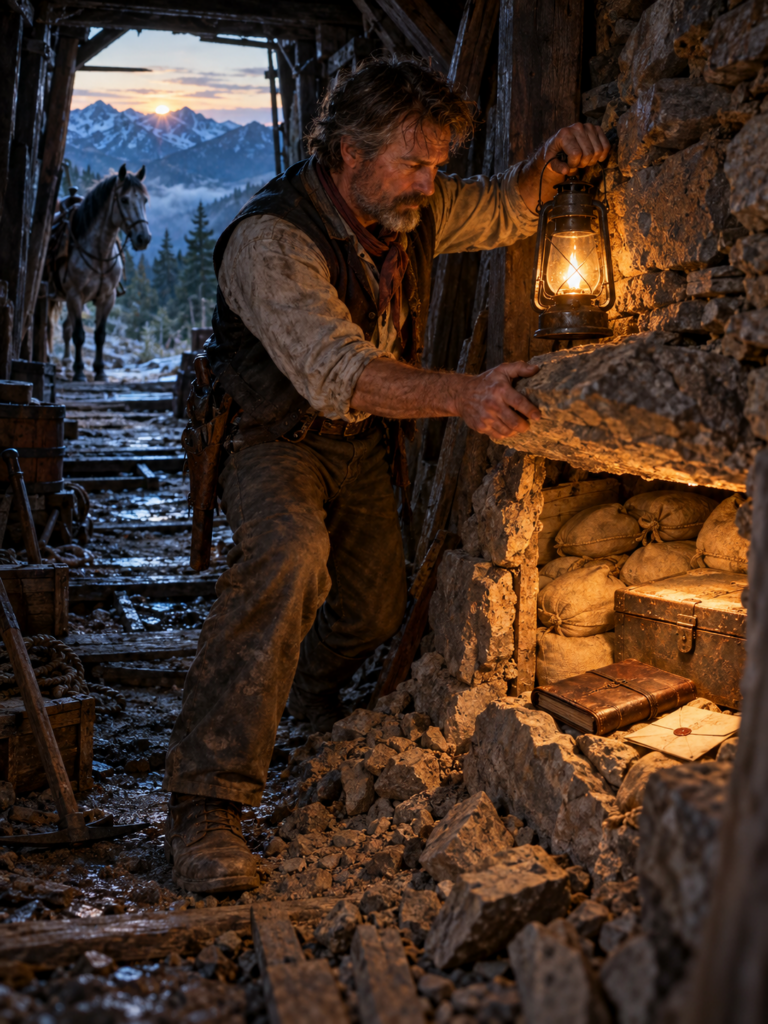
George thought of sixteen sealed sacks.
The unfinished vein.
The ledger.
The letter naming a wife and a boy who might still be alive somewhere.
Then he looked toward the shack where the injured family slept.
“What somebody left behind.”
Doss’s face hardened.
“Your deed gives you the mine.”
“Maybe.”
“So whatever’s in it is yours.”
George looked toward the mountain.
That was the easiest answer.
It was also the one that bothered him most.
At daylight, Doss sent one rider into town for a doctor and wagon.
George watched him go.
Then he entered the shack, took the tin box from beneath his coat, and placed it where the morning light reached it.
He opened the ledger again.
The name of the man who had hidden the second drift stared back at him.
George reached the final page.
Below the production figures was an address.
A town three days south.
The same town named in the letter.
If the boy had survived, he would be a grown man now.
George closed the ledger.
Doss watched from the doorway.
“You’re going to look for him.”
George met his eyes.
“Yes.”
Doss gave a short, humorless laugh.
“You finally find silver, and your first thought is how much of it belongs to someone else.”
George wrapped the ledger again.
“No.”
He secured the tin box.
“My first thought was that somebody waited twenty-eight years for me to do the right thing.”
George locked the tin box beneath the repaired bunk before the doctor arrived.
The decision did not make the silver less real.
It made the responsibility heavier.
Doctor Howerin came up the switchbacks in a borrowed spring wagon late that morning, square spectacles flashing in the sun after the storm. He examined the injured woman inside the shack while her husband paced outside.
George stood beside Juno.
Doss stood near the shaft.
For the first time since arriving, neither man had much to say.
Howerin emerged after nearly an hour.
“She keeps the arm.”
The husband sagged against the wall.
“The leg?”
“Cut deep. Clean enough. She’ll heal.”
Then the doctor turned to George.
“That splint was yours?”
George nodded.
“Good work.”
George disliked praise almost as much as pity.
He touched the brim of his hat.
Howerin lowered his voice.
“There’s something else.”
George waited.
“I saw the tin box while laying out my instruments.”
Doss looked over.
The doctor continued.
“I didn’t read what wasn’t mine to read. But the ledger opened when I moved the box.”
His eyes sharpened.
“I know recorded mining figures when I see them.”
George said nothing.
“That hand is old.”
“Yes.”
“Filed?”
“Looks that way.”
“If it documents production hidden before abandonment, the county needs to see it.”
“They will.”
Doss stepped closer.
“When?”
George looked at him.
“When the family gets down this mountain safely.”
Doss’s mouth tightened.
But he did not argue.
That surprised George.
By noon the injured woman was settled into the wagon beneath quilts.
Her daughter climbed beside her.
The husband remained at the rear wheel as though he could keep the wagon upright by touching it.
Before they left, he walked to George.
“I don’t have much.”
George knew what was coming and stopped it.
“You don’t owe me.”
“I owe you my wife.”
“No.”
George’s voice sharpened enough that the man blinked.
“You still have your wife. That’s what matters.”
The man looked down.
Then back up.
“What can I do?”
George considered the question.
“Come by the assay office tomorrow.”
The man frowned.
“Why?”
“Because I may need somebody who writes a clean number and doesn’t scare easy.”
The first genuine expression George had seen on his face appeared then.
Confusion.
“Are you offering me work?”
“I’m offering you tomorrow.”
The man nodded.
“I’ll come.”
The wagon started down.
The girl twisted around in her seat.
“Mr. Shaw!”
George looked up.
“Thank you.”
He raised one hand.
Nothing more.
When the family disappeared below the bend, the mountain grew quiet again.
Doss remained.
George wished he wouldn’t.
“You still want to buy?” George asked.
Doss looked toward the mine entrance.
“No.”
The answer surprised him.
Doss removed his watch from his pocket, looked at it, then closed it.
“I want to know what you found.”
“No.”
Doss glanced at him.
“No?”
“No.”
“You think I came here with three men because I enjoy mountain air?”
“I think you came because somebody told you I’d been repairing a mine you believed worthless.”
Doss’s expression confirmed enough.
George continued.
“You wanted me gone before I learned why you wanted the ridge.”
Doss’s jaw tightened.
“I wanted the ridge for grazing.”
“Maybe.”
“There’s no conspiracy here, Shaw.”
“I didn’t say there was.”
That irritated Doss more.
George walked toward the shaft.
Doss followed two steps.
George stopped.
“You don’t own permission to come farther.”
Doss stared at his back.
“You bought an abandoned mine four days ago and suddenly you think you’re a king?”
George turned.
“No. I think I own a deed.”
That silenced them both.
Doss finally laughed once.
Not mockery.
Recognition.
“Fair enough.”
He mounted and rode down alone.
George watched until the black coat vanished among the pines.
Then he entered the mine.
This time he carried the ledger.
At the hidden wall, he stopped.
The stones he had removed remained stacked neatly.
He could rebuild the wall in an hour.
Hide the drift again.
Say nothing.
The thought came naturally enough to frighten him.
A hundred forty dollars had bought him legal claim to the Blue Feather.
The recorded owner of the hidden ore had never returned.
Maybe the law would say everything in the mountain belonged to George.
Maybe no one could force him to share a cent.
He stepped through.
Sixteen sacks waited in lantern light.
The untouched vein gleamed at the face.
He sat on the pine crib and opened the letter again.
The writer’s name was Samuel Rankin.
George read it twice before the connection struck.
Rankin.
Ali Rankin.
The old foreman who had told a seventeen-year-old George that the mountain still had more in her.
George closed his eyes.
Ali had known.
Perhaps not exactly where.
Perhaps only enough to know the official story was false.
The letter identified Samuel Rankin as the man who had overseen the final hidden load.
Brother?
Cousin?
George did not know.
But twenty-eight years earlier, somebody with that name had walled nearly half a ton of high-grade ore into the mountain before winter.
And Ali Rankin had later carried the certainty that ore remained.
George suddenly understood the sentence that had lived in him all those years.
They ran from winter.
Not the ore.
It had not been a miner’s boast.
It had been knowledge.
George raised the lantern toward the raw face.
The vein ran on.
His $140 had purchased more than abandoned workings.
It had purchased the unfinished end of another man’s labor.
That meant the mine could live again.
But only if George chose what kind of owner he would become before the money gave him reasons to forget.
He went back outside.
Juno stood near the cistern.
George sat beside her in the grass.
“Seems like everybody left me work to do.”
She chewed.
He scratched beneath her jaw.
“You’ve never once offered useful advice.”
Her eye moved toward him.
“That’s fair.”
The next afternoon George rode into Coyote Creek.
The assay office porch was full before he arrived.
Word of the rescue had reached town.
So had rumor about Doss riding to the mine with three men.
The boy who had watched George buy the Blue Feather stood near the boardwalk again.
This time he removed his cap when George passed.
George dismounted.
His hip almost buckled.
He hid the worst of it by leaning against Juno.
The assay clerk opened the door.
No laughter now.
George carried the tin box inside.
Set it on the counter.
Opened it.
The room behind him went quiet.
The clerk read the ledger.
Then the letter.
Then returned to the first page and began again.
Finally he said, “Mr. Shaw.”
George waited.
“This appears genuine.”
“Does that mean anything?”
“It means the Blue Feather wasn’t worked out when abandoned.”
“I know that part.”
The clerk looked over his spectacles.
“The production entries reference a secondary drift never included in the county closure survey.”
“Also true.”
“You found it?”
“Yes.”
“Standing?”
“Yes.”
“Ore?”
“Sixteen sacks.”
Someone behind George inhaled.
The clerk stared.
“How much?”
“The letter says nine hundred forty pounds.”
The silence changed.
Not laughter now.
Calculation.
Men began doing arithmetic behind their eyes.
George disliked the room immediately.
“The vein continues at the face,” he added.
That made it worse.
Merritt Doss entered.
Alone.
No black coat.
He placed his hat on the counter.
He looked at the ledger.
Then George.
“I was wrong at the door.”
No one moved.
“And wrong on the ridge.”
George said nothing.
Doss continued.
“If you reopen, my freight yard can supply hauling at cost until you’re standing.”
George looked at him for a long moment.
“At fair rate.”
Doss frowned.
“I’m offering cost.”
“And I’m saying fair rate.”
“Why?”
“Because I don’t want favors turning into ownership later.”
Something moved in Doss’s eyes.
Respect, perhaps.
Or irritation at being understood.
He nodded.
“Fair rate.”
He picked up his hat.
Before leaving, he said, “You’re going to reopen it.”
“Yes.”
Doss looked at the ledger.
“And the old ore?”
“Not decided.”
That answer traveled through the room before Doss reached the door.
George turned to the clerk.
“I need another thing.”
“What?”
“Help finding the family in this letter.”
The clerk read the address.
“Twenty-eight years.”
“I can count.”
“The boy could be anywhere.”
“Yes.”
“Or dead.”
“Yes.”
The clerk looked at him.
“You really mean to find him.”
George folded the letter.
“I mean to know whether he can be found before I decide what’s mine.”
Outside, the old man who had warned George about the second drift stood at the end of the boardwalk peeling an apple.
George walked toward him.
The old man did not look up.
“You knew Rankin,” George said.
The knife stopped.
“Which one?”
“Samuel.”
The old man raised his eyes.
That was answer enough.
George sat beside him.
“Who was he?”
“Ali’s brother.”
The pieces settled.
“Samuel wrote the letter.”
“I reckoned he might.”
“You knew about the hidden drift?”
“I knew there was one.”
“Why didn’t you say so twenty-eight years ago?”
The old man looked toward the ridge.
“Because I was a nineteen-year-old mucker who knew men had hidden ore from creditors before the winter and knew nothing beyond that.”
He peeled another strip.
“Then men scattered. Samuel didn’t come back. Ali went looking for family. By the time anybody cared, the county had marked the Blue Feather dead.”
“Why tell me?”
The old man smiled faintly.
“Because you remembered how to listen.”
George almost rejected the answer.
Then he remembered Juno standing at the shaft.
The cold air.
Water moving under rock.
The sideways feather.
Patience had done what force would not.
The old man dropped the peel into George’s palm.
“Water told you.”
George curled his fingers around it.
“It did.”
Three days later, a reply came from the town listed in Samuel Rankin’s letter.
The boy had survived.
He was fifty-eight years old now.
And he was coming to Coyote Creek.
George read the telegram twice.
Then folded it inside his coat.
For the first time since finding the second drift, he knew exactly what frightened him.
Not losing the silver.
Learning what doing right would actually cost.
Samuel Rankin’s son arrived on a Tuesday afternoon riding a borrowed gelding and carrying one canvas bag.
His name was Thomas.
He looked nothing like the man George had imagined.
No prosperous merchant.
No hardened miner.
No angry heir.
Thomas Rankin was narrow-shouldered, gray at the temples, and walked with the careful stiffness of someone whose hands had worked more than his back.
George met him outside the assay office.
Thomas looked at him for a long moment.
“You’re Shaw.”
“Yes.”
“You found my father’s letter.”
“Yes.”
Thomas swallowed.
“Is it really his?”
George removed the folded letter from inside his coat.
He did not hand it over immediately.
Not because he doubted Thomas.
Because after carrying it through the mountain, storm, town, and three sleepless nights, the paper had come to feel less like evidence and more like a voice.
Then George placed it in Thomas’s hands.
Thomas opened it.
The street continued around them.
A wagon rattled.
Someone hammered iron at the smithy.
A dog crossed the road.
Thomas read the letter once.
Then again.
His mouth trembled.
George looked away.
Some grief deserved privacy even on a public street.
“My mother waited six years,” Thomas said.
George turned back.
“She thought he’d been killed.”
“I’m sorry.”
“She remarried eventually.”
Thomas folded the paper carefully.
“She never knew where he disappeared.”
“Neither do I.”
Thomas nodded.
“That’s better than pretending.”
George understood the sentence.
He had spent most of his adult life among men who considered certainty a form of strength.
Age had taught him otherwise.
Sometimes truth stopped at I don’t know.
Thomas touched the letter.
“This tells me he meant to come home.”
“Yes.”
“That matters.”
George felt something loosen in his chest.
He had assumed the silver would become the difficult part.
He had been wrong.
Sometimes the inheritance was simply knowing you had not been abandoned willingly.
They rode together to the Blue Feather the next morning.
Juno carried George.
Thomas rode the borrowed gelding.
Halfway up, Thomas asked, “How bad’s the hip?”
George looked ahead.
“Depends who’s asking.”
“The man watching you pretend it doesn’t hurt.”
George almost smiled.
“Bad enough.”
“You reopening a mine with a bad hip?”
“Looks that way.”
“That seems foolish.”
“Town already settled that question.”
Thomas laughed.
It was the first easy sound between them.
At the mine bench, the rescued family’s wagon stood beside the repaired shack.
The woman George had pulled from beneath the overturned wagon sat in the sunlight with her arm bound across her chest.
Her husband, Caleb Martin, was inside copying figures from the mine ledger into a clean book.
The daughter was brushing Juno with a worn currycomb.
The old mare had discovered that being admired required no particular effort.
George dismounted carefully.
Caleb came outside.
“Mr. Shaw.”
“George.”
Caleb nodded.
“George.”
George introduced Thomas.
Caleb’s expression changed when he understood who he was.
He offered his hand.
Thomas accepted it.
No speeches.
George appreciated that.
They entered the Blue Feather together.
Thomas stopped at the first sideways feather mark.
“My father cut these?”
“Maybe.”
George pointed toward the three notches.
“They lead to the hidden drift.”
Thomas touched them once.
Then lowered his hand.
At the stone wall, George let Thomas enter first.
That decision mattered to him.
Thomas stepped through the opening with the lantern.
When the light touched the sixteen sacks, he stopped.
George remained behind him.
Thomas looked toward the sealed ore.
Then the raw vein.
Then the pine crib.
“This was his last work?”
“Far as we know.”
Thomas walked to the nearest sack.
He did not touch it.
“How much is it worth?”
“Assay will tell us.”
“That isn’t what I meant.”
George understood.
“How much is yours?”
Thomas nodded.
George took the ledger from beneath his coat.
“I bought the legal claim.”
“Then the mine belongs to you.”
“The mine does.”
George pointed at the sacks.
“Those were above ground in a man’s account before I ever owned the claim.”
Thomas looked at him.
“You think they belong to me.”
“I think at least part of them does.”
Thomas shook his head slowly.
“My father was paid wages.”
“The ledger says he supervised the load.”
“That doesn’t make him owner.”
“No.”
“Then what are you proposing?”
George had rehearsed this conversation.
Every version had sounded better before another man stood in front of him.
“The letter says this ore was cribbed against winter under Samuel Rankin’s record. It names his family because he expected the load to matter if he didn’t return.”
Thomas looked at the sacks again.
George continued.
“I’m having the historical ownership reviewed. If somebody else has a lawful claim, they get heard. If they don’t—”
He paused.
Thomas waited.
“Half of the value from this stored load goes to you.”
Thomas stared at him.
“No.”
George had expected argument.
Not refusal.
“Why?”
“Because you bought the claim.”
“That part we covered.”
“And you found it.”
“Also covered.”
Thomas turned.
“My father asked whoever found the letter to tell us. He did not ask that man to give away his mine.”
George disliked the relief he felt.
Relief was precisely why he could not accept the refusal quickly.
“He expected that load to come down.”
“Yes.”
“For somebody.”
“The company.”
“Maybe.”
Thomas’s eyes sharpened.
“You want a clean answer.”
“I prefer them.”
“You may not get one.”
That sounded familiar.
George leaned against the timber.
“What do you want?”
Thomas considered.
“The truth recorded.”
George waited.
“That the drift existed. That my father worked it. That he didn’t simply disappear because he was irresponsible or drunk or running from us.”
Thomas looked at the letter.
“I want my mother’s name put beside his in the county record if they preserve this history.”
“Done.”
“And I want enough from whatever you decide is fair to put a stone at her grave with the full truth on it.”
George felt the mountain grow very quiet.
“That’s all?”
“No.”
Thomas smiled faintly.
“I’d like to see if you really found nine hundred forty pounds.”
George laughed.
It hurt his hip.
He laughed anyway.
The assay took two weeks.
The ore was genuine.
High-grade silver-bearing material, exactly as Samuel’s letter described.
The old ledger matched surviving company figures preserved in county books.
Ownership was less simple.
The company that had operated the Blue Feather had dissolved decades earlier.
Its remaining interests had passed through estates no one had properly untangled because everyone believed the mine worthless.
George could have spent years fighting over the stored ore.
Instead he negotiated.
Publicly.
He refused private bargains.
That surprised people most.
The county recognized his deed to the claim and reopening rights.
The stored load was sold under supervised accounting after outstanding historical obligations were reviewed.
Thomas received the agreed share.
Not because George pretended the entire mine belonged to Samuel’s family.
Not because Thomas demanded what was not his.
Because both men accepted that law and fairness sometimes overlapped imperfectly, and a decent arrangement required neither side to pretend otherwise.
Merritt Doss handled freight.
At fair rate.
Every invoice went through Caleb Martin.
The same Caleb who had once knelt helpless beside an overturned wagon now kept the Blue Feather’s books in a clean hand.
George hired him because Caleb knew what a number meant when somebody’s future depended on it.
The rescued woman recovered through autumn.
Her shoulder remained stiff, but she could use the arm.
She came to the mine bench once after the doctor allowed travel and stood looking at the mended shack.
“This held us through the storm?”
George nodded.
She touched the doorframe.
“You repaired it before you knew anyone would need it.”
“Needed somewhere to sleep.”
She looked at him.
“That isn’t what I meant.”
George did not know how to answer.
Her daughter solved the problem by calling from across the bench.
“George! Juno won’t move.”
George looked.
The girl stood tugging uselessly on the mare’s lead rope while Juno remained planted beside the water trough.
“She moves when she wants.”
“That’s not helpful.”
“It’s accurate.”
The woman laughed.
George went to help.
The Blue Feather reopened slowly.
George refused to turn it into another fever.
No night shifts.
No men underground alone.
Timbers replaced before ore came out.
Water watched daily.
Every new worker learned the feather marks and the second drift, not as a secret anymore, but as a warning about what happened when haste, winter, debt, and silence combined.
Some miners disliked George’s caution.
He let them.
He had spent thirty years watching men prove toughness to animals, weather, employers, and one another.
Most of the time the mountain remained unimpressed.
Merritt Doss visited in October.
He rode up alone.
George found him standing beside the mine mouth.
“You lost?”
Doss looked at him.
“I own half the freight contracts in the valley. I can find a road.”
“Congratulations.”
Doss almost smiled.
He watched two workers replace a crown post.
“You could be moving twice this amount.”
“Yes.”
“You could hire another crew.”
“Yes.”
“You could run nights.”
“No.”
Doss frowned.
“There it is.”
“What?”
“The part where you stop making sense.”
George leaned on a shovel handle.
“Twenty-eight years ago men rushed winter until they had to wall off a drift and run.”
“You don’t know that.”
“I know enough.”
Doss looked toward the repaired cabins.
“You’re leaving money underground.”
“It stayed there twenty-eight years.”
George shrugged.
“Seems patient.”
Doss shook his head.
“You don’t think like an owner.”
George considered that.
Maybe once it would have sounded insulting.
Now it did not.
“What does an owner think like?”
“Take what’s his while it’s available.”
George looked toward Juno.
The old mare stood half asleep in the afternoon sun while the rescued girl braided a piece of red yarn into her mane.
“That attitude nearly killed me more than once.”
Doss followed his gaze.
“When?”
“Every time I thought being foreman meant getting more from an animal than it could safely give.”
Doss’s expression changed.
George continued.
“Mountain’s no different.”
“You comparing a silver vein to a horse?”
“No.”
George smiled.
“Horse is easier to argue with.”
Doss actually laughed.
It surprised both men.
He stayed for coffee.
That was all.
No friendship declared.
No past erased.
A man who had arrived with three riders and an insulting offer did not become trustworthy because he later behaved better once.
But George noticed Doss no longer stepped across the mine bench as though every piece of ground would eventually belong to him.
Changed behavior counted.
So did memory.
By first frost, Thomas Rankin returned south carrying a bank draft and his father’s original letter.
Before leaving, he stood beside George at the assay office.
“I put the stone up.”
“For your mother?”
Thomas nodded.
“What did you write?”
Thomas looked toward the ridge.
“That Samuel Rankin went to work in the autumn of 1878 intending to come home.”
George said nothing.
Thomas smiled sadly.
“It was enough.”
Then he handed George a smaller envelope.
“What’s this?”
“Copy of the letter.”
“I have copies.”
“Not that.”
Inside was a photograph.
Two young men stood beside an ore wagon.
George recognized one.
Ali Rankin.
The foreman from his youth.
The second must have been Samuel.
On the back, Thomas had written the year.
George turned it over again.
Twenty-eight years vanished for one instant.
He could almost smell mule sweat and powder smoke from the old boom days.
Hear Ali telling a seventeen-year-old boy that the mountain still held something.
Thomas extended his hand.
“My father left something unfinished.”
George shook it.
“So did his brother.”
“You finished it.”
George shook his head.
“No.”
Thomas glanced toward the ridge.
“No?”
“I opened a wall.”
That evening George rode back alone.
The old man sat on his stump beside the north road.
Same knife.
Same apple.
George stopped Juno.
“Thomas came.”
“I heard.”
“He got the letter.”
“Good.”
“And his share.”
The old man nodded.
George showed him the photograph.
The knife stopped moving.
The old man stared at Ali and Samuel Rankin.
For several breaths he said nothing.
Then he handed the picture back.
“Mountain keeps longer memory than men.”
George put the photograph inside his coat.
“Seems so.”
The old man peeled the apple in one long curl.
When it broke near the end, he frowned.
“Hands aren’t what they were.”
George looked at his own.
Neither were his.
The old man held out half the apple.
George accepted it.
They ate without speaking.
By late November, the Blue Feather bench looked inhabited again.
The ore chute stood straight.
Rails ran from the shaft.
The shack had a sound roof.
Two new cabins showed lantern light after dark.
Caleb kept the books.
His wife sometimes sat outside on warmer afternoons while her daughter walked Juno around the bench and complained that the old mare liked George better.
The nine-year-old boy from Coyote Creek carried water after school.
George paid him.
The boy objected the first time.
“I’d do it free.”
“No.”
“Why?”
George handed him the coins.
“Because work isn’t gratitude.”
The boy stared at the money.
George added, “And gratitude isn’t wages.”
The boy considered that as seriously as any grown man.
Then pocketed the coins.
Snow threatened on the final clear evening of the season.
George stood above the shaft watching gold light move across the pines.
His hip hurt.
Cold weather made it worse.
He had stopped pretending otherwise.
Juno stood beside him.
Her muzzle had grown whiter since spring.
George rested one hand on her neck.
Caleb came up from the cabins.
“The county wants the operating name tomorrow.”
George looked at him.
“Blue Feather.”
“They want to know if you’re changing it.”
“Why?”
“New ownership. New filing.”
George watched lantern light glow faintly inside the shaft.
He thought about the laughter in the assay office.
The $140.
The cold air through the hidden wall.
Samuel’s letter.
Thomas holding proof that his father had planned to return.
Doss taking the rope when George told him to lift.
A family alive because an abandoned shack had been repaired before anyone knew it would matter.
The old man saying the mountain never lied about water.
“I’m not changing it.”
Caleb nodded.
“Blue Feather stays.”
“Yes.”
Caleb started away.
Then stopped.
“What does it feel like?”
George looked over.
“What?”
“Knowing it’s yours.”
George turned toward the mine.
Men had spent much of his life telling him ownership was the measure of success.
Own cattle.
Own land.
Own a business.
Own enough money that nobody could count your years and send you away.
He had once believed that.
Then Chandler’s outfit had replaced him.
His body had begun refusing commands.
His future had narrowed until the only door left was an abandoned shaft every sensible man mocked.
Yet what saved him had not been taking the mountain.
It had been listening to it.
George looked at Caleb.
“It never felt like mine.”
Caleb frowned.
“You bought it.”
“That’s paper.”
“You rebuilt it.”
“With other men.”
“You found the drift.”
“Somebody else dug it.”
Caleb waited.
George watched Juno’s breath cloud faintly in the evening air.
“I think I only kept it awake.”
Caleb smiled.
“That going on the county form?”
“No.”
“Good.”
He walked back toward the cabins.
George remained.
The light faded.
Juno shifted closer.
Somewhere below them, water moved through the second drift.
Still steady.
Still patient.
George closed his eyes and listened.
Twenty-eight years earlier, men had boarded the mountain shut and called it empty.
The mountain had waited.
George had spent decades believing usefulness meant staying in the saddle longer than pain, age, or sense allowed.
He understood differently now.
A man could lose the work that had defined him without losing his worth.
He could begin again after everyone else had decided his useful years were finished.
He could inherit another person’s unfinished work without stealing it.
He could hold something valuable without squeezing it dry.
He could find wealth and still ask who else had a claim on its meaning.
George opened his eyes.
The shaft mouth held the final light softly.
Not like a mouth ready to swallow him.
Like an open door.
Juno flicked one ear toward the mountain.
George rubbed her neck.
“You heard it first.”
She breathed out.
“Don’t get proud.”
Another ear moved.
George laughed quietly.
Then he turned toward the warm windows of the cabins.
Behind him, the Blue Feather remained open.
Ahead, people were waiting for supper.
And beneath everything, where stone preserved what men forgot, the water went on moving exactly as it had for twenty-eight years.
Patient.
Unhurried.
Telling the truth to anyone willing to listen.


