
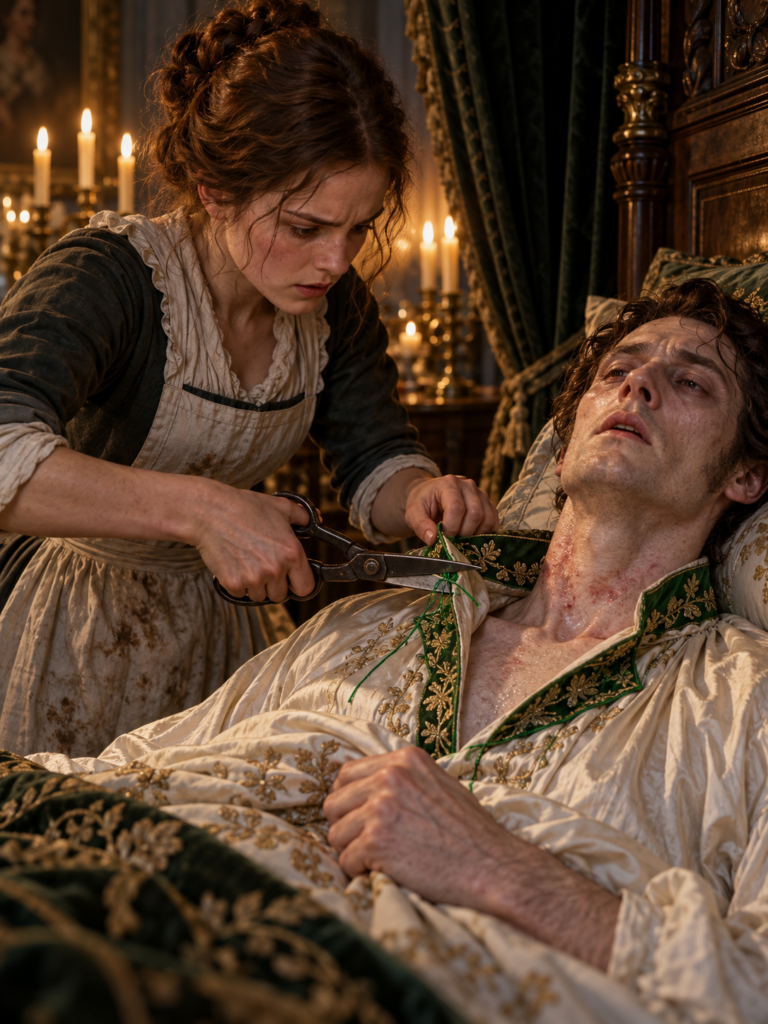
Nora caught the pail handle and dragged it behind the bed just as the bedroom door opened.
Lord Edward Hawthorne entered carrying a silver candlestick.
His eyes went first to the duke.
Then to Nora.
“Why is his shirt gone?”
She curtsied, keeping one hand on the bedpost.
“The collar was rubbing his neck, my lord.”
Edward looked at the clean linen covering his cousin.
“Dr. Lipton specifically advised against disturbing him.”
“He was suffering.”
“He’s dying, girl. Suffering is hardly unexpected.”
Edward approached the mattress.
Nora moved aside, but not far enough to leave the duke entirely beyond her reach.
“Where is the garment?”
“In the washing, my lord.”
Edward’s gaze sharpened.
“I should like it returned.”
“Certainly. Once it’s properly cleaned.”
A silence followed.
Edward examined her face, perhaps wondering why a chambermaid had suddenly become so particular about laundry.
Then he smiled.
“You’re an attentive servant, Miss…”
“Reed.”
“Miss Reed. I shall remember that.”
It sounded less like gratitude than a warning.
He leaned over the duke and studied his motionless features.
“Has he spoken?”
“Only nonsense, my lord.”
“Has he recognized anyone?”
“No.”
Edward straightened.
“Good. I mean, mercifully, he needn’t be troubled by the business of the estate.”
Nora lowered her eyes.
“Of course, my lord.”
He remained another minute, speaking softly to his unconscious cousin about peace, family, and the natural end of human suffering.
Then he left.
Nora listened until his footsteps faded.
Only then did she retrieve the pail.
“That,” she whispered, “was not a man grieving.”
From the bed came a dry, painful sound.
“Never… was.”
Nora turned.
Alister Hawthorne was looking at her.
His eyes were clearer than they had been an hour earlier, though his body remained dreadfully weak.
“Your Grace?”
“Edward.”
His throat worked painfully.
“Where… is he?”
“Gone downstairs.”
Alister closed his eyes.
Nora poured a little fresh water into a cup.
“Can you swallow?”
He nodded faintly.
She helped him raise his head and waited while he managed two cautious mouthfuls.
His hand trembled so badly that water spilled onto the blanket.
He noticed her looking.
“Don’t,” he whispered.
“Don’t what?”
“Pity me.”
“I haven’t the leisure.”
An unexpected expression crossed his face.
Almost amusement.
Almost.
Nora placed the cup aside.
“Your cousin gave you a green silk nightshirt.”
Alister’s eyes opened.
“Yes.”
“When?”
“Before… the doctors.”
“And you began falling ill soon afterward?”
He watched her.
A long pause passed.
“Why?”
Nora drew a short length of green embroidery from her apron.
She held it close enough for him to see without touching it.
“This was sewn into your collar. I believe the dye contains arsenic.”
Alister stared.
“Poison?”
“Possibly enough to make you very ill. I cannot tell you how much harm it has done. But I know that dye, and I know it has no business lying against a man’s throat.”
“Edward…”
“I have no proof he ordered it deliberately.”
“Then why hide it?”
“Because he asked for that shirt before he asked whether you were comfortable.”
The duke said nothing.
Nora wrapped the thread in a clean scrap of linen.
“I’ve kept the garment. If you’re to accuse anyone, you’ll need more than a chambermaid’s word.”
Alister tried to sit up.
Pain crossed his face.
His arm failed, and he fell back against the pillows.
Nora moved to steady him.
“Don’t spend what little strength you have.”
“I need Sterling.”
“Who?”
“Thomas Sterling. My solicitor. London.”
“He cannot help if your cousin reads the letter first.”
Alister’s expression darkened.
“Edward controls the post.”
“Then we must find another way.”
The word we seemed to startle him.
He studied the young woman whose apron smelled of soap, candle smoke, and long hours of unpaid exhaustion.
“Why would you risk yourself?”
Nora looked toward the hidden washing pail.
“Because someone decided your life was worth less than the money he might inherit.”
She was about to say more when footsteps sounded again.
This time two men were speaking.
Edward’s voice was unmistakable.
“Tomorrow morning,” he said beyond the door, “I want that girl removed from his rooms.”
Nora stiffened.
A second voice answered.
Dr. Lipton.
“And the nightshirt?”
“Burn it.”
Nora closed her fingers around the hidden green thread.
The duke heard both men.
His face changed.
For the first time, he was not merely afraid of dying.
He understood that someone might kill the only person who knew why.
Nora crossed the room, turned the key in the bedroom lock, and placed the washing pail beneath the window.
Then she began to pull the heavy curtains aside.
The curtains slid apart, exposing the wet gray darkness beyond the glass.
Nora lifted the window catch.
Cold night air entered the bedchamber, carrying the smell of rain-soaked earth and fallen leaves.
Behind her, Alister struggled to raise his head.
“What are you doing?”
“Finding out whether there’s another way from this room.”
“You’re three floors above the ground.”
“I can count, Your Grace.”
She leaned forward carefully.
Below, a narrow stone ledge ran toward a rainwater pipe. Beyond it stood the service courtyard.
An impossible escape for a man who could scarcely sit upright.
A dangerous one even for her.
Nora closed the window.
“Well,” she muttered, “that settles one possibility.”
Alister gave a faint, exhausted laugh.
It ended in a cough.
“An encouraging report.”
“I’ve not promised encouragement. I’ve promised to think.”
She returned to the bedside and inspected the water jug.
The duke watched her movements.
For most of his adult life, he had been surrounded by people who answered questions before he finished asking them.
Men praised his judgments.
Servants anticipated his preferences.
Physicians delivered opinions with the certainty of men who never suffered the consequences of being wrong.
Now his continued survival depended upon a chambermaid who openly considered him difficult.
It was an unfamiliar arrangement.
And an unsettlingly effective one.
“Nora.”
She glanced up.
“Yes?”
“How did you recognize the thread?”
“I worked in a dressmaker’s shop before I came here.”
“Why did you leave?”
Her expression closed.
“That’s a longer conversation than you’ve strength for.”
He accepted the answer.
After a moment, he said, “Then tell me what you intend.”
“First, you must rest. Second, we must keep that garment safe. Third, you cannot let your cousin know you’ve begun to improve.”
“And fourth?”
She hesitated.
“We need someone outside this house.”
“Sterling.”
“Perhaps. But somebody must carry a message he can trust.”
Alister thought for several seconds.
“Justice Hale.”
“The magistrate?”
“He has known me since I was a boy. He knows Sterling as well.”
“Does Edward know him?”
“Certainly.”
“Then we ought to be careful what reaches his ears.”
Alister looked at her with reluctant admiration.
“You assume everyone can be purchased.”
“No. Only that the wrong person can be.”
She drew a chair near the bed.
“Tell me where Justice Hale lives.”
Before dawn, Nora had learned the location of the magistrate’s residence, the names of two servants Alister believed dependable, and the extent to which Edward had taken control of the household.
The list was discouraging.
Edward had assumed responsibility for correspondence.
He directed the physicians.
He dealt with visitors.
He had even persuaded Mrs. Higgins to limit the duke’s attendants, supposedly to preserve quiet.
Nora listened without interruption.
When Alister finished, she asked one question.
“How long have you allowed him to manage your affairs?”
“Since I became ill.”
“And before that?”
“Occasionally. He was my cousin.”
“That answers how he gained your trust. It doesn’t explain why he kept it.”
Alister turned away.
His silence was answer enough.
For the remainder of the night, she watched his breathing, changed the clean cloth at his neck, and made certain he could take small amounts of water without choking.
His condition did not transform miraculously.
The weakness remained.
His stomach was unsettled.
The damaged skin hurt.
At times he shook so violently that the cup rattled against its saucer.
But by morning he could recognize her consistently.
That alone felt like an extraordinary victory.
When the servants began their duties, Nora returned to the familiar invisibility of her station.
She lowered her head.
She carried linen.
She answered questions in as few words as possible.
And when Mrs. Higgins reprimanded her for lingering upstairs, Nora apologized with practiced meekness.
The performance nearly made her laugh.
All her life she had been accused of insufficient obedience.
Now obedience was her finest disguise.
For the next three days, she arranged extra food and clean water for the duke whenever she could do so without drawing notice.
He managed bread softened in broth, a little egg, and thin slices of apple.
He needed assistance with nearly everything.
Yet slowly, painfully, his strength began to return.
During the physicians’ visits, he resumed the appearance of a man slipping toward death.
He kept his eyes shut.
He answered no questions.
When Dr. Lipton approached, he gave only a feeble groan.
The doctor examined him with growing irritation.
“Remarkable,” Lipton told Edward on the third afternoon. “His Grace continues to linger.”
Edward’s mouth tightened.
“Can nothing be done?”
“We have exhausted the usual remedies.”
“Then perhaps unusual ones are required.”
Nora stood beside the washstand, holding clean towels.
Neither gentleman looked at her.
But she saw Lipton’s expression.
And she knew the conversation would not end there.
That evening, she helped Alister move from the bed to the armchair.
He insisted on standing by himself.
His legs buckled almost immediately.
Nora caught his arm.
“There’s no shame in needing help.”
“Spoken by someone who has never been obliged to ask for it.”
Her face hardened.
“You know remarkably little about my life, Your Grace.”
He looked at her.
“You’re right.”
The apology was so unexpected that she almost missed it.
They moved together toward the chair.
Each step cost him effort.
He leaned against her shoulder, breathing harshly.
When they reached the hearth, he sank down with a trembling exhalation.
“Twenty feet,” he said bitterly. “I once rode for hours without tiring. Now a bedroom defeats me.”
“Then tomorrow we’ll try twenty-one.”
He looked up.
“You’re merciless.”
“I’m practical.”
She placed water beside him and began stripping the sheets.
For a while, they worked in silence.
Then Alister spoke.
“You said you once worked in Spitalfields.”
Nora folded the last sheet.
“Yes.”
“Did you have family there?”
Her hands stopped.
“A brother.”
“Where is he now?”
“Dead.”
Alister said nothing.
Nora appreciated that.
Most people rushed to offer sympathy before they knew what had happened.
She sat on the edge of the empty mattress.
“Tommy worked in a mill in Manchester. He was younger than I was. Thought if he worked hard enough, we’d both have a proper place to live.”
She looked at the fire.
“He fell ill. The overseer threatened to dock his wages if he left his loom.”
Alister remained still.
“He stayed at work. Collapsed beside the machinery. By the time anyone stopped it, he was beyond saving.”
The words were plain.
She had spent years making them plain because anything else threatened to break her.
“The mill owner called it an unfortunate accident.”
Alister lowered his eyes.
“I’m sorry.”
Nora shook her head.
“It wasn’t unfortunate. It was convenient. The men who made money from his labor decided his life was cheaper than an hour’s interruption.”
She looked directly at him.
“When I found that green thread, I thought of Tommy. Another man being destroyed while the people responsible spoke of fate.”
Alister studied his hands.
They were thin and unsteady, but still unmistakably the hands of a gentleman who had never needed to scrub a floor for wages.
“You despise men like me.”
“I distrust men who forget what their decisions cost other people.”
“There’s a difference.”
“There can be.”
He considered her answer.
Then he said quietly, “I should like the opportunity to prove it.”
Nora did not reply.
But when she brought him another cup of water, she allowed him to take it without insisting upon help.
It was a small thing.
For him, it was dignity.
For her, it was trust.
The following afternoon, Nora was polishing the brass banister above the library when Edward’s voice reached her through the open doors.
“I am finished waiting, Horace.”
She stopped moving.
Dr. Lipton answered in a low voice.
“The duke’s condition is already grave.”
“And yet he persists.”
“There is only so much medicine can accomplish.”
“Then administer more laudanum.”
A pause.
Nora’s fingers tightened around the polishing cloth.
“An excessive dose,” Lipton said, “might stop his breathing.”
Edward’s answer came immediately.
“That would end his suffering.”
“Lord Edward—”
“Your debts are considerable, Doctor. My offer to support your new practice remains available.”
The silence that followed seemed endless.
Then Lipton spoke.
“What precisely do you require?”
Edward lowered his voice.
Nora leaned closer.
“I shall visit him tonight. Alone. By morning, this tiresome matter will be settled.”
Nora dropped the polishing cloth.
It struck the staircase below.
Neither man appeared to notice.
She hurried toward the servants’ passage, her heart beating painfully.
The hour for caution had ended.
She reached the duke’s room and shut the door.
Alister was sitting beside the fire, an open book in his lap.
He saw her face and immediately closed it.
“What happened?”
“Edward is coming tonight.”
“He’s visited before.”
“Not like this.”
She told him everything.
The conversation.
The promised money.
The instruction to increase the laudanum.
Edward’s determination that the duke should be dead by morning.
Alister listened without moving.
When she finished, he looked toward the window.
“Then we must make his intentions undeniable.”
“We must get you out.”
“I cannot reach the courtyard, Nora.”
“I could find a cart.”
“And collapse before we’ve passed the gates?”
She knew he was right.
But accepting it made her feel trapped.
“We cannot simply wait for him.”
“No,” Alister agreed. “We cannot.”
He stood slowly, gripping the arm of the chair until his legs steadied.
Then he crossed to the fireplace.
There, among the brass implements, rested a heavy iron poker.
He lifted it.
Nora stared.
“You’re scarcely strong enough to hold that.”
“I’m not proposing to fight him.”
“Then what?”
Alister studied the blackened iron.
“Edward expects a helpless man. We need him to show precisely what he intends to do while someone capable of stopping him is present.”
Nora understood.
She wished she did not.
“You want me to hide.”
“Yes.”
“And wait until he attacks.”
“Only if you agree.”
She looked toward the bed.
The duke would be exposed.
If Edward acted quickly, she might not reach him in time.
Alister saw her hesitation.
“I will not ask you to do what you cannot bear.”
Nora took the poker from his hand.
It was heavier than she expected.
“Then you had better keep your nerve, Your Grace.”
“And you?”
She tested the weight in both hands.
“I’ve had to keep mine since I was fourteen.”
By evening, the bedchamber had been prepared.
The curtains were drawn.
The duke lay beneath his blankets, his face gray in the candlelight.
Nora waited inside the cedar wardrobe, the door open barely an inch.
The poker rested across her knees.
At ten o’clock, footsteps approached.
A key turned.
Edward entered with a candlestick.
He shut the door behind him.
For a long moment, he watched his cousin breathe.
Then he set the candle beside the bed.
“Poor Alister,” he murmured. “You always did make everything more difficult than necessary.”
He lifted a heavy velvet pillow from the chair.
Inside the wardrobe, Nora’s grip tightened.
Edward stepped beside the bed.
He raised the pillow.
And with both hands, he pressed it over the duke’s face.
The pillow sank against Alister’s face.
For one dreadful heartbeat, Nora could not move.
The sight of Edward standing above his own cousin, calmly using both hands to smother him, was more terrible than anything she had imagined.
There was no hesitation in his movements.
No last-minute struggle of conscience.
Only determination.
Then Nora drove the wardrobe door open.
The hinges struck the wooden frame.
Edward turned his head.
Too late.
Nora swung the iron poker into the side of his knee.
He cried out, lost his balance, and fell against the bed.
The pillow dropped.
Alister drew in a ragged breath.
Edward struck the floor heavily, clutching his injured leg.
“What have you done?” he screamed.
Nora stood between him and the bed.
“The very thing you were hoping nobody would do.”
Alister dragged the pillow away and struggled upright.
His face was pale, his breathing uneven.
But his eyes were fully awake.
Edward stared at him.
For the first time since entering the room, he looked genuinely frightened.
“Alister?”
“Good evening, Edward.”
“You were dying.”
“So you kept telling everyone.”
Edward tried to push himself backward.
Pain twisted his expression.
“You don’t understand.”
Alister swung his feet over the bedside.
“I understand a great deal more than I did a week ago.”
He stood, supported by the bedpost.
Nora moved instinctively toward him.
He accepted her arm.
There was no embarrassment now.
No wounded pride.
Only the practical understanding that they needed one another.
“Tell me,” Alister said, “why you wished me dead.”
Edward looked from the duke to Nora.
The terrible meaning of the scene was becoming clear to him.
His cousin had not recovered by accident.
Someone had discovered the poison.
And that someone was standing before him wearing a maid’s apron.
“You,” Edward whispered.
Nora met his eyes.
“Yes. Me.”
“An ignorant servant—”
“An experienced seamstress,” she corrected. “You chose the wrong embroidery.”
Edward’s expression collapsed.
That single change told Alister more than a dozen denials could have done.
“You knew,” he said.
Edward looked away.
“You had everything.”
The words emerged bitterly.
“The title. The estates. The shipping interests. Everything our family spent generations gathering.”
Alister’s face hardened.
“And you thought murdering me would give it to you?”
“I would have managed it better.”
“You were already managing my correspondence.”
“Because you never paid attention!”
Edward’s voice rose.
“You trusted your solicitors, your agents, your servants. You signed what was placed before you and assumed loyalty would follow your seal. You never understood how much could be gained by a man willing to take control.”
Alister studied him.
“That much, at least, appears to be true.”
Edward mistook the quiet answer for weakness.
He straightened a little, though the movement made him wince.
“You cannot prove anything.”
Nora crossed to the washing pail.
She removed the concealed silk and laid it carefully upon the table.
The ruined nightshirt gleamed green beneath the candlelight.
Edward stopped speaking.
Alister approached slowly.
“Do you recognize your gift?”
Edward swallowed.
“It was an expensive garment.”
“With poisonous stitching.”
“I knew nothing about its manufacture.”
“Then perhaps you’ll explain why you ordered it destroyed.”
Edward looked sharply at Nora.
She continued without waiting.
“I heard you speaking with Dr. Lipton outside this room. You wanted the shirt burned. You wanted me removed.”
Edward’s eyes narrowed.
“Servants listen at doors. They invent tales.”
“Not this one,” Alister said.
He took a careful breath.
“Nor did she invent the pillow you pressed over my face.”
Edward’s confidence faltered.
From his position on the floor, he looked suddenly less like a gentleman accustomed to giving orders and more like an ordinary frightened man.
Alister sat down before his strength failed him.
“We shall send for Justice Hale.”
Edward gave a bitter laugh.
“And present him with what? A torn shirt, a maid’s accusation, and your word against mine?”
“No,” Nora answered. “We’ll present him with all of it. And Dr. Lipton’s conversation concerning the money you promised.”
“He’ll deny it.”
“Then perhaps you’ll both have difficulty explaining why you entered a sickroom alone carrying a pillow.”
Edward fell silent.
Alister watched him with an expression Nora could not read.
There was anger there.
But something sadder lay beneath it.
Edward was not merely an enemy.
He was family.
A man who had sat at the same table, shared childhood memories, and received the protection of the very person he intended to bury.
“You might have asked me for help,” Alister said.
Edward’s mouth twisted.
“I didn’t want your charity.”
“So you chose my death.”
Edward gave no answer.
Nora did not allow the silence to soften what had happened.
“Your Grace, we need witnesses before he finds a different account of tonight.”
Alister looked toward the bellpull.
Then toward her.
“You’re right.”
He rang for assistance.
When footsteps hurried along the corridor, Nora unlocked the door and summoned the butler and two footmen.
The men stopped in astonishment at the sight of the duke sitting upright and Lord Edward on the floor.
Alister spoke with what authority he could summon.
“His lordship is to remain here until the magistrate arrives. Send someone for Justice Hale immediately. And find a surgeon. His leg requires attention.”
Edward opened his mouth to protest.
Alister interrupted.
“You will receive proper treatment. More consideration, I think, than you extended to me.”
The butler, pale with shock, bowed and hurried away.
Nora remained beside the bed.
She did not surrender the poisoned garment.
Not yet.
She no longer trusted the appearance of respectability.
And after the events of the past week, no one could reasonably blame her.
***
By morning, the household knew something extraordinary had happened.
The duke was alive.
Lord Edward had been restrained after an apparent attempt upon his life.
And the chambermaid who once cleaned the upper floors was being questioned by a magistrate in the drawing room.
Justice Hale listened carefully.
He examined the damaged nightshirt without touching the colored embroidery directly.
He heard Nora describe the dye, the illness, and the marks around Alister’s throat.
He asked when the garment had arrived.
He asked who had purchased it.
He listened to Alister’s account of the night.
And he questioned the servants who had heard Edward’s cry.
Most importantly, he heard Nora repeat the conversation between Edward and Dr. Lipton.
When she finished, Hale sat back.
“You understand, Miss Reed, that an accusation against a gentleman of Lord Edward’s standing is a serious matter?”
Nora kept her hands folded.
“Yes, sir.”
“And you are prepared to repeat all of this under oath?”
“Every word.”
Hale studied her.
“You seem remarkably certain.”
Nora met his gaze.
“I am certain of what I saw and heard. I am certain the embroidery was dangerous. I leave you to determine what the gentlemen intended.”
The magistrate nodded.
It was a more careful answer than he had expected.
He ordered the garment retained as evidence, directed that the relevant witnesses be interviewed, and made arrangements for Edward to be held while the matter was investigated.
Dr. Lipton was summoned.
He arrived believing he had been called to certify the duke’s death.
Instead, he found Alister propped against fresh pillows, a magistrate beside the window, and Nora Reed standing near the fireplace.
The physician stopped dead.
“Your Grace?”
“Good morning, Doctor.”
Lipton’s face lost its color.
“Astonishing. A most extraordinary recovery.”
Alister regarded him coldly.
“Extraordinary indeed.”
Hale placed the ruined green collar on the table.
“Doctor, I should like an explanation of this.”
Lipton stared at the fabric.
He knew enough chemistry to recognize that certain brilliant green dyes were hazardous.
His eyes moved toward Nora.
“Who suggested poisoning?”
“Miss Reed recognized the embroidery,” Hale replied.
Lipton cleared his throat.
“I cannot be expected to identify every textile dye used in England.”
“No,” Alister said. “But you might have noticed the damage to my throat.”
Lipton’s hands began to tremble.
He attempted to defend his treatment.
He spoke of misleading symptoms, uncertain diagnoses, and the limitations of medical knowledge.
Some of what he said was true.
Nineteenth-century medicine remained an imperfect science.
But nothing could explain why the physician had agreed to increase a sedative at the direction of a man impatient for his cousin’s death.
Hale asked about that conversation.
Lipton denied it.
Nora repeated the words she had heard.
The doctor denied them again.
Then Alister asked one simple question.
“How much did Edward promise toward your new practice?”
Lipton went very still.
His silence changed the atmosphere of the room.
Hale leaned forward.
“Doctor?”
Lipton looked toward the door.
“Lord Edward exerted considerable pressure.”
“What sort of pressure?”
“He knew of certain debts.”
“And in return?”
Lipton’s composure began to fail.
He admitted that Edward had offered financial assistance.
He acknowledged discussions about stronger doses of laudanum.
Under continued questioning, he conceded that Edward had spoken of bringing the duke’s suffering to a final end.
It was enough to deepen the investigation considerably.
Hale ordered him detained for further examination of his role.
When the constables escorted the physician away, Nora felt no triumph.
She felt exhausted.
The truth had not restored Tommy’s life.
It had not returned the months Alister had spent suffering.
It had not made the great household suddenly just.
But for once, a wealthy man’s version of events had failed to silence someone with little money and no title.
And that mattered.
***
Later that morning, Mrs. Higgins received instructions to prepare a proper meal and a hot bath for the duke.
Alister requested a physician not connected with Edward or Lipton, someone who would assess the lingering damage without another round of reckless treatments.
He also instructed the servants to follow the magistrate’s directions regarding evidence.
Then he asked to speak privately with Nora.
Mrs. Higgins closed the bedroom doors behind her.
The silence felt different now.
For the first time in many weeks, no one stood outside plotting the duke’s death.
Rain tapped softly against the windows.
The fire burned steadily.
Alister sat in an armchair near the hearth.
Nora stood beside the mantel, examining the red, cracked skin on her hands.
“You should sit,” he said.
“I’d rather stand.”
“As you wish.”
He waited.
Nora had expected gratitude.
Perhaps a purse of money.
Perhaps an instruction from the housekeeper to return to ordinary duties once the disturbance faded.
Instead, the duke seemed uncertain how to begin.
“You saved my life.”
“I removed a poisoned shirt. You’ve still a long recovery ahead.”
“You also prevented my cousin from finishing his work.”
Nora looked away.
“I did what was necessary.”
“At considerable danger to yourself.”
“Yes.”
He studied her face.
“You don’t make it easy to thank you.”
“I’ve known men who were generous with thanks and rather less generous with wages.”
Alister gave a quiet laugh.
It caused him to cough, and he waited until his breathing settled.
“Then let us discuss something practical.”
Nora braced herself.
Here it came.
The reward.
The dismissal.
The polite restoration of distance between a duke and a chambermaid.
“I’ll be leaving Penrith Manor,” she announced.
Alister looked surprised.
“Leaving?”
“I cannot remain as I was.”
“Mrs. Higgins will not dismiss you.”
“Mrs. Higgins needn’t dismiss me.”
Nora raised her chin.
“Every servant in this house knows what happened. Some will be pleased. Others will resent me. You may order them to treat me kindly, but you cannot make me an ordinary chambermaid again.”
Alister considered her words.
“No,” he admitted. “I cannot.”
“And I will not live the rest of my days having gentlemen speak of the brave little girl who rescued their master.”
“You’re not a little girl.”
“Then don’t reward me as though I were.”
Her voice was firmer than she intended.
Alister did not rebuke her.
Instead, he asked, “What would you choose if you had the means?”
Nora hesitated.
The question surprised her more than any offer of gold.
“I would work with accounts,” she said finally. “Or textiles. Something where knowing my trade mattered more than how low I could curtsy.”
“Have you kept accounts before?”
“At the dressmaker’s. Orders, measurements, prices, wages when the mistress allowed it.”
“Can you read and write confidently?”
“English, yes. I’ve no university education, if that’s what you’re asking.”
“I wasn’t.”
He looked toward the writing desk.
“I have an estate manager in York whose figures have troubled me for some time. And textile purchases throughout the estate which no one has examined with much care.”
Nora narrowed her eyes.
“What are you proposing?”
“Paid work using the abilities you’ve demonstrated.”
“Here?”
“If you wish.”
“Under Mrs. Higgins?”
“No.”
“Without a uniform?”
“Certainly.”
“With authority to examine the accounts properly?”
“Yes.”
She folded her arms.
“Authority is little use if a gentleman can overturn my findings whenever he dislikes them.”
Alister inclined his head.
“Then we would have to agree upon the responsibilities and limits of the position in writing.”
For several seconds, Nora said nothing.
She had imagined freedom as leaving the manor behind.
She had not imagined the possibility of changing her place within it.
“How much?” she asked.
“What would you consider fair?”
“Fifty pounds a year.”
Alister did not pretend to be offended.
“Agreed.”
“And rooms of my own.”
“Agreed.”
“And I keep the right to resign.”
“Of course.”
Nora studied him suspiciously.
“You agree rather quickly for a gentleman accustomed to giving orders.”
“I’ve recently discovered that my judgment is not infallible.”
“An expensive lesson.”
“Very.”
He smiled faintly.
Then his expression became serious.
“There is something else.”
Nora stiffened.
“Your Grace—”
“I’d like you to remain because your judgment is sound, and because this house badly needs someone who will tell me the truth. I would also like the chance to know you beyond the circumstances in which we met.”
He paused.
“But one has nothing to do with the other. Your employment will not depend upon your answering any personal invitation.”
Nora looked at him.
For the first time, she had difficulty finding a sharp reply.
Alister continued.
“When I’ve recovered, perhaps I might invite you to dine with me.”
“As an employee?”
“As a woman whose company I should enjoy.”
“And if I refuse?”
“You will still have your salary, your rooms, and the right to tell me I’m a fool.”
“That last privilege may prove exhausting for you.”
“I suspect it already has.”
Nora laughed.
The sound surprised them both.
She had not laughed freely in months.
Perhaps years.
“Very well,” she said. “You may ask when you can walk downstairs without assistance.”
“And the answer?”
“Will depend upon whether you’ve learned to behave yourself by then.”
***
Alister’s recovery was long.
Removing the dangerous garment had ended his continuing exposure, but it could not instantly repair months of illness, harsh medical treatment, and weakness.
There were days when he barely managed a walk around the room.
There were nights when pain made sleep impossible.
Nora no longer served as his private nurse.
A properly engaged attendant cared for him, under the direction of a new physician.
Nora spent her days studying ledgers and discovering how the estate functioned.
The work was not easy.
She had to learn unfamiliar terminology and old accounting practices.
She asked questions that embarrassed the clerks.
She found inconsistencies in textile purchases and demanded supporting records.
She discovered that some errors were carelessness rather than dishonesty.
And she learned that good judgment required evidence, not simply suspicion.
Alister gave her time to learn.
More importantly, he took her findings seriously.
When she disagreed with him, they argued.
When she was mistaken, she admitted it.
When he was mistaken, she insisted that he do the same.
Their conversations gradually grew longer.
They spoke of books, London streets, the textile trade, and the estate’s tenants.
She told him more about Tommy.
He listened without trying to explain away the cruelty that had killed her brother.
In return, Alister admitted how carelessly he had trusted certain people merely because they belonged to his own class.
“I believed rank reflected character,” he said one evening.
Nora looked up from her papers.
“And now?”
“Now I believe it mostly reflects who one’s parents happened to be.”
“An improvement, Your Grace.”
“I live for your approval, Miss Reed.”
“You’ll have a difficult life of it.”
By the time he could manage the stairs without assistance, the atmosphere between them had changed.
There was warmth.
There was respect.
There was also something neither hurried to name.
One evening, Alister appeared at the doorway of the small sitting room assigned to Nora beside her office.
He wore a dark coat and carried no walking stick.
She looked up.
“You’re standing.”
“A remarkable observation.”
“Without leaning on anything.”
“I thought you might approve.”
“How far have you walked?”
“All the way here.”
She set down her pen.
“And what brings you?”
He smiled.
“I believe you once told me I could invite you to dinner when I could reach the downstairs rooms unaided.”
Nora regarded him carefully.
“And?”
“I’ve managed it.”
“Have you learned to behave yourself?”
“Not entirely.”
“Then at least you’re honest.”
He waited.
She closed the ledger.
“Very well, Alister.”
It was the first time she had used his name without anger, urgency, or the fear that he might die before hearing it.
His expression softened.
“Very well?”
“One dinner.”
“Shall I have the dining room prepared?”
Nora stood.
“No grand performance. No announcement. And no twelve-course meal merely because you can afford one.”
“What do you suggest?”
“Something edible, a decent fire, and conversation.”
He offered his arm.
She considered it.
Then she took it.
***
The proceedings against Edward and Lipton continued through the proper authorities.
The evidence surrounding the green nightshirt, the medical treatment, the promised money, and the attack in the duke’s bedroom was gathered and examined.
Edward could no longer conceal his ambition behind expressions of grief.
Lipton’s professional standing suffered under the scrutiny of his conduct.
Their ultimate legal punishment lay beyond Nora’s control, and she did not pretend otherwise.
She had told the truth.
She had preserved the evidence.
She had survived.
That was enough to let her begin a different life.
As the seasons passed, Penrith Manor became a less frightening place to her.
Not because its hierarchy vanished.
It did not.
But because she no longer accepted that hierarchy as a measure of her worth.
She earned her salary.
She controlled her rooms.
Her recommendations affected real decisions.
And when Alister sought her company, he did so with an understanding that she was free to decline.
Their affection grew in ordinary hours.
Sometimes over the accounts.
Sometimes during walks through the grounds as his strength returned.
Sometimes across a supper table, where they disagreed about everything from household expenses to the proper way of cooking an apple tart.
He admired her intelligence.
She admired his willingness to learn.
Neither confused gratitude with love.
Neither mistook affection for an obligation.
One afternoon, Nora found a small parcel waiting on her desk.
Inside lay a fine pair of dressmaking shears.
Not ornamental.
Not jeweled.
A proper working pair, beautifully balanced and made for years of use.
Beside them was a brief note from Alister.
He had remembered that the old shears, the ones which cut the poisonous collar, had been damaged during the struggle to save him.
Nora turned the new pair over in her hands.
Then she walked to his study.
He looked up as she entered.
“Are they suitable?”
She held up the shears.
“They are.”
“I’m relieved.”
“They’re rather expensive.”
“I thought good tools were worth the price.”
She approached the desk.
“Do you know what these remind me of?”
“A ruined nightshirt?”
“No.”
She placed the shears on the blotter.
“The moment I understood that being poor did not mean being powerless.”
Alister stood.
“You were never powerless, Nora.”
“I was in that house. Before you listened.”
He absorbed the correction.
“Then I’m grateful you made me listen.”
She looked at the man before her.
He no longer resembled the pale figure who had once struggled to draw a breath against embroidered pillows.
His strength had returned.
But the change she valued most had nothing to do with health.
He no longer treated listening as a concession.
He treated it as part of living beside another person.
Nora took his hand.
This time, she reached first.
“I’ve been thinking,” she said.
“An alarming beginning.”
“About that first night.”
“The collar?”
“Yes. You couldn’t protect yourself. I barely knew you. Yet everything turned upon whether I trusted what I knew.”
“And you did.”
She nodded.
“I think I’ve been doing that ever since.”
Alister looked at their joined hands.
“Will you continue?”
Nora smiled.
“So long as we both remember I may say no.”
“Always.”
He waited until she moved closer.
Then he kissed her.
It was gentle.
Unhurried.
And entirely chosen.
***
Years later, the ruined green collar remained preserved among the records of the case.
Nora never wanted it displayed as a romantic keepsake.
It represented cruelty, ignorance, and a frightening abuse of trust.
But she also refused to forget what it had taught her.
A title was not wisdom.
A physician’s authority was not proof of sound judgment.
Fine clothing did not guarantee a good heart.
And a servant’s apron could conceal more knowledge and courage than anyone in a grand drawing room cared to imagine.
Her life at Penrith Manor did not become a fairy tale in which she was rewarded simply by winning a duke’s affection.
She continued her work.
She earned respect through competence.
She kept the freedom for which she had bargained.
And Alister, who once believed his rank made him the center of every room, learned that partnership demanded more than affection.
It demanded listening.
It demanded fairness.
It demanded the willingness to surrender the comfort of always being right.
Their future was built through those ordinary choices.
When Nora passed the bedchamber where she had first cut away the poisonous silk, she sometimes remembered the sound of the shears closing.
The frightened silence afterward.
The faint pressure of Alister’s hand around hers.
At the time, she had believed she was saving a stranger from a terrible death.
She could not have known that the same act would open the possibility of a life she had never dared imagine.
Not a life handed to her by a grateful aristocrat.
A life she negotiated, worked for, and chose.
And whenever Alister asked how a chambermaid had accomplished what twenty celebrated physicians could not, Nora always gave him the same answer.
“They were looking at the man they thought you were.”
She would pick up her shears, smile slightly, and finish:
“I was looking at what was hurting you.”
That was where their story had begun.
Not with a declaration of love.
Not with a promise of wealth.
But with one woman who knew the difference between beautiful embroidery and dangerous thread—and had the courage to cut it away.


