
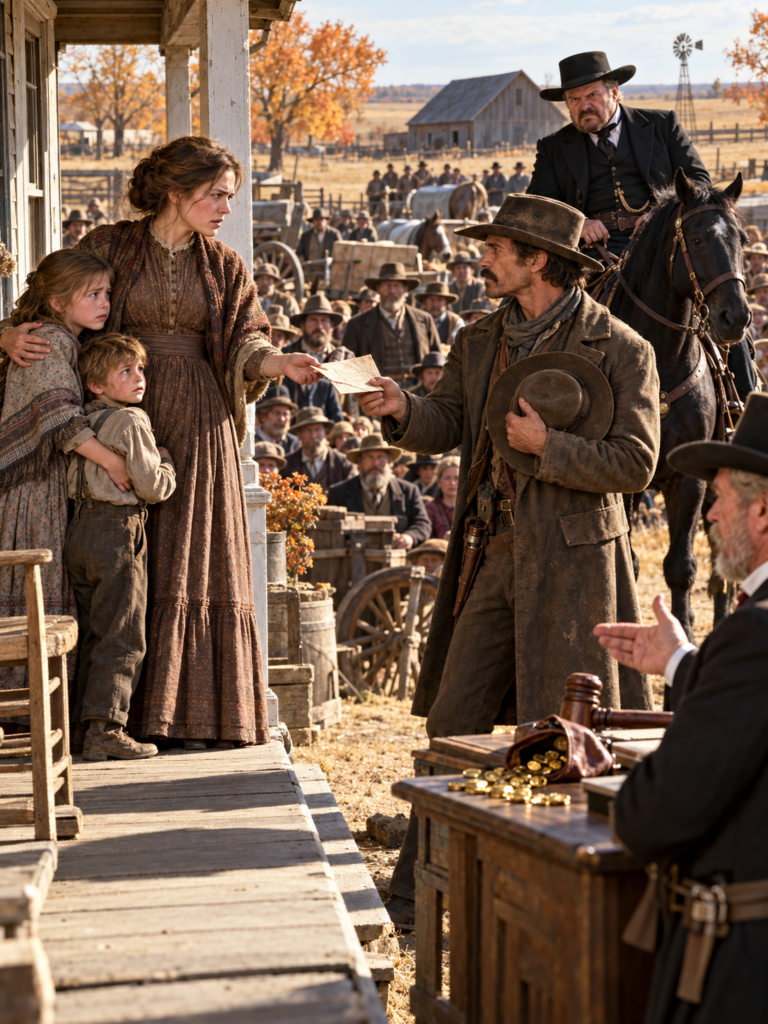
Theresa’s fingers closed around the letter, and Abel released it immediately.
For several seconds, she could only hold it.
The paper was thin from handling. Along one edge, a small stain had darkened the fibers. Henry had always folded his letters in thirds, pressing each crease firmly with his thumb.
She knew that habit as well as she knew the sound of his footsteps.
“Mama?” Peter asked.
“It’s your father’s writing.”
The boy looked from the page to Abel.
“Did you know him?”
“Yes,” Abel answered. “Though not nearly as long as I wish I had.”
Theresa opened the paper.
Henry had written while he was ill, during the week before his death.
He had addressed it to Abel.
He wrote that he feared he might not see another harvest. If that happened, he asked Abel to look after Theresa and the children.
He mentioned an old debt Abel had once insisted he owed.
Henry had never considered it a debt.
But if Abel still believed it was one, Henry wanted his family to receive whatever kindness that promise could provide.
Theresa read the final lines twice.
Then she pressed her fingers against her mouth.
Henry had known how sick he was.
He had been frightened for them.
And while she was preparing soup, changing his damp bedding, and telling him that spring sunshine would help him recover, he had been writing to someone hundreds of miles away.
A terrible tenderness rose through her grief.
“He never told me,” she whispered.
Abel lowered his eyes.
“He may have hoped there’d be no need.”
“Where were you when the letter found you?”
“Down in Arizona Territory, near the San Pedro.”
“You came all that way?”
“I started north as soon as I could arrange it.”
“And you knew about the auction?”
“Only when I reached the county and began asking after the Caldwell place.”
Theresa looked toward his exhausted gray horse.
“You couldn’t have known you’d arrive in time.”
“No, ma’am.”
The honesty of it nearly undid her.
Behind Abel, the remaining spectators were beginning to disperse. Some avoided looking at Theresa altogether.
They had watched her lose her husband, struggle with the farm, and finally stand helpless while her land was offered to the lowest bidder.
She had not forgotten their silence.
Nor had she forgotten Voight’s.
“Mr. Stone,” she said, “I don’t know what Henry told you about our affairs. But I will not take money from a stranger without understanding the terms.”
“There aren’t any.”
“There must be.”
“There is one promise I meant to keep. That’s all.”
She shook her head.
“You cannot simply purchase someone’s farm and call it kindness.”
Abel considered that.
“No. I suppose I can’t.”
He looked toward the auctioneer, who was still gathering his documents.
“I’ll see the proper papers are made out to you. I’ll pay whatever charges are necessary. You can have them examined in town.”
“And afterward?”
“Afterward, you decide what to do with your land.”
Theresa searched his face for the smallest suggestion that he expected gratitude to become obedience.
There was none.
“There’s something else,” she said.
Abel waited.
“Henry paid that bank note. I know he did.”
He glanced toward the road Voight had taken.
“Can you prove it?”
“No.”
“Then we ought to be careful about accusing him.”
“I have been careful for three months. Careful while he called me confused. Careful while he told my neighbors the farm was already lost.”
Her voice hardened.
“I won’t mistake being quiet for being wrong.”
A faint change crossed Abel’s expression.
Something like respect.
“Then don’t,” he said.
The answer surprised her.
She had expected another man to tell her to leave difficult matters to him.
Instead, Abel stood waiting for her decision.
The children had begun to shiver in the autumn breeze.
And Theresa finally understood the practical question before her.
This stranger might be telling the truth about Henry.
He might also be carrying a story her husband had never intended her to hear.
Either way, she would not let him disappear before she had heard it.
She folded the letter carefully.
“Mr. Stone, I’ll offer you supper and a place for your horse. But I’d like the whole story tonight.”
Abel glanced at the children.
“Are you certain?”
“I am.”
She turned, opened the farmhouse door, and held it wide for the man who had just spent a thousand dollars keeping her family inside it.
Abel stepped across the threshold with his hat still in his hands.
The little farmhouse smelled of bread, wood smoke, and the apples Theresa had been preserving before the auction preparations consumed her days.
He stopped just inside the kitchen.
On the wall hung a photograph of Henry Caldwell.
Younger than he had been when Theresa buried him, Henry stood beside the first plow he’d purchased after settling the land.
Abel stared at the photograph.
For an instant, all the years seemed to leave his face.
“That’s him,” he said.
Theresa followed his gaze.
“Taken our second year here.”
Abel nodded.
“I’d have known him anywhere.”
He did not step farther until she indicated a chair.
That evening, Peter and Bella ate at the kitchen table while their mother asked the stranger questions about his journey.
Abel answered patiently.
He had worked for years as an Army scout, traveling through country where roads were uncertain and settlements far apart. He had spent little and saved most of what he earned.
Henry’s letter had reached him after following his movements through Kansas, Colorado, and finally Arizona Territory.
He had ridden north as quickly as a horse and changing circumstances allowed.
But whenever Theresa asked how he knew Henry, he grew still.
“After the children are asleep,” he said, “I’ll tell you.”
She wanted to insist.
Then she saw the way Peter watched him.
The boy had already endured the funeral, the bank notices, and a yard full of neighbors who would not meet his mother’s eyes.
Some stories ought not be told across a child’s supper.
Later, when the last dishes were washed and both children had gone upstairs, Theresa returned to find Abel sitting beside the kitchen lamp.
Henry’s photograph stood between them.
Outside, the wind moved through the dry corn stalks.
“Tell me,” she said.
Abel drew a long breath.
“November thirtieth, eighteen sixty-four. Franklin, Tennessee.”
Theresa felt her hands grow cold.
Henry had spoken that place-name only once in their marriage.
“I was nineteen,” Abel continued. “Henry was seventeen. We were serving with the Union Army, but we’d never met.”
He rested one hand on his stiff leg.
“I was wounded. By the time darkness settled, I was lying in a ditch among men who couldn’t get up.”
His voice remained quiet.
Theresa did not interrupt.
“The fighting had torn everything apart. Men were calling for water. Some were trying to crawl. I couldn’t even manage that.”
Abel looked toward the window.
“I thought I’d die there.”
Henry found him after nightfall.
A seventeen-year-old farm boy from Nebraska, exhausted and frightened, with enough strength left to get himself clear.
He could have kept walking.
Instead, he stopped.
“He asked whether I could stand,” Abel said. “I told him no.”
Henry tried helping him rise.
When Abel’s injured leg failed, the young soldier crouched and pulled him onto his back.
“He carried me toward help.”
“How far?”
“Near four miles before we reached a field hospital.”
Theresa stared.
Her Henry, who complained good-naturedly when carrying two sacks of grain instead of one.
Her Henry, who had once walked an hour out of his way to rescue a neighbor’s lost calf.
She could see him now, seventeen years old, refusing to abandon a wounded stranger.
“Four miles?”
Abel nodded.
“He had to stop again and again. Every time, I told him to leave me.”
“What did he say?”
“That he’d come too far to start listening to me.”
Despite herself, Theresa gave a broken little laugh.
“That sounds like him.”
“He talked the whole way. Told me about Nebraska. His people. The farm he hoped to have someday.”
Abel’s mouth tightened.
“He said he wanted enough land that a man could stand in the middle of it and see something he’d made with his own hands.”
Theresa glanced around the kitchen.
Henry had done exactly that.
Abel continued.
“When we reached the hospital, I told him I owed him my life. He said he hadn’t carried me for payment.”
The lamp crackled softly.
“I told him if he ever needed anything, he could send for me.”
“And then?”
“We went our separate ways. I never saw him again.”
Theresa looked at Henry’s photograph.
“Twenty years.”
“Almost.”
“Did you ever hear from him before this letter?”
“No.”
“Then why keep that promise?”
Abel’s eyes met hers.
“Because I was alive to keep it.”
Tears slipped down her cheeks.
For months she had believed Henry’s death had left behind nothing but an empty place at the table and a debt she could not pay.
Now she learned that somewhere beyond the horizon, a kindness he had shown as a boy had continued living.
Long enough to come home to his family.
She cried then, not merely for what she had lost, but for the part of Henry she had never known.
Abel remained seated.
He did not reach for her.
He simply pushed a clean handkerchief across the table.
When she finally spoke, her voice was steady.
“You’ve done what he asked.”
“I hope so.”
“Then what will you do?”
“See the paperwork settled. Then head back to my work.”
The answer brought an unexpected emptiness.
Theresa looked away.
“You must have people waiting for you.”
“Not particularly.”
“No wife?”
“No, ma’am.”
“No family?”
“None I’ve kept a home with.”
She considered that.
Henry had built his life around a family.
Abel Stone had spent his wandering from place to place.
Yet one young man’s act of mercy still joined them.
The next morning, Abel rose before daylight.
He had slept in the barn, refusing Theresa’s offer of the small room off the kitchen.
She found him saddling his gray horse.
Before she could speak, Peter came running across the yard.
“Mr. Stone!”
Abel turned.
“Morning, son.”
“Do you know how to fix a windmill?”
Theresa closed her eyes.
“Peter, the gentleman has a long journey ahead.”
But the boy pressed on.
“Papa was going to fix ours. It stopped turning before he got sick.”
Abel looked toward the windmill standing beyond the barn.
Its blades hung motionless.
“When did it quit?”
“Spring.”
“Has anyone looked at the mechanism?”
“No, sir.”
Abel glanced at Theresa.
She nearly told him not to trouble himself.
Then she remembered all the mornings she had carried water because the windmill pump no longer worked.
“It would mean a great deal,” she admitted. “But I cannot pay you.”
“I wasn’t asking.”
“You’ve already done more than enough.”
He loosened the saddle cinch.
“Doesn’t mean I can’t do one more thing.”
By noon, Abel had inspected the gearing and found the worn connection that had stopped the pump.
Theresa fetched the tools Henry had kept in the barn.
Peter held bolts and listened while Abel explained what each piece did.
Theresa helped identify the parts Henry had intended to replace. She knew the farm’s machinery better than Abel expected, having worked beside her husband through years of planting and harvest.
When the windmill blades finally began turning, Peter shouted so loudly Bella came racing from the house.
Water rose again into the trough.
Theresa stood watching it flow.
For the first time since Henry’s death, something broken on the farm had been restored.
And for once, the restoration did not require surrendering something else.
Abel stayed to repair the sagging barn door.
Then the chicken coop.
Then a damaged wheel on the hay wagon.
Each morning, Theresa expected to see his horse saddled.
Each morning, there was another piece of necessary work.
But he never took charge of the farm.
He asked her which repairs mattered most. He accepted when she said an expense could wait. When she disagreed with his plan for strengthening the barn door, he listened to her explanation of how the winter wind struck that side.
She was accustomed to working with a man who respected her judgment.
She had not realized how deeply she missed it.
Together, they finished gathering the remaining corn.
Peter rode beside Abel on the wagon.
Bella followed Theresa through the rows, collecting the ears that fell beyond the basket.
At supper, the children’s voices filled the kitchen again.
Peter argued that he could soon handle a team by himself.
Bella demonstrated the whistle Abel had taught her to make with a blade of grass.
Theresa laughed so unexpectedly that all three turned toward her.
For a moment, she felt embarrassed.
Then Bella laughed too.
One evening, after the dishes were put away, Theresa found Abel on the porch.
The windmill turned slowly against the fading sky.
“May I ask you something?”
“Of course.”
“Why did you never marry?”
Abel thought for some time.
“I was always going somewhere else.”
“That doesn’t answer the question.”
He gave a small, rueful smile.
“No. I suppose it doesn’t.”
He leaned against the porch post.
“After the war, I couldn’t seem to settle. I took work that carried me from one place to the next. After a while, I stopped thinking anyone would notice whether I came back.”
Theresa looked through the window.
Peter was bent over a drawing. Bella had fallen asleep beside him.
“They’d notice here,” she said.
Abel turned.
She did not look away.
“And so would I.”
The admission frightened her.
Not because it was false.
Because it was true.
She had loved Henry deeply. She still did.
And she was beginning to understand that affection for another man would not erase the life she had shared with her husband.
Abel said nothing for a while.
Then he answered carefully.
“I wouldn’t want to make your life harder, Theresa.”
She looked toward the dark fields.
“Then don’t decide what’s best for me without asking.”
He accepted the rebuke with a slight nod.
It was the first time he had called her by her Christian name.
It was also the first time she had asked him to see her as more than Henry Caldwell’s widow.
Neither slept easily that night.
But outside their peaceful farmyard, Jasper Voight had not abandoned his plans.
The banker had spent the past year acquiring land along a proposed Burlington railroad branch.
The line’s survey made the Caldwell property particularly valuable.
A station was expected near their orchard.
Voight had already promised to deliver that location.
Losing the farm endangered the arrangement.
And Abel’s unexpected purchase had threatened far more than the banker’s pride.
Abel began hearing disturbing accounts during his trips into Elm Crossing.
Farmers described debts they thought they had paid.
Storekeepers admitted they feared losing credit if they challenged the bank.
Several men said Voight had warned them away from the Caldwell auction.
Abel visited neighbors one by one.
He did not ask them to take up arms.
He asked them to remember what they had seen, examine whatever papers they possessed, and consider whether their silence had protected anyone but Voight.
Three days before the end of October, he sent a telegram to the county sheriff describing his suspicions and asking the officer to investigate.
Meanwhile, Theresa searched again for proof of Henry’s payment.
She examined his desk, the loose floorboard beneath their bed, and the tins where he stored accounts.
Nothing.
She began to fear that she would never prove the truth.
Then, one afternoon, Bella sat beside the kitchen table leafing carefully through her father’s old Bible.
Henry had kept little pictures between its pages.
When Bella turned to the Book of Ruth, something slipped out and fell to the floor.
“Mama?”
Theresa bent down.
It was a folded bank receipt.
She opened it.
Her hands began to shake.
Two hundred eighty dollars.
The Caldwell farm note.
Paid in full.
Dated fourteen months before Henry’s death.
And beneath the written acknowledgment was Jasper Voight’s signature.
Theresa stared at the paper.
Then she called for Abel.
He examined the receipt under the kitchen lamp.
For a long time, he said nothing.
Finally, he looked at her.
“You were right.”
Theresa swallowed.
“I knew I was.”
That evening, she placed the receipt carefully back inside Henry’s Bible for safekeeping.
Abel went to the barn to check his horse and make another round of the buildings.
The night was cold and clear.
Near midnight, while resting inside the barn, he caught a smell that did not belong there.
Kerosene.
He rose and moved quietly toward the door.
Through the narrow opening, he saw two men approaching the barn carrying a fuel can and an unlit torch.
Four mounted men waited along the road.
Farther back, astride a black horse, sat Jasper Voight.
Abel reached for his rifle.
Then he stepped out of the darkness and into the moonlight.
The men stopped when Abel Stone emerged from the barn.
His rifle rested in his hands, its barrel angled toward the ground.
He made no move to raise it.
“Evening, gentlemen.”
The man carrying the kerosene can nearly dropped it.
For several seconds, nobody spoke.
Behind the two men, the horses shifted uneasily in the cold.
Voight remained mounted near the road.
Abel looked at the fuel, then toward the farmhouse.
“A woman and two children are sleeping over there.”
One of the men glanced back at the banker.
The other tightened his grip on the torch.
Abel did not move.
“You ought to think carefully before you put fire to a building this close to a family.”
Voight urged his horse forward a few paces.
“You’ve made a serious mistake, Stone.”
“Have I?”
“You came into a town where nobody knows you. You interfered in business you don’t understand.”
Abel looked at him calmly.
“I understood the auction well enough.”
The banker’s face hardened.
“You think paying for that farm gives you the right to challenge me?”
“No,” Abel answered. “But the people living here have that right.”
Voight looked toward the dark farmhouse.
“You’ve filled the widow’s head with foolish ideas.”
A voice rose from the porch.
“No, Mr. Voight. Those ideas were mine.”
Theresa stood in the doorway holding a lantern.
Henry’s Bible rested beneath her other arm.
She had heard voices in the yard and come downstairs, leaving the children inside.
Her brown shawl was pulled tightly around her shoulders.
Abel turned his head.
“Theresa, stay near the house.”
“I intend to.”
She descended one step, just enough to bring the lantern into full view.
Then she faced the banker.
“You told me Henry never paid his loan.”
Voight said nothing.
“You told me my memory could not be trusted.”
“Mrs. Caldwell, this is hardly the time—”
“I think it is.”
She opened the Bible.
From between its pages she removed the bank receipt.
The paper fluttered in the cold breeze, but she held it firmly.
“Two hundred eighty dollars. Paid in full. The summer before Henry died.”
Voight’s posture changed.
Theresa raised the page.
“Your signature is on it.”
The man holding the kerosene looked toward his employer.
Voight’s mouth tightened.
“I don’t know what you think you’re proving with some scrap of paper.”
“Then you can explain it to the sheriff.”
The banker gave a short, contemptuous laugh.
“Who do you think the sheriff is going to believe?”
A distant light appeared along the road.
Then another.
And another.
Abel looked beyond Voight.
“That,” he said quietly, “may be worth finding out.”
The banker turned.
Lanterns were moving across the dark fields.
Men came walking and riding toward the Caldwell farm.
Theresa recognized several of them.
Samuel Briggs, whose wheat had failed the previous year.
Thomas Miller, who owed the bank for his seed.
Old Mr. Whitcomb, who had stood beside the auction wagon with his hat crushed between his hands.
The same neighbors who had watched her home being sold and had not dared raise a hand.
This time, they had come.
At the front rode the county sheriff.
He dismounted near the gate.
“Evening, Mrs. Caldwell.”
“Sheriff.”
The officer looked toward the fuel can and torch.
Then at Voight.
“I believe we’ll have some explaining to do.”
The banker recovered enough to speak.
“These men are trespassing on property that doesn’t belong to them.”
Theresa’s voice rang across the yard.
“It belongs to me.”
The sheriff glanced at the receipt in her hand.
“And I understand you’ve brought papers to support a complaint against the bank.”
“Yes.”
He approached the porch.
Theresa handed him the receipt.
The sheriff carried it toward the light of her lantern and read it carefully.
Voight tried to interrupt.
The officer raised one hand.
“Mr. Voight, I suggest you remain quiet.”
The two men near the barn exchanged nervous looks.
One slowly set down the kerosene can.
The other laid the torch beside it.
Several farmers moved forward to see that neither man approached the buildings again.
No shots were fired.
Nobody needed them.
For years, Voight had relied on the belief that every farmer in the county stood alone.
That night, the people of Elm Crossing had discovered what happened when they stood together.
The sheriff folded the receipt.
“Mrs. Caldwell, you’ll need to make a formal statement.”
“I will.”
“And I’ll want every man here who witnessed what happened tonight to tell me exactly what he saw.”
The farmers nodded.
Voight glanced from one face to another, searching for the obedience he had once commanded.
He found none.
The sheriff placed him under arrest on suspicion of fraud and forgery, while his deputies secured the men who had approached the barn with fuel.
Voight protested all the way toward the road.
But the black horse carried him out of the Caldwell yard that night without the farm he had expected to take.
Theresa remained on the porch until the last lantern disappeared.
Only then did she realize how cold her hands had become.
Abel crossed the yard.
“Are you all right?”
She looked down at Henry’s Bible.
“For months, I thought there was something I had missed.”
“You hadn’t.”
“I kept wondering whether I should have been more careful with the money. Whether I should have asked Henry more questions. Whether I had failed him somehow.”
Abel stopped beside the lowest porch step.
“You were fighting a man who had the records and meant to keep you from proving the truth.”
Theresa looked at him.
“And if you hadn’t come?”
He did not pretend the answer was simple.
“I don’t know.”
She nodded.
Neither spoke for a while.
Then Theresa glanced toward the barn.
“You might have been killed tonight.”
“So might you.”
“I was frightened.”
“I know.”
“But I was more frightened of letting him take what Henry left us without ever speaking the truth aloud.”
Abel looked at the receipt.
“You did speak it.”
Theresa drew a breath.
“And tomorrow I’ll speak it again.”
The days that followed were difficult.
There were statements to give, records to examine, and questions that brought back the bitterness of the auction.
Theresa attended to the matter herself.
Abel accompanied her when she wished, but he did not speak for her.
At the bank, she identified Henry’s note, confirmed the details of his final payment, and challenged the false account presented against the farm.
The auction paperwork and the disputed debt were examined.
Abel’s willingness to place the purchased property in her name was documented, and the necessary transfer was completed.
By Christmas, bank examiners had uncovered similar wrongdoing involving eleven other farming families.
The evidence against Voight extended far beyond the Caldwell note.
Several families who had been deprived of their land were able to recover it through the proceedings that followed.
The railroad arrangement that Voight had intended to profit from also came under scrutiny.
Elm Crossing spoke of the scandal for months.
Yet the part Theresa remembered most was not the banker’s downfall.
It was the sight of neighbors arriving with lanterns.
At first, their return to the Caldwell home was awkward.
Men who had avoided her eyes at the auction came to the porch with apologies.
Some tried to explain their silence.
Voight controlled their loans. Their businesses depended on his favor. Their wives and children depended on the farms he could threaten.
Theresa understood their fear.
She had lived beneath the same threat.
But understanding did not make the hurt disappear.
When Samuel Briggs came to apologize, she listened until he finished.
Then she said, “I needed my neighbors before I needed witnesses.”
The older man looked down.
“I know.”
“I hope if another family stands where mine stood, they won’t stand alone.”
“They won’t,” he promised.
Only time would prove whether he meant it.
Theresa accepted the apology without pretending the past had vanished.
And slowly, through shared work and honest dealings, the ties between the Caldwell farm and its neighbors began to mend.
Meanwhile, winter approached.
There was corn to store, fencing to reinforce, and livestock to prepare for colder weather.
Abel had intended to leave as soon as the property matter was settled.
Instead, he stayed through the first hard frosts.
Then through November.
Then December.
Not because Theresa had no alternatives.
With the farm secured, she could plan her household and livelihood again. The remaining stores were carefully counted. She could purchase the necessary supplies, make arrangements for hired help when the season demanded it, and continue farming the land she knew.
She did not need Abel to make her decisions.
That distinction mattered to both of them.
When they discussed the winter repairs, Theresa kept the accounts.
Abel estimated the labor and supplies.
They disagreed over the order of several tasks.
Sometimes she was right.
Sometimes he was.
Neither needed to win every argument.
One cold morning, they repaired a section of fence that had begun to lean.
Theresa stood beside the post, holding it steady while Abel drove the stakes.
“You’re putting it too far toward the lane,” she said.
He stopped.
“Am I?”
“The horses rub against that side. Henry learned it the hard way.”
Abel examined the ground.
Then he shifted the post.
“Good thing one of us knows this farm.”
Theresa smiled.
“Only one?”
He grinned.
“Perhaps you might teach me.”
It was the sort of conversation she had once taken for granted.
Now it could make her happy for the rest of an afternoon.
Abel was learning something equally unfamiliar.
He had lived for years by routes, duties, and temporary shelters.
Every place he occupied had been somewhere he would eventually leave.
At the Caldwell farm, Peter began saving a place beside him at supper.
Bella brought him crooked drawings of horses.
Theresa asked for his opinion about the next planting season.
He found himself thinking of spring as something he might be present to see.
One evening, he told Theresa that an old Army acquaintance had written about work farther west.
She was seated at the kitchen table mending a shirt.
“Is it good work?” she asked.
“It would be familiar.”
“That wasn’t what I asked.”
He gave a small smile.
“Yes. I expect it would pay fairly.”
She drew another stitch.
“When would you leave?”
“I haven’t decided.”
Her hands went still.
“Is something troubling you here?”
“No.”
“Then why consider going?”
He took his time answering.
“Because leaving is what I’ve always done.”
Theresa put down the shirt.
“Abel, I cannot ask you to stay out of duty to Henry.”
“I know.”
“And I won’t ask you to give up your work merely because the children would miss you.”
“I know that too.”
She looked toward the lamp.
“But if you want to stay, I would rather hear the truth than watch you ride away because you think you’re protecting me.”
Abel sat opposite her.
“I do want to stay.”
The words were simple.
The admission cost him more than she knew.
“I’ve wanted it for some time,” he continued. “But I don’t know how to be part of a place that already belonged to another man.”
Theresa looked at Henry’s photograph.
“It still belongs to his memory.”
“I know.”
“That doesn’t mean there can be no room for anyone else.”
Abel was quiet.
She added, “Henry and I built this home together. I loved him. Nothing will change that.”
“I wouldn’t ask it to.”
“And if there is ever something between you and me, it cannot be because he sent you.”
Abel met her eyes.
“No.”
“Or because you bought the land.”
“Never.”
“It must be because we both want it.”
For a long moment, they listened to the winter wind outside the window.
Then Abel said, “That’s the only way I would want it.”
Neither made a promise that night.
But something changed.
He no longer spoke of leaving as though it were inevitable.
And Theresa no longer hid how glad she was when he came home from the fields.
As the winter deepened, Abel remained in the barn for his sleeping quarters.
Theresa offered him a small room in the house when the cold became severe, but he left the decision about the household entirely with her.
They discussed it openly.
Eventually she prepared the room off the kitchen for his use, with a proper bed and a door that could close.
The arrangement was practical and understood by both of them.
Nothing about it required a promise of marriage.
Peter was delighted.
Bella declared that the house sounded better when Mr. Stone was in it.
Abel pretended not to be moved.
But Theresa saw him turn away to hide his expression.
On the thirtieth of November, Abel rose before sunrise and went out to the barn alone.
Theresa watched him cross the yard.
Only after he disappeared through the door did she realize the date.
The anniversary of Franklin.
The date Henry had spent in solitude every year.
She allowed Abel his quiet.
By afternoon, she carried a cup of coffee to the barn and found him sitting near the open doorway.
He was looking out over the fields.
“May I come in?”
“Of course.”
She handed him the cup.
For a while they sat together without speaking.
Then Abel said, “I used to wonder why he never asked me for anything.”
Theresa leaned against the doorframe.
“Henry wasn’t fond of asking.”
“He could’ve made use of a hundred things over the years. Money. Tools. Help bringing in a harvest.”
“He had a way of believing he could manage.”
Abel nodded.
“Then that letter came.”
His voice grew rough.
“He finally asked me for something, and he was already gone.”
Theresa rested a hand gently over his.
“You answered.”
“I nearly arrived too late.”
“But you came.”
Abel looked toward the yard.
“I couldn’t save him.”
Theresa’s eyes filled.
“No.”
She let the word stand.
It was the truth they both had to live with.
Then she said, “And neither could I.”
They sat together, grieving the same man in different ways.
For Theresa, Henry was the husband who had kissed her before leaving for the fields, the father who carried Bella upstairs when she fell asleep, the man who had built the white farmhouse board by board.
For Abel, he was forever seventeen, struggling through the darkness with another soldier on his back.
Neither memory diminished the other.
When they returned to the house at dusk, Peter and Bella ran to meet them.
Abel held the barn door for Theresa.
And for the first time, the anniversary of Franklin ended not with one man alone in the dark, but with a family gathering around a warm kitchen table.
By the time winter loosened its hold on Nebraska, the farm had begun to look like itself again.
The windmill turned.
The barn doors closed properly.
The orchard had been pruned.
Theresa had arranged the seed purchases, balanced the household accounts, and prepared for spring planting.
Abel worked beside her.
Sometimes he offered an easier method.
Sometimes she showed him why the old one suited the land better.
He began to know which fence post Peter liked to sit on and where Bella hid her favorite collection of smooth stones.
He learned that Theresa liked her coffee strong and preferred to finish the evening accounts before sitting down to rest.
She learned that Abel could mend harness neatly but was hopeless at making bread.
Their affection grew through ordinary days.
There were no grand declarations.
Only conversations that lasted longer than necessary.
A glance across the supper table.
A hand offered when a wagon wheel sank into soft ground.
The quiet pleasure of finding someone already doing the task you had been dreading.
And the freedom to disagree without fear that kindness would be withdrawn.
Then the railroad men arrived.
The proposed Burlington branch had survived Voight’s scheme.
But the arrangements he had made concerning the Caldwell property could not stand.
Representatives approached Theresa about purchasing a narrow strip along the edge of her land.
They hoped to place a small station near the orchard.
This time, no one spoke to her as though the farm were already theirs.
She examined the proposal, considered the effect on her fields and trees, and discussed the practical consequences with Abel.
He offered his opinion when asked.
The decision remained hers.
Theresa negotiated a fair price for the strip the railroad required.
She made certain the agreement would not interfere needlessly with the land her family farmed.
Only then did she consent.
By May, the little station was taking shape beside the apple orchard.
The trees were covered in white blossoms.
Spring sunlight moved over the fields.
One afternoon, Theresa walked through the orchard with Abel.
They had finished checking the young trees after a windy night.
Petals drifted across the grass.
Near the oldest apple tree, Abel stopped.
“Theresa?”
She turned.
He removed his hat.
It was a gesture she had come to know.
The same gesture he had made on the auction day.
But this time there was no crowd.
No banker.
No hammer waiting to fall.
Only the two of them, standing on land she had nearly lost.
“I’ve been trying to find the right words,” he said.
Theresa smiled faintly.
“You’ve never needed many.”
“I may need a few more today.”
He looked toward the farmhouse.
“When I came here, I meant to keep my promise to Henry and then go back to the life I knew.”
“I remember.”
“I thought that was all I had to give.”
She watched him carefully.
“But these months have been the first time in years I haven’t spent every morning wondering where I ought to go next.”
A breeze stirred the blossoms.
Abel continued.
“I don’t want to stay because Henry asked me to look after you. And I don’t want you to feel you owe me anything because of that auction.”
“I know.”
“I want to stay because I love you.”
Theresa’s eyes filled with tears.
Abel took a breath.
“I’ve only made one bid in my life that truly mattered. I’d like to make another, if you’ll allow it.”
She laughed softly through her tears.
“Abel Stone, you are making a terrible business of this.”
He smiled.
Then his face grew serious.
“Will you marry me, Theresa?”
She stood very still.
He did not hurry her.
“I cannot take Henry’s place,” he said. “I wouldn’t try.”
Theresa glanced through the branches toward the white house.
She thought of Henry.
Of Chicago, where they had first met.
Of the long journey west and the first night she had cried beneath the enormous Nebraska sky.
Of Peter’s birth, then Bella’s.
Of the years of harvests and hardships that had made the land a home.
She thought of Henry’s last letter.
How, even while dying, he had feared for the people he would leave behind.
And she thought of the man standing before her.
A man who had come out of duty.
Stayed through choice.
Listened when she spoke.
Respected what she refused.
And learned how to belong without asking her to surrender what was already hers.
“Abel,” she said, “I loved my husband with all my heart.”
“I know.”
“I always will.”
“I know that too.”
She took his hand.
“But I have come to love you.”
His expression changed.
The guarded look she had first seen beneath his dusty hat softened into something almost disbelieving.
“I want to marry you,” she continued. “Not because you saved my farm. Not because Henry wrote that letter. Because I want to share the rest of my life with you.”
Abel closed his fingers gently around hers.
Theresa smiled.
“And because you’ve finally learned that a man may be missed when he leaves.”
He laughed.
Then she stepped closer and kissed him.
The apple blossoms moved softly around them.
When they walked back toward the farmhouse, they were still holding hands.
They told the children that evening.
Peter listened with the grave seriousness of a boy who believed family matters required careful consideration.
“Will Mr. Stone live here all the time?”
Abel looked toward Theresa.
“That is what your mother and I have been discussing.”
Peter nodded.
“Good.”
Bella wanted to know whether there would be a wedding.
Theresa laughed.
“Yes, sweetheart.”
“Can I carry flowers?”
“I believe that can be arranged.”
“Then I think it’s a fine idea.”
They married in June at the little church in Elm Crossing.
The congregation filled the pews.
Farmers who had once been too frightened to raise a hand at the auction sat beside their families.
Some had recovered land lost through Voight’s wrongdoing.
Others had learned to question men who believed wealth entitled them to unquestioned obedience.
Peter stood beside Abel.
Bella scattered apple blossoms along the aisle.
Theresa entered the church wearing a simple dress, her expression bright with nerves and happiness.
She did not walk toward a man who was rescuing her.
That rescue was long finished.
She walked toward a man she had chosen, knowing she could have remained on her farm without marrying him.
Abel waited at the front, his hands trembling slightly.
When they spoke their vows, both understood what was being promised.
Not a replacement for the past.
A future they would build together.
After the wedding, their life continued much as it had begun.
There were crops to plant.
Animals to tend.
Repairs that never seemed to end.
Peter grew tall enough to take on greater responsibility in the fields.
Bella developed her mother’s stubborn determination and her father’s quiet kindness.
Theresa continued managing the farm’s household accounts and taking part in its major decisions.
Abel worked alongside her, putting his knowledge of land, animals, and difficult country to useful purpose.
He was no longer merely a traveler passing through.
The farm did not become his simply because he married its owner.
It remained the place Henry and Theresa had built, now also the home Abel helped preserve and improve.
In time, their marriage became woven into its daily rhythms.
Two cups appeared on the porch each evening.
Two voices discussed the weather, the harvest, and the price of grain.
When Peter had questions about machinery, he went to Abel.
When Bella wanted advice about something difficult, she often began with her mother.
And on the evenings when grief returned unexpectedly, nobody was asked to pretend it wasn’t there.
Every November thirtieth, Abel went to the barn.
He sat quietly for a little while and remembered a seventeen-year-old soldier who had carried him through the cold darkness at Franklin.
But he no longer remained there until nightfall.
Theresa came to find him.
Sometimes she brought coffee.
Sometimes only the lantern.
The children often followed.
They spoke Henry’s name freely.
They remembered the things he had said and done, the funny habits that made them smile, and the love he had given them.
Then they returned together to the house.
Years passed.
The apple trees spread their branches.
The windmill continued turning above the fields.
Peter grew into a capable farmer, eventually taking on the work of the same land his father had claimed and cultivated.
Bella grew older with stories of two men who had loved her family in different ways.
One spring, a young newspaper reporter came from Omaha.
He had heard about the extraordinary Caldwell auction of 1884.
People still told the story in Elm Crossing.
A widow facing the loss of her farm.
A wealthy banker certain of victory.
A stranger in a dust-covered coat who had appeared from nowhere with a thousand dollars in gold.
The reporter found Peter working near the barn.
“Is it true,” he asked, “that a man nobody knew bought your family’s land and then gave it back?”
Peter straightened.
Across the yard, on the farmhouse porch, Theresa sat beside Abel.
Abel’s hair had turned gray.
His mustache was silver now.
One hand rested over Theresa’s.
The reporter followed Peter’s gaze.
“Quite a story,” he said. “A stranger buying a farm just to return it.”
Peter considered the words.
He remembered being a frightened boy on the porch, holding his mother’s skirt while strangers shouted prices across their yard.
He remembered the hand rising at the back of the crowd.
The leather pouch.
The gold.
His mother’s tears.
Then he remembered the windmill turning again.
Abel showing him how to use a wrench.
Bella laughing over a blade of grass.
His mother finding reasons to smile.
And all the Novembers when they had walked together to the barn with a lantern.
Peter looked at the reporter.
“He did give the farm back,” he said.
Then he glanced toward the two people sitting beneath the afternoon sun.
“But that wasn’t the most important thing he did.”
“What was?”
Peter smiled.
“He stayed.”
The reporter wrote those words down.
On the porch, Theresa turned toward Abel.
“Do you remember that auction?”
“Every bit of it.”
“You frightened me terribly.”
“I imagine I did.”
“I thought you were going to send us away.”
Abel shook his head.
“Never crossed my mind.”
She rested her head against his shoulder.
“For a long time,” she said, “I thought the worst day of my life would be remembered only for what it took from me.”
Abel held her hand.
They sat quietly, watching Peter return to his work.
Then Theresa looked toward the apple orchard.
Henry had planted those trees with her years before his death.
Now their branches sheltered a family that had endured more than she once believed possible.
“What do you think he would say?” she asked.
Abel looked out across the fields.
“I think he’d be glad the farm was cared for.”
Theresa smiled.
“And the children?”
“He’d be proud.”
“And you?”
Abel was quiet for a moment.
Then he said, “I think he’d tell me I took an awfully long road to get here.”
Theresa laughed.
The windmill turned above the barn.
Somewhere near the orchard, a train sounded its whistle.
And as the evening settled over the Caldwell farm, two people sat side by side beneath the wide Nebraska sky.
One had nearly lost her home.
The other had spent twenty years believing he belonged nowhere.
A young soldier’s kindness had brought them together long after his death.
But it was the love they freely chose, and the life they built with their own hands, that kept them there.
When the shadows lengthened, Abel rose and offered Theresa his hand.
She took it.
Together, they walked inside, leaving the porch empty and a lantern glowing in the window.

