
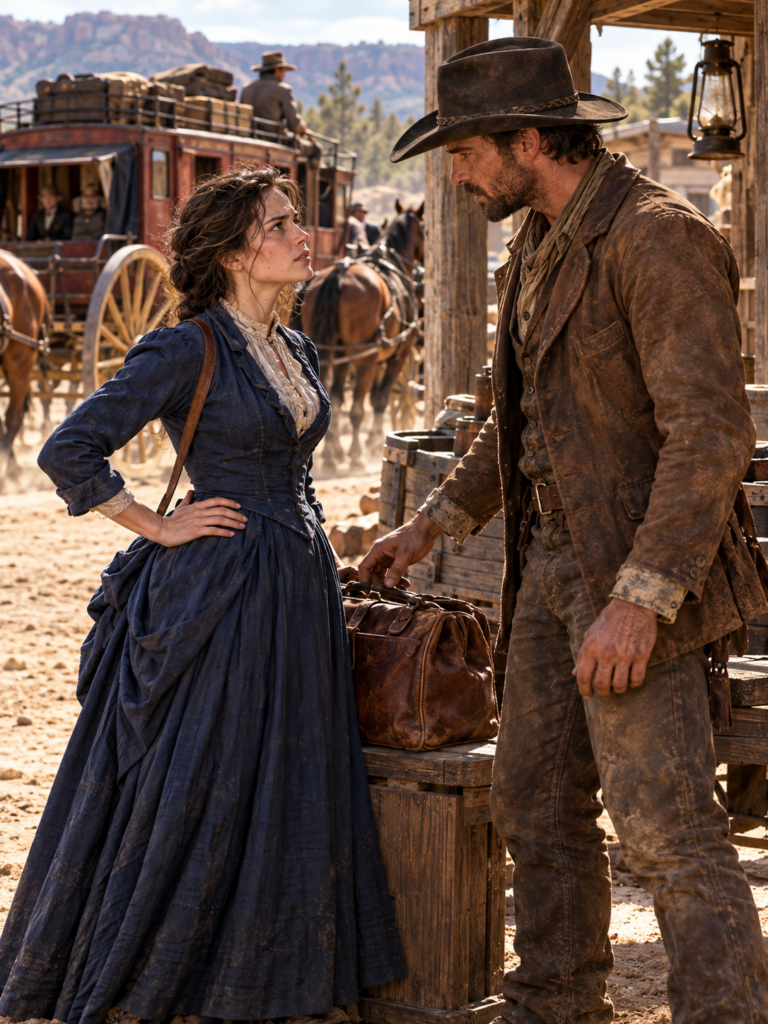
Caleb met her questioning eyes while Blackwell waited on the boardwalk, plainly hoping to see distrust take root between them.
“There’s a disagreement over part of my northwest boundary,” Caleb said.
Blackwell’s smile returned.
“A disagreement is one way of describing it.”
“The records have been examined,” Caleb replied. “And the land is mine.”
Eleanor watched both men.
“Then I imagine the county records will establish the facts.”
Blackwell’s expression hardened.
For a moment, nobody spoke.
Then Eleanor turned away and entered the store.
Caleb remained outside just long enough to understand that she had accomplished something his own anger might have spoiled.
She had refused to make their business into a public quarrel.
On the drive home, he finally spoke.
“You handled Blackwell better than I would have.”
“I noticed you weren’t particularly pleased with him.”
“That’s a mild description.”
“He wanted you angry. Men like that become considerably less impressive when denied an audience.”
Caleb looked at her.
“Have you dealt with men like him before?”
Eleanor kept her gaze on the sunlit road.
“Yes.”
Something in that single word made Caleb wait.
Eventually, she continued.
“My father died when I was nineteen. He left debts, and my mother remarried. Her second husband made it clear there was little room for me in his household.”
“I’m sorry.”
“I found employment in Columbus. Bookkeeping for a dry-goods merchant. I was good at it.”
“I believe that.”
“The merchant’s son took an interest in me that had nothing to do with the accounts.”
Caleb’s hands tightened around the reins.
Eleanor noticed.
“I refused his attentions. His father dismissed me. Afterward, finding another respectable position became difficult.”
“Because of what he said?”
“Because people found it easier to believe him.”
Caleb absorbed that.
“So the agency was your way out.”
“It was a way forward.”
Her voice remained level, but her fingers had closed tightly around her gloves.
“I don’t need anybody to punish those men on my behalf, Mr. Harrison. I need the chance to do honest work without somebody deciding my character for me.”
Caleb considered that for a long time.
“You’ll have that chance at my ranch.”
“Provided you continue to think I deserve it?”
He looked at her sharply.
“No. Provided you wish to remain.”
She turned toward him.
He continued before he could retreat into his usual silence.
“I shouldn’t have counted your lack of prospects as a reason you’d be easy to please. I did. That wasn’t fair.”
For a moment, Eleanor looked genuinely surprised.
Then she nodded.
“Thank you for saying so.”
When they returned, Roy was waiting near the corral.
He needed Caleb to examine a problem with the fencing, so Eleanor went inside with the supply invoices.
By supper, she had already identified two merchants whose prices could substantially reduce the ranch’s expenses.
She brought her calculations to the office.
Caleb examined them carefully.
“You’re proposing we change both suppliers?”
“Yes. But only after confirming the quality of what they deliver.”
“That could save us a considerable amount.”
“That’s the intention.”
He looked up.
“You’ve been here barely a week.”
“Numbers don’t become less accurate because I’m new.”
Caleb nearly smiled.
“Then make the arrangements.”
She did.
Over the following weeks, Roy began seeking her opinion on supply questions. Mrs. Greer discovered Eleanor understood the difference between helping in a kitchen and interfering with somebody else’s work.
The evenings gradually changed, too.
Caleb found himself lingering at the dining table.
Eleanor stopped retreating to her room immediately after supper.
Sometimes they talked about ranch expenses.
Sometimes about Ohio.
Sometimes about how Caleb and Roy had built fencing across difficult ground, or the early years when the cattle had barely paid for their feed.
But even as the house grew more comfortable, one matter remained unsettled.
Blackwell continued asking questions about the northwest pasture.
Caleb dismissed the inquiries as another attempt to provoke him.
Eleanor was less certain.
“Keep your older records together,” she advised one evening.
“They’re safe.”
“Safe isn’t the same as readily available.”
Caleb almost objected, then remembered how often she had been right.
“I’ll show you where the originals are tomorrow.”
Tomorrow never came as they expected.
Near ten that night, Eleanor was finishing a letter upstairs when an unfamiliar smell reached her window.
Smoke.
She went downstairs, opened the back door, and saw a thin orange glow at the base of the storage building.
The dry boards were beginning to burn.
She knew what the building contained.
Hay. Feed. Equipment.
And the iron document box Caleb had shown her.
She called for help, seized a wet sack from beside the pump, and hurried toward the flames.
The box stood within reach of the doorway.
Heavy, but movable.
She gripped its handles and dragged it over the threshold, scraping it across the dirt until it was well clear of the wall.
Then she caught up the wet sack and struck at the growing fire.
Behind her, boots pounded across the yard.
“Eleanor!”
Caleb was coming from the stable.
“Get away from that wall!”
“The papers are clear!” she shouted. “Bring water!”
He reached the pump.
She struck the flames again.
And as Caleb lifted the first full bucket, Eleanor saw something near the blackened boards that made her understand the fire might not have started by accident.
“The base of the wall,” Eleanor called as Caleb hurried toward her with the bucket. “Look where the burning began.”
He threw the water across the boards.
Steam rose into the night.
The flames diminished, then flared along a narrow strip of dry wood.
Eleanor stepped back, letting Caleb reach the dangerous section. She returned to the pump while he beat down the remaining fire.
They worked without wasting breath.
A second bucket.
Then a third.
At last, only blackened timber remained beneath the fading smoke.
Caleb set the empty bucket down.
“Are you burned?”
“No.”
“Your hands?”
“Only sore.”
He checked her face, then deliberately stepped aside when she moved toward the damaged wall.
Eleanor crouched beside the boards.
“Look at this.”
Caleb lowered himself beside her.
The burning had begun along a small, concentrated section near the base.
“There wasn’t a lantern here,” he said.
“Or any work being done tonight?”
“No.”
She glanced toward the rescued iron box.
“Then we ought to preserve everything we can observe before it’s disturbed.”
Caleb looked toward the distant darkness beyond the ranch buildings.
“Blackwell.”
“Possibly. But suspicion isn’t proof.”
He turned toward her.
“You believe somebody started it.”
“I believe the circumstances require an investigation.”
For once, Caleb did not argue.
He carried the iron box inside.
Eleanor followed with the lantern, and together they spent the next two hours recording the damage, drawing a rough plan, and describing what each had witnessed.
She insisted they distinguish observation from suspicion.
Caleb found that harder than she did.
Blackwell had wanted the northwest pasture for years.
The storage building contained documents establishing the ranch’s title.
The coincidence was troubling.
Still, when Eleanor placed the final sheet before him, she said, “We mustn’t claim to know what we cannot prove.”
Caleb signed.
Then he watched her sign beneath his name.
Her dark hair had loosened around her shoulders. Ash remained along one cheek. She looked exhausted.
“You ought to sleep,” he told her.
“So ought you.”
He hesitated.
“Eleanor.”
She lifted her eyes.
“I don’t know what would have happened to those papers if you hadn’t been awake.”
“Perhaps you’d have reached them.”
“Perhaps.”
His gaze moved toward the iron box.
Then back to her.
“But you did.”
Something about his expression unsettled her more deeply than his earlier sternness.
He was looking at her not as the woman an agency had sent, but as someone whose judgment he trusted.
The next morning, Roy examined the burned building and added his observations to their written account.
Within days, Caleb and Eleanor brought the report to Sheriff Dale Holt.
Holt questioned Eleanor carefully.
She answered with equal care, explaining that her uncle had served as a volunteer fire warden in Columbus and that she had learned something about recognizing suspicious fire damage from listening to him.
The sheriff acknowledged the evidence but would not accuse Blackwell without additional proof.
Caleb disliked that answer.
Eleanor expected it.
Outside the sheriff’s office, she caught Caleb studying the street.
“What are you considering?”
“Having a conversation with Blackwell.”
“Then have it after we’ve considered whether it helps.”
He looked at her.
She raised one eyebrow.
“That’s what partners do, isn’t it?”
The word remained with him all the way home.
PARTNERS.
He had first intended it as a description of shared responsibilities.
Now it sounded increasingly like something else.
Their first important victory came through conversation rather than confrontation.
Eleanor persuaded Caleb to visit Tom Aldridge, the county assessor, and his wife Margaret.
Margaret proved welcoming, observant, and thoroughly familiar with the social workings of Harlow Creek.
Eleanor did not arrive complaining about Blackwell.
She arrived asking questions about the community.
By the time they left, Margaret had offered to introduce her to several neighboring families.
Caleb was astonished.
“You never mentioned the dispute.”
“Not everything is best accomplished by discussing it directly.”
“Then what did we accomplish?”
“People know me now. Not as the woman from an advertisement, but as Eleanor Whitfield.”
Caleb considered this.
“That matters?”
“More than you might think.”
It mattered very soon.
Word reached Roy that someone had begun spreading ugly stories about Eleanor’s former life in Ohio.
The allegations were false.
They questioned her honesty, her previous employment, even her moral character.
Caleb reacted immediately.
He rode to Blackwell’s ranch and demanded the stories stop.
Blackwell denied responsibility while clearly enjoying Caleb’s anger.
When Caleb returned, Eleanor was waiting.
“You went to him.”
“Yes.”
“Without speaking to me.”
“I wanted to spare you.”
Her expression tightened.
“Spare me what? Having a say in my own reputation?”
Caleb stopped.
Eleanor stood beside the kitchen table, her hands pressed against its edge.
“Five years ago, a man who disliked hearing no cost me my livelihood. His father ensured that I could hardly find another position. I know what public accusations can do.”
“I know.”
“No, Caleb. You know what they did to me. That’s not the same as understanding why I cannot let another man make every decision about how they’re answered.”
He drew a slow breath.
She continued.
“Blackwell wanted a reaction. You’ve just shown him exactly where to strike.”
Caleb looked at the floorboards.
He had thought he was defending her.
Instead, he had left her out of the decision.
“You’re right,” he said.
Eleanor became still.
“I should have asked,” he continued. “I won’t pretend otherwise.”
She studied him.
Then she pulled out a chair.
“Sit down. We need a better plan.”
He sat.
This time, he listened.
Eleanor explained what she believed Blackwell was attempting.
First, pressure over the boundary.
Then the suspicious fire.
Now damaging rumors.
“He’s trying to weaken our standing before making another move against the land.”
“Our standing?” Caleb repeated.
“Yes. The ranch has a reputation, and so do the people managing it.”
Caleb’s eyes rested on her.
“Then what do you suggest?”
“A dinner.”
He stared.
“A dinner?”
“Invite the families whose judgment carries weight in Harlow Creek. Let them meet us. Let them see the household operating properly.”
Caleb looked as though she’d suggested driving cattle through the dining room.
“I don’t entertain.”
“I noticed.”
“And you think that will help?”
“I think isolation is helping Blackwell.”
He considered her argument.
Then said, “Tell me what you need.”
The next weeks transformed Harrison Ranch.
Mrs. Greer took charge of the kitchen.
Roy helped move extra furniture.
Eleanor wrote invitations, arranged the seating, and managed a dozen details Caleb had never considered important.
She also continued her work with the accounts and helped Roy reconsider the timing of the fall cattle movement.
For the first time, Caleb watched someone bring together the household and ranch business without treating either as unworthy of serious thought.
The evening before the dinner, Eleanor found him in the stable grooming his old gray mare.
“Are you hiding?” she asked.
“Resting.”
“With a horse?”
“She’s better company than most dinner guests.”
Eleanor laughed softly.
Caleb glanced toward her.
“You’re worried about tomorrow,” she said.
“I’m better with cattle than conversations.”
“Then don’t pretend otherwise.”
He leaned the brush against the stall.
“What do you expect me to do?”
“Listen. Answer honestly. Trust that the people who know your work will recognize its value.”
He studied her.
“And what will you do?”
“My part.”
There it was again.
Not his ranch and her obligations.
Their separate contributions to the same task.
The dinner succeeded.
Margaret Aldridge sat near the center of the table and brought warmth to every conversation.
Henry Foresight, the county land registrar, spoke at length with Caleb about the documented northwest boundary.
Roy made the visiting ranchers comfortable.
When one guest offered an awkward remark about marriage arrangements made through agencies, Eleanor answered graciously enough that the conversation moved on without embarrassment.
After the visitors departed, Caleb found her standing beside the long table.
“Foresight told me the title records are sound,” he said.
“That’s encouraging.”
“He also made a point of saying so where others could hear.”
“Even better.”
Caleb waited until she faced him.
“What you accomplished tonight matters, Eleanor.”
“We all worked hard.”
“Yes. But the evening was your idea.”
She looked away.
He spoke gently.
“You needn’t give away the credit every time somebody recognizes your work.”
Her eyes returned to him.
For several seconds, neither moved.
Then she whispered, “Thank you.”
Caleb looked at the empty chairs.
The house had never seemed so alive.
“I ought to thank you for more than one dinner.”
Before Eleanor could answer, he added, “I’m beginning to understand what it means to have somebody beside me.”
Her breath caught.
But the moment remained unfinished.
Three days later, Gerald Finch arrived from Billings carrying legal papers on Blackwell’s behalf.
Caleb was away inspecting fencing.
Eleanor received the documents.
Blackwell was claiming that his continued use of the northwest section gave him grounds to challenge Harrison’s title.
The filing required a prompt response.
Finch expected her to accept the papers quietly.
Instead, she asked when the claim had been submitted, identified the stated response period, and requested his office details.
Only after he departed did she allow herself to feel the weight of the threat.
Then she went straight to the records.
By the time Caleb returned, the office was covered with ledgers.
“What’s happened?”
She handed him the filing.
He read it.
His expression darkened.
“He has no right to that pasture.”
“Then we must prove it.”
“We’ve used it for years.”
“Where are the records?”
He opened a cabinet and brought out the livestock books.
Together, they examined the entries.
Every June, Roy had recorded the movement of the breeding mares to the northwest pasture.
Year after year.
The entries were dated.
The work could be corroborated.
Eleanor found the earlier notations and laid them beside the newest ones.
“These matter,” she said.
Caleb looked over her shoulder.
“Enough to stop him?”
“They establish a strong account of your use. A lawyer must determine what else we need.”
Caleb studied the papers.
Then he remembered standing in Blackwell’s yard, speaking on Eleanor’s behalf without consulting her.
“What do you think we should do?”
She looked up.
The question was simple.
Its significance was not.
“Go to Billings. Speak with Aldrich and Moore. Take the ledgers, the fire report, and Roy’s records.”
Caleb nodded.
“Anything else?”
“Yes.”
She closed the ledger.
“I’m coming with you.”
He held her gaze.
“Then we’ll leave at first light.”
And for the first time since stepping off the stagecoach, Eleanor felt certain that when trouble came, Caleb Harrison intended to stand beside her rather than in front of her.
At first light, Caleb brought the wagon around while Eleanor carried the leather satchel containing their documents onto the porch.
He took the satchel only after she offered it.
Then he placed it carefully beside her on the wagon seat.
Roy came from the stable carrying his signed account of the northwest pasture.
“I’ve marked the dates Blackwell’s cattle crossed through our fencing,” he said. “Twice in six years. Both times we sent them back.”
Eleanor examined the entries.
“You kept a record?”
“Always have.”
“Then you’ve just made our attorney’s work considerably easier.”
Roy smiled.
“Glad my old habits amount to something.”
Caleb took the reins.
They left Harrison Ranch as morning light spread across the valley.
For some distance, neither spoke.
The satchel rested between them.
At last Caleb said, “There’s something you ought to know about that pasture.”
Eleanor turned toward him.
“I know how important it is to the ranch.”
“There’s another reason.”
He kept his eyes on the road.
“When I first started building the place, I had a partner. Ardan Cole.”
She waited.
“We bought the original land together. Worked from daylight until we couldn’t see our own hands. Ardan understood land better than I did. He saw what that northwest section could become before I did.”
Caleb paused.
“He died of influenza in the winter of ’75.”
Eleanor looked toward the mountains.
“I’m sorry.”
“He was twenty-nine.”
The wheels rattled over a shallow rut.
Caleb steadied the team.
“After he died, I kept developing that section. Improved the grazing. Maintained the water access. Every year it became more valuable.”
“You were completing something you’d begun together.”
He glanced at her.
“Yes.”
For the first time, Eleanor understood why the dispute troubled him beyond money.
The pasture represented years of labor, but also the memory of a man whose faith in the ranch had helped make its existence possible.
“Blackwell doesn’t know what that land means to you,” she said.
“No.”
“Then perhaps that’s for the best. He already wants it badly enough.”
Caleb nodded.
“I suppose you’re right.”
She rested one hand on the document satchel.
“But we’ll do everything properly. Nothing will be helped by losing our heads.”
“I know.”
“And you must let the attorney lead the legal argument.”
“I know that, too.”
She regarded him.
“You’re becoming remarkably agreeable.”
“Don’t tell Roy.”
For a moment, they both smiled.
At the Billings law office, James Moore listened carefully.
He examined the filing, the pasture records, Roy’s diary, and Eleanor’s report of the fire.
He made no extravagant promises.
Blackwell’s claim required a proper answer, and there was work ahead.
But the Harrison records were substantial.
“What we need,” Moore explained, “is independent testimony confirming your continued use and the records supporting your title.”
“Henry Foresight can speak to the county records,” Eleanor said.
Moore nodded.
“That will matter.”
“And Tom Aldridge knows the boundary,” Caleb added.
“Good.”
Moore turned another page.
“Miss Whitfield, you prepared this account of the fire?”
“Yes.”
“It’s unusually thorough.”
“I wanted there to be as little uncertainty as possible.”
“That’s a sound instinct.”
He looked toward Caleb.
“You have a very capable partner.”
Caleb answered without hesitation.
“I do.”
Eleanor looked down at the papers.
The warmth she felt had little to do with praise.
It came from the ease with which he had said it.
By the time they left Billings, Moore had agreed to represent the ranch and organize the documentary response and supporting testimony.
A county hearing would follow.
They were facing weeks of preparation.
On the return journey, Caleb was unusually thoughtful.
Finally, he spoke.
“Blackwell won’t stop because we’ve retained counsel.”
“No,” Eleanor agreed.
“He may come after you again.”
“He may.”
Caleb’s expression tightened.
“I don’t know how to stand quietly while somebody insults you.”
“Then don’t stand quietly when the truth requires an answer. But don’t give him the quarrel he wants.”
He considered that.
“You’re asking a great deal.”
“I’m asking you to trust my judgment.”
The wagon continued through the sunlit valley.
Caleb looked at the road.
“I do.”
Eleanor turned toward him.
“Do you?”
“More every day.”
She was silent.
Then he said something neither of them had expected.
“I don’t want you to leave after this is settled.”
Her breath caught.
“Caleb…”
“I know what our arrangement was. I know what I told you when you arrived.”
He stopped, searching for a way to speak without hiding behind practicality.
“But I’ve grown accustomed to having you here. More than accustomed.”
Eleanor looked at the open country.
“I’ve spent years arranging my life so that losing someone’s approval cannot take everything away from me.”
“I understand.”
“I’m not certain I can change that quickly.”
“I’m not asking you to.”
She considered him for a long moment.
“Then ask me again after the hearing.”
Caleb nodded.
“After the hearing.”
Neither spoke of it again for some time.
But the promise remained.
The following weeks tested every bit of patience they possessed.
James Moore came to the ranch and took statements from Roy, Caleb, and the hired hands familiar with the northwest pasture.
Tom Aldridge confirmed his knowledge of the fence line.
Henry Foresight agreed to testify concerning the county records, making clear that his duty was to the accuracy of those records rather than to either rancher.
Eleanor arranged the evidence, copied relevant entries, and kept the correspondence in order.
Caleb attended to the livestock, autumn grazing, and the ordinary business that could not stop because another man wanted his land.
They worked side by side.
And slowly, the nature of their partnership changed.
Caleb began consulting Eleanor before making decisions that affected the household or ranch accounts.
Eleanor learned to ask for help when a task exceeded what one person could reasonably accomplish.
Neither found these habits easy.
Both recognized their importance.
One evening, Roy leaned against the office doorway and watched Eleanor working through invoices while Caleb examined a grazing report beside her.
“You two ever consider that this ranch is better run with both of you doing the thinking?”
Caleb glanced up.
“We’re aware.”
Roy smiled.
“Just checking.”
He left before either could answer.
Eleanor lowered her pen.
“He’s pleased with himself.”
“He’s been pleased with himself since the day he suggested the agency.”
“Then I suppose he deserves some credit.”
“Don’t encourage him.”
She laughed.
Caleb looked at her.
It was no longer the careful half-smile of a woman uncertain whether she belonged.
It was the sound of someone at ease in a place she’d chosen to inhabit.
He knew then how much he would miss it if she went away.
But he kept his promise.
He did not ask again.
Not yet.
Then a letter arrived from Ohio.
Eleanor opened it at the kitchen table.
It was from Dorothea Ames, the wife of the merchant’s son whose conduct had cost Eleanor her employment.
Dorothea had learned enough about what had happened to recognize the wrong done to her.
She expressed regret and offered a statement supporting Eleanor’s account.
For a long time, Eleanor sat with the letter in her hands.
Caleb found her there.
“Bad news?”
She handed it to him.
He read carefully.
Then looked up.
“She knew what happened?”
“She knows now. She understands more than she did.”
“And she’s willing to say so.”
“Yes.”
Eleanor folded her hands.
“For years, people accepted what was said about me because nobody with standing cared enough to question it.”
Caleb pulled out a chair.
He did not reach for her.
He simply sat where she could see him.
“Does the letter help?”
“Perhaps. It doesn’t give me those years back.”
“No.”
“But it’s something.”
He nodded.
“Then keep it.”
She considered the folded pages.
“I will.”
They wrote to request the formal statement Dorothea had offered.
For Eleanor, the letter did something no explanation from Caleb could have done.
It confirmed that the injustice she had carried from Ohio was real and that her refusal to submit to it had not been wrong.
Yet the approaching hearing still threatened to place her reputation before another room of people who might prefer a convenient story to the truth.
Blackwell was not finished.
His next approach came through Vera Linton, the wife of one of the county land commissioners.
Vera appeared at Harrison Ranch carrying a fruitcake and an abundance of polite concern.
At first, she asked about the house and the approaching autumn.
Then she began speaking about arrangements made through matrimonial agencies.
She suggested that such relationships lacked the certainty of ordinary marriages.
Eleanor recognized the purpose of the visit.
Vera was probing for insecurity.
For some weakness she could repeat elsewhere.
Eleanor placed her coffee cup on the table.
“Mrs. Linton, may I speak plainly?”
“Of course.”
“I came west under an arrangement both Mr. Harrison and I understood. Our household operates honestly. The ranch records are properly maintained. The land dispute is being answered through the appropriate proceedings.”
Vera shifted in her chair.
“I meant no criticism.”
“I’m glad.”
Eleanor’s voice remained pleasant.
“Then we needn’t discuss my standing here as though it were a matter for strangers to settle.”
The visit ended sooner than Vera had intended.
Eleanor sent Moore an account of the conversation, leaving him to decide whether it had any bearing on the hearing.
That evening, she told Caleb everything.
He listened.
Then he said, “I’m glad you handled it your way.”
She looked at him.
“Even though she came into your house and insulted our arrangement?”
“Our house,” Caleb said.
The words came without hesitation.
Eleanor became very still.
He continued.
“I didn’t bring you here to make every decision for you. I hope I’ve learned that much.”
A quiet smile touched her face.
“You have.”
“And I want you to understand something else.”
She waited.
“Whatever the commission decides, this household isn’t temporary to me.”
Eleanor looked at her hands.
He did not ask for an answer.
He simply reached for the coffee pot.
She found herself smiling again.
***
On the morning of the hearing, Harlow Creek was already warm.
Caleb arrived with Eleanor, Roy, and their lawyer.
Blackwell sat across the room beside Gerald Finch.
The county land commission had assembled to examine the competing positions concerning the northwest pasture.
Eleanor carried the organized evidence file.
Caleb noticed her hands were steady.
Only when they were seated did she quietly admit, “I’m nervous.”
He looked at her.
“So am I.”
She almost laughed.
“You don’t look it.”
“Neither do you.”
Their eyes met.
Then Moore called their attention to the opening of the proceeding.
Blackwell’s claim rested on the assertion that his cattle operation had used the disputed land for a sufficient period, without effective objection, to support his position.
His attorney presented the argument carefully.
Moore answered with the Harrison records.
The title documents.
The pasture-use entries.
The dated accounts of the breeding mares.
The evidence that Blackwell’s cattle had only occasionally crossed the boundary and had been returned.
Roy testified to the work he had personally supervised.
Tom Aldridge described his familiarity with the property line.
Henry Foresight explained the county records and the documented basis of the Harrison title.
The proceedings were detailed and sometimes tedious.
Eleanor found herself grateful for every hour she had spent checking those ledgers.
Because accuracy, she knew, was often most valuable when somebody else intended to make the truth confusing.
Then Blackwell rose.
He began questioning the credibility of the people managing Harrison Ranch.
His remarks shifted toward Eleanor.
The woman recruited through a matrimonial agency.
The rumors from Ohio.
Her supposedly uncertain position in Caleb’s household.
Caleb’s jaw tightened.
Eleanor saw it.
For one frightening second, she imagined him standing to confront Blackwell.
Instead, he remained seated.
He turned toward her.
And waited.
Moore objected to the attack on her personal character and challenged its relevance to the land claim.
Eleanor was prepared to answer factual questions concerning the records she had handled.
When called upon to explain her documentation, she stood.
Her voice did not tremble.
She described the work she had performed.
The dates she had recorded.
The entries she had checked.
The statements she had organized.
She did not pretend to have legal training.
Nor did she claim to know who had started the storage-building fire.
She limited herself to what she had witnessed and documented.
When Blackwell attempted to revive the Ohio rumors, she answered plainly that they were false.
Dorothea Ames’s statement was available to support her account.
But Eleanor did not allow the hearing to become a trial of her worth.
“The records,” she said, “are capable of being examined independently of anyone’s opinion of me.”
The room grew quiet.
Caleb looked at her.
He thought of the woman who had stood beside the stagecoach with one traveling bag and warned him she would not exchange her dignity for a roof.
She had not changed her principles.
She had found room to live by them.
The commissioners continued examining the evidence.
Blackwell had little to offer against the documented record of Harrison’s ownership and use.
When the commission reached its determination, the claim against the northwest pasture failed.
The Harrison title stood.
Caleb closed his eyes briefly.
Roy released a breath.
Moore gathered the papers.
Eleanor remained seated, suddenly unable to move.
It was over.
Not every consequence of Blackwell’s conduct had been addressed, and the suspicious fire remained an unresolved matter.
But the attempt to take the northwest pasture had failed.
And the testimony attacking her reputation had not overcome the evidence.
She had come west hoping only to find a place where she could work honestly.
Now she had stood before the county and defended the life she was helping build.
Margaret Aldridge approached when the proceedings ended.
She took Eleanor’s hand.
“You did well.”
Eleanor tried to answer.
For once, no words came easily.
Margaret smiled.
“That’s what friends are for, dear. Helping one another remember they’re not alone.”
Across the room, Caleb was watching.
Eleanor excused herself and walked toward him.
The others were leaving.
Roy had turned away with an exaggerated interest in the papers Moore was carrying.
Eleanor stopped before Caleb.
“You said you wanted to ask me something after the hearing.”
He looked at her for a long moment.
“I did.”
“Then ask.”
Caleb removed his hat.
He did not make an elaborate speech.
He had never possessed the talent for one.
“When I sent for you, I thought I needed someone to help me manage the ranch.”
Eleanor waited.
“I thought that was enough reason to arrange a marriage.”
“And now?”
“Now I know I was asking too little of life. And expecting too little of you.”
Her eyes brightened.
He continued.
“I don’t want you here because you have nowhere else to go. I want you to stay because this is where you choose to be.”
Eleanor looked at him.
“And if I chose otherwise?”
“I’d see you safely on your way. I’d be sorry. But I’d respect it.”
She held his gaze.
For the first time, there was no calculation behind her eyes.
Only certainty.
“Then I’m staying.”
Caleb let out a long breath.
“You’re sure?”
“Yes.”
She smiled.
“Not because of the agency. Not because I require your permission to have a life. Because the life we’ve begun building is one I want.”
He reached for her hand.
She placed hers in his.
“Let’s go home,” he said.
And Eleanor realized that the word no longer frightened her.
***
They returned to Harrison Ranch that afternoon.
The grass moved softly in the breeze.
The familiar fences stretched across the valley.
Roy rode ahead, leaving the wagon road to them.
Eleanor sat close beside Caleb.
After a while, she said, “I never expected to feel at home so far from Ohio.”
“Do you miss it?”
“Some things. Not the way I lived there.”
He nodded.
“I used to think being alone was the safest arrangement a man could make.”
“And now?”
“Now I find I prefer hearing you correct my bookkeeping.”
She laughed.
“I intend to continue.”
“I was afraid of that.”
When they reached the house, Mrs. Greer was waiting.
She took one look at their expressions.
“Well?”
“The claim failed,” Caleb told her.
Mrs. Greer closed her eyes.
Then opened them and said firmly, “Supper will be at six, as always.”
But she embraced Eleanor before returning to the kitchen.
That evening, the dining room was full.
Roy joined them.
Mrs. Greer sat rather than remaining at work.
They spoke about the hearing, the pasture, the witnesses, and the ordinary business that would resume the next morning.
When Roy raised his cup in Eleanor’s honor, she shook her head.
“All of us contributed.”
“That’s true,” Roy said. “But somebody had to remind this ranch what working together means.”
Caleb reached beneath the table and took her hand.
She held it.
Neither tried to conceal the gesture.
In October, Caleb and Eleanor were married before a justice of the peace in Harlow Creek.
The ceremony was modest.
Roy and Margaret Aldridge witnessed it.
Mrs. Greer waited nearby, declaring that she wanted nothing elaborate while looking more emotional than anyone had ever seen her.
Eleanor spoke her vows without uncertainty.
She had already made the important decision.
The ceremony gave that decision a public form.
When Margaret embraced her afterward and called her Eleanor Harrison, Eleanor smiled.
The name was new.
Her sense of belonging was not.
***
Winter arrived with snow across the ranch.
Eleanor had prepared carefully, arranging stores, checking household supplies, and ensuring the accounts were in order.
Even so, her first sight of a Montana landscape transformed by snow left her standing silently at the kitchen window.
Caleb came beside her.
“It’s beautiful,” she whispered.
“It is.”
“And rather intimidating.”
“That too.”
She turned toward him.
“Did you always love this place?”
He considered.
“I loved the work. Loving the life took longer.”
She understood.
There had been a time when the ranch represented everything he had survived.
Now it represented what they were building.
Throughout the winter, Eleanor continued managing the household and business records.
Caleb worked with Roy to keep the livestock supplied and sheltered.
Their days were often tiring.
They disagreed over practical matters.
Sometimes Caleb preferred to make a decision too quickly.
Sometimes Eleanor worked long past the hour when she ought to rest.
Neither became perfect.
But they had learned something more useful.
How to recognize when the other person was right.
How to admit a mistake.
How to ask instead of assume.
And how to remain without surrendering themselves.
During the winter, Eleanor also began teaching local children in the ranch’s unused upstairs room.
The arrangement grew out of a need in the community and her own wish to put her education to good use.
Caleb helped prepare the space.
Margaret provided books.
Henry Foresight contributed readers.
The first Tuesday, six children came.
Before long, there were ten.
Eleanor stood at the front of the room on the first morning, looking at the young faces waiting for her.
For a moment, she remembered Columbus.
The merchant’s office.
The dismissal.
The closed doors.
The years spent being told her abilities were worth less than one influential man’s displeasure.
Then she looked at the books arranged across the tables.
At the small chalkboard.
At the children holding their primers.
And she began the lesson.
Downstairs, Caleb heard their voices.
He stopped near the doorway.
He did not interrupt.
There were many things he admired about Eleanor Harrison.
Her courage.
Her judgment.
Her steadiness under pressure.
But perhaps the greatest was her determination to use the freedom she had fought for.
She had not escaped Ohio merely to become his wife.
She had built a place for herself that was larger than either of them had imagined.
In February, Blackwell sold his ranch and left the county.
Roy brought the news one morning.
Caleb listened without satisfaction.
The land dispute was settled.
The man who had tried to disturb their peace was gone.
But Caleb had learned that peace was not simply the absence of an enemy.
It was the presence of something worth protecting through honest effort.
***
Spring returned to the northwest pasture before it reached much of the surrounding valley.
One clear morning, Caleb and Eleanor rode out together.
She had become a capable rider during the winter, learning carefully and taking considerable pride in the skill.
They followed the familiar trail until the pasture opened before them.
New grass covered the slopes.
Water moved through the low ground.
The breeding mares would return when the grazing season began.
Caleb drew his horse to a stop.
Eleanor halted beside him.
For a while, they simply watched the land.
Then Caleb said, “Ardan would have liked seeing this.”
Eleanor turned toward him.
“Tell me something else about him.”
He smiled faintly.
“He laughed at everything. Even when there wasn’t much to laugh about.”
“Was he a good partner?”
“The best I could have asked for in those years.”
He looked across the pasture.
“I used to think holding on to this land meant never letting anything change.”
Eleanor followed his gaze.
“And now?”
“Now I think he would have wanted to see what it could become.”
She smiled.
“The mares will appreciate that grass.”
“They certainly will.”
“And Roy says the north fencing needs attention.”
“Roy says that every spring.”
“And we ought to review the supplier agreements before summer.”
Caleb laughed quietly.
“Do you ever stop thinking about the accounts?”
“Occasionally.”
“When?”
She leaned slightly toward him.
“At moments like this.”
He reached across the small distance between their horses and offered his hand.
She took it.
Below them lay the pasture they had defended.
Beyond it stood the ranch Caleb had once believed could be managed by strength, discipline, and careful distance from other people.
He had asked an agency for a practical wife.
He had imagined someone who would occupy the empty chair, manage the household, and never demand more of him than he was prepared to give.
Instead, a stagecoach had arrived forty minutes late.
A woman in a plain blue dress had stepped down carrying one battered bag.
She had looked him in the eye and insisted on being treated with dignity.
At the time, he had thought her expectations troublesome.
Now he knew they had been the beginning of everything that mattered.
Eleanor looked at the pasture and then at him.
“Do you remember what I told you on the day we met?”
“Most of it.”
“That I wouldn’t stay where I wasn’t respected.”
“I remember.”
She squeezed his hand.
“I meant every word.”
“I know.”
“And you remember what you promised?”
“That I’d give you no reason to regret coming.”
She smiled.
“You’ve had your difficult moments.”
“So have you.”
“Indeed.”
They shared a quiet laugh.
Then Eleanor looked toward the far line of green hills.
“I used to think a home was a place nobody could take away from me.”
Caleb waited.
“Now I think it’s also a place where I don’t have to spend every day proving I’m allowed to remain.”
He held her hand a little more firmly.
“You never did.”
“I know that now.”
They turned their horses toward the ranch.
There would be accounts to balance.
Fence posts to replace.
Children arriving for lessons.
Cattle requiring care.
Good seasons and difficult ones.
Decisions neither could foresee.
Nothing about the future promised to be effortless.
But they had learned how to face it together.
And when the house came into view, sunlight shining on its windows, Eleanor no longer saw the distant refuge of a desperate woman with nowhere else to go.
She saw the home she had freely chosen.
The one she helped govern.
The one where her voice mattered.
And beside her rode a man who had once believed love would cost him everything.
Instead, it had taught him how to share everything that mattered.
Not by surrendering the land he had built.
Not by forgetting the people he had lost.
But by making room for another person to build something new alongside him.
Caleb looked toward the house.
“Ready to go home, Mrs. Harrison?”
Eleanor smiled at him.
“Yes, Caleb.”
Then she urged her horse forward.
And together, they rode toward the life they had chosen.

