
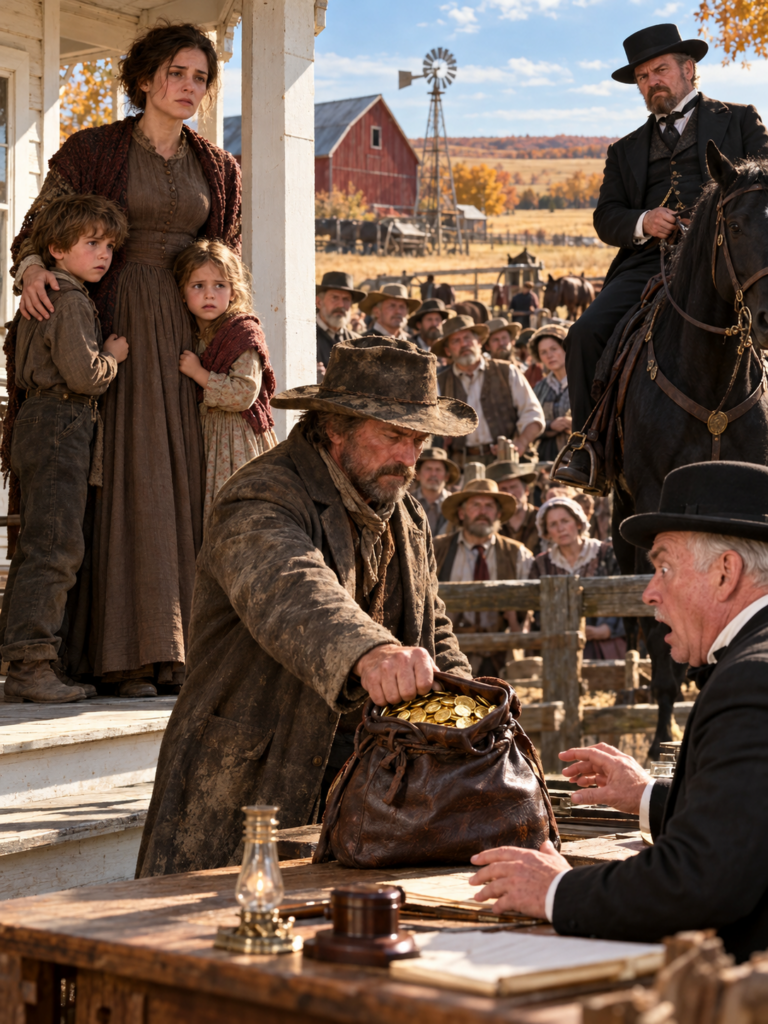
Abel opened the worn letter with careful fingers, and Theresa caught the paper before the October breeze could bend it backward.
She recognized Henry’s handwriting immediately.
Not merely the shape of the letters, but the pressure of his pen. He had always pressed harder when something troubled him.
Her eyes found the first line.
Dear Abel.
Below it, Henry had written that his health had grown uncertain. If he did not survive, he wanted Abel to look after Theresa and the children.
Then came a sentence that made her stop breathing.
There was a debt between the two men, one Henry had never considered a debt at all.
Theresa looked up.
“What debt?”
Abel’s eyes moved briefly toward Peter.
“Your husband saved my life.”
“When?”
“During the war.”
The wind stirred the dry leaves around the porch steps.
Henry had told Theresa only scattered details of his service with the Union Army. He had been seventeen when he fought at Franklin, Tennessee, and every November afterward, he spent one afternoon alone in the barn.
She had never pressed him.
Now she wondered how much he had carried without speaking.
“You knew Henry when he was a boy?”
“For one night,” Abel answered. “It was enough.”
Peter edged closer.
“Did Pa really save you?”
Abel crouched until his face was level with the boy’s.
“He did. I’d like to tell you how, if your mother permits.”
Theresa folded the letter again.
The auctioneer had started gathering his papers. A few farmers lingered near the gate, pretending to examine wagon harnesses while watching the stranger.
This was no place for her children to hear about a battlefield.
“You may tell us inside,” she said. “But first, I want the matter of this farm settled.”
Abel stood.
“Of course.”
“You paid for it. The auction papers are in your name. I won’t pretend they aren’t.”
“That’s true.”
“Then I want written proof of what you’re giving us. Not another promise somebody can deny after you’re gone.”
For the first time, Abel nearly smiled.
“Henry told me you were careful.”
“He should have told you I was stubborn.”
“He mentioned that too.”
She had not intended to laugh. The small sound surprised her, and Peter looked up as though he had heard something impossible.
Abel turned to the auctioneer.
“We’ll need the transfer witnessed and properly recorded. Mrs. Caldwell is to have the property without any claim from me.”
The man glanced uneasily toward the gate where Voight had disappeared.
“That may take some arranging.”
“Then arrange it,” Theresa said.
Her voice carried across the porch.
One of the farmers removed his hat.
Another stepped forward and offered to witness the papers.
The gesture was small. Yet Theresa noticed it. Men who had been afraid to speak an hour earlier were beginning to find their voices.
Abel did not hurry her.
He waited while she examined the sale document and asked exactly what it gave him.
When she finished, he placed the papers back in her hands.
“Nothing about this requires you to trust me blindly,” he said.
Theresa studied him.
“Then why did Henry never tell me about you?”
Abel’s expression changed.
“Perhaps because he couldn’t bear remembering how we met.”
That answer hurt more than she expected.
From inside the house came Bella’s frightened call for her mother.
Theresa turned immediately. The child had gone into the kitchen and discovered that the cupboard still held only the little food they had set aside for leaving.
The farm might be saved, but supper, winter supplies, and the coming planting season remained uncertain.
Abel saw the worry in Theresa’s face.
“I have some provisions in my saddlebags,” he offered.
“We have food for tonight.”
“Then I’ll leave mine with my horse.”
He did not argue.
Beyond the yard, the windmill stood motionless above the barn. It had stopped working not long after Henry’s death. Peter followed his mother’s gaze toward it.
“Pa always said he’d mend that.”
Theresa pressed Henry’s letter against her chest.
There was something else she needed to know.
“Mr. Stone, did my husband tell you about the bank note?”
“No, ma’am.”
“Then you need to understand something. I believe Jasper Voight sold this property on a debt Henry had already paid.”
Abel’s gaze sharpened.
“Do you have proof?”
“Not yet.”
“Then keep looking.”
“And if I find it?”
His answer came without hesitation.
“Then the truth ought to be brought into daylight.”
Theresa looked toward the kitchen, where her children were waiting, and then at the stranger holding the future of her farm in his hands.
She opened the front door and stepped aside.
“Come in, Mr. Stone. Tell us about Henry.”
Abel stepped across the threshold, then stopped long enough to wipe the road dust from his boots.
It was such an ordinary courtesy that Theresa nearly cried.
All morning, men had walked through her yard as though her home were already empty. Some had examined the barn. Others had discussed what the windmill might fetch. Nobody had thought to ask permission.
This stranger, who had just spent a thousand dollars for the place, would not enter without being invited.
Peter led him toward the kitchen.
Bella hid behind her mother’s skirt.
The room smelled faintly of coffee and the bread Theresa had baked before dawn, not knowing whether she would still own the stove by sundown.
Abel removed his coat and laid it across the back of a chair.
Theresa noticed the careful way he lowered himself into another. He favored one leg, though he seemed practiced at disguising it.
“That’s an old wound,” she said.
Abel glanced down.
“Yes, ma’am.”
“From the war?”
He nodded.
Peter immediately leaned forward.
“Is that where Pa saved you?”
Abel rested his hands on the table.
“Yes, son. It was.”
Theresa poured coffee into the only clean cup left on the shelf.
“Then tell us.”
Abel looked at the children before answering.
“It happened at Franklin, Tennessee, on the thirtieth of November, 1864.”
He paused.
Outside, an autumn gust rattled the loose kitchen window.
“I was nineteen then. Your father was seventeen. We served in the Union Army, though I didn’t know him before that night.”
Peter sat straighter.
Abel spoke quietly, without making the battle sound glorious.
There had been confusion, terrible noise, and men falling faster than others could reach them.
Late in the fighting, Abel had been struck in the leg.
He remembered dropping into a ditch. He remembered trying to rise and discovering that his leg would no longer bear his weight.
Then darkness came.
The cold settled over the wounded.
For a long time, Abel thought nobody would find him.
He had almost stopped calling for help when someone appeared above the ditch.
A young soldier.
A boy, really, with a face still too young for the exhaustion in his eyes.
“Can you walk?” the boy asked.
Abel had shaken his head.
The boy looked toward the distant field hospital.
Then he lowered himself into the ditch.
“What are you doing?” Abel remembered asking.
“Getting you out.”
“There are too many wounded. Go find somebody you can actually help.”
But the boy had already slipped an arm beneath his shoulders.
“He told me his name was Henry Caldwell,” Abel said. “Said he was from Nebraska.”
Theresa covered her mouth.
Abel looked down at his hands.
“That boy carried me through the dark. Four miles, near enough. He’d walk a little way, set me down, catch his breath, and start again.”
Peter’s eyes widened.
“Pa carried you four miles?”
“With more determination than sense, probably.”
A faint smile touched Abel’s mouth.
“He talked the whole way. Told me about the farm he wanted someday. Said he’d build a house, plant trees, and raise a family.”
Theresa’s eyes filled.
Henry had told her those same dreams when they first met in Chicago.
“He wouldn’t let me sleep,” Abel continued. “Every time I closed my eyes, he’d start talking again. By the time we reached the hospital, he knew more about my life than most men I’d served beside.”
“What happened then?” Peter whispered.
“They took me inside. Your father stayed until the men there said I’d live.”
Abel looked at Theresa.
“I promised him that if he ever needed anything, he only had to send word.”
“And Henry?”
“He said I didn’t owe him anything.”
Abel paused.
“That was the kind of man he was.”
Theresa turned toward the window.
She had known Henry’s kindness. She had seen him bring food to sick neighbors, stop work to mend an elderly farmer’s fence, and give away seed corn when another man’s crop failed.
But she had never imagined him carrying a wounded stranger for miles through the darkness.
Nor had she imagined that the stranger would return twenty years later.
Bella crept out from behind her mother’s skirt.
“Did Papa know you’d come?”
Abel considered the question.
“He hoped I would.”
“Did you get his letter right away?”
“No, little miss.”
He explained that Henry’s letter had traveled after him for months, through Kansas and Colorado, and finally into Arizona Territory, where Abel had been working as an Army scout.
It reached him at a military post near the San Pedro River only five weeks earlier.
He had read it twice.
Then he had arranged to leave and ridden north as quickly as he reasonably could.
“Six hundred miles,” Theresa murmured.
“Near enough.”
“And you had no idea whether we’d still be here?”
“No.”
“Or whether the bank had already taken everything?”
“No.”
She shook her head.
“That was a terrible risk.”
Abel looked toward the children.
“Seemed worth taking.”
For several moments, nobody spoke.
Then Peter asked a question that returned them all to the present.
“Mr. Stone, can you fix a windmill?”
Theresa closed her eyes.
“Peter, this gentleman has ridden a very long way.”
Abel turned toward the window.
“The one beside the barn?”
“Yes, sir. It quit turning after Pa died. The stock trough’s been running low, and Mama has to haul water.”
“Peter.”
“It’s true, Mama.”
Abel studied the motionless wheel.
“Could be several things. I’ll have a look tomorrow if your mother wants.”
Theresa hesitated.
She had already accepted more than she could understand.
“I haven’t asked you to stay.”
“I know.”
“And I cannot pay you what your work would be worth.”
“I’m not asking for wages.”
“Then what are you asking?”
He met her eyes.
“Nothing tonight, Mrs. Caldwell.”
The answer troubled her because she believed it.
That evening, Abel slept in the barn, despite Theresa’s offer of a place near the kitchen stove.
He said the loft was dry and his horse needed tending. He seemed more comfortable among hay and harness than under a family’s roof.
But the following morning, Peter found him saddling his gray horse.
The boy stopped in the barn doorway.
“Are you leaving?”
Abel tightened a strap.
“That was the plan.”
Peter looked at the ground.
He had learned too young how quickly the adults he depended on could disappear.
“Then who’ll fix our windmill?”
Abel’s hands stilled.
For a long moment, he looked at the boy.
Then he unfastened the saddle.
“I reckon I can spare a day.”
That day became three.
The windmill needed more than a loose bolt. Several working parts required attention, and Abel made an additional trip into Elm Crossing for what he could not repair.
Peter helped where it was safe, fetching tools and holding pieces while Abel worked.
Theresa watched from the yard as the two of them argued over the proper use of a wrench.
It was not an angry argument.
Peter was certain he knew how his father would have done the job.
Abel listened before explaining why the worn fitting needed a different approach.
By the third afternoon, the wheel began turning.
Water rattled through the pipe into the trough.
Bella shouted with delight.
Peter threw his hat into the air.
Theresa stood beside the barn with both hands pressed to her mouth.
It was not merely the windmill.
For months she had carried every broken thing in her life like another stone in her apron.
A door that would not close.
A wagon wheel needing repair.
A fence sagging beneath its own weight.
Two children asking when things might become normal again.
And now one small part of the farm had begun to function as it used to.
Abel climbed down from the mill structure and wiped his hands.
“There,” he said. “Should hold if the wind stays reasonable.”
Peter seized his hand.
“Can we fix the barn door next?”
Abel looked toward Theresa.
She folded her arms.
“Mr. Stone, that boy will have you rebuilding the whole county if you let him.”
“Then I’d best teach him to use a hammer.”
It was the first time Theresa laughed without immediately feeling guilty.
She did not stop him from hearing it.
***
Over the following days, Abel helped mend the barn door, straighten the chicken enclosure, and repair the damaged wagon wheel.
But Theresa would not allow him to assume responsibility for the entire farm.
One evening she spread Henry’s account book across the kitchen table.
“If you’re going to help,” she said, “you ought to know what we’re trying to keep.”
Abel pulled out a chair.
She showed him the wheat already stored, the remaining corn harvest, the money still needed for seed, and the household expenses she had been tracking in careful columns.
He listened without interrupting.
When he suggested selling part of the corn quickly, she shook her head.
“Not all of it. We can hold some and still manage the feed.”
He examined her figures.
“You’re right.”
She looked up in surprise.
“You agree?”
“I can read arithmetic, Mrs. Caldwell.”
“So can Jasper Voight.”
Abel’s expression hardened.
“Yes. He can.”
Theresa turned another page.
“Henry handled most dealings with the bank. I should have insisted on knowing more.”
“You’ve kept the place going since he died.”
“That doesn’t mean I did everything well.”
“No,” Abel said. “It means you did what had to be done while grieving.”
She lowered her eyes to the accounts.
The words were simple.
They reached someplace she had been protecting for months.
As autumn deepened, Abel helped bring in the last corn with Peter riding beside him on the wagon.
Bella learned to whistle using a blade of grass, though her first attempts sounded more like a wheezing kettle.
Theresa began setting another place at supper.
Sometimes Abel joined them.
Sometimes he ate in the barn, unwilling to disturb a family still learning to live with an empty chair.
One evening, Theresa found him standing on the porch, watching the sunset beyond the harvested fields.
“Mr. Stone?”
“Ma’am.”
“Why did you never marry?”
He looked surprised.
She nearly apologized.
But he answered.
“I spent most of my years traveling. Scouting country, working wherever the Army had need of me.”
“That doesn’t answer the question.”
“No, I suppose it doesn’t.”
His fingers rested against the porch railing.
“I never stayed in one place long enough for anyone to miss me.”
Theresa looked toward the windmill, turning slowly against the fading sky.
“Someone would miss you here.”
He turned to face her.
But she had already stepped toward the kitchen door.
It was easier to speak courageously when she did not have to witness what the words did to him.
***
The trouble began with a survey stake.
Peter found it near the outer edge of the orchard one afternoon.
Theresa recognized the markings well enough to understand that men had been examining the property without speaking to her.
In Elm Crossing, she learned that a proposed Burlington railroad branch might pass near the Caldwell farm.
And Jasper Voight had apparently been buying neighboring land along the expected route.
Abel listened closely when she told him.
“Voight knew about the railroad before the auction,” he said.
“That’s what I believe.”
“Which means he had a reason to want your land beyond the bank note.”
Theresa looked down at the stake in her hands.
“Henry paid that note. I know he did.”
“Then there ought to be a record.”
“I’ve searched everything.”
“Perhaps not everything.”
She almost snapped at him.
He saw it coming.
“I don’t mean you haven’t tried, Theresa.”
It was the first time he had called her by her given name.
The sound stopped her.
He continued more gently.
“People put important papers in strange places. Especially when they mean to keep them safe.”
Theresa thought of Henry’s desk, his coat, the wooden box beneath the bed.
She had searched them all.
But the next morning she began again.
Abel, meanwhile, went into town.
He spoke with farmers who owed money to Voight. He asked questions about the railroad. He tried to learn whether others had disputed bank records.
Most men were reluctant to discuss the matter.
Yet a few began admitting that their own dealings with Voight had not always made sense.
Abel did not promise to bring the banker down.
He said only that he wanted the facts.
Three days later, he sent a telegram to the county sheriff explaining his concerns.
By late October, the house had grown colder at night.
Theresa had begun preserving what remained from the garden.
Peter was carrying wood without being asked.
Bella spent afternoons looking through the illustrated pages of Henry’s old family Bible.
Then, one afternoon, a folded paper slipped from between the pages of Ruth.
Bella carried it to her mother.
“Mama, this fell out.”
Theresa unfolded it at the kitchen table.
Her hands began trembling.
At the top was the name of the Elm Crossing Bank.
Below it, a notation that the two-hundred-and-eighty-dollar note against the Caldwell property had been paid in full.
The date was fourteen months before Henry’s death.
At the bottom was Jasper Voight’s signature.
Theresa read it three times.
Then she called for Abel.
He came in from the yard.
She held the paper toward him.
“Henry paid.”
Abel studied the receipt.
His expression became grave.
“This changes the matter.”
Theresa’s eyes filled.
“For months he let me believe I might lose my children’s home because my husband had left us in debt.”
Abel placed the document on the table.
“Keep that somewhere safe.”
“I intend to take it to the sheriff.”
“I think you should.”
“And I want to confront Voight.”
Abel hesitated.
Theresa saw the concern in his eyes.
“I’m not asking your permission.”
“I know.”
“He’s lied to me long enough.”
Abel nodded slowly.
“Then let’s make certain he can’t destroy the proof.”
That evening, Theresa laid Henry’s Bible beside her bed, with the receipt folded safely inside.
She had waited ninety days for someone to believe her.
Now she had proof in her own hands.
Near midnight, a faint smell reached Abel as he lay awake in the barn.
Kerosene.
Then came the muffled sound of horses on the road.
He rose, moved to the barn doorway, and looked across the moonlit yard.
Four mounted men waited near the lane.
Two others were approaching the barn on foot.
One carried a kerosene can.
The other carried an unlit torch.
Farther back sat Jasper Voight on his black horse.
Abel reached for his rifle.
Then he stepped into the moonlight.
“Evening, gentlemen.”
The two men froze.
Behind Abel, the farmhouse kitchen door opened.
Theresa appeared on the porch.
She held a lantern in one hand and Henry’s Bible in the other.
“Mr. Voight!” she called. “Before your men take another step, there’s something you need to see.”
Jasper Voight turned toward Theresa’s voice.
The lantern in her hand cast a warm circle across the porch, illuminating the determined face of a woman he had expected to find frightened and defenseless.
Abel stood near the barn with his rifle lowered.
He did not aim it at anyone.
There was no need.
The men holding the kerosene had stopped moving.
“Go back inside, Mrs. Caldwell,” Voight called.
Theresa stepped down one stair.
“No.”
“There’s no cause for you to involve yourself.”
“This is my property. You’ve brought men here in the middle of the night carrying fuel and a torch. I would say I’m already involved.”
Voight shifted in his saddle.
“You’re making accusations you can’t prove.”
Theresa lifted the Bible.
“Then listen carefully.”
Abel glanced toward the house. Behind the kitchen window, Peter and Bella had appeared together, their small faces pale in the lamplight.
He moved just enough to place himself between the children and the men near the barn.
Theresa opened the Bible and removed the folded receipt.
“Fourteen months before Henry died, he paid the note against this farm.”
Voight’s expression barely changed.
“I’ve told you before that the bank holds no record of such a payment.”
“You told me that while you were holding the money.”
“Mind your words.”
She raised the receipt.
“Two hundred and eighty dollars. Paid in full. Recorded by the Elm Crossing Bank.”
The men by the barn exchanged uneasy glances.
Voight’s horse moved restlessly beneath him.
Theresa continued.
“And here, Mr. Voight, is your signature.”
The silence that followed was different from the one at the auction.
That day, the neighbors had been silent because they were afraid.
Tonight, the men who had accompanied Voight seemed uncertain whether they wanted any part of his business.
One of them lowered the torch.
“Let me see that,” Voight said.
Theresa folded the receipt and slipped it back inside the Bible.
“You may see it when the sheriff sees it.”
Voight’s voice hardened.
“You have no idea what you’re getting into.”
“I know my husband paid his debt.”
“That land is worth a great deal more than your husband ever understood.”
Theresa looked at him steadily.
“Then perhaps you should have offered to buy it honestly.”
For an instant, anger overwhelmed his caution.
“You think that little patch of apple trees is going to keep the railroad from coming?”
Theresa felt Abel turn his head.
There it was.
The reason the banker had been so determined to own her farm.
Voight realized his mistake immediately.
But he could not draw the words back.
“You wanted the station ground,” Theresa said.
He gave no answer.
“You knew the railroad might come through here. You knew Henry had paid his note. And you tried to take everything for two hundred dollars.”
“You’re a foolish woman.”
“No,” she replied. “I was a grieving woman. There’s a difference.”
From the road came the faint sound of wagon wheels.
Then another sound.
Horses.
Voight looked toward the gate.
Lanterns began appearing along the dark lane.
One at first.
Then several.
Within minutes, a line of farmers approached the Caldwell property.
The same men who had stood helplessly around the auction wagon were returning.
But they were not alone.
The county sheriff rode at the front.
Voight drew himself upright.
“What’s the meaning of this?”
The sheriff dismounted.
“Evening, Jasper.”
“You’ve no business here.”
“Reckon I do.”
He looked at the two men standing beside the barn.
“And I reckon those gentlemen can explain the kerosene.”
One of them set the can down.
“We were only doing what we were told.”
Voight rounded on him.
“Keep your mouth shut.”
The sheriff raised a hand.
“That’ll be enough.”
Theresa walked slowly toward the yard, carrying the Bible.
Abel stepped aside to let her pass.
He did not take the paper from her.
He did not speak for her.
When she reached the sheriff, she opened the Bible and handed him the receipt.
He examined it in the lantern light.
“Mrs. Caldwell, is this your husband’s original bank receipt?”
“Yes, sir.”
“And you’ve kept it in your possession?”
“My daughter found it tucked inside his Bible this afternoon.”
The sheriff looked at Voight.
“This deserves a proper examination.”
Voight gave a contemptuous laugh.
“A scrap of paper doesn’t prove anything.”
“No,” the sheriff replied. “But neither does a bank book when someone has reason to question how it was kept.”
He turned to the farmers.
“Several other families have brought me complaints about their accounts.”
Voight’s face changed.
Until that moment, he had believed each farmer frightened and isolated.
He had not expected them to talk to one another.
Abel had spent days visiting their farms, asking careful questions without promising anything he could not deliver.
The sheriff had received his telegram three days earlier.
And tonight, when men saw Voight riding toward the Caldwell place after dark with companions carrying suspicious supplies, several neighbors followed.
The sheriff had already been making inquiries.
Now he had enough reason to act.
“Jasper Voight,” he said, “you’re coming with me.”
Voight looked from the sheriff to the gathering of farmers.
Nobody moved to defend him.
Two men who had once borrowed seed money from his bank stood shoulder to shoulder near the gate.
Another held his lantern high.
The banker opened his mouth.
Then closed it.
The sheriff directed his deputies to secure the kerosene and speak with the men Voight had brought.
Theresa watched as Jasper Voight was led away.
Only then did her legs begin to tremble.
Abel approached, leaving enough distance for her to refuse his assistance if she wished.
“Theresa?”
She handed him the Bible for a moment.
Then she sat down on the porch step.
“I was so frightened,” she whispered.
“I know.”
“I thought if I stood there and spoke, my voice would fail me.”
“It didn’t.”
She looked toward the barn.
“The children.”
“They’re safe.”
Peter was already running down the porch steps, Bella following him.
They reached their mother almost together.
Theresa wrapped her arms around them.
For a long time, she held them without speaking.
Abel stood nearby, Henry’s Bible resting carefully in his hands.
When Theresa finally looked up, she said something that surprised him.
“I want the sheriff to have every account Henry kept. If Voight cheated us, he may have cheated others.”
Abel nodded.
“Then we’ll see the papers delivered.”
“Not you alone. Me.”
“Of course.”
It was the first night since Henry’s death that Theresa slept without dreaming of losing the farm.
***
The investigation moved more slowly than the excitement of that night.
Documents had to be examined.
Bank entries had to be compared.
Farmers had to provide their receipts and explain the terms of old loans.
Voight’s arrest did not magically untangle everything he had done.
But it allowed people who had been afraid of him to speak.
Theresa took Henry’s receipt to the proper authorities and gave a full account of the disputed note and the auction.
Abel provided a statement concerning the men at the barn.
The farmers who had followed Voight that night told what they had witnessed.
During the following weeks, bank examiners uncovered a pattern of altered accounts and fraudulent claims affecting eleven other families.
Each case required separate attention.
Yet by Christmas, the families had received decisions and arrangements restoring the land wrongfully taken from them.
For Elm Crossing, the scandal did more than remove a dishonest banker.
It revealed how thoroughly fear had governed ordinary life.
Men who had remained silent at the auction began speaking more openly at the general store.
Neighbors who had been ashamed of their debts discovered that others had faced the same threats.
Theresa did not consider herself responsible for changing the town.
She had simply wanted to keep her home.
Still, when one elderly farmer came to thank her for refusing to be quiet, she invited him inside for coffee.
“I was afraid too,” she told him.
He looked at the children playing beside the stove.
“Maybe courage is what folks do while they’re still afraid.”
She smiled.
“Maybe so.”
***
Winter settled over the Caldwell farm.
The fields rested beneath frost.
The windmill turned on clear days, its familiar creaking restored to the rhythm of the place.
Abel continued sleeping in the barn for a time.
He never assumed that helping the family entitled him to move into Henry’s home.
Theresa noticed this more than she expected.
One evening, after the children were asleep, she carried a cup of coffee to the barn.
Abel sat near a lantern, mending a piece of harness.
“You could sleep in the house,” she said.
He looked up.
“You’ve been kind enough.”
“There’s room.”
He studied her carefully.
“Theresa, I don’t want you to feel you must offer me anything because of what happened at the auction.”
She entered the barn and set down the cup.
“I know.”
“Or because of Henry.”
“I know that too.”
He laid the harness aside.
“Then why?”
She looked toward the door.
Outside, frost silvered the yard.
“Because I worry about you being cold. Because Peter asks for you every morning. Because Bella has decided nobody else can whistle properly.”
Abel lowered his eyes.
“And because?” he asked.
Theresa felt warmth rise into her face.
“Because I like having you here.”
He said nothing.
She almost wished he would.
Then he answered with the plain honesty she had begun to recognize.
“I like being here.”
They stood in the barn for a quiet moment, close enough to hear the horses shifting in their stalls.
Theresa finally spoke.
“I’m not ready to decide what that means.”
Abel nodded.
“Then we won’t decide tonight.”
She looked at him gratefully.
He understood something essential.
Her gratitude for the farm was real.
So was her growing affection.
But one could not be allowed to purchase the other.
***
The following weeks passed in the difficult, useful work of winter.
Theresa continued managing the accounts and household.
Abel repaired equipment, cared for the animals, and helped Peter learn tasks that Henry had once intended to teach him.
They planned the spring planting together.
Not because Abel had become master of the Caldwell farm.
Because Theresa asked his opinion and he respected her decisions.
Sometimes they disagreed.
Once, over the purchase of feed, Abel argued that they should keep more cash in reserve.
Theresa believed the animals needed better provision before the worst cold arrived.
They went through the figures twice.
In the end, they chose a smaller purchase that met the immediate need without exhausting what remained.
Abel looked at the account book.
“Not bad.”
Theresa raised an eyebrow.
“That sounds suspiciously like praise.”
“It was meant to.”
She smiled.
Their affection grew through moments like that.
Not grand speeches.
Not a sudden forgetting of grief.
It grew when Abel remembered that Bella disliked the dark loft.
When Theresa left an extra blanket near the kitchen stove.
When Peter proudly showed Abel a gate latch he had repaired without assistance.
When they laughed together over something ordinary, then fell silent because both remembered someone absent.
Henry remained part of the household.
His photograph stayed where Theresa had placed it.
His Bible remained on the shelf.
His name was spoken at supper.
Abel never treated those memories as an obstacle.
Sometimes, when Peter asked about the war, Abel answered questions Henry had been unable to face.
Sometimes Theresa told Abel stories from the years Henry had spent building the farm.
In this way, they each came to know more of the man they had both loved in different seasons of his life.
***
On the thirtieth of November, Theresa noticed Abel had disappeared after breakfast.
She found him in the barn.
He was sitting on an overturned crate, his hat in his hands.
The lantern beside him had burned low.
For a moment, she remained near the doorway.
Then she said quietly, “Henry used to come here on this day.”
Abel looked up.
“I wondered if he did.”
“He never told me why.”
Abel’s eyes settled on the floor.
“Some memories don’t loosen their hold because a man stops speaking of them.”
She walked closer.
“Do you remember that night every year?”
“Every year.”
“The cold?”
“Some of it.”
“The pain?”
“Less than I used to.”
She waited.
Abel rubbed one hand across his face.
“What I remember most is his voice.”
Theresa sat beside him.
“He talked the whole four miles,” Abel continued. “Told me about Nebraska. About what kind of farm he meant to own. About how, when he had a family, nobody was ever going to face hardship alone if he could help it.”
Theresa pressed her lips together.
“He kept that promise as long as he lived.”
“Yes.”
“And when he couldn’t, he wrote to you.”
Abel nodded.
She reached for his hand.
He let her take it.
Neither spoke for some time.
Then Theresa stood.
“Come inside before your coffee gets cold.”
Abel looked toward the open barn door.
For twenty years, that November date had belonged to memory and silence.
Now someone was asking him to return to a warm kitchen.
He rose and followed her.
***
By spring, the Burlington railroad’s planned route was no longer merely a rumor.
Surveyors came through the district and confirmed that the branch line would pass along the edge of the Caldwell property.
The proposed station would stand beside the apple orchard, not in the middle of the house or fields as Theresa had feared.
The railroad representatives approached her about purchasing the strip of ground they needed.
She listened carefully.
Then she requested time to study their offer.
Abel sat with her afterward.
“What do you think?” he asked.
“I think they need the land.”
“That seems plain enough.”
“And I think needing it should mean paying a fair price.”
Abel smiled.
“Henry would have been proud of that answer.”
Theresa considered the figures.
She had spent months fearing that somebody else would decide the value of everything she owned.
Now men representing a railroad had come to negotiate with her.
The difference mattered.
She sought advice, reviewed the proposed boundary, and negotiated until she was satisfied.
Only then did she agree to sell the narrow strip.
The money provided security for the children and helped the farm prepare for future seasons.
The orchard remained theirs.
So did the house.
So did the windmill.
One afternoon after the arrangements were settled, Theresa walked to the orchard with Abel.
The trees were beginning to bloom.
White blossoms lifted in the spring breeze.
Abel stood beneath one of the older trees, looking toward the land Henry had once described to him as a boy.
“Strange thing,” he said.
“What is?”
“That I heard about this place twenty years before I ever saw it.”
Theresa smiled.
“Henry did like describing a thing before he’d finished building it.”
“He told me he’d plant trees.”
“And he did.”
“He said he’d find someone willing to make a life here.”
Theresa looked at him.
“He did that too.”
A long silence followed.
Abel removed his hat.
“Theresa, may I ask you something?”
“You may.”
“I’ve been trying to find the right words since winter.”
She felt her heartbeat quicken.
“Then perhaps you’ve waited long enough.”
He gave a small, nervous smile.
“I’ve only ever made one bid that mattered much to me.”
Theresa laughed softly.
“That was a terribly expensive bid, Mr. Stone.”
“It was.”
“And you weren’t exactly careful about what you were buying.”
“I wasn’t trying to buy anything for myself.”
“I know.”
Abel took a breath.
“Then I’d like to make an offer that costs no money at all.”
She watched him closely.
“I’d like to marry you, Theresa.”
The words settled gently between them.
He did not reach for her.
He did not tell her what her answer ought to be.
Instead, he continued.
“I know Henry will always have a place in your heart. I wouldn’t want it otherwise. I cannot be him, and I won’t try.”
Theresa’s eyes filled.
“Abel—”
“I’ve spent most of my life moving from one place to another. I thought that was the only way I knew how to live.”
He glanced toward the house.
“But these past months have taught me something different.”
“What?”
“That I want to stay. Not because I owe Henry a debt. Not because you or the children need somebody to mend a fence.”
He looked into her eyes.
“I want to stay because I’ve come to love you.”
The orchard seemed very still.
Theresa looked at the man standing before her.
She remembered his dusty coat on auction morning.
The gold scattered across the wagon boards.
Henry’s letter trembling between his hands.
She remembered the windmill turning again.
The children’s laughter.
The long winter evenings when Abel had sat patiently at the kitchen table, never demanding that grief make room for him before it was ready.
And she remembered how he had listened whenever she said no.
“Abel, I have something to say before I answer.”
“Anything.”
“This farm remains the Caldwell farm.”
“Yes, ma’am.”
“Peter and Bella must always know that their father loved them and worked for what they have.”
“They will.”
“And I won’t spend the rest of my life feeling that I owe you a marriage because you rescued us.”
Abel’s expression softened.
“I would never ask that of you.”
Theresa stepped closer.
“Good. Because I don’t owe you my heart.”
“No.”
She took his hand.
“I’m giving it to you.”
For one unguarded moment, Abel looked almost unable to believe what he had heard.
Then Theresa smiled through her tears.
“I think I’d like to accept your second offer, Mr. Stone.”
He laughed, a warm, startled sound.
“Does that mean yes?”
“It does.”
He held her hands gently.
“May I kiss you?”
Theresa nodded.
Beneath the apple blossoms, they kissed.
And neither had to pretend the love that had come before was gone.
***
They married in June at the little church in Elm Crossing.
Peter stood beside Abel.
Bella scattered apple blossoms along the aisle.
Theresa wore a simple dress she had carefully prepared herself, and when she entered the church, she paused for one moment near the doorway.
Not because she doubted the decision.
Because she was remembering another wedding.
A young farmer from Nebraska.
A church near the Chicago stockyards.
A future she had never been able to picture until Henry took her west.
She carried that memory with her.
Then she walked forward toward Abel.
The church was filled with neighbors.
Some were the same farmers who had once watched helplessly while Voight tried to take her home.
Their presence could not erase that earlier silence.
But several had apologized, and in the months since, they had begun behaving differently.
They were learning that a community required more than standing beside one another when things were easy.
After the ceremony, Peter took Abel aside.
“Does this mean you’re staying forever?”
Abel crouched.
“That’s what your mother and I intend.”
Peter looked serious.
“Will you still teach me about the farm?”
“As long as you’ll listen.”
“And can I still talk about Pa?”
Abel’s eyes grew gentle.
“Son, I hope you always do.”
Peter considered that answer.
Then he wrapped his arms around Abel’s shoulders.
Abel held him close.
Across the churchyard, Theresa watched them together.
She had not married to replace her children’s father.
She had married a man who understood that he could love them without asking them to forget.
***
Life after the wedding was not free of hardship.
There were fences to repair, crops to bring in, accounts to settle, and seasons when the rain came too late or too early.
The railroad brought new activity to Elm Crossing, along with changes not everyone welcomed.
The station near the Caldwell orchard made travel and trade easier, but it also meant more people passing the farm than Henry had ever imagined.
Through it all, Theresa remained deeply involved in the decisions concerning the land.
Abel never confused being her husband with having the right to make those decisions alone.
They learned one another’s habits.
He learned that Theresa needed quiet in the early morning before tackling the day’s accounts.
She learned that Abel sometimes withdrew when an old memory troubled him.
Neither always understood the other immediately.
But they had learned how to ask.
Peter grew into a capable young farmer.
Bella became a spirited girl who could make Abel laugh even when the day’s work had worn him out.
And each year, as November approached, Theresa noticed a change in him.
His thoughts turned inward.
His movements became quieter.
On the thirtieth, he still walked to the barn.
At first, Theresa let him sit there alone.
Then she would bring coffee.
Sometimes Peter and Bella followed.
They never forced him to speak.
Yet the silence gradually became something gentler.
No longer the closed door of a memory he could barely bear.
Instead, it became a place where Henry could be remembered with gratitude.
One year, Peter sat beside Abel and asked whether his father had been frightened at Franklin.
Abel thought carefully before answering.
“I expect he was.”
“Then why did he help you?”
“Because he decided somebody else’s life mattered more than his fear.”
Peter looked across the barn.
“I hope I can be like him.”
Abel rested a hand on the young man’s shoulder.
“In some ways, you already are.”
Theresa stood nearby, holding the lantern.
She had once feared that Henry’s death meant her children would lose not only their father, but the entire world he had built for them.
Now she understood that a life could continue shaping others long after it ended.
Henry had saved a stranger.
That stranger had answered his call twenty years later.
And the kindness of a seventeen-year-old boy had somehow traveled across decades to protect the home he would one day build.
***
Years passed.
The orchard grew older.
The windmill continued turning, though Peter eventually replaced worn parts that Abel had once repaired.
The farmhouse gained the comfortable marks of a family who expected to remain.
The kitchen table grew scarred from work and daily meals.
Henry’s Bible stayed on the shelf.
His photograph stayed in its place.
And beside it, in time, Theresa placed a photograph of herself and Abel on their wedding day.
One did not replace the other.
Both belonged to the family’s story.
When Peter became a grown man working the same land, a young newspaper reporter traveled from Omaha to ask about the remarkable auction that people in the district still remembered.
The reporter stood in the Caldwell yard, notebook in hand, looking from the farmhouse to the barn.
“Is it true,” he asked Peter, “that a stranger came here carrying a thousand dollars in gold and bought this entire farm?”
Peter smiled.
“That’s true.”
“And then he gave it back to your mother?”
Peter looked toward the porch.
Theresa sat there in the afternoon sunshine.
Her hair had begun to silver.
Beside her sat Abel, older now, his mustache gray and his once-restless hands folded comfortably over hers.
The reporter followed Peter’s gaze.
“That’s the stranger?”
“That’s Abel Stone.”
“Your stepfather?”
“Yes.”
The reporter hurried to write it down.
“What a remarkable thing. He traveled all that way, paid a thousand dollars, and returned the property.”
Peter watched Abel lean closer to hear something his mother had said.
Then he turned back to the reporter.
“You’re missing the important part.”
The young man looked up.
“What part?”
Peter smiled.
“He stayed.”
Across the yard, the windmill turned slowly in the breeze.
The apple trees stirred.
And on the porch of the house she had nearly lost, Theresa rested her head against Abel’s shoulder.
The man who had once spent his life moving from place to place had finally found somewhere he wanted to remain.
The woman who had watched her future being auctioned away had chosen a new one on her own terms.
And the boy who had carried a wounded stranger through the darkness at Franklin had given his family something he never could have planned.
Not another father in his place.
Not a debt that demanded repayment.
But a kindness that returned when they needed it most.
Later that November, Theresa walked to the barn carrying a lantern and two cups of coffee.
Abel sat on the familiar crate.
He looked up when she entered.
“Come to fetch me?”
“Every year,” she answered.
He accepted the warm cup.
For a while they sat together, remembering Henry.
Then Abel reached for her hand.
Outside, the evening light was fading over the same fields Henry had once dreamed of owning.
The windmill creaked gently.
From the house came the familiar sounds of family gathering for supper.
Theresa stood and offered Abel her arm.
“Come home,” she said.
And the man who had once believed nobody would ever miss him rose and went with her.

