
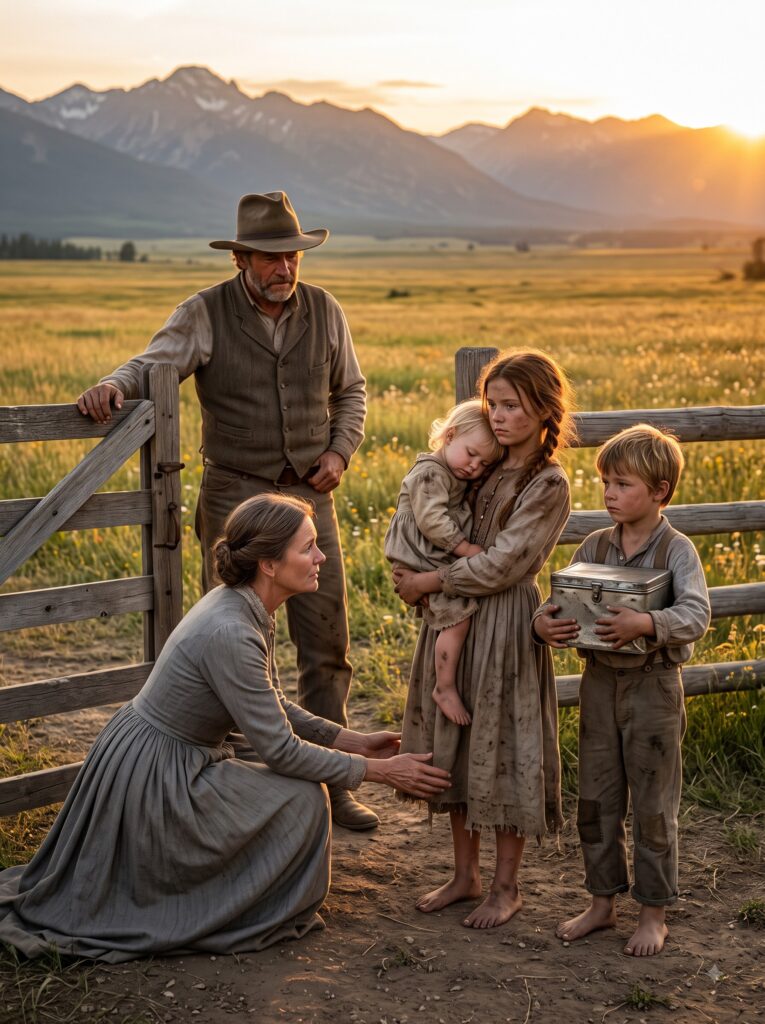
Molly dropped to her knees and snatched at the letter before Eleanor could read the writing on its outer fold.
But her injured foot twisted beneath her, and she gasped.
Thomas instinctively stepped forward.
The girl flinched so violently that he stopped where he stood.
“Easy,” he said. “Nobody’s taking anything.”
Molly clutched the paper against her chest.
“It belongs to us.”
“Then it’s yours,” Eleanor answered.
Finn appeared at the top of the stairs.
The moment he saw the open box, he hurried forward and gathered its other contents: a faded wedding photograph and a string of inexpensive blue glass beads.
He returned them carefully to their place.
Then he held out the box to Molly.
Neither child seemed concerned about their bleeding feet anymore.
Only the letter mattered.
Eleanor knelt beside them.
“Is it from your mother?”
Molly’s eyes filled with terror.
“Please don’t ask.”
Eleanor felt the force of that plea.
She had once been a young governess arriving in Montana with one trunk and a box of books, frightened of strangers and determined that no one should see it.
But she had never been twelve years old and responsible for two younger children.
“All right,” she said.
Molly stared at her.
“You’re not angry?”
“No.”
“What if we haven’t told you everything?”
Thomas leaned against the doorframe, leaving the stairway clear.
“Then perhaps you’ve had good reason.”
Molly’s fingers tightened around the paper.
For one moment, Eleanor thought the girl might explain.
Instead, Molly rose unsteadily.
“Could Finn and me sleep close to Rosie?”
Thomas glanced into the nursery.
There was enough floor space, though it would be crowded.
“I can bring your bedding up here,” he said.
“Please.”
“And Molly,” Eleanor added, “you may keep your mother’s things wherever you feel they’re safest.”
The girl studied her for so long that Eleanor almost looked away.
Then Molly whispered, “Thank you, ma’am.”
Within minutes, three small beds lay near the window.
Finn settled beside the tin box.
Molly lay closest to the door.
Rosie slept through everything.
But Eleanor noticed that Molly did not close her eyes until Thomas had left the room.
That night, Eleanor sat beside her husband on the porch.
The river sounded faintly through the trees.
“They’re running from something,” she said.
Thomas nodded.
“I reckon so.”
“Should we ask in town?”
“Not before we know what asking might do to them.”
Eleanor looked toward the upstairs window.
For three years she had avoided looking at it after dark.
Tonight, a little lamp glowed behind the glass.
“They cannot stay forever without someone knowing where they are.”
“No,” Thomas agreed. “But they can stay tomorrow.”
Eleanor turned toward him.
“And the day after?”
“We’ll see what they need.”
He took her hand.
That was Thomas Whitaker’s way.
He rarely promised more than he could give.
But what he promised, Eleanor had learned to trust.
By morning, Molly was already awake.
Despite the bandages around her feet, she had gone downstairs and begun scrubbing the kitchen floor.
Eleanor found her on her knees beside a bucket.
“Molly! What on earth are you doing?”
The girl looked startled.
“Working, ma’am.”
“Your feet aren’t fit for standing, much less scrubbing.”
“I can finish.”
“You don’t have to.”
Molly’s face hardened.
“I told Mr. Whitaker I could earn our supper.”
Eleanor took the rag gently from her hand.
“Listen to me. Your supper was never a bargain.”
Molly looked toward the doorway.
“But we can’t stay for nothing.”
“You may help when you’re well enough, if you wish. Today, you’re going to rest.”
The girl swallowed.
“People don’t keep children they can’t use.”
Eleanor’s heart contracted.
“Who told you that?”
Molly’s lips parted.
Then closed.
From outside came the clink of a milk pail.
Finn was following Thomas toward the barn.
Rosie still slept upstairs.
For the first time, Molly seemed uncertain which of her responsibilities to attend to first.
Eleanor drew out a kitchen chair.
“Sit with me.”
Molly obeyed reluctantly.
After a long silence, she asked, “If someone comes here looking for us, would you tell them we’re inside?”
Eleanor considered her answer carefully.
“I won’t make a promise without knowing the circumstances. But I will hear what you have to say before I make any decision.”
Molly’s eyes shone.
“And you won’t separate us?”
“I will do everything I honestly can to prevent that.”
The girl lowered her head.
Her hands moved toward the hidden letter.
Then stopped.
“There’s something you should know,” she whispered.
Eleanor waited.
Molly drew the folded paper halfway from her pocket.
“My mother told me to find somebody before she died.”
“Who?”
Molly looked up.
For the first time, her fear seemed mixed with something almost like hope.
“Someone she believed would help us.”
She began unfolding the letter, then heard Thomas calling from the yard that Finn had found a loose rail near the corral.
Molly sprang to her feet.
“I have to see he’s all right.”
Her foot faltered.
Eleanor steadied the chair without touching her.
“He’s with Thomas. You can stay here.”
But Molly was already moving toward the kitchen door, the half-open letter trembling in her hand.
Molly reached the kitchen door before Eleanor could persuade her to stop.
Outside, Finn stood beside Thomas at the corral, examining a loose fence rail.
He was perfectly safe.
But Molly did not relax until she had seen him with her own eyes.
Thomas glanced at her bandaged feet.
“Your brother found a rail that needs fastening,” he explained. “He was showing me where it’s split.”
Finn looked pleased.
He did not speak, but his eyes brightened when Thomas handed him a small wooden peg.
“Good eye, son.”
Molly stood motionless.
She had grown accustomed to hearing adults speak of Finn as a burden because he would not talk.
Thomas seemed entirely untroubled by it.
“He notices things,” Molly said.
“He certainly does.”
Finn gave the rail another careful inspection.
Molly smiled before she could stop herself.
For the first time since their arrival, Eleanor saw something of the child beneath the weary little guardian.
That morning, she did not ask again about the letter.
Instead, she brought Molly inside, changed the bandages on her feet, and set out a book to read while Finn helped Thomas with small tasks near the barn.
Rosie awoke late and wanted bread with honey.
When Eleanor gave it to her, she looked astonished by the amount.
“All mine?”
“Every crumb.”
Rosie considered this magnificent news.
Then she broke the bread in half and carried one piece to Molly.
That was how the Whitakers began to understand the three children.
They had survived by watching after one another.
Even when there was enough, they divided everything.
Even when they were safe, they counted every doorway.
And even in sleep, Molly kept one hand extended toward Rosie’s small mattress.
One night became two.
Two became a week.
Thomas repaired the gate where the children had first appeared.
Eleanor mended Molly’s torn dress and found shoes for all three.
Their injured feet gradually healed.
Finn began following Thomas through the ordinary rhythm of ranch life, helping carry empty pails, gathering tools, and learning how to approach the horses without startling them.
Molly insisted on helping Eleanor.
At first she treated every chore like an examination upon which her future depended.
She swept too quickly, apologized too often, and looked frightened whenever she broke or spilled anything.
One afternoon, she dropped a pottery bowl.
It shattered on the kitchen floor.
Molly went pale.
“I’ll pay for it.”
Eleanor reached for a broom.
“It’s only a bowl.”
“I didn’t mean to.”
“I know.”
“I can work extra.”
Eleanor set the broom aside.
“Molly, look at me.”
The girl raised her eyes reluctantly.
“You’re allowed to make mistakes in this house.”
Molly’s expression crumpled.
She turned away before Eleanor could see her tears.
But Eleanor had already seen them.
As the days passed, a different kind of life began taking shape.
Rosie followed Eleanor into the garden and across the meadow, asking questions without end.
“What flower’s that?”
“Lupine.”
“And that yellow one?”
“Balsamroot.”
“And that red?”
“Paintbrush.”
Rosie repeated the names with great seriousness.
She brought Eleanor handfuls of blossoms until the kitchen table was crowded with jars.
Eleanor did not have the heart to remove them.
Thomas began finding reasons to come inside during the afternoon.
He would stand in the kitchen doorway with his hat in his hands, pretending to look for a tool.
Eleanor knew perfectly well what he was doing.
He wanted to hear Rosie talking.
Sometimes the little girl climbed into his lap and made him identify every flower she had collected.
Thomas knew a considerable amount about cattle and horses, but Eleanor soon discovered his knowledge of flowers was less impressive.
Rosie corrected him cheerfully.
“That’s not a daisy. That’s a paintbrush.”
“Is it now?”
“Mrs. Whitaker says so.”
“Then I expect she’s right.”
Eleanor watched them from the stove with an ache she had no wish to explain.
The house had changed.
Not because the grief had disappeared.
Because there were new voices sounding through it.
And Thomas no longer passed the cottonwood tree without looking toward the empty place where the swing had once hung.
One dawn, he woke the children before sunrise.
Eleanor protested when he asked them to come outside in their nightclothes and shawls.
“Thomas, whatever are you planning?”
“Something worth being cold for.”
He led them toward the river meadow.
Mist drifted between the cottonwoods.
Then Molly stopped.
Ahead of them, an elk herd grazed among the wildflowers, their shapes emerging from the pale morning light.
A great bull lifted its antlered head.
Rosie opened her mouth in wonder but made no sound.
Finn stood perfectly still.
And Molly, without thinking, reached for Eleanor’s hand.
Her other hand found Thomas’s.
For several minutes they stood together, watching the animals move through the mist.
Only when the herd disappeared did Molly realize what she had done.
She released their hands quickly.
Eleanor pretended not to notice.
But she remembered the warmth of those small fingers all day.
Later that week, Thomas took Finn fishing in the Yellowstone River.
They stood in a shallow stretch where the current moved steadily over smooth stones.
Thomas taught him how to cast toward the quieter water beside a deeper channel.
Finn listened without speaking.
When he finally caught a trout nearly as long as his forearm, his whole face broke into a smile.
Thomas laughed.
“Well, now. That’s better than anything I’ve caught this week.”
The boy grinned.
Still not a word.
That evening, Thomas asked Molly whether Finn had always been so quiet.
She shook her head.
“He used to talk enough for all of us.”
“When did he stop?”
Molly looked toward the window.
“When Mama died.”
Thomas did not ask anything further.
Instead, he handed Finn the fishing line to wind neatly for their next trip.
And the boy, who had spent weeks expecting adults to grow impatient with him, worked beside Thomas until supper.
By the middle of July, the children were beginning to look healthy.
Rosie’s cheeks had filled.
Finn’s shoulders no longer seemed quite so narrow.
Molly’s feet had healed enough that Eleanor proposed they ride together along the old trail toward the foothills.
Molly was uncertain.
“I’ve never ridden a horse alone.”
“You won’t have to. I’ll show you, and we’ll go slowly.”
Thomas saddled two gentle horses and checked their tack.
Molly took the reins with the solemn determination she brought to everything.
Eleanor watched her carefully on the way uphill.
They passed groves of aspen, crossed the shallow places where mountain water ran over stone, and climbed toward a narrow stream that spilled down the hillside.
The waterfall came into view through the trees.
White water poured into a clear pool bordered by smooth rocks.
Molly stared.
“It’s beautiful.”
Eleanor dismounted.
“It was one of the first places Thomas showed me after we met.”
“You’ve been married a long time?”
“Eighteen years.”
“Are you happy?”
The question surprised her.
“Yes,” Eleanor said after a moment. “Though happiness isn’t the same as never being sad.”
Molly looked at the falling water.
“Did you ever have children?”
Eleanor’s breath caught.
“Yes.”
“Where are they?”
For a moment, the only sound was water striking the pool.
Then Eleanor answered.
“They died, sweetheart.”
Molly turned sharply.
“All of them?”
Eleanor nodded.
“We had three little ones. None could stay with us very long.”
Molly looked down at her hands.
“I’m sorry.”
“Thank you.”
They sat beside the pool in the afternoon sunlight.
Eleanor did not tell Molly everything.
She did not explain the nursery, the discarded swing, or the long years of waiting.
But she told her about William.
She said his name aloud.
And something about hearing that name in the mountain air loosened the grief she had kept carefully folded away.
Molly began crying.
At first Eleanor assumed the child was crying for the babies.
Then Molly covered her face and sobbed with such desperation that Eleanor moved closer.
“What’s wrong, darling?”
“I lied to you.”
Eleanor remained still.
“About Oregon?”
Molly nodded.
“We haven’t any aunt waiting there.”
“Then where were you going?”
“Here.”
Eleanor looked at her.
“To our ranch?”
Molly reached into her saddlebag.
Her hands shook as she lifted out the battered tin box.
Finn had finally allowed her to bring it, though he had watched her pack it twice.
She opened the lid.
Inside lay the old photograph, the blue beads, and the folded letter.
“Our real name is Doyle,” she whispered. “My father’s name was Patrick. He worked on the railroad.”
Eleanor listened.
“Two years ago, a bridge gave way near Bozeman. Papa was killed. Mama washed clothes for people after that. She worked nearly every day.”
Molly swallowed.
“Then she got sick.”
Eleanor felt a chill despite the warm sunlight.
“Where?”
“In Livingston. We were staying at a boardinghouse. She had a fever, and she couldn’t get better.”
Molly looked at the letter.
“She died in May.”
Eleanor reached for her hand.
Molly gripped it.
“Afterward, county men came for us. They said somebody had to provide for us, and we couldn’t stay together.”
“Who said that?”
“A commissioner. He arranged for Finn and me to work for a freighter called Hiram Gault. He hauls supplies to the mining camps.”
“And Rosie?”
Molly’s face twisted.
“They said she was too little to work.”
Eleanor’s fingers tightened around hers.
“They were going to send her to the county poor farm first. Then to an orphan home in Helena.”
Molly could barely speak.
“I asked when we could see her again. Mr. Gault said there was no reason to bother. He said she was so little she’d forget us.”
Eleanor felt anger rise through her grief.
“What happened next?”
“We left that night. I woke Finn. I carried Rosie until my arms wouldn’t hold her, and then we took turns helping her walk.”
“Forty miles?”
“We hid when wagons came near. We were afraid somebody would send us back.”
Eleanor looked toward the tin box.
“But how did you know where to come?”
Molly unfolded the letter.
“Mama wrote it when she knew she wasn’t getting well. She said if anything happened to her, we must find you.”
Eleanor took the paper.
The handwriting was faint and uneven.
She began reading.
Her face changed before she reached the end.
The woman who had written those words had known her.
Not merely heard her name.
Known her from a summer long ago.
A young Irish cook who had come to the ranch ill and frightened.
A girl Eleanor had nursed through three weeks of fever.
A girl who had later married a railroad worker.
Eleanor stared at the signature.
Kate Doyle.
She remembered the girl’s maiden name.
Kate O’Brien.
The blue beads.
Her bright laugh when she had recovered enough to stand.
The autumn morning she had left to begin married life.
“Oh, Kate,” Eleanor whispered.
Molly looked terrified.
“Do you remember her?”
Eleanor pressed the letter to her chest.
“Yes, darling. I remember your mother.”
Molly’s tears spilled.
“She said you saved her life.”
Eleanor could no longer contain her own tears.
“She was very ill. I sat with her until the fever broke.”
“She said you were the kindest woman she’d ever met.”
Eleanor put her arms around Molly.
This time the girl did not hesitate.
She collapsed against Eleanor and cried for her mother, for the miles of walking, for the nights without safety, and for the enormous burden she had carried since May.
When her tears finally quieted, she whispered, “I didn’t tell you because everybody who heard the truth wanted to send us somewhere else.”
Eleanor held her tighter.
“You came where your mother wanted you to come.”
“Will they take us away?”
Eleanor could not promise otherwise.
But she could promise something real.
“We will not stand by and do nothing.”
That evening, Eleanor showed Thomas Kate’s letter.
They sat together on the porch while twilight spread over the valley.
Thomas read the paper carefully.
When he finished, he looked toward the upstairs nursery.
“Their mother remembered you all those years.”
“She trusted me,” Eleanor whispered.
“And those children trusted her.”
Eleanor wiped her eyes.
“I cannot bear the thought of someone separating them.”
Thomas folded the letter with care.
“Neither can I.”
He sat quietly for a while.
Then he said, “Perhaps we’ve spent eighteen years asking for a family without knowing which children we were asking for.”
Eleanor leaned her head against his shoulder.
For the first time in years, she allowed herself to imagine the future.
Not as a promise.
As a possibility.
The next morning, Thomas rode to Livingston to consult a lawyer.
When he returned that evening, his face was grave.
Eleanor met him beside the porch.
“What did he say?”
Thomas dismounted slowly.
“Gault has county apprenticeship papers for Molly and Finn. They’re signed and apparently lawful. The lawyer says we must petition Judge Ashford to have them set aside.”
“And Rosie?”
“Her placement hasn’t been settled in the same way.”
Eleanor closed her eyes.
“Then we may lose them.”
“Not without a hearing.”
Thomas removed his hat.
“Gault’s already asking questions along the valley. He knows the children are somewhere near here.”
Eleanor looked toward the house.
Through the kitchen window, Rosie was showing Molly a jar of flowers.
Finn sat at the table winding fishing line.
None of them knew how close their old fear had come.
Then Thomas took Eleanor’s hand.
“If we keep them here, we’ll have to stand before the judge and answer for it.”
Eleanor looked back at her husband.
“Then that’s what we’ll do.”
Neither noticed Molly standing just beyond the open kitchen doorway.
She had heard enough.
And when Eleanor turned toward the house, she saw the twelve-year-old girl step forward, holding her mother’s letter against her heart.
“If there’s a judge,” Molly said, her voice trembling, “I want to speak to him myself.”
Eleanor crossed the porch and stopped before Molly.
The girl was holding Kate Doyle’s letter so tightly that the folds had begun to wrinkle.
“You don’t have to face all this alone,” Eleanor said.
Molly looked past her toward Thomas.
“Will the judge listen if I tell him everything?”
“I believe he’ll hear you,” Thomas answered. “But I can’t say what he’ll decide.”
Molly nodded.
It was a serious answer, and she seemed to respect him for giving it.
“Then I’ll tell him anyway.”
Eleanor reached for the letter.
“Would you like me to keep this safe until then?”
Molly considered.
After a moment, she handed it over.
“Please don’t lose it.”
“I won’t.”
Thomas watched the exchange.
He understood that the paper meant more than the children’s past.
It was the last instruction their mother had given them.
And Molly had obeyed it, even when doing so required a journey no child should ever have been asked to make.
For several days, the ranch waited.
The Whitakers continued their work.
Cattle still needed tending. Meals still had to be prepared. Fences still required repairs.
But every approaching horse made Molly stiffen.
Every unexpected sound from the lane sent Finn toward the window.
Rosie, too young to understand the danger clearly, asked why Molly kept holding her hand so tightly.
“Because I love you,” Molly answered.
Rosie considered this.
Then she hugged her sister around the waist.
“I love you too.”
Eleanor watched them from across the room.
She had once imagined motherhood as a thousand ordinary pleasures: small shoes beside the door, bedtime stories, the sound of children running across a floor.
She had never imagined it beginning with a courtroom petition.
But she had learned that caring for a child sometimes meant being unable to promise that everything would turn out well.
All she could do was stand beside them.
And refuse to let fear make her silent.
The first week of August brought warm mornings and a thin veil of mist over the Yellowstone River.
At sunrise one day, Eleanor was setting bread on the breakfast table when she heard several horses approaching.
Thomas was outside.
Through the window, she saw him turn toward the ranch road.
Four riders came through the gate.
One was a large man with a black beard and a red face.
A mule whip hung from his saddle.
Two rough-looking teamsters rode with him.
The fourth was a young deputy from Livingston.
Thomas stepped into the yard.
The large man remained mounted.
“Whitaker,” he called. “I’m Hiram Gault. You’ve got two children bound under county papers. I’ve come to collect them.”
Eleanor’s hand tightened around the edge of the table.
Behind her, Molly went perfectly still.
Finn looked toward the back door.
Rosie clutched a piece of bread.
Outside, Thomas stood without reaching for the rifle kept inside the house.
He was a rancher, not a lawman.
He knew that waving a weapon at four mounted men would do nothing to help the children.
“You’ve come a long way,” he said. “You’d best tell me exactly what authority you’re claiming.”
Gault pulled folded papers from his coat.
“County apprenticeship agreements. Signed properly. Those youngsters ran off before reporting for work.”
“They’re children.”
“They’re old enough to be useful.”
Thomas’s expression hardened.
“That doesn’t make them livestock.”
Gault gave an unpleasant laugh.
“I didn’t come to discuss feelings. I’ve got wagons to keep moving.”
He gestured toward his two men.
“Fetch them.”
The teamsters dismounted.
Before either reached the porch, the front door opened.
Eleanor stepped outside.
Molly stood beside her.
Rosie had both hands around Molly’s skirt.
The little girl’s eyes were enormous.
Eleanor addressed Gault.
“You were told these children had lost both parents?”
“That’s why the county placed them.”
“And you knew they had a younger sister?”
“She wasn’t part of my agreement.”
“You told Molly that Rosie would be sent away and might never see them again?”
Gault shifted in his saddle.
“That’s county business.”
“Did you tell her that?”
He shrugged.
“Little ones forget soon enough.”
Molly made a small sound.
Not quite a sob.
Not quite a cry.
Eleanor put her hand against the porch railing to steady herself.
She had heard Molly repeat those words beside the waterfall.
Hearing Gault confirm them was worse.
One of the teamsters climbed the steps.
Molly pulled Rosie behind her.
“Come along,” the man said.
Molly shook her head.
“No.”
He extended a hand toward her arm.
Then a voice came from the yard.
“Please don’t take my sisters.”
Everyone turned.
Finn had come from the barn.
His oversized hat sat crooked on his head.
He was shaking so hard that his arms trembled at his sides.
But he kept walking.
He stopped beside Thomas.
“Please,” he said again, louder this time. “Don’t take them.”
Eleanor stared.
She had never heard the boy speak.
Neither had Thomas.
Molly covered her mouth.
Finn turned toward Gault.
“I’ll go,” he said. “I’ll work. You don’t have to pay me. Just let Molly and Rosie stay together.”
The silence that followed seemed to swallow every sound in the yard.
Thomas looked down at the boy.
Finn’s face was wet with tears.
He was offering himself because he believed that was the only thing he had left to give.
Thomas knelt beside him.
“No, son.”
Finn’s eyes widened.
“You don’t have to bargain for your sisters.”
Gault shifted impatiently.
“Enough of this.”
But the young deputy had already moved.
He led his horse forward, placing it between the porch and the two teamsters.
“That’s far enough.”
Gault glared at him.
“You’re here to enforce county business.”
“I’m here to see that it’s handled properly.”
The deputy looked at Finn.
Then at Rosie.
Then at Molly, standing on the porch with her fists clenched.
“Nobody’s being dragged out of this house today,” he said. “You want those agreements enforced, Mr. Gault, you can put the matter before Judge Ashford.”
Gault’s face darkened.
“I’ve got the signed papers.”
“Then bring them to court.”
For several seconds, nobody moved.
At last Gault jerked his reins.
“Fine. We’ll see who the judge favors.”
His men remounted.
The four riders turned toward the road.
As the sound of their horses faded, Finn suddenly seemed to lose the strength that had carried him across the yard.
Thomas caught him before he fell.
“Easy now.”
Finn buried his face against Thomas’s shoulder.
Molly rushed down the steps.
She wrapped her arms around her brother.
Then Rosie joined them.
Three children clung together while Eleanor stood beside them, trying to control her tears.
Thomas rested a hand lightly on Finn’s back.
“You did a brave thing,” he said.
Finn shook his head.
“I was scared.”
“Brave folks usually are.”
Finn looked up.
“Do you think they’ll come back?”
Thomas answered carefully.
“There’ll be a hearing. We won’t hide that from you.”
Molly reached for Eleanor.
“Will you come?”
Eleanor knelt.
“Yes.”
“And Mr. Whitaker?”
Thomas removed his hat.
“I wouldn’t miss it.”
Molly looked from one to the other.
For the first time, she did not ask whether they intended to keep her.
She simply leaned against Eleanor and allowed herself to be held.
Three days later, they traveled to Livingston.
The family rose well before dawn.
Eleanor dressed the children in their cleanest clothes.
Molly wore the mended dress Eleanor had altered for her.
Finn’s hat was still too large, but he refused to exchange it.
Rosie carried one small blue bead from her mother’s necklace, which Molly had tied securely into a little cloth pouch.
Thomas harnessed the horses to the wagon.
He checked the wheels and straps, then brought out the small trunk holding the children’s belongings.
Molly insisted on keeping the tin box beside her.
No one objected.
They followed the road north through Paradise Valley, with the Yellowstone River sometimes visible beyond the trees.
The mountains rose behind them.
Eleanor sat close to Thomas on the wagon seat.
The children rested together in the back.
At intervals, Molly asked questions about what would happen in court.
Would the judge make Rosie speak?
Would Mr. Gault be there?
Would they have to return to the poor farm if they lost?
Thomas answered what he knew.
When he did not know, he said so.
Eleanor explained that they had asked the lawyer to seek guardianship of all three children together.
She told Molly that the judge would consider their circumstances and the papers presented by the county.
She did not pretend the outcome was certain.
Molly listened carefully.
Then she placed the tin box against her knees and said, “Mama told us to find you. I still think she was right.”
Eleanor turned away for a moment.
She could not bear to let the girl see how afraid she was of disappointing her.
The courthouse in Livingston was smaller than Molly had imagined.
Railroad smoke drifted through the town, and wagons rattled along the streets outside.
Inside the courtroom, Judge Ashford sat behind a plain wooden bench.
Hiram Gault was already waiting with his lawyer.
Thomas and Eleanor sat with the children.
The young deputy from the ranch stood nearby.
The hearing began with the apprenticeship agreements.
Gault’s lawyer presented the county papers, explaining that Molly and Finn had been placed in his client’s service under arrangements made by county authorities.
The signatures appeared genuine.
No one disputed that.
The lawyer argued that Gault had been assigned responsibility for the older children and that their departure had disrupted the arrangement.
Thomas’s lawyer did not pretend the papers were meaningless.
Instead, he asked the judge to examine whether the placements served the children’s welfare, particularly when their younger sister was to be sent elsewhere.
Judge Ashford listened without interruption.
Then he looked toward the front bench.
“I would like to hear from the eldest girl.”
Molly’s face drained of color.
Eleanor touched her hand.
“You can tell him the truth.”
Molly rose.
For an instant, she looked very small in the enormous room.
Her shoes were new.
Her dress was clean.
Her hair had been braided carefully that morning.
But beneath those small improvements was the same girl who had stood barefoot at the Whitakers’ gate.
Judge Ashford spoke gently.
“Tell me your name.”
“Mary Catherine Doyle, sir. Folks call me Molly.”
“And how old are you?”
“Twelve.”
“Will you tell me why you left the county’s care?”
Molly swallowed.
“Because they were going to separate us.”
She looked toward Gault.
Then back at the judge.
“Our father was killed working on the railroad. Mama took in washing after that. She worked as hard as she could, but she got sick in the spring.”
Her voice shook.
“She died in May.”
The judge waited.
“Afterward they said Finn and me were going to work for Mr. Gault. Rosie was supposed to go somewhere else.”
Molly drew a breath.
“I asked if we could stay together. They said no.”
She glanced at her little sister.
“Rosie was only three. She’d already lost Mama and Papa. I couldn’t let her wake up somewhere and not know where Finn and I had gone.”
The room was utterly still.
“So we left,” Molly continued.
“I know we weren’t supposed to. But Mama gave us directions. She told us where to go if something happened.”
“Where did she tell you to go?”
Molly turned toward Eleanor.
“To Mrs. Whitaker.”
The judge regarded Eleanor.
“Mrs. Whitaker, is that correct?”
Eleanor stood.
“Yes, Your Honor.”
She handed Kate’s letter to the clerk.
It was passed forward to the bench.
Judge Ashford unfolded it.
The writing was faint.
In several places, the pencil marks had nearly worn away where Molly had repeatedly opened and refolded the paper.
The judge read it slowly.
Kate Doyle had asked her daughter not to let the three children be divided.
She had directed them to the Whitaker ranch in Paradise Valley.
She had named Eleanor Whitaker as someone she trusted.
When the judge finished reading, he looked up.
“How did you know Mrs. Doyle?”
Eleanor clasped her hands.
“Fourteen years ago, she came to our ranch to work as a cook. She was Kate O’Brien then. She became very ill with fever, and I cared for her until she recovered.”
“Did you know she had children?”
“Not until they arrived at our gate.”
“And are you and your husband willing to assume responsibility for all three?”
“Yes, Your Honor.”
Thomas rose beside her.
“We have a home and the means to provide for them.”
Eleanor spoke again.
“And they deserve to remain brother and sisters. Whatever else the court decides, I beg you to consider that.”
Judge Ashford looked toward Finn.
“Young man, I understand you spoke to a deputy at the ranch.”
Finn nodded.
“Would you like to tell me anything?”
The boy stood.
His voice was quiet, but everyone could hear him.
“Mama said Mrs. Whitaker was the kindest woman she’d ever known.”
He looked at Eleanor.
“We came all the way because Mama said she’d help.”
His lip trembled.
“Please don’t send Rosie away.”
Judge Ashford removed his spectacles.
For a moment, he said nothing.
Then he turned toward Gault’s lawyer.
“The purpose of an apprenticeship placement is to provide for a child’s care and future, not simply to furnish labor.”
The lawyer began to reply.
The judge raised a hand.
“The court must consider the welfare of these children, the proposed division of their family, and the alternative home now being offered.”
He examined the papers again and questioned the adults before him.
He also heard the young deputy’s account of what had taken place at the Whitaker ranch.
At length, the judge set the documents down.
He announced that the existing apprenticeship arrangements for Molly and Finn were set aside under the court’s authority.
The children would not be returned to Gault.
Then he addressed Thomas and Eleanor.
“Mr. and Mrs. Whitaker, this court is prepared to appoint you guardians of Mary Catherine Doyle, Finnegan Patrick Doyle, and Rose Doyle, together.”
Eleanor pressed a hand to her mouth.
Thomas’s shoulders lowered as though he had been carrying a great weight.
Molly stared at the judge.
“All three?” she whispered.
Judge Ashford nodded.
“All three.”
For one breath, Molly did not move.
Then she turned toward Finn.
Her brother was smiling.
Rosie, who understood only that the adults suddenly looked happy, held out her arms.
Eleanor gathered her up.
Molly stepped toward Thomas.
“Does that mean we can go home with you?”
Thomas looked into the girl’s face.
It was the first time she had called the ranch home.
“Yes, Molly.”
Her eyes filled.
“For how long?”
Thomas glanced at Eleanor.
Then he knelt so Molly could look directly into his eyes.
“As long as you need a home, we’ll have one for you. And if you’re asking whether we want you with us, the answer is yes.”
Molly leaned into him.
Thomas embraced her carefully.
Finn joined them.
Eleanor bent down with Rosie in her arms.
For a moment, the five of them stood in a little cluster while the courtroom watched.
The young deputy at the back lifted his hat high.
He did not care that everyone saw his eyes shining.
That evening, they traveled home through Paradise Valley.
The children fell asleep in the wagon.
Molly rested against Finn, one arm protectively around Rosie.
But something had changed.
Her hand no longer gripped the tin box.
It lay safely beside her.
Eleanor looked backward several times.
Finally, Thomas asked, “What are you thinking?”
She gazed across the meadows.
“That they walked forty miles.”
Thomas smiled faintly.
“Must have been a hard road.”
“They crossed all that country because Kate remembered something I did fourteen years ago.”
“You kept her alive.”
“I only did what anyone should have done.”
Thomas shook his head.
“Not everyone does.”
Eleanor watched the children sleeping.
“I spent so long wondering why our house had all those empty rooms.”
Thomas kept his eyes on the road.
“We know what to do with them now.”
Eleanor slipped her hand into his.
They arrived as the mountains turned rose-colored in the fading light.
Thomas helped the children down from the wagon.
Eleanor took Rosie upstairs while Molly and Finn carried their few possessions inside.
When Thomas finished tending the horses, he went into the barn.
At the back, beneath old harnesses and unused boards, lay the wooden swing he had removed after William died.
He stood looking at it.
The ropes were worn.
The seat was dusty.
It had been made for children he had once imagined growing up beneath the cottonwood beside the house.
For three years, he had not been able to touch it.
Now he lifted it into the light.
He checked the wood, replaced the ropes, and carried it outside.
The cottonwood stood where it always had, its broad branches stirring above the yard.
Thomas set a ladder against the trunk.
By the time Eleanor came outside, he was fastening the new ropes around a sturdy branch.
She stopped beneath the tree.
“Thomas?”
He looked down.
“Thought it was time.”
Eleanor’s eyes filled.
He climbed down, tested the swing carefully, and stepped aside.
Rosie appeared on the porch.
She stared at the wooden seat.
“What’s that?”
“A swing,” Thomas said.
“For who?”
He smiled.
“For anyone who wants a turn.”
Rosie ran toward it.
Molly hurried after her, telling her not to go too fast.
Finn came out carrying a piece of bread.
Eleanor watched Thomas lift Rosie onto the seat and give it one gentle push.
The little girl’s laughter rang through the yard.
It was a sound Eleanor had dreamed of hearing for eighteen years.
But when she looked toward the house, she did not think only of the children she had lost.
She thought of Kate Doyle.
A young woman who had trusted her kindness long after Eleanor herself had nearly forgotten that summer.
A mother who had used her last strength to leave her children a place to go.
Eleanor turned toward Thomas.
“Do you think Kate knew what she was giving us?”
Thomas considered.
“I expect she was thinking about what she could give them.”
Eleanor nodded.
That answer was enough.
The months that followed were not always easy.
Molly still woke from bad dreams.
Sometimes she hurried to Rosie’s bed to make certain her little sister was there.
Eleanor learned not to tell her that there was nothing to fear.
Instead, she would sit beside her until her breathing slowed.
Finn began talking again, though not all at once.
He spoke first when something mattered urgently.
Then in short questions.
Then, as the weeks passed, in long conversations with Thomas about horses, fish, fences, and nearly everything else a curious boy could discover.
Thomas listened patiently.
When Eleanor teased him that Finn might someday talk them all into exhaustion, Thomas replied, “After waiting so long to hear his voice, I reckon we can manage.”
Rosie adapted most quickly.
She claimed a place at the kitchen table.
She insisted on helping arrange flowers.
And she developed an enormous affection for the swing.
Molly had the hardest task.
She had to learn how to be twelve again.
At first, she still tried to manage her brother and sister as though their safety depended entirely upon her.
Eleanor never scolded her for loving them.
But she gradually showed Molly that the burden could be shared.
When Rosie needed tending, Eleanor helped.
When Finn was troubled, Thomas listened.
When there was work to do, the children contributed according to their ages and abilities, without being made to believe their meals or beds depended on it.
One evening, Molly admitted something she had never told anyone.
“I thought if I stopped being useful, nobody would want us.”
Eleanor set aside her sewing.
“Molly, I loved my own children before they could do a single thing for themselves.”
Molly looked toward the nursery.
“And you want us even when we can’t help?”
“Yes.”
“Even when I’m cross?”
“Even then.”
Molly thought about it.
Then she laid her head against Eleanor’s shoulder.
It was a small gesture.
But for Eleanor, it meant that the girl was finally beginning to feel safe enough to be a child.
That October, the remaining arrangements were completed, and Thomas and Eleanor formally adopted the three children.
Molly, Finn, and Rosie became Whitakers.
At Eleanor’s insistence, they retained Doyle as part of their names.
She explained the reason to them one evening beside the kitchen fire.
“Your mother loved you enough to send you across forty miles of difficult country because she believed someone would care for you here. I never want you to feel that loving us means forgetting her.”
Molly took her hand.
“Can we still talk about Mama?”
“Whenever you wish.”
“And Papa?”
“Of course.”
Finn looked toward Thomas.
“Could I tell you about the trains Papa used to show me?”
Thomas pulled another chair close to the fire.
“I’d like that.”
And so they made room in their new family for the people who had come before.
Kate and Patrick Doyle were not erased.
Neither were the three little Whitaker children who had died.
William’s cradle remained in the nursery.
Eleanor kept it carefully, not because she expected to use it again, but because she no longer felt that remembering him required shutting the room away.
The old English quilt became Rosie’s favorite cover.
She asked Eleanor about the woman who had made it, and Eleanor told her stories of Yorkshire, of green hills and a stone parsonage far across the ocean.
The nursery became a place of life.
Finn’s books found a shelf there.
Molly kept the tin box safely in a drawer.
Rosie’s wildflowers sometimes appeared on the windowsill.
The house was not the same.
And it would never again be the house it had been before loss.
It was something they had made afterward.
Every June, when the valley filled with purple lupine and golden balsamroot, the Whitakers followed the old trail toward the waterfall.
They brought food wrapped in cloth.
The horses rested in the shade while the family ate beside the clear pool.
Molly always carried Kate’s letter.
As she grew older, the words became easier to read but no less precious.
Sometimes she read them aloud.
Sometimes she kept them folded in her pocket.
Eleanor never asked her to do one or the other.
It was Molly’s remembrance to keep.
The years passed.
Finn grew into a capable cattleman who loved the work Thomas had taught him.
His boyhood silence became a family story only because he eventually learned to smile at it himself.
Molly grew into a thoughtful, determined young woman.
She married a schoolteacher beneath the cottonwood tree, with wildflowers woven into her chestnut hair and the old swing moving gently in the breeze.
Before the wedding, she found Eleanor alone in the nursery.
“Do you remember the first thing I said to you?” Molly asked.
Eleanor smiled.
“You wanted to work for your supper.”
Molly laughed softly.
“I was so afraid.”
“I know.”
“You never made me feel foolish for it.”
Eleanor touched her cheek.
“You were carrying more than any little girl should have carried.”
Molly embraced her.
“You gave us a home.”
Eleanor held her close.
“And you brought life back into ours.”
Rosie grew into a woman who could scarcely pass a lonely child or frightened stray animal without wanting to help.
She had Eleanor’s tenderness and something of Molly’s stubborn courage.
When asked why she cared so deeply for those who had nowhere to go, she usually gave the simplest answer.
“Someone once opened a gate for us.”
As the years turned, Thomas’s hair grew silver.
Eleanor’s hands became thin and lined.
The ranch changed with the seasons, and the younger generation gradually assumed more of its daily work.
Yet in June, the valley remained much as it had been on the evening three exhausted children first appeared along the lane.
The river still shone beneath the cottonwoods.
The mountains still rose blue beyond the meadows.
The wildflowers still moved in the wind.
And the swing still hung from the tree.
One golden evening, Thomas and Eleanor sat together on their porch.
Their grandchildren were playing below the house.
One child ran through the flowers.
Another called for someone to push the swing.
Laughter floated up from the yard.
Eleanor watched them for a long time.
Then she turned to Thomas.
“Do you remember the years when we used to sit here and never hear a sound from upstairs?”
Thomas nodded.
“I do.”
“I was so certain we had been forgotten.”
He took her hand.
Eleanor looked across the meadow.
“I thought the life we wanted was one we would never have.”
Thomas followed her gaze.
Near the gate, one of their grandchildren had stopped to pick a handful of wildflowers.
The child came running toward the porch, carrying the blossoms as carefully as if they were treasure.
Eleanor accepted them with both hands.
Purple lupine.
Golden balsamroot.
Red paintbrush.
The same flowers that had lined the road all those years before.
The child ran away laughing.
Thomas watched Eleanor arrange the blossoms in her lap.
Then he said quietly, “Maybe the answer was coming from farther away than we knew.”
Eleanor smiled through her tears.
Forty miles.
Three barefoot children.
One frightened girl determined never to let her family be broken apart.
A little boy who had forgotten how to speak.
A toddler who had only wanted something to eat.
And a letter written by a mother who had remembered a kindness fourteen years after receiving it.
Eleanor thought of the locked nursery.
The cradle.
The empty swing.
The years when every prayer had seemed to vanish unanswered into the Montana night.
She thought of the day Thomas opened the gate.
And of how none of them had known that a family was beginning there.
She rested her head against her husband’s shoulder.
Below them, a child’s laughter rose from the wildflowers.
The gate stood open.
The nursery window caught the last sunlight.
And the house that had once been painfully silent was full of people who knew they belonged.
Eleanor pressed Thomas’s hand.
After all those years of longing, she had learned something she wished she could tell the younger woman she had once been.
Love did not always arrive in the form a person had imagined.
Sometimes it came quietly.
Sometimes it carried an old photograph, a string of blue beads, and a mother’s final letter.
And sometimes, after eighteen years of hoping for children, it came walking up a dusty Montana lane.
Forty miles on wounded feet.
Through the wildflowers.
Straight toward home.

