
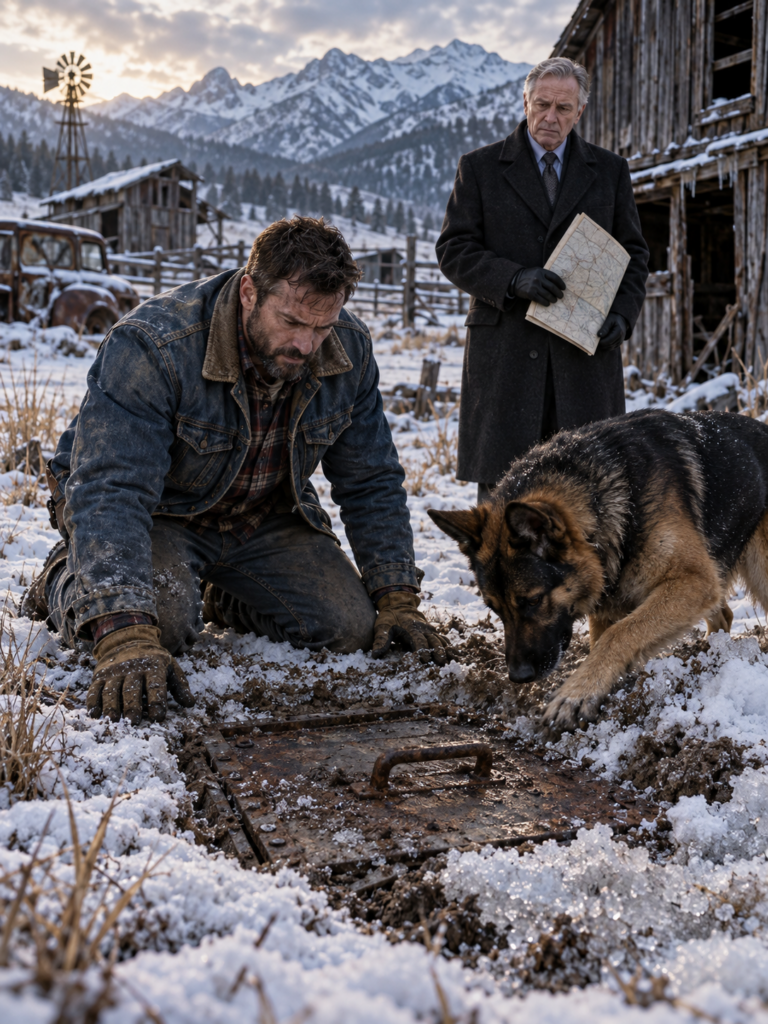
The hatch rose another few inches, releasing a breath of cold, stale air from the darkness below.
Caleb shifted his grip and pulled again.
This time, Reeves helped.
The heavy steel door finally opened far enough to reveal a square shaft descending into the earth.
A metal ladder disappeared beneath the barn.
Caleb leaned over the opening.
He could just make out concrete walls and a dim light far below.
“This wasn’t a root cellar,” he said.
“No.”
“Then what was Harold keeping under his property?”
Reeves approached the opening.
“The original structure was built in 1962 as a fallout shelter. Harold had it extensively renovated years later.”
Caleb looked at the lawyer.
“Renovated for what?”
“That is something he wanted you to see for yourself.”
Caleb studied the shaft.
He didn’t like entering an unfamiliar underground structure, particularly one whose maintenance history he hadn’t verified.
He tested the visible ladder supports and examined the concrete around the opening.
The ladder appeared stable, although that told him little about the condition of everything below.
“Stay up here,” he told Atlas.
The dog obeyed reluctantly.
Caleb began climbing.
At the bottom, his boots touched a cold concrete floor.
The weak lights revealed a space much larger than he had expected.
Steel beams crossed the ceiling.
Long rows of shelves lined the walls.
Metal containers stood stacked near emergency supplies, water storage, and old equipment.
Farther away, he heard a low mechanical hum.
“There’s power down here.”
Reeves descended behind him.
“Harold kept the essential systems maintained.”
Caleb walked slowly along the central passage.
His Army training made the structure immediately recognizable.
Reinforced construction.
Stored provisions.
A layout designed for isolation and extended use.
But something about it was unusual.
Parts of the shelter were decades old.
Other sections had clearly been modernized.
Newer electrical fittings ran alongside aging concrete.
And at the far end stood a reinforced steel door unlike anything in the original shelter.
Caleb pointed toward it.
“That’s the reason we’re here.”
Reeves nodded.
The lawyer climbed back up to help bring Atlas down safely.
When all three were inside, the dog immediately began investigating the unfamiliar scents.
Caleb approached the reinforced door.
Reeves produced a small brass key.
“Harold gave me instructions concerning this chamber.”
“You’ve been inside?”
“Yes.”
“How long have you known about it?”
“Several years.”
Caleb turned toward him.
“And you watched Logan take over the company without saying anything?”
Reeves held his gaze.
“I followed Harold’s instructions regarding when these materials could be disclosed.”
Caleb thought about yesterday’s laughter.
About Natalie looking at him with pity.
About the old man whose final months had been spent wondering what would happen to the business he built.
“What materials?”
Reeves inserted the key.
The lock turned.
The reinforced door moved inward.
Beyond it was a smaller vault chamber.
A heavy steel safe stood against the back wall.
Beside it was a wooden desk.
And on that desk rested a single sealed envelope.
Caleb could see his name on the front.
Harold’s handwriting.
For a moment, he didn’t move.
Then a metallic creak sounded above the doorway.
Atlas reacted first.
He stepped suddenly toward Caleb.
A loose support panel dropped from above.
Metal struck concrete with a deafening crash.
Atlas yelped.
“Atlas!”
Caleb dropped to his knees.
A bracket had caught the dog’s front leg.
The injury was bleeding, though the cut appeared shallow.
Caleb quickly examined the leg and wrapped it with a clean strip torn from his sleeve.
Atlas remained still, trembling slightly.
“Easy, partner. I’ve got you.”
Reeves looked at the fallen panel.
“If he’d been a few feet farther back—”
“Don’t.”
Caleb’s voice stopped him.
For several moments, the only thing that mattered was the dog’s breathing.
Then Atlas touched his nose against Caleb’s hand.
Caleb carefully helped him settle outside the damaged doorway.
He looked toward the desk.
The envelope remained exactly where Harold had left it.
Caleb walked over and lifted it.
He recognized the handwriting immediately.
The same distinctive letters he had seen on birthday cards and handwritten notes during his marriage.
The seal was intact.
On the envelope, Harold had written only Caleb’s name.
Reeves stepped closer.
“Whatever you think about yesterday, Harold wanted you to hear this from him.”
Caleb ran his thumb along the sealed edge.
For the first time, he understood that the public reading had concealed something deliberate.
The dollar had not been a careless insult.
The hidden ranch was not merely forgotten property.
And Harold had arranged for Reeves to bring him to this precise room.
But why?
Caleb broke the envelope’s seal and carefully drew out the folded letter.
The folded letter slid into Caleb’s hand, its thick paper stiff beneath his fingers.
He opened it carefully.
The first line made him stop.
Harold had written that the dollar was intended to protect a private arrangement from being discovered too soon.
Caleb read the sentence twice.
He looked toward Reeves.
“That’s why you gave it to me in front of everyone?”
“The public bequest was part of Harold’s plan,” the lawyer answered. “The separate instructions are here.”
Caleb lowered his eyes again.
Harold’s letter began with memories.
Not money.
Not property.
Memories.
The afternoons Caleb had driven him to the hospital when cancer treatment left him exhausted.
The broken fence behind the Whitmore residence that Caleb had repaired without being asked.
The long evenings when the old man had wanted company but couldn’t bring himself to say so.
Harold remembered Atlas, too.
He wrote about the dog’s patience, the way he had settled beneath Harold’s chair, and how he seemed to know when the old man was having a particularly difficult day.
Caleb swallowed.
He remembered those visits differently.
Most of the time, he’d felt useless.
There was nothing he could do to stop Harold’s illness.
He could bring groceries, fix things, drive, listen.
He couldn’t make the cancer disappear.
Yet Harold’s handwriting made clear that those ordinary acts had mattered.
Then the letter changed direction.
Caleb read a paragraph describing financial irregularities inside Whitmore Timber.
Unauthorized borrowing.
Questionable contracts.
Money transferred through companies whose ownership was deliberately obscured.
Harold believed the activity led back to Logan.
Caleb stopped.
For a moment he could only hear the low hum of the bunker equipment.
He looked at Reeves.
“Harold knew?”
“He suspected something was wrong. He eventually commissioned an investigation.”
“And what did it find?”
Reeves glanced toward the large safe.
“Evidence that made him deeply concerned about the future of the company.”
Caleb looked back at the letter.
Harold wrote that he had spent years building a business that employed thousands of people across Montana and Idaho.
Loggers.
Truck drivers.
Mill workers.
Mechanics.
Office employees.
Families whose mortgages, groceries, and futures depended on the company staying open.
If Logan’s financial conduct became public without a plan to protect the business, Harold feared the consequences would reach far beyond his son.
It was a possibility Caleb could understand.
He had known men who lost livelihoods because of decisions made far above them.
But something still bothered him.
“If Harold had proof, why didn’t he act himself?”
Reeves answered carefully.
“By the time the investigation was complete, Logan had significant influence over the company’s leadership and operations. Harold believed a poorly managed confrontation could destroy the company before its employees were protected.”
Caleb looked down.
The next paragraph contained a figure he almost thought he’d misread.
Fifty million dollars.
Harold described a protected trust assembled from the sale of private assets over approximately five years.
The money had been kept separate from Whitmore Timber’s operating accounts.
It was not an undisclosed company bank balance.
It was a reserve Harold had deliberately built beyond Logan’s control.
And Harold had named Caleb Ward as the person whose actions would determine whether the trust’s purpose could be fulfilled.
Caleb set the letter on the desk.
“Fifty million?”
Reeves nodded.
“The trust documentation is among the materials Harold preserved.”
“You’re telling me I inherited fifty million dollars?”
“Not as an unrestricted personal payment.”
The lawyer chose his words carefully.
“Harold established conditions. The funds are intended to help secure Whitmore Timber’s future after Logan is removed from control and the misconduct is properly exposed. You have an important role in that process.”
Caleb stared at him.
He remembered Logan laughing over the single dollar bill.
Natalie’s expression.
The casual way the family had divided Harold’s possessions.
And now this.
“Why would he choose me?”
Reeves gestured toward the letter.
“Because you were the person he trusted.”
Caleb shook his head.
“Trusting me to drive him to a doctor’s appointment isn’t the same as trusting me with a corporation.”
“Harold knew that.”
“Then he should’ve chosen someone who understands finance.”
“He chose people who understand finance to assist you.”
Caleb looked toward the steel safe.
“What people?”
“First, I think you should see what he collected.”
Reeves opened the safe with the access instructions Harold had left.
Inside were organized folders, financial statements, storage devices, and records gathered during the private investigation.
Caleb selected a folder.
The first pages described payments involving companies with no obvious reason to be receiving money from Whitmore Timber.
Other pages linked those companies to shipping and inventory transactions.
Caleb could follow portions of the pattern.
A company moved inventory.
A second company billed for services.
Funds passed through another account.
The documents suggested that timber shipments and internal payments were being used to move money away from legitimate operations.
He turned another page.
Several transactions had been flagged by Harold’s investigators.
“Are these authentic?”
“That is precisely what the investigators worked to establish,” Reeves said. “You’ll meet the people who can explain the records and the verification behind them.”
Caleb closed the folder.
“Logan’s been stealing from the company.”
“That’s what the evidence indicates.”
“And Harold expected me to do something about it.”
“Yes.”
Caleb sat on the edge of the wooden desk.
Suddenly the inheritance felt less like a reward than an obligation.
He had spent years fighting battles that other people planned.
He had left the Army hoping to find a quieter life.
Instead, his marriage had ended, his finances had deteriorated, and the only place he could afford to live was a small rented cabin.
Now a dead man had entrusted him with a corporate investigation.
Beside him, Atlas shifted his injured leg.
Caleb immediately knelt.
The temporary bandage remained in place, but the dog needed proper veterinary care.
Caleb examined him gently.
“You’ve already done enough for one morning.”
Atlas placed his muzzle against Caleb’s wrist.
Reeves waited.
Finally Caleb asked, “Suppose I say no.”
“Harold expressly allowed for that choice.”
“What happens to the money?”
“The trust has alternative provisions involving federal investigators. Harold understood that refusing the responsibility was a possibility.”
Caleb looked toward the letter.
He could walk away.
He owed the Whitmores nothing.
Natalie had made that abundantly clear during their divorce.
Logan had treated him like an embarrassment.
And Harold was gone.
There was no longer anyone who could demand that Caleb prove his loyalty.
But four thousand workers had no part in what happened between Caleb and the Whitmore family.
He thought of Harold sitting on the porch, looking toward the mountains.
Then he stood.
“I’m not making decisions about fifty million dollars based on one letter.”
Reeves nodded approvingly.
“That’s a reasonable position.”
“I want the evidence checked independently. I want to know what the trust documents actually say. And I want Atlas treated.”
“Agreed.”
Caleb put the letter back inside its envelope.
“Then let’s start there.”
***
The next morning, two people joined them at the ranch.
Maya Torres arrived first, a financial investigator with a direct manner and little patience for vague explanations.
Ethan Cole followed with a laptop, several storage devices, and the restless curiosity of someone who genuinely enjoyed untangling complicated systems.
Both had previously worked on assignments connected to Harold’s private investigation.
Maya shook Caleb’s hand.
“Harold spoke highly of you.”
“He apparently spoke highly of a man who doesn’t know much about accounting.”
“That makes you less likely to pretend you do.”
Ethan smiled.
Caleb wasn’t sure whether to take that as a compliment.
Atlas, whose injured leg had been examined and properly dressed, lay on a padded blanket beside the desk.
His eyes followed everyone moving through the bunker.
Maya began by explaining the documentary trail.
She showed Caleb how legitimate shipments had been linked to questionable contractors, how inventory values had been manipulated, and how funds appeared to have passed through businesses connected to Logan.
Ethan explained the corresponding digital records.
Some had been gathered during Harold’s original investigation.
Others needed further authentication.
The evidence was significant, but Maya refused to call every suspicious transaction proof of fraud.
“A strange payment isn’t automatically a criminal payment,” she told Caleb. “We need to establish where the money came from, where it went, and who authorized it.”
That mattered to him.
He had no interest in destroying Logan because he disliked him.
He wanted to know what could actually be proved.
Maya highlighted one set of transactions.
“These involve a private inventory operation near Kalispell.”
Caleb examined the associated records.
“Timber shipments?”
“Yes. We believe Logan used the yard to route inventory through companies he controlled. The documentation we have is incomplete.”
“What would confirm it?”
“Warehouse shipment identifiers and supporting records that match the financial trail.”
Caleb studied the map.
“Then that’s where we look.”
Maya nodded, although her expression remained serious.
“There’s a complication.”
She wrote a date on the whiteboard.
“The Jackson Hole charity gala.”
Caleb had heard Natalie mention the event during their marriage.
Whitmore Timber regularly used the gathering to entertain investors and announce major business arrangements.
“Logan is preparing to finalize a significant investment deal there,” Maya explained. “We believe the deal will make the disputed transactions harder to untangle.”
Ethan looked up.
“We have to preserve the records and get the evidence into the right hands before that happens.”
Caleb studied the dates.
“How long?”
“The event is approaching quickly. We need to move.”
He looked toward Atlas.
The dog lifted his head.
Caleb sighed.
“Last time I agreed to follow a map, we ended up in an underground vault.”
Maya almost smiled.
“Then this next part won’t surprise you.”
***
Their trip to Kalispell began in freezing weather.
Maya drove.
Caleb sat beside her studying the warehouse layout.
Atlas traveled in the back, resting carefully.
The yard lay among timber stacks, storage buildings, and industrial equipment.
What Caleb saw from a distance matched the maps and photographs Maya had shown him.
But he needed physical evidence of the shipments.
During a guard shift change, Caleb and Atlas entered through a loose section of perimeter fencing.
He knew it was risky.
He also knew that anything obtained improperly might become difficult to use later.
Nevertheless, the source records had led them here, and he made the decision to document what he could.
Inside the warehouse, he photographed identifying marks on timber containers and associated shipping manifests.
Several matched numbers Ethan had already flagged.
For the first time, the questionable financial records were connected to visible inventory.
Then Atlas froze.
Footsteps approached.
Caleb lowered himself behind a stack of crates.
Two guards entered.
A flashlight crossed the floor.
Atlas remained beside him, perfectly still.
One guard moved closer.
The beam caught the dog’s face.
“What the—”
Atlas barked.
The guard stumbled backward.
Caleb stepped forward, struggling briefly with him before breaking away.
A second guard shouted.
Then a gunshot cracked through the building.
Atlas yelped.
Caleb looked down.
Blood appeared along the dog’s shoulder.
“Atlas!”
He caught the dog by the harness and hurried toward the exit.
Outside, Maya had already opened the SUV.
Caleb lifted Atlas inside.
“Drive!”
The vehicle accelerated away from the yard.
Caleb pressed cloth against the wound, his face tight with fear.
Atlas had survived explosions and combat overseas.
He had survived the falling metal in Harold’s bunker.
And now Caleb had brought him into another dangerous situation.
“Stay with me,” Caleb whispered.
Atlas looked up and touched Caleb’s hand with his nose.
***
At the ranch, they treated the wound immediately and arranged veterinary assessment.
The bullet had grazed Atlas’s shoulder without causing the deeper damage Caleb feared.
But the injury was painful.
And Caleb knew he’d come too close to losing the companion who had stayed with him through everything.
He sat beside the resting dog while Maya and Ethan reviewed the photographs.
Then Maya approached.
“Caleb.”
He looked up.
“The shipment identifiers match.”
“Match what?”
“The companies and transactions Harold’s investigators flagged.”
Ethan turned his laptop toward them.
“It’s the connection we needed between the financial trail and the physical inventory.”
Caleb stared at the records.
Harold’s suspicions were no longer based solely on financial anomalies.
The evidence was beginning to form a coherent picture.
Maya showed him the corresponding records and the chain of transfers.
They led back toward Logan’s control of the business.
For the first time, Caleb understood what Harold had been trying to preserve beneath that forgotten barn.
Not simply money.
Evidence.
Evidence strong enough to threaten the person who had publicly inherited control of Whitmore Timber.
Caleb looked at the sleeping dog.
Then he asked Maya one question.
“How do we make sure this reaches people who can act on it?”
Maya exchanged a glance with Reeves.
“We prepare the complete record for investigators. And we make certain Logan cannot finalize that deal without his investors discovering what the documents show.”
Caleb turned toward the marked calendar.
Jackson Hole.
The gala.
The same family that had mocked him over one dollar would soon be forced to confront the evidence Harold had spent years collecting.
But Caleb’s decision was no longer about humiliation.
He looked back at Atlas.
Then he placed Harold’s letter beside the financial records.
“Get the files ready,” he said. “We’re going to Jackson Hole.”
Maya took Harold’s letter from beside the records and placed it inside a protective folder.
Then she opened the first file Ethan had prepared.
“We need to separate what we suspect from what we can demonstrate,” she said.
Caleb nodded.
“Start with what we know.”
They spent the following days working through the material.
It wasn’t glamorous.
There were no dramatic discoveries every hour.
There were long stretches of checking numbers, comparing documents, establishing dates, and determining which records came from which original sources.
Caleb learned to recognize the difference between a transaction that looked suspicious and one that could be connected to Logan through supporting evidence.
Maya reconstructed the flow of money.
Ethan organized the verified digital records.
Reeves reviewed the trust documents and coordinated the preservation and disclosure of the evidence.
The team prepared the material for federal investigators.
The planned Jackson Hole presentation would make the accusations public, but the underlying records were what mattered.
Caleb insisted on that distinction.
“I don’t want a room full of rich people deciding someone’s guilty because a screen tells them so.”
Maya regarded him for a moment.
“Neither do I.”
“Then we show what we have, and let the investigation establish the rest.”
It was the first time Caleb had truly felt that he understood his role.
He wasn’t expected to become a forensic accountant overnight.
He wasn’t being asked to replace Harold.
His job was to make difficult decisions without sacrificing the people affected by them.
And to refuse to let a powerful man bury evidence simply because he could.
***
Five days after the warehouse incident, Caleb stood outside the Grand Summit Hotel in Jackson Hole.
The evening air was bitterly cold.
Luxury vehicles arrived beneath the entrance lights.
Guests stepped onto the pavement wearing tailored suits, long coats, and expensive jewelry.
Inside, the ballroom glittered with chandeliers.
Caleb wore a dark suit that felt less familiar than his old denim jacket.
Atlas remained close beside him, his shoulder recovering beneath a carefully fitted harness.
Caleb had been reluctant to bring him.
But the dog was healing, his veterinarian had cleared him for limited activity, and the evening’s arrangements allowed him to remain at Caleb’s side.
Maya adjusted a folder beneath her arm.
“Everything’s ready.”
Ethan, standing nearby, nodded.
“The presentation files are organized. The supporting material has been forwarded through the channels Reeves arranged.”
Caleb looked across the ballroom.
There stood Logan Whitmore.
Black tuxedo.
Confident smile.
One hand wrapped around a glass as he entertained a circle of investors.
Caleb recognized the performance.
Logan had always known how to occupy a room.
He could speak about jobs, family values, and community investment with convincing warmth.
It was one of the reasons Harold had originally trusted him with increasing responsibility.
Caleb wondered how many people in this ballroom would struggle to reconcile that public image with the financial evidence.
Then Logan noticed him.
His smile changed.
He excused himself and crossed the room.
“Well, look who’s here.”
Caleb said nothing.
Logan looked him over.
“I didn’t realize this event was open to just anybody.”
His eyes moved toward Atlas.
“And you brought your dog.”
“He goes where I go.”
Logan laughed softly.
“Still doing everything together, huh?”
Caleb held his gaze.
“How’s the company, Logan?”
“Better than ever.”
“Good.”
“Why?”
Caleb glanced toward the stage.
“Because I hope the people who work there get to keep their jobs.”
For an instant, Logan’s expression tightened.
Then he smiled again.
“That’s a strange thing to say.”
Caleb didn’t answer.
Logan leaned closer.
“I heard somebody caused trouble at one of our warehouses.”
Caleb’s hand rested lightly on Atlas’s harness.
“Then I imagine your security people filed a report.”
Logan studied him.
“Careful, Caleb.”
“Enjoy your speech.”
The words were calm.
That seemed to bother Logan more than any threat would have.
***
The evening program began shortly afterward.
Guests gathered near the stage.
Reporters prepared their cameras.
Board members occupied tables closest to the front.
Logan stepped to the microphone.
He spoke about Whitmore Timber’s history, its workers, and the opportunities ahead.
Caleb listened.
Every time Logan mentioned Harold’s name, he felt the folded dollar in his pocket.
For several days he had carried it with him.
A reminder of the moment he had believed Harold’s family had finally found a way to dismiss him entirely.
Now he understood that the bill had been part of something larger.
But understanding the arrangement did not erase the humiliation.
Nor did it erase Harold’s secrecy.
Caleb still wished the old man had trusted him enough to explain the truth while he was alive.
Onstage, Logan began discussing a major investment partnership.
Maya glanced toward Caleb.
He nodded.
The presentation behind Logan changed.
A financial diagram appeared.
Then a sequence of company records.
Payments.
Transaction dates.
Connections between contractors.
Shipping information.
The ballroom’s low conversation gradually disappeared.
Logan turned toward the screen.
His expression sharpened.
“What is this?”
Maya moved toward the front.
“These documents concern transactions involving Whitmore Timber and companies connected to Mr. Logan Whitmore,” she announced.
Logan stepped away from the microphone.
“Who authorized this?”
Maya continued.
“The records have been reviewed as part of an investigation into suspected financial misconduct. Supporting material has been provided to federal investigators.”
The screens displayed the relationships between the accounts and the shipping records from Kalispell.
Caleb watched several board members lean forward.
One spoke quietly to another.
An investor stood.
Logan’s face reddened.
“This is fabricated!”
Maya didn’t raise her voice.
“The original records, transaction histories, and supporting evidence are available to the investigators handling the matter.”
Logan pointed toward Caleb.
“He’s behind this.”
Caleb walked forward with Atlas beside him.
The room became unusually quiet.
For eighteen months, Caleb had imagined what it would feel like to stand in front of the Whitmores without having to apologize for existing.
He had imagined anger.
Triumph.
Some perfect sentence that would finally make them understand what they had done.
But standing there, he felt mostly tired.
Logan stared at him.
“You have no idea what you’re interfering with.”
Caleb stopped several feet from the podium.
“I know what your father was afraid of.”
Something moved behind Logan’s expression.
“Don’t talk about my father.”
“He was worried about the company.”
Logan gave a brittle laugh.
“He left me the company.”
“Yes.”
Caleb reached into his pocket.
He unfolded the dollar.
Then he placed it carefully on the podium.
Logan looked down.
The paper lay between them, small and almost ridiculous beneath the stage lights.
Recognition crossed his face.
“You kept that?”
Caleb nodded.
“I did.”
Logan stared at the bill.
Caleb continued.
“Your father also left instructions about what should happen if the records he collected confirmed what he feared.”
Logan looked toward Reeves.
The lawyer stepped forward.
“Harold established a separate trust and made arrangements concerning emergency restructuring,” Reeves explained. “Those arrangements are now relevant to the company.”
The words drew immediate attention from the board.
Logan’s voice rose.
“That’s impossible.”
Reeves remained composed.
“The documents exist.”
For the first time that evening, Logan looked genuinely frightened.
Not because of a dramatic speech.
Not because Caleb had returned.
Because there were records he couldn’t simply talk away.
***
Federal investigators and officers who had been notified of the evidence entered the ballroom as the confrontation continued.
They approached Logan and requested his cooperation.
He protested.
He accused Caleb of trying to ruin the company.
He called the records fraudulent.
But the evening was no longer under his control.
A senior board member asked him to step away from the podium.
Logan refused at first.
Then he saw the expressions around him.
The investors who had been smiling at him an hour earlier were consulting quietly with advisers.
Other executives were avoiding his eyes.
The board members were gathering around Reeves and Maya.
The evidence had forced questions they could no longer ignore.
Logan looked at Caleb.
“You think you’re better than me?”
Caleb considered the question.
“No.”
Logan seemed almost disappointed by the answer.
“I think your father wanted the people who work for Whitmore Timber to have a future.”
Logan’s jaw tightened.
“He never trusted me.”
Caleb didn’t answer immediately.
He had read the old man’s letter enough times to understand something important.
Harold had trusted Logan once.
That was what made the discovery so painful.
The secret records weren’t evidence of a father who had always hated his son.
They were evidence of a father who had watched his confidence erode until he believed he had to protect his life’s work from the person expected to inherit it.
“Maybe he wanted to,” Caleb said.
Logan stared at him.
Then the investigators asked him to accompany them.
He was escorted away as the inquiry moved forward.
The legal consequences would take time.
The evidence would be examined.
Accusations would have to be tested.
But Logan’s uncontested control of the company had ended.
***
Near the ballroom entrance, Natalie stood beside a marble column.
Caleb hadn’t noticed her until then.
She looked at him with an expression he couldn’t immediately interpret.
“Did you know about all of this when the will was read?”
“No.”
She looked toward the podium.
“Dad really left those instructions?”
“Yes.”
Natalie folded her arms.
For once, she seemed to have nothing prepared to say.
“I thought he was insulting you.”
“So did I.”
Her gaze dropped to Atlas.
“He always liked that dog.”
Caleb gave a small nod.
“He did.”
Natalie looked toward the room where her brother had just been escorted away.
“Is the company going to survive?”
“That’s what we’re trying to make possible.”
She looked back at Caleb.
There was a time when he would have searched her face for an apology.
A sign that she understood the damage their divorce had done.
An acknowledgment that he had mattered to her.
Instead, he found himself thinking about the mill workers, the truck drivers, and the families who would wake the following morning wondering whether their paychecks were safe.
“I hope you can save it,” Natalie said.
Caleb answered quietly.
“So do I.”
Then he walked away.
***
The Whitmore Timber board convened to address the immediate leadership crisis.
With Harold’s trust documentation and the investigation records before them, the directors reviewed the emergency restructuring arrangements.
The process was contentious.
Some executives feared reputational damage.
Others worried about losing investors.
Several wanted operations suspended until the investigation progressed.
Caleb opposed that last option.
“If you shut down the mills without a plan, the people who had nothing to do with this will pay first.”
A director asked him what he proposed instead.
Caleb glanced toward Maya.
She had helped prepare a stabilization strategy using the protected trust funds.
The plan provided for independent financial oversight, changes in executive authority, transparent review of disputed contracts, and a reserve to maintain operations while the company addressed its problems.
Caleb didn’t pretend to understand every technical detail.
He asked questions when he needed to.
He challenged assumptions.
And he refused to approve decisions simply because someone wearing an expensive suit said they were necessary.
Ultimately, the board agreed to transfer operational control to Caleb under the emergency restructuring arrangements.
It was an enormous responsibility.
He accepted it on one condition.
“I’m not doing this alone. The people who know how to run these operations need to be part of fixing them.”
Maya nodded.
Reeves agreed.
And Whitmore Timber began the difficult work of separating its legitimate business from the misconduct uncovered by the investigation.
***
The weeks following Jackson Hole were not easy.
The scandal dominated regional conversations.
Federal investigators continued examining the financial records.
Logan faced serious legal proceedings.
Whitmore Timber had to review contracts, reconsider leadership decisions, and rebuild confidence among lenders, workers, and customers.
Caleb spent more time in meetings than he had ever imagined possible.
Some days, he missed the simplicity of his cabin.
Other days, he wondered whether Harold had understood how much responsibility he was placing on a man who had already spent years trying to recover from war.
But each time Caleb visited a mill or spoke with workers worried about their futures, the purpose became clearer.
Harold had not left him an easy fortune.
He had left him the opportunity to protect something bigger than either of them.
The fifty-million-dollar trust became central to that work.
Funds supported stabilization and necessary restructuring.
The company adopted stronger financial oversight.
Operations continued.
And the thousands of workers Harold had feared for retained their livelihoods.
For Caleb, that was the first genuine measure of success.
Not what Logan lost.
What others were able to keep.
***
Six months after the gala, spring arrived in the Bitterroot Mountains.
Snow receded from the valleys.
Streams ran along the edges of fields that had been silent throughout winter.
At the old ranch, fresh boards now covered the barn’s damaged walls.
The farmhouse had been repaired.
New fencing marked the training areas.
Small cabins stood along the property.
The steel hatch beneath the barn remained securely preserved, its entrance reinforced and access controlled.
But the ranch was no longer a secret hiding place.
It had become a center where military veterans could work with trained dogs as part of their adjustment to civilian life.
Caleb had used the available resources from Harold’s trust, after the company’s essential needs were addressed, to develop the program.
It was the first project in years that felt entirely his own.
Not because he had created it without help.
Maya had assisted with planning.
Reeves had handled legal arrangements.
Trainers and experienced staff had joined the effort.
But the idea came from something Caleb understood personally.
He knew what it meant to return home from a war and discover that the world expected you to become someone different overnight.
He knew what sudden sounds could do to a man who had spent years listening for danger.
And he knew how much one loyal animal could matter when everything else felt uncertain.
Atlas had proved it over and over.
***
One clear morning, Caleb stood near the training field watching a younger veteran struggle with a nervous German Shepherd.
The dog’s attention moved constantly.
The handler gripped the leash too tightly.
Each time the dog pulled away, the man became more frustrated.
Caleb walked toward them.
Atlas followed.
“Mind if I show you something?”
The veteran looked embarrassed.
“I’m not doing very well.”
“That’s all right.”
Caleb crouched beside the dog.
He asked the man to relax his grip and give the animal room to settle.
The dog hesitated.
Then Atlas approached.
He sniffed the younger dog calmly.
The other shepherd slowly stopped pulling.
The veteran looked down in surprise.
Caleb smiled.
“Sometimes the first thing they need is for us to stop fighting the leash.”
The man gave a small, uncertain laugh.
“I guess that applies to more than dogs.”
Caleb looked across the field.
“Yeah,” he said. “It does.”
He understood that healing wasn’t something a dog could accomplish alone.
Some veterans needed medical treatment.
Others needed counseling, time, family support, or help rebuilding everyday routines.
But companionship could make difficult moments less lonely.
And sometimes the simple act of caring for another living creature gave someone a reason to keep moving forward.
That mattered.
***
Later that afternoon, two pickup trucks arrived.
Several veterans climbed out, looking around the unfamiliar property.
Some seemed curious.
Others looked hesitant.
A man near the second truck stood with his hands in his pockets, watching the dogs in the training field.
Atlas noticed him.
The old shepherd walked over at an easy pace.
He stopped a respectful distance away.
The man crouched.
Atlas approached and gently rested his head against the man’s shoulder.
For several seconds, neither moved.
Caleb watched from the fence.
He remembered sitting in his cabin after the will reading, the single dollar on the table, convinced that the last person in the Whitmore family who had cared about him was gone.
Now he was standing on land that had once seemed abandoned, watching men who had also struggled to find their place after returning home.
He looked toward the repaired barn.
Beneath it, Harold’s bunker still contained the history of the decision that had brought them here.
The vault.
The documents.
The desk where a sealed letter had waited.
All of it had once represented secrecy and distrust.
Now the property above it represented the opposite.
A place where people could speak about their struggles.
Where asking for help wasn’t treated as weakness.
Where belonging didn’t depend on wealth or status.
Reeves joined him beside the fence.
“You’ve done something remarkable with the land.”
Caleb shook his head.
“A lot of people helped.”
“Harold would have been pleased.”
Caleb watched Atlas walk back toward the training field.
“Maybe.”
Reeves looked at him.
“You still have doubts?”
“About Harold?”
“Yes.”
Caleb considered his answer.
“I wish he’d told me the truth while he was alive.”
The lawyer remained silent.
“I wish I hadn’t needed to learn about it through a lawyer showing up at my door the morning after his family laughed at me.”
Reeves nodded slowly.
“That seems fair.”
Caleb looked across the mountains.
“But I understand why he was afraid.”
Harold had spent a lifetime building something he wanted to survive him.
Near the end, he had discovered that the future he expected was no longer secure.
His solution had been imperfect.
It had placed a heavy burden on someone already struggling.
But his underlying intention had been clear.
He wanted the company protected.
He wanted its workers protected.
And he wanted Caleb to know that the kindness he had shown an old man hadn’t been forgotten.
“Harold trusted me,” Caleb said finally.
Reeves smiled faintly.
“He did.”
Caleb rested his hands on the fence.
“For a long time, I wasn’t sure I trusted myself.”
Across the field, Atlas barked once, impatient for the next exercise.
Caleb laughed quietly.
“He never had that problem.”
***
As evening approached, the last training session ended.
The veterans returned to their cabins.
The fields settled into a peaceful silence.
Caleb stood on the ranch house porch, watching sunlight stretch across the grass.
Atlas lay beside his boots.
His front leg had healed from the bunker injury.
The bullet graze on his shoulder had left a small scar, almost hidden beneath his thick fur.
He moved more slowly than he had years ago.
But his eyes remained attentive.
The porch door opened.
Maya stepped outside carrying two mugs of coffee.
She handed one to Caleb.
“Everyone’s settled in.”
“Good.”
She leaned against the railing.
“New applications are coming in.”
Caleb looked toward the cabins.
“We’ll make room where we can.”
Maya nodded.
For a while, they watched the field without speaking.
Then she noticed the folded dollar in Caleb’s hand.
“You still carry that?”
He smiled.
“Not every day.”
He opened the bill carefully.
The creases had softened with use.
The paper was worn now, but still intact.
Maya studied it.
“It’s strange, isn’t it? Something that small starting all of this.”
Caleb looked at the dollar.
He remembered the lawyer’s conference room.
Logan laughing.
Natalie looking at him with pity.
The cold walk to his truck.
Atlas beside him.
And the terrible certainty that his loyalty had meant nothing.
Then he remembered the next morning.
The black SUV.
The map.
The barn.
The buried steel hatch.
The letter waiting underground.
He folded the dollar again.
“For a while,” he said, “I thought this was Harold’s way of telling me what I was worth.”
Maya looked toward him.
“And now?”
Caleb considered the question.
He could have answered with the amount of the trust.
Fifty million dollars.
A number large enough to change the lives of thousands of people.
But that wasn’t what he had been thinking about.
He looked across the field where a younger veteran was walking beside a dog.
The man seemed more relaxed than he had earlier that morning.
Not healed.
Not suddenly free of everything he carried.
Just a little less alone.
Caleb slipped the dollar into his pocket.
“Now I think it was his way of making sure I found the rest.”
Maya smiled.
Atlas raised his head at the sound of Caleb’s voice.
Caleb crouched beside him.
For a moment, he remembered another place, another time.
A shattered building overseas.
Dust in the air.
Pain.
The fear that he might never make it home.
And Atlas pulling him toward safety.
Later, in Montana, the same dog had stood between him and falling metal.
He had stayed close through storms, nightmares, humiliation, and uncertainty.
He had never cared whether Caleb had one dollar or fifty million.
Caleb scratched gently behind his ears.
“Some inheritance, huh, buddy?”
Atlas leaned into his hand.
His tail struck the porch boards twice.
Beyond them, the Bitterroot Mountains rose into the evening sky.
Caleb stood again and watched the last sunlight settle over the ranch.
He no longer lived in the small cabin where he’d spent that lonely winter.
He no longer measured his future by what he’d lost in the divorce.
And he no longer believed that a person’s value could be determined by the amount written beside their name in a will.
Harold’s buried secret had revealed a financial betrayal.
It had helped expose Logan’s misconduct.
It had preserved a company and the livelihoods connected to it.
But the part Caleb carried with him most deeply wasn’t the money.
It was the memory of an old man who had seen his worth at a time when Caleb could barely see it himself.
He looked toward the training field.
Tomorrow, more veterans would arrive.
More dogs would need patience and guidance.
More difficult days would come.
And Caleb knew some of his own difficult days would return, too.
But he had somewhere meaningful to be.
People depending on him.
A purpose that belonged to the life he was building rather than the one he’d lost.
Atlas rose and stood beside him.
Caleb rested a hand on the dog’s head.
“Come on, partner,” he said softly. “We’ve still got work to do.”
Together, they walked down the porch steps toward the quiet field.
The folded dollar remained in Caleb’s pocket.
He would keep it—not as proof of the fortune he had discovered, but as a reminder of the one thing Atlas and Harold had understood long before he did.
Loyalty was never measured by what someone could give you.
It was measured by who stayed when you had nothing left to give.

