
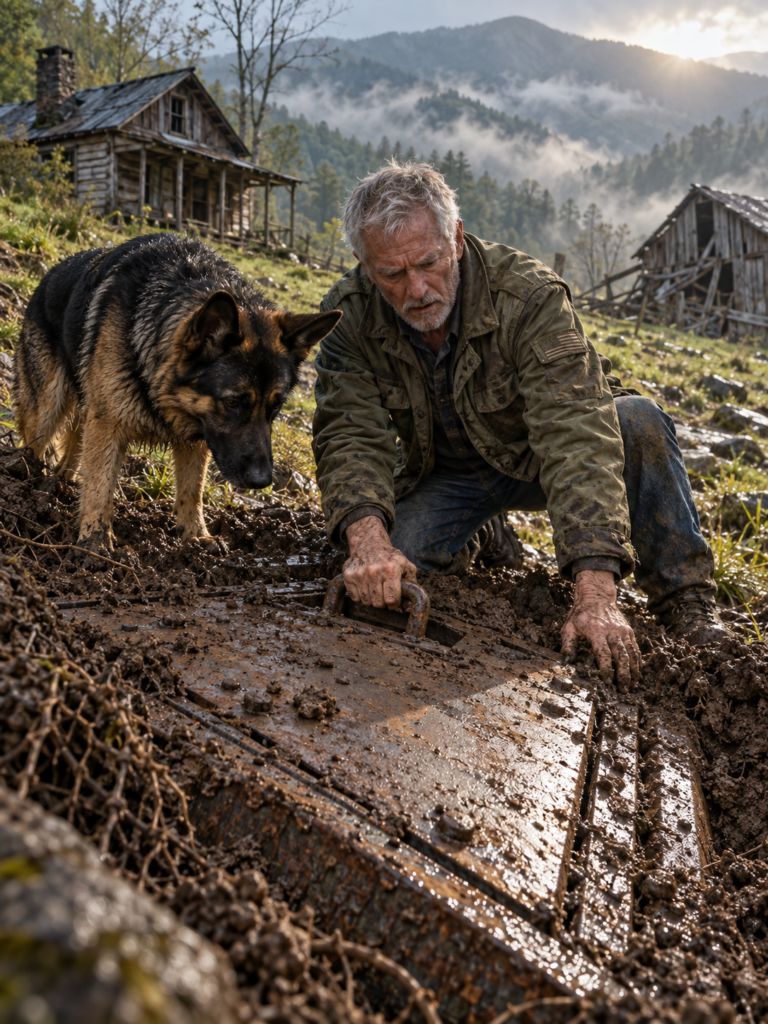
Daniel’s second boot found the next rung, and the cold metal vibrated beneath his weight.
He descended cautiously, pausing whenever his injured knee complained.
Above him, Shadow paced around the open hatch, occasionally lowering his head into the shaft.
“Stay up there,” Daniel called.
The dog gave a dissatisfied whine.
At the bottom, Daniel stepped onto concrete and held still.
The silence was extraordinary.
Even the noises of the forest seemed far away.
His flashlight revealed a chamber roughly the size of a small garage. Reinforced walls enclosed the space, and heavy steel supports ran across the ceiling.
Dust covered most surfaces.
But the room was unexpectedly orderly.
Wooden crates stood in rows against the left wall. A metal desk occupied the far corner, and several large maps hung beyond it.
Daniel moved toward the crates.
The first bore faded military-style markings.
He brushed a layer of dust from the wood with his sleeve.
His heartbeat quickened.
The markings identified the United States Army Corps of Engineers.
Daniel stepped back.
He had spent 32 years in the Army, much of that time working with engineering operations.
He knew the difference between ordinary military surplus and equipment organized for a specific installation.
These crates appeared to belong to the latter.
A second crate carried an old project designation and a year.
1963.
Daniel repeated the year quietly.
That was long before his military career.
Back when the Cold War had shaped American emergency planning.
He had heard stories about underground facilities, communications stations, and civil defense preparations.
But finding marked engineering equipment beneath his father’s abandoned land was something else entirely.
He turned toward the desk.
Brittle sheets lay scattered across its surface.
Daniel lifted one by the edges.
Structural drawings.
Measurements.
Sections of reinforced concrete.
He recognized the layout of the chamber around him.
At least part of the drawing depicted the very structure in which he stood.
So this was not simply a farmer’s personal shelter assembled from salvaged government equipment.
The room belonged to a planned installation.
That answered one question.
It made another impossible to ignore.
How had his father become involved?
Daniel inspected the maps.
They showed portions of the Appalachian region, with several locations circled.
One circle appeared to correspond to the ridge behind the Brooks cabin.
He followed the lines with his flashlight.
If the map represented a larger infrastructure program, this site might have been one component of it.
But a map alone could not tell him how the land had been acquired, who controlled the equipment, or what responsibilities his father had held.
“There’s more to you than I knew, Dad.”
A sharp bark sounded overhead.
Daniel looked up.
Shadow was watching from the opening, his front paws dangerously close to the edge.
“Easy. Don’t jump.”
The dog pulled back.
Daniel returned to the desk and examined the scattered papers more carefully.
Among the drawings lay several thick folders.
Their covers were worn, but the paper inside appeared less exposed than the documents on the desktop.
He opened the first.
Engineering plans.
Equipment inventories.
Ventilation specifications.
The pages described a structure intended to function independently when ordinary services were interrupted.
There were references to emergency communications and water storage.
Nothing Daniel had seen suggested a weapons installation or a hidden fortune.
The facility’s significance appeared more practical.
It had been built to keep essential equipment and people functioning during a crisis.
Then Daniel found a designation repeated across several documents.
Site 47B.
He looked back toward the wall map.
The same designation appeared beside the circle marking the ridge.
The connection was no longer just a guess.
He now had multiple documents placing the installation beneath his family property.
A noise came from the ladder.
Daniel turned.
Shadow had begun working his way downward, moving cautiously on the rungs.
“You’re supposed to be watching the top,” Daniel said, half exasperated.
But the dog continued until he reached the concrete floor.
Daniel steadied him at the bottom.
Then Shadow walked directly to his side.
For the first time in days, Daniel felt something other than exhaustion and loss holding his complete attention.
He wasn’t thinking about Caroline.
He wasn’t remembering the lawyer’s office.
He was trying to solve a question that had been buried beneath the land his father had left him.
And the answer might be in the documents in front of him.
He returned to the desk, pulled another folder from beneath the stack, and began separating its yellowed pages.
Near the back, a report was clipped to a set of installation drawings.
Daniel turned the final page over.
At the bottom was a typed line identifying the report’s author.
He brought the flashlight closer.
The name was familiar enough to make his hand stop moving.
Harold Brooks.
His father.
Daniel held the flashlight steady over the name.
Harold Brooks.
For several moments he didn’t turn the page.
He had expected to find evidence that his father had known about the bunker. Perhaps Harold had allowed someone to use the property. Perhaps he’d bought the land after the installation was abandoned.
But this was different.
His father’s name appeared on an engineering report connected directly to the underground facility.
Daniel lowered himself into the dusty chair beside the desk.
Shadow came closer and rested his head against Daniel’s leg.
“Looks like you found more than a place to dig,” Daniel whispered.
He began reading.
The report dated from 1963.
It described the installation of an emergency support site in the Appalachian region during the Cold War.
According to the documents, the facility was intended to preserve supplies and working infrastructure in the event of a major national emergency.
Its equipment could support communications, repairs, and emergency operations if conventional systems were damaged or unavailable.
The inventories listed field radios, engineering tools, medical supplies, maintenance equipment, and provisions stored for emergency use.
But what held Daniel’s attention was the information concerning Site 47B itself.
Harold Brooks had been involved in the site’s engineering work and later its maintenance.
Daniel looked at the signature line again.
He recognized the name.
He recognized the family connection.
What he could not reconcile was the man described in those papers with the father he remembered.
Harold had always seemed content with ordinary routines.
He repaired fences.
He tended the land.
He kept the old water pump working long after it should have been replaced.
When Daniel was young, his father sometimes left home to collect parts or tools, returning with little explanation.
Daniel had assumed it was simply what a man did when he owned an isolated mountain property.
Now he wasn’t certain those trips had always been for farm work.
He continued examining the records.
One sheet identified Site 47B as part of a wider emergency infrastructure program.
Another connected its location to the coordinates of the ridge outside.
This was the answer to why the bunker had been built there.
The site was remote, protected by the surrounding terrain, and capable of remaining unnoticed.
Its concealment had been deliberate.
Not because it housed evidence of a crime.
Not because Harold had been hiding a personal fortune.
The facility had been designed for a period when authorities feared that essential services might suddenly become unavailable.
Daniel sat back and studied the room.
The stacked crates no longer looked like an inexplicable collection of military objects.
They belonged to a particular purpose.
The maps were not treasure maps.
They recorded infrastructure locations.
The thick walls weren’t meant to imprison anyone.
They were meant to protect what was inside.
The mystery had become less frightening.
And more personal.
Because his father had helped build something intended to survive catastrophe, then spent years caring for it without ever making that part of his life known to Daniel.
“Why didn’t you tell me?” he asked quietly.
No answer came.
Only Shadow’s steady breathing beside the chair.
Daniel carefully returned the report to its folder and turned his attention to the crates.
He had no reason to assume that decades-old equipment was safe or still usable, and he understood that government markings raised questions about its status.
Still, he could document what he found without disturbing more than necessary.
One crate contained sealed metal cases.
Another held emergency equipment and old field manuals.
He examined a radio case, then replaced it.
A metal cabinet against the wall contained additional supplies.
The arrangements suggested that the facility had been stocked for practical use rather than converted into a private storehouse.
Then Shadow stiffened.
The dog’s ears went up.
A low growl escaped his throat.
Daniel turned sharply.
“What is it?”
Shadow stared toward the crates at the opposite end of the room.
Daniel raised the flashlight.
Something moved behind the wood.
For one instant, all his military instincts returned.
He stood motionless, scanning the narrow gap between the crates and the wall.
Then a large raccoon emerged.
The animal darted across the floor toward the ladder.
Shadow barked.
“Leave it!”
The raccoon scrambled upward and disappeared into the daylight.
Daniel let out the breath he’d been holding.
The dog turned back toward him, looking immensely satisfied.
“Wonderful security work,” Daniel said. “Though I think that fellow had the place before we did.”
He shook his head and laughed.
The sound surprised him.
It had been a long time since laughter came without effort.
He spent another hour examining the chamber.
Beyond the desk stood a large structure covered by canvas.
When Daniel pulled the tarp back, he found an industrial generator.
The machine was substantial, connected to the facility’s original power system.
Daniel inspected the housing and nearby equipment without attempting to start it.
An installation designed to withstand extended interruptions would need electricity.
The presence of a dedicated generator fit the facility’s purpose.
Nearby were water-storage components, ventilation equipment, and maintenance areas.
Taken together, the pieces told a coherent story.
Site 47B had been designed as a functioning emergency support installation.
And Harold Brooks had maintained it.
That explained the reports and the preserved arrangement.
It didn’t explain why his father had kept the work entirely out of their conversations.
But Daniel knew better than to confuse an unanswered family question with evidence of wrongdoing.
Harold had lived through an era when military and civil-defense projects were often handled discreetly.
Perhaps he had been instructed not to discuss the facility.
Perhaps he believed the subject was unimportant once the project ended.
Perhaps he was simply the kind of man who allowed work to speak for itself.
Daniel could not establish which explanation was correct.
He refused to invent one merely because he wanted an answer.
Before leaving, he examined the condition of the ladder and the hatch from below.
He was already thinking about restoration, but his engineering experience warned him against trusting old structures without checking them thoroughly.
He gathered the papers he had handled, returned them to their places, and climbed toward the surface.
Shadow remained close, following only after Daniel reached the top.
Outside, the afternoon had turned warm.
Sunlight fell across the hill.
A breeze stirred the long grass around the exposed hatch.
From the surface, the opening looked small compared with the facility beneath it.
Daniel stood there, looking toward the cabin.
He remembered the day his father had shown him how to repair a broken fence rail.
Harold hadn’t simply completed the work himself.
He’d placed the tools in Daniel’s hands and shown him what to examine.
“Understand what you’re fixing before you start fixing it,” he’d said.
Daniel had carried that lesson into military service.
He’d used it on damaged machinery, temporary bridges, and countless engineering problems that required patience instead of force.
Now he was standing on his father’s hillside, looking at one of the most complicated things Harold had ever worked on.
And he had barely known it existed.
Daniel lowered the hatch and secured it against accidental entry.
He walked toward the cabin with Shadow beside him.
The old house still needed repairs.
So did the barn.
The garden was overgrown, and sections of fencing had collapsed.
Three days earlier, Daniel had seen those problems as obstacles between himself and a quiet retirement.
Now he saw them as work worth doing.
The discovery hadn’t handed him money.
It hadn’t solved his divorce.
It hadn’t changed the injury in his knee or given him back the marriage he’d believed would last the rest of his life.
But it had returned something he hadn’t realized he’d lost.
A reason to get up the next morning.
Over the following days, he began repairing the homestead.
He replaced damaged roofing boards, cleared the porch, checked the plumbing, and made his father’s old bedroom usable.
Shadow stayed close.
Sometimes the dog slept beside the tools.
Sometimes he patrolled the fence line.
And sometimes he wandered toward the hill and watched Daniel as if expecting the metal door to open again.
Daniel returned to Site 47B regularly.
He worked through the documents, distinguishing the installation’s original purpose from what remained functional.
He inspected the generator and the supporting systems.
The equipment required careful attention, but much of the underlying structure was remarkably sound.
After cleaning, examining, and testing components, he eventually managed to bring the generator into operation.
The machine rumbled through the underground chamber.
A moment later, the electric lights came on.
Daniel stood in the middle of the room, looking around.
Under steady light, he could finally appreciate the scale of his father’s work.
The concrete walls.
The organized storage.
The water and ventilation systems.
The engineering decisions that had allowed the facility to survive long after its original program faded into history.
It had been built to provide help when ordinary life was disrupted.
Daniel looked toward the folder bearing Harold’s name.
“Well, Dad,” he said softly, “some of your work still holds up.”
Shadow wagged his tail beside him.
Yet Daniel’s discovery had another consequence.
A consequence he didn’t recognize immediately.
The more he restored the property, the more noticeable it became.
Smoke rose from the chimney.
The porch no longer sagged.
Light appeared at night.
People in nearby Pine Ridge began talking about the veteran who had returned to the Brooks homestead.
Then Martha Hill, the owner of the town’s hardware store, drove up one afternoon.
She had known Harold.
And when she saw Daniel restoring the place, she smiled.
“Your father would have liked seeing somebody take care of this land again.”
Daniel glanced toward the hillside.
“I’m learning there was a lot about him I didn’t know.”
Martha studied his expression, but he didn’t explain further.
He wasn’t ready to turn the underground facility into local gossip.
Still, stories traveled.
And as spring advanced, Daniel’s return became part of the town’s conversation.
One afternoon, Shadow helped locate a young boy who had wandered into the woods near a creek.
The child was frightened but unharmed.
His older brother embraced him when Daniel brought him back.
Martha shook her head in amazement.
“That dog of yours is going to be famous around here.”
Daniel looked down at Shadow.
“He’ll expect better meals.”
But the search changed something important.
People who had known Daniel only as a quiet veteran living outside town began greeting him as a neighbor.
They remembered what Shadow had done.
They saw Daniel’s work.
And Daniel, who had returned to the mountains hoping to avoid the world, found himself becoming part of a community.
By then, months had passed since the divorce.
His cabin was warmer.
The garden had begun growing.
And Site 47B was no longer merely a bewildering discovery beneath the earth.
It was becoming a meaningful project.
Then, one morning, Shadow stopped in the clearing and stared toward the road.
An unfamiliar black SUV approached through the mist.
Daniel set down his coffee.
The vehicle stopped near the cabin.
The driver’s door opened.
And Caroline Brooks stepped out.
She looked toward the restored house, the repaired barn, and the hillside behind them.
Then she turned to Daniel.
“I heard you’ve found something interesting on this property.”
Shadow moved quietly between them.
Daniel rested a hand on the dog’s neck.
For the first time, he understood that the secret beneath his father’s hill had reached the one person who believed the old homestead was worthless.
And Caroline had driven four hours to find out whether she had been wrong.
Daniel watched Caroline cross the clearing.
Her shoes sank into the soft ground, and she glanced down with visible irritation before continuing toward the porch.
Shadow stood in front of Daniel.
His body was rigid, ears upright, eyes fixed on the approaching woman.
“Easy,” Daniel said.
The German Shepherd remained still but stopped growling.
Caroline removed her sunglasses.
“Hello, Daniel.”
He looked at the woman he had once expected to grow old beside.
Six months earlier, he would have asked whether she wanted coffee.
He would have brought her suitcase inside.
He might even have believed that the journey meant she wanted to repair their marriage.
Now he waited.
Caroline looked around the property.
“The place looks different.”
“I’ve been working on it.”
“I can see that.”
Her gaze moved from the roof to the straightened fence and the barn beyond.
The restored homestead clearly wasn’t what she had expected.
When they divorced, she had dismissed Harold Brooks’s mountain property as a burden.
A neglected cabin.
Unproductive land.
An inheritance with little financial value.
That had been her reason for showing no interest in it while seeking the family’s principal residence and financial assets.
Now the old property was alive again.
And somewhere beneath the hill was a facility whose existence had started attracting attention.
Caroline folded her arms.
“People have been telling stories.”
“People do that.”
“About the hill.”
Daniel said nothing.
She studied him.
“Is there really some kind of military installation under this property?”
Shadow shifted closer to Daniel.
Caroline noticed.
“Your dog still doesn’t like me.”
Daniel’s hand remained on the dog’s neck.
“He doesn’t need to.”
For a moment, Caroline looked as though she might challenge the remark.
Instead, she drew a careful breath.
“Daniel, I’m not here to fight.”
“Then what are you here for?”
“To discuss what’s been discovered.”
Daniel glanced toward the hill.
“Why?”
“Because if there’s something valuable on that land, we need to understand what it means.”
“We?”
Caroline hesitated.
“The property was connected to our marriage.”
Daniel watched her face.
She had not asked how he was living.
She had not mentioned his knee, which made him noticeably limp on the uneven ground.
She had not even asked about Shadow, though she had known the dog for years.
Instead, she had arrived asking about an underground installation.
“Six months ago,” Daniel said, “you wanted nothing to do with this place.”
“That was before I knew there might be something important here.”
He nodded slowly.
There it was.
The reason for the journey.
Caroline looked toward the hill again.
“Do you know what a government installation could be worth?”
“I know what the documents say it was built for.”
“That’s not what I asked.”
“No,” Daniel agreed. “It isn’t.”
She stepped closer.
“Victor thinks developers might pay a great deal for a property with that kind of history.”
Victor.
Daniel knew the name only through the life Caroline had begun building after leaving him.
Victor Hale was a real estate developer, and the investments associated with him had once seemed to offer Caroline the future she wanted.
What Daniel didn’t know was the full extent of their financial trouble.
Back in Charleston, Caroline and Victor had suffered severe losses through their development investments.
The money she had expected to grow had instead diminished.
The possibility of valuable property in the mountains had suddenly become attractive.
Daniel didn’t need to know every detail of those losses to understand Caroline’s interest.
Her own words were enough.
She had rejected the land when she believed it was worthless.
She wanted a share now that she believed it might hold something profitable.
Daniel gestured toward the cabin.
“We can talk inside.”
Caroline seemed surprised.
But she followed him.
Shadow stayed beside Daniel as he crossed the porch and opened the door.
Inside, the cabin smelled of coffee, fresh wood, and the faint remains of the previous night’s fire.
The floors had been cleaned.
The furniture was repaired.
Tools were stored neatly along one wall.
The old stone fireplace had become the center of a home again.
Caroline looked around in silence.
“You really did all this yourself?”
“Most of it.”
“It must have cost something.”
“Mostly time.”
She ran a hand over the wooden table.
For a brief moment, Daniel wondered whether she was remembering their early years together.
They had once made plans for retirement.
She had talked about traveling.
He had imagined quiet mornings, a garden, and somewhere to work with his hands.
The old mountain property had been part of that imagined future.
But he didn’t mistake her silence for regret.
Finally, Caroline turned toward him.
“If that bunker contains equipment the government wants, or infrastructure a developer can use, the property could be worth millions.”
Daniel took the chair near the table.
Shadow settled beside him.
“Could be,” Daniel said.
“Then we need to discuss what happens next.”
“What happens next depends on what the property records and the divorce agreement actually say.”
Caroline looked annoyed.
“You know I was married to you when you owned this land.”
“And you know you chose not to pursue it when we separated.”
“That doesn’t necessarily mean I can’t challenge anything.”
“No. It doesn’t.”
Daniel wasn’t interested in pretending he could settle a complicated legal question by arguing across a kitchen table.
But he also wasn’t going to treat Caroline’s speculation as proof that she owned part of the bunker, its contents, or anything connected to it.
The old project documents identified government equipment and an installation history.
They didn’t establish that Daniel had discovered a privately owned fortune.
Nor did they transform the property into an asset worth millions simply because an old facility existed beneath it.
Caroline had come expecting a financial revelation.
Daniel had already learned a different lesson.
The bunker mattered because of what it had been built to do.
And because of the man who had cared for it.
“My father worked on that place,” Daniel said.
Caroline blinked.
“What?”
“He was one of the engineers involved with it.”
“Harold?”
Daniel nodded.
“The reports are down there. His name is on one of them. The site dates back to 1963.”
Caroline appeared genuinely startled.
“Your father never told us.”
“He never told me, either.”
For the first time since arriving, she seemed interested in something other than the potential price of the property.
“What was it for?”
“Emergency support. Communications, equipment, supplies, infrastructure. Things that could help people keep going if a major disaster interrupted ordinary services.”
She considered that.
“Then there must be some important machinery down there.”
“There is old equipment.”
“Which could be valuable.”
Daniel lowered his eyes briefly.
The conversation had returned to money.
He looked at Shadow.
The German Shepherd rested his chin on Daniel’s boot.
Months earlier, the dog had done the same thing when Daniel struggled to sleep.
Back then, Daniel had been convinced that losing his marriage meant losing everything that made his life recognizable.
Now, sitting in the cabin his father had left him, he understood how mistaken that belief had been.
He still had his skills.
He still had the ability to work.
He still had the loyalty of the animal beside him.
And he had found a place where those things mattered.
“Caroline,” he said, “I didn’t come up here looking for money.”
“Nobody said you did.”
“You keep talking about what that hill could sell for. I keep thinking about what my father helped build.”
“Sentiment doesn’t pay bills.”
“No,” Daniel said. “But it can tell you which bills are worth taking on.”
She frowned.
He continued.
“The roof was leaking when I got here. The barn was leaning. The garden was gone. I could barely sleep through a night without thinking about the courthouse.”
Caroline looked away.
“I know things were difficult.”
“You knew they would be.”
She didn’t answer.
Daniel wasn’t trying to punish her with the conversation.
He had spent enough nights replaying their divorce.
He simply wanted her to understand what she was asking him to surrender.
“Working here gave me something to do every morning. Fixing that facility helped me remember what I was good at. I found out my father had spent years looking after something that could help people when they needed it.”
He glanced toward the window.
“And the neighbors have treated me like I belong here.”
Caroline studied him.
“You’ve become attached to this place.”
“Yes.”
“Too attached to see an opportunity?”
Daniel shook his head.
“Maybe I’m finally seeing one clearly.”
Silence settled across the room.
Caroline walked to the window, looking at the hillside beyond the garden.
“Victor says an installation like that could attract serious investors.”
“Victor hasn’t inspected it.”
“He knows real estate.”
“And I know engineering.”
She turned back toward him.
Daniel’s voice remained level.
“Old government equipment isn’t automatically ours to sell. An underground structure isn’t automatically worth a fortune. And I’m not going to tear apart my father’s land because somebody imagines there’s a check waiting underneath it.”
Caroline’s face tightened.
“You’ve always been stubborn.”
“Maybe.”
She looked down at the floor.
Then she changed her approach.
“You could at least consider what this might mean for both of us.”
Daniel studied her.
“For both of us?”
“We spent 35 years together.”
“We did.”
“That has to count for something.”
“It does.”
For a moment, she looked hopeful.
Then he continued.
“But it doesn’t mean we’re still making decisions as husband and wife.”
Caroline’s expression hardened.
“You can’t just shut me out.”
Daniel stood slowly.
His knee ached as he straightened.
He walked to the front door and opened it.
Sunlight spilled across the wooden floor.
Outside, the clearing looked bright and peaceful.
Shadow rose and came to his side.
Caroline stared at the open doorway.
“You’re asking me to leave?”
“I’m telling you I’ve heard what you came to say.”
“You could regret this.”
Daniel considered her words.
He had spent months regretting things.
Conversations he should have had.
Work that kept him away from home.
Promises neither of them had managed to keep.
But returning to his father’s land was not among his regrets.
“Maybe you’ll decide to pursue a claim,” he said. “If you do, it’ll have to be handled properly. I’m not deciding ownership questions standing in this cabin.”
Caroline gathered her coat.
“You really aren’t going to discuss selling?”
“No.”
She stood motionless for a moment, looking at the repaired room.
Then she passed him through the doorway.
Shadow watched her but didn’t bark.
Caroline walked down the porch steps to the waiting SUV.
The engine started.
Gravel shifted beneath the tires.
Daniel remained in the doorway until the vehicle disappeared around the bend in the forest road.
Then he closed the door.
The latch clicked into place.
He stood there a moment longer, listening to the quiet cabin.
Shadow pressed against his leg.
Daniel knelt and wrapped one arm around the dog’s shoulders.
“I spent a long time thinking I had nothing left,” he said.
Shadow leaned into him.
Daniel smiled faintly.
“Guess we were both wrong.”
He didn’t know what Caroline would choose to do next.
But he knew what he would do.
He would keep caring for the land.
He would preserve what he could of his father’s work.
And he would make a home here.
Not because the mountains had made him wealthy.
Because they had given him something worth staying for.
***
Summer arrived with heat rising from the valley and long green afternoons spreading across the ridges.
By then, the Brooks homestead was almost unrecognizable.
Daniel repaired the barn until its red boards stood straight again.
The garden produced potatoes, beans, and corn.
The fence posts were secure, the road cleared, and the cabin roof held firm against the rain.
Shadow continued his daily patrols, moving from the barn to the tree line before returning to the porch.
Sometimes Daniel watched him and remembered the extraordinary circumstances that had brought them back to the mountains.
A divorce.
A truck loaded with almost everything he owned.
An abandoned property.
A dog that wouldn’t stop digging.
And beneath the soil, a steel hatch that had remained unnoticed for decades.
Daniel kept working on Site 47B.
He sorted the old documents with increasing care.
He preserved what he could of the original equipment and left the historical records organized.
With his knowledge of engineering, he inspected and restored the generator, ventilation, and water-support systems.
He understood that an old underground facility was not safe simply because it had been built well.
Systems required maintenance.
Old components failed.
Access had to be managed responsibly.
But the chamber’s fundamental construction had survived remarkably well.
And as Daniel worked, its original purpose grew more meaningful.
The facility had been designed to support people during emergencies.
That was what Harold had helped build.
What good was preserving it if it never served anyone?
Martha Hill was among the first people Daniel spoke with about that possibility.
She had become a regular visitor to the homestead.
Sometimes she brought supplies from the hardware store.
Sometimes she came to see how the repairs were progressing.
And sometimes she simply sat on the porch drinking coffee while Shadow rested at her feet.
One afternoon in late August, Martha arrived while dark clouds gathered beyond the ridge.
She climbed out of her truck and studied the sky.
“Looks like we’re getting serious weather.”
Daniel followed her gaze.
The mountains were nearly hidden behind gray clouds.
“Could be a rough night.”
Martha stepped onto the porch.
“Some people in town have been talking about your old shelter.”
Daniel turned toward her.
“Oh?”
“Flooding’s always a worry when we get storms like this. Folks know you’ve been fixing it up.”
He looked toward the hill.
He had considered making the restored facility available for emergencies.
But considering an idea and putting it into practice were different things.
He understood the responsibility that came with inviting people into a structure.
Still, much of his recent work had been directed toward exactly that possibility.
Fresh emergency supplies had been organized.
The equipment had been inspected.
The access route had been cleared.
The generator was functioning.
And the central chamber was ready for practical use.
“If people need help,” Daniel said, “we’ll do what we can.”
Martha smiled.
“Your father would appreciate that.”
Daniel looked toward the hillside.
The remark stayed with him.
He had spent months wondering why Harold had never discussed Site 47B.
But he was beginning to understand that his father’s silence did not diminish the work.
The records established what Harold had done.
The facility itself demonstrated the care with which the engineering had been carried out.
And Daniel could choose what that work meant now.
The first thunder arrived just after sunset.
Rain followed.
At first, it fell steadily against the cabin roof.
Then the wind strengthened, moving through the trees in long, restless bursts.
Lightning flashed beyond the ridge.
Daniel checked the windows, secured the porch, and made sure the equipment in the shelter was prepared.
Shadow followed him from room to room.
By midnight, the storm had become severe.
Rain hammered the roof.
Water rushed through the low ground beyond the clearing.
The dirt road gleamed in the headlights when the first truck appeared.
Daniel looked through the window.
A second vehicle followed.
Then another.
He put on his jacket and stepped outside.
Shadow stayed close as Daniel approached the arriving neighbors.
Families from Pine Ridge had come seeking safer ground.
Some lived near the river.
Others had been concerned about flooding along the roads and low-lying properties.
They had heard about the underground shelter.
And now they were looking to Daniel for help.
He looked at the faces in the rain.
Parents holding children close.
Older neighbors climbing carefully from their vehicles.
People frightened by a storm whose strength they couldn’t control.
Something in Daniel’s chest tightened.
Years earlier, he had served in places where people depended on reliable infrastructure to survive dangerous conditions.
He knew how much a solid building, working light, clean supplies, and a calm person could mean when circumstances turned uncertain.
He also knew what it meant to be the one searching for somewhere safe.
He raised his voice above the rain.
“Stay together. We’ll get everyone inside.”
Then he led them toward the hill.
The entrance Shadow had uncovered was no longer hidden beneath roots and earth.
Daniel had kept it accessible and maintained for use.
The metal hatch opened against the storm-dark sky.
Warm light rose from below.
He checked the ladder and directed the descent carefully, helping those who needed assistance while other adults supported the children.
Shadow stayed near the entrance, alert but calm.
One by one, the neighbors entered the reinforced chamber.
Belowground, the sound of the storm became muffled.
The lights shone steadily.
Emergency blankets were distributed.
Parents settled beside their children.
The air was cool, and the heavy walls offered protection from the wind and rain.
Daniel moved through the room, checking that everyone was comfortable.
Martha stood beside the metal desk where he had first discovered his father’s engineering documents.
She looked around the chamber.
“It’s hard to believe this was under the hill all those years.”
Daniel glanced at the reinforced ceiling.
“Harder to believe I never knew.”
She smiled.
“Harold sure kept busy.”
Daniel laughed softly.
“He did.”
A young boy approached Shadow.
“Can I pet him?”
Daniel looked at the dog, who was sitting quietly beside his leg.
“Let him come to you.”
The boy held out his hand.
Shadow sniffed it.
Then he lowered his head, accepting a careful scratch behind the ears.
The boy smiled.
His mother watched from nearby, visibly relieved.
Daniel looked around the room.
Families talking quietly.
Children sharing blankets.
Martha helping an older neighbor settle into a chair.
Shadow resting near the entrance.
And beyond the electric light, the crates and engineering equipment left from the Cold War.
The same facility that had mystified Daniel on the morning of its discovery was now doing something its designers had intended.
It was helping people endure an emergency.
The revelation didn’t come from a final secret document.
It came from looking around and seeing the purpose of the building fulfilled.
Harold Brooks had helped construct a place intended to protect and sustain others if disaster struck.
Daniel had returned decades later and restored it.
And Shadow had made that connection possible by uncovering the entrance.
The documents could not tell Daniel everything his father had thought or felt.
They could not explain every decision Harold had made.
But the central mystery was no longer uncertain.
Site 47B was a Cold War emergency-support installation.
Harold had worked on its engineering and maintenance.
Its concealed location and long abandonment explained why Daniel had never encountered it before.
And the supplies inside were part of a preparedness effort, not a secret personal fortune.
Now its usefulness was visible in the faces surrounding him.
Daniel rested a hand against Shadow’s back.
“Good work, partner.”
The dog wagged his tail.
Above them, the storm continued through the night.
But inside the shelter, the hours passed safely.
***
The rain eased before dawn.
When Daniel opened the hatch again, cool morning air drifted down the shaft.
The storm clouds were breaking.
A faint golden light touched the highest ridges.
The families emerged gradually, grateful to find the worst of the weather had passed.
The roads still needed caution, and the valley was wet from the night’s heavy rain, but the people who had taken refuge in the shelter were safe.
Martha climbed up beside Daniel.
She looked across the clearing.
“You know something? People around Pine Ridge have started calling you the mountain guardian.”
Daniel gave a tired laugh.
“That’s a little much.”
“Maybe.”
She looked down at Shadow.
“But I think everybody knows who found the place.”
The German Shepherd stood proudly beside the open hatch.
Daniel bent to scratch the dog’s neck.
“He’ll be impossible to live with after this.”
Martha laughed.
Then her expression softened.
“Harold built something good out here. You brought it back.”
Daniel looked at the hillside.
For a moment, he could almost picture his father walking across the same ground, carrying tools toward an entrance most people never knew existed.
He imagined the years of inspection and repair.
The quiet responsibility of maintaining a facility that might never be needed.
Daniel couldn’t claim to know exactly what Harold had believed about the future.
But he knew his father had continued caring for the installation.
And now the work had served the people living in these mountains.
Daniel nodded.
“I think he’d be glad it was useful.”
He helped Martha down the hill.
Then, after the last of the neighbors had left, he returned to the entrance with Shadow.
He checked the shelter, made sure the equipment was secured, and closed the hatch.
This time, he did not cover it with dirt.
It no longer needed to remain forgotten.
***
By autumn, the mountains had turned gold and red.
The cabin stood warm and sound beneath the trees.
The garden’s harvest had been gathered.
The barn was repaired.
And the old gravel road no longer disappeared beneath weeds.
Daniel had developed a routine he once believed was beyond him.
He woke early.
Fed Shadow.
Drank coffee on the porch.
Worked on the property.
Checked the shelter.
Sometimes he visited Pine Ridge, where Martha greeted him at the hardware store and neighbors stopped to ask about the garden or the dog.
Other mornings, he stayed home and enjoyed the silence.
It was a different silence from the one he’d found when he first returned.
Back then, the quiet had seemed to confirm that he had been left behind.
Now it belonged to a life he had chosen.
One crisp morning, Daniel stood on the porch while the first sunlight reached the valley.
Shadow sat beside him.
The German Shepherd had grown older, but his amber eyes remained watchful.
Daniel looked across the clearing.
He remembered arriving in the rain.
He remembered carrying his suitcases into a dusty cabin and wondering how he was supposed to begin again at 67.
He remembered his father’s old bedroom.
The fireplace.
The sleepless nights.
And that first morning when Shadow had wandered up the hill and begun tearing at the earth.
Daniel looked toward the ridge.
Beneath it was the installation his father had once helped maintain.
A place built for emergencies.
A place preserved through decades of obscurity.
A place Daniel now knew how to care for.
The discovery had not given him back his marriage.
It had not erased his military injuries or the difficult memories that sometimes returned after dark.
It had not made every future day easy.
But it had changed the way he understood his father’s past.
It had given him meaningful work.
It had connected him to neighbors who had become part of his new life.
And it had shown him that a man could lose the future he expected without losing the possibility of another.
Daniel lowered himself into the porch chair.
Shadow leaned against his knee.
“Remember the day we got here?” Daniel asked.
The dog looked up.
“I didn’t think we had much of a chance.”
Shadow’s tail moved against the wooden boards.
Daniel smiled.
“Turns out we had more than I knew.”
The morning breeze carried the scent of pine and damp autumn leaves.
Beyond the repaired fence, sunlight moved slowly across the hillside.
Daniel rested his hand on Shadow’s head.
“Your digging made a difference, old friend.”
The German Shepherd closed his eyes and leaned closer.
Daniel looked once more toward the hill.
His father had helped build a shelter for people facing an uncertain future.
Years later, Daniel had arrived on that same property with a future of his own he could no longer recognize.
And the dog who refused to leave him had uncovered the one place that reminded him what he was still capable of doing.
He had come to the mountains believing his life was over.
Instead, he had found work worth doing, people worth helping, and a home worth protecting.
The steel hatch behind the cabin was no longer a mystery.
It was part of his father’s legacy.
And caring for that legacy had become part of his own.
Daniel leaned back in his chair as the sun rose above the Appalachian ridges.
Shadow settled at his feet.
For once, there was nothing Daniel needed to chase, prove, or recover.
He had his land.
He had his purpose.
And beside him was the faithful companion who had helped him find both.
He reached down and scratched behind Shadow’s ears.
“Come on, buddy,” he said softly. “We’ve still got plenty of living to do.”
Shadow stood, stretched, and followed him down the porch steps into the morning light.

