
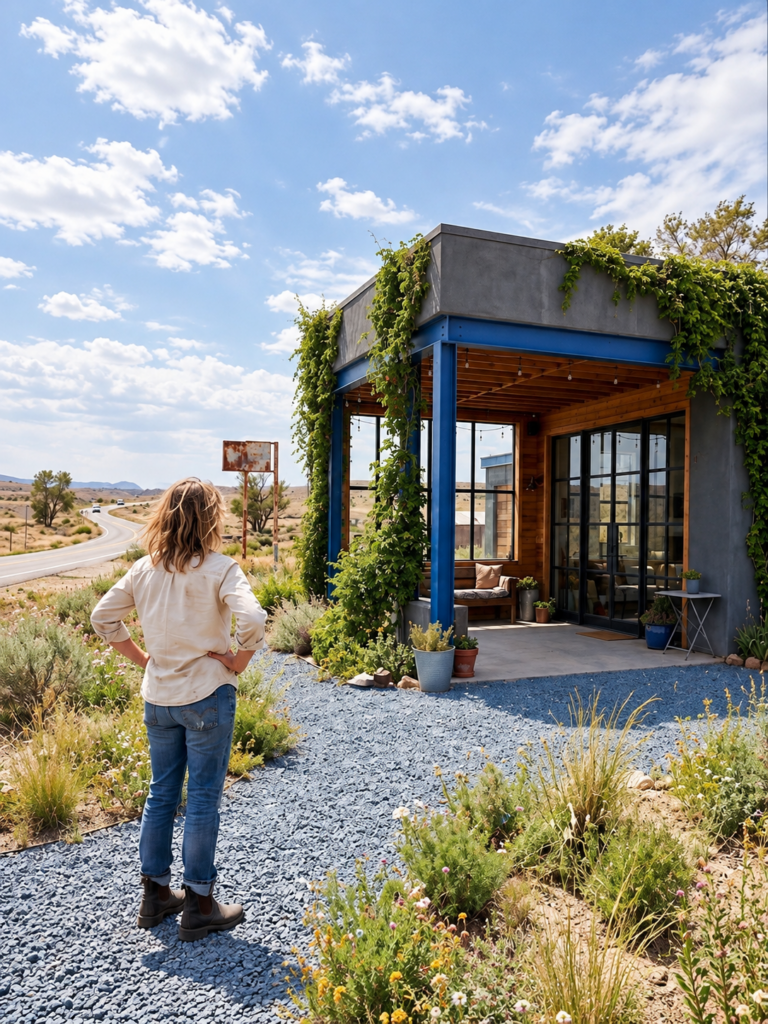
her husband divorced her at 58 and took the house so she turned a rotting gas station into the one fortress he could never claim
Part 1
The gavel never banged. That only happened on television. In the real courtroom on a Tuesday morning the judge simply shuffled a stack of papers, signed the top sheet with a cheap ballpoint pen, and finished thirty-two years of marriage before the court broke for lunch. Nora sat at her table with her hands folded in her lap. She had worn the beige cardigan she usually saved for charity dinners. The pearl earrings she had put on that morning still felt too heavy. Across the aisle Arthur adjusted the cuffs of his tailored suit and did not look at her. He did not need to. Through a maze of corporate structures, a prenuptial agreement she had signed at twenty-two when they owned nothing but a secondhand sofa, and a legal team that billed by the hour, he was walking away with the four-bedroom colonial they had built, the stock portfolios, and the summer cabin in the Berkshires. Nora received a modest lump-sum alimony buyout. Enough for a cramped condominium in a neighborhood she did not know, or enough to rent a mediocre apartment until she died.
At fifty-eight she was being handed a severance package from her own life.
Arthur left town the next day on a business trip. Nora suspected he was not alone. She packed alone. She took her clothes, her books, the cast-iron skillet she had seasoned for two decades, and the small wooden box that held the dog’s ashes. She left the expensive art and the imported rugs. She left her keys on the kitchen island beside the espresso machine she had bought him for his fiftieth birthday. When she locked the front door for the last time the click sounded final. She drove north out of the suburbs in her ten-year-old Subaru, past the manicured lawns and neighborhood associations, until the roads turned to cracked asphalt and the trees grew wild and heavy. She did not cry. Crying required energy she no longer possessed. She felt hollowed out, scraped down to the bone.
She did not know where she was going until she saw the sign. It leaned at a desperate angle against a chain-link fence choked by weeds: For Sale. Owner Financing. Behind the fence sat an abandoned gas station, a concrete-block monstrosity from the early nineteen-seventies. The paint, once stark white, had flaked away to reveal damp gray. The massive steel canopy over the old pump islands was thick with orange rust and bowed slightly in the middle. The rolling garage doors of the service bays were dented and tagged with faded graffiti. It looked like a corpse of American industry left on the side of Route 90 to rot. Nora pulled over. The crunch of gravel under her tires was loud in the heavy afternoon silence. She stepped out. The air smelled of pine needles and faint ancient petroleum. She walked to the greasy glass of the convenience storefront and peered inside. Dust coated everything. Dead flies littered the linoleum. The old service counter was warped and peeling. It was filthy. It was ruined. It had been entirely discarded by the world.
Nora pressed her hand against the cold glass. Perfect, she thought.
The real-estate agent was a sweaty man named Gary who kept looking at his watch. “The pumps and underground tanks were removed ten years ago,” he said, rattling off a disclaimer he had clearly memorized. “Passed all environmental soil tests. But the structure is, well, it’s a tear-down. The value is in the commercial zoning of the lot. You’re looking to put up a dollar store? A diner?”
“I’m going to live in it,” Nora said.
Gary stopped wiping his forehead. He took in her neat bob, her sensible cardigan, the pearl earrings she had not bothered to remove since court. “Ma’am, it’s a gas station. There’s no residential plumbing. The heating is an industrial blower that sounds like a jet engine. It smells like unleaded.”
“How much?”
He named a figure that was aggressively low, less than a third of her settlement. “I’ll pay cash,” Nora said, opening her purse, “but you leave the keys in my hand today.”
Three days later she slept on an air mattress in the center of what used to be the station’s office. The silence of the highway at night was absolute, broken only by the occasional roar of a long-haul trucker shifting gears in the distance. The floor was freezing. The walls felt as though they were closing in. She lay in the dark staring at the water stains on the acoustic drop ceiling. For the first time since Arthur had said the words “I think we need a change,” the tears finally came. They were not elegant. They were the ugly, choking sobs of a woman who had just purchased a concrete grave.
Part 2
Morning light was merciless. It streamed through the grime-caked windows and illuminated decades of neglect. Nora sat up. Her spine protested the cheap mattress. She wrapped her cardigan tight around her shoulders and fired up a camp stove on the floor to boil water for instant coffee. Her phone buzzed. It was Chloe.
“Mom, please tell me this is a joke.” Her daughter’s voice crackled through the terrible reception. “Dad said you bought a commercial lot. A junkyard.”
“It’s a vintage service station, Chloe,” Nora said, blowing on her black coffee. It tasted like ash.
“Mom, you’re fifty-eight. You have arthritis in your hands. You can’t live in a dilapidated garage like some teenage runaway. Come stay with me in the city. We’ll figure it out.”
Nora closed her eyes. She loved Chloe, but Chloe was twenty-six, freshly married, and still believed the world operated on fairness and logic. Chloe did not understand the humiliation of being a guest in someone else’s life.
“I’m not a stray dog to be taken in,” Nora said, her voice dropping into a register of quiet, absolute stubbornness. “I own this concrete, free and clear. Arthur can’t touch it. The bank can’t touch it. I will call you when I have plumbing.” She hung up.
She stood, walked to her cardboard boxes, and pulled out a pair of heavy canvas coveralls she had bought at a farm-supply store the day before. She pulled her hair back into a tight utilitarian knot. The grief was still there, sitting like a lead weight in her chest. Sitting still let the grief metastasize. Movement was the only chemotherapy.
Nora started with the drop ceiling. She bought a ladder and a crowbar and dragged them into the main office space. The acoustic tiles were rotting, stained brown with old roof leaks and cigarette smoke. She drove the crowbar into the metal grid and pulled. A shower of dust, dead spiders, and crumbling fiberglass insulation rained down on her face. She gagged, coughing violently, her eyes watering. She stood at the bottom of the ladder, chest heaving, wiping a streak of black grime across her cheek. The urge to quit was a physical ache. She could sell it, take a loss, go sleep on Chloe’s futon.
Then she looked up. Above the ruined drop ceiling, hidden for thirty years, were massive, gorgeous steel trusses. Heavy industrial iron painted a faded, striking cobalt blue, supporting a soaring roof line she had not realized was there. The space suddenly doubled in height. The ugly cinder-block box was not just a box. It was a cathedral of steel and space, buried under cheap nineteen-seventies remodeling. Something clicked inside Nora’s chest. The lead weight of grief shifted just a fraction, replaced by a tiny sharp spark of vision.
Over the next month Nora Hayes disappeared. The woman who hosted charity dinners in pearls vanished, replaced by a ghost haunting a roadside ruin. She rented a commercial dumpster and filled it three times over. She ripped out the warped linoleum, peeling it back to reveal heavily stained but perfectly level concrete underneath. She rented a floor grinder. The machine vibrated so violently it left her hands numb for hours, but she pushed it back and forth across the former convenience-store floor until the heavy layers of grease, glue, and dirt were scoured away. Underneath, the concrete polished up to a mottled, stone-like finish that looked strangely expensive.
She learned the language of the forgotten. She spent her evenings reading plumbing codes by the light of a camping lantern. She watched tutorials on framing until her phone battery died. Locals started to notice. At the hardware store in the nearest town, an old logging outpost, she became a regular. The owner, a man named Ben with a permanent scowl and hands like catcher’s mitts, watched her buy increasingly heavy-duty equipment.
“You’re going to blow a breaker running that industrial sander on a residential generator,” Ben said one Tuesday, ringing up her purchase of fifty-grit belts.
“I have it wired to a 240-volt output on a heavy-duty rig,” Nora replied without looking up from her wallet.
Ben paused, staring at her dirt-smudged forehead and the band-aids on her knuckles. “You out there at the old Texaco alone?”
“Yes. Roof leaks on the west side. I tarred it on Sunday.”
Ben grunted. It was not an offer of help, and she did not ask for one. It was merely a transaction of facts. But the next time she came in for lumber, Ben had set aside the straightest two-by-fours in the yard for her without asking.
The physical toll was brutal. Nora woke every morning feeling as though she had been in a car crash. Her shoulders burned. Her lower back throbbed with a dull, incessant rhythm. Her fingernails were permanently stained gray. But as the weeks bled into autumn and the cold set into the cinder blocks, the space began to breathe. She framed out a bedroom in the back corner where the manager’s office used to be. She hired a crew just once to run the main plumbing lines from the road, but she laid the interior PVC herself, gluing the purple primer with a fierce, quiet satisfaction. When she finally hooked up a utility sink and turned the handle, a sputtering, coughing stream of brown water burst out, quickly turning into a clear, steady rush. Nora put her hands under the freezing water. She washed the concrete dust from her skin. She looked up at her reflection in the dirty window pane. She looked ten years older, weathered and exhausted. But for the first time since the divorce, she did not look defeated.
Part 3
Winter hit the highway with the subtlety of a freight train. The cinder-block walls absorbed the freezing temperatures and turned the inside of the station into an icebox. Nora had insulated the bedroom and installed a heavy wood-burning stove in the center of the main floor, its black iron pipe punching straight up through the cobalt steel trusses. She spent the cold nights huddled near the fire, drawing on grid paper. The main convenience store was now habitable. It was brutalist, raw, but clean. The real challenge lay on the other side of the interior wall: the service bays. It was a cavernous space, nearly a thousand square feet. The floor was still stained with the ghosts of a thousand oil changes. The front of the bays was dominated by three massive rusted roll-up metal doors. They were ugly. They leaked air like a sieve and they rattled terrifyingly in the winter winds. This was the space that would make or break the property. It was the difference between living in a renovated shack and creating something extraordinary.
She wanted glass. Nora envisioned replacing the rolling metal doors with floor-to-ceiling industrial glass panels. She wanted to flood the greasy cavern with sunlight. She wanted the living space to bleed seamlessly out onto the concrete apron where cars used to idle. She called three commercial window suppliers. The quotes were staggering. The glass alone would consume the last of her settlement money, dipping into the tiny emergency fund she had scraped together. If she bought the glass, there was no safety net. If she broke an ankle, if the roof caved in, she was bankrupt. She sat at her plywood worktable looking at her bank statement. She thought of Arthur’s leather-bound study. She thought of the patronizing look on the judge’s face. She signed the contract and wired the money the next morning.
The installation happened in early March just as the frost was beginning to yield to mud. The crew arrived with cranes and suction rigs. Nora stood back holding a mug of coffee, watching as they used torches to cut the rusted tracks of the old garage doors. The grinding of metal shrieked across the empty highway. When the metal doors fell away, the raw, gaping holes looked like wounds in the building’s facade. The cold wind howled through the bays. Then the glass went in. Massive double-paned commercial panels framed in matte black steel. They were fitted perfectly into the concrete openings. As the final panel was sealed into place, the afternoon sun broke through the clouds. The light hit the glass and poured into the service bays. It illuminated the soaring steel trusses. It washed over the polished concrete floors. The space was instantly transformed from a dark, greasy cavern into a breathtaking light-drenched atrium. It felt like an ultra-modern loft dropped into the middle of the wilderness.
Nora walked into the center of the room. The acoustics had changed. The harsh echoes were gone, replaced by a quiet, insulated stillness. She placed her hand on the cold glass, looking out at the pines swaying across the highway. She had bet everything on this light and she had won.
Two weeks later, as she was framing out what would become a massive open-concept kitchen in the corner of the atrium, a luxury SUV crunched onto the gravel lot. Nora paused her impact driver. She wiped her forehead with the back of a dusty glove and walked to the glass. It was Arthur. He stepped out of his pristine vehicle wearing a tailored overcoat, looking entirely out of place among the weeds and the lingering patches of dirty snow. He walked toward the front of the station, his expression a mix of pity and morbid curiosity.
Nora did not open the door. She slid open one of the massive glass panels just enough to stand in the gap.
“Nora,” Arthur said, stopping a few feet away. He looked at her coveralls, her messy hair, the sawdust coating her boots. He sighed, a heavy condescending sound. “Chloe told me what you were doing. I didn’t believe her. I thought you were just going through a phase.”
“What do you want, Arthur?” Her voice was flat, devoid of the panic she used to feel when he used that tone on her.
“I came to see if you needed help.” He lied smoothly. “You can’t live like this. It’s embarrassing. People in our circle are asking questions. You’re squatting in a toxic dump.” He looked past her, trying to peer into the shadows. He expected to see a squalid, pathetic mess. He expected to see failure. Instead his eyes adjusted to the glare of the glass. He saw the soaring ceiling. He saw the striking polished floors. He saw the massive gleaming wood stove sitting on a raised concrete hearth, casting a warm glow across a space that looked like a million-dollar architectural-digest spread in the making. He saw the sheer scale of the vision.
Arthur’s mouth opened slightly. The smug certainty in his eyes flickered, replaced by profound confusion. This was not the work of a defeated, hysterical ex-wife. This was power.
“You—” Arthur stammered, pointing a manicured finger at the structural steel. “How are you paying for this?”
“With the change you left me,” Nora said.
“Nora, be reasonable. This place has no resale value. You’re throwing away what little you have.” He took a step closer, trying to regain his footing. “Come back to the city. Let my financial guy set you up in a nice townhouse. I’ll front the down payment. Just stop this—this spectacle.”
Nora looked at the man she had spent thirty years serving. She saw the soft hands that had never built a single thing. She saw the ego that required her submission to survive. She did not yell. She did not cry.
“You don’t understand, Arthur,” Nora said softly, her hand resting on the heavy black steel of the door frame. “I’m not doing this to sell it. I’m doing this so I never have to look at a man like you again.”
She slid the heavy glass panel shut. It locked with a solid, satisfying thud. Through the glass she watched him stand there for a long moment, looking small and absurd against the backdrop of the wild woods. Finally he turned, got back into his luxury SUV, and drove away. Nora did not watch him disappear down the highway. She turned her back to the glass, picked up her impact driver, and went back to work. There was a kitchen to build.
Part 4
July arrived with a punishing, breathless heat. The cinder blocks of the old station, which had acted as an icebox in February, now absorbed the summer sun and radiated it inward like a pizza oven. Nora kept the massive glass panels open during the early mornings to catch the cool forest drafts, but by noon the air inside grew thick and heavy. She bought three industrial warehouse fans. They roared like airplane engines, vibrating the concrete floors, moving hot air around in relentless circles. Under their mechanical whine, Nora built her kitchen.
She did not want standard off-the-shelf cabinets. Standard meant compromise, and Nora was entirely done with compromising. She scoured architectural salvage yards across three counties until she found the bones of her vision: heavy welded-steel workbenches from a defunct textile mill and a twelve-foot, four-inch-thick slab of reclaimed American walnut from a demolished barn. Getting the steel bases into the house took a week of strategic leverage using a come-along winch anchored to a structural column. Getting the walnut slab inside nearly broke her. The wood weighed over four hundred pounds. The delivery driver, a kid who looked barely old enough to vote, had dumped it on a pair of sawhorses in the gravel lot, tipped his hat, and drove off.
Nora stared at it for an hour. It was a beautiful monster, raw and splintered at the edges, hiding a rich dark grain beneath decades of dust. She backed her Subaru up to the sawhorses. She laid down PVC pipes as rollers on a makeshift ramp of plywood. It was a trick she had learned from a late-night video of off-grid cabin builders. For three hours in the blistering afternoon sun she inched the massive slab toward the open service-bay doors. Push, wedge, roll. Push, wedge, roll. Her shoulders screamed. Her hands were blistered through her leather gloves. Sweat stung her eyes, mixing with the ever-present concrete dust. She got the slab inside the bays, positioned right next to the steel workbenches, but she still had to lift it three feet in the air to set it in place.
She set up two hydraulic car jacks, intending to raise it inch by inch, blocking it with scrap wood as she went. She pumped the jack handle. The heavy wood groaned, lifting slightly on the left side. She shoved a four-by-four block underneath. She moved to the right side. Pump, lift, block. On the third rotation the left jack slipped. The sound was a sharp metallic crack. The walnut slab dropped off the jack, catching the edge of the steel workbench and violently twisting. The heavy wood slammed onto the concrete floor, missing Nora’s steel-toed boot by less than two inches. The impact echoed through the cavernous space like a gunshot.
Nora jumped back, her heart hammering against her ribs. She stared at the slab resting diagonally on the floor. Her knees buckled. She sat down hard on the dusty concrete. The adrenaline drained out of her, leaving nothing but a hollow, crushing exhaustion. She looked at her trembling hands. They were the hands of an aging woman, veiny, scarred, coated in grime.
What are you doing? a voice whispered in her head. It sounded exactly like Arthur. You aren’t a carpenter. You aren’t an architect. You’re a discarded housewife playing in the dirt.
She pulled her knees to her chest. She did not cry. Crying was for people who had someone to comfort them. She just sat there breathing the hot, dusty air, waiting for the strength to stand back up.
The crunch of tires on gravel pulled her out of her spiral. A rusted forest-green pickup truck rolled to a stop outside the open glass panels. The engine sputtered and died. The door groaned open and Ben stepped out. He was wearing faded work jeans and a sweat-stained baseball cap. He carried a heavy cardboard box under one arm. He walked up to the glass threshold and stopped. He looked at Nora sitting on the floor. He looked at the massive slab of walnut wedged awkwardly against the steel. He looked at the spilled hydraulic jack. He did not ask if she was okay. He did not offer pity. He simply set the cardboard box down on the floor.
“Your heavy-duty lag bolts came in,” Ben said, his voice a low, gravelly rumble. “Figured I’d drop them on my way home. Save you a trip.”
“Thank you,” Nora managed to say. Her voice was raspy from the dust.
Ben stood there for a moment, chewing on the inside of his cheek. He walked over to the walnut slab. He ran a thick, calloused hand over the rough edge. “Black walnut. Good tight grain. Going to be heavy as a dead preacher.”
“Four hundred pounds,” Nora said, finally standing up and dusting off her coveralls.
“Where’s it going?”
Nora pointed to the steel frames on top. Ben grunted. He walked back to his truck and returned a minute later with two heavy-duty lifting straps. He tossed one to Nora. “Loop it under your side. Hook it over your forearms, not your hands. Use your legs.”
They did not discuss it. They just positioned themselves on opposite ends of the wood. “On three,” Ben said. “One, two, three.”
Nora pushed from her heels, her thighs burning, the strap biting into her forearms. Ben let out a sharp breath on the other side, his broad shoulders bunching under his T-shirt. The slab lifted in one smooth, violent motion. They shuffled three steps sideways, the veins in Nora’s neck bulging, and lowered the wood onto the steel bases. It landed with a heavy, satisfying thud that shook the floor.
Nora unhooked the strap, panting, leaning her hands on the raw wood. Ben stood on the other side, wiping his forehead with the back of his arm. He looked around the space. Really looked. He took in the polished concrete, the towering black-framed glass, the exposed cobalt steel trusses, the massive wood stove sitting on its hearth. He walked over to the plumbing fixtures Nora had surface-mounted to the cinder-block walls. “Using brushed copper piping. You did the sweating on these pipes?”
“I did.”
“Clean joints. No slop,” he noted, turning back to her. He reached into his pocket, pulled out two crushed cans of cheap domestic beer, and tossed her one. Nora caught it. She popped the tab and took a long drink. It was warm and tasted metallic, and it was the best thing she had ever had. They stood in the cavernous, beautiful space, leaning against the walnut counter, drinking in silence. The roaring fans moved the hot air around them.
“Not a bad garage,” Ben finally said, looking out the glass at the highway. From a man who spoke in grunts and transactions, it was a knighthood.
Nora smiled. It was a small, tired smile, but it reached all the way to her eyes. “It’s getting there.”
That afternoon was a turning point. The physical barrier had been broken, but more importantly the psychological one had shattered. Nora realized she did not have to be an impenetrable island to be independent. Accepting help was not a failure. It was just a tool, like a crowbar or a jack.
August was dedicated to the exterior. The building was structurally sound, but it still looked like an abandoned gas station from the outside. She rented a commercial paint sprayer and fifty gallons of exterior masonry paint in a shade called iron ore, a deep flat bruised charcoal. She spent a week masked and goggled, walking the perimeter, coating the ugly gray concrete. The transformation was startling. The dark color swallowed the utilitarian lines of the cinder blocks. It made the building recede into the shadows of the tall pine trees, grounding the structure. The stark matte-black frames of the massive windows popped against the charcoal walls. It no longer looked discarded. It looked intentional. It looked like a modern fortress.
For the front lot the old concrete pump island remained. Instead of trying to remove it, which would require heavy machinery she could not afford, she turned it into an architectural feature. She clad the raised concrete in rich slatted cedar. She ordered a custom steel fire pit and mounted it dead center where the unleaded pumps used to stand. She rented an industrial wet saw and spent four brutal days cutting the cracked asphalt apron into sections, prying them up with a heavy digging bar and hauling the chunks away in a rented dump trailer. Beneath the asphalt was compacted earth. She hauled in six tons of crushed blue-stone gravel and raked it out by hand, creating a sweeping, elegant courtyard that led up to the glass facade.
When September arrived, bringing the first crisp edges of autumn air, Nora stood at the edge of the highway at dusk. She pressed a button on a remote. The exterior sconces she had wired, heavy brass nautical fixtures, clicked on, throwing warm pools of amber light down the charcoal walls. Inside, the Edison bulbs hanging from the cobalt trusses glowed like fireflies against the dark ceiling. The fire pit on the cedar patio snapped and popped, throwing sparks into the twilight. She had not just salvaged a ruin. She had resurrected it.
Part 5
October fourteenth, a Tuesday. Nora was standing at the walnut island, chopping a yellow onion. The knife made a rhythmic, heavy thack against the wood. The wood stove was burning nicely, radiating a dry, comfortable heat that chased away the chill seeping through the cinder blocks. She paused, the knife resting on the cutting board. One year. Exactly one year ago today she had stood in a sterile courtroom in a beige cardigan and watched a judge erase her life. She looked down at her hands. The manicured nails were gone. Her knuckles were thicker now, the skin slightly calloused, permanently stained with a faint ghost of motor oil and wood stain. She looked at her reflection in the glass of the oven door. The neat bob had grown out into wild silver-streaked waves, tied back with a leather cord. She wore heavy denim and a gray wool sweater. She looked like a woman who could survive a winter.
A pair of headlights swept across the blue-stone courtyard, illuminating the glass facade. Nora wiped her hands on a towel and walked to the front door. A sleek silver sedan was parked near the cedar patio. The driver’s-side door opened and Chloe stepped out. She was wearing a tailored camel coat and carrying a designer leather tote. She looked exactly like the world Nora had left behind: polished, anxious, and moving too fast.
Chloe froze by the car door. She stared at the matte charcoal exterior, the warm brass lighting, the sweeping gravel courtyard. She looked at the massive floor-to-ceiling glass panels that revealed the stunning warm industrial cathedral inside. Nora slid the heavy glass door open.
“You’re letting the heat out, Chloe.”
Chloe did not move for a long second. Then she walked forward slowly as if she were stepping onto an alien planet. She crossed the threshold and stepped onto the polished concrete floor. She looked up. She saw the soaring cobalt-blue steel trusses. She saw the massive wood stove sitting on its raw concrete pedestal. She saw the warm leather armchairs, the sprawling walnut kitchen island, the brushed copper pipes glinting against the painted brick. It did not smell like a garage. It smelled like wood smoke, roasting onions, and expensive coffee.
“Mom,” Chloe breathed, dropping her tote bag onto the floor. “Mom, what is this?”
“I told you,” Nora said, turning back to the kitchen. “It’s a vintage service station.”
Chloe walked through the space, running her hands over the back of a leather chair, touching the smooth, heavy surface of the walnut counter. She walked into the back bedroom where Nora had installed a heavy sliding barn door made of frosted glass and steel leading to a sprawling spa-like bathroom with an open-concept rainfall shower built right over a floor drain. When Chloe came back out to the main living space, her eyes were wet.
“Dad told everyone you were living in a squatter’s den,” Chloe said, her voice shaking slightly. “He said you had lost your mind. He said you were trying to punish him by living in filth.”
Nora picked up her knife and swept the chopped onions into a cast-iron skillet. They hissed immediately. “Your father,” Nora said calmly, without malice, “has a very limited imagination.”
Chloe walked over and sat on one of the heavy steel stools at the island. She watched her mother cook. She watched the fluid, strong way Nora moved. There was no hesitation in her. The nervous, accommodating woman who used to apologize when the caterers were late was entirely gone.
“I’m sorry,” Chloe said. A tear spilled over, tracing a line down her expensive foundation. “I’m so sorry, Mom. I should have come out here. I should have helped you. I just—I didn’t want to see you broken.”
Nora stopped. She put the wooden spoon down, walked around the massive island, and took her daughter’s face in her rough, calloused hands. “Listen to me,” Nora said, her voice dropping to a fierce, quiet hum. “I was broken. For thirty years I was a very expensive, very polite accessory. The day your father took the house, he did me the greatest favor of my life. He forced me to find out what my own hands could do.” She wiped the tear from Chloe’s cheek with her thumb. “You don’t need to apologize,” Nora continued. “I had to do this alone. If you’d been here, I would have relied on you. I would have let you call the contractors. I would have let you carry the weight. I had to carry it. Do you understand?”
Chloe nodded, swallowing hard. “It’s beautiful, Mom. It belongs in a magazine.”
“It belongs to me,” Nora corrected gently. “That’s better.”
They ate dinner at the massive dining table Nora had built from leftover roof joists. They drank a heavy, expensive Cabernet Sauvignon out of heavy glass tumblers. They talked until the fire in the stove burned down to glowing red embers. For the first time in her adult life, Chloe did not treat Nora like a fragile antique. She treated her like an equal, like a force. When Chloe finally left, hugging her mother tightly before getting back into her sedan, Nora stood in the open doorway and watched the taillights disappear down the dark highway. The silence rushed back in to fill the space. But it was not the suffocating, terrifying silence of that first night on the air mattress. It was a thick, comfortable quiet. It was the sound of safety.
Nora walked out onto the cedar patio. The autumn air was sharp and cold. She sat down in an Adirondack chair next to the steel fire pit. She wrapped a heavy wool blanket around her shoulders and poured the last two inches of the Cabernet into her tumbler. She looked out at the dark tree line. She listened to the distant lonely rumble of a semi-truck shifting gears miles down the highway. She thought about Arthur sitting in his four-bedroom colonial, surrounded by art he did not understand and a life he had not built with his own hands. She thought of the thirty-two years she had given him. She took a sip of her wine. It tasted like victory. She rested her calloused hand on the cool steel of the fire pit. Behind her the massive glass fortress glowed with amber light, a beacon of defiance wrapped in cinder block and iron. She was not an exile. She was a queen in a castle of her own making. And the mortgage was paid in full.


