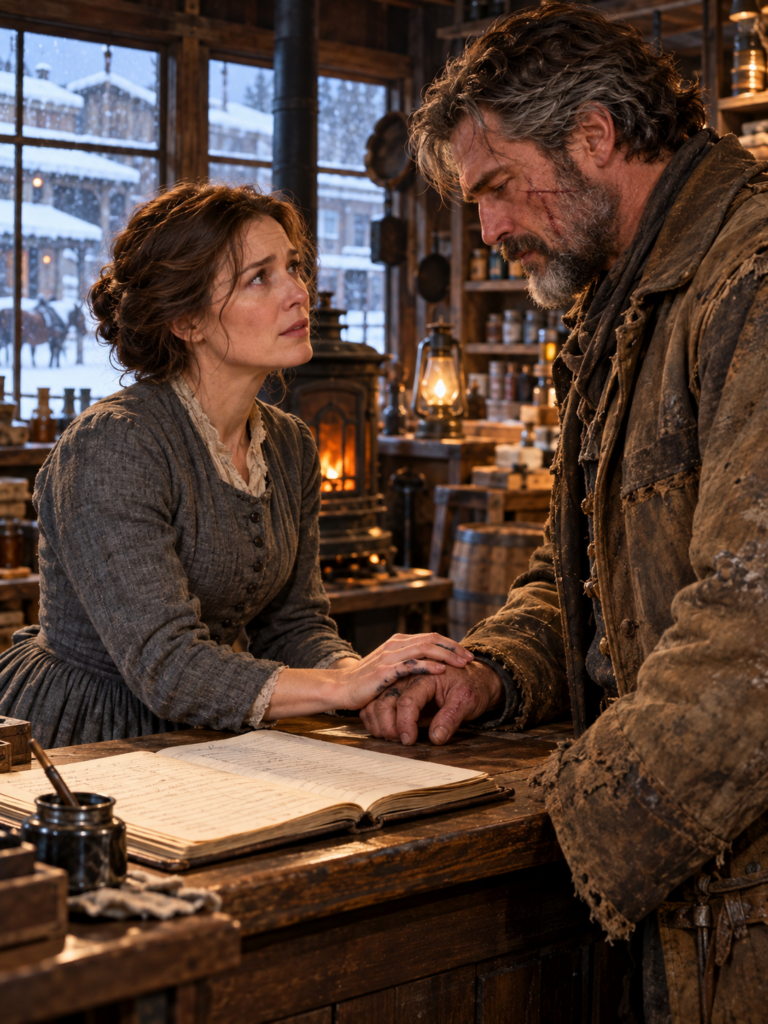
Kora’s hand struck the edge of her ledger as she withdrew it.
The sharp sound made them both look down.
Hamlin lowered his own hand immediately.
He did not reach after her.
“I’m sorry,” she whispered.
“What for?”
“I don’t know.”
That was the trouble.
She could refuse a drunken customer without hesitation. She could argue freight charges with men twice her size. She could keep a business alive on accounts that barely balanced.
But one kind word from this battered stranger had left her uncertain of the ground beneath her feet.
“Words are easy in winter,” she said.
Hamlin listened.
“People promise all manner of things when they’re cold and want a warm place to stay.”
“I reckon they do.”
“You’ll be heading back into the mountains when the passes open.”
He looked toward the frosted window.
“I used to think so.”
Kora folded her arms.
“That’s not an answer.”
“No.”
She waited.
Hamlin rubbed his injured hand against his trousers.
“I came down because my leg wasn’t fit for another hard winter trapping. I needed somewhere to work and a roof until the snow eased.”
“And now?”
He looked at her.
“Now there’s something here I’d be sorry to leave.”
Kora felt the words settle between them.
She wanted more.
A promise.
A certainty.
Something that would protect her from the humiliation of believing a man who had only been lonely.
But she also knew how little a promise could mean if it came before a person had made his choice.
“I’m not asking you to stay,” she said.
“I know.”
“And I won’t have you working here because you think it buys you a place in my life.”
“I never figured it did.”
She searched his face.
For once, she found no answer prepared to please her.
Only a man willing to stand where he was and let her decide what to believe.
At last she turned toward the ledger.
“There’s still work to do.”
Hamlin nodded.
“I’ll fetch the wood.”
He collected his coat and left through the rear door.
Kora watched it close.
Outside, the wind struck the building hard enough to rattle the windowpanes.
The afternoon darkened.
Hamlin had mentioned unsettled weather earlier, and now the sky beyond the glass had turned a heavy gray.
Kora returned to her accounts.
She tried to concentrate.
But the page seemed filled with figures that no longer held their ordinary meaning.
Twenty pounds of flour.
Three bolts of calico.
A charge for lamp oil.
And in the margin, the small ink stain left where her hand had trembled.
She thought of his words.
Exactly the woman I’d choose.
Not because she was young.
Not because she was helpless.
Not because she promised to make his life easy.
He had seen her as she was.
And she had no idea what to do with that.
The storm arrived before sundown.
Snow swept across the street, quickly obscuring the opposite storefronts.
Kora closed the shutters and checked the stove.
She had survived Wyoming winters before.
She knew how quickly a strong wind could find weakness in an old building.
She added wood to the fire.
Then she looked toward the rear door.
Hamlin’s rented tack room was little more than a wooden enclosure.
It had served him during milder weather, but she knew its walls offered limited protection against a hard storm.
Another gust struck.
Something outside cracked loudly.
Kora stood.
“Hamlin?”
No answer.
She took up a lantern and approached the back door.
Before she reached the latch, it opened against a rush of snow.
Hamlin staggered inside carrying his saddlebags and an armful of split firewood.
His coat was coated white.
His breathing was labored.
Kora pushed the door shut behind him.
“What happened?”
“Wind took the tack-room roof.”
He lowered the wood beside the stove.
“The mule’s safe at the livery.”
Then he reached for the table to steady himself.
His injured knee failed to bear his weight.
Kora caught his arm.
He was too heavy for her to support alone, but she guided him toward the nearest chair.
“Sit.”
He obeyed.
Snow melted onto the floor.
Kora brought a dry towel and knelt to examine his cold hands.
He looked embarrassed.
“I can manage.”
“Then manage to do as you’re told for once.”
A faint smile touched his scarred mouth.
But the smile vanished when he tried to straighten his leg.
Kora saw the pain in his face.
She looked toward the stove, then toward the unheated rooms.
The storm was worsening.
The tack room could no longer shelter him.
And whatever uncertainty existed between them, she was not sending an injured man back into that weather.
She rose, pulled a narrow cot toward the fire, and began spreading her thickest wool blankets across it.
Kora pulled the final blanket across the cot and tested its position beside the stove.
“Can you stand?”
Hamlin looked at his knee.
“With help.”
“Then take my arm.”
He accepted her support, moving slowly enough that she could guide him without bearing his full weight.
When he finally lowered himself onto the bedding, his face had gone pale.
Kora brought him coffee and dry clothing.
He thanked her quietly.
She noticed that.
For all his size and wilderness experience, Hamlin did not turn helplessness into anger.
He disliked his limitations, but he did not punish her for seeing them.
“Your room is gone,” she said.
“Looks that way.”
“You’ll stay here until the storm clears.”
He studied her.
“Are you certain?”
“I have room. You need shelter.”
He nodded.
“Obliged.”
She pointed toward the cot.
“And don’t mistake this for an answer to our conversation earlier.”
“I won’t.”
The relief that passed over her surprised her.
She had been afraid he might treat her kindness as an invitation to demand more.
Instead, he respected the distinction.
That night they slept separately near the stove.
The wind shook the mercantile.
Snow gathered against the doors.
Kora woke repeatedly to check the fire.
Once, she found Hamlin already awake, watching the embers.
“You ought to be resting,” she whispered.
“So should you.”
She fed another log into the stove.
“Then we’re both poor at taking advice.”
He smiled in the darkness.
For the first time in years, her home did not feel quite so silent.
***
The storm held them inside for four days.
The snow piled high enough to make ordinary travel unsafe.
Kora kept an account of the firewood and food.
Hamlin helped where his knee allowed, though the swelling worsened during the cold.
Neither of them pretended that hardiness could make an old injury disappear.
Kora prepared warm cloths to ease his discomfort and insisted he rest when walking became difficult.
He protested occasionally.
She ignored him occasionally.
Gradually, they discovered a rhythm that required less argument.
On the third afternoon, she sat beside his cot while he examined the missing fingers on his left hand.
She had wondered about the injury since the day they met.
Now she asked.
“Was it an animal?”
He looked at her.
“No.”
She waited.
Hamlin stared toward the stove.
“Had a trapping partner once. Thomas.”
Kora remained still.
“We worked together five years.”
His voice changed.
Not louder.
Simply flatter.
During the brutal winter of 1872, he explained, they had been stranded near their trapping country with dwindling food and valuable pelts they hoped to sell.
Thomas decided to leave with the sled, the dogs, and the remaining supplies.
Hamlin woke while he was preparing to depart.
He tried to stop him.
Thomas attacked him with a knife.
The wounds cost Hamlin two fingers and left the scar across his face.
Then Thomas abandoned him.
Kora felt her stomach tighten.
“He left you there?”
“Yes.”
“In that cold?”
“Yes.”
“How did you live?”
Hamlin looked at his damaged hand.
“Got myself moving. Found help after a hard journey.”
He spoke briefly of the desperate travel, the cold injury, and the broken leg that continued troubling him.
He did not present survival as a grand triumph.
He described it as something brutal and costly.
Kora understood that the visible scars were only part of what he carried.
“What happened to Thomas?”
Hamlin’s jaw tightened.
“I found him the following spring.”
He said no more.
She did not press for details he was unwilling to give.
After a while, he looked toward her.
“That’s why I don’t take being discarded lightly.”
Kora lowered her eyes.
“I know something of that.”
“Not the same way.”
“No. But I know what it’s like to be useful to people who don’t much care about the person doing the work.”
Hamlin turned toward her.
“I’ve watched them.”
She looked up.
“You’ve watched what?”
“The way they expect you to keep this store going. The way they take credit and complain about prices. The way they speak of you as though the years you’ve spent keeping it open count for nothing.”
Kora swallowed.
“It’s my business.”
“I know.”
“I don’t need pity.”
“You haven’t got mine.”
For a moment the only sound was the fire.
Then he said, “You’ve got my respect.”
She looked at him.
His face was weathered.
His hand was scarred.
His knee would never move easily again.
But none of those things frightened her now.
What frightened her was how clearly he saw her.
She reached toward his hand.
This time she did not pull away.
Hamlin waited until she had settled her fingers against his palm.
“May I kiss you?” he asked.
Kora held his gaze.
“Yes.”
The kiss was quiet at first.
It carried none of the swagger she had endured from men who mistook attention for a favor.
He gave her time to move away.
She chose not to.
When they separated, Kora rested her forehead briefly against his.
“You still haven’t promised to stay.”
“I know.”
“And I haven’t asked you to.”
“I know that too.”
He smiled faintly.
“But when the roads open, I’d like to talk about what staying could mean.”
She nodded.
“I’d like that.”
***
The thaw came with warmer winds from the mountains.
The streets turned muddy.
Customers began returning to the mercantile.
But news traveled faster than the wagons.
Mrs. Higgins arrived carrying the kind of concern that never seemed to include practical help.
She asked how Kora had survived the storm.
Kora answered plainly.
“Hamlin was here. We kept the stoves going.”
Mrs. Higgins looked toward the rear room.
“You were alone with him?”
“We were snowed in together.”
The woman lowered her voice.
“Kora, people will talk.”
“They generally do.”
“A woman in your position has her reputation to consider.”
Kora looked across the counter.
“And what position is that?”
Mrs. Higgins hesitated.
“An unmarried woman keeping company with a wandering trapper.”
“He works here.”
“That isn’t the point.”
“Then perhaps you should make your point clearly.”
Mrs. Higgins straightened.
She explained that several influential townspeople were prepared to take their business to Oak Haven unless Hamlin left.
Jeb Miller had been telling his own version of the trouble in the store, claiming he had been threatened without cause.
Kora listened.
When Mrs. Higgins finished, Kora opened her ledger.
“You owe fourteen dollars and sixty cents.”
Mrs. Higgins blinked.
“What?”
“Your account. Fourteen dollars and sixty cents.”
“This is hardly the moment.”
“I believe it is.”
Kora turned the book so the figures were visible.
“I’ve spent years extending credit to families in this town. I’ve done it when cattle prices were poor and when winter made travel difficult. I won’t have customers using their accounts to dictate whom I may employ or invite into my home.”
Mrs. Higgins flushed.
“You’ll ruin yourself.”
“Perhaps. But I’ll make my own decision.”
Kora looked toward the other customers.
“From today, further purchases are cash unless we agree otherwise. Old debts still stand.”
The silence was painful.
Hamlin stood near the storeroom door.
He had heard everything.
Kora turned toward him.
“You may stay if you still want the work.”
His expression changed.
“You don’t have to risk your business for me.”
“I’m deciding how my business will be run.”
He nodded.
“I understand.”
Mrs. Higgins left.
The others followed.
The bell stopped ringing.
For three weeks, the mercantile became painfully quiet.
***
Kora had expected trouble.
She had not expected the depth of the boycott.
Customers traveled to Oak Haven rather than enter her shop.
The shelves remained stocked.
But the till grew lighter.
The tax payment due in August became a serious concern.
One evening, Kora sat examining the accounts.
Hamlin approached with two cups of coffee.
“Bad?”
“Worse than last week.”
He sat across from her.
She showed him the numbers.
He studied them carefully.
“You need eighty dollars before August.”
“Yes.”
“I’ve got hides stored in the back.”
“Those are yours.”
“I could sell them in Oak Haven.”
“You’d be giving up the value of your winter’s work.”
He nodded.
“I know.”
“Hamlin, I’m not accepting charity in exchange for your place here.”
“Wasn’t offering charity.”
“What, then?”
“A business arrangement. I sell my goods. You keep the accounts. We agree how much goes toward stock and what remains mine.”
Kora studied him.
“And if the store fails?”
“Then we’ll both know we tried.”
She looked down.
For the first time, she began to see how their work might become a partnership.
Not through possession.
Not through obligation.
But through agreed responsibility.
The following morning, Hamlin set out for Oak Haven with his mule and saleable hides.
The journey took several days.
Kora kept the shop ready.
She checked the inventory.
She swept the floor.
She tried not to watch the road every hour.
When Hamlin returned, soaked by a cold spring rain, she hurried to the rear door.
He was tired, his knee stiff from travel.
But the mule carried fresh merchandise.
He placed a pouch on the table.
“Eighty-five dollars in coin after the purchases.”
Kora opened it.
Then she examined the supplies.
Coffee.
Sugar.
Thread.
Goods her customers would eventually need.
She looked at Hamlin.
“You did well.”
He smiled.
“Didn’t give the trader much room to argue.”
Then he brought out a small parcel.
“Something for you.”
Inside was a tin of rosewater salve.
Kora stared at it.
“Hamlin.”
“Your hands crack when you’re working. Thought it might help.”
She closed her fingers around the tin.
No man had brought her something simply because he had noticed her discomfort in years.
She stepped toward him.
“May I?”
He opened his arms.
She embraced him.
And for a moment, all the strain of the past weeks seemed lighter.
***
As spring advanced, a few customers returned.
They came quietly at first.
Older ranchers.
Widows.
Families unable to afford repeated journeys to Oak Haven.
Kora served them at fair prices.
She did not punish those who had doubted her.
But she no longer pretended that their judgment gave them authority over her life.
The boycott began weakening.
Then one evening, Jeb Miller returned to the center of her troubles.
It was late.
Kora had finished closing the shop.
Hamlin was resting in the rear room.
A suspicious smell reached him from outside.
He rose and approached the back door.
Through the gap, he heard voices.
Jeb and two ranch hands stood near the stored firewood.
They had brought kerosene.
One held a match.
Hamlin opened the door.
“Get away from that wood.”
The men turned.
Jeb swore.
One of his companions dropped the match before lighting it.
Hamlin stepped forward, furious, but the men began backing away.
Jeb reached for a heavy wrench at his belt.
Hamlin stopped.
Behind him, Kora appeared at the doorway carrying her father’s shotgun.
She had heard the voices.
She had seen the kerosene jug.
And she understood what might happen if the confrontation continued.
“Hamlin,” she said. “Come back.”
He looked toward her.
“Now.”
He stepped away from Jeb.
Kora kept the shotgun pointed safely downward but ready.
“You brought kerosene to my building,” she said.
Jeb’s face lost its color.
“I was only trying to scare you.”
“Then you’ll explain that to the sheriff.”
He hesitated.
Kora did not move.
“You and your friends will go. We’ll be bringing the evidence.”
Jeb looked at Hamlin.
The trapper stood beside Kora, breathing hard.
His anger was plain.
But he had obeyed her request to stop.
At last Jeb and his companions retreated toward the street.
Kora watched until they were gone.
Then she lowered the shotgun completely.
Hamlin looked at the kerosene-soaked ground.
“That was close.”
“Yes.”
She turned toward him.
“I don’t want you ruining your life over that fool.”
He nodded slowly.
“I understand.”
She looked at his scarred face.
“Do you?”
He took a long breath.
“I do now.”
Kora handed him the lantern.
“Then help me make sure there isn’t any danger of fire left here.”
He accepted it.
Together they began examining the rear of the mercantile, preserving the jug and disturbed materials as evidence.
And when the immediate danger was under control, Kora straightened, looked toward the town square, and said, “Tomorrow we settle this properly.”
Kora’s words were still hanging in the evening air when Hamlin turned toward her.
“Properly?”
“With the sheriff. And with witnesses.”
He looked toward the dark street.
“Jeb won’t admit what he intended.”
“He already admitted he meant to frighten me. And we’ve got the kerosene.”
Hamlin considered the evidence.
Then he nodded.
“Then we’ll see that it doesn’t disappear.”
Together they kept the damaged jug and the remaining materials clear of the building.
Hamlin checked the nearby wood.
Kora inspected the rear wall by lantern light.
Neither found that a fire had taken hold.
They returned inside and secured the door.
Only then did Kora realize how badly her hands were trembling.
She set the shotgun aside.
Hamlin noticed.
But he did not take her hands without asking.
“Are you hurt?”
“No.”
“Certain?”
She nodded.
He remained nearby.
After a moment she said, “I was frightened.”
“I know.”
“I thought they might burn the store.”
“So did I.”
She looked at him.
“And I thought you might do something to Jeb that neither of us could undo.”
Hamlin’s face tightened.
He sat heavily in a chair.
For a while he stared at his damaged left hand.
“I’ve been angry before.”
“I know.”
“Sometimes anger feels simpler than fear.”
Kora sat across from him.
She remembered his account of Thomas, the trapping partner who had abandoned him in the mountains.
She remembered the fingers he had lost.
The scar across his face.
The way he had learned to expect betrayal before offering trust.
“You were afraid of losing this place,” she said.
He looked up.
“And you.”
The honesty made her still.
Hamlin lowered his eyes.
“I’ve spent a good part of my life believing that if somebody meant to hurt me, I had to strike first.”
Kora waited.
“Tonight I heard you tell me to stop. And I did.”
She nodded.
“I’m glad.”
He looked toward the shotgun resting near the door.
“You took charge when I couldn’t see past my temper.”
“I need you to trust me to do that.”
He met her gaze.
“I will.”
It was not a promise made lightly.
And Kora understood that keeping it would require more than one night of restraint.
But he had begun.
That mattered.
***
The sheriff came the following morning.
Elias Higgins examined the evidence and listened to Kora’s account.
Jeb’s version of events had already reached him.
The young ranch hand had claimed he only intended to frighten the storekeeper.
But bringing kerosene and a match to a wooden building was a serious matter regardless of whether he later tried to minimize it.
Kora stood on the back porch while Elias questioned her.
Hamlin remained nearby but allowed her to tell what she had witnessed.
She described the voices.
The smell.
The jug.
The men near the woodpile.
The match that had not been brought to flame.
Elias listened without interruption.
When she finished, he looked toward the building.
“This could have gone very badly.”
“Yes.”
He removed his hat.
“Kora, I owe you an apology.”
She studied him.
“About Jeb?”
“About more than that.”
He looked uncomfortable.
He had known her father.
He had eaten at their table.
He had watched Kora struggle to keep the mercantile open after her father’s health failed.
Yet when the town began questioning her association with Hamlin, Elias had allowed the gossip to grow into a boycott.
He admitted that.
“People had no business trying to dictate your private life,” he said.
“No,” Kora replied. “They didn’t.”
“And the threat to your store should never have been used that way.”
She nodded.
Elias glanced toward Hamlin.
“I understand there was an incident here before the storm.”
“There was,” Kora answered. “Jeb refused to leave after I denied him further credit. Hamlin intervened. The versions you’ve heard don’t tell the whole story.”
Elias looked troubled.
“Then I ought to have heard yours first.”
“Yes.”
The word was quiet.
But it carried years of being overlooked.
Elias promised that Jeb’s conduct would be addressed through the proper authorities.
Kora did not ask for revenge.
She asked for the law to be applied fairly.
Then she looked toward the front of the mercantile.
“And there’s the boycott.”
Elias lowered his eyes.
“Martha was wrong. Others were too.”
Kora waited.
“Iron Ridge needs this store,” he continued.
She glanced toward Hamlin.
Then back at Elias.
“This store has always served Iron Ridge. But I decide who works here and who is welcome in my home.”
Elias nodded.
“Understood.”
“And Hamlin stays as long as we both agree that’s what we want.”
The sheriff looked toward the trapper.
Hamlin said nothing.
He did not need to.
Kora had spoken for herself.
***
Mrs. Higgins returned later that morning carrying a basket of fresh bread.
She stood awkwardly at the counter.
Kora greeted her as she would any customer.
Martha set down the basket.
“I thought you might like this.”
“Thank you.”
There was a long pause.
Then Martha said, “I was unkind.”
Kora looked at her.
“Yes.”
Martha winced.
“I suppose I deserve that.”
Kora said nothing.
The older woman glanced toward the repaired storeroom door.
“We shouldn’t have threatened your business.”
“No.”
“And I had no right to speak of Hamlin as I did.”
Kora closed the ledger.
“I appreciate your saying so.”
Martha looked relieved.
But Kora had not finished.
“There will be no more deciding what kind of life I ought to live because I’m unmarried.”
Martha nodded.
“And no more treating a man’s scars as evidence of his character.”
“I understand.”
Kora considered her.
She did not believe one apology could erase everything.
But she was willing to recognize an honest beginning.
“Would you care for some coffee?”
Martha hesitated.
Then smiled faintly.
“I would.”
***
The mercantile recovered gradually.
Customers returned as the weather improved and the inconvenience of traveling to Oak Haven became increasingly apparent.
Some came because they needed supplies.
Some because they regretted their conduct.
Others simply resumed their ordinary habits as though nothing had happened.
Kora did not require a public declaration of loyalty.
She required payment for goods, reasonable conduct, and respect for the decisions that belonged to her.
The new terms suited her better.
She began reviewing accounts more carefully.
Credit was no longer extended merely because someone important expected it.
Customers who had fallen on genuine hard times could still discuss arrangements with her.
But nobody received special treatment through intimidation.
Hamlin helped with the heavier work.
His knee continued troubling him, particularly after long days.
So Kora adjusted the tasks they shared.
He repaired shelving, prepared wood, tended to the building, and handled work suited to his abilities.
She managed purchases, inventory, accounts, suppliers, and pricing.
He learned enough about the store’s expenses to discuss decisions intelligently.
She learned to recognize when his pride tempted him to carry more than he should.
Neither had to become the other.
Their differences were useful.
And increasingly, their work made room for ordinary tenderness.
***
One evening, Kora found Hamlin sitting near the back porch, examining a length of timber.
She leaned against the doorway.
“What’s that for?”
“A frame.”
“For what?”
He looked up.
“You said you missed fresh tomatoes in winter.”
Kora laughed.
“That doesn’t explain the lumber.”
“I was thinking about a small glazed growing space near the kitchen wall.”
She studied him.
“You’ve been making plans.”
“Only a notion so far.”
He showed her where the structure might go and how it could receive sunlight.
He believed it might offer some protection for plants during milder periods, though the harsh Wyoming winter would make growing tomatoes through the coldest months uncertain without more heat and care than they could easily supply.
Kora listened.
Then she crossed her arms.
“Did you ask whether I wanted a new structure against my kitchen?”
Hamlin stopped.
For a moment he looked almost embarrassed.
“No.”
“Well?”
He put down the timber.
“Would you?”
She considered the question.
“I might. But I’d like to see what it costs before you start building.”
A smile moved across his scarred face.
“Fair enough.”
She sat beside him.
They began discussing the materials.
The available glass.
The cost of lumber.
The light along the wall.
The possibility of beginning with something smaller.
Nothing had yet been built.
But the conversation itself mattered.
Hamlin was imagining a future in Iron Ridge.
And Kora was helping decide what shape that future should take.
***
As summer passed, Hamlin received word that trapping work would become possible again when the season changed.
He could return to the high country.
His experience still had value.
He knew the routes.
He knew how to trade hides.
He knew how to live where few others wished to stay.
Kora heard the news without commenting.
That evening she remained unusually quiet.
Hamlin noticed.
“Something troubling you?”
She looked toward the window.
“The passes will be open soon.”
“Yes.”
“You could go back.”
“I could.”
She folded her hands.
“I won’t ask you to give up your life because you think I need someone.”
Hamlin sat across from her.
“I know that.”
“And I won’t be the woman who waits each winter wondering if you’ll come home.”
He listened.
“Then I reckon you ought to hear what I’ve decided.”
She looked at him.
“I don’t intend to return to the high country as I used to.”
Her breath caught.
“Why?”
He took a moment before answering.
“My knee’s worse than it was years ago. I can’t work the old routes as I once did. And I’ve found something here I want more than another season alone.”
“Kora, I’ve lived a long time with no place I cared to return to. I’d like that to change.”
She looked down.
“Are you asking to stay?”
“If you’ll have me. Not as a guest who may vanish when the weather improves. As a man willing to share the work and make a life here.”
Kora was silent.
He continued.
“The store is yours. You know the trade better than I ever will. I won’t pretend otherwise.”
She smiled faintly.
“That’s fortunate.”
He smiled back.
“I’d like to build something with you. But I want it to be something you choose too.”
Kora felt tears pressing behind her eyes.
She had spent years expecting people to tell her what her life ought to become.
A dutiful daughter.
A grateful merchant.
A woman who should marry before her chances disappeared.
A woman who should accept loneliness quietly once those chances were supposedly gone.
Now the man before her was asking what she wanted.
Not because she was young.
Not because she was helpless.
Not because he had rescued her.
But because they had learned to work, argue, laugh, and trust together.
“I want you here,” she said.
Hamlin’s face changed.
“But I want us to keep speaking plainly, even when it’s difficult.”
“I can try.”
“And I want this place to remain a home where neither of us has to prove our worth every morning.”
He nodded.
“That sounds like a place I’d be glad to live.”
She reached across the table.
He placed his scarred hand in hers.
This time there was no hesitation.
***
By late September, the aspens on the higher ridges had begun turning gold.
The Wyoming wind carried the first warning of approaching frost.
On an afternoon when the store was quiet, Kora closed the front shutters early and went out to the rear yard.
Hamlin was measuring the ground beside the kitchen wall.
The proposed growing space had finally become a practical project.
Not a grand glasshouse promising impossible harvests.
A modest sheltered structure they had agreed upon together.
Something they could build with the resources available.
Kora watched him check the measurements.
“You’re taking your time.”
He looked up.
“I was told there would be no building until we agreed on the cost.”
“Wise man.”
“Had a good teacher.”
She approached him.
His tools lay neatly beside a stack of boards.
He had learned to work with his injured hand, but the tasks still required care.
She took the measuring line.
“Where do you want this corner?”
He showed her.
She considered the position.
“A little farther from the doorway.”
He adjusted the mark.
“Better?”
“Yes.”
They worked together until the afternoon light began fading.
Then Hamlin set down his tool and looked toward the mountain ridges.
Kora followed his gaze.
“Do you miss them?”
“Some days.”
“The quiet?”
“Yes.”
“The trapping?”
“Parts of it.”
She nodded.
He looked at her.
“But I don’t miss being alone.”
Kora felt his fingers brush hers.
She turned toward him.
“You really aren’t going back?”
“Not to live there.”
He smiled.
“I’ve spent enough winters wondering whether I’d see another spring.”
She stepped closer.
“And now?”
“Now I’d rather spend them wondering whether we’ve got enough wood stacked and whether your tomatoes have any chance of surviving.”
Kora laughed.
“Those tomatoes may defeat both of us.”
“Then we’ll grow something else.”
She rested her hands against his chest.
He waited.
Then she drew him toward her.
Their kiss was gentle.
Not a desperate attempt to fill years of loneliness.
Not a promise that every winter would be easy.
It was the quiet certainty of two adults who had learned what the other could offer and what neither should demand.
***
The months ahead would still bring hardship.
Iron Ridge would still have bitter winds.
The store would still require careful accounts.
Hamlin’s knee would still trouble him.
Kora’s hands would still ache after long workdays.
And some people would probably continue speaking thoughtlessly about matters that were none of their concern.
But the difference was real.
Kora no longer measured herself by the men who had failed to notice her.
She had built a business, defended her independence, and chosen companionship without surrendering either.
Hamlin no longer treated solitude as the only place where he could be safe.
He had trusted someone with his difficult history.
He had allowed himself to need help.
And he had learned that protecting a person also meant respecting her judgment.
Together they made a household that belonged to both of them in daily responsibility and mutual choice, while Kora retained ownership of the mercantile she had struggled to preserve.
On cold mornings, he cleared the steps.
She kept the coffee strong.
On busy afternoons, she balanced the accounts while he prepared orders.
Sometimes they argued about supplies.
Sometimes they laughed over small mistakes.
And sometimes, when the store was closed and the wind rattled the windows, they sat together without needing to fill the room with words.
One evening Kora found the small tin of rosewater salve beside her ledger.
She opened it and rubbed a little into her work-worn hands.
Hamlin was repairing a wooden shelf nearby.
He looked up.
“Helping?”
“A little.”
He smiled.
“Good.”
Kora studied him.
The broad shoulders.
The graying hair.
The old scar.
The damaged hand moving patiently over the wood.
Once, she had believed that a man like him would pass through her life as quickly as the mountain wind.
And once, he had believed that everyone eventually decided a broken man was more trouble than he was worth.
Neither believed those things anymore.
“Hamlin?”
He looked over.
“Yes?”
“I’m glad you came into my store that day.”
He set down the tool.
“So am I.”
She smiled.
“Even though I made you pay winter prices for the salt?”
“Especially because of that.”
She laughed, the sound warm and unguarded.
Outside, the first frost gathered along the window edges.
Inside, the stove burned steadily.
The ledger lay open, the shelves stood repaired, and two cups of coffee rested on the table.
There was still work to be done.
There always would be.
But no one in that house had to face it alone.
And when Kora reached for Hamlin’s scarred hand, she did so not because he had told her she was perfect for him, but because together they had made room for one another exactly as they were.