Part 1
Molly Finch was waving at her best friend when she accidentally spent forty thousand dollars she didn’t have.
That was the explanation she would eventually give her mother in Gloucester, her landlord in Dorchester, the Boston Herald, and approximately four million strangers who watched the footage online.
Unfortunately, by the time she managed to explain herself, the auctioneer had already brought down his hammer.
And the man she had supposedly purchased was standing on a stage, looking almost as astonished as she was.
It happened on a Saturday evening in October, inside the magnificent marble hall of the Boston Public Library.
Five hundred guests in evening gowns and tailored tuxedos had gathered for the Library Foundation’s annual charity gala. Crystal chandeliers scattered light across polished floors. Waiters circulated with silver trays. A string quartet played beneath the conversation, and a television crew from Channel Five had positioned its cameras to capture the final moments of the charity auction.
Molly stood near the coat-check station in a borrowed green evening gown.
She wasn’t a guest.
She was thirty feet away from the nearest champagne tower because she had been assigned to distribute programs, collect abandoned glasses, and assist the guests who had apparently forgotten how to hang up their own coats.
Her gown belonged to Jojo, her closest friend and fellow librarian at the Dorchester branch. It was slightly too long, and Molly had spent most of the evening trying not to trip over the hem.
She was also hungry.
Terribly hungry.
She had eaten a sandwich around noon, and it was now approaching ten.
Across the room, Barnaby Leeds, the auctioneer, was preparing to introduce the evening’s final prize.
Barnaby was a large, cheerful man in a burgundy velvet jacket. He had already persuaded the audience to spend extraordinary sums on a week in a Tuscan villa, a signed Red Sox jersey, and a private dinner prepared by a celebrity chef.
Now he lifted his microphone with theatrical excitement.
“Ladies and gentlemen, our final offering is something rather special. Six Saturdays with Boston’s most eligible bachelor. Every date arranged and paid for by the gentleman himself. All proceeds benefit the Library Foundation.”
He extended his arm toward the stage entrance.
“Please welcome Hugh Thornton!”
The applause was immediate.
Molly stopped folding programs.
Everyone in Boston knew the name.
Hugh Thornton, thirty-eight, was the founder of Thornton Marine, the Charlestown shipbuilding company renowned for constructing some of the fastest sailing yachts in the world. He had turned the small business his father started into an empire worth billions.
He was also famously private.
He didn’t give personal interviews. He rarely attended social events. No photographer had ever managed to capture him publicly dating a woman.
The newspapers called him the Ghost of Charlestown.
When he walked onto the stage, Molly noticed something the newspapers had never mentioned.
He looked deeply uncomfortable.
He was tall, with dark, slightly unruly hair and gray-green eyes. His black tuxedo fitted perfectly, but his posture suggested he would have preferred being stranded aboard a sinking vessel to standing beneath five hundred curious gazes.
He clasped his hands behind his back.
Barnaby started the bidding at five thousand dollars.
Within moments, the price climbed past twenty thousand.
Then thirty.
A blonde woman in a glittering silver gown raised her paddle again.
Cressida Pemberton.
Molly recognized her immediately. Two hours earlier, Cressida had treated her like an inconvenient piece of furniture while retrieving her coat.
Cressida’s father, Harold Pemberton, chaired the Library Foundation. His daughter was wealthy, beautiful, socially influential, and widely rumored to have spent the past two years attempting to marry Hugh Thornton.
“Thirty-five thousand!” Barnaby announced.
Another woman offered thirty-six.
Cressida raised her paddle.
“Thirty-eight thousand!”
Onstage, Hugh’s expression became increasingly grim.
And then Molly saw Jojo.
Her friend had appeared beside the dessert table, holding two enormous cream puffs and grinning triumphantly.
Molly’s stomach responded before her brain did.
She lifted her hand and waved.
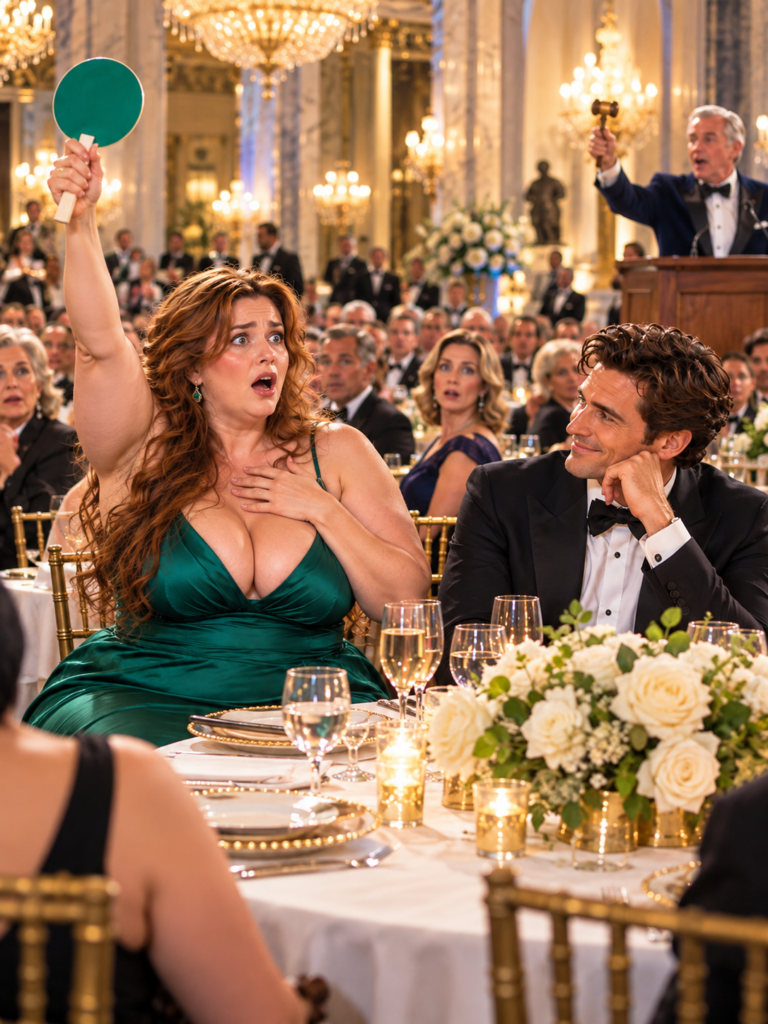
Unfortunately, she was holding a green auction paddle marked with the number 47, which a guest had abandoned at the coat check.
“FORTY THOUSAND DOLLARS!”
Barnaby’s voice thundered through the hall.
“Forty thousand from the lady in green!”
Five hundred people turned toward Molly.
Her arm froze above her head.
“No!” she cried. “I’m not— I was waving!”
“Forty thousand, going once!”
“Please, that’s not—”
“Going twice!”
Cressida’s paddle was already rising.
But onstage, Hugh Thornton made a tiny movement.
He looked directly at Barnaby.
And nodded.
“SOLD!”
The hammer struck.
The orchestra played a triumphant flourish.
The audience erupted in applause.
Channel Five swung its camera toward Molly, catching her standing beside a rack of expensive coats, her borrowed dress gathering around her ankles, her mouth hanging open.
Forty thousand dollars.
For six dates.
With a billionaire.
Molly earned fifty-one thousand dollars a year.
She had two hundred and sixteen dollars in her checking account.
And her car needed new tires.
Across the room, Jojo dropped both cream puffs.
The next ten minutes were a nightmare.
A young woman with a clipboard approached Molly for payment information. Two photographers wanted to know her name. Several guests congratulated her, apparently believing she had just accomplished something remarkable.
Molly kept trying to explain.
Her supervisor, Ruth Delaney, finally pushed through the crowd.
Ruth was the director of the Dorchester branch, a practical woman with reading glasses attached to a chain and seven years of experience managing Molly.
“What happened?”
“I waved at Jojo.”
Ruth looked at the paddle.
Then at the stage.
Then back at Molly.
“Oh, dear.”
“I can’t pay forty thousand dollars. I couldn’t pay four thousand dollars. I was trying to get Jojo to bring me something to eat.”
“Then tell them it was a mistake,” Ruth whispered. “They can give the dates to Miss Pemberton.”
Molly looked toward the front of the hall.
Cressida was advancing toward the stage with the determination of someone preparing to reclaim stolen property.
Molly turned to find the auction organizers.
Instead, she nearly collided with a tall man in a black tuxedo.
Hugh Thornton was standing directly in front of her.
Up close, his eyes were more green than gray. He smelled faintly of cedar and cold autumn air.
“I believe,” he said, “you’ve just bought me.”
Molly closed her eyes.
“Mr. Thornton, I’m so sorry. It was an accident. I was waving at my friend, and I didn’t realize I had the paddle. I’m going to explain everything.”
“Please don’t.”
She opened her eyes.
“What?”
He glanced toward the cameras.
“Canceling the final auction item would be rather embarrassing for the Foundation. Especially with television cameras present.”
Molly stared at him.
Surely he wasn’t suggesting she should actually pay.
He cleared his throat.
“What do you do, Miss…?”
“Finch. Molly Finch. I’m a librarian at the Dorchester branch.”
Something in his expression softened.
“A librarian.”
“I run our adult literacy program. Chapter Two.”
“And what does Chapter Two do?”
“We teach adults to read. People who, for different reasons, never had the opportunity to learn properly.”
For the first time, Hugh seemed genuinely interested.
Molly continued, unable to prevent the bitterness creeping into her voice.
“Although we won’t be doing it much longer. The city’s cutting the funding. We close in January.”
Hugh looked at her for several seconds.
“What would it cost to keep the program operating?”
Ruth answered before Molly could.
“Forty thousand dollars would keep us going for another two years. I’ve spent eighteen months trying to get the city to approve it.”
Hugh studied Ruth.
Then Molly.
Without another word, he walked back onto the stage.
Barnaby appeared delighted when Hugh took the microphone.
“Miss Finch’s bid will stand,” Hugh announced.
Molly felt the blood drain from her face.
Then he continued.
“I’ll cover the forty thousand dollars personally. And I’ll make an additional matching contribution to the adult literacy program at the Dorchester branch.”
A ripple of surprise moved through the audience.
“Eighty thousand dollars for Chapter Two.”
Ruth caught Molly’s hands.
Hugh paused.
“With one condition.”
Molly looked up.
“Miss Finch attends all six Saturdays.”
The audience applauded again.
Ruth squeezed Molly’s fingers so tightly that her rings hurt.
“Eighty thousand dollars,” Ruth whispered. “Molly, think about Teddy. Mrs. Alvarez. All forty of them.”
Molly thought of the students who arrived at Chapter Two after years of hiding something they believed should have been easy.
She thought of the bus driver who couldn’t complete a job application, the grandmother who wanted to understand the instructions on her medication, and the people who still walked past the classroom door without finding the courage to enter.
Then she looked at the billionaire waiting on the stage.
“Fine,” she said quietly.
“Six Saturdays.”
At the front of the hall, Cressida Pemberton snapped her auction paddle in half.
Her father watched her approach his table. After a short whispered conversation, Harold summoned the Foundation’s attorney.
Molly didn’t see any of it.
She was too busy trying to understand how she had become responsible for six dates with a man worth several billion dollars.
By Sunday morning, the video had been viewed more than two hundred thousand times.
By Sunday evening, someone had added ridiculous romantic music.
The television headline read:
Librarian’s Accidental Wave Wins Date With Billionaire.
Molly became a local celebrity for the worst possible reason.
At the library on Monday, Jojo offered her a cream puff by way of apology.
Molly refused it on principle.
Then a messenger delivered an envelope.
Inside was a thick cream-colored card embossed with a small blue sailboat.
The message was written in unusually large, careful handwriting. Each letter seemed deliberately formed, as though the writer had concentrated on it individually.
Saturday. 10:00 a.m.
Helicopter from Logan to Nantucket.
Lunch at the Wauwinet.
Dress warmly.
H. Thornton.
Molly read it twice.
Then she turned the card over and wrote her response.
No helicopters.
It’s my Saturday too, and I’m choosing.
10:00 a.m. Lucky Strike, Dorchester Street.
Wear something you can bowl in.
M. Finch.
She mailed it to Thornton Marine.
She didn’t expect a reply.
But at exactly ten o’clock the following Saturday, a long black car stopped outside Lucky Strike.
The bowling alley had been a beloved fixture in Dorchester since 1952. Its exterior was worn, its carpet questionable, and its regular customers fiercely loyal.
Molly stood near the entrance as the car door opened.
Hugh emerged wearing a navy sweater, jeans with suspiciously sharp creases, and spotless white sneakers.
One shoe still had its price tag attached.
He approached her cautiously.
“I’ve never bowled before.”
Molly looked down at his sneakers.
“That much is obvious.”
He followed her gaze.
For the first time, she saw genuine embarrassment color his face.
She bent down, removed the tag, and handed it to him.
“First lesson. In Dorchester, we don’t advertise that our shoes have never touched the ground.”
His mouth twitched.
Inside, Molly introduced him to candlepin bowling.
It was, she explained, a New England tradition. Smaller balls, narrower pins, and three attempts per frame instead of two.
Hugh listened with the concentration of an engineer receiving instructions for an unfamiliar machine.
Then he threw his first ball directly into the gutter.
His second crossed into the neighboring lane.
His third somehow bounced backward and rolled to a stop near Molly’s shoes.
Behind the counter, Sal, the seventy-year-old proprietor, laughed until he had to sit down.
Hugh looked at the ball.
Then at Molly.
“I assume that was not the correct procedure.”
She burst out laughing.
What surprised her was that he didn’t become angry.
He didn’t make excuses or blame the equipment.
Instead, he watched her bowl.
He asked how she positioned her feet, where she focused her eyes, and how much pressure she put on her leading leg.
Then he practiced.
By the fourth frame, he knocked down nine pins.
He turned toward her with such unguarded delight that Molly forgot, for a moment, that he was the most famously inaccessible billionaire in Boston.
He looked like a boy who had just discovered something wonderful.
Afterward, they went to the diner next door.
A waitress named Bev dropped two laminated menus on the table.
Molly ordered a tuna melt and a chocolate milkshake.
Hugh studied his menu with an intensity she found slightly odd.
Then he closed it.
“I’ll have what she’s having.”
Molly raised an eyebrow.
“You don’t like tuna.”
“How would you know?”
“Because your face reacted like I’d ordered motor oil.”
“I believe in trying new experiences.”
He ate the entire sandwich with the expression of a man fulfilling an unpleasant obligation.
Molly tried not to smile.
Eventually, curiosity overcame her.
“Can I ask you something?”
He looked up.
“Of course.”
“Why did you pay for my bid? You could have let Cressida win.”
Hugh set down his milkshake.
For a moment, he watched traffic passing outside the diner.
“Cressida Pemberton has invited me to dinner eleven times in two years.”
“Eleven?”
“She sent a birthday cake to my office shaped like my face.”
Molly nearly choked.
“And once,” Hugh continued, “she followed me onto a ferry.”
“That’s horrifying.”
“It was not my favorite afternoon.”
“So I was your escape route.”
His expression changed.
“When I saw you raise your hand, I was relieved.”
There was something deeply sincere in his answer.
But there was also something he wasn’t saying.
Molly noticed the pause.
She simply didn’t know what belonged inside it.
“Well,” she said, finishing her milkshake, “one Saturday down. Five to go, Mr. Thornton.”
“Hugh.”
She looked at him over her glass.
“That depends on how you perform next Saturday.”
He laughed.
Not politely.
Not carefully.
It was a surprised, slightly rusty laugh that seemed to catch him off guard.
And Molly realized, with considerable alarm, that she was beginning to like him.
The second Saturday was Hugh’s choice.
The Boston Symphony Orchestra.
A private box.
Brahms.
Molly wore the same borrowed green dress, because it remained the only formal gown she owned.
Hugh noticed.
He didn’t ask why.
Instead, he told her the color suited her.
During the performance, Molly tried very hard to behave appropriately.
Unfortunately, she had worked a double shift earlier that week, the music was unusually slow, and Hugh appeared entirely comfortable sitting in silence for prolonged periods.
Forty minutes into the second movement, she leaned toward him.
“Is it supposed to sound like the cellos are walking home in the rain?”
Hugh pressed his lips together.
Five minutes later, she whispered again.
“That poor drummer looks exhausted. Someone should tell him he’s allowed to participate.”
Hugh lowered his head.
His shoulders began shaking.
Molly stared.
He was laughing.
Silently, helplessly, with both hands covering his face.
An elderly woman in the adjoining box leaned over the divider.
“Shhh!”
Her reprimand was loud enough that several musicians glanced upward.
By intermission, an apologetic usher had asked Molly and Hugh to leave.
Outside, they walked beside the Charles River beneath the trees.
Cambridge glittered across the dark water.
“I’ve been a member of the Symphony for nine years,” Hugh said.
Molly looked horrified.
“Oh, no.”
“Not once have I been asked to leave.”
“I’m sorry.”
He stopped walking.
“Molly.”
She looked up.
“I cannot remember enjoying an evening more.”
He said it without exaggeration, and that made it impossible not to believe him.
They walked farther along the river.
Molly told him about Chapter Two.
She described the forty adults who came to the small room at the back of the library twice a week.
Mrs. Alvarez wanted to read her medication labels without relying on other people.
A retired bus mechanic named Teddy Mensah had been bringing a shoebox of letters to class for nearly a year.
His wife, Lorraine, had written them when they were young.
He had kept every letter.
Thirty-one of them.
And he had never been able to read them himself.
“He’s working on the third letter now,” Molly explained. “Sometimes he only manages one sentence in a week. When he finished the first one, he cried.”
Hugh kept his eyes on the river.
“Then he laughed,” she added, “because Lorraine had spelled his name wrong.”
For a long time, Hugh didn’t respond.
Molly wondered whether she had made him uncomfortable.
Then he asked quietly, “Does Teddy ever get discouraged?”
“All the time.”
“And what do you tell him?”
“That taking longer doesn’t make what he’s doing any less important.”
Hugh looked across the black water.
The conversation had changed something in him.
Molly could feel it.
But when she asked what he was thinking about, he only shook his head.
“Nothing I know how to explain.”
The third Saturday belonged to Molly.
The Friends of the Library were holding their annual used-book sale in the basement of the Dorchester branch.
Thousands of donated books covered folding tables. Volunteers wore faded aprons, and the entire basement smelled of old paper and coffee.
Molly handed Hugh an apron printed with the words Friends of the Library.
He examined it.
“You want me to work?”
“I want you to sort books.”
“All right.”
“Fiction on the left. Nonfiction on the right. Cookbooks at the back.”
He nodded with solemn confidence.
“Understood.”
An hour later, Molly went to check his progress.
She found twelve cookbooks arranged neatly among true-crime titles.
A biography of Abraham Lincoln had somehow landed in romance.
And Knitting for Beginners sat in the military history section.
Molly picked it up.
“Hugh.”
He turned.
“Yes?”
“Was knitting involved in a war I’m unfamiliar with?”
He looked at the shelf.
A long silence followed.
Then he lowered his eyes.
Around them, the volunteers began laughing.
Mrs. Alvarez purchased the knitting book on the spot, announcing that she intended to tell the story at church.
Hugh laughed with everyone else.
But Molly noticed what happened in the instant before his smile appeared.
His face went pale.
There was no irritation in it.
No wounded vanity.
There was fear.
Old fear.
As though he had made a mistake that would once have cost him something far more painful than embarrassment.
Molly looked at the book in her hands.
Then she remembered the diner.
The menu Hugh had closed without ordering from it.
The carefully printed letters on his invitation card.
The symphony program he had carried all evening without opening.
And the students in Chapter Two who copied other people’s food orders because reading a menu felt impossible.
An uncomfortable possibility formed in her mind.
She dismissed it immediately.
Hugh Thornton built the world’s fastest sailing yachts.
He operated a billion-dollar company.
He negotiated enormous contracts.
Surely she was imagining things.
At that moment, Teddy Mensah came down the basement stairs carrying a box of donated books.
He stopped when he saw Hugh.
For a brief second, recognition appeared on his face.
Then he looked away.
“Evening,” Teddy said, setting the box down.
He turned and hurried back upstairs.
Molly frowned.
Before she could follow him, Jojo called for help at the cash table.
By the time Molly finished, both the moment and its strange significance had slipped away.
But one question remained.
Why did a man who could build almost anything seem so frightened of a book?
Part 2
For their fourth Saturday, Hugh took Molly sailing.
It was the one activity he seemed genuinely excited to share with her.
His boat, a forty-foot sailboat named Second Wind, lay moored in Gloucester Harbor. He had designed and built it himself, using honey-colored wood, beautiful brass fittings, and white sails that caught the November sunlight.
When Molly stepped aboard, Hugh ran a hand along the polished railing.
“This is my favorite place in the world,” he admitted.
Molly smiled.
She hadn’t told him she was from Gloucester.
She hadn’t mentioned that her father had spent thirty-five years fishing for lobster in those waters, or that she’d been holding the wheel of a boat since she was seven years old.
She wanted to see what Hugh would do.
Twenty minutes after leaving the harbor, she found out.
The wind strengthened.
The water grew rough.
And the billionaire who designed some of the fastest yachts in existence turned a disturbing shade of green.
“Are you all right?” she asked.
“Perfectly.”
“You’re turning the color of old lettuce.”
“It’s the motion. I’m usually aboard larger vessels with stabilizers.”
“You’re seasick.”
“I design boats more often than I sail them.”
He swallowed hard.
“I’m fine.”
Molly examined the position of the sails.
Then she moved toward the wheel.
“Sit down, Hugh.”
“I can manage.”
“Put your head down. Or watch the horizon. But please stop trying to be impressive.”
She took the wheel.
He looked startled.
“You know how to sail?”
“Watch.”
With practiced movements, Molly adjusted their course, eased the mainsail, and brought Second Wind into a smoother line along the coastline.
The boat responded beautifully.
She guided it past Eastern Point Lighthouse, then along the breakwater where she had fished as a girl.
Spray glittered in the sunlight.
Hugh sat against the cabin, recovering slowly, watching Molly with an expression she couldn’t quite interpret.
“Who taught you that?”
“My father. Thirty-five years fishing for lobster out here.”
She nodded toward an old dock.
“That’s where he used to keep his boat.”
Hugh followed her gaze.
“My father started Thornton Marine in a garage. One little boat, built mostly by hand.”
Molly smiled.
“Mine always said you could judge a boat by what happened when the weather turned bad. Didn’t matter how beautiful it looked tied to the dock.”
Hugh’s expression changed.
“My father believed something similar.”
“About boats?”
“About me.”
Molly glanced at him.
He stared toward the horizon.
“He used to say I wouldn’t last when things got difficult.”
The admission was so quiet she almost missed it.
“Why?”
“I wasn’t a good student. Every report card said the same things. Lazy. Not trying. Capable of doing better if I applied myself.”
He gave a short laugh without humor.
“So I spent the rest of my life trying to prove him wrong.”
“You built an extraordinary company.”
“Yes.”
“And?”
He looked down.
“It was never quite enough.”
Molly didn’t press him.
Instead, when the water calmed, she invited him to sit beside her at the wheel.
He came carefully, still a little unsteady.
She positioned his hand against the wood and placed hers over it.
“Feel that?”
“The pressure?”
“The wind pushing against the sail. You don’t have to fight it. You just need to understand what it’s asking the boat to do.”
He listened.
They remained that way as the afternoon light turned gold over Gloucester Harbor, her hand resting on his while they sailed toward shore.
Neither mentioned how natural the contact felt.
At the dock, Hugh tied the boat with deliberate attention.
Then he asked a peculiar question.
“Molly, do you teach the Thursday evening class?”
“No. Jojo does Thursday. I teach Tuesday.”
He tightened the knot.
“Right.”
“Why?”
“No particular reason.”
She watched him.
For the first time, she was certain he was hiding something.
She simply didn’t know how important it was.
The following Thursday, Jojo came down with the flu.
At six-thirty that evening, Molly arrived at the Dorchester branch to cover her friend’s adult literacy class.
She carried lesson materials into the small room at the back of the library, where mismatched plastic chairs faced a whiteboard.
Eleven students were waiting.
Mrs. Alvarez sat near the front.
A young cook named Danny was reviewing his workbook.
Teddy Mensah occupied his usual place beside the window, his shoebox of letters resting on his knees.
And sitting in the chair next to Teddy was Hugh Thornton.
He wore a plain gray sweater.
A pencil rested beside his open notebook.
On the attendance sheet, he had written his name in large, painstaking block letters.
H. THORN.
Molly stopped in the doorway.
Hugh looked up.
The color left his face.
In that moment, he wasn’t the founder of a billion-dollar company.
He wasn’t the Ghost of Charlestown.
He looked like a little boy waiting to be told he had failed again.
No one spoke.
Then Teddy placed his large hand on Hugh’s shoulder.
“He’s been coming since October, Miss Finch. Started the week after your auction. Never missed a Thursday.”
Molly slowly turned toward him.
Teddy continued gently.
“He asked us not to tell you. We promised.”
She looked back at Hugh.
His pencil was trembling between his fingers.
Molly understood the menu.
The invitation.
The misplaced books.
The concert program.
Everything.
And suddenly she understood why the man who could afford almost anything had wanted to know so much about people who struggled to read.
She walked to the front of the room.
Placed her materials on the table.
Opened the lesson book.
“Good evening, everyone.”
Her voice was steady.
“Let’s continue where Jojo left off. Who would like to read first?”
No one volunteered.
Then Hugh raised his hand.
“I will.”
He picked up a large-print poetry book intended for adult beginners.
Molly nodded.
“Whenever you’re ready.”
He began reading Robert Frost’s Nothing Gold Can Stay.
Eight short lines.
It took him four minutes.
He moved his finger beneath the words. Some he sounded out quietly before speaking. Others he had to try more than once.
Twice, he stopped altogether.
His breathing grew uneven.
But he began again.
No one interrupted.
That was the first rule of Chapter Two.
You allowed people to finish what they started.
When Hugh reached the final line, he placed the book carefully on the desk.
For a second, the room remained quiet.
Then Teddy began clapping.
Mrs. Alvarez joined him.
Danny followed.
Soon all eleven students were applauding.
Molly remained at the front, pressing one hand over her mouth.
She had seen students overcome their fear before.
She had witnessed tears, frustration, anger, and eventually triumph.
But she had never watched someone she was falling in love with expose the wound he had spent his entire life concealing.
And she had never been prouder of him.
After class, Hugh waited in the main reading room.
The library was closed.
Green-shaded lamps cast warm circles across the old wooden tables, and the windows reflected only darkness.
Molly found him standing near the glass with his hands in his pockets.
“Severe dyslexia,” he said before she could speak.
She stopped.
“They didn’t properly test for it when I was a child. At least, not at my school. Teachers said I wasn’t trying. My father believed them.”
He looked toward the bookshelves.
“So I learned to hide it.”
Molly waited.
“I memorize things. I have people read contracts, specifications, and correspondence aloud. Felix reads my email. Someone goes through the newspaper with me every morning.”
He swallowed.
“When I’m out, I order whatever the person beside me orders.”
“The tuna melt.”
He gave a small, embarrassed smile.
“The tuna melt.”
She stepped closer.
“I built a company worth billions,” he continued. “But I’ve never read a book from beginning to end for pleasure.”
His eyes met hers.
“And you live among books. You’re one of the most intelligent people I’ve ever met. I didn’t know how to tell you that I sometimes struggle with a restaurant menu.”
“Why did you think that would matter to me?”
“Because it mattered to my father.”
A painful silence settled between them.
“He looked at me as though I were the one thing he’d built that couldn’t survive a storm.”
Molly crossed the room.
“Hugh.”
He lifted his head.
It was the first time she had used his first name without joking.
“You walked into a room full of strangers at thirty-eight years old. You sat beside a retired mechanic, picked up a book, and read aloud while other people listened to you make mistakes.”
His expression faltered.
“Do you know how many people I’ve watched stand outside that classroom door and walk away because they’re frightened?”
He shook his head.
“Hundreds.”
She moved nearer.
“You came inside. That took courage. Far more courage than standing onstage and accepting applause for being rich.”
For several moments, he simply looked at her.
Then Molly asked the question that had been waiting in her mind.
“Why did you start coming the week after the auction?”
“Because of what you said about Chapter Two.”
She waited.
“I thought that if you could help Teddy learn, perhaps I could learn too.”
He glanced at the book in his hand.
“And I wanted to read your cards.”
“My cards?”
“The ones you mailed me. I had Felix read them. But I wanted to understand your words without needing another person.”
Molly felt something inside her give way.
“Read me the poem again.”
He opened the book.
This time, his hands were steadier.
He worked through Frost’s eight lines slowly, looking up at her after each one.
When he finished, Molly took the book gently from his fingers.
“Frost was wrong about one thing,” she whispered.
“What?”
“Some beautiful things can last.”
Then she kissed him.
Hugh made a tiny sound of surprise.
His hands rose carefully to her face, as though he wasn’t entirely certain he was allowed to touch her.
Then he kissed her back.
Beyond the windows, a bus moved through Dorchester Street. The old radiators hissed and clicked.
Neither of them paid attention.
When they finally separated, Hugh rested his forehead against hers.
“That wasn’t part of the Saturday arrangement.”
Molly smiled.
“It’s Thursday.”
He laughed softly.
“Thursday doesn’t count?”
“Not even a little.”
And for the first time, the future seemed to belong to them.
Over the following ten days, Molly fell completely in love with Hugh Thornton.
Not with his money.
Not with the idea of being photographed beside a billionaire.
She loved the way he listened carefully before answering. The way he remembered conversations that other people would forget. The way he could be precise and confident about designing a vessel, yet painfully uncertain when deciding whether he was welcome to hold her hand.
She loved that he kept attending Thursday classes.
And she loved the slow, surprising freedom with which he had begun to laugh.
For ten days, she was happier than she had been in years.
She didn’t notice the danger approaching.
The first warning arrived in the Boston Herald.
Someone had photographed Hugh and Molly aboard Second Wind in Gloucester Harbor.
The article described her as a Cinderella from Dorchester and questioned whether a woman earning fifty-one thousand dollars a year could genuinely have offered forty thousand dollars at an auction by mistake.
Another columnist suggested motives far less flattering.
Molly wondered who had been watching them from the dock with a long camera lens.
Then, distracted by work, she let the question go.
The second warning came from the Foundation’s lawyers.
The full eighty thousand dollars promised to Chapter Two would not be released until Molly completed all six Saturdays.
Harold Pemberton had personally requested the condition on the night of the auction.
Ruth had already told the students the program was saved.
Teddy had bought himself a new notebook.
Now everything depended on the final date taking place exactly as planned.
The third warning was a gray sedan.
Teddy noticed it parked outside the library every Thursday evening.
There was always a man inside.
Always a camera with a long lens.
“Same car every week,” he told Molly. “He’s watching the building. I don’t care for it.”
Molly tried to reassure him.
But Teddy had spent thirty years listening to bus engines. He trusted patterns.
Before leaving, he wrote down the license plate number in his new notebook.
Each letter took effort.
He wrote them all.
On the Wednesday before their fifth Saturday, Cressida Pemberton was waiting outside the library.
Molly emerged from the staff entrance shortly after six.
Cressida stood beside a white car wearing a luxurious white fur coat, her blonde hair perfectly arranged.
A large brown envelope rested beneath one arm.
“Miss Finch,” she said pleasantly. “We need to speak.”
Molly stopped several feet away.
“I don’t think we do.”
“Oh, you’ll want to hear this.”
Cressida placed the envelope on the hood of her car.
She withdrew a stack of photographs.
Molly saw Mrs. Alvarez.
Danny.
Teddy.
A small classroom photographed through a window at night.
And Hugh.
Hugh sitting beside Teddy, bent over a book, his finger following a line of large printed words.
Molly’s stomach tightened.
Cressida produced another sheet.
A photocopied worksheet from Chapter Two.
Simple sentences.
Three-letter words circled in pencil.
At the top, the same painstaking handwriting.
H. THORNTON.
“I hired a very competent investigator,” Cressida said. “He’s been watching Hugh since the auction. Naturally, I assumed he was involved with another woman.”
She smiled.
“Imagine my surprise.”
Molly couldn’t move.
“Did you know Thornton Marine is negotiating a two-billion-dollar contract with the United States Navy?” Cressida continued. “Forty new vessels. The agreement is expected in January.”
She tapped Hugh’s photograph.
“How do you think the Navy will react when it discovers that the man running the company struggles to read technical documents? And what about his board?”
Molly felt her throat tighten.
“What do you want?”
“Saturday evening. The Foundation’s winter dinner. You’ll attend with Hugh, of course.”
Cressida began putting the photographs back into the envelope.
“Then you’ll end the relationship. Publicly. No sixth Saturday.”
Molly stared at her.
“If you cooperate, no one sees the pictures.”
“And if I don’t?”
“The Herald receives everything on Monday. So does the Navy. And Hugh’s board.”
Cressida closed the envelope.
“Of course, without a sixth Saturday, your little literacy program won’t receive its money either. My father’s attorneys were very clear about that.”
“You planned this.”
Cressida’s smile widened.
“I usually get what I bid for, Miss Finch.”
She climbed into her white car.
Molly stood beneath the parking-lot lights long after the taillights disappeared.
She had thought that someone might mock Hugh if his difficulties became public.
She had never imagined someone would turn his courage into a weapon.
That night, Molly lay awake in her small Dorchester apartment.
She pictured Hugh reading eight lines of poetry, his hand trembling as he moved his finger beneath the words.
She remembered how he had described his father’s disappointment.
She imagined the word lazy appearing above his photograph in the newspaper.
By morning, she had made a decision.
She would tell Hugh everything at Saturday’s dinner.
Whatever happened next, they would face it together.
She didn’t know Cressida had prepared a different way to destroy them.
The fifth Saturday brought Molly back to the Boston Public Library.
The Foundation’s winter dinner was being held in the same marble hall where the auction had taken place.
Hugh had invited her as his partner.
Not as the woman who had won six dates.
As the woman he wanted beside him.
This time, Molly bought her own gown.
It was dark blue, from a secondhand shop on Newbury Street, and it cost more than she had ever spent on a dress.
When she entered the hall on Hugh’s arm, photographers called her name.
For once, she didn’t mind.
Hugh looked at her with quiet admiration.
“You look beautiful.”
“So do you.”
He glanced down at his tuxedo.
“I look exactly as I did the last time.”
“Then perhaps I’m developing very consistent taste.”
His smile made her heart ache.
Throughout dinner, Molly waited for an opportunity to tell him about Cressida’s threat.
But every time she started, someone approached to congratulate Hugh, discuss Thornton Marine, or ask about the Foundation.
Across the hall, Cressida sat beside her father.
She watched them with the focused patience of someone who already knew how the evening would end.
Molly also noticed her spending an unusual amount of time at the bar with Barnaby Leeds.
The auctioneer was drinking champagne and laughing loudly.
By dessert, Cressida had convinced him to visit Hugh’s table.
“Barnaby,” she said sweetly, “tell them that amusing story about the auction.”
Barnaby grinned at Molly.
“Ah! The famous lady in green. My dear, you’ve done wonders for my career. Four million people have seen that video. Nineteen new bookings for my agency!”
He leaned toward Hugh.
“I’ll never forget that look you gave me, old friend.”
Hugh went still.
Barnaby laughed.
“Twenty years in the auction business and I’d never seen a man choose his own buyer quite like that.”
Molly set down her dessert spoon.
“What did you say?”
Barnaby’s smile faded.
Hugh turned toward her.
“Molly—”
She didn’t look at him.
“Mr. Leeds, when I raised that paddle, did you actually think I was bidding?”
Barnaby stared at his shoes.
“I saw you waving toward the dessert table.”
Molly felt cold.
“I was going to let it pass,” he admitted. “Then I looked toward Mr. Thornton, and he gave me the signal to accept it.”
Molly turned toward Hugh.
“You nodded.”
He said nothing.
“I saw you do it. I thought I’d imagined it.”
“Molly, I can explain.”
She rose from the table.
Carefully.
Slowly.
Because she wasn’t entirely sure her legs would hold her.
“Excuse me.”
She walked out.
Hugh followed.
He caught up with her on the great stone steps outside the library, beneath the inscription carved above the entrance.
FREE TO ALL.
Snow had begun falling, light and dry.
“Molly, please.”
She turned.
“You knew.”
He stopped.
“From the beginning, you knew I wasn’t bidding.”
“I knew you were waving.”
“And you told him to accept it.”
Hugh lowered his eyes.
“Yes.”
For a moment, all Molly could hear was the traffic moving through Copley Square.
Then the anger came.
“You let me stand there while five hundred people laughed. You let the television cameras put my face on the news. You knew I couldn’t pay forty thousand dollars, and you never said a word.”
“I didn’t know about your finances when I nodded.”
“But you knew afterward. You had six weeks to tell me.”
He looked miserable.
“I wanted to.”
“When? After the sixth Saturday? After the money arrived and I couldn’t walk away without destroying the program?”
“No.”
She stared at him.
“Then why?”
He breathed in slowly.
“I saw you before the auction. At the entrance.”
Molly frowned.
“Teddy had come to the gala in his only good suit,” Hugh continued. “The man at the door tried to turn him away because he didn’t have a ticket.”
She remembered.
Teddy had wanted to see the beautiful building where the Foundation was holding its celebration.
Molly had taken his arm, brought him inside, and introduced him to the mayor’s wife as the most important guest in the room.
“I watched you do that,” Hugh said. “You treated him as though he belonged there more than anyone else.”
His voice became strained.
“Two hours later, I was onstage, watching Cressida prepare to win the bidding. Then you raised your paddle. I saw you, and I thought that if I could have one Saturday with someone like you, I wanted it.”
Molly’s eyes filled.
“So you chose for both of us.”
He swallowed.
“Yes.”
“You could have asked me.”
“I know.”
“Instead, you made me feel trapped.”
Hugh stepped closer, then stopped when she moved back.
“I wasn’t thinking about the cameras or the newspapers. I only knew I didn’t want to lose the chance.”
“And afterward?”
He had no answer.
Molly wiped her eyes with the back of her glove.
“I’m the only person involved in this who never made a plan. You made one. Cressida made one. The Foundation made one. Everyone decided what would happen to me.”
She shook her head.
“I actually thought what we had was something we’d chosen together.”
“It is.”
“Not from the beginning.”
Hugh looked as though she had struck him.
The snow settled on his shoulders.
Molly thought of the envelope.
Of Cressida’s photographs.
Of the secret Hugh had trusted her enough to reveal but had not yet found the courage to share with the world.
She could expose Cressida now.
She could tell him about the threats.
But a frightened part of her knew what Hugh might do.
He might confront Cressida.
He might try to buy the evidence.
He might be dragged into the public scandal before he was ready.
And Molly refused to let that woman decide when Hugh’s private struggle became public knowledge.
So she said the words that broke her heart.
“I’m not coming next Saturday.”
“Molly, the money—”
“I know.”
“Chapter Two will lose eighty thousand dollars.”
“I’ll find another way.”
“Molly—”
“I’ll write to every foundation in New England. I’ll organize fundraisers. I’ll stand outside the State House with a sign if I have to.”
Her voice shook.
“But I won’t continue dating someone because I was bought at an auction.”
She moved down one step.
Then turned back.
“Teddy taught me something important. You can’t let someone else read your entire life for you. At some point, you have to do the difficult part yourself.”
Hugh stood beneath the falling snow.
Molly walked away without looking back.
She was afraid that if she saw his face again, she would return to him.
When she reached home, she sent a message to Cressida.
It’s finished. Leave him alone.
A reply came almost immediately.
Always a pleasure, darling.
Molly stared at the screen.
She had protected the man she loved.
And in doing so, she had lost him.
Part 3
Monday brought worse news.
Ruth Delaney summoned Molly into her small office at the back of the Dorchester branch.
A letter lay on her desk.
Ruth’s reading glasses hung untouched from their chain.
“The Foundation has frozen our funding,” she said.
Molly stared at her.
“Chapter Two?”
“All of it. Every Foundation grant to this branch.”
The letter was signed by Harold Pemberton.
It announced an ethical review of the October auction and the circumstances surrounding Molly’s relationship with Hugh.
Ruth looked exhausted.
“Oh, Molly.”
There was no accusation in her voice.
That somehow made it worse.
On Tuesday, the Herald published another story.
Librarian Walks Away From Billionaire. Was the Romance a Setup?
An anonymous source suggested that Molly had manipulated a wealthy man to obtain funding for her program.
The description sounded remarkably like Cressida.
She had kept her promise about Hugh’s photographs.
But she had found another way to punish Molly.
On Wednesday, Molly stood before her Chapter Two students and told them the program would probably close in January.
Mrs. Alvarez lowered her eyes.
Danny stared at his workbook.
Teddy kept his shoebox balanced on his knees.
Nobody blamed Molly.
That was the hardest part.
She waited until the classroom was empty before she cried.
But that night, instead of going home, she returned to her desk.
Teddy had given her the license plate number of the gray sedan.
She opened her computer.
She was a librarian.
Finding information was what she did best.
And Cressida Pemberton had made one very serious mistake.
She had assumed that because Molly had no money, she had no power.
On Thursday evening, Teddy left the library carrying his shoebox.
A long black car was waiting in the parking lot.
He opened the back door and climbed inside.
Hugh Thornton sat in the rear seat.
He looked as though he hadn’t slept properly in days.
“She won’t answer my calls,” Hugh said.
Teddy settled the shoebox on his lap.
“No, sir. I don’t imagine she will.”
Hugh stared at the dark library windows.
“I don’t know how to fix this.”
Teddy watched him for a moment.
“There’s something you ought to know.”
He explained that he had seen Cressida confronting Molly in the parking lot the previous Wednesday.
He had seen photographs spill from a brown envelope.
One had shown Hugh attending their literacy class.
Hugh stopped breathing for a moment.
“Photographs?”
“There’s been a man outside with a camera every Thursday. I wrote down his license plate.”
Teddy opened his notebook.
“I gave Molly the number on Monday. Ruth says she’s been at the library until midnight every night.”
Hugh looked at the carefully written letters.
Slowly, he understood.
“She didn’t leave only because I lied.”
“That’s my guess.”
“She was protecting me.”
Teddy didn’t answer immediately.
Instead, he opened his shoebox and selected a folded letter.
“I finished the fourth one yesterday.”
Hugh recognized the envelope. Teddy had been working on that letter for six weeks.
“Lorraine wrote it in 1972,” Teddy explained. “Just before I asked her to marry me.”
He unfolded the paper.
“She told me I was a man who never said what he felt. I did things and hoped she’d understand. But she wanted to hear the words.”
Teddy smiled sadly.
“Fifty-two years I carried that letter without knowing what it said.”
Hugh looked down.
“I thought if I did enough, Molly would understand.”
“That’s your trouble. You keep trying to fix things without telling people the truth.”
Teddy returned the letter to its envelope.
“You’ve spent two months reading in a little room with eleven people who care about you. Maybe it’s time you tried reading somewhere difficult.”
Hugh was silent.
Teddy opened the car door.
“And remember something. A secret loses its power over you when you decide to tell it yourself.”
On Friday morning, Hugh entered Felix Brandt’s office at Thornton Marine.
Felix had worked for him for six years.
He knew more about Hugh’s reading difficulties than almost anyone alive.
“I need you to contact the Library Foundation,” Hugh said.
Felix looked up.
“Certainly.”
“Tell them I want to participate in tomorrow’s reading event.”
Felix stopped typing.
“The public reading?”
“Yes.”
“At Bates Hall?”
“Yes.”
Felix removed his glasses.
“Mr. Thornton, you mean to read aloud?”
“That’s generally how these events work.”
“Sir, I’ve spent six years reading lunch menus to you.”
“I know.”
“There will be reporters. Television cameras. Members of your board.”
“I know.”
“Your company’s share price could suffer.”
“I’m aware.”
Felix regarded him for a long time.
Then he rose, walked around his desk, and offered his hand.
“I’ll arrange it.”
Hugh shook it.
“And sir?”
“Yes?”
“I’ll be in the front row. If you stumble, I won’t help.”
Hugh’s expression softened.
“Good.”
The Boston Public Library held its annual Read-Aloud Night on the second Saturday of December.
The event took place in Bates Hall, the grand reading room on the second floor of the McKim building in Copley Square.
Eight hundred guests attended beneath its soaring vaulted ceiling.
Actors, writers, politicians, and other public figures traditionally read from their favorite books.
The mayor was scheduled to participate.
So was a famous novelist and a Red Sox pitcher.
This year, a late addition appeared on a separate slip inside every printed program.
Final Reader: Hugh Thornton, Founder of Thornton Marine.
Molly didn’t know he would be there.
She had come for another reason.
Using Teddy’s license plate number, she had identified the photographer as Joe Kowalski, a licensed private investigator from Quincy.
The name matched the initials beneath the Herald’s photograph of Second Wind.
With Jojo’s help, Molly had reviewed security footage from the library parking lot.
The gray sedan appeared every Thursday for two months.
One recording showed Cressida’s white car pulling alongside it.
A woman in a white fur coat passed something through the window.
Then Molly had called Joe Kowalski.
She told him about Chapter Two.
She explained that his photographs were being used to threaten a man for learning to read.
Joe had remained silent for a long time.
Then he told her that his mother had been unable to read until she was fifty.
She had finally learned in a church basement in Quincy.
“The woman who hired me said she suspected her boyfriend was cheating,” he admitted.
He agreed to send the records.
The invoice.
The emails.
The instructions identifying Cressida as his client.
Everything.
Molly arrived at Bates Hall carrying the evidence in a brown envelope.
Teddy stood beside her near the back of the room.
She was looking for Dr. Margaret Osei, the Foundation’s vice chair, a seventy-year-old retired judge with a reputation for being exceptionally difficult to intimidate.
Then the announcer introduced the final reader.
And Hugh Thornton walked onto the stage.
Molly froze.
He was pale.
He placed a book on the lectern but didn’t open it.
For several seconds, he looked across the audience.
Then he spoke.
“I’m supposed to read from my favorite book tonight.”
A few people smiled.
Hugh glanced down.
“The difficulty is that I don’t have one.”
The room grew quiet.
“I’ve never read a book all the way through for pleasure. Not in thirty-eight years.”
Molly pressed her hand against her mouth.
Hugh continued.
“I have severe dyslexia. I’ve spent my life hiding it. Most of my employees don’t know. My board doesn’t know. Until tonight, neither did our shareholders.”
A murmur traveled through the hall.
Several executives in the front row exchanged alarmed looks.
Cressida, sitting beside her father, became deathly pale.
Hugh took a breath.
“In October, I enrolled in an adult literacy class at the Dorchester branch. It’s called Chapter Two.”
He glanced toward the back of the room.
“One of my classmates is a retired bus mechanic named Teddy. He’s learning to read letters written by his wife. He’s already reached the fourth letter, which means he’s doing rather better than I am.”
A gentle ripple of laughter spread through the audience.
“The woman responsible for that program is Molly Finch.”
Hundreds of heads began turning.
“Some of you may remember her from the auction.”
Molly stood motionless.
Hugh gripped the edges of the lectern.
“The newspapers got the story wrong. And that was my fault.”
He explained what had happened.
Molly had been waving at a friend.
He had deliberately signaled the auctioneer to accept her accidental bid.
He had wanted to spend time with her.
He had been too afraid to ask.
“So I took her choice away,” he said. “I let her be embarrassed in front of everyone, and afterward I kept the truth from her.”
His voice grew rough.
“When she discovered it, she left. She had every right.”
He looked down briefly.
“She also knew someone had obtained photographs of me in that classroom. Someone threatened to release them to the press, to my board, and to the Navy unless she ended our relationship.”
The silence was absolute.
“Molly walked away to protect me. She allowed me to believe she hated me rather than let someone turn my greatest insecurity into a public humiliation.”
He paused.
“For thirty-eight years, I was afraid someone would call me lazy. Tonight, I’m telling you myself why reading is difficult for me.”
His gaze moved toward the book.
“There’s nothing left for anyone to use against me.”
Then he made another announcement.
The eighty thousand dollars promised to Chapter Two had been provided in full, without conditions.
He had also established and funded a charitable endowment to support the program’s long-term future.
The documents were signed.
No sixth date was required.
No further agreement with Molly was necessary.
The program belonged to its students.
Hugh finally opened the poetry book.
“I’m going to read now,” he said. “Please bear with me.”
He began.
Slowly.
Painfully.
One word at a time.
Eight lines of Robert Frost.
His finger moved along the page.
Twice, he stopped and had to begin again.
Eight hundred people waited.
Nobody interrupted.
Nobody supplied the difficult words.
Six minutes passed before he reached the end.
But instead of reading the last line, Hugh lifted his head.
“Frost ends this poem by saying that nothing gold can stay.”
He searched the room until he found Molly.
“Someone once told me that wasn’t true.”
His voice softened.
“I’d very much like the chance to find out whether she was right.”
He closed the book.
And stepped away from the lectern.
For a moment, no one moved.
Then Teddy Mensah began clapping.
His large hands struck together with a sound that seemed to fill the entire hall.
One by one, the audience rose.
The mayor.
The novelist.
The baseball player.
The nervous executives from Thornton Marine.
Eight hundred people stood applauding a man who had just spent six minutes reading eight lines of poetry.
But Molly didn’t clap.
She was walking down the center aisle.
The brown envelope was pressed against her chest.
She stopped in front of Dr. Margaret Osei.
“Dr. Osei, I’m Molly Finch from Chapter Two.”
The elderly woman regarded her carefully.
“I believe we’ve just heard quite a lot about you, Miss Finch.”
Molly extended the envelope.
“The Foundation froze our funding pending an ethical review. I’ve conducted an investigation that I believe your board needs to examine.”
Dr. Osei accepted the envelope.
Molly explained the photographs, the private investigator, the invoices, and the emails showing Cressida’s instructions.
She described the parking-lot footage.
Then she added one final fact.
“Harold Pemberton froze our funding immediately after his daughter lost the outcome she wanted from the auction.”
The retired judge opened the envelope.
She read the first page.
Then the second.
Finally, she removed her glasses.
“Harold.”
Her voice carried the authority of forty years in courtrooms.
Harold Pemberton looked ill.
“I believe you and I need to have a conversation tonight.”
Her eyes shifted toward Cressida.
“And your daughter should leave.”
Cressida stood.
For a moment, she stared at Molly with an expression that held anger, fear, and something almost like envy.
Then she picked up her white fur coat.
And walked out of Bates Hall alone.
By the time the hot cider was served, Harold Pemberton had resigned as chairman of the Library Foundation.
By ten o’clock that evening, the freeze on Dorchester’s funding had been lifted.
But Molly was no longer inside the building.
Hugh found her on the great granite steps outside the library.
Snow was falling heavily now.
Large white flakes drifted past the stone lions and gathered in Molly’s hair.
She sat on the uppermost step beneath the inscription.
FREE TO ALL.
Hugh approached quietly.
Then he sat beside her.
Not too close.
“You knew about the photographs,” he said.
Molly watched the snow settle on the pavement.
“Yes.”
“You let me believe you left because of what I did at the auction.”
“I did leave because of that.”
He looked at her.
“Partly,” she added. “I’m still angry with you.”
“I know.”
She rubbed her hands together.
“But your dyslexia was yours to talk about. Not Cressida’s. Not mine. Yours. When you were ready.”
She turned toward him.
“Of course, you went and told eight hundred people, you idiot.”
Hugh gave a small smile.
“Teddy was persuasive.”
“He’s good at that.”
“My stock has already fallen four percent. Felix has sent eleven messages.”
Molly studied his face.
“Are you frightened?”
“A little.”
“About the company?”
“About whether you’ll ever trust me again.”
The honesty of the answer made her look away.
Hugh continued.
“I hid my reading difficulties for thirty-eight years. Then I spent six weeks hiding the one terrible decision I made because I wanted you in my life.”
He looked down at his hands.
“I’m finished hiding things from you.”
Molly remained quiet for a long time.
Then she said, “You should have asked me.”
“I know.”
“At the auction. You could have walked off that stage and asked whether I’d like to have dinner with you.”
“You might have said no.”
“I might have.”
She turned to face him fully.
“But I would have been the person making that decision. You stole that moment from me.”
Hugh nodded.
“You’re right.”
He reached into his coat pocket.
“I’d like to give it back.”
He withdrew a small green auction paddle.
Number 47.
One corner was bent.
The paint had faded slightly.
Molly stared.
“Where did you get that?”
“You left it in my car after our first Saturday at the bowling alley.”
“You’ve kept it?”
“For two months.”
He held it out.
“I’m not asking you to bid on me, Molly.”
She looked into his eyes.
“I’m asking whether you’d like a seventh Saturday. And an eighth. And perhaps every Saturday after that.”
He paused.
“No conditions. No auctioneer making the decision. No donation depending on your answer.”
Snow gathered on his dark hair.
“You choose.”
Molly took the paddle.
She looked at the green cardboard, the bent corner, the number that had begun everything.
Then she looked at Hugh.
Slowly, deliberately, she lifted it into the air.
Hugh’s face changed.
“Sold,” he whispered.
And he kissed her beneath the great stone arches of the Boston Public Library.
Behind them, the doors opened.
Guests began spilling out into the snow.
Someone recognized them.
Applause broke out.
At the top of the steps, Teddy Mensah stood with his shoebox tucked beneath one arm.
He smiled.
“Told her,” he announced to nobody in particular.
One year later, on a Saturday evening in October, the Library Foundation held its annual charity gala.
Five hundred guests filled the grand marble hall.
The string quartet played.
Channel Five had returned with its cameras.
And Barnaby Leeds, largely forgiven for the previous year’s catastrophe, stood onstage in another velvet jacket.
He had promised never again to treat an accidental wave as a legitimate bid.
The final item was announced.
“Lot thirty,” Barnaby said, examining the card. “Donated by Mr. Hugh Thornton.”
His voice softened.
“Every Saturday for the rest of my life, planned by the winning bidder.”
He looked toward the rear of the hall.
“Only one person is eligible to bid, at the donor’s request. Opening price: one dollar.”
Five hundred guests turned.
Molly Finch stood beside the coat-check station.
This time, she was a guest.
Her green gown belonged to her.
And it fitted perfectly.
Jojo stood beside her holding two cream puffs, tears streaming down her cheeks.
Molly reached into her handbag.
She withdrew a familiar green paddle.
Number 47.
She raised it high.
“One dollar.”
Barnaby smiled.
“One dollar to the lady in green. Going once. Going twice.”
Onstage, Hugh Thornton looked straight at Molly.
He nodded.
“Sold.”
Hugh left the stage.
He walked the length of the marble hall, past the string quartet, the photographers, and the hundreds of watching guests.
When he reached Molly, he lowered himself onto one knee.
The room became quiet.
Hugh took out a small velvet box.
Inside was a ring.
“I wrote a speech,” he told her. “Then I realized I didn’t need it.”
Molly began crying.
He smiled up at her.
“Molly Finch, will you marry me?”
She laughed through her tears.
“Yes.”
Then, louder:
“Yes, Hugh!”
The audience erupted.
The Channel Five cameras swung toward the woman in green.
This time, Molly didn’t mind being filmed.
Not even a little.
Chapter Two eventually expanded to two hundred students across four library branches.
Every Thursday evening at the Dorchester branch, a volunteer named Hugh helped teach the adult literacy class.
He still read slowly.
Sometimes he struggled with a word.
He no longer apologized for it.
And when his students needed extra time, he always let them finish.
Teddy Mensah eventually read all thirty-one of Lorraine’s letters.
The final page of the final letter contained a message he had waited most of his life to discover.
I knew you’d get here, Teddy. Take your time.
And on the wall of the Dorchester branch reading room, inside a small wooden frame, hung a faded green auction paddle.
Number 47.
Its corner was still bent.
Beneath it was a little brass plaque bearing three simple words.
FREE TO ALL.