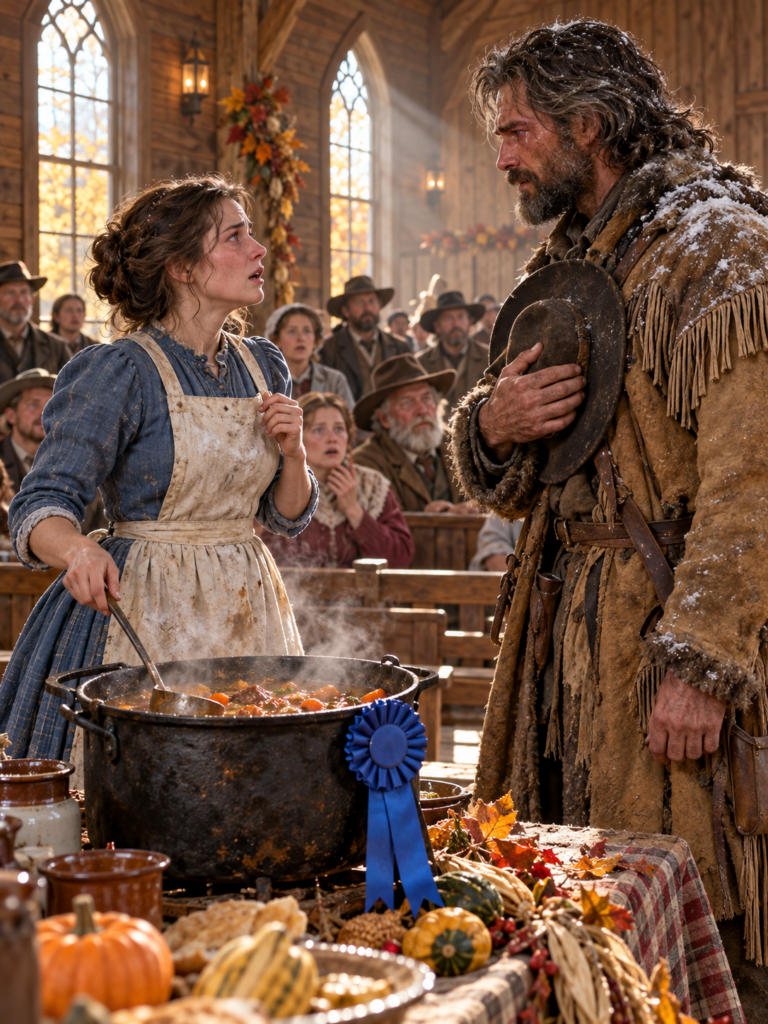
Thad lowered his head beneath the kitchen doorway and stepped into the cramped room.
Nell followed, closing the door against the murmuring crowd.
A little stove warmed the corner. Flour dusted the worktable, and empty bowls stood beside a basin of cooling water.
Thad remained near the door until Nell gestured toward a flour barrel.
“You can sit there.”
“Thank you, ma’am.”
He sat carefully.
For a man so large, he seemed determined to occupy as little space as possible.
Nell wiped her hands against her apron.
“I need to ask your mother’s name.”
His expression tightened.
“Delia.”
Nell closed her eyes.
The promise she had carried for eleven years had finally found its rightful owner.
“Delia Mercer?”
Thad nodded.
“Did you know her?”
Nell pulled out a chair and sat opposite him.
“Yes.”
He leaned forward.
“Where?”
“At a railroad boarding house, about two hundred miles south.”
His hands opened across his knees.
Nell took a breath.
“I was fifteen when I went to work there. I scrubbed floors and washed dishes. I had no family to help me, and the wages were barely enough to keep me fed.”
Thad listened without interruption.
“The cook was a quiet woman everyone called Dee. She had a gray streak in her hair and a scar across her left thumb.”
His face changed.
“She cut it on a kitchen blade,” he whispered. “I was six. I cried harder than she did.”
Nell pressed her fingers together.
“She was left-handed.”
“Yes.”
“And she used to hum while she cooked.”
Thad looked away.
For a moment, Nell thought he might stand and leave.
Instead, he asked, “When did you know her?”
“Eleven years ago.”
His head turned sharply.
“That can’t be.”
Nell remained silent.
“My mother died twenty years ago.”
“I know that’s what you were told.”
He stared at her.
The little stove cracked softly.
“My father said fever took her while I was away with my uncle. When I came home, there was a cross on the ridge.”
Nell felt her heart twist.
“Thad, she was alive when I knew her.”
He shut his eyes.
“No.”
“I’m sorry.”
“Twenty years,” he said. “I’ve knelt beside that cross for twenty years.”
He bowed his head, his great hands pressed together.
Nell wanted to comfort him.
But she understood that touching a stranger in such grief might be more than he could bear.
She waited.
At last, he lifted his face.
“Did she ever speak about a son?”
“Often.”
He swallowed.
“What did she say?”
“That she had left a boy in the mountains. That she thought of him every day.”
Thad’s jaw worked.
“Did she try to find him?”
“I don’t know everything she tried. She spoke little about why they were separated.”
Nell looked toward the closed kitchen door.
“But every year on his birthday, she made the same stew.”
Thad stared.
“She said she hoped the wind might carry the smell up to the ridge.”
His eyes filled.
“And the song?”
“She hummed it for him.”
He covered his face.
Nell sat with him through the silence.
Then he asked the question she had feared.
“Where is she now?”
Nell’s own eyes burned.
“She died eleven years ago, in the spring.”
Thad lowered his hands.
“Was she alone?”
“No.”
Nell’s voice steadied.
“I was holding her hand.”
A single tear moved down his weathered cheek.
“Did she suffer?”
“She was weak for a long while. But she knew I was with her.”
“What did she say?”
Nell swallowed.
“Your name.”
Thad bent forward as though the words had struck him physically.
Nell reached into the deep pocket of her apron.
She brought out a small tin box with rounded, worn corners.
“She gave me this.”
Thad stared at it.
“She asked me to keep it sealed until someone recognized the song.”
Nell placed the box on the table between them.
“I didn’t know whether that day would ever come.”
Thad looked at her.
“Why keep a promise to a woman who was gone?”
“Because she kept me alive when I had no one. And because she loved you.”
His hand moved toward the box, then stopped.
“May I?”
“It’s yours.”
He opened it.
Inside lay a stained recipe card and a sealed envelope.
The envelope bore his full name in delicate, slanting handwriting.
His breath caught.
Before he could open it, the kitchen door creaked.
Granny Odum stood in the doorway.
Her face was pale.
“I heard enough,” she said.
Thad turned.
The old woman gripped her cane.
“Your mother did not die when your father said she did.”
Thad stared at her.
“You knew?”
Granny Odum lowered her eyes.
“Yes.”
The confession seemed to fill every corner of the little room.
“I helped her leave.”
Thad rose slowly.
Nell stood as well.
Granny Odum’s hands shook.
“Your father gave her a terrible choice. She could stay under his rule and keep silent, or leave with nothing and never see you again.”
Thad’s face hardened.
“And you let me believe she was buried?”
Granny Odum began to cry.
“I was afraid, boy.”
He looked down at the unopened letter.
Then he broke the seal.
Inside was one sheet of paper.
His mother had written that she loved him, that she had never willingly forgotten him, and that something remained hidden beneath the third stone of the hearth in his father’s old cabin.
Thad read the final instruction twice.
Then he folded the letter carefully.
He looked at Nell.
“I haven’t entered that cabin in eight years.”
She waited.
“I don’t know what she’s left me.”
Nell touched the edge of the table.
“Then you should go when you’re ready.”
Thad looked at the doorway.
Then back at the letter.
“Would you come with me?”
Nell studied his face.
The mountain man everyone feared looked like a boy who had lost his way.
She picked up the tin box.
“Yes.”
Thad stared at the little tin box in Nell’s hands.
For a moment, he did not move.
Then he reached for his hat.
“I can bring horses in the morning.”
Nell nodded.
“That’s sensible. It’ll be dark before long.”
He glanced toward the window.
The afternoon was already fading.
Outside, voices drifted through the church hall.
People were talking about the cook-off, the blue ribbon, and the strange meeting between a penniless newcomer and the most solitary man in Pine Hollow.
Nell knew how quickly curiosity could become judgment.
She had encountered enough of it since arriving.
Thad seemed to understand.
“You don’t have to explain anything to them.”
“I know.”
“And you don’t owe me your company.”
Nell looked at him.
“I gave my word that I’d come.”
He nodded.
“Then I’ll see you tomorrow.”
He left quietly.
Nell remained beside the table with Delia Mercer’s tin box held against her apron.
For eleven years, she had carried it from place to place.
Now she knew why.
***
By morning, the story had spread through Pine Hollow.
Mrs. Pruitt arrived at Nell’s wagon with Reverend Dalrymple following several steps behind.
Nell was packing a small bundle when the doctor’s wife approached.
“Miss Harper.”
“Mrs. Pruitt.”
“The church board has concerns.”
Nell straightened.
“About what?”
“The circumstances surrounding yesterday’s competition.”
Nell looked at her.
“My stew was judged fairly.”
“That isn’t precisely the issue.”
“Then say what the issue is.”
Mrs. Pruitt glanced at the patched canvas of Nell’s wagon.
“A stranger arrives, wins our prize, and suddenly becomes involved in a very private matter concerning an old family.”
Nell felt a familiar heat rise in her chest.
“Mr. Mercer’s family history has nothing to do with my cooking.”
“Nevertheless, the board believes it would be prudent to postpone handing over the kitchen keys.”
Nell stood very still.
The room behind the kitchen.
The warmth.
The promise of not waking beneath frosted canvas.
All of it was suddenly being held beyond her reach.
“Until when?”
“Monday, at least.”
Reverend Dalrymple shifted uncomfortably.
“Mrs. Pruitt, perhaps—”
“Surely we can take a little time to consider.”
Before Nell could answer, a cane struck the wagon wheel.
Granny Odum stood behind them.
“The board includes me, does it not?”
Mrs. Pruitt stiffened.
“Of course.”
“Then you’ll not speak for all of us.”
The old woman stepped closer.
“That girl cooked the best stew in Pine Hollow. The judges said so. The ribbon’s hers, and so is the prize.”
Mrs. Pruitt’s mouth tightened.
“There’s still the matter of appearances.”
Granny Odum raised her chin.
“Then perhaps it’s appearances we ought to improve.”
Nell nearly smiled.
The reverend cleared his throat.
“I see no reason to withhold what was properly awarded.”
Mrs. Pruitt said nothing.
At last, she turned sharply and walked away.
Granny Odum watched her go.
“Good. That settles it as far as I’m concerned.”
Nell looked at the old woman.
“Thank you.”
Granny Odum’s expression softened.
“No thanks needed for telling the truth.”
She hesitated.
“And I owe Thad more truth than I gave him.”
Nell remembered the little kitchen.
The enormous man sitting silently with his mother’s letter.
“You can still speak to him,” she said.
“I intend to.”
***
Thad arrived shortly afterward with two saddled horses.
His face showed the exhaustion of a sleepless night.
Nell noticed at once.
“Have you eaten?”
“A little.”
“That’s not what I asked.”
He looked at her.
Then, unexpectedly, he smiled.
“Not enough.”
She handed him bread wrapped in a clean cloth.
“Then eat before we ride.”
He accepted it.
“You sound like Mama.”
Nell felt a sudden ache.
“She was the one who taught me to notice when a man was pretending not to be hungry.”
Thad looked down.
For a moment, the bread rested untouched in his hands.
Then he broke off a piece and ate.
When they mounted, he explained the route.
His father’s old cabin stood high on the ridge, beyond a winding trail through pine and aspen.
It was not the cabin where Thad now lived.
He had kept a separate place farther along the mountain.
The family house had remained closed since Harlan Mercer’s death eight years earlier.
They rode slowly enough for the horses to negotiate the rising ground without strain.
Frost silvered the shaded grasses.
The air smelled of pine resin and dry leaves.
Nell had never climbed so high above Pine Hollow.
She looked out across the valley.
“It’s beautiful.”
Thad glanced toward the distant hills.
“My mother thought so.”
They rode in silence for a while.
Then Nell asked, “What was she like when you were little?”
He considered the question.
“Small.”
Nell smiled.
“She was.”
“Never sat still if someone needed feeding.”
“That sounds right.”
“She sang when she worked.”
Nell glanced at him.
“What else?”
Thad’s expression softened.
“She could make a meal out of things Pa thought weren’t worth keeping.”
He paused.
“And she remembered everything about me.”
Nell thought of Delia’s careful hands, the gray streak in her hair, and the way she had smiled whenever she spoke of the mountains.
“She remembered you when I knew her too.”
Thad looked ahead.
“Then why didn’t she come back?”
It was the question that neither of them could answer.
Not yet.
***
Halfway up the ridge, Nell caught a clean, sharp smell drifting from the rocks.
She turned.
A low shrub grew among the stones, its dark berries scattered across evergreen branches.
“What’s that?”
“Juniper.”
Thad dismounted and crushed a berry between his fingers.
“Ma used to do this when I was small.”
He lifted his hand near his face.
The sharp scent reached his nose.
He sneezed.
Nell startled, then laughed.
Thad laughed too.
For a moment, the grief between them loosened.
“She’d do that on purpose,” he said.
“To make you sneeze?”
“She thought it was the funniest thing in the world.”
Nell smiled.
“That sounds like her.”
He dropped the crushed berry and remounted.
As they continued, Nell noticed that he seemed a little less burdened.
The memories were hurting him.
But some were returning with warmth instead of pain.
***
Near the top of the ridge, two grave markers appeared on a rocky shelf.
One was a plain stone bearing Harlan Mercer’s name.
The other was a weathered wooden cross.
Nell knew whose name Thad believed it represented.
He slowed his horse.
For twenty years, he had mourned his mother at that spot.
He had knelt beside a cross and spoken to someone who was not buried there.
Now the old marker seemed less like comfort than a terrible unanswered question.
Nell did not speak.
Thad rode past.
Above the graves stood the cabin.
It was built from heavy logs, with a broad stone hearth and a narrow porch.
The door had been nailed shut.
Thad dismounted and stared at it.
“Eight years,” he said.
Nell climbed down beside him.
“You don’t have to go inside immediately.”
He looked at her.
“I know.”
Then he took a hammer and worked the nails loose.
The first resisted.
The second came free.
By the time he removed the last, his hands were shaking.
He pushed the door.
It opened with a long wooden groan.
Dust hung in the still air.
The cabin contained a table, two chairs, a narrow bed, and a tin bowl on a shelf.
The hearth stood cold.
Nell looked around.
The room had the strange emptiness of a place abandoned without being allowed to change.
Thad stepped inside.
“My father sat here every evening.”
He touched the back of one chair.
“The other was Mama’s.”
Nell noticed that the chair remained near the hearth.
As though someone had continued expecting its owner to return.
Thad crossed the room.
The hearth was built from gray river stones.
He counted carefully.
“One.”
His finger moved to the next.
“Two.”
Then the third.
He knelt.
The stone was larger than Nell had expected and firmly set.
Thad worked a narrow iron tool into the old mortar.
Little pieces loosened.
He shifted his weight and lifted.
The stone moved.
Beneath it lay a small hollow lined with dry material.
Inside was an oilcloth bundle.
Thad stared.
Nell stepped closer.
“Is that it?”
He nodded.
He reached down and lifted the bundle into the light.
His hands moved with almost impossible care.
He unfolded the cloth.
Inside lay a small book bound in faded blue fabric.
Thad opened the cover.
The first page carried Delia’s familiar slanting handwriting.
He read silently.
Then his shoulders began to tremble.
Nell waited.
Finally he turned the book toward her.
It was a collection of recipes.
But the margins contained something far more precious.
Notes about a little boy.
Thaddeus dislikes turnips.
Thaddeus ate three bowls and wanted another.
Thaddeus lost his first tooth in the biscuits.
Thad let out a sudden laugh.
Then the laughter broke into a sob.
Nell turned toward the window, giving him the privacy he needed.
For several minutes, the only sounds were the turning pages and the wind outside.
At last, Thad spoke.
“She wrote down everything.”
Nell returned to him.
“She remembered everything.”
He turned to the stew recipe.
His finger stopped near the bottom.
“The last ingredient.”
Nell leaned closer.
Wild juniper from the ridge.
Thad read the note beneath it.
His mother had written that the stew never tasted quite like home without the berries growing behind their cabin.
Nell covered her mouth.
Delia had made that stew year after year at the boarding house.
Always carefully.
Always with love.
But every time she tasted it, she had sighed.
Now Nell understood why.
The missing ingredient had been a piece of home she could never carry away.
Thad read the final page.
The handwriting was less steady there.
His mother had written that if his father ever told him she was gone, he must not believe it.
She was only far away.
She had not stopped loving him.
She would never stop cooking for him.
Thad closed the book.
He sat with it against his chest.
Nell remained beside him.
Then he asked the question that had been waiting for twenty years.
“What did he bury under that cross?”
Nell looked toward the window.
The wooden marker stood on the rocky shelf below.
“I don’t know.”
Thad rose.
He carried the book to the table.
Then he went into the shed adjoining the cabin and returned with a spade.
Nell followed him outside.
The afternoon air had grown colder.
Thad stood before the weathered cross.
He rested one hand against the wood.
“For twenty years, I thought she was beneath this ground.”
Nell said quietly, “You don’t have to discover everything today.”
He looked at the marker.
“I need to know.”
He loosened the cross and laid it carefully aside.
Then he drove the spade into the earth.
The first cut was difficult.
The ground was hard with cold.
The second was easier.
He worked slowly and steadily.
Nell stood nearby, watching his face.
She did not ask him to stop.
She understood that the work was his decision.
At a little less than three feet, the spade struck wood.
Thad froze.
The sound was small.
Hollow.
Not the sound of a coffin.
He knelt and cleared the dirt away with his hands.
A flat cedar box lay beneath the soil.
It was no longer than a Bible.
Two crooked letters had been carved into the lid.
D M.
Thad stared at them.
Then he slid his knife beneath the rusted latch.
The metal gave with a brittle snap.
He opened the box.
For a moment, he did not move.
Nell could not see inside.
She saw only his shoulders beginning to shake.
Then he whispered, “Mama.”
He lifted a bundle of letters tied with faded kitchen string.
Nine envelopes.
Nine birthdays.
All addressed to Thaddeus Mercer on High Ridge.
Every seal remained unbroken.
Thad turned the bundle over.
A small scrap of paper lay beneath it.
The handwriting was rough and uneven.
His father’s.
Thad read the words.
Then he sat back on his heels.
Nell knelt beside him.
“What does it say?”
He handed her the paper.
Harlan had written that he could not bring himself to burn the letters, but had not been able to give them to his son.
At the bottom was a plea for forgiveness.
Nell looked at Thad.
He stared toward his father’s gravestone.
For years, he had believed that man had buried his wife.
Now he knew Harlan had buried the evidence of a living mother’s love.
Thad’s face tightened.
“I don’t know whether I can forgive him.”
Nell folded the paper.
“You don’t have to decide that today.”
He looked down at the nine sealed letters.
“Then I want to hear what Mama had to say.”
He untied the kitchen string.
And opened the first envelope.
Thad unfolded the first letter with hands that could barely keep the paper still.
Nell remained kneeling beside him on the cold earth.
He read the opening line silently.
Then he tried to speak it aloud.
“My darling Thaddeus.”
His voice broke.
He stopped and pressed his lips together.
Nell said nothing.
The letter had waited nearly two decades for its rightful reader.
It could wait another moment.
Thad drew a slow breath.
His mother had written on his fifteenth birthday.
She hoped he was healthy.
She hoped he had enough to eat.
She wondered whether he had grown tall like his father.
And she told him she had made his favorite stew that evening, humming his childhood song over the pot.
Near the bottom, she had added a small joke about crying enough into the broth to improve the salt.
Thad gave a startled laugh.
It escaped him before he could stop it.
“That sounds like her.”
Nell smiled through her own tears.
“It does.”
He opened the second letter.
Then the third.
One year unfolded after another.
Delia had written about finding work.
About rooms that were too cold.
About the price of food.
About cooking for railway laborers, travelers, and strangers who arrived hungry and tired.
She had saved small pieces of her life for the boy she believed might someday read them.
In one letter, she described a girl who helped wash dishes and fed stray dogs when she barely had supper for herself.
Thad looked up.
“That’s you.”
Nell nodded.
“She never told me she’d written about me.”
He read the passage again.
His mother had described Nell as a hardworking girl with a generous heart who needed somebody to believe she could make something of herself.
Nell pressed her hand against her mouth.
For years she had believed Delia cared for her.
But seeing that affection preserved in a private letter was something different.
It was proof.
The kind that could not be mistaken for politeness or duty.
Thad continued reading.
The later letters were shorter.
His mother’s health had begun to fail.
Her handwriting lost some of its firmness.
But every letter returned to the same thought.
She loved her son.
She had never chosen to forget him.
And she hoped he had found kindness somewhere beyond the ridge.
At last, Thad reached the ninth envelope.
Across the back, four words had been underlined twice.
Open this one last.
He looked at Nell.
She nodded.
He broke the seal.
The letter contained only a few lines.
Delia wrote that she did not expect to be well enough to write another year.
She asked him not to spend his life grieving over what they had lost.
Instead, she wanted him to offer warmth to someone who had none.
To cook for the cold.
To feed the hungry.
To remember that love could survive even when people were kept apart.
Thad folded the page carefully.
For a long while, he sat with his mother’s last letter pressed against his chest.
Then he looked toward Harlan’s grave.
“I spent twenty years mourning a woman who was alive for nine of them.”
Nell listened.
“And he knew.”
“Yes.”
“He watched me come to that cross.”
His voice shook.
“He watched me kneel there.”
Nell felt the terrible weight of that knowledge.
Granny Odum had confessed her fear.
But Harlan’s deception had lasted far longer.
He had been willing to let his son live in grief rather than admit what he had done.
Thad looked down at the letters.
“I loved my father.”
Nell nodded.
“I know.”
“And I hate what he did.”
“Both can be true.”
He closed his eyes.
“I don’t know if I can forgive him.”
“You don’t owe him forgiveness merely because he’s gone.”
Thad turned toward her.
She spoke gently.
“What he did was wrong. You can understand his fear without making his cruelty right.”
The wind moved over the ridge.
Thad looked toward the weathered cross.
“Then I won’t decide today.”
He gathered the letters.
“But I’m finished mourning Mama as though she stopped loving me.”
Nell reached for the tin box.
Together, they secured the papers against the cold and carried them back toward the cabin.
***
Inside, the old room seemed changed.
Nothing had been moved.
The table still stood near the window.
The chairs remained beside the hearth.
Dust covered the shelves.
But Thad now understood that the emptiness he had carried for twenty years had been built on a lie.
His mother had not abandoned him willingly.
She had not forgotten him.
She had kept cooking for him in every place she could find.
He set the letters carefully on the table.
Then he opened her recipe book again.
Nell watched his finger move down the page until it reached the stew.
“The juniper,” he said.
She smiled sadly.
“That’s what Dee was missing all those years.”
Thad looked toward the ridge path.
“There’s plenty growing nearby.”
Nell glanced at the cold hearth.
The thought came before she could stop it.
“Would you like to make her stew here?”
Thad looked up.
“In this cabin?”
“Yes.”
He stared toward the empty chair beside the fireplace.
“I haven’t lit that hearth since Pa died.”
“You don’t have to.”
He considered the room.
Then looked again at his mother’s handwriting.
“She’d have wanted it used.”
Nell nodded.
“I think so.”
Thad stood.
“I’ll gather wood.”
“And I’ll need the ingredients.”
He smiled faintly.
“You’re giving orders already.”
“Only in kitchens.”
“Then I’d best listen.”
The smile reached his eyes for the first time that day.
***
They gathered what they needed without hurrying.
Thad brought dry wood from the shed and checked the old hearth before lighting a fire.
Nell fetched the food they had carried, using Delia’s instructions to measure the ingredients.
The work was familiar to her.
For eleven years, she had made that stew whenever she needed courage, comfort, or a reminder that someone had once treated her with kindness.
But this was the first time she had made it for the boy Delia had loved.
Thad returned with a handful of juniper berries.
“Found them along the ridge.”
Nell looked at the little dark fruits.
“She always sighed when she tasted the stew without them.”
“She would have.”
He crushed a small amount.
The sharp scent rose into the kitchen.
Thad sneezed so loudly that Nell startled.
Then both burst into laughter.
He wiped his eyes.
“She used to do that to me on purpose.”
“I believe it.”
They laughed again.
The sound filled the cabin.
It seemed almost improper in a place that had held so much silence.
But neither wanted to stop.
Nell browned the meat and added the vegetables and barley.
Thad carried water, tended the fire, and helped prepare the ingredients.
He did not stand aside expecting her to serve him.
When she handed him a knife and asked him to chop carrots, he obeyed.
His pieces were uneven.
Nell inspected them.
“Those are rather large.”
“They’ll cook.”
“Eventually.”
He looked at the pile.
“Think I ought to try again?”
“Yes.”
He laughed and began cutting smaller pieces.
It was the kind of ordinary disagreement that made Nell feel strangely at home.
After a while, the stew began to simmer.
The smell filled the cabin.
Nell stirred slowly.
Then she began to hum.
The melody came without effort.
Soft.
Familiar.
The same tune Delia had taught her beside a boarding-house stove.
Thad stood still.
For a moment, she thought the music might hurt him.
But then he began to sing along.
His voice was deep and uncertain.
He missed a note.
Nell smiled.
He tried again.
Soon the two voices moved together above the sound of the simmering pot.
The cabin had not heard that song in twenty years.
Now it held the melody once more.
***
The sound of wagon wheels came from the trail outside.
Nell stopped stirring.
Thad turned toward the window.
A small procession was climbing the ridge.
At its front, Granny Odum sat driving the doctor’s buggy, with Mrs. Pruitt beside her.
Behind them came Reverend Dalrymple, Mrs. Tilly, and several townspeople carrying covered dishes and loaves of bread.
Nell felt her stomach tighten.
“Why are they here?”
Thad looked at her.
“I don’t know.”
He stepped toward the door.
Then paused.
“Would you rather they stayed outside?”
Nell considered the question.
She had spent much of her life being watched and judged.
Part of her wanted to hide.
But she had done nothing wrong.
Neither had Thad.
“Let’s hear what they’ve come to say.”
He nodded.
They went onto the porch together.
Granny Odum climbed down slowly.
Her eyes moved to Thad.
“Boy, I know I can’t set right what I did.”
He stood very still.
“I should’ve told you the truth years ago,” she continued. “I let fear keep me silent, and you paid for it.”
Thad looked at her for a long moment.
Then he said, “I know more now than I did yesterday.”
Granny Odum nodded.
“And I hope, in time, that helps.”
He did not offer immediate forgiveness.
She did not ask for it.
Instead, she reached into the buggy and brought out a loaf of bread.
“Thought you might need something to eat.”
Thad glanced toward the cabin.
“Mama’s stew is cooking.”
The old woman’s face crumpled.
“Is it?”
He nodded.
“With the juniper.”
Granny Odum pressed a hand to her chest.
“Oh, Thaddeus.”
Behind her, Mrs. Pruitt stepped down from the buggy.
She held a peach cobbler carefully in both hands.
“Nell.”
Nell waited.
Mrs. Pruitt looked uncomfortable.
“I came to apologize.”
The words seemed difficult for her.
“I judged you because you were a stranger. You won fairly, and instead of being gracious, I looked for a reason to take away your prize.”
Nell listened.
Mrs. Pruitt glanced at the cobbler.
“I’ve spent years being proud of my cooking. Then you arrived and made something better.”
Her cheeks reddened.
“I behaved badly.”
Nell looked at the dish in her hands.
“Thank you for saying so.”
Mrs. Pruitt held out the cobbler.
“I brought this.”
Nell accepted it.
“And the church kitchen keys?”
Mrs. Pruitt reached into her pocket.
“Yours. As they should have been from the start.”
She placed them in Nell’s palm.
The metal was cool against her skin.
Nell closed her fingers around the keys.
For weeks, she had been sleeping in a wagon and worrying about the coming winter.
Now the little room behind the kitchen would be hers.
She had earned it with her work.
No one had given it to her out of pity.
Thad watched her expression.
Nell smiled.
“Thank you.”
Mrs. Pruitt nodded.
Then she looked toward the cabin.
“Is that really Delia Mercer’s stew?”
“It is.”
“May we come in?”
Nell glanced at Thad.
The cabin was his.
The memory was his.
He considered the people gathered outside.
Then he stepped aside.
“There’s room if everyone doesn’t mind being crowded.”
The visitors laughed softly.
They carried their dishes inside.
***
The cabin filled with voices.
Some people sat at the table.
Others stood beside the hearth.
Several took their bowls outside into the pale mountain sunlight.
Nell served the stew.
Thad helped.
He carried bowls, brought more bread, and made certain Granny Odum had a comfortable place near the fire.
Mrs. Tilly tasted the stew and smiled broadly.
“That’s even better than yesterday.”
Nell laughed.
“Now I know what was missing.”
She nodded toward the juniper.
Thad took his own bowl.
He lifted the spoon.
For an instant, his expression became the same as it had been in the church hall.
That terrible moment of recognition.
But this time, he did not turn pale.
He closed his eyes.
Tasted again.
Then opened them.
“It tastes like home.”
The room grew quiet.
Granny Odum wiped her cheeks.
“Delia would have been pleased.”
Thad looked toward his mother’s recipe book resting safely on the table.
“I reckon she would.”
Nell stood beside him.
She had spent eleven years keeping a promise.
Now it was fulfilled.
But she also understood that she had not brought Delia back.
Nothing could restore the years Thad had lost.
No bowl of stew could undo Harlan Mercer’s cruelty.
What the meal could offer was something smaller and truer.
A beginning.
A chance for Thad to remember his mother through love rather than deception.
A chance to use the old cabin without feeling trapped by it.
And perhaps, for Nell, a chance to belong somewhere without having to pretend she came from an easier past.
***
By late afternoon, the visitors had begun their descent toward Pine Hollow.
The cabin grew quiet.
The dishes were stacked near the washbasin.
A little stew remained in the pot.
Nell stood at the doorway watching the last wagon disappear around the bend.
The sky was turning gold.
Thad joined her.
For several minutes, neither spoke.
Then he said, “I owe you thanks.”
Nell shook her head.
“You don’t owe me anything.”
“You kept Mama’s promise.”
“I was glad to.”
“And you came up here when I couldn’t have faced it alone.”
She looked at him.
“You could have.”
He smiled faintly.
“Perhaps. But it was easier with you.”
Nell felt warmth rise into her cheeks.
Thad looked toward the valley.
“The church room is yours now.”
“Yes.”
“You’ve earned it.”
“I know.”
He hesitated.
Then he turned his hat in his hands.
“I’d like to ask something, if you don’t mind.”
Nell smiled.
“Go ahead.”
“Would you consider coming up here on Sundays?”
She raised an eyebrow.
“To cook?”
“Sometimes.”
“And the other times?”
He looked suddenly uncertain.
“To visit. To walk the ridge. To talk.”
Nell watched him.
The great mountain man seemed more nervous asking that simple question than he had been opening his mother’s letters.
He took a breath.
“I’d like to court you, Nell. Properly. If you’d welcome it.”
Her heart stirred.
She thought of the way he had entered the church carrying his hat against his chest.
The way he had given her room when she needed it.
The way he had accepted help without treating it as weakness.
And how, in the old cabin, he had learned to let another person share his grief.
She did not answer immediately.
“I intend to keep the church kitchen,” she said.
“I hope you do.”
“And I’ll be working through winter.”
“I know.”
“I won’t move up here merely because you have a house and I need one.”
Thad met her eyes.
“I wouldn’t ask you to.”
She smiled.
“Then yes. I’d like to come on Sundays.”
He looked relieved.
“Good.”
“But there’s one condition.”
“Name it.”
“If I cook, you wash the dishes.”
Thad laughed.
“I can do that.”
“All of them.”
“Even the pot?”
“Especially the pot.”
He grinned.
“Mama would have liked you.”
Nell looked toward the warm light spilling through the doorway.
“I think she did.”
***
The winter passed without grand declarations.
Nell worked in the church kitchen.
She cooked for gatherings, prepared meals for travelers when arrangements allowed, and used the little room behind it as her home.
The work was steady.
The room was warm.
And the keys remained hers.
Thad came down from the ridge more often.
Sometimes he brought supplies.
Sometimes he helped carry heavy pots or stack firewood.
Sometimes he simply sat at the kitchen table while Nell finished her work.
He never acted as though her time belonged to him.
When she was busy, he waited or returned another day.
She appreciated that more than he knew.
On Sundays, when weather and work permitted, she traveled to the ridge.
They cooked together.
Sometimes they used Delia’s recipes.
Other times Nell made dishes of her own.
Thad learned to cut vegetables into smaller pieces.
Nell learned where the best juniper grew.
They laughed often.
But there were difficult days too.
On some visits, Thad grew quiet while reading his mother’s letters.
Sometimes anger toward Harlan returned unexpectedly.
Nell never insisted that he forgive his father.
She listened when he wanted to speak.
And when he needed silence, she respected it.
In turn, Thad learned more about Nell’s years at the boarding house.
She told him about hunger, low wages, and the loneliness of having no family to write to.
He did not try to erase that history with promises.
He asked what she wanted from the years ahead.
Nell told him she wanted work that mattered.
A place where she was welcomed.
And people who would remember her for what she gave rather than how little she once owned.
Thad nodded.
“That sounds worth building.”
She smiled.
“It is.”
***
When spring returned, the ridge changed.
Snow retreated from the shaded hollows.
New grass appeared between the rocks.
Along the path near the old cabin, Thad planted young juniper where the soil would support them.
Nell helped carry water.
They worked carefully, knowing the little plants would need time to establish themselves.
Near the place where the false grave had stood, Thad set a modest memorial stone.
It honored Delia Mercer.
Not as someone buried there.
But as the woman whose love had survived the distance between herself and her son.
He moved the old wooden cross aside.
It had represented twenty years of mistaken grief.
The new stone represented a truth he finally knew.
Nell stood with him when he finished.
“Are you satisfied?” she asked.
He considered it.
“I think Mama would understand.”
She took his hand.
They remained there for a while.
No one spoke.
The ridge was quiet except for the wind moving through the trees.
***
One Sunday that summer, Nell arrived at the cabin carrying her old dented iron pot.
Thad met her at the door.
“Bringing the whole kitchen with you?”
“Only the important part.”
He took the pot from her.
“Heavy.”
“It always was.”
They placed it over the hearth.
Nell began preparing the stew.
Thad brought water, chopped vegetables, and crushed a few juniper berries.
The familiar sharp scent rose into the air.
He sneezed.
Nell laughed.
Then, without thinking, she began to hum.
Thad joined her.
Their voices were different.
Hers light and clear.
His deep and rough.
But the melody held them both.
When the stew was ready, they sat beside the hearth and ate from simple bowls.
After supper, Thad carried the pot to the washbasin.
Nell watched him.
“Remember our agreement.”
He glanced back.
“I haven’t forgotten.”
She smiled.
He began washing.
Outside, the evening wind moved through the young juniper plants.
The old cabin no longer stood silent.
Its hearth was used.
Its chairs were occupied.
Its table held meals prepared by two people who had chosen to spend time together.
Nell still had her room behind the church kitchen.
She still earned her own wages.
And Thad still kept his life on the ridge.
Neither had surrendered the things that made them themselves.
But the distance between their worlds had become a road they traveled willingly.
***
Years later, people in Pine Hollow still remembered the harvest cook-off.
They remembered the stranger who had entered with a battered pot.
They remembered the blue ribbon.
And they remembered the giant mountain man who had taken one bite of stew and begun to cry.
Some said it was the finest meal ever served in the church hall.
Others said the story was really about the old letters hidden beneath a false grave.
But Nell knew it was about something simpler.
A woman who had been forced away from her son had refused to stop loving him.
A young girl who had been shown kindness had kept a promise through eleven difficult years.
And a man who believed himself forgotten had finally learned that his mother’s love had never ended.
Nell never thought of the dented pot as a valuable possession.
It was scratched.
The bottom was dark from years of use.
One handle sat a little crooked.
But whenever she filled it, she remembered Delia’s hands guiding her own.
The pinch of seasoning.
The patient stirring.
The quiet tune.
And the words her old teacher had once spoken.
A good meal did more than fill an empty stomach.
It reminded someone that they mattered.
On quiet evenings, when smoke curled from the ridge cabin, two voices could sometimes be heard humming above the simmering pot.
The song belonged to Delia.
The home belonged to the living.
And the warmth they made together was something neither grief nor distance could take away.