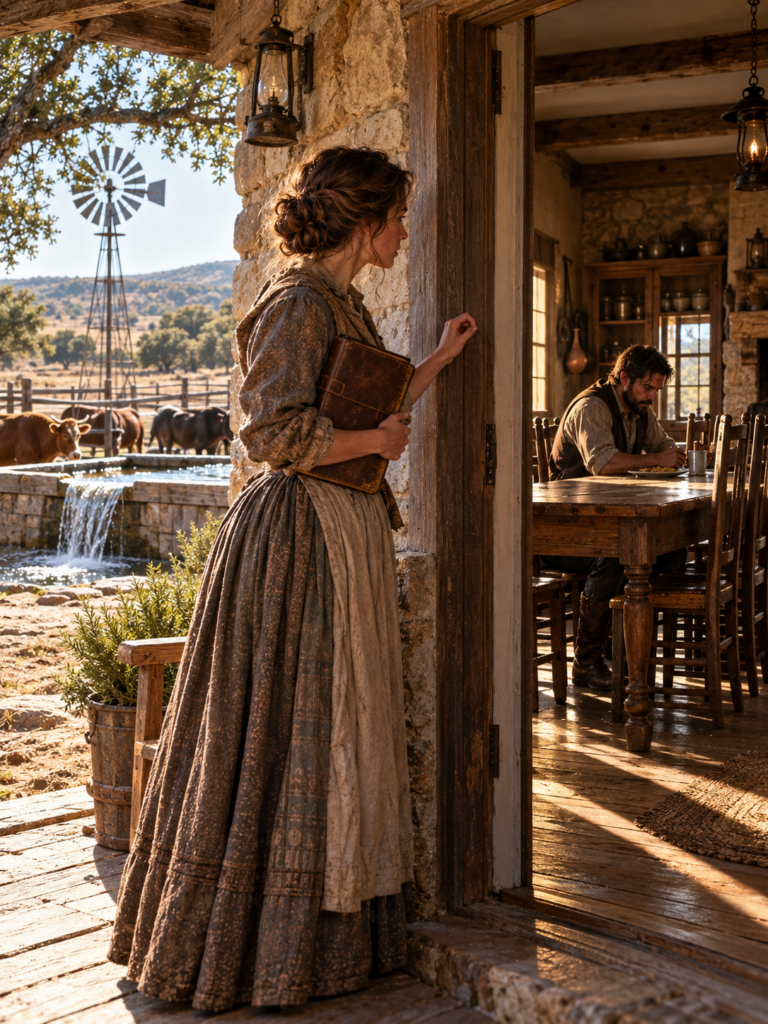
Judith added the earliest entries and discovered something she had overlooked.
The feed purchases followed a remarkably steady pattern.
Not enormous loads.
Not irregular purchases for an expanding herd.
Modest quantities, collected repeatedly, often early in the morning.
She examined the dates.
Ezra Colton had been purchasing feed on credit since March, long before the drought reached its worst.
That did not prove he had lied about his finances.
A rancher could own land, stock, and equipment while having almost no cash available.
Still, she had assumed the feed was going directly into his own barn.
Now she realized she had never asked.
She closed the ledger.
Whatever the explanation, she needed her mill running.
On Monday, August 16, Ezra arrived with a wagon carrying a long timber beam and the two draft horses he had promised.
Davey ran from the dock.
“Those horses are enormous.”
Ezra climbed down.
“They have to be.”
“What are their names?”
“Duke and Sally.”
“Which one’s stronger?”
“Sally thinks she is.”
“Which one’s smarter?”
“Duke thinks he is.”
Judith appeared at the doorway.
“That’s already several questions, Davey.”
The boy grinned.
Ezra measured the open ground beside the mill, examined the old gearing, and marked a broad circular track for the horses.
Judith had found her father’s patterns in the loft and arranged for new iron castings.
They cost eleven dollars.
She paid from the strongbox.
It felt like lowering eleven precious coins into a well whose bottom she could not see.
For three days, Ezra worked steadily.
He positioned the sweep beam, fitted the pivot, and adjusted the gearing that would transfer the horses’ movement to the millstones.
Judith prepared the stones themselves.
She lifted and inspected the worn runnerstone, refreshing its grooves so it could grind properly once power returned.
The work covered her sleeves with pale dust and left her arms aching.
When she came downstairs, Ezra offered her a dipper of cool water.
She tasted it.
It was clean and sweet.
“Where did you get this?”
“My spring.”
Of course.
The same spring that fed the overflowing trough.
He had brought water from his ranch without asking for payment or even mentioning the trouble.
Judith finished the dipper.
“Thank you.”
Ezra nodded.
Then he returned to work.
On Thursday, August 19, the horses were hitched to the sweep.
Judith stood near the millstones with one hand against the meal spout.
“Easy,” she called.
Duke and Sally leaned into their collars.
The beam moved.
The shaft groaned.
Then, slowly, the gearing caught.
The great stones began to turn.
For the first time in nine weeks, meal emerged from Branic Mill.
It came in a thin, warm stream.
Judith rubbed a pinch between her fingers.
The grind was coarse, but good.
Davey shouted so loudly that sparrows scattered from the roof.
Old Mr. Zeller, waiting with corn, removed his hat.
By noon, nine bushels had been ground.
Less than the creek-powered mill once managed, but nine more than they had ground in weeks.
Judith was checking the day’s tally when Davey appeared carrying a bench.
He dragged it into the kitchen.
“What are you doing?”
“Making room.”
“For what?”
“Dinner.”
There were three plates on the table.
Judith usually ate standing at her office desk while reviewing accounts.
Ezra had been eating alone in the kitchen.
Davey generally took his food outside.
The boy looked at her stubbornly.
“We got a whole table.”
Judith opened her mouth to object.
Then she saw Ezra standing quietly by the doorway.
He was leaving the choice to her.
The sound of that prayer returned.
So did the memory of her father’s chair, empty since his death.
She sat down.
Ezra took the place across from her.
Davey settled on the bench.
For several moments, none of them seemed to know what to say.
Finally, Judith looked at Ezra.
“Would you say grace?”
He bowed his head and gave the simple thanks she had heard at his ranch.
He did not mention eating alone.
There was no reason to.
Not that afternoon.
The next morning, Judith saddled her mare to visit the Pettybone farm, four miles east.
The family owed her three dollars and fifty cents.
It was the smallest debt on her collection list, and perhaps the one she dreaded most.
Tilda Pettybone met her near the gate.
“We haven’t got it,” the woman said before Judith could explain her visit.
Judith assured her that she had not come to take livestock.
Tilda gave her a strange look.
“Good. Ezra Colton wouldn’t forgive that.”
Judith tightened her grip on the ledger.
“What does Mr. Colton have to do with your cows?”
Tilda glanced toward the barn.
Then she answered.
And the moment Judith understood what the woman was saying, the eighty-six-dollar debt took on an entirely different meaning.
Judith stepped closer to the gate.
“What do you mean, Mr. Colton wouldn’t forgive me?”
Tilda Pettybone looked surprised.
“Surely you know.”
“Know what?”
The older woman wiped her hands against her apron.
“He’s been feeding our two cows since March.”
Judith did not speak.
Tilda continued.
“And Hester Dunlap’s animals. And the old Swedish family’s mule. He brings feed when he thinks nobody’s watching.”
For a few seconds, Judith heard only the dry wind brushing against the fence.
“Since March?”
Tilda nodded.
“Amos tried to refuse it. But when the animals began weakening, we didn’t have much choice.”
Judith opened her ledger.
She found the first Colton entry.
Then the next.
And the next.
Small purchases.
Repeated quantities.
Feed collected before sunrise.
All those weeks, she had imagined Ezra feeding his own substantial herd while neglecting the bill.
She had not considered that some of the feed might never reach his ranch.
“Did he tell you he was buying it on credit?”
“No.”
Tilda’s expression changed.
“Is that why you’re asking?”
Judith looked down at the figures.
“Eighty-six dollars and forty cents.”
Tilda pressed a hand against the gate.
“Oh.”
The simple sound carried embarrassment and regret.
“We knew he was helping. We didn’t know he couldn’t pay.”
Judith shut the ledger.
“Please don’t trouble yourself over his account.”
“But it’s your money.”
“Yes.”
She paused.
“And I need it. That’s what makes this difficult.”
Tilda disappeared into the house and returned with a small jar.
She counted out two dollars and twenty cents.
It was not the full amount she owed.
Judith accepted it, wrote a receipt, and assured her the remaining balance would stay on the books.
As she mounted her mare, she looked toward the Pettybones’ cows.
They were thin, but alive.
Someone had been keeping them that way.
During the ride home, she reconsidered her visit to Ezra’s ranch.
He had told her he lacked the cash to pay.
That had been true.
He had said his money was tied up in land and livestock.
That, too, had been true.
But he had never told her he was using part of his credit to support neighbors.
She had made an assumption.
He had allowed it to stand.
Judith wondered whether he had kept silent to protect those families from embarrassment.
Tilda’s account strongly suggested it.
But Judith also knew the difference between a convincing explanation and something Ezra himself had confirmed.
She would not put words into his mouth.
By evening, her collections totaled $14.35.
Useful money.
Painfully insufficient money.
She entered each payment into the ledger.
Then she turned to Ezra’s account.
For a moment, she considered making a notation beside the feed charges.
Instead, she left the figures as they were.
The money was still owed.
The truth had not canceled the debt.
It had changed her understanding of the debtor.
At supper, Ezra sat across from her at the mill kitchen table.
Davey was explaining how the horse sweep might be improved if Duke could be persuaded to walk faster.
Ezra explained that the horses needed a steady pace, not a race.
Judith watched him speak.
He had no idea what she had learned.
When the meal ended, he thanked her and returned to check the harness.
She almost called after him.
Almost told him she knew about the Pettybones and the other families.
But then she remembered the quiet way he had delivered feed.
Perhaps those people had needed their dignity as much as they had needed his help.
She kept their confidence.
On Saturday, when the mill was closed, Judith baked a peach cobbler using the last of her dried peaches.
She prepared cornbread, packed both into a basket, and rode the nine miles to Ezra’s house.
He was away in the pasture.
She left the food on his porch beneath a clean cloth.
Under the cloth, she tucked a note.
It explained that a hired man’s wages covered dinner, but she was supplying supper as well.
And, she added, it was simply custom.
She rode home before Ezra returned.
He found the basket at sunset.
The cobbler and cornbread sat on his long kitchen table that evening.
He pulled out another chair.
Then he ate alone, with the empty chair beside him.
It was an odd thing to do.
But he left it there.
Monday brought a letter from Toiver Crossing Bank.
Judith read the notice twice.
Then she rode to town and demanded to speak with Ellis Garity, the banker who had known her father.
Ellis looked genuinely uncomfortable when she sat down.
“My lender in San Antonio has called our paper,” he explained. “I have to call certain local notes earlier than planned.”
“My note is due September thirtieth.”
“There is a clause permitting an earlier call.”
Judith stared at him.
“How much time?”
“Until September first.”
Nine days.
The room seemed to shrink.
She had been planning around the end of September.
Now the bank wanted its $340 before summer had even finished.
Ellis removed his spectacles.
“I know the mill has started running again.”
“At a third of its old pace.”
He nodded.
Then he offered her the only arrangement he believed he could make.
If she brought at least sixty percent of the debt by September first and showed that the mill was operating, he would carry the remaining balance until the end of October under his own responsibility.
Sixty percent.
Two hundred and four dollars.
Judith had $133.35.
She needed more than seventy additional dollars in nine days.
The horse-powered mill could not produce enough business at its current pace.
She understood that before Ellis finished explaining.
Still, she thanked him for the offer.
Then she walked outside and stood beside her mare.
For the first time, the possible loss of Branic Mill felt immediate.
Her father had operated it for more than two decades.
He had taught Judith the work when she was young.
She knew the sound of correctly dressed stones, the smell of fresh meal, and the changing pressure of a full water race.
She knew the accounts.
She knew the customers.
She had thought hard work and careful bookkeeping might be enough to preserve what he left her.
Now a dry creek and a bank clause threatened to take it all.
That night, she sat at her office desk adding figures.
The horse sweep could bring in revenue.
Not quickly enough.
Farmers across the county had grain waiting.
If the creek-powered wheel could run for one full day, the mill might earn enough to meet Ellis’s condition.
But the creek was dry.
She leaned back.
And remembered Ezra’s trough.
Water spilling continuously from a pipe.
Clear water disappearing into the dirt while her mill sat idle.
She reached for a pencil.
Then stopped.
The spring.
It had been running when every nearby creek had failed.
What if there was enough water to turn the millwheel?
She rose and went to the window.
The waterwheel stood motionless against the moonlit stone building.
For the first time in weeks, Judith did not see a dead machine.
She saw a problem of distance.
At dawn, she was waiting when Ezra arrived.
He climbed down from his wagon.
“Morning, Miss Renick.”
“Where does your trough water come from?”
He looked surprised.
“The spring above my house.”
“Does it run all summer?”
“Usually. Ran through the dry year of ’74.”
“How much water?”
“More than I use.”
Judith stepped closer.
“Could it reach Branic Creek?”
Ezra remained silent for a moment.
Then he looked toward the hills.
“My father once dug a ditch in that direction.”
Judith felt something tighten in her chest.
“Your father?”
“He talked with yours about supplying water to the mill. They walked the route and tested the flow.”
“What happened?”
“They never reached an agreement. The ditch filled with silt. Must be twenty years since anyone touched it.”
“How far?”
“About a mile and a half.”
Judith stared at him.
There had been an old watercourse between the Colton spring and her father’s mill.
All these years, she had known nothing about it.
“Could it still be opened?”
“Maybe.”
“How long?”
“One man digging?”
“Yes.”
“At least a month, I’d reckon.”
She felt hope begin to disappear.
Then Ezra added, “With enough men, a few days.”
Judith looked at him.
“How many?”
“Twenty would make better work of it.”
“I don’t know twenty men who can abandon their own farms.”
Ezra looked away.
Neither spoke.
They both knew the drought had left many households struggling.
Judith remembered the Pettybones, the Dunlap widow, and the mule belonging to the Swedish family.
She remembered feed charges that had seemed like the expenses of an ordinary rancher.
And she finally understood that Ezra’s quiet generosity had formed connections he might not fully recognize.
“You could ask your neighbors,” she said.
He rubbed the back of his neck.
“I’ve never been much for asking.”
“I’ve noticed.”
He looked at her.
She spoke carefully.
“There are people who might be willing to help you, Mr. Colton.”
Ezra studied her expression.
Something passed across his face.
Not suspicion, exactly.
Perhaps the discomfort of realizing that someone knew him better than he expected.
At last he nodded.
“I reckon I could try.”
He went first to Amos Pettybone.
Judith did not accompany him.
Later, Ezra told her what happened.
He stood near the man’s barn, hat in hand, and admitted he needed help clearing the old ditch.
He could not do the work alone.
Amos looked at him for a long time.
Then he walked into the barn and returned with a mattock.
“About time you asked,” he said.
By Wednesday, eleven people had gathered.
Not the twenty Ezra had imagined.
But enough to begin.
Amos Pettybone brought his tools.
Hester Dunlap arrived wearing her late husband’s boots.
Pastor Orin Wills rolled up his sleeves.
Old Mr. Zeller sat nearby offering practical advice earned through decades of work.
Tilda Pettybone brought food.
Judith carried water to the workers and helped wherever she could.
The old ditch was difficult to recognize in places.
Twenty years of silt, roots, and neglect had nearly erased it.
Men and women dug through hard earth, cleared obstructions, and followed the faint remains of the route Ezra’s father had started.
The heat was punishing.
Hands blistered.
Tools struck buried stones.
More than once, they found a section that required more digging than expected.
But the line gradually opened.
At noon, everyone ate together.
Judith watched Ezra sitting among the workers.
He had spent months delivering feed without asking for gratitude.
Now people were offering something he could not provide for himself.
Their time.
Their labor.
Their willingness to stand beside him.
At one meal, Amos said something that made Ezra laugh aloud.
Judith looked up.
It was the first time she had heard him laugh freely.
She thought about the empty chairs at his ranch.
Perhaps loneliness had not come from a complete lack of people who cared for him.
Perhaps he had simply forgotten how to let them close enough to show it.
By Saturday evening, the ditch had been cleared.
Its long channel stretched from the spring toward Branic Creek.
But there was still no water moving through it.
The gate at the spring remained closed.
Ezra wanted to wait until the next day before opening it.
The workers agreed.
On Sunday, August 29, the congregation at Toiver Crossing gathered in the little white church.
Pastor Wills spoke about people who lived alone and the responsibility of neighbors to care for one another.
Judith sat in the third pew.
Ezra sat beside her.
Neither had arranged it with much discussion.
He simply entered, saw the empty place, and sat down.
During the service, Judith became aware of his shoulder only an inch from hers.
She did not move away.
Afterward, Hester Dunlap invited Ezra to supper later in the week.
The invitation surprised him.
He accepted awkwardly.
Then he looked toward Judith.
She smiled.
For once, he did not appear embarrassed by being needed or wanted.
That evening, work resumed at the spring gate.
Ezra inspected the channel one final time.
The old ditch was open.
The water was ready.
Judith stood beside him.
Tomorrow, the bank deadline would be dangerously close.
If the flow proved too weak, if the ditch failed, if the wheel refused to turn, there would be almost no time to recover.
Ezra gripped the gate handle.
Judith lifted her lantern.
“Ready?” he asked.
She looked toward the dark line of the ditch disappearing through the hills.
“Open it.”
Ezra pulled.
And water began moving toward Branic Mill for the first time in twenty years.
The first water slid beneath the raised gate in a narrow stream.
Judith watched it gather against the mud before slipping into the reopened ditch.
For several moments, she said nothing.
Ezra stood beside her, one hand still resting on the gate mechanism.
The spring had run through years of drought.
That much he knew.
But neither of them knew whether the cleared channel would carry enough water all the way to the mill.
The distance was considerable.
A mile and a half of old earthworks could conceal weaknesses no one had noticed during the digging.
Water might seep away.
An unstable bank might fail.
Silt might collect at a low point.
Judith understood all of it.
She had spent most of her life studying the movement of water through races, channels, and mill machinery.
Yet she found herself holding her breath like someone who knew nothing at all.
They followed the first part of the flow.
The stream advanced slowly.
At one shallow section, water spread wider than expected before gathering again into the cut channel.
Ezra knelt and examined the bank.
“It’ll need watching.”
“Yes.”
“We may have to strengthen some sections.”
“We will.”
Judith spoke with certainty she had not felt that morning.
The old ditch was imperfect.
So was the horse sweep.
So was her mill.
But for the first time since May, she had more than one way to keep the machinery working.
They returned toward Branic Mill as evening deepened.
By the time the water reached the lower end of the channel, darkness had settled across the hills.
Judith took a lantern to the wheel pit.
Ezra stood beside her.
Davey had been sent to bed, although Judith strongly suspected he was watching from the loft.
The great waterwheel loomed above them.
Its buckets were dry.
Its timbers had stood motionless for nine weeks.
Judith had begun to fear she would hear it turn only in memory.
Then came a sound.
Faint at first.
A soft movement along the dry race.
Judith lifted the lantern.
“Ezra.”
“I hear it.”
The sound grew louder.
A thin stream appeared in the channel, gathering strength as water continued arriving from the spring.
It passed over cracked mud and reached the millrace.
Judith stepped closer to the stone edge.
Water spilled toward the wheel.
The first bucket began filling.
The wheel creaked.
For one terrible instant, it seemed nothing would happen.
Then the weight shifted.
The wheel moved.
Only a little.
Then farther.
A second bucket filled.
The great wooden structure turned again.
Judith laughed.
The sound surprised her.
She had spent months tightening her emotions into something as orderly as a ledger.
She had endured the silent mill, the unpaid accounts, and the bank’s demands without allowing herself much more than a moment’s anger.
Now water was moving past her feet, and the wheel was turning.
She laughed until her eyes filled.
Ezra removed his hat.
He watched her instead of the machinery.
And Judith knew there was something she could no longer keep hidden.
“I need to tell you what happened the day I came to collect your account.”
Ezra turned.
She looked at the lantern.
Then back at him.
“Your door was open. You were saying grace.”
His expression became thoughtful.
“I remember.”
“I heard more than I meant to.”
The water continued pouring into the race.
Judith forced herself to speak plainly.
“I heard you say you were tired of eating alone.”
Ezra went still.
For a moment, she feared she had injured the trust developing between them.
“I shouldn’t have listened,” she continued. “I was about to leave. Then the porch creaked.”
He looked down at his hat.
“I thought someone might have been there.”
“Are you angry?”
“No.”
He answered without hesitation.
Then he considered his words.
“I said it because it was true.”
Judith looked at him.
“I know.”
Ezra’s gaze moved toward the turning wheel.
“I didn’t expect anyone to hear it. But I can’t say I wish you hadn’t.”
She lowered her eyes.
The confession had brought another truth close to the surface.
One she had avoided naming since her father’s death.
“I eat at my office desk,” she said.
Ezra nodded.
“I know.”
“I tell myself it’s because I’m busy. Because the accounts need tending and the work never ends.”
She stopped.
“Before my father died, we ate together whenever we could. Afterward, I kept working through supper. I thought staying occupied would make the house feel less empty.”
Ezra listened.
“It didn’t,” she admitted.
The wheel turned steadily beside them.
“I’ve been eating alone for fourteen months.”
He rested his hat against the stone rim.
For a long moment, neither spoke.
Then he placed his hand near hers.
Not over it.
Not demanding anything.
Simply close enough that she could decide.
Judith moved her fingers.
Their hands met.
The water kept flowing.
They remained beside the wheel until the lantern flame burned low.
There was still a debt to face.
There was still a bank demanding payment.
And neither knew exactly what their growing affection would become.
But Judith was no longer standing alone beside the machinery.
That was something.
The next morning, August 31, wagons began arriving at Branic Mill before sunrise.
Mr. Zeller was first.
He had been waiting nine weeks to grind his corn.
Behind him came the Pettybones.
Then wagons from the Dunlap family.
Then more farmers carrying wheat, corn, and oats that had been held back by the drought.
The line stretched toward the county road.
Davey stood on the loading dock, staring.
“I’ve never seen so many wagons.”
Judith looked along the line.
“Then we’d better begin.”
The millwheel turned.
The gearing engaged.
Above them, the dressed stones began grinding.
Judith worked at the hopper.
Ezra carried sacks and managed the flow of work.
Davey kept the tally on a slate.
Farmers waited their turn and helped move grain when they could.
For hours, the building filled with the sounds Judith remembered from childhood.
The heavy turning of the wheel.
The vibration of the stones.
The steady rush of water.
The scrape of sacks over wooden boards.
And the voices of customers who had almost forgotten what a working mill sounded like.
By midday, Judith’s sleeves were white with meal.
Her shoulders ached.
She barely noticed.
Every sack represented another small amount of money toward the bank.
Every completed order meant another farmer could take ground grain home.
And every turn of the wheel made it harder to believe that only weeks earlier, she had stood beside an empty creek wondering whether she would lose everything.
Davey came running up the stairs.
“Miss Judith!”
“What?”
“There’s more wagons!”
“Then write them down.”
“I’ve already filled the first side of the slate.”
“Use the other.”
He stared at her.
Then grinned.
“Yes, ma’am.”
The mill ran until evening.
The last of the day’s grain was loaded.
Customers drifted away with wagons heavier in one sense and lighter in another.
Ezra cleaned the work area while Davey organized the tally.
Judith went into the office.
She locked the door, opened the strongbox, and counted the day’s earnings.
Once.
Then again.
Seventy-eight dollars and sixty-five cents.
Her breath caught.
She placed the amount beside the money she had already gathered.
One hundred thirty-three dollars and thirty-five cents.
Together, they made exactly two hundred twelve dollars.
She stared at the total.
Davey slipped into the doorway.
“Did we make it?”
Judith did not answer immediately.
He approached the desk.
She pointed to the figures.
The boy worked the calculation in his head.
Then he grinned.
“That’s more than sixty percent.”
Judith looked at the total again.
He was right.
The bank required at least $204 against the $340 note.
She had $212.
Eight dollars more than the minimum.
The margin was small.
But it was real.
She leaned back into the chair.
For a moment, the strength seemed to leave her legs even though she was already sitting.
Davey looked worried.
“Are you all right?”
Judith laughed softly.
“Yes.”
She covered her eyes.
“Yes, Davey. I believe I am.”
The next morning, she carried the money to Toiver Crossing Bank.
Ellis Garity counted every bill.
Judith watched his hands, trying not to count along.
He finished.
Then he looked up.
“Two hundred twelve dollars.”
She nodded.
“That’s more than sixty percent of the note.”
“I know.”
He studied her for a moment.
“I heard your mill running yesterday.”
“It ran all day.”
“People have been talking about that ditch.”
“Eleven people helped clear it.”
“And Mr. Colton?”
“He supplied the water.”
Ellis nodded slowly.
Then he prepared the agreement.
The remaining $128 would be carried to the end of October under the terms he had offered.
Judith read the paper carefully.
She understood that the debt had not disappeared.
She would still have to work, collect payments, and make the remaining balance good.
But the immediate threat of losing the mill had been pushed back.
The wheel was turning.
Customers were returning.
The old watercourse gave her a new opportunity to keep the business operating through dry weather.
For the first time in months, the figures on her ledger pointed toward a future rather than an ending.
She signed.
Outside, Ezra was waiting beside the wagon.
He stood when he saw her.
He did not ask for an explanation.
Judith smiled.
That was enough.
He smiled back.
On Sunday, September 5, Judith returned to the Colton ranch.
This time, she had not come to collect money.
She had been invited to dinner.
Ezra had asked her in front of Pastor Wills and several neighbors after church.
His invitation had been plain.
There was room at his table.
Judith had accepted.
Davey rode beside her in the wagon.
For once, the boy was unusually quiet.
Judith suspected he was thinking about food.
She was thinking about the first time she had climbed Ezra’s porch steps.
The heat.
The ledger under her arm.
The single plate.
The prayer she had never meant to hear.
As they approached the house, she saw the trough still receiving water from the spring.
Only now she understood its significance.
The overflow she had judged wasteful had revealed the existence of a reliable water source.
The spring had been a clue to something her father and Ezra’s father had once considered.
An old ditch.
An unfinished arrangement.
A possibility buried beneath twenty years of silt.
The water had not needed to be discovered.
It had been flowing the entire time.
What had been missing was the knowledge of where it could go.
Judith climbed down from the wagon.
Ezra met them at the porch.
“Miss Renick.”
“Mr. Colton.”
Davey made an impatient noise.
Judith looked at him.
“What?”
“Are we going to eat?”
Ezra laughed.
“We certainly are.”
Inside, the kitchen looked different.
The long table still stood beneath the window.
But the chairs were no longer stacked against the wall.
They had been arranged around it.
Seven chairs.
A bench for Davey.
And people already gathering.
Tilda and Amos Pettybone were there.
Hester Dunlap had arrived.
Mr. Zeller had brought a pie.
Pastor Wills stood near the window.
The room was full of conversation.
Ezra seemed almost overwhelmed by the number of voices in his kitchen.
Judith noticed the way he looked from face to face.
The same man who once ate beneath six empty chairs now had to move around people to reach his own seat.
Nothing about the gathering felt extravagant.
The food was ordinary.
The tableware was mismatched.
The furniture showed its years.
But everyone had a place.
Before they sat, Ezra stood at the head of the table.
He rested his hands against the chair back.
“Would you let me say grace?”
The room quieted.
Heads bowed.
Ezra thanked God for the bread, for those who had prepared it, and for the water that had brought the mill back to life.
Then he hesitated.
Judith recognized the silence.
It was the same pause she had heard on August 12.
The pause after the familiar prayer ended.
The place where, weeks earlier, he had admitted to an empty kitchen that he was tired of eating alone.
This time, he looked around at the gathered neighbors.
Then he bowed his head again.
“Lord, thank you that I’m not eating alone today.”
“Amen,” the table answered.
Judith sat down beside him.
For a moment, she looked at the faces around the room.
Tilda, whose two cows had survived because someone quietly bought feed.
Amos, who had answered Ezra’s request for help by taking a tool from his barn wall.
Hester, who had worked the ditch and now had a place at the table.
Pastor Wills, who had helped turn neighbors into a work crew.
Mr. Zeller, whose waiting grain had finally passed between the millstones.
Davey, who had insisted on three plates in Judith’s kitchen before she could admit she wanted company.
And Ezra.
The man she had ridden nine miles to confront.
The man who had owed her $86.40 and could not pay.
The man whose unpaid account had helped feed struggling neighbors.
The man who had repaired her mill with horses, timber, iron, and his own labor.
The man who had finally found the courage to ask for help and discovered he had more friends than he realized.
Judith knew his debt was not yet fully resolved merely because the wheel was turning.
She knew affection did not excuse unpaid accounts.
She also understood that generosity could not replace responsible bookkeeping.
But she had learned that numbers were sometimes only the visible part of a larger story.
The entry marked eighty-six dollars and forty cents had seemed to describe a careless rancher.
It had actually included the cost of keeping several neighbors’ animals alive.
The overflow at his trough had looked like indifference to the drought.
It had pointed toward water that could restore an entire mill.
And the prayer she overheard had sounded like a lonely man’s private sorrow.
It had become the beginning of a table large enough for people to gather around.
Ezra passed her the cornbread.
“Will you have some more?”
“Yes,” she said.
There was no need to pretend she wasn’t hungry.
They ate.
The conversation moved from the mill to the harvest, from the spring ditch to the coming cattle drive.
Davey asked more questions than anyone could count.
Hester teased Ezra about the number of chairs he had stored against the wall.
He accepted it with a smile.
Judith found herself laughing without looking toward an office clock.
When the plates were nearly empty, she noticed that Ezra had not once glanced at the vacant spaces along the wall.
There were none.
And for the first time in fourteen months, Judith finished a meal without rising halfway through to return to her ledger.
The work would be there tomorrow.
The bank balance would still require attention.
The millstones would need tending.
Ezra would return to his ranch, and Judith would return to the mill.
Their future together had not been decided by one prayer or one meal.
But the door between two solitary lives had opened.
Neither seemed eager to close it.
Outside, spring water continued flowing downhill toward Branic Mill.
Inside, every chair at Ezra Colton’s table was occupied.
And neither Judith nor Ezra had to ask God to take away their loneliness that evening.
They were already learning how to answer that prayer for each other.