Part 1
The first sign that Salvatore Gallow had arrived was the sudden absence of music.
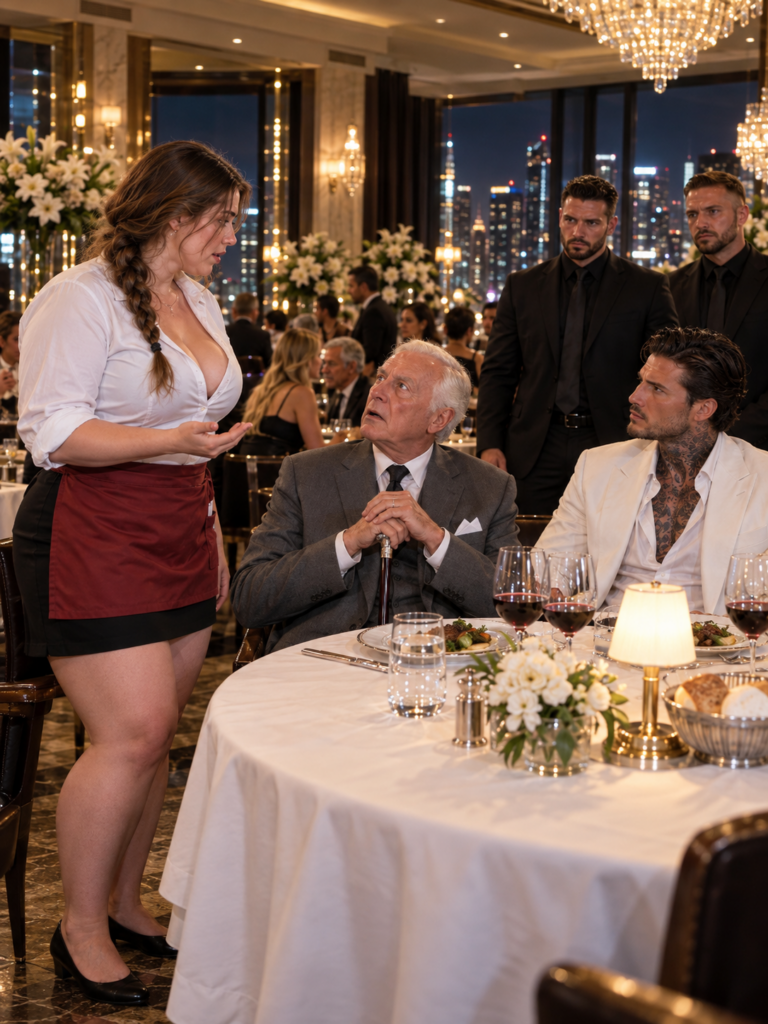
Inside La Catedral, one of Chicago’s most exclusive Italian restaurants, the jazz pianist lifted his hands from the keys. Conversations stopped halfway through sentences. A senator seated near the windows lowered his eyes to his untouched dinner.
And twenty-two-year-old Norah Rossi, holding a bottle of expensive Pinot Noir, watched an entire room of powerful people become afraid of one elderly man.
Salvatore stood just inside the entrance, a polished silver cane supporting his slight frame. His charcoal suit was immaculate, his thinning gray hair carefully combed, his expression almost bored.
Two enormous men followed him.
Neither needed to display a weapon.
Everyone already knew what they represented.
At the corner table, Dante Gallow rose to his feet.
Norah had never seen her employer stand for anyone.
At thirty-two, Dante controlled a network of shipping businesses, valuable Chicago properties, and powerful connections stretching from the waterfront to the courthouse. His legitimate holdings were worth billions. His criminal influence was considerably harder to calculate.
Men twice his age addressed him with carefully measured respect. Politicians returned his calls. People who crossed him sometimes disappeared from their comfortable positions in the world.
Yet as his father approached, Dante looked less like Chicago’s untouchable ruler and more like a man preparing to defend himself against an accusation he had heard his entire life.
Norah lowered the wine bottle.
She knew trouble when she saw it.
And she had survived too much to volunteer for more.
Earlier that evening, she’d been standing in the restaurant kitchen, trying to ease the ache in her lower back while the cooks prepared for dinner service.
La Catedral paid better than most restaurants, particularly on weekends. That was the primary reason she tolerated its demanding customers, unreasonable management, and occasional glimpses of men who looked as though they belonged in federal investigations.
Her grandfather had left her nearly fifty thousand dollars in medical debt when he died two years earlier.
Every paycheck had somewhere to go before it reached her hands.
Rent. Utilities. Collections payments. Groceries, when something remained.
On weekends, she worked mornings at a diner in Logan Square. During the week, she covered whatever additional shifts Paul, La Catedral’s floor manager, would give her.
Her old Honda Civic had begun making an expensive grinding noise. Her winter jacket was too thin. The radiator in her apartment worked whenever it felt inclined.
None of those problems would be solved by offending the Gallow family.
Which was why Norah had always considered invisibility an excellent professional skill.
She served efficiently, remembered orders, and never lingered near table four, Dante’s preferred booth.
Usually, he barely noticed her.
Tonight, however, the entire restaurant was organized around his father’s visit.
“He’s coming from Sicily,” Carla, the senior waitress, had whispered while nervously checking her lipstick.
“Who?”
“Don Salvatore.”
Norah remembered the way Carla’s hand trembled around her compact.
“He hasn’t been here in five years. He hates America. He hates the way Dante runs things. And when he comes to Chicago unexpectedly, somebody usually pays for it.”
Norah hadn’t replied.
She had grown up with an elderly Sicilian man who disliked America, distrusted prosperity, and considered disappointment a reasonable response to almost everything.
Her grandfather, Petro Rossi, came from Prizzi, a small mountain village where family history mattered more than official records.
He had immigrated in the late 1960s and spent years working around Chicago’s rail yards.
He never truly forgave the city for being cold, noisy, or American.
After Norah’s parents died in a car accident on the Dan Ryan Expressway when she was nine, Petro became her guardian.
He was strict, stubborn, and difficult to please.
He also insisted that she speak his village’s old Sicilian dialect at home.
Not standard Italian.
Not the polished language heard in expensive restaurants.
His dialect was rougher, full of expressions that made little sense outside the mountains where he’d been born.
As a child, Norah had learned it because Petro refused to answer her in English.
As a teenager, she’d argued with him in it.
By the time he died, the language was so deeply embedded in her memory that certain phrases brought back the sound of his footsteps before she could stop herself.
She hadn’t expected that childhood to become relevant at work.
Especially not tonight.
When Salvatore finally reached table four, Dante bowed his head slightly.
“Papa.”
His father acknowledged him with a small nod and settled into the chair opposite.
Only then did the pianist resume playing.
Near the kitchen doors, Paul was practically pleading with Carla.
“You have to serve them.”
“I can’t.”
“You’re our most experienced waitress.”
“And I’d like to remain alive long enough to enjoy my experience.”
Carla shook her head, pulled away, and disappeared into the kitchen.
Paul stared after her.
Then he saw Norah.
She knew immediately what was coming.
“No.”
“Nora, please.”
“Absolutely not.”
“Just take the menus and water. You never make mistakes.”
“Then let me continue not making mistakes in section B.”
Paul glanced toward the corner booth.
“Marco doesn’t speak Italian. David can barely speak English when he’s nervous. I need someone calm.”
Norah crossed her arms.
“Find someone else.”
“I’ll give you permanent Friday-night shifts.”
She hesitated.
Paul noticed.
“And double your shifts when you want them.”
Friday nights could bring enough tips to change the way her month looked.
She pictured the stack of medical statements waiting on her kitchen counter.
“Put it in writing tomorrow,” she said.
Paul almost sagged with relief.
“Done. And Nora?”
“What?”
“Don’t look the old man in the eyes.”
She collected two leather-bound menus and crossed the restaurant.
Every step seemed louder than it should have been.
At table four, Dante was speaking quietly to his father.
“The ports are secure. Union leadership understands the transition. There’s no reason to turn this into another war.”
Salvatore stared past him.
Norah approached with her professional smile.
“Good evening, gentlemen. Would you care for sparkling water?”
“San Pellegrino,” Dante replied without looking up. “And fresh bread.”
She placed the menus before them.
Salvatore regarded her briefly, then returned his attention to his son.
Norah was already preparing to leave when the old man muttered something beneath his breath.
It was only a short sentence.
Dante frowned.
“Papa?”
Salvatore didn’t repeat himself.
But Norah had understood every word.
The phrase was from Petro’s village.
A bitter old saying about men pretending to be kings where they held no real authority, followed by an insulting complaint about the food.
Her grandfather had used almost the same words when he disliked her mother’s cooking.
For one terrible instant, Norah wasn’t standing inside a restaurant owned by Chicago’s most dangerous man.
She was thirteen again, listening to Petro complain across their kitchen table.
And before common sense could stop her, she answered.
In the same ancient dialect.
“The dust only stays where the wind has no strength. And our bread is made from wheat, not manure. If you don’t want to eat, you can go hungry like a stubborn child.”
The words emerged clearly, naturally, with the sharp rural cadence Petro had taught her.
Then she remembered where she was.
Dante turned so quickly his chair scraped the floor.
“What did you say?”
One of the guards moved a hand toward his jacket.
The pianist struck the wrong note.
Norah’s stomach dropped.
She had just called the father of a mafia boss a whining child.
Over bread.
“I apologize,” she began.
Dante stood halfway.
“You will address my father in English. Do you understand?”
“Sit down.”
Salvatore’s command was quiet.
Dante stopped.
For several seconds, the old man studied Norah.
Not her uniform this time.
Her face.
Her posture.
The way she kept her hands still even though her pulse was racing.
“Look at me,” he instructed.
Norah lifted her chin.
His eyes were dark and unsmiling.
“Where did you learn those words?”
“From my grandfather.”
“Where was he born?”
“Prizzi.”
Something changed in Salvatore’s expression.
He leaned forward.
“What was his name?”
“Petro Rossi.”
The old man repeated it slowly.
Then he asked another question in the mountain dialect, using an expression so obscure that Norah had not heard it since her grandfather’s funeral.
She answered immediately.
Salvatore’s eyes widened.
Then he laughed.
Not a polite chuckle.
A genuine, delighted laugh that shook his narrow shoulders and made him put a hand against his chest.
Around them, people stared.
Dante looked genuinely stunned.
Salvatore wiped the corner of one eye.
“A waitress,” he said in English. “An American girl in a cheap apron, and she speaks the language of my home better than my own son.”
“Papa—”
“Listen to her. The pronunciation. The fire.”
He pointed toward Norah.
“That is Prizzi. That is how people spoke before everyone decided money could replace a man’s roots.”
Dante’s expression darkened.
“She’s an employee.”
“And a remarkable one.”
Salvatore looked at her again.
“What is your name, child?”
“Norah, sir.”
“Norah.”
He appeared pleased by it.
“Bring us your fresh bread. The wheat bread. And perhaps you can explain to my son what a proper Sicilian dinner should taste like.”
Norah swallowed.
“Of course, sir.”
She escaped toward the kitchen, conscious of Dante watching her entire journey.
Paul intercepted her at the swinging doors.
“What happened?”
“Nothing.”
“Nothing? Don Salvatore laughed. I have worked here for eleven years and never seen him laugh.”
Norah pressed her hand against the edge of a prep counter.
“I answered something he said.”
“What did you answer?”
“Something about bread.”
Paul stared at her.
She reached for the bread basket.
“Please don’t ask me anything else.”
When she returned, Salvatore was waiting.
He inspected the warm loaf, broke off a piece, and tasted it.
“Good. Sit.”
Norah looked at the empty chair beside the table.
“Sir, I have customers.”
“They can wait.”
Dante leaned back, studying her.
“Sit down, Nora.”
She obeyed, occupying the edge of the leather cushion.
Salvatore immediately began criticizing his son’s business methods.
Dante relied on lawyers, contracts, politicians, and accountants.
Salvatore believed power came from loyalty and fear.
“My son thinks he can purchase what our fathers earned,” the old man said. “He walks into boardrooms and imagines those men are his brothers.”
“The old methods sent half our relatives to prison,” Dante replied. “My lawyers keep our operations alive. My businesses keep people employed.”
“You trust men whose loyalty lasts until someone offers more.”
“They’re easier to manage than men who shoot first and think afterward.”
The silence that followed was unpleasant.
Norah became painfully aware of her position.
Salvatore wasn’t simply enjoying her company.
He was using her as evidence against his son.
The poor waitress understood tradition. The billionaire businessman had forgotten it.
When Salvatore suggested that she understood real loyalty because she knew what hunger felt like, Norah answered before thinking.
“I mostly understand the importance of paying my electric bill, sir.”
Dante let out a short laugh.
For the first time, he looked at her without anger.
“At least someone here understands practical economics.”
Salvatore ignored him.
“Your grandfather raised you well.”
“He did his best,” Norah answered.
She wasn’t sure whether that was entirely true.
But it was the kindest description she had available.
The two men resumed their disagreement, and she realized neither cared that she had been pulled into it.
To Salvatore, she was a reminder of Sicily.
To Dante, she was an unexpected variable.
To herself, she was a waitress who needed to finish her shift.
She stood.
“Excuse me, gentlemen. The kitchen needs my orders.”
Salvatore nodded.
“We’ll speak again, Norah of Prizzi.”
Dante said nothing.
His gaze followed her as she left.
By two in the morning, the last customer was gone.
The dining room smelled of extinguished candles, stale wine, and cleaning chemicals.
Norah removed her apron, changed into her worn denim jacket, and collected her canvas bag.
Carla watched from the locker room.
“You should be careful,” she said.
Norah tried to smile.
“I intend to be.”
“That’s not what I mean.”
Norah understood.
Being noticed by the Gallow family was not a promotion.
It was a complication.
Outside, November wind cut through the narrow alley.
Norah pulled her collar up and started toward the employee parking lot.
She stopped when she saw the black Lincoln Navigator blocking the exit.
Its engine idled quietly.
The rear door opened.
Dante Gallow stepped onto the wet pavement.
He had removed his tie. The open collar of his white shirt revealed the edge of a tattoo near his collarbone.
He lit a cigarette and watched her through the rising smoke.
“Your car’s giving you trouble.”
Norah tightened her grip on her bag.
“It works.”
“For now.”
“Was there something you needed, Mr. Gallow?”
He came closer.
“My father doesn’t like surprises.”
“Neither do I.”
“Yet you surprised both of us.”
Norah said nothing.
Dante studied her for a moment.
“While you were serving dessert, I had someone investigate you.”
Cold spread through her stomach.
“Nora Rossi. Twenty-two. Parents killed when you were nine. Raised by Petro Rossi. Fifty thousand dollars in medical debt. Two jobs. No criminal history.”
Her face burned.
“You had no right.”
“You’re right.”
The admission was so unexpected that she looked up.
“It doesn’t change what I did,” he continued.
He paused near her.
“My father sees something in you. He will invite you back to his table. He’ll offer money, favors, protection. Eventually he’ll ask for information about me.”
“Then tell him to leave me alone.”
Dante’s expression remained unreadable.
“I can’t control what my father wants.”
“But you control this restaurant.”
“I control considerably more than that.”
He reached out and caught her chin, forcing her attention toward him.
The contact made her stiffen.
“Listen carefully. If you accept anything from him, he’ll consider you his property. His favors always come with a price.”
Norah pulled her face away as soon as his hand relaxed.
“And yours don’t?”
A faint change crossed his expression.
“Mine come with terms you can understand.”
“Then explain them.”
“You continue serving him. You listen. And anything he says about me comes directly to me.”
Norah stared at him.
“You want me to spy on your father.”
“I want to know when he decides to move against me.”
“That’s insane.”
“That’s my family.”
For a moment, only the engine disturbed the silence.
Norah thought about her apartment, her grandfather’s bills, and the miserable possibility of losing her job.
Then she made a decision.
“If you expect me to work for you outside my job description, you pay for it.”
Dante’s eyebrow lifted.
“Excuse me?”
“My grandfather’s debt. Fifty thousand dollars. Clear it.”
The corners of his mouth moved.
“You’re negotiating with me?”
“I’m trying to survive this conversation.”
He looked at her for a long moment.
Then he smiled.
Not kindly.
But with genuine interest.
“Consider the debt paid.”
Norah’s breath caught.
“Just like that?”
“By tomorrow morning.”
He turned toward the Navigator.
“My driver will take you home.”
“I can drive myself.”
“It’s late. Get in the car.”
She looked toward the dark parking lot, then at the silent driver standing beside the vehicle.
This was not a choice she liked.
But staying in the freezing alley would not give her a better one.
She walked to the open passenger door.
As she sat down, the locks clicked into place.
For two years, she’d believed fifty thousand dollars was the problem standing between her and freedom.
Now, for the first time, she wondered what freedom would cost when a billionaire decided to pay the bill.
Part 2
At ten the following morning, Norah opened the hospital’s online billing portal.
Her apartment radiator rattled behind her. Cold air slipped through the poorly sealed window, stirring the corner of an overdue electricity notice on the table.
She refreshed the page.
Then she refreshed it again.
The balance remained unchanged.
$0.00 — Paid in Full.
Norah sat motionless on the edge of her bed.
For two years, that debt had governed every decision she’d made.
She had measured grocery purchases against collection notices. She had taken extra shifts while sick, skipped meals to save money, and learned the precise number of days a utility bill could remain unpaid before the threats became serious.
And Dante Gallow had erased the entire amount between midnight and breakfast.
There should have been relief.
Instead, she felt exposed.
If fifty thousand dollars meant so little to him, what else could he arrange with a single telephone call?
What happened to someone who disappointed a man with that much influence?
Norah put down her phone.
In the bathroom, she turned on the shower and waited through its familiar sputtering before the water ran clear.
She stood beneath the lukewarm spray until her skin began to ache.
She didn’t feel fortunate.
She felt purchased.
At three that afternoon, she returned to La Catedral.
Paul was waiting near the host stand.
When he saw her, his entire posture changed.
“Norah.”
“Afternoon.”
He hurried after her.
“Mr. Gallow called this morning. Your assignment has changed.”
She stopped.
“Changed how?”
“You’re no longer working section B.”
Her heart gave an unpleasant jump.
“Am I fired?”
“No. Absolutely not.”
Paul seemed horrified by the suggestion.
“You’ll be assigned exclusively to the private dining room whenever Mr. Gallow or Don Salvatore is here. Twenty dollars an hour, plus a guaranteed share of the private tip pool.”
Norah studied him.
“Is that in writing?”
“Of course.”
“And my Friday-night shifts?”
“Guaranteed.”
“Good.”
She continued toward the kitchen.
Paul hurried to open the swinging door for her.
That was new.
Inside, Marco was preparing stock at the stove.
Normally, he would have greeted her with some ridiculous remark about her exhausted expression.
Today, he only nodded.
“Hey, Norah.”
“Hey.”
He returned to his work.
She felt several other employees watching her.
Nobody knew what had happened in the alley. Nobody knew about the debt.
But Dante had changed her schedule, doubled the significance of her position, and made Paul afraid of disappointing her.
In La Catedral’s strange hierarchy, that meant something.
She wished it didn’t.
At five o’clock, Salvatore arrived alone.
Norah carried a small silver tray into the soundproofed private dining room at the rear of the restaurant.
The room was paneled in dark mahogany, with antique mirrors along the walls and a heavy dining table beneath a frosted skylight.
Salvatore sat at its head, resting both hands on his silver cane.
Without the crowded restaurant around him, he looked older.
His face seemed thinner. His breathing was slightly labored.
Norah placed a black espresso and a small glass of sambuca before him.
“Good evening, sir.”
“Sit with me.”
She hesitated, then took the chair to his right.
Salvatore drank his espresso without sugar.
For several moments, he regarded her silently.
Then he asked, in the dialect of Prizzi, whether his son had bought her.
Norah’s fingers tightened beneath the table.
She answered in the same language.
“The debt has been paid.”
A small, humorless smile appeared on his face.
“Of course it has.”
He set down his cup.
“Dante believes every problem has a price. He thinks a man becomes loyal because a bank account changes.”
Norah kept her eyes on him.
“Your son helped me.”
“Yes. And now he expects something in return.”
She said nothing.
Salvatore leaned back.
“He has been trying to turn our family into a corporation. He employs attorneys instead of soldiers. He trusts politicians who smile at him in public and despise him in private.”
“He seems successful.”
“At earning money.”
The old man’s tone was dismissive.
“Money is not power if the men around you stop being afraid.”
Norah thought about Dante standing in the alley.
He had not seemed like a man anyone considered harmless.
Salvatore continued.
“In Sicily, there are men who remember how our family operated before my son took control. They consider his methods a disgrace.”
“Then perhaps you should discuss that with him.”
“He doesn’t listen.”
“That sounds like a family problem.”
Salvatore almost smiled.
“It is. And you understand family better than most.”
Norah shifted uneasily.
“Sir, I’m a waitress.”
“You observe people. I saw it yesterday. You notice what they try to hide.”
“I notice when customers need more water.”
“And when men are lying.”
He rested a hand on his cane.
“I need someone near my son. Someone who can tell me whom he meets, what he plans, and whether he is losing his grip on the men around him.”
Norah felt the blood leave her face.
He was asking her to do exactly what Dante had predicted.
“Why me?”
“Because you know what hardship means. Men born into wealth often misunderstand loyalty. You haven’t had that luxury.”
“I don’t know anything about your business.”
“You know how to listen.”
He reached inside his suit jacket.
When his hand returned, it held a thick white envelope.
He placed it on the table and slid it toward her.
“For the inconvenience.”
Norah looked at it.
The envelope was heavy enough that she could imagine the money inside.
She could buy a new winter coat.
Repair her car.
Move somewhere with reliable heating.
For one brief, humiliating moment, she pictured what it would feel like to stop calculating every dollar she spent.
Then she remembered Dante’s warning.
His father’s favors came with ownership.
Norah pushed her chair back.
“I can’t take that.”
Salvatore’s expression cooled.
“You haven’t even opened it.”
“I don’t need to.”
She stood.
“My grandfather taught me that my blood isn’t for sale. I work for an hourly wage, sir. That’s enough.”
For the first time since she entered, Salvatore appeared uncertain how to answer.
Norah inclined her head.
“If you need anything else, I’ll be outside.”
She left before he could stop her.
In the corridor, she leaned briefly against the wall.
Her knees were shaking.
She had turned down more money than she had ever held in her life.
And she wasn’t certain she’d survive the consequences.
Twenty minutes later, she was in the wine cellar, taking inventory of a shipment of Barolo.
The temperature was kept at fifty-five degrees.
Norah held a metal clipboard against her chest while searching for the correct bottle numbers.
She had written the same figure twice when a voice emerged behind her.
“He offered you money.”
Norah spun around.
The clipboard slipped from her hands and struck the stone floor.
Dante stood at the end of the aisle.
His jacket was unbuttoned, his expression unreadable.
“How did you know?”
“I monitor the private dining room.”
She stared at him.
“You were listening?”
“The room is equipped for it.”
“So your father asks me to spy on you while you’re already spying on him.”
“Something like that.”
Norah let out a disbelieving breath.
“This family is unbelievable.”
Dante approached, stopping a comfortable distance away.
“You refused the envelope.”
“Yes.”
“Why?”
She looked at him.
“Because I already made an agreement with you.”
“Most people would have taken the money.”
“Most people probably haven’t been threatened by both of you in forty-eight hours.”
Something flickered across his face.
“Fair.”
Norah bent to collect her clipboard.
Dante reached it first.
Instead of looming over her, he picked it up and handed it back.
Their fingers brushed.
“Thank you,” she said cautiously.
He watched her.
“You knew it was dangerous.”
“Of course I knew.”
“Then why did you stand up to him?”
She hugged the clipboard against her chest.
“Because taking his money would make me a liar. You cleared my debt. I agreed to report to you. I didn’t agree to serve both sides.”
Dante’s expression softened by a fraction.
“You have an unusual understanding of loyalty.”
“No. I have an extremely practical understanding of staying alive.”
His mouth twitched.
“Is that all this is?”
Norah regarded him for a moment.
In the cellar’s dim light, he looked different from the man in the restaurant.
Still imposing. Still dangerous.
But tired.
There were faint shadows beneath his eyes, and his expensive clothes did little to conceal the tension in his shoulders.
She wondered whether he had slept since his father’s arrival.
Then she reminded herself that wondering about him was a luxury she could not afford.
“Don’t make this romantic,” she said. “You terrify me. Your father terrifies me. I’m grateful the debt is gone, but gratitude isn’t devotion.”
Dante became still.
For once, he seemed to have no immediate response.
Norah continued.
“I work for you because you pay me. I refused his money because I don’t want to be caught between two men who can destroy my life without even leaving their chairs.”
He looked down briefly.
When he met her eyes again, his voice was quieter.
“You say exactly what you think.”
“Somebody has to.”
He exhaled through his nose, almost laughing.
Then his expression changed.
The moment of unexpected warmth disappeared.
“There’s something you need to know.”
Norah’s stomach tightened.
“What now?”
“My father is bringing five senior capos from Sicily tomorrow night.”
She stared at him.
“Five?”
“They’re coming to discuss my leadership.”
“That sounds like something you should handle without me.”
“It would be, if they spoke a language my people could understand.”
Norah slowly lowered her clipboard.
“They speak the village dialect?”
“Every one of them.”
She felt the terrible direction of the conversation before he finished.
“No.”
Dante didn’t move.
“Listen first.”
“No. I know what you’re going to ask.”
“My father has been speaking to men who believe I should be removed. Those five capos can decide whether I remain in charge of the Chicago operations.”
“Then hire a translator.”
“A translator announces that someone is listening.”
“And I don’t?”
“They see you as a waitress.”
Norah stared at him.
“That’s supposed to make me feel better?”
He stepped closer, his voice controlled.
“They won’t pay attention to you. You’ll serve the wine, hear what they say, and tell me which men intend to vote against me.”
She shook her head.
“No. Absolutely not.”
“Nora—”
“If they discover I understand them, what do you think happens?”
Dante’s silence answered more than his words could have.
Norah’s breathing quickened.
“Yesterday, I almost got shot for talking about bread. Today, your father tried to buy me. Now you want me in a room with five Sicilian criminals discussing whether to kill you.”
He waited until she finished.
Then he spoke softly.
“If I lose control, my father’s people will take the city back to the way they ran it twenty years ago.”
“That isn’t my responsibility.”
“No. It isn’t.”
The admission caught her off guard.
“But you will still be in their reach,” he continued. “My father already sees you as useful. He won’t simply forget you when he returns to Sicily.”
Norah looked away.
Dante was right about one thing.
She had attracted Salvatore’s attention, and nothing she had done since had persuaded him to look elsewhere.
“He’s your father,” she whispered.
Dante’s face hardened.
“He’s also the Don.”
“Surely he wouldn’t allow them to hurt you.”
Dante gave her a bleak look.
“He taught me that this family survives by sacrificing whatever threatens it. Including its own blood.”
The cellar seemed colder.
Norah tried to picture the elderly man who had laughed at her joke about bread.
The man who had seemed almost affectionate when he heard the dialect of his childhood.
Now she imagined that same man calmly approving his son’s death.
She wasn’t sure which image frightened her more.
Dante rested his hands briefly on her shoulders.
She tensed, and his grip loosened.
“You’re capable of doing this,” he said. “You kept your composure when everyone else panicked. You refused my father when he tried to buy you. And you know exactly how to listen without being noticed.”
“That doesn’t mean I’m brave.”
“Then be careful instead.”
Norah looked up at him.
His eyes held something she hadn’t seen before.
Not command.
Not arrogance.
Fear, tightly controlled.
He was genuinely afraid of what his father’s men might do.
And he was asking a waitress for help because his money, weapons, and authority could not give him the one advantage she possessed.
She didn’t like knowing that.
She liked even less that it changed how she saw him.
“What happens if they decide against you?” she asked.
Dante’s answer was immediate.
“They’ll kill me.”
The simplicity of it left her silent.
He withdrew his hands.
“Tomorrow night. Wear black. You need to look like every other member of the service staff.”
He started toward the cellar door.
“Dante.”
He stopped.
Norah stared at him.
“If I do this, I want to be finished afterward.”
His expression shifted.
“Finished?”
“No more secret assignments. No more being trapped between you and your father. I want my life back.”
For a long moment, he said nothing.
Then he answered.
“Help me survive tomorrow, and we can discuss what comes next.”
It wasn’t the promise she’d asked for.
But it was the only answer he gave.
The cellar door closed behind him.
Norah remained between the towering racks of expensive wine.
She had spent years imagining that wealth meant safety.
Now she knew a billionaire who owned half the waterfront and still feared the people who shared his name.
Her grandfather had once told her that understanding another person’s words could protect you from their intentions.
He had never warned her that it could also make her responsible for what happened next.
Part 3
The following evening, Norah dressed entirely in black.
Black trousers. Black shirt. Black orthopedic shoes.
She pinned her brown hair tightly behind her head and checked her reflection in the small employee mirror.
She looked like a waitress.
Which was exactly the point.
No jewelry. No bright lipstick. Nothing that might invite a second glance.
For most of her adult life, Norah had worked hard to be unnoticed.
Tonight, the skill might keep someone alive.
At the entrance to the private dining room, she stopped long enough to steady her breathing.
From beyond the thick mahogany door came the muffled voices of six men.
One was Salvatore Gallow.
The other five had arrived from Sicily that afternoon.
Norah had seen them enter through the restaurant’s private access corridor.
Heavy wool coats. Weathered faces. Expensive watches worn on hands that looked accustomed to harder work.
Two of the men had missing fingers.
Another bore a deep scar crossing his upper lip.
They had not looked around in admiration of La Catedral’s luxurious interior.
They had assessed its doors, corners, and security arrangements.
That frightened her more than their appearances.
These were men who automatically considered how a room could become dangerous.
She adjusted the silver tray in her hands.
Three decanters of Barolo rested upon it.
The wine was darker than the ordinary dinner service selections, its aged color almost brown-red beneath the corridor lights.
Norah drew a careful breath.
Then she entered.
Six men sat around the long table.
Salvatore occupied the head, his silver cane resting beside his chair.
He acknowledged Norah with a slight movement of his eyes.
The others barely registered her presence.
She moved to the first guest and began pouring.
The man nearest the window spoke while studying his glass.
“He has forgotten what kind of family he comes from.”
Norah understood immediately.
The words were in the same harsh mountain dialect Petro had used when he was angry.
She kept pouring.
A broad-shouldered man with a thick neck leaned forward.
Carmine Spat.
She had heard Dante mention him earlier, but the name meant nothing to her beyond the danger he represented.
“He builds towers of glass,” Carmine said. “He pays taxes and hires lawyers. He has made us respectable in the eyes of men who would laugh at us behind closed doors.”
Another capo muttered agreement.
Carmine continued.
“The Russians think we have grown weak. Every family watches what happens in Chicago. They see Dante Gallow sitting among businessmen, pretending contracts can replace strength.”
Norah moved to the next glass.
Her hands stayed steady.
Salvatore answered without raising his voice.
“My son produces money. That money protects our interests and keeps our men out of prison.”
Carmine made a dismissive sound.
“Money can be taken.”
“And so can freedom,” Salvatore replied. “You should remember that.”
A tense silence followed.
Norah recognized the argument.
She had heard a version of it two nights earlier over a basket of fresh bread.
Old power against new power.
Fear against wealth.
Violence against organization.
But here, there was no possibility of a joke breaking the tension.
She moved around the table.
The scarred capo turned his glass slowly between his fingers.
“The question is straightforward. We remove Dante from leadership. We take control of the ports. We appoint a Sicilian who understands the families.”
Salvatore’s face remained blank.
“And my son?”
“If he accepts the decision, there are ways to settle it.”
Carmine gave a short laugh.
“He won’t accept it.”
Norah’s stomach tightened.
She had reached the opposite side of the table.
Only two glasses remained.
Another capo spoke.
“Then he must be eliminated. The family’s survival is more important than one man.”
The scarred man nodded.
“Even if that man is your son.”
Salvatore looked at him for a long moment.
“You are asking me to approve the death of my only heir.”
Carmine leaned forward.
“No, Don Salvatore.”
His voice had changed.
The disrespect was subtle, but unmistakable.
“We are informing you of what must happen.”
Norah’s pulse hammered against her ribs.
She kept her gaze on the wine.
Carmine continued.
“The decision has already been made. The majority is ours.”
Salvatore’s fingers tightened around the handle of his cane.
For the first time, Norah saw something other than cool calculation in the old man’s eyes.
It was the smallest flash of surprise.
Carmine noticed it too.
“You thought this was a discussion?”
He rested his forearms on the table.
“It isn’t.”
The scarred capo glanced toward the door.
“The men are in position.”
Norah kept pouring.
What men?
Where?
Carmine answered before she could wonder further.
“Your son has an armored car in the underground garage. He’ll use it when he leaves tonight.”
Norah felt her heart stop.
“We have men waiting beside it,” Carmine continued. “When Dante comes down, they will shoot him. Three rounds to the chest. It will be finished before his guards can react.”
The final glass filled.
Norah held the decanter steady with both hands.
A drop of wine slipped down its neck.
She caught it with the folded linen napkin before it reached the table.
Nobody noticed.
Carmine spoke as though arranging a routine delivery.
“The police will hear it was a rival organization. By tomorrow, the ports will be under our control.”
Salvatore stared at him.
“And you expect me to accept this?”
“We expect you to think about the future of your family.”
For several seconds, the old man said nothing.
Norah desperately wanted him to object.
To summon his guards.
To order Carmine out.
To remind these men that Dante was his son.
Instead, Salvatore slowly lifted his glass.
He drank.
“A bold decision,” he murmured.
Carmine smiled.
Norah felt sick.
Dante had feared his father might approve his death.
But even he hadn’t expected this.
The five men were not waiting for a vote.
They had already organized an assassination.
And Salvatore, despite his moment of surprise, was allowing it to proceed.
Norah placed the decanter back on her tray.
She turned toward the door.
Every instinct told her to run.
But she forced herself to walk.
One step.
Then another.
The men continued their conversation.
She could hear the faint scrape of Salvatore’s cane against the floor.
No one called her back.
No one asked whether she understood.
Her fingers closed around the brass door handle.
She stepped into the corridor and shut the door gently behind her.
Then she ran.
Her shoes skidded against the tile as she rushed through the rear hallway.
She burst through the kitchen doors.
Paul nearly collided with her.
“Norah! What are you—”
She didn’t stop.
Marco looked up from the stove as she passed.
Someone shouted her name.
She kept running.
At the far end of the back corridor stood the reinforced door to Dante’s private office.
Two armed guards blocked the entrance.
“Move,” Norah gasped.
The nearer guard frowned.
“Mr. Gallow is busy.”
“I need to see him.”
“No one goes inside without—”
“His life is in danger!”
The words echoed down the corridor.
Neither man moved.
Norah stepped forward.
“There are men waiting in the underground garage. They’re going to kill him when he goes to his car. If you don’t open that door right now, he’ll be dead before the night is over.”
The office door swung open.
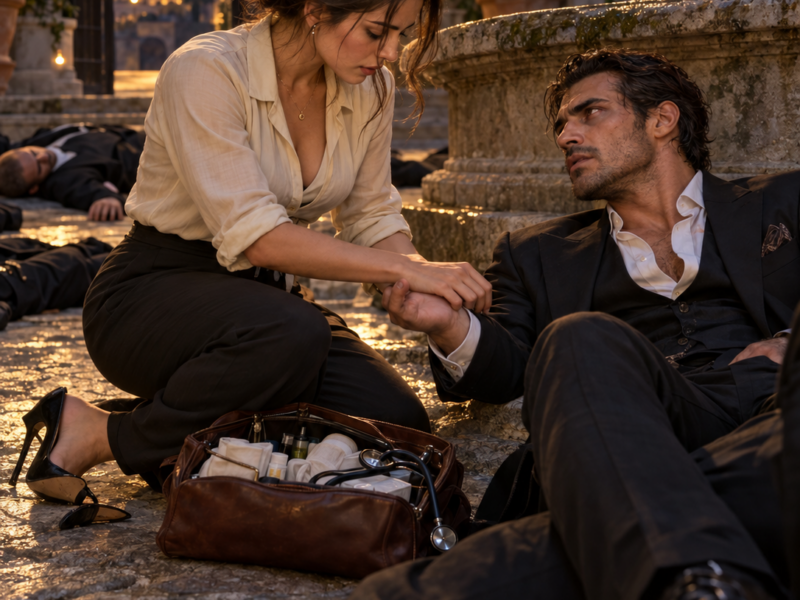
Dante stood in the doorway.
He had removed his suit jacket.
A black shoulder holster crossed his white shirt, and a handgun rested beneath his arm.
His eyes went immediately to Norah.
“What happened?”
She was breathing too hard to answer.
He caught her arm and drew her inside.
The door shut behind them.
“Talk to me.”
Norah leaned against the edge of his mahogany desk.
“Carmine,” she managed. “Carmine Spat.”
Dante became still.
“What about him?”
“They aren’t voting.”
His eyes narrowed.
“What?”
“The decision was made before they arrived. They want the ports. They want you removed, and Carmine brought men with him.”
“Where?”
“The garage.”
Dante’s expression changed.
Norah forced herself to continue.
“They’re waiting beside your armored car. They plan to shoot you when you go downstairs. Three bullets. Carmine said three bullets in your chest.”
For one terrifying second, Dante didn’t move.
Then the transformation happened.
The uncertainty she had seen in the wine cellar vanished.
His face became completely controlled.
He was no longer a man trapped in his father’s judgment.
He was calculating.
“How many men?”
“They didn’t say.”
“Who agreed?”
“All five capos.”
Dante looked toward the door.
“And my father?”
Norah hesitated.
Dante saw it.
“Tell me.”
“He didn’t order the attack.”
Something in his expression shifted.
A possibility of relief, perhaps.
Norah hated what she had to say next.
“But he didn’t stop them.”
Dante’s eyes returned to hers.
“He knew?”
“Once Carmine explained, yes. He understood everything.”
“What did he say?”
Norah swallowed.
“He called it a bold decision.”
The silence that followed was worse than shouting.
Dante looked away.
For a fleeting moment, she saw the cost of what she’d told him.
Not the loss of territory.
Not the betrayal of criminal associates.
Something older.
A son realizing that his father had chosen power over him.
Then Dante moved.
He opened a concealed compartment beneath his desk and removed a tactical shotgun.
Norah stared as he checked the weapon.
“What are you doing?”
“Handling it.”
“Dante—”
He looked up.
“Stay here.”
“You’re going down there?”
“Not alone.”
“That’s exactly what they want.”
He crossed toward the door.
Norah stepped into his path.
“Listen to me. They think you don’t know. That’s the only advantage you have.”
Dante stopped.
His gaze settled on her face.
She could barely breathe, but she held her ground.
“You told me I was useful because I listen,” she said. “Then listen now. Don’t walk into their trap.”
He studied her for another second.
Then he gave a brief nod.
“I won’t.”
He glanced toward the office’s security controls, then back at her.
“Lock the door behind me. Don’t open it until I return.”
Norah looked at the weapon in his hands.
“And if you don’t?”
Dante’s expression softened almost imperceptibly.
“Then you did what you could.”
He stepped around her.
The door closed.
Norah turned the lock.
She heard hurried footsteps in the corridor.
Men calling to one another in low, urgent voices.
A door opened somewhere beyond the kitchen.
Then the building became quiet.
She stood beside Dante’s desk, trying to slow her breathing.
On the wall behind his chair hung several framed photographs of shipping terminals and sleek corporate buildings.
They depicted an empire worth more money than she could imagine.
Yet the man who owned it was somewhere beneath the restaurant with armed enemies waiting for him.
Norah looked at the photographs until they blurred.
She thought about Petro.
His bitter complaints.
His stubborn insistence on speaking the old language.
All the mornings she had resented him for making ordinary conversations unnecessarily difficult.
She would have given anything to hear him complain again.
Three minutes passed.
Then gunfire shook the building.
The first sound was deep and violent.
A shotgun blast.
Another followed.
Then several sharper reports echoed through the floor.
Norah dropped to her knees beside the desk.
She covered her mouth with both hands.
The shooting stopped.
She waited.
There were no footsteps.
No voices.
No explanation.
The silence stretched until her muscles began to ache.
She remembered the six men around the table.
Carmine calmly describing where Dante would be shot.
Salvatore lifting his glass.
And the terrible moment she’d realized she possessed information that could determine whether someone lived.
She had run.
She had warned Dante.
Now people were dead.
Norah pressed her forehead against her knees.
She hadn’t carried a gun.
She hadn’t fired a shot.
But her decision had changed everything.
She was no longer a bystander who could pretend the violence around her belonged to someone else’s world.
She had become part of its consequences.
Ten minutes after the gunfire, the office door handle turned.
Norah flinched.
The lock held.
A familiar voice came through the wood.
“Nora. It’s me.”
She stood unsteadily.
Her hands trembled so much that she had to try twice before the lock released.
Dante entered.
His white shirt was marked with blood.
There was more on his hand and along one sleeve.
He carried the shotgun at his side.
Norah stared at him.
He closed the door, made the weapon safe, and set it against the wall.
Neither spoke.
She looked at the blood.
“Are you hurt?”
“No.”
The single word barely reached her.
Dante followed her gaze.
“It’s not mine.”
She pressed her lips together.
Her knees weakened.
Dante crossed the room.
“It’s finished.”
“What happened?”
“Carmine’s dead. His men are gone. The others surrendered.”
Norah struggled to understand the words.
“And your father?”
Dante’s face became unreadable again.
“He’s leaving Chicago.”
“Leaving?”
“He’s boarding a private plane to Palermo. He won’t be coming back.”
Norah closed her eyes.
The old man with the silver cane.
The forgotten dialect.
The laughter that had silenced an entire restaurant through sheer surprise.
For two nights, Salvatore had seemed like the most powerful person in Dante’s world.
Now he was being sent away by the son he had considered weak.
A businessman, he’d called him.
Soft.
American.
But when danger came, Dante had survived because he’d recognized the value of something his father had overlooked.
A waitress.
Not her money.
Not her family name.
Not her capacity for violence.
Her knowledge.
Her judgment.
Her willingness to act.
Norah opened her eyes.
“Are you going to fire me?”
Dante stared at her.
Then, unexpectedly, he laughed.
The sound was low, tired, and almost disbelieving.
“Fire you?”
She folded her arms tightly around herself.
“I disobeyed almost every instruction anyone gave me tonight.”
“You saved my life.”
“I told you what I heard.”
“And I would have walked straight into that garage without it.”
His expression grew serious.
“You knew how dangerous it was. You understood what they were planning, and you came to warn me anyway.”
Norah looked toward the closed door.
“I didn’t want anyone to die.”
“I know.”
For a moment, his certainty unsettled her more than his anger ever had.
Dante had spent their brief acquaintance issuing commands, evaluating threats, and buying solutions.
Now he was standing in front of her with blood on his shirt, acknowledging something she had chosen to do.
“You aren’t going back to section B,” he said.
Norah gave a weak, exhausted laugh.
“Paul won’t like that.”
“Paul will survive.”
She shook her head.
“I still need a job, Dante.”
“You’ll have one.”
“Doing what?”
“We’ll work that out.”
He paused.
“But you’re never waiting another table in this restaurant.”
Norah studied his face.
She wasn’t sure whether to be relieved or suspicious.
Perhaps both.
That seemed to be the effect Dante Gallow had on her.
He extended his hand.
It was still stained with blood.
Norah looked down at it.
Forty-eight hours earlier, she’d been an invisible waitress struggling beneath a debt she couldn’t escape.
Then an elderly Sicilian had entered her restaurant and spoken a language nobody else understood.
One careless answer had brought her to this room.
One decision to listen had saved the life of Chicago’s most dangerous businessman.
Now that businessman stood before her, offering his hand as though crossing the distance between them was the most important choice she’d make all night.
She knew he was dangerous.
She knew his wealth did not erase the things he’d done.
And she knew the terrifying world around him would not suddenly become safe simply because he had survived.
But she also knew she had refused Salvatore’s money, faced Dante’s anger, and warned him when she could have protected herself by remaining silent.
Whatever happened after tonight, those had been her choices.
She reached out and took his hand.
Dante drew her to her feet.
For a moment, she stood close enough to feel the heat of his body and the unsteady rhythm of his breathing.
He was alive.
That simple fact seemed to surprise them both.
His free hand rose toward her face.
When his thumb brushed away a tear, the gentleness of the gesture contrasted sharply with the blood on his sleeve.
Norah hadn’t realized she’d been crying.
Dante looked at her with an intensity she couldn’t easily interpret.
Gratitude.
Relief.
Possession.
Something more vulnerable beneath all three.
“You belong to me now, Nora,” he whispered. “And I protect what’s mine.”
The words should have frightened her.
Part of her was still frightened.
She remembered the dark alley, the locked car, and his first warning that powerful men always expected something in return.
She had no intention of forgetting any of it.
But she also remembered the man in the wine cellar who had admitted that his own father might sacrifice him, and the man standing before her now who owed his life to the waitress everyone else had dismissed.
Norah did not mistake his declaration for an ordinary promise of love.
Dante Gallow was not an ordinary man.
And she had no desire to become another possession in his expensive, dangerous world.
Still, she didn’t release his hand.
Outside the office, La Catedral remained unusually quiet.
Somewhere beyond the kitchen, the silverware would be collected, the wine counted, and the tables prepared for another evening.
Tomorrow, the same politicians and businessmen might return to their favorite booths, speaking in discreet voices about money and influence.
Most would never learn what had happened in the private dining room or the underground garage.
They would never know that five hardened Sicilian capos had planned to take Chicago from its billionaire ruler.
Or that their plan had failed because they believed a young waitress was too insignificant to understand them.
Norah glanced once at the blood on Dante’s shirt.
Two nights earlier, she’d wanted nothing more than to pay her bills and remain invisible.
Now she had saved a man’s life and altered the balance of a criminal empire.
Dante held her hand as though he understood that everything between them had changed.
Perhaps he did.
Perhaps neither of them yet understood how much.
But one truth was impossible to deny.
The men who had plotted Dante Gallow’s death had been prepared for bodyguards, weapons, money, and power.
They had not been prepared for Norah Rossi.
And all because a grandfather from a small Sicilian village had taught his granddaughter never to forget the language of home.