
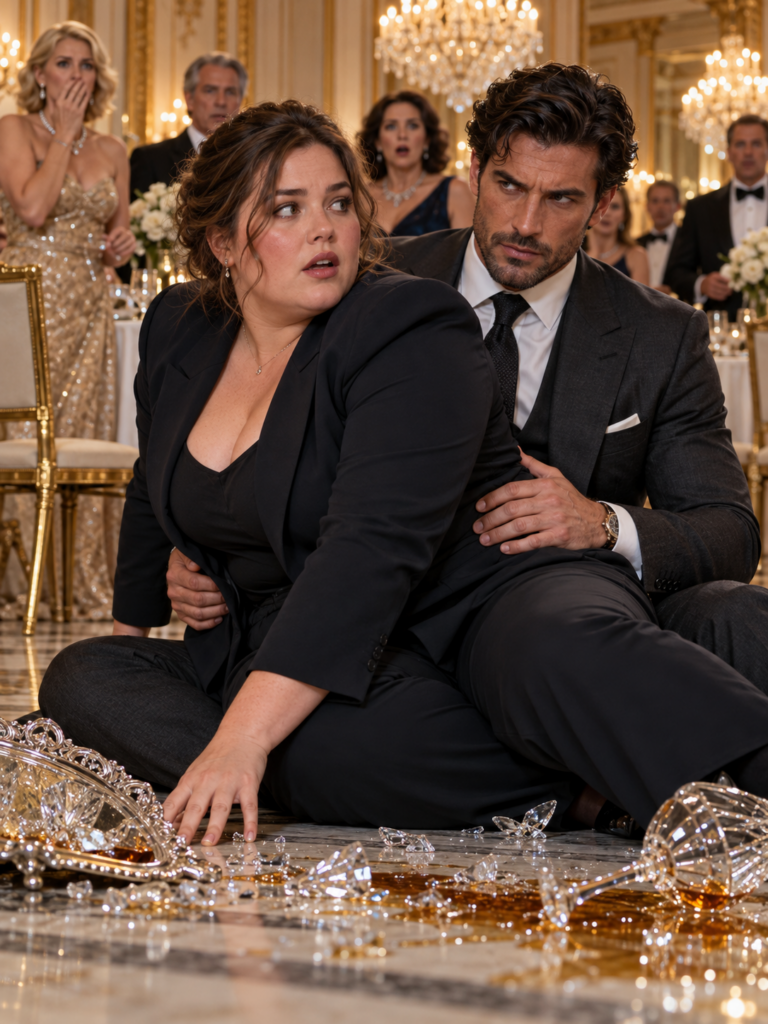
Federal agents poured through the gilded doors as Quinn turned away from Marello and reached for her phone.
“No signal.”
“They’re jamming internal communications,” Marello said.
Quinn looked at him.
“You knew that too?”
“Yes.”
“Stop saying yes like it makes any of this better.”
He accepted the blow without argument.
Around them, guests began murmuring as agents separated staff from attendees.
Quinn’s professional instincts switched on despite the adrenaline.
“Khloe.”
“What?”
“My assistant.”
Quinn scanned the ballroom.
“She’ll be in the service corridor with the vendor binders. Her name is on invoices too.”
Marello lifted one hand toward a bodyguard.
Quinn blocked the gesture.
“No.”
His eyes sharpened.
“I was going to locate her.”
“Then say that.”
A beat.
“May I have someone locate her?”
Quinn nodded once.
“Yes.”
The guard left.
That tiny correction mattered more than it should have.
An FBI agent approached.
“Ma’am, are you with Paulo Ashby Ricardo?”
Quinn swallowed.
“I was until about seven minutes ago.”
“Name?”
“Quinn Sheffield. Senior event coordinator.”
The agent looked toward the shattered VIP table.
“You were terminated tonight?”
“In front of most of Manhattan.”
Marello said nothing.
Good.
The agent asked Quinn to remain available for a statement.
Quinn agreed.
Then another agent hurried toward the ballroom stage.
“Underwood is gone.”
Quinn’s stomach tightened.
Maro had known.
Maybe he had been warned.
Maybe her firing had not been anger at all.
Maybe he had wanted her outside before questions started.
The interpretation changed again.
Quinn turned toward Marello.
“Did Maro know about the raid?”
“I don’t know.”
“That sounds like the first honest uncertainty you’ve given me tonight.”
His jaw flexed.
The bodyguard returned with Khloe, pale but unharmed.
Quinn hugged her.
“Did you approve any cash vendor changes this month?”
Khloe shook her head rapidly.
“No. Maro took those himself.”
“Good. Tell the agents that. Tell them exactly what you know, nothing more.”
Khloe nodded.
Quinn watched her leave with an investigator.
Then she faced Marello again.
“My ankle.”
His gaze dropped.
“What about it?”
“You keep staring at it.”
“You’re injured.”
“I am also angry.”
“Both can be true.”
Unfortunately, he was right.
A hotel medic arrived and examined the swelling.
“Likely a sprain. You should get imaging.”
“I’ll go to urgent care.”
“I have a physician.”
Quinn gave Marello a look.
He corrected himself.
“If you want one.”
“No private doctor.”
“Fine.”
She almost hated how quickly he adapted.
“What exactly were you planning after getting me fired?”
Marello’s expression changed.
“I intended to offer you a job.”
Quinn laughed.
“You sabotaged my employment so you could recruit me?”
“No.”
“From where I’m standing, that looks remarkably accurate.”
“The raid would have ended the company whether I interfered or not.”
“That is not the point.”
“I know.”
“Do you?”
He went quiet.
Quinn stepped closer despite her ankle.
“You decided the safest outcome and manipulated the pieces until I reached it.”
“Yes.”
“You protected me without giving me information.”
“Yes.”
“You made my career look disposable because you thought you had a better one waiting.”
Marello’s face tightened.
“I did.”
“And that was wrong.”
The words hung between them.
Behind Marello, senators and billionaires were being questioned by federal agents.
Yet the most powerful man in the room seemed focused only on Quinn’s answer.
Finally he said, “Yes.”
Her anger loosened by one degree.
Not forgiveness.
Recognition.
“What job?”
“The Bowmont Hotel.”
Quinn blinked.
“You bought the Bowmont?”
“This morning.”
“What position?”
“Director of operations.”
She stared.
“That property has four hundred employees.”
“You’ve managed events with eight hundred temporary staff across five venues.”
“That is not the same.”
“No. It is harder.”
Against her will, a laugh escaped her.
Marello’s mouth moved slightly.
Quinn immediately sobered.
“I am not accepting anything tonight.”
“I didn’t ask you to.”
“Good.”
“I was going to.”
She gave him a look.
He added, “Tomorrow.”
Better.
An FBI agent called Quinn’s name.
She turned.
Before walking away, she looked back at Marello.
“If the offer is legitimate, send it through an attorney.”
“I will.”
“And no one follows me home.”
His expression hardened.
“Quinn—”
“No.”
A long pause.
Then he nodded.
“No one follows you home.”
She began limping toward the agent.
Behind her, Marello said, “One condition.”
Quinn stopped.
“I said no conditions.”
“Not on the job.”
She looked back.
His gaze held hers.
“Go to a hospital before you put full weight on that ankle.”
Quinn almost smiled.
“That sounds suspiciously like concern.”
“It is.”
For once, he did not disguise it as authority.
Quinn turned and walked toward the federal agents on her own.
Quinn gave her statement before she went anywhere near a hospital.
By three in the morning, her ankle was wrapped, Maro Underwood was officially wanted for questioning, and Paulo Ashby Ricardo Events had become the centerpiece of a federal money-laundering investigation.
Quinn sat in the back of a taxi with a folder of discharge papers in her lap and stared at Manhattan through rain-streaked glass.
No black car followed.
No bodyguard waited when she reached her apartment.
Marello had kept his word.
At ten the next morning, an email arrived from a law firm.
Not from Marello.
The attached employment offer was forty-eight pages long.
Director of Operations, Bowmont Hotel.
Salary nearly eight times what Quinn had been earning.
Independent hiring authority.
Budget control.
Direct reporting to the hotel board.
Security staff answered operationally to her within the property.
There was no personal clause.
No expectation that she attend syndicate events.
No requirement that she live on-site.
A handwritten note appeared on the final scanned page.
You said legitimate. This is legitimate.
Quinn stared at it for a long time.
Then she called her own attorney.
Three days later she entered the Bowmont through its main doors.
Not as an employee.
As a candidate.
Marello waited in a conference room with the hotel’s chief financial officer, executive chef, head of engineering, human-resources director, and two independent board members.
Quinn paused.
He noticed.
“You expected a private meeting.”
“I expected manipulation.”
“That is becoming inconveniently difficult.”
One board member coughed to hide a smile.
For two hours, they interviewed her.
Quinn forgot Marello was dangerous.
She argued over staffing ratios.
Challenged the renovation schedule.
Rejected a plan to outsource housekeeping because the proposed contractor had a ninety-percent annual turnover rate.
When the CFO suggested wealthy guests would expect a more “traditional luxury profile” at the front desk, Quinn leaned forward.
“What does that mean?”
The man hesitated.
Marello said nothing.
Good.
The CFO cleared his throat.
“A certain visual standard.”
“You mean thin and decorative.”
“I would not phrase it that way.”
“You just did with better tailoring.”
Silence.
Quinn continued.
“Luxury is consistency. Discretion. Anticipating needs. Solving problems without drama. It is not a dress size.”
The HR director nodded.
The CFO looked uncomfortable.
Marello looked pleased.
Quinn ignored him.
At the end of the meeting, the board offered her the position.
She accepted two days later.
Her first condition was simple.
“No one threatens a guest on my behalf.”
Marello stood in her unfinished office overlooking Midtown.
“What if the guest threatens you?”
“Security removes them.”
“And if they refuse?”
“Then security does its job.”
His jaw tightened.
“You realize my definition of that job may differ.”
“Then use mine inside my hotel.”
He looked at her.
“My hotel.”
Quinn smiled.
“Not operationally.”
Something almost proud entered his expression.
“Fair.”
The next four weeks altered Quinn’s life.
Not because of gowns or private cars.
Because authority felt different when it was written beside her name.
She rebuilt vendor contracts.
Promoted Khloe after the federal investigation cleared her.
Created an anonymous staff-reporting line.
Replaced two managers who had been quietly forcing servers to work unpaid closing hours.
Refused three VIP requests for illegal after-hours liquor service.
And discovered that rich people became remarkably polite when “no” came from the woman controlling their suite upgrades.
Marello visited often.
He did not interfere.
That was not the same as disappearing.
He appeared at breakfast meetings without warning.
Sat in the lobby with coffee while reading financial reports.
Occasionally watched Quinn handle difficult guests with an intensity that still unsettled her.
One night, after she removed a movie producer for grabbing a hostess, Marello found Quinn in the service office.
“You banned him for life.”
“Yes.”
“He spends almost half a million dollars a year here.”
“He can spend it elsewhere.”
Marello smiled.
“That was exactly my answer.”
Quinn narrowed her eyes.
“Were you waiting to see whether I would make it?”
“Yes.”
“That is irritating.”
“You are excellent when irritated.”
She laughed before she could stop herself.
Their attraction developed inconveniently from there.
Not through gifts.
Through work.
Marello knew every service corridor in the building because his security people had reviewed them.
Quinn knew every service corridor because she had walked them with housekeeping.
He noticed strategic vulnerabilities.
She noticed human ones.
One evening, he proposed placing two armed guards permanently outside her office.
“No.”
“There has been pressure from the Abbott family.”
“Then tell me what pressure.”
He stopped.
A month earlier he would have tried to solve it first.
Now he said, “They lost access to several laundering channels after the raid. They believe my cooperation with investigators caused it.”
“Did it?”
“Yes.”
“And because I now work for you, they might target me.”
“Yes.”
Quinn appreciated the truth even though it chilled her.
“One guard in the executive corridor,” she said. “Visible. Hotel security uniform. No weapons displayed.”
“That is inadequate.”
“It is my workplace.”
“It is my war.”
“That is precisely why you do not get to turn my workplace into a bunker without me.”
His expression hardened.
Then he exhaled.
“One visible guard. Additional response team downstairs.”
“Not shadowing me.”
“No.”
“Agreed.”
That was how trust accumulated.
Not in declarations.
In arguments that ended differently than they once would have.
The grand reopening arrived on a cold Friday night.
Quinn stood at the top of the Bowmont’s marble staircase in a midnight-blue gown she had selected because she liked it.
Not because someone told her it was flattering.
Not because it made her look smaller.
It didn’t.
It made her visible.
The lobby glowed beneath restored chandeliers.
Staff moved with precision.
The mayor was drinking wine he would absolutely be billed for.
Everything worked.
Marello was upstairs in a private meeting.
Quinn preferred that.
This was her floor.
Her operation.
At 10:17, a server approached.
“Miss Sheffield, there is someone in the west corridor asking for you.”
“Name?”
“He wouldn’t give one.”
Quinn’s instincts tightened.
“Tell security.”
“I tried. He said you would understand the name Abbott.”
Quinn went still.
She did not walk toward the corridor.
Instead she touched the earpiece concealed beneath her hair.
“Security control, this is Sheffield.”
No response.
Static.
Her pulse changed.
She tried again.
Nothing.
Then the west-corridor door opened.
A man in a leather jacket stepped into the lobby’s edge.
Nino Abbott.
Quinn recognized him from briefing photographs Marello had shown her.
He smiled.
She did not.
Quinn turned toward the nearest server.
“Take the mayor’s table through the east ballroom doors. Tell Khloe we are initiating a maintenance evacuation.”
The server blinked.
“Now.”
He moved.
Quinn walked toward Nino only far enough to prevent him from entering the crowded lobby.
“You are not invited.”
Nino’s smile widened.
“You really do run the place.”
“Yes.”
“Redmond’s little investment.”
Quinn felt the insult land.
This time it did not become truth.
“You need to leave.”
Nino stepped closer.
“Your old company put my family under federal microscopes.”
“Your family’s crimes did that.”
His face changed.
Quinn saw his right hand move toward his pocket.
She did not wait.
She hit the emergency panel beside the corridor door.
Steel fire shutters began descending between the private wing and the ballroom.
Nino cursed and lunged.
Quinn backed through the narrowing gap.
His hand came free.
A gun.
She slammed the second switch.
The shutter dropped fully between them.
A gunshot cracked.
Metal rang.
Quinn stumbled backward.
Guests screamed.
Security flooded the lobby from the east stairwell.
Marello appeared above the staircase.
His face went white when he saw Quinn beside the bullet-marked shutter.
He took one step toward her.
Then stopped.
“Are you hit?”
“No.”
“Where is he?”
“Trapped in the west service corridor.”
Marello looked toward his men.
Quinn caught his gaze.
“Alive.”
His jaw tightened.
“He pointed a gun at you.”
“And now he is contained.”
“Quinn.”
“If you kill him here, everything I built becomes part of your war.”
The lobby had gone silent.
Marello looked at the shutter.
Then at her.
His hands curled once.
Slowly, he unclenched them.
“Call NYPD,” he said.
Security moved.
Quinn exhaled.
That was the moment she understood something terrifying.
Marello had not changed because he had become less dangerous.
He had changed because, for her, he was learning when not to use danger at all.
Police removed Nino Abbott through the loading entrance twenty-three minutes later.
Alive.
Armed.
Furious.
And recorded on three separate security systems trying to fire through a hotel safety shutter at Quinn Sheffield.
It was not the ending the Abbott family wanted.
It was worse.
It was evidence.
Quinn stood in the security office watching the final police vehicle disappear down Fifty-Fifth Street.
Marello remained behind her.
He had not touched her.
Not because he did not want to.
She could feel the force of that restraint from across the room.
Finally Quinn turned.
“You can ask.”
His expression changed.
“May I?”
She nodded.
Marello crossed the room and pulled her carefully into his arms.
No crushing grip.
No claim.
Just warmth.
For the first few seconds, Quinn stood stiffly.
Then the adrenaline cracked.
Her forehead dropped against his chest.
His hand settled between her shoulder blades.
“I thought the shutter would be faster,” she whispered.
“It was fast enough.”
“I heard the bullet hit it.”
“I know.”
“You look angry.”
“I am.”
“At me?”
His arms tightened slightly.
“At myself.”
Quinn pulled back.
“For what?”
“For not taking the threat seriously enough.”
“You did.”
“Not enough.”
She shook her head.
“No.”
His eyes narrowed.
“This is not one of those situations where you get to rewrite events until you become responsible for everything.”
The sentence stopped him.
“Nino exploited the loading entrance during shift change,” Quinn continued. “He jammed internal radio traffic and entered using a stolen contractor credential. We will fix those weaknesses.”
“We?”
“It is my hotel.”
A faint smile touched his mouth.
Then disappeared.
“He could have killed you.”
“Yes.”
The truth sat between them.
Quinn did not soften it.
Neither did he.
“What happens now?” she asked.
Marello’s gaze went distant.
“The Abbotts will argue Nino acted alone.”
“Did he?”
“I doubt it.”
“Can you prove otherwise?”
“Not yet.”
“Then don’t pretend certainty.”
His eyes returned to hers.
Another correction.
Another habit changing.
“You’re right.”
Quinn sat at the security console.
“Show me their legitimate businesses.”
Marello frowned.
“Why?”
“Because if they are desperate enough to attack the Bowmont, something is failing.”
“It is.”
“How badly?”
He hesitated.
Quinn lifted an eyebrow.
He sat beside her.
For the first time, Marello showed her the full legitimate side of the conflict.
The Abbott family controlled catering companies, freight contractors, event-security firms, and two aging hotels.
Since the federal raid, banks had tightened oversight.
Corporate clients were fleeing.
The Bowmont had won several major contracts previously held by Abbott-linked vendors.
Quinn stared at the numbers.
“I did this?”
“You did your job.”
“I moved three conventions here.”
“And two international product launches.”
“I renegotiated beverage distribution.”
“You took one of their most profitable hospitality contracts.”
Quinn leaned back.
For weeks she had thought Marello’s war existed entirely somewhere behind locked doors.
Instead, part of it had been unfolding through invoices, contracts, staffing quality, service reliability, and business reputation.
She looked at him.
“Did you hire me to destroy their legitimate operations?”
“No.”
“Think carefully.”
“I hired you because you were the best operator I had seen.”
“That answer is convenient.”
“It is also true.”
“And when you realized my work was hurting them?”
“I allowed it.”
“You encouraged it?”
“No.”
“Used my name in threats?”
“No.”
“Used the Bowmont to hide criminal money?”
His face hardened.
“No.”
Quinn believed that answer.
Not because she trusted him blindly.
Because she had spent a month with the books.
“You said the hotel was supposed to be clean.”
“It is.”
“And it stays that way.”
“Yes.”
She studied him.
“What would you do if I found otherwise?”
A pause.
“Ask me to leave.”
“That wasn’t the question.”
Marello understood.
“You would resign.”
“Yes.”
“And expose it.”
“If necessary.”
He stared at her.
Then nodded.
“Good.”
Quinn blinked.
“You mean that?”
“I need someone who can tell me no and survive doing it.”
“That is a very low bar.”
“In my life, it is revolutionary.”
She laughed.
Two nights later, a message arrived requesting a sit-down.
Orazio Abbott wanted a truce.
Marello intended to attend alone with Matteo.
Quinn read the message across his study desk.
“No.”
Marello looked up.
“No what?”
“I’m coming.”
“Absolutely not.”
There he was.
The old instinct.
Quinn folded her arms.
“Why?”
“Because they put a gun against your body two nights ago.”
“Which means this negotiation is partially about me.”
“It is about territory.”
“It is about the Bowmont’s contracts too.”
“That does not require your presence.”
“It requires someone who understands the legitimate numbers.”
“I understand them.”
“You understand what they mean to your war. I understand what they mean to businesses.”
His jaw tightened.
“Quinn.”
“Do not protect me by excluding me from a decision that affects my work.”
His silence grew hard.
She waited.
Finally he asked, “What conditions?”
Quinn almost smiled.
“Public restaurant. Closed dining room but active staff outside. No weapons on the table.”
“That one will be difficult.”
“Then no meeting.”
“You are becoming tyrannical.”
“I learned from management.”
He laughed under his breath.
They went together.
Not with Quinn behind him.
Beside him.
The private dining room in a Midtown Italian restaurant held six people.
Orazio Abbott looked older than Quinn expected.
Tired.
Angry.
His eldest son sat beside him.
No Nino.
He remained in custody.
Orazio’s gaze moved over Quinn.
“So this is the hotel manager.”
“Director of operations,” Quinn corrected.
He smiled without warmth.
“You brought a civilian to a syndicate negotiation, Redmond.”
Marello reached for the chair beside his.
Quinn sat before he could pull it out.
“I asked to come.”
That surprised Orazio.
Good.
Quinn opened her portfolio.
Not stolen ledgers.
Not blackmail documents.
Public corporate filings.
Vendor contracts.
Insurance notices.
Licensing records.
Bankruptcy petitions from two Abbott-affiliated companies.
Documents any competent business analyst could obtain legally.
Orazio looked down.
“What is this?”
“Your problem.”
His eyes narrowed.
Quinn tapped the first page.
“Your freight company lost three contracts this month because its insurance coverage was reduced after repeated claims.”
Second document.
“Your catering group failed a city inspection.”
Third.
“Your Midtown property is carrying debt against an occupancy rate that cannot support it.”
Orazio looked toward Marello.
“This is your threat?”
Marello leaned back.
“Ask her.”
Orazio’s gaze returned to Quinn.
She continued.
“You think Marello is destroying your legitimate businesses.”
“He is.”
“No.”
Quinn shook her head.
“Your legitimate businesses are badly managed.”
The eldest Abbott half rose.
Marello’s expression changed.
Quinn lifted one finger.
“Sit down.”
To her surprise, the man did.
She continued.
“You depended on political favors and criminal money to compensate for mediocre service. Once federal pressure disrupted those advantages, your companies had to compete normally.”
Orazio’s face darkened.
“And they failed,” Quinn said.
“You arrogant—”
Marello moved.
Quinn put her hand over his.
Not restraint by force.
A reminder.
He stopped.
Quinn looked at Orazio.
“If you insult me, I leave. Then you negotiate with him.”
Orazio glanced at Marello.
The calculation was immediate.
Dealing with Quinn was clearly preferable.
He sat back.
“What do you want?”
“I want your people away from the Bowmont.”
“And in exchange?”
“Nothing criminal.”
His eyes narrowed.
Quinn continued.
“Marello will not interfere with your remaining legitimate companies if you cease threatening his properties, employees, and vendors.”
Marello turned slightly.
That was not the deal he had planned.
Quinn looked at him.
“You agreed I could negotiate the legitimate side.”
A beat.
Then he nodded.
“Yes.”
Orazio noticed.
That mattered.
“For the criminal territories,” Quinn said, “you two can negotiate whatever lawfully discussable arrangement your attorneys can stomach. I’m not part of it.”
Orazio almost smiled.
“So you want clean hands.”
“No.”
Quinn’s voice stayed steady.
“I want honest boundaries.”
The older man studied her.
“You think Redmond can maintain those?”
Quinn did not answer for Marello.
She looked at him.
“So do I.”
His expression shifted.
Not anger.
Something more vulnerable.
Expectation.
Responsibility.
Marello looked at Orazio.
“The Bowmont is off limits. So are its employees and vendors. Any further threat brings law enforcement evidence directly from our security systems, not retaliation.”
Orazio frowned.
“That is not how men like us settle things.”
“It is how that hotel settles them.”
Quinn felt Marello’s hand turn beneath hers.
His palm opened.
She placed her fingers into it.
Not because she needed protection.
Because he had just publicly accepted her boundary inside the center of his own world.
After forty minutes, the meeting ended.
No dramatic surrender.
No empire handed over.
But the Abbott family agreed to withdraw from three disputed legitimate contracts and stop interference with Bowmont vendors.
Marello agreed not to target their remaining lawful businesses.
The criminal dispute did not magically vanish.
But the part touching Quinn’s hotel acquired rules.
Real ones.
Enforceable ones.
They returned to the Bowmont after midnight.
Quinn walked through the lobby in flats.
The reopening flowers had been replaced with simple white orchids.
Khloe was finishing reports at reception.
Staff greeted Quinn normally.
No fear.
No theatrical reverence.
That pleased her more than a room falling silent ever could.
Marello followed her into the darkened ballroom.
It reminded Quinn of the Plaza.
Different chandeliers.
Different night.
Same kind of glittering room.
She stopped beside an empty table.
“You know what bothered me most that first night?”
Marello leaned against a chair.
“That I manipulated your firing.”
“That remains high on the list.”
His mouth curved.
“But no.”
Quinn looked across the empty dance floor.
“It was that everyone suddenly saw me because you touched me.”
The smile disappeared.
“I had spent years being competent in rooms like that. Nobody cared. Then you caught me and suddenly my existence mattered.”
Marello’s face tightened.
“I’m sorry.”
“You didn’t create that world.”
“No.”
“But you benefited from it.”
“Yes.”
Quinn appreciated that he did not rush to defend himself.
“The Bowmont changed that,” she said.
“How?”
“People know who I am because I run it.”
He nodded.
“They know my decisions.”
“Yes.”
“My work.”
“Yes.”
“Not because I sit beside you.”
“No.”
She looked at him.
“That is why I stayed.”
His gaze sharpened.
“Stayed?”
“At the hotel.”
A pause.
“And with me?”
Quinn smiled faintly.
“We have not actually defined that.”
Marello went still.
For all his power, this seemed to frighten him more than armed rivals.
Good.
Quinn stepped closer.
“You wanted me from the beginning.”
“Yes.”
“You watched me for six months.”
“Yes.”
“Which was unsettling.”
“I know.”
“You interfered with my job.”
“Yes.”
“Manipulated a public firing.”
“Yes.”
“Then offered me another position as though competence erased consent.”
His jaw tightened.
“Yes.”
“And after that?”
Marello understood the question.
“I learned to ask.”
“Sometimes.”
“Frequently.”
“Improving.”
His mouth finally curved.
Quinn touched the front of his jacket.
“You let me run the Bowmont.”
“No.”
She raised an eyebrow.
He corrected himself.
“You run the Bowmont. I stopped getting in the way.”
“Better.”
He looked at her hand against his chest.
“May I kiss you?”
That was the question.
Not Are you mine?
Not Will you stay?
Not Do you understand what I would destroy for you?
Just may I.
Quinn looked up at him.
“Yes.”
His hand settled lightly against her waist.
He waited another second.
Then kissed her.
Slowly.
No audience.
No shocked senators.
No socialites frozen with champagne in their hands.
Nothing about it was public enough to increase his power.
That was why it mattered.
When they separated, Marello rested his forehead against hers.
“I still hate that you walked toward Nino alone.”
“I did not walk toward him alone. I initiated evacuation, attempted radio contact, and used the corridor containment system.”
“You sound offended.”
“I am an operations professional.”
“You are terrifying.”
“Good.”
His thumb moved once at her waist.
“What happens now?”
Quinn considered.
“The Bowmont remains mine operationally.”
“Yes.”
“No armed shadows intimidating guests.”
“Visible hotel security.”
“Yes.”
“No criminal meetings in my function rooms.”
He sighed.
“Painful.”
“Marello.”
“Agreed.”
“And if your world creates risk around me—”
“I tell you.”
“Before acting.”
“Yes.”
“Even when you think the truth will frighten me.”
His expression became serious.
“Especially then.”
Quinn nodded.
“And us?”
He did not answer immediately.
Another improvement.
“What do you want?” he asked.
Quinn felt something warm settle inside her.
Not rescue.
Not validation.
Choice.
“I want dinner.”
His eyebrows rose.
“Dinner.”
“A normal one.”
“I don’t know what that means.”
“No private restaurant buyout.”
“That seems inefficient.”
“No bodyguards at the table.”
“Nearby.”
“Across the room.”
“Two.”
“One.”
He looked genuinely pained.
Quinn smiled.
“One.”
“Fine.”
“And you do not order for me.”
“I would never.”
“You absolutely would.”
“I have excellent taste.”
“So do I.”
He laughed.
The sound moved through the empty ballroom.
Three months later, Quinn stood at the Bowmont’s front entrance during another sold-out charity gala.
She wore a deep red dress.
Comfortable shoes.
Her earpiece.
Her authority.
A young server hurried toward her.
“Miss Sheffield, table twelve says their champagne isn’t cold enough.”
Quinn smiled.
“Bring them another bottle and check the cooler temperature.”
“Yes, ma’am.”
The server ran off.
Marello approached from the lobby.
He wore black.
Of course.
Quinn looked at him.
“You are blocking traffic.”
The first night they met, those words would have been impossible for anyone to say to Marello Redmond.
Now he immediately stepped aside.
“My apologies, Director Sheffield.”
She laughed.
Across the lobby, a wealthy guest began complaining loudly to Khloe.
Quinn started forward.
Marello moved with her.
She stopped.
He stopped too.
“I have it.”
“I know.”
“Then why are you following?”
“I’m going to the bar.”
“The bar is the other direction.”
He looked toward it.
“So it is.”
Quinn folded her arms.
Marello surrendered.
“I like watching you work.”
“That answer I believe.”
He bent closer.
“Dinner after?”
“Yes.”
“Your restaurant choice?”
“Yes.”
“One bodyguard?”
“Across the room.”
His mouth twitched.
“Cruel woman.”
Quinn turned toward the difficult guest.
A year earlier, she might have apologized before hearing the complaint.
Might have shrunk herself between tables.
Might have believed invisibility was the price of keeping her place.
Not anymore.
She crossed the lobby with her shoulders straight.
The guest saw her coming and immediately adjusted his tone.
Not because Marello Redmond walked behind her.
He didn’t.
He remained where she had left him.
Watching.
Waiting.
Respecting the line.
Quinn handled the problem in three minutes.
When she returned, Marello offered his hand.
She took it.
The ballroom doors opened behind them.
Quinn could leave whenever she wanted.
She could stay whenever she wanted.
And the man beside her finally understood that her freedom to do either was not a threat to love.
It was the only reason love meant anything at all.


