
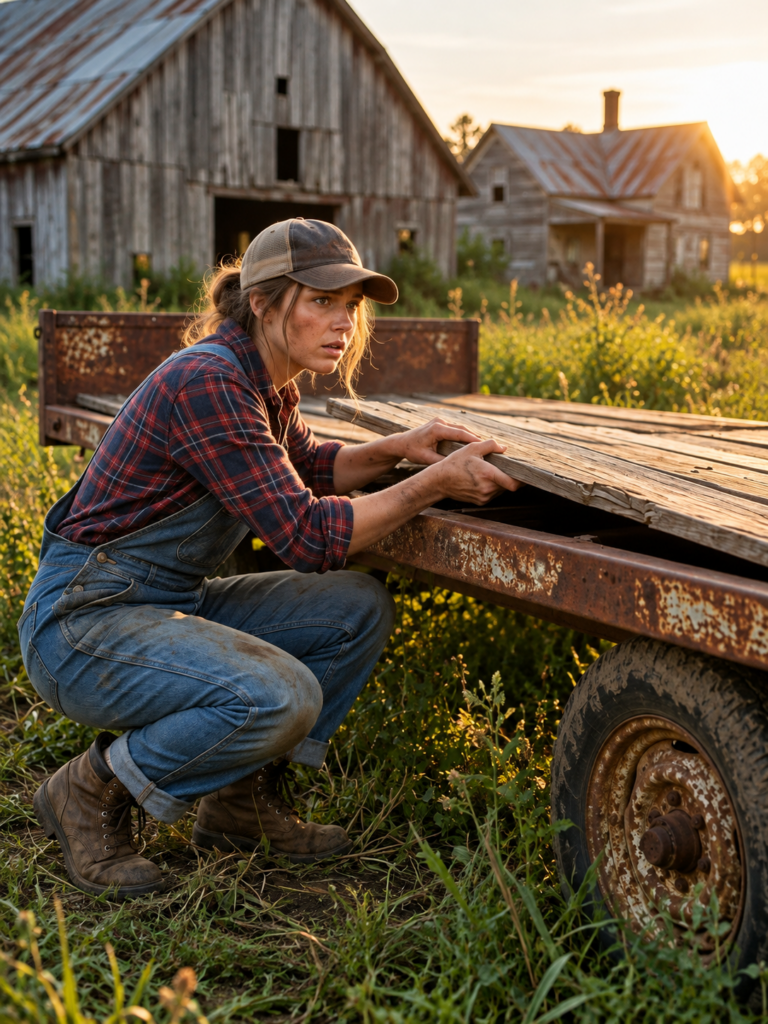
at twenty she bought the rusted farm trailer for three hundred fifty dollars then one floorboard would not lift and what she found inside saved the fields the county had already forgotten
Part 1
Norah Hail stacked the last of the fifty-pound feed sacks against the wall of the Harmon Ford mill and wiped her hands on the rag she kept in her back pocket. The counter was empty for the moment. Outside, the late-March wind pushed across the flat ground and rattled the metal siding. A farmer from the north township had just finished arguing with the man ahead of him about whether the wet corner in his east forty was a tile problem or simply the way the land had always been. Norah had listened while she loaded the sacks. She had been listening for four years.
She was twenty. She had started at the mill the summer she turned sixteen because the money was steady and the hours left room for the six acres Clara Dunlevy rented her for almost nothing. The land sat behind Clara’s house on the county road. Most years the vegetables did well enough for the Saturday markets in town. The low corner did not. Every April a pond formed there and stayed until June. Last spring it had taken nine hundred tomato seedlings and a roll of black plastic mulch. Close to two thousand dollars of the money Norah had managed to set aside went under standing water. Clara said the field had drained itself for fifty years. Nobody could say why it had stopped.
Clara was seventy-eight and still sharp enough to notice when a man at the mill counter was guessing instead of measuring. Her husband, Ned, had laid drainage tile across half the county from 1962 until his knees gave out. He had put the main line under the field behind the house himself in 1971. Ned had been gone eleven years. His sayings still hung in the kitchen the way the smell of coffee hung after the pot was empty. You never judge a machine by its paint, he used to tell anyone who would listen. You judge it by where the paint has worn off, and then you look for the one place that hasn’t.
Norah drove out to the Hollis farm auction that afternoon because the mill had closed early and she had nothing better to do with the light that was left. The sale was the usual mix of worn implements, boxes of hand tools, and machinery that had sat too long under tarps. Two men dragged an old trailer out of the hedgerow and onto the lot while the auctioneer worked through a set of cultivator shanks. The paint was mostly gone. The tongue still carried faded stencil letters that read Dunlevy Tile and Ditch. Ned’s rig. Built by hand in 1968 on the frame of a retired grain truck. Sold after he passed and left in the weeds until somebody decided the scrap value was worth the trouble of hauling it.
Norah stood with her hands in her jacket pockets and watched the bidding. A few men near the hay wagons laughed when the auctioneer called three hundred fifty dollars and looked around for another bid. It was not a cruel laugh. It was the easy kind people share when they have already agreed how something will end. The trailer went to the girl in the cap. Walt Branick walked over while she was still signing the slip. Thirty years of buying other people’s bad luck by the pound had given him a slow, sure way of moving. He stopped at the rusted tongue the way a man stops at a grave he has already decided is empty.
“Honey, you just bought sixteen feet of scrap iron with a hitch on it,” he said. “Frames rotted through. Decks rotted through. I’ll give you two hundred cash right now and haul it off myself. Save you the embarrassment.”
Norah looked at the trailer. “I bought a trailer.”
“You bought eighteen hundred dollars of repairs,” Walt said. “You’re out of money anyway. Sun’s going down.”
He had not asked her name. At the Hollis sale she was simply the twenty-year-old from the feed mill, and Walt had made sure the men still standing around remembered it. He gave her room the way a man gives a calf room in a pen, not as kindness, but to watch her find the fence. Norah did not argue. She took the ball-peen hammer from the bag on the seat of her truck and crouched at the front of the frame. Walt turned around to talk about hay prices with the men who had laughed. That was the first thing he got wrong.
The ground in northwest Ohio is so flat that a dropped marble has to think about which way to roll. Corn stands on one side of the county roads and soybeans on the other. Water is the real story of the place. A hundred and seventy years earlier none of it was farmland. It was the great black swamp. Close to a million acres of standing water and mosquito-thick mud stretching from near Sandusky across to Fort Wayne. Under the muck lay a deep layer of clay that held the water like the bottom of a bowl. Then somebody noticed the clay could be baked into pipe. By the late 1850s farmers were burying short clay tiles in hand-dug ditches. In the 1890s a machine-shop worker from Bowling Green built a steam-driven ditching machine called the Buckeye. Within a few decades the swamp was mostly a memory. By 1920 Ohio had counted twenty thousand miles of public ditches, fifteen thousand of them in the northwest corner. Under every field in Harmon Ford ran a second landscape that nobody could see. Round clay pipes about a foot long, laid end to end three or four feet underground, carrying water off the fields and into the open ditches.
The farmers who inherited that hidden system forgot it one retirement at a time. Land changed hands. Families moved. The man who laid the pipe put his drawings in a drawer, and sooner or later the drawer went into a dumpster. Today farmers pay good money to find pipe their own grandfathers buried. They push steel rods into the ground and listen for a hollow click. They walk bare fields in early spring looking for faint stripes where the soil dries faster. Norah understood that hidden country better than most people twice her age. Four years of listening to men argue at the mill counter about drainage had taught her more than the single year of agriculture classes she had been able to afford at the community college. What she had instead was six acres and a low corner that would not empty.
She started at the tongue of the trailer and worked backward, tapping the frame every few inches with the hammer. A dull thud meant steel rotted down to scale. A clear ring meant steel that was still doing its job. Under the orange crust the frame rails rang like a bell. They were boxed, heavy channel, the kind of rail that had come off a truck built to haul a full load of grain. She found pitting, but only shallow. The rust was fine and tight, not the kind that peels away in sheets. She checked the welds along every crossmember for cracks and did not find one.
“Surface rust sells repair bills,” Walt called from the fence post. “Every man in this county has bought some.”
“Surface rust is surface rust,” Norah said. “I’m checking whether it’s anything else.”
She took hold of the nearest tire at nine o’clock and three o’clock and rocked it hard. There was play in the wheel. Bearings, she figured. Forty dollars of parts and an afternoon with a grease gun. The U-bolts holding the axle to the springs were tight. The tires were dry-rotted and would have to go. That would cost real money. Walt said the deck was shot. The planks were gray as driftwood, two inches of rough oak scarred by what looked like forty years of bales and chains. Norah pressed the tip of her pocketknife against one of the boards. The blade would not go in. Red oak can start going soft after a decade or two in the weather. This was white oak, which can sit in the rain for generations. Two boards at the rear, where water had pooled, crumbled under her thumb. The rest were as hard as the day they were laid.
She pulled a pry bar from the bag and began lifting boards to look at the crossmembers underneath. The old nails let go with a long squeal. Eight boards came up that way, one after another, and each one showed her the same thing. Clean, heavy steel under a skin of dried grease. The ninth board did not come up. Norah leaned on the bar and felt nothing give. She sat back on her heels. The sun had dropped low enough to run straight along the deck, and in that light every scratch stood out. Eight boards were covered in them. Board nine, in forty years, had picked up almost none. The nail heads were wrong too. On the other boards they had rusted dark into the grain. Board nine had eight round steel circles that looked like nail heads and were not. She worked one loose with her thumbnail. It was a short stub of metal glued in place with nothing underneath it.
Walt had stopped leaning on the post. “Don’t fight it,” he said. “Take a reciprocating saw and cut it out. It’s rotted onto the crossmember. I’ve done it a hundred times.”
“If it’s stuck, something is holding it,” Norah said. “Boards don’t hold themselves.”
She slid the flat end of the bar into the edge. The board rose a quarter inch and stopped the way a drawer stops when it is locked. Norah lay on her back in the grass beside the trailer and aimed the light from her phone upward. Between two crossmembers directly under board nine, a steel box had been welded into the frame. It was painted black and built to fit the space exactly. Two carriage bolts ran up from a plate on its bottom and through the board. The threads were packed with thick old grease.
“Well,” Walt said. He had come around to the side and was crouching in the weeds. “That is not rot.”
Part 2
The first nut turned half a rotation under her socket and then spun free. The second one rounded off. She tried again and it rounded further. The light was almost gone. Walt walked to his truck and came back with a pair of locking pliers. He did not say a word. He handed them over the way a man pays a toll he has already decided is unavoidable. Norah clamped them on and leaned. The nut gave with a crack like a knuckle. The ninth board lifted on a steel hinge pin at its far end like the lid of a trunk. The inside of the box was dry as a drum. Lying across the bottom was a length of four-inch steel pipe with threaded caps on both ends. Beside it lay a five-foot steel rod with a T-handle wrapped in friction tape. Norah knew the tool from the mill counter. A tile probe. She unscrewed the cap on the pipe. Inside were rolled sheets wrapped in waxed paper and slid into an old feed sack.
She pulled out the first roll and spread it across the trailer deck, holding down the corners with the hammer and Walt’s pliers. It was ink on linen-backed paper. A field drawn in careful lines. Pipes ran across it in long straight strokes, each labeled in small neat numbers. Four-inch at three feet six. Eight-inch at four feet. An arrow marked the outlet. In the corner, in block letters, were the words Branick Farm, East 40, 1974. Dunlevy.
Walt read it in the last of the light. His father had been Ned’s customer. Walt had been twelve the summer that tile went in. “That’s my dad’s name,” he said, and nothing else.
There were twenty-three sheets in all. The oldest dated 1962 and the newest 1994. Each carried a landowner’s name, the size and depth of every pipe, and the exact spot where each outlet met a ditch. Ned Dunlevy had not only laid half the county’s drainage. He had drawn every foot of it, and then he had hidden the only copies where weather and thieves could never reach them. The seventh sheet Norah unrolled was labeled Dunlevy, South Field. She looked at the lines for a long time before she rolled it again.
She towed the trailer home at twenty miles an hour with the pipe riding on the passenger seat. Clara was still up. The kitchen light was on and the coffee pot was still warm. Norah laid the South Field sheet across the table. Clara held down one corner with a mug and said nothing for a long while. Then she touched the inked line of the main with one finger, the way a person touches a name on a stone.
“I turned this house upside down,” Clara said. “My nephew sold that rig and told me it was all rust and rubber. Ned used to say tools can be replaced and maps cannot. The safest place for something valuable is a place that works for a living.”
Norah sat down. Outside, the wind moved across the low corner that had taken her seedlings. Clara looked at the map again. “He drew them all,” she said. “Every job. He kept the originals because he said a man who didn’t know where his own tile ran was only renting the ground, not farming it. When the knees went, he stopped laying pipe. He never stopped drawing what he had already laid.”
They sat with the sheet between them until the coffee went cold. Norah asked about the trailer. Clara said Ned had built the hidden box himself the winter after a neighbor’s shed burned and the man lost every paper he had. He had told Clara the maps would outlast both of them if they stayed where a working trailer could carry them. After he died the nephew had sold the rig without looking under the boards. Clara had not known the box existed. She had assumed the drawings were gone the way so many other things had gone.
Norah spent the next weeks learning the rest of the sheets. She spread them on the kitchen floor when the table was not large enough and marked the ones that still matched names she heard at the mill. Some of the landowners were dead. Some of the farms had changed hands twice. A few of the outlets had been filled or moved when the county widened a road. The paper itself was still good. The waxed wrapping had done its work. Ned’s handwriting stayed small and exact. Depths. Grades. Notes in the margins about where the clay had been soft or where a rock had forced a bend. One sheet carried a single line at the bottom: Keep this outlet open. Lowest point on the farm.
Walt did not come back to the house that week. Norah saw him once at the mill when she was loading sacks for a man who farmed ground that had once belonged to Walt’s uncle. Walt nodded and kept walking. The men who had stood near the hay wagons at the auction did not mention the trailer again. Word moved slower than people thought it did, or faster, depending on whether the story was useful.
Part 3
Norah spent the winter on the trailer. She repacked the bearings with new grease and bought four used tires that still had enough tread to roll. She replaced the two soft boards at the rear with rough-cut white oak from a sawmill outside town and hinged the ninth board back in place with a new pair of bolts. The steel box stayed empty for the moment. Walt’s prediction of eighteen hundred dollars in repairs came in at four hundred twelve. She paid for the work out of the money she had set aside for seed and told herself the low corner would make the difference back if the map was right.
In March, when the frost finally left the ground, she and Clara walked out to the field with the South Field sheet. The map placed the main line two hundred twelve feet west of the northeast fence corner, then straight south. Norah stretched a tape from the post and pushed the probe into the clay. The rod came up with nothing but gray soil. She moved a foot and tried again, then another foot. For an hour she worked that line. By afternoon she had dug a hole four feet deep and found only more clay. She sat on the trailer deck at dusk with the sheet in her lap and listened to the wind move across the empty ground. Walt’s voice came back to her. Sixteen feet of scrap iron with a hitch on it. Maybe the drawing was wrong. Maybe she had spent a winter chasing a line that no longer existed.
Clara came out with two cups of tea and looked at the paper over Norah’s shoulder, then at the fence and the road beyond. “The county took a strip of that road for the shoulder in 1988,” she said. “Ned reset the corner post himself after they finished.”
Norah looked up. “How far?”
“Fourteen feet.”
The map was right. It had been drawn from a post that no longer stood where it used to stand. Norah went out the next morning at first light when the soil was bare and just beginning to dry. She walked the field slowly with her head down. Halfway across she found it. A pale line ran through the dark ground, narrow and straight, fourteen feet off from where the map had sent her the day before. She set the probe on the line and pushed. Four feet down the rod struck something with a hollow click, like a spoon against a cup.
It took her a weekend to uncover the pipe. The clay main was eight inches across. Under the old farm lane a stretch of it lay crushed, packed with silt and the pale threads of willow roots. Fifty years of tractor wheels had pressed down on that section until one winter it gave. The water in the low corner had been backing up ever since. Norah rented a small excavator for a day and replaced the broken length with new eight-inch plastic pipe wrapped in a filter sock, joined to the old clay at both ends with careful couplings. She backfilled the trench and packed the soil by hand where the machine could not reach.
The first heavy rain came three weeks later. Clara stood at the kitchen window with her coffee going cold. The low corner took the water in. By the second morning it had drunk all of it. No pond formed. The ground that had stayed soft into June the year before was firm enough to walk by the end of the week. Norah planted the tomatoes she had started in the greenhouse trays. They went into soil that no longer held a lake.
Word moved the way it does when a field that has flooded for years suddenly does not. A man who farmed two miles east stopped at the mill and asked whether the girl who stacked sacks had really found Ned Dunlevy’s old maps. Norah said she had. He asked whether any of them showed his ground. She said she would have to look. He left his name and the section number on a scrap of paper. Two more names came the following week. Norah kept the sheets in the pipe and the pipe in the box under the ninth board. She did not charge anyone to look. Clara made the coffee when they came to the kitchen.
Part 4
In late May a white truck turned in at Clara’s gate. Walt Branick climbed out and stood by the barn with his cap in both hands. He looked older in the daylight than he had at the auction. The easy certainty was gone from the way he stood.
“Heard you fixed the Dunlevy corner,” he said.
“Clara and Ned did,” Norah said. “I just read the map.”
Walt looked at the trailer parked beside the fence. The ninth board sat flush with the others. The new bolts were still bright. “I paid a contractor last fall to put new tile in my east forty,” he said. “Twenty-six thousand dollars. It’s still wet in April. He says it needs more pipe. I don’t have more pipe money.”
Norah studied him for a moment. “Come inside.”
She laid the Branick sheet across the kitchen table. Walt put on his reading glasses and leaned over it. The old main from 1974 ran at a long diagonal across the field to an outlet on the south ditch. The contractor’s new lines, which Walt had marked in pencil on a copy he pulled from his pocket, ran straight across the old system in the wrong direction and ended in a headland where no outlet existed. Beside the old outlet, in Ned’s small block capitals, was the note Norah had already read. Lowest point on the farm. Keep this one open.
Walt read the line for a long time. Then he took off the glasses. “The outlet’s been choked with brush for years,” he said. “I never knew what it was.”
“It’s the whole system,” Norah said. “Everything he laid drains to it. Clear that and your new pipe has somewhere to go.”
Walt cleared the outlet that weekend with a rented backhoe and a borrowed chainsaw. He cut the brush back to the ditch bank and dug out the silt that had packed the mouth of the clay pipe. By the following Thursday the east forty had stopped holding water after a rain. He came back to the kitchen on Friday evening. He took out his wallet and counted two hundred dollars onto the table, one bill at a time.
“That’s what I offered you for the trailer,” he said.
“I’m not selling the trailer.”
“It isn’t for the trailer,” Walt said. “It’s for the copies.”
Norah looked at the money and then at Clara, who stood at the counter with her hands resting on the edge. Clara nodded once. Norah took the bills and put them in the drawer where she kept the seed receipts. She told Walt she would have the sheets scanned at the county extension office. The originals would go back into the pipe. He could have copies of his own ground and of any neighboring fields he needed to understand. He did not argue about the price. He had already paid twenty-six thousand dollars for pipe that had nowhere to empty.
Other farmers began to arrive on Saturday mornings. They sat at Clara’s kitchen table with their caps on their knees and found their own ground on Ned’s drawings. Some of them had spent years probing for tile their fathers or grandfathers had laid and never mapped. Some of them had paid contractors who worked from incomplete surveys or from memory. A few discovered that outlets they had filled during road work or fence repairs were the only places their systems could empty. Norah made no charge. Clara kept the coffee pot full. The men left with photocopies folded into their shirt pockets and with a clearer idea of where the water was supposed to go.
Walt stopped by the mill one afternoon while Norah was loading sacks. He waited until the customer had left. “The contractor called me,” he said. “Wanted to know who told me the outlet was still there. I told him the map was older than he was. He didn’t have much to say after that.”
Norah set another sack on the stack. “Ned drew what he laid,” she said. “That’s all.”
Walt nodded. He looked at the open door of the mill and the flat fields beyond it. “Most of us forgot the second landscape was even under there,” he said. “We kept farming the top and hoping the bottom would take care of itself. Turns out it doesn’t.”
Part 5
Norah took every sheet to the county extension office on a Tuesday when the mill was slow. The woman who ran the scanner was careful with the linen-backed paper. She made two sets of copies and returned the originals in the same waxed wrapping. Norah drove them home and slid them back into the steel pipe. She threaded the caps on tight and set the pipe in the box under the ninth board. The new bolts went through the board and into the plate. The board lifted on its hinge the way it always had. The box now held the pipe, a coffee can of pencils, and a roll of masking tape. That was all.
On Saturdays the line of trucks sometimes reached the mailbox. Men who had never spoken to one another at the mill counter sat at Clara’s table and compared the lines on their sheets. They talked about grades and outlets and the places where the old clay had been crushed by years of traffic on lanes that no longer existed. Norah answered what she could. When she did not know, she said so. Clara poured coffee and occasionally corrected a memory about which year Ned had worked a particular farm. The trailer stayed parked beside the barn. The ninth board still lifted. The steel box still kept the maps dry.
One evening in early June Norah walked out to the low corner after the market. The tomatoes were already setting fruit. The ground was firm under her boots. She stood where the pond had been the year before and looked back toward the house. Clara was at the kitchen window. The light was on. The trailer sat in its place by the fence, the tongue still carrying the faded stencil that read Dunlevy Tile and Ditch. Norah thought about the men who had laughed at the auction and about the two hundred dollars Walt had offered for scrap. She thought about the nephew who had sold the rig without looking under the boards and about the drawer that had never held the maps because Ned had already decided the safest place for them was a machine that still had work to do.
The knowledge had not disappeared when the hands that first carried it grew too stiff to hold a probe. It had stayed in the steel box under a floorboard that looked like every other board until someone was willing to notice that it did not. Farmers who had spent money on pipe that went nowhere now knew where the water was supposed to leave their fields. The low corner behind Clara’s house no longer held a lake in April. The maps that had been hidden for years were being read again at a kitchen table by men who had forgotten their own grandfathers had drawn them.
Norah walked back to the house. Clara met her at the door with two cups. They sat at the table where the South Field sheet had first been spread. Outside, the light was failing across the flat ground. Under every field in the county the old clay pipes still ran, end to end, carrying water toward ditches that had been cut when the swamp was still a memory people were trying to forget. Some of those pipes were crushed. Some of the outlets were choked. The drawings that showed exactly where they lay were no longer lost. They waited in a steel pipe under a hinged board on a trailer that had once been called scrap. The girl who had bought it for three hundred fifty dollars had not been looking for treasure. She had been looking for the reason a field would not drain. She had found the reason, and she had found the maps that let other people find theirs. The work of keeping the second landscape clear had never really belonged to one generation. It had only needed someone patient enough to lift the board that would not lift and to read what an old man had drawn so carefully that the ink was still sharp forty years later.
