
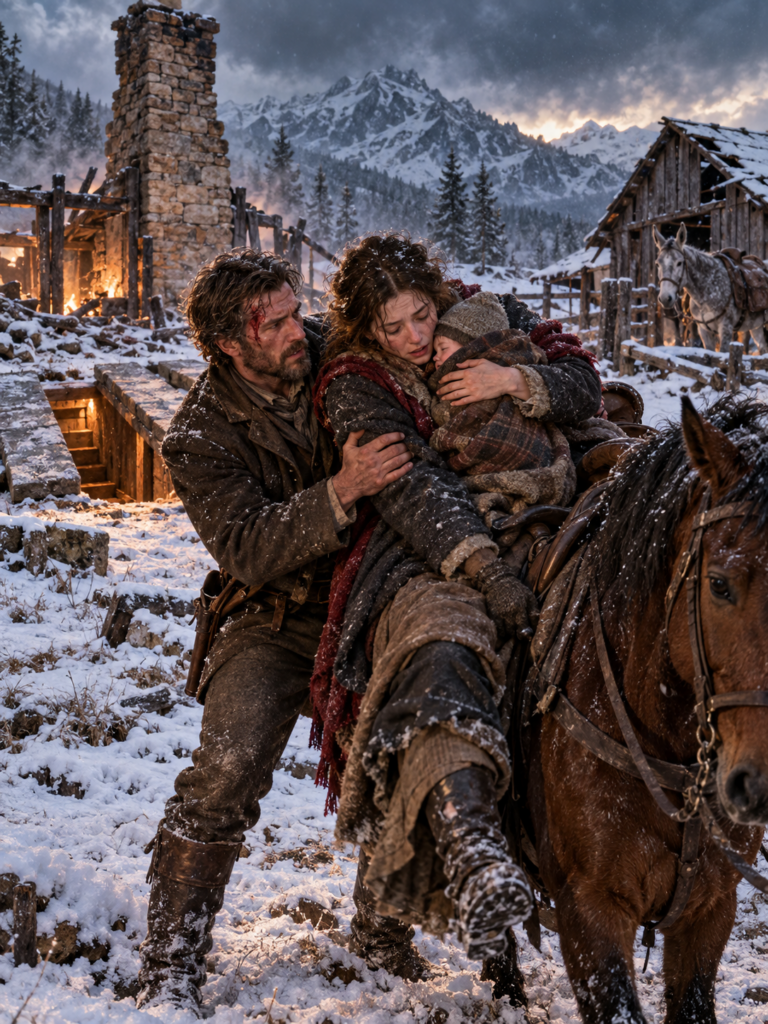
Henry caught the woman with one arm and the child with the other before either struck the snow.
Pain tore through his right knee so sharply that black spots crowded his vision.
He ignored them.
The child barely moved.
That frightened him more than the storm.
“Can you hear me?”
The woman’s eyes opened.
“Take the child.”
Not help me.
Not save me.
Take the child.
Henry pulled open his coat and tucked the small bundled body against his shirt. A faint breath touched his chest.
Alive.
He buttoned his coat over the child.
The woman tried to stand without assistance.
She failed.
“I can walk.”
“Not yet.”
Her gaze sharpened despite the cold.
“I said I can.”
Henry recognized pride when he heard it. He also recognized a body a few minutes from collapse.
So he did not lift her.
He put her arm over his shoulder instead.
“Then walk.”
Something changed in her expression.
Not gratitude.
Assessment.
She tested her weight against him, then nodded once.
Together they reached the barn.
Juno shifted aside as Henry settled the woman near the manger. The woman immediately reached for the child.
Henry unbuttoned his coat and returned the bundle.
Only then did her shoulders loosen.
“My name is Eleanor,” she whispered.
Henry gave her his own name and began building a small fire on the packed-earth floor.
He warmed snow.
Wrapped Eleanor’s hands in cloth.
Let the child sip sweetened water from the edge of his spoon.
He went back for the mare, coaxed her upright, and rubbed her legs until the trembling eased.
When he returned, Eleanor was awake.
And staring at the blanket beside her.
The blanket covering the Whittaker papers.
Henry stopped.
She had not touched them.
But one corner of the oilcloth showed.
“What’s under there?” she asked.
“Something I found.”
“In the cabin?”
Henry glanced toward the storm.
“Yes.”
Her eyes shifted to the leaning chimney visible through the broken boards.
“The room behind it?”
Henry’s hand went still around the coffee tin.
Eleanor saw the answer before he gave it.
“You knew there was a room?”
“No.”
“But you knew enough to ask.”
She looked down at the child, then back at him.
“My mother grew up hearing about Cedar Hollow. About a house that burned. About a man named Whittaker.”
Henry felt the barn grow smaller.
He pulled back the blanket.
Not all the way.
Only enough to expose the leather ledger.
Eleanor stared at the name stamped inside.
Amos Whittaker.
Her face lost what little color the fire had returned to it.
“My mother said her mother never spoke his name after leaving this valley.”
Henry did not move.
The wind pushed the barn door.
The latch held.
“You’re kin?”
“I don’t know.”
The answer came too fast to be rehearsed.
Then she corrected herself.
“I don’t know what can be proved.”
That was different.
Henry handed her the ledger.
She opened it carefully.
Her fingers stopped on one page.
“What?”
Eleanor pointed.
A woman’s name had been written beside a payment entry.
Sarah Whittaker.
“My grandmother.”
Henry looked toward the blanket again.
Beneath it lay the filing that could redraw Boone’s holdings.
If Eleanor was telling the truth, then the papers did not belong to him.
Not really.
He pulled out the territorial document.
Eleanor read it once.
Then again.
“This gives the creek to him.”
“Prior right.”
“And his heirs.”
“Yes.”
Her eyes rose to Henry’s.
“You could have filed this before anyone knew I existed.”
“I still could.”
Silence.
Henry regretted the words the instant they left him.
Not because they were untrue.
Because he saw what they sounded like.
Eleanor folded the document and placed it deliberately on the blanket between them.
“Then decide what kind of man owns this place.”
Henry looked at her.
“I don’t think the place is the question.”
“No?”
“The paper is.”
Outside, the snow began to weaken.
Inside, Eleanor placed one hand over her sleeping child and the other flat on the Whittaker ledger.
“Then when the road opens,” she said, “we take it to town together.”
Henry had planned to carry the filing himself.
Planned to face Boone himself.
Planned to decide what happened next because deciding alone was a habit twenty years of range work had carved into him.
He looked at Eleanor’s hand on the ledger.
Then at the child.
Then at the territorial seal.
“All right.”
At dawn the clouds broke.
Henry saddled Juno, wrapped the papers in oilcloth, and brought them to Eleanor instead of putting them inside his own coat.
She accepted the bundle.
That one act made the choice irreversible.
They would walk into Cedar Hollow together.
And whatever the papers changed, neither of them would be able to return afterward to being strangers in the snow.
Eleanor slid the oilcloth bundle beneath her coat, where Henry could see it but could not take it back without asking.
That mattered.
Henry tightened Juno’s girth.
The child sat in the pack saddle wrapped in Henry’s spare blanket while Eleanor’s bay mare, still stiff from the storm, walked unburdened beside them.
“You’re limping worse,” Eleanor said.
“So is your mare.”
“I asked about you.”
Henry checked the strap again although it did not need checking.
“Three good steps and one careful one.”
“You count them?”
“My knee does.”
Eleanor almost smiled.
It was the first softness he had seen in her face.
They started down the valley.
Snow lay clean across the flats, broken only by the creek and their tracks.
Two miles below the ruin stood Pearly Boone’s gate.
Henry had passed it before as a man Boone considered temporary.
Now the gate looked different.
Not because the timber had changed.
Because Henry knew the creek above it had once belonged on paper to someone else.
Boone had said the water belonged by right to whoever had sense enough to use it.
The filing said otherwise.
Eleanor slowed beside Henry.
“Is this his?”
“Boone’s lower holding.”
“Does he know?”
“Not yet.”
“Do you think his family burned the cabin?”
Henry looked at her.
“No.”
She waited.
“You sound certain.”
“I’m certain I don’t know.”
That answer seemed to satisfy her more than accusation would have.
Henry had heard enough men build certainty from rumor. He would not become one because a hidden room had handed him an old grievance.
They kept walking.
At the edge of town, heads turned.
The first time Henry had returned to Cedar Hollow, people had watched a broken rider carrying a saddle without a horse.
Now they watched him arrive beside a woman, a child, two animals, and a secret no one could see.
The land-office clerk looked up when they entered.
His pen stopped tapping.
“Mr. Holt.”
Henry nodded toward Eleanor.
“She needs to hear what you tell me.”
The clerk’s eyes moved between them.
Henry could feel the old instinct rise—the instinct to speak for the situation, organize it, keep trouble orderly.
He stepped aside instead.
Eleanor removed the oilcloth packet.
“I believe these were hidden at the Whittaker place.”
The clerk’s expression changed before he touched a single page.
Not fear.
Recognition.
He unfolded the territorial filing first.
Read it.
Held it to the window.
Read the seal.
Then opened the ledger.
His breath left slowly.
“Where did this come from?”
“Behind the chimney,” Henry said.
Eleanor added, “In a stone room built outside the original cabin wall.”
The clerk looked at her.
“And you are?”
“Eleanor Hale.”
Hale.
The surname told Henry nothing.
“My grandmother was Sarah Whittaker Hale.”
The clerk sat down.
Henry looked at Eleanor.
She had given him only her first name in the barn.
He should have been annoyed.
Instead he understood.
A woman traveling alone with a child through unfamiliar country had reasons not to hand every stranger her history.
Even a stranger who saved her from snow.
Especially then.
The clerk turned pages.
“Do you have proof of descent?”
“No.”
Eleanor’s voice stayed steady.
“My mother may. She keeps family papers.”
“Where?”
“East.”
The clerk nodded.
“That can be established. But the water filing itself—”
He touched the territorial paper.
“This is valid on its face.”
Henry felt the room narrow.
“Meaning?”
“Meaning Amos Whittaker filed before Boone’s lower claims.”
“Pearly’s father?”
“And perhaps others.”
Eleanor leaned forward.
“What happens now?”
The clerk looked from her to Henry.
“I record that the original filing has been recovered. No transfer until heirship is established. No man gets to simply take it because he found it.”
Henry appreciated the sentence.
Eleanor noticed.
Her shoulders eased by a degree.
The clerk continued.
“And until a county lawyer examines the chain, everyone currently drawing from the disputed section will be notified.”
Henry almost laughed at the word notified.
In Cedar Hollow, Boone would hear before ink dried.
They were still in the land office when the door opened.
Pearly Boone entered.
Good coat.
Silver watch chain.
No smile.
His gaze fell on the territorial paper.
Then Eleanor.
Then Henry.
“So,” Boone said quietly. “That’s what you dug up.”
Henry did not answer.
The clerk stood.
“This is an official matter now, Mr. Boone.”
Boone ignored him.
“You planning to take my water, Holt?”
Henry felt Eleanor beside him.
Not behind him.
Beside.
“It isn’t mine to take.”
Boone’s eyes narrowed.
“Your ground.”
“Possibly her family’s right.”
Boone looked at Eleanor for the first time as though she were not simply a traveler accompanying Henry.
“Whittaker?”
“His granddaughter’s daughter,” Eleanor said.
Boone’s jaw tightened.
“You can prove that?”
“Not today.”
“Then today you’re a woman carrying a story.”
Eleanor did not flinch.
“And today you’re a man watering cattle from a creek whose oldest filing isn’t in your name.”
The clerk coughed into his hand.
Henry looked away because the corner of his mouth had moved.
Boone saw it anyway.
“You think this is funny?”
“No.”
Henry met his eyes.
“I think she answered you.”
The room held still.
Boone could have shouted.
He did not.
That made him more formidable than the men who did.
“My father bought those flats in good faith.”
“Then the records will show it,” Eleanor said.
“And if they don’t?”
“Then good faith doesn’t turn another family’s right into yours.”
Boone looked at Henry.
“You teaching her this?”
Eleanor answered before Henry could.
“He isn’t teaching me anything.”
Another shift.
Another small surrender of control Henry had not known he needed to make.
Boone looked between them and seemed to understand something Henry himself had only begun to understand.
Eleanor was not under Henry’s protection in the way Boone meant it.
She was standing there by choice.
That made the alliance harder to dismiss.
Boone removed his gloves finger by finger.
“I didn’t burn Whittaker’s house.”
No one had accused him.
The clerk looked down.
Eleanor went very still.
Henry said, “I didn’t say you did.”
“My father didn’t either.”
“Didn’t say that.”
Boone’s face hardened.
“But you’re thinking it.”
Henry shook his head.
“I’m thinking somebody hid those papers before the fire reached them.”
Boone’s eyes flicked to the ledger.
There.
A reaction.
Small.
Real.
Henry noticed.
So did Eleanor.
She closed the ledger.
“You knew about the room.”
Boone looked at her.
“No.”
“You knew something.”
“That place was talked about before you were born.”
“That wasn’t my question.”
Boone glanced toward the window.
For the first time, the richest rancher in Cedar Hollow looked like a man trying to decide whether silence cost more than truth.
“My father used to say Whittaker was a fool for keeping records.”
Henry felt cold spread through him unrelated to snow.
“What records?”
“I don’t know.”
“Pearly.”
Boone’s mouth tightened at the use of his name.
“I was twelve.”
The answer was almost angry because it was almost vulnerable.
“I heard men argue. My father and another rancher. They said Whittaker had measurements that could prove where every ditch pulled from the creek. My father said no sensible man kept that much paper unless he expected trouble.”
Eleanor gripped the ledger.
“And then the house burned.”
Boone met her gaze.
“Yes.”
“Who was the other man?”
“Dead fifteen years.”
“Name.”
Boone hesitated.
“Elias Mercer.”
The clerk looked up sharply.
Henry noticed.
“You know it.”
The clerk nodded.
“Mercer witnessed several early land transfers.”
Including, Henry realized, transfers that may have followed the fire.
The mystery changed.
The question was no longer simply who owned the water.
It was whether the records made after Amos Whittaker disappeared had been built on a truth everyone accepted because the original proof was presumed burned.
Eleanor opened the ledger again.
A loose sheet slipped from the back.
Henry bent automatically.
Eleanor reached it first.
Her fingers closed around the page.
She looked at Henry.
He stopped.
A moment earlier he would have taken it because he was nearest.
Now he waited.
Eleanor unfolded the sheet.
Columns of measurements covered one side.
On the other were three names.
Amos Whittaker.
Elias Mercer.
Nathaniel Voss.
Henry’s breath caught.
“Old Nate.”
Boone swore softly.
The clerk came around the desk.
“Nate Voss?”
“The harness shop,” Henry said.
The old man who had told him to knock.
The old man who had known where the door was.
Eleanor folded the paper.
“We talk to him.”
Henry nodded.
Boone moved toward the door.
“So do I.”
Eleanor stepped into his path.
“No.”
Boone stared at her.
She did not move.
“You’ve had twenty years of advantage over whatever happened at that cabin. We get one conversation before the whole town crowds around him.”
“You don’t order me.”
“No,” Eleanor said. “But the clerk can ask you to leave an active records matter alone until counsel arrives.”
The clerk cleared his throat.
“I can.”
Boone looked furious.
Not because Eleanor had threatened him.
Because she had understood the room faster than he had.
He turned to Henry.
“You letting her run this?”
Henry thought of every ranch foreman who had believed authority meant speaking first.
Then he looked at Eleanor holding her family’s ledger.
“It’s hers to run.”
Boone left.
No slammed door.
No threat.
Just boots hitting the boardwalk hard enough to tell the street the conversation had gone badly.
Eleanor exhaled.
Henry watched her hands tremble once.
Only once.
“You all right?”
“No.”
The answer surprised him.
Then she looked at him.
“But I’m going anyway.”
They crossed the street together.
Old Nate was not beneath the harness-shop awning.
For the first time since Henry returned to Cedar Hollow, the chair in the shade was empty.
The harness maker looked up when they entered.
“He left ten minutes ago.”
“Where?”
The man pointed west.
“Toward your place.”
Henry turned.
Eleanor was already moving.
She tucked the ledger under her coat and headed for the door.
Her choice left no room for argument.
Henry followed.
Outside, Juno lifted her gray head.
The old mule faced west.
Toward the burned cabin.
Toward the hidden room.
And toward the only living man whose name appeared beside Amos Whittaker’s on the paper no one had been meant to find.
Henry caught Eleanor at the hitching rail.
Not by the arm.
By the reins.
She looked at his hand.
He released them.
“I can saddle the mare faster than your knee can carry you.”
“I know.”
That answer stopped the argument before it formed.
Henry saddled Juno.
Eleanor saddled her bay.
The child remained at the feed store with the owner’s wife, warm, fed, and loudly displeased at being left behind.
Henry found the noise reassuring.
They rode west slowly enough for his knee and quickly enough to make conversation unnecessary.
Halfway to Boone’s gate, Eleanor spoke.
“You knew I hadn’t told you my surname.”
“I knew after the clerk asked.”
“You’re angry.”
“No.”
“You should be.”
Henry looked across at her.
“Why?”
“Because you trusted me with the papers.”
“I trusted what you did when you had them.”
Eleanor’s eyes narrowed slightly.
“That sounds dangerously reasonable.”
“I have my moments.”
She looked ahead.
The brief humor vanished.
“I didn’t tell you because men hear a woman traveling alone with a child and start filling in the rest themselves.”
Henry said nothing.
“They decide she needs managing. Or saving. Or explaining.”
“And I didn’t?”
“You tried.”
He accepted that.
In the barn he had planned the trip to town before asking what she wanted.
He had nearly put the Whittaker filing inside his own coat.
He had assumed because he found it, he should carry it.
“You stopped,” Eleanor added.
“Eventually.”
“Eventually matters.”
The words stayed with him.
They reached the ruined homestead near dusk.
Old Nate’s horse stood at the wagon turn.
Nate himself sat on a stone beside the chimney.
He had removed his hat.
The hidden door was open.
Henry dismounted too quickly and pain hit his knee.
Eleanor was down before him.
She crossed the snow-crusted ground first.
Nate watched her approach.
His pale eyes moved to the ledger beneath her arm.
“So,” he said.
Eleanor stopped.
“You knew.”
Nate looked toward Henry.
“I told him to knock.”
“That isn’t an answer.”
“No.”
Nate folded his hands over his cane.
“It isn’t.”
Henry came alongside Eleanor.
Nate looked older than he had in town.
Not frail.
Burdened.
Eleanor opened the ledger to the loose sheet.
“Your name.”
“I know my name.”
“Why is it here?”
Nate stared at the handwriting.
“Because I helped measure the creek.”
The wind moved through the alder.
Nothing else did.
Henry asked, “You worked for Whittaker?”
“With him. Not for him.”
Nate’s gaze remained on the ruin.
“We were young enough to believe measuring something correctly meant men would behave correctly afterward.”
Eleanor sat on the flat stone opposite him.
She did not soften her voice.
“What happened?”
Nate closed his eyes.
For several seconds Henry thought the old man might refuse.
Then he began.
Amos Whittaker had filed his water claim legally.
He had also kept exact records of every diversion along the creek.
Not accusations.
Measurements.
Dates.
Witnesses.
During the dry year, those measurements became dangerous because several ranchers below him were drawing beyond their claims.
Elias Mercer had helped prepare later transfers.
Nate had measured with Amos and signed the original notes.
Pearly Boone’s father had argued with Amos repeatedly.
“But did he burn the cabin?” Eleanor asked.
Nate opened his eyes.
“I never saw who set the fire.”
Henry felt the answer settle correctly.
No convenient confession.
No dead man made villain because no one could challenge it.
“What did you see?” he asked.
“Smoke.”
Nate’s voice roughened.
“I was two miles south. Rode up. Amos was already gone.”
“Gone where?”
“He’d sent his wife and little girl east that morning.”
Eleanor’s hand tightened over the ledger.
“My grandmother.”
Nate nodded.
“Sarah was the little one.”
The child’s shoe in the stone room.
Henry suddenly understood.
Amos had hidden his daughter’s shoe with the papers because the room had held more than evidence.
It had held the shape of the life he was trying to protect.
Eleanor’s voice became very quiet.
“And Amos?”
“Never found him.”
Henry looked toward the creek.
The source of every rumor in Cedar Hollow had no clean ending.
A man vanished.
A house burned.
Paper survived.
People decided the absence of proof was permission to stop asking.
Nate continued.
“I knew about the room because I helped Amos lay the floor over it.”
“Why didn’t you tell anyone?” Eleanor asked.
Nate’s jaw moved.
“Because I was afraid.”
The simple answer carried more weight than excuses would have.
“Afraid of Boone?”
“Of everyone.”
Nate looked at Henry.
“You think a town chooses silence in one meeting? It doesn’t. One man says he saw nothing. Another says it isn’t his concern. Another needs work from a rancher downstream. Another has a wife expecting a baby. Another thinks the sheriff will sort it. Another hears the widow already left.”
His gaze returned to Eleanor.
“Then twenty years pass.”
Eleanor stood.
Henry saw anger in her face.
Not theatrical anger.
The deeper kind.
“You let my family become a story.”
“Yes.”
“You watched people laugh at the place.”
“Yes.”
“You watched Boone expand his holdings.”
“Yes.”
Nate did not defend himself.
That, more than tears would have, changed something.
Eleanor paced once toward the chimney, then back.
“Why tell Henry?”
“Because he bought it.”
“That’s all?”
“No.”
Nate studied Henry.
“Because Boone mocked him and he didn’t answer.”
Henry frowned.
Nate gave a tired half smile.
“Men show themselves quickest when insulted. Henry could’ve thrown Boone’s words back. Could’ve made a spectacle. Instead he checked his mule’s pack.”
Henry almost objected to the absurdity of basing twenty years of silence on a saddle strap.
Nate continued.
“I thought maybe a man who took care with an old animal nobody valued might take care with an old truth nobody valued.”
Eleanor looked at Henry.
He wished she would not.
It felt too much like praise for something that had cost him nothing.
“What happened to Amos?” she asked again.
Nate shook his head.
“I don’t know.”
The unresolved answer hurt her.
Henry saw it.
But he also saw her accept it.
Truth did not become more truthful because someone wanted closure.
Eleanor stepped toward the hidden door.
“I want to see the room.”
Henry moved instinctively.
“The ladder—”
She looked at him.
He stopped.
“The second rung is weak on the left.”
That was different.
Information.
Not permission.
Eleanor nodded.
“Thank you.”
She descended.
Henry remained above.
Every part of him wanted to follow.
Not because he thought she was incapable.
Because he knew what waited below.
The child’s shoe.
The ring.
The room her family had carried only as silence.
He forced himself to stay where she had left him.
After several minutes, her voice came from below.
“Henry.”
He went down.
Eleanor knelt beside the folded blanket.
The little leather shoe rested in her hands.
Tears stood in her eyes but had not fallen.
“My mother told me Grandmother Sarah hated shoes that pinched.”
Henry waited.
“She said when she was little, Sarah would hide one shoe so no one could make her leave the house.”
Eleanor laughed once through her breath.
“This could be hers.”
“It could.”
Not it is.
Could.
She appreciated the distinction.
Beside her lay the silver ring.
Eleanor did not touch it.
Instead she looked around the stone walls.
“My grandmother remembered a dark little room.”
Henry stared.
“She told my mother she used to play somewhere cool behind the fireplace. Everybody thought it was a child remembering badly.”
“It wasn’t.”
“No.”
Eleanor looked up at him.
“Henry, these papers belong with the family. But the room belongs to the place.”
He understood before she explained.
“You don’t want it emptied.”
“I want the legal documents copied and filed. I want the originals protected. But I don’t want this turned into some curiosity where strangers come pry at a dead man’s life.”
Henry leaned one shoulder against the stone.
“It’s your decision.”
“And yours.”
“The cabin’s mine.”
“The history isn’t.”
Henry considered that.
“Then we keep it.”
“Together?”
The word moved between them.
It was the first openly dangerous thing either had said.
Not because it promised love.
Because it suggested a future.
Henry looked at Eleanor.
She had arrived in a storm asking for the road east.
He had never asked why.
Now he did.
“Are you still going east?”
Eleanor looked at the shoe in her hands.
“I don’t know.”
Henry nodded.
He did not ask her to stay.
Something in her face shifted.
“Most men would.”
“Ask?”
“Tell.”
“I’ve spent most of my life taking orders from men who believed a decision became correct when they said it louder.”
“And?”
“I’m trying not to inherit the habit.”
Eleanor smiled then.
Small.
Real.
It affected him more than any woman’s beauty had in years.
Footsteps sounded above.
Henry straightened.
Pearly Boone’s voice came through the opening.
“Holt.”
Eleanor’s smile disappeared.
They climbed out.
Boone stood beside Nate.
No hired men.
No rifle in his hand.
Only his coat, his watch chain, and an envelope.
Henry’s shoulders stayed tense anyway.
Boone held the envelope toward Eleanor.
“My father’s papers.”
She did not take it immediately.
“Why bring them here?”
“Because after you left, I went through his safe.”
Eleanor accepted the envelope.
Inside were receipts, ditch agreements, and one letter.
Boone looked at Nate.
“You tell them?”
“What I knew.”
Boone nodded.
“My father wrote this six years after the fire.”
Eleanor unfolded the letter.
Henry read over her shoulder only when she angled the page toward him.
Boone’s father had not confessed to burning the Whittaker cabin.
He had written something less dramatic and, in Henry’s mind, more believable.
He knew Amos Whittaker’s original filing existed.
He knew later claims were vulnerable if it surfaced.
He had bought grazing land while the filing was considered lost.
And he had chosen not to ask too many questions.
Eleanor lowered the page.
Boone’s face was hard.
“My father benefited from Whittaker disappearing.”
Nate said nothing.
Boone continued.
“I can’t prove he caused it.”
“No,” Eleanor said.
“But he knew enough to keep quiet.”
“Yes.”
The word cost Boone something.
Henry saw it.
“What do you want?” Boone asked Eleanor.
She looked surprised.
“Not what does the paper require?”
“I know what the lawyer will tell me that part means.”
Boone glanced toward the creek.
“I’m asking what you want before men with offices turn this valley into lines on maps.”
Eleanor considered him.
“The original water right recognized.”
Boone nodded once.
“Your fences moved off land attached to the old claim if the survey says they should be.”
Another nod.
“And no story that your family ‘gave’ anything back.”
Boone’s jaw tightened.
Eleanor continued.
“It wasn’t yours to give.”
Henry watched Boone absorb that.
“I can live with that.”
“I’m not finished.”
A spark came into Henry’s chest.
Not pride of ownership.
Recognition.
Eleanor was doing what she had done from the moment the storm dropped her at his door.
Refusing to let other people define the available choices.
“If my family holds more water than this cabin needs, I don’t want your cattle dying to make a point.”
Boone stared at her.
“The legal amount can be leased back fairly where it’s not being used. Written terms. Public record.”
Boone’s expression changed.
“You’d lease water to me?”
“If the right is ours.”
“After what my father did?”
“Your father’s silence doesn’t feed your cattle today.”
Boone looked toward Henry.
Henry said nothing.
Boone almost smiled.
“She does run this.”
Henry answered, “You finally noticed.”
Eleanor shot him a look.
This time Henry did smile.
The matter did not resolve that night.
Real things rarely did.
A lawyer came from the county seat.
A surveyor followed.
The territorial filing proved valid.
Genealogical records arrived from the east confirming that Sarah Whittaker Hale had been Amos’s daughter and Eleanor’s grandmother.
No document established what became of Amos.
That uncertainty remained.
Eleanor chose not to turn it into an accusation no evidence could carry.
Boone moved his line back when the survey required it.
He signed a water lease months later under terms Eleanor reviewed twice and Henry did not review over her shoulder.
That mattered too.
By then, winter had settled into Cedar Hollow.
Eleanor had planned to leave once the legal work ended.
She said so plainly.
Henry believed her.
So he repaired the cabin without building a place for her into it.
He raised the north wall.
Hung a door.
Repaired the roof.
Straightened the chimney enough to make it safe and left its old lean showing.
Eleanor came sometimes with the child.
At first to inspect family papers.
Then to help.
She was better with accounts than Henry.
Better at remembering which receipts belonged to which shipment.
Better at bargaining with the mercantile owner.
Henry was better with timber, animals, stone, and silence.
One evening they argued over where to put a shelf.
“The wall braces there,” Henry said.
“So?”
“So you can’t drive into it.”
“You can.”
“You shouldn’t.”
Eleanor crossed her arms.
Henry heard himself preparing to say, I know what I’m doing.
He stopped.
“What do you need the shelf to hold?”
Her eyes narrowed.
Then softened.
“The ledger copies.”
Henry walked to the other wall.
“Here.”
“Too close to the stove.”
He considered.
She was right.
They placed it beside the window.
That became the pattern.
Not agreement.
Better disagreement.
At Christmas, Eleanor received a letter from her mother.
She read it at Henry’s table.
Her mother remembered Cedar Hollow only through Sarah’s stories and wanted the Whittaker documents preserved.
She also wrote that Eleanor was free to come east.
Henry saw that line because Eleanor handed him the letter herself.
He gave it back.
“You should go if you want.”
Eleanor watched him.
“That easy?”
“No.”
It was the first time he admitted anything.
Her expression changed.
Henry continued because stopping would turn honesty into a trick.
“But difficult doesn’t give me a vote that belongs to you.”
Eleanor folded the letter.
“What if I stayed?”
Henry’s pulse struck hard once.
“Then I’d ask why.”
“To make sure I’m not staying because I owe you?”
“Yes.”
“I don’t.”
“I know.”
“To make sure it isn’t because of the land?”
“Yes.”
“It isn’t mine yet in every legal sense.”
“I know.”
“To make sure it isn’t because you saved us in the storm?”
Henry nodded.
Eleanor stood.
Walked toward him.
Stopped close enough that he could see a tiny pale scar beside her eyebrow.
“What if I stayed because my child sleeps without fear here?”
Henry said nothing.
“Because I like the work.”
Nothing.
“Because my grandmother’s history doesn’t feel like a ghost when I’m here.”
He swallowed.
“And because,” Eleanor said, “I have come to trust a man who learned to hand me the papers instead of deciding what they meant for me.”
Henry’s voice came rough.
“That sounds dangerous.”
“It is.”
She smiled.
“Trust usually is.”
Henry lifted one hand.
Stopped before touching her.
Eleanor noticed.
Then she stepped the remaining inch and placed his hand against her cheek.
The kiss, when it came, did not settle anything.
It did not erase twenty years of silence in Cedar Hollow.
It did not heal Henry’s knee.
It did not tell them what happened to Amos Whittaker.
It did not turn Eleanor’s choice into a promise she could never reconsider.
It was simply true.
That was enough.
By spring, the cabin stood again.
The hidden stone room remained behind the chimney.
The territorial filing stayed protected in a proper case after certified copies were made.
The silver ring went to Eleanor’s mother.
The child’s shoe stayed in the room at Eleanor’s request.
The little tin whistle Henry had found in the barn rested on a shelf above the threshold.
Old Nate came once a week when weather allowed.
Sometimes he spoke about Amos.
Sometimes he sat with Juno and said nothing.
Boone rode up one April afternoon to inspect the new diversion markers.
He dismounted at the fence rather than riding straight through.
Henry noticed.
So did Eleanor.
Boone asked, “Mind if I come in?”
Henry looked at Eleanor.
She answered.
“Yes.”
Boone opened the gate.
Small things.
Changed behavior.
That was how a valley corrected itself when it could not undo the past.
One evening, with the last snow retreating from the alder shade, Henry stood at the wagon turn.
Juno beside him.
The child playing near the new door.
Eleanor on the porch reviewing figures for the spring lease.
The chimney still leaned slightly against the gold sky.
Henry had once thought buying the ruin meant possessing something.
Land.
Shelter.
A last place no employer could take from him.
He understood it differently now.
Eleanor closed the ledger and came to stand beside him.
“You’re staring again.”
“Thinking.”
“That has caused trouble before.”
He looked at her.
“Probably will again.”
She slipped her hand into his.
Not because he reached first.
Because she chose to.
Henry looked over the rebuilt cabin, the barn, the creek running dark and cold through the alder.
The ground still carried burn marks if a person knew where to look.
So did people.
That did not make either worthless.
Eleanor rested her shoulder lightly against his.
“What are you thinking?”
Henry watched the creek.
Then the leaning chimney.
Then the child at the doorway where the old threshold stone still held the groove of twenty years of footsteps.
“A man doesn’t own a place.”
Eleanor waited.
Henry squeezed her hand.
“He keeps it for the next hand.”
This time, when Eleanor smiled, Henry knew he was not talking only about land.
And when they went inside, Henry paused at the hidden door behind the chimney.
He knocked twice.
Eleanor knocked once beside him.
Then they opened it together.


