
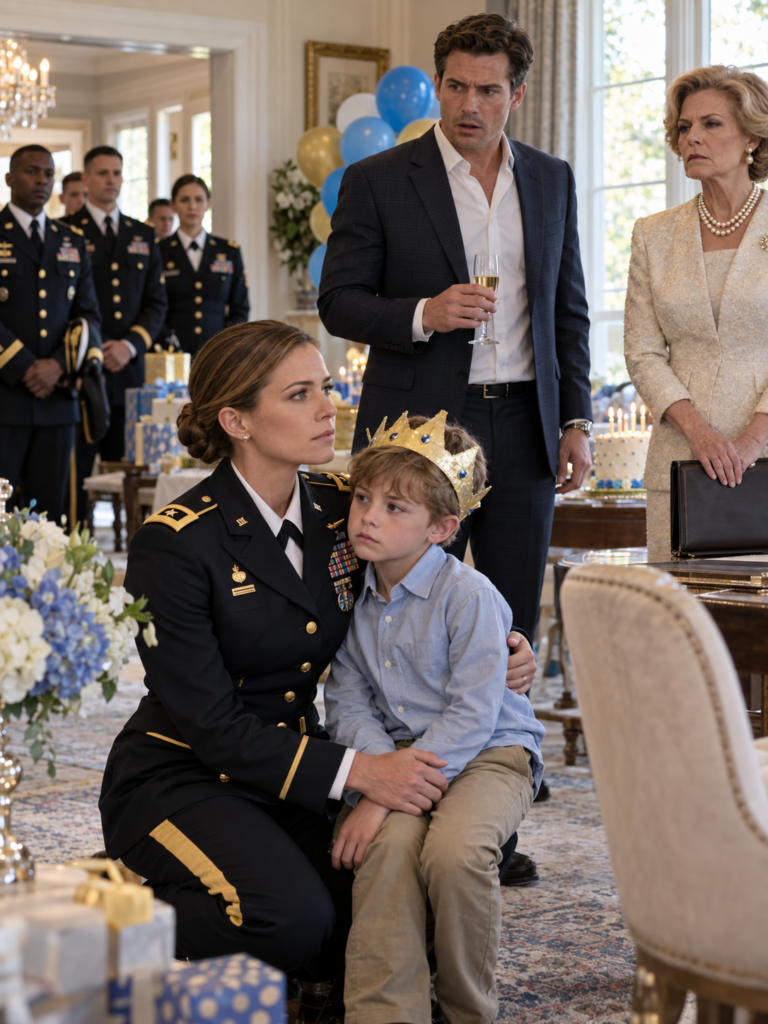
Her eyes moved down the page.
Once.
Then again.
The color drained from her face.
“This cannot be legal.”
Howard did not raise his voice.
“It is.”
She looked at Ethan, then back at the page.
The deed structure was complicated, but the important fact was not.
An entity entirely controlled by me held the relevant title and secured interest.
Not Ethan.
Not Richard.
Not the Whitmore family trust.
Me.
Margaret’s fingers tightened around the paper.
“This is Ethan’s house.”
“No,” I said. “It is our home.”
I let the distinction sit between us.
“And those are not the same thing.”
Her mouth opened.
“You would throw your own husband onto the street?”
“I said nothing about throwing Ethan anywhere.”
Then I stepped closer.
“But you were invited here as a guest.”
Her face hardened.
“You wouldn’t dare.”
The previous night returned to me with almost comic precision.
The message.
The request that I disappear.
The explanation that important people should not have to see me.
“You taught me something useful last night,” I said.
Margaret stared.
“Apparently when someone is ashamed to have you in their home, the respectful thing to do is leave.”
Her expression twisted.
“You vindictive—”
“Mom.”
Ethan’s voice stopped her.
She turned.
I had known Ethan more than a decade, and I had never heard that tone directed at Margaret.
“Stop.”
Her face changed from anger to disbelief.
“Excuse me?”
“I said stop.”
“You’re taking her side?”
He looked at the deed.
Then at the officers near the entrance.
Then toward the room where Noah was opening presents beneath decorations I had chosen for him.
“No,” Ethan said quietly.
He looked at me.
“I’m finally taking my wife’s side.”
The words should have felt like a victory.
They didn’t.
Twelve years late was still twelve years late.
Margaret folded her arms.
“After everything your father and I gave you—”
“You refused to help me.”
She stopped.
Ethan pointed toward the document.
“When the company was collapsing, I asked Dad for help. He told me failure would build character.”
Margaret’s jaw tightened.
“And Claire saved the house while both of you let everyone believe I had done it myself.”
Several nearby guests suddenly became fascinated by their plates.
Margaret noticed.
Public embarrassment had always been the thing she feared most.
I had imagined, more than once, that watching her lose control in front of the same people she tried so hard to impress would feel satisfying.
It didn’t.
Humiliation could not give me back twelve years of swallowing my anger.
Colonel Reed checked his watch.
I nodded.
It was time.
Outside, the Virginia morning was bright and cold.
The convoy waited along the curb.
A few neighbors had appeared on their porches.
As I reached the bottom step, running footsteps sounded behind me.
“Mom!”
I turned.
Noah came racing down the walkway carrying the box containing his telescope.
Ethan hurried after him.
“Noah, slow down.”
My son stopped in front of me, breathing hard.
“You forgot this.”
“That’s yours.”
“I know.”
He pulled a small envelope taped to the top.
I opened it.
Inside was a drawing.
Three stick figures.
Noah.
Ethan.
Me.
Our house stood behind us.
Across the top, in a seven-year-old’s uneven handwriting, he had written MY FAMILY.
My throat closed.
“When did you make this?”
“Yesterday.”
He pointed to my figure.
“I didn’t know about your army clothes, so I drew your blue sweater.”
I looked at Ethan.
He looked wrecked.
Maybe some things had to break before anyone admitted they were already damaged.
I folded Noah’s drawing carefully and slid it inside my jacket.
“This comes with me.”
He smiled.
“Okay.”
I kissed him and climbed into the vehicle.
As we pulled away, I looked back once.
Ethan stood in the driveway.
Margaret stood several feet behind him.
For the first time since I had married him, he was not positioned beside his mother.
He was between us.
I came home at 7:46 that evening.
Margaret’s car was gone.
So were most of the guests.
Half-deflated balloons moved gently against the ceiling.
Wrapping paper still littered the living room.
Noah was asleep on the couch with telescope instructions spread over his chest.
Ethan sat alone at the kitchen table.
No champagne.
No expensive watch.
No crowd to perform for.
Just my husband.
I carried Noah upstairs, tucked him into bed, and returned.
Ethan had placed two things on the table.
His phone.
And a printed copy of his 2:07 a.m. message.
I sat across from him.
“I’ve read it about a hundred times,” he said.
I waited.
“I keep trying to find a version where I don’t sound like a coward.”
“There isn’t one.”
He nodded.
“I know.”
For several seconds neither of us spoke.
Then he said, “I knew you were military.”
“Not really.”
“I knew you served.”
“You thought I had some administrative reserve position.”
He looked down.
“Yes.”
“Why?”
He rubbed both hands over his face.
“Because part of me liked believing I was the impressive one.”
That answer was so nakedly ugly that I believed it.
“My family measured everything,” he continued. “Schools. Money. Cars. Clubs. People you knew. When I met you, you didn’t care about any of it.”
“I cared about you.”
“I know.”
His voice broke.
“And instead of valuing that, I eventually started needing you to fit into our world.”
“No.”
He looked up.
“You needed me to shrink inside it.”
He closed his eyes.
“Yes.”
I asked the question I had avoided for years.
“Did you know your mother talked about me when I wasn’t there?”
His silence answered before he did.
“Yes.”
“How bad?”
“She called you provincial.”
I almost laughed.
Of course she did.
“She said you lacked refinement.”
“To whom?”
He hesitated.
“Friends. Family. People from the club.”
“And you?”
“I told her to stop.”
“When?”
Another pause.
“Privately.”
I stood so quickly the chair scraped the floor.
“There it is again.”
“Claire—”
“She insults me publicly, and you defend me privately where nobody can see you disagree with her.”
“I know.”
“You wanted credit for protecting me without paying the price of protecting me.”
He lowered his head.
I paced once across the kitchen.
“This house almost disappeared five years ago.”
“I remember.”
“You came home terrified every night.”
“Yes.”
“You thought Noah was going to lose his home.”
“I know.”
“I fixed it.”
He stared at the table.
“And after I fixed it, you let your father tell people you had engineered some brilliant recovery.”
His shoulders tightened.
“I was embarrassed.”
“Of me?”
His head came up immediately.
“No.”
“Then what?”
“Of myself.”
That stopped me.
He swallowed.
“I knew somebody had stepped in. I knew some outside investor had saved us. I knew the restructuring didn’t happen because I suddenly became brilliant.”
“Then why didn’t you find out who did it?”
His eyes met mine.
“Because if it wasn’t me, I didn’t want to know.”
I sat again.
That might have been the first time in years that Ethan had told me a truth before I forced it out of him.
He pushed his phone toward me.
“I called Dad after you left.”
I frowned.
“What did he say?”
Ethan’s face changed.
Not shame this time.
Something closer to betrayal.
“He knew.”
“Knew what?”
“That Ashford Residential belonged to you.”
I stared at him.
“He knew you saved the house.”
My chest tightened.
“How long?”
“Four years.”
The kitchen seemed to narrow around me.
“How?”
“One of his attorneys apparently recognized Howard’s name during another filing.”
“And Richard never told you?”
“No.”
I stood again.
“So your father knew I saved the property.”
“Yes.”
“He knew I assumed part of the Arlington exposure.”
“Yes.”
“And he watched Margaret talk about me like I was some embarrassing woman Ethan had dragged home?”
Ethan’s jaw tightened.
“Yes.”
I could barely understand it.
Ignorance was one thing.
Pride was another.
But deliberate silence meant Richard had watched his wife humiliate me while holding information that could have stopped her.
“Why?” I asked.
Ethan gave a bitter laugh.
“He said he wanted to see how long I would keep accepting credit for something I hadn’t done.”
“That explains what he thought of you.”
I looked at him.
“It doesn’t explain what he thought of me.”
Ethan said nothing.
A sound came from the dark hallway behind him.
A shoe against tile.
We both turned.
Richard Whitmore stood in the doorway.
Perfectly dressed.
Silver hair neat.
An envelope in one hand.
And for once, no confidence in his face at all.
I stared at him.
Richard did not step farther into the kitchen.
Ethan rose first.
“Dad?”
“I used the back entrance.”
“I gathered that.”
Richard’s eyes stayed on me.
“Claire, I owe you an apology.”
“You owe me several.”
“Yes.”
The lack of argument unsettled me more than defensiveness would have.
He crossed the room and placed the envelope on the table.
“I knew about the house.”
“I heard.”
“I also knew more about your career than Margaret did.”
My anger sharpened.
“How much?”
“Not operational details.”
He shook his head.
“But enough to understand that you were not doing paperwork somewhere while Ethan built the important life.”
Ethan winced.
I folded my arms.
“So you knew she was wrong.”
“Yes.”
“You knew for years.”
“Yes.”
“And you let her keep treating me that way.”
Richard looked older than he had that morning.
“Yes.”
“Why?”
He glanced toward Ethan.
Then back at me.
“Because you made me uncomfortable.”
I actually laughed once.
There was no humor in it.
“That is your explanation?”
“No. It’s the beginning of it.”
He pulled out the chair but did not sit until I gave the smallest nod.
“When Ethan’s company started failing, I refused to help him because I believed he had become careless. I thought consequences would force him to grow up.”
Ethan leaned against the counter.
“You said losing everything might build character.”
“Yes.”
“Excellent strategy.”
Richard accepted the insult.
“Then Claire did what I refused to do.”
He looked around the kitchen.
“She protected you.”
I said nothing.
“She did it quietly. Without asking me for recognition. Without humiliating you. Without telling the family what she had done.”
His jaw tightened.
“And when I discovered it, I had to confront something I did not want to confront.”
“What?” I asked.
“That I had been wrong about you.”
The answer was almost too small for the damage it had caused.
“You dismissed me because of where I came from.”
“Yes.”
“My clothes.”
“Yes.”
“My parents.”
“Yes.”
“My job.”
“Yes.”
“And when you discovered I had been the person keeping your son’s household standing, your response was to say nothing.”
Richard’s eyes dropped.
“Yes.”
“Because admitting the truth would have bruised your pride.”
“Yes.”
No excuse.
No defense.
Just agreement.
Somehow that made me angrier.
“At least Margaret didn’t know the truth.”
Richard’s face tightened.
“I know.”
“You did.”
“I know.”
“You could have stopped it.”
“Yes.”
Ethan looked at his father.
“You let Mom humiliate Claire because you were embarrassed that Claire had done something you wouldn’t.”
Richard closed his eyes.
“Yes.”
The word stayed in the room.
Then Richard pushed the envelope toward me.
“I resigned from Whitmore Development this afternoon.”
Ethan straightened.
“What?”
“The board will announce it Monday.”
“Why?”
Richard looked toward the staircase where Noah slept.
“Because today I watched my grandson ask why his grandmother didn’t like his mother.”
No one moved.
“I have spent decades telling myself that standards matter,” he continued. “That discipline matters. That reputation matters.”
He looked at Ethan.
“Somewhere along the way, we turned arrogance into a family tradition.”
Ethan said nothing.
Richard touched the envelope.
“These are instructions regarding my voting shares.”
Ethan’s face changed.
“What about them?”
“I intend to transfer them.”
“To whom?”
“Not you.”
Richard looked at me.
“To Noah’s trust. Independently managed until he is thirty.”
For a moment, even I was stunned.
Ethan stared at him.
“Dad, you can’t fix this with shares.”
“I know.”
“Then why are you doing it?”
“Because I no longer trust the culture I created around money.”
He looked at me.
“And because I want one thing in this family to belong to the next generation without being tied to status, approval, or obedience.”
I placed my hand on the envelope.
Then pushed it back.
“No.”
Richard blinked.
“You haven’t read it.”
“I don’t need to.”
“Claire—”
“Noah does not need a fortune to repair what happened today.”
Richard went still.
“He needs adults who behave better.”
I pushed the envelope another inch toward him.
“If you want to leave your grandson something useful, leave him an example.”
Richard’s expression changed.
Something in him seemed to collapse quietly.
Then small footsteps sounded overhead.
A moment later Noah appeared in the kitchen doorway, rubbing one eye.
“Why is Grandpa here?”
All three adults looked guilty.
That nearly made me laugh.
Richard stood.
“Hey, buddy.”
“Did you miss cake?”
“I did.”
“There’s still some.”
“So I heard.”
Noah looked around the room.
Then at Richard.
“Grandma was mean to Mom.”
Richard’s face tightened.
“Yes.”
Noah waited.
“And I was too,” Richard said.
Noah frowned.
“You were?”
“Yes.”
“Why?”
Richard looked at me before answering.
“Because adults can be foolish for a very long time.”
Noah considered that.
Then he said, “You should say sorry.”
Ethan turned away and covered his mouth.
Richard almost smiled.
“You’re right.”
He faced me.
No conditions.
No explanation.
No request that I understand his intentions.
“Claire, I am sorry.”
I studied him.
“I hear you.”
Not forgiveness.
Not absolution.
Just acknowledgment.
For that night, it was enough.
Richard left ten minutes later.
I walked Noah upstairs and settled him back into bed.
When I returned, Ethan was still sitting in the kitchen.
“What happens now?” he asked.
I looked at the man I had loved for twelve years.
That was the difficult part.
I still loved him.
Respect can be damaged while love remains stubbornly alive, which is precisely why betrayal inside a marriage can be harder than simple hatred.
“I’m not filing anything tomorrow,” I said.
Hope flashed across his face.
I stopped it immediately.
“That does not mean we are fine.”
“I know.”
“You’re moving into the guest room.”
He nodded.
“Your mother is not allowed in this house unless I agree first.”
Another nod.
“Noah will never again be used as the reason I’m expected to disappear.”
“Agreed.”
“And if you ever ask me to make myself smaller so your family can feel bigger—”
“I won’t.”
I held up a hand.
“Don’t answer quickly.”
He stopped.
“Think.”
He did.
Nearly a full minute passed.
Then he looked at me.
“I will never ask you to disappear for someone else again.”
That was better.
“We are going to counseling.”
“Yes.”
“And not with anyone Margaret knows.”
Despite myself, I laughed.
So did he.
The laugh lasted only a second, but it reminded me that marriages are rarely made of a single emotion.
Then Ethan glanced toward my uniform jacket over the chair.
“Can I ask you something?”
“Yes.”
“What rank are you?”
I stared at him.
Two seconds.
Three.
Then I laughed harder than I had all day.
After twelve years, my husband had finally asked.
I told him.
His mouth fell open.
“You’re serious?”
“Yes.”
He leaned back.
“Oh my God.”
“Apparently that was the general reaction this morning.”
He rubbed his face.
“I may never recover.”
“You’ll survive.”
He glanced toward the hallway.
“Mom may not.”
“That is no longer my responsibility.”
“No.”
His expression changed.
“For the first time, I think she’s mine to deal with.”
Good.
The next morning, I found Noah at the kitchen island eating cereal.
“Mom?”
“Yeah?”
“Are you still rich?”
I nearly inhaled my coffee.
“What?”
“Dad said you own the house.”
I sat beside him.
“Our family is comfortable.”
“That means rich.”
“Eat.”
He grinned.
Then his expression became serious.
“Are we moving?”
There it was.
Not wealth.
Not rank.
Not deeds.
Security.
“No.”
“Is Dad leaving?”
“Dad is sleeping in the guest room for a while.”
“Because he was mean?”
“Because adults sometimes need space while they fix things.”
Noah nodded.
Then he said, “Grandma called.”
I looked at him.
“When?”
“Last night.”
“What did Dad do?”
Noah looked delighted.
“He pushed the red button.”
I smiled.
“Did he?”
“Yep.”
For twelve years, Ethan had asked me to absorb Margaret’s behavior so he would not have to confront it.
Now, for the first time, he had begun absorbing the consequences himself.
Margaret did not accept the change quietly.
The next day she sent six messages.
Then twelve.
Then an email accusing me of “weaponizing private financial matters.”
I never replied.
Ethan did.
Before sending it, he showed me the message.
Claire is my wife.
You disrespected her.
Until you can acknowledge that without blaming her, do not contact us.
I read it twice.
Then handed the phone back.
“I wouldn’t change anything.”
He sent it.
That did not repair our marriage.
Repair was slower.
Ethan started individual therapy.
We began counseling together.
Some sessions were awful.
One ended with me walking out.
Another ended with Ethan crying in the parking lot.
At one point, I admitted something I had resisted saying: I had hidden parts of myself too.
Not because his family had a right to judge them.
Not because their cruelty was somehow my responsibility.
But because somewhere along the way, I had started protecting my private life so fiercely that Ethan had stopped knowing what questions he should have been asking.
That was mine to examine.
His silence was still his.
Margaret’s contempt was still hers.
Richard’s pride was still his.
Understanding each person’s failure did not require mixing them together until nobody was accountable.
Richard began seeing Noah without Margaret.
Howard cleaned up the ownership structure so there could never again be confusion about who controlled the property.
Ethan stayed in the guest room.
He stopped using phrases like “that’s just how Mom is.”
He stopped asking me to ignore small insults.
He stopped trying to negotiate boundaries downward after we had set them.
And six months after Noah’s birthday, Margaret asked me to meet her.
Alone.
My first instinct was no.
Then I agreed under three conditions.
Public place.
Forty-five minutes.
No Noah.
When I walked into the café, Margaret Whitmore was already sitting there.
Ten minutes early.
She had never been early for anything in the twelve years I had known her.
For several minutes, she talked about the weather.
I let her.
Then she lowered her coffee cup and looked directly at me.
“I was cruel to you.”
I did not rescue her from the silence.
Margaret tightened both hands around her coffee cup.
“I kept telling myself I was protecting Ethan.”
“From what?”
She looked at me.
“From becoming ordinary.”
That was so perfectly Margaret that I almost laughed.
Instead I waited.
She looked down.
“And then I realized I had raised him to be terrified of ordinary things.”
“What things?”
“Being wrong.”
Her voice weakened.
“Needing help.”
She swallowed.
“Having a wife who was stronger than he was in certain ways.”
That last sentence sat between us.
Then she said something I had never expected from her.
“I was jealous of you.”
I stared.
“Not your rank,” she said quickly.
She shook her head.
“And not your money.”
“Then what?”
“Your freedom.”
I did not understand.
Margaret looked through the café window before continuing.
“You never needed our approval.”
The words almost made me interrupt her.
For years, I had swallowed insult after insult partly because some piece of me had desperately wanted to be accepted.
But Margaret continued.
“You may have wanted us to like you. But you never organized your whole identity around whether we did.”
Her mouth tightened.
“I did.”
She looked down at her hands.
“My whole life.”
For the first time, I saw her without the family mythology around her.
Not a villain.
Not a secretly gentle woman whose cruelty had been misunderstood.
Just a woman who had built status into armor and then used that armor against other people.
Understanding the shape of it did not erase the injury.
But it explained why the injury had been so consistent.
“I am sorry,” she said.
I nodded.
“Thank you.”
She waited.
“For?”
“For saying it.”
Her eyes filled.
“Will you forgive me?”
I looked out at the traffic moving past the window.
People crossing the street.
Someone carrying groceries.
A delivery driver double-parking.
Ordinary life continuing while Margaret Whitmore waited for a verdict she could not purchase.
“Maybe,” I said.
Her expression tightened.
“But forgiveness will not restore our old relationship.”
“What does that mean?”
“It means there is no going back.”
I leaned forward.
“If you and I have a relationship, it will be a new one.”
She nodded slowly.
“With boundaries.”
Another nod.
“With respect.”
“Yes.”
“And if you ever speak about me in front of Noah the way you used to—”
“I won’t.”
I held her gaze.
She stopped.
Then corrected herself.
“I understand.”
That mattered more.
A promise could be made quickly.
Understanding required accepting what happened if the promise was broken.
We left the café after forty-three minutes.
I did not hug her.
She did not ask.
That was probably the first respectful thing we had ever done together.
Things changed slowly after that.
Margaret did not become a different person overnight.
She still loved formality.
Still noticed brands.
Still occasionally said something so class-conscious that Ethan would close his eyes before I even reacted.
The difference was that now he reacted first.
“Mom.”
Sometimes that one word was enough.
Other times he told her plainly that the comment was inappropriate.
Once, when she started explaining that she “hadn’t meant it that way,” Ethan stopped her.
“I know what you meant. I’m telling you how it sounded.”
I watched Margaret absorb the correction.
She did not like it.
But she listened.
Richard changed too.
He never transferred the voting shares to Noah’s trust.
Instead, he remained out of day-to-day leadership and spent months restructuring his estate with independent advisers.
He asked for my opinion once.
I told him it was not mine to give.
That surprised him.
For years, the Whitmores had treated money as both proof and leverage.
I wanted Noah to grow up knowing it could simply be a tool.
Ethan and I stayed in counseling.
There was no dramatic evening when everything became repaired.
Trust returned in boring pieces.
He told me things before I asked.
He stopped letting discomfort determine whether he spoke.
He apologized without immediately explaining himself.
He began asking questions about my work—not classified details, not gossip, but me.
What parts were hard?
What parts did I miss?
Who had mattered?
Why had I stayed in service?
Sometimes his ignorance was almost comical.
Once he asked a question so basic that I stared at him until he said, “I deserve that look.”
“Yes.”
“But will you answer?”
So I did.
I began telling him things too.
Not because I owed him proof of my worth.
Because if we were rebuilding a marriage, neither of us could live behind an edited version of ourselves.
He remained in the guest room for months.
Eventually, after a counseling session neither of us particularly enjoyed, I told him he could come back.
He did not celebrate.
He simply nodded and carried his things upstairs.
That restraint probably helped more than flowers would have.
One year after the birthday that changed everything, Noah turned eight.
We celebrated in the same house.
No investors.
No executives.
No carefully chosen guest list designed to impress anyone.
Children.
Parents.
Pizza.
A magician Noah insisted was “probably actually magic.”
Colonel Reed came for twenty minutes and brought Noah a model helicopter.
Richard arrived with three astronomy books.
Margaret came too.
When I opened the door, I stopped.
She was wearing jeans.
Ethan appeared beside me.
“Don’t stare.”
“I’m trying.”
“She apparently owns denim.”
“I’m processing.”
Margaret heard us.
For one terrifying second, I expected offense.
Instead she glanced down at her jeans.
“Supermarket.”
I burst out laughing.
She laughed too.
It did not erase anything.
That was what made the moment worth having.
Real reconciliation is not amnesia.
It is remembering what happened without recreating it.
Later that afternoon, Noah climbed onto a dining chair.
“Speech!”
Every adult turned.
Ethan frowned.
“What speech?”
“My birthday speech.”
Apparently this had become a tradition.
Noah stood proudly, gripping a juice box.
“I want to thank everybody for coming.”
Everyone applauded.
“And Mom.”
He pointed at me.
“For not missing my birthday again.”
The adults fell silent.
Noah frowned.
“What?”
I smiled.
“Nothing, sweetheart. Keep going.”
“And Dad.”
Ethan raised his eyebrows.
“For pushing the red button when Grandma calls too much.”
The backyard erupted.
Margaret shouted, “Noah!”
He dissolved into giggles.
Then he pointed at Richard.
“And Grandpa.”
Richard straightened solemnly.
“For being less foolish.”
Even I lost it.
Richard bowed his head like a man accepting a military citation.
“I’ll take it.”
Finally Noah raised both arms.
“And me, because I’m eight.”
Everyone cheered.
He jumped down from the chair.
I stood at the edge of the table and looked around.
Richard.
Margaret.
Ethan.
Then the house.
For years, I had privately treated the deed as evidence that I was stronger than the Whitmores understood.
I had saved the property.
I had taken on the debt.
I had solved what Ethan could not solve.
I had carried information none of them knew.
But the deed was not what proved my strength.
Neither was my rank.
Neither were the ribbons on my uniform.
Neither was the convoy outside that morning.
Those things only revealed facts they had been too arrogant—or too comfortable—to ask about.
My real turning point had been smaller.
A message at 2:07 a.m.
A request to disappear.
And the moment I finally understood that keeping peace and keeping silent were not the same thing.
Ethan stepped beside me.
“You okay?”
“Yes.”
He watched Noah organize candles with extraordinary seriousness.
“He remembered.”
“Kids remember everything.”
“I know.”
His voice lowered.
“I’m glad you came downstairs that day.”
I looked at him.
“So am I.”
He smiled.
“Front row?”
I followed his gaze.
Noah was at the table.
Eight candles glowed in front of him.
Richard stood nearby, supervising from a distance after being warned twice not to lean over the cake.
Margaret was helping one of Noah’s friends untangle a party hat.
Then, without anyone asking, she noticed where I was standing.
She moved aside.
Not dramatically.
Not apologetically.
She simply made room.
Ethan stepped forward with me.
Not in front.
Not behind.
Beside.
Noah looked up.
“You ready?”
I looked around the house I had once saved without telling anyone.
The house where I had once been asked to hide.
The house where my son had once heard people speak about his mother as though belonging had to be earned through money, manners, clothes, or approval.
Then I looked at Noah.
“Ready.”
Everyone began singing.
I stood exactly where I had promised him I would.
Front row.
And this time, nobody in that house questioned whether I belonged there.
Least of all me.


