
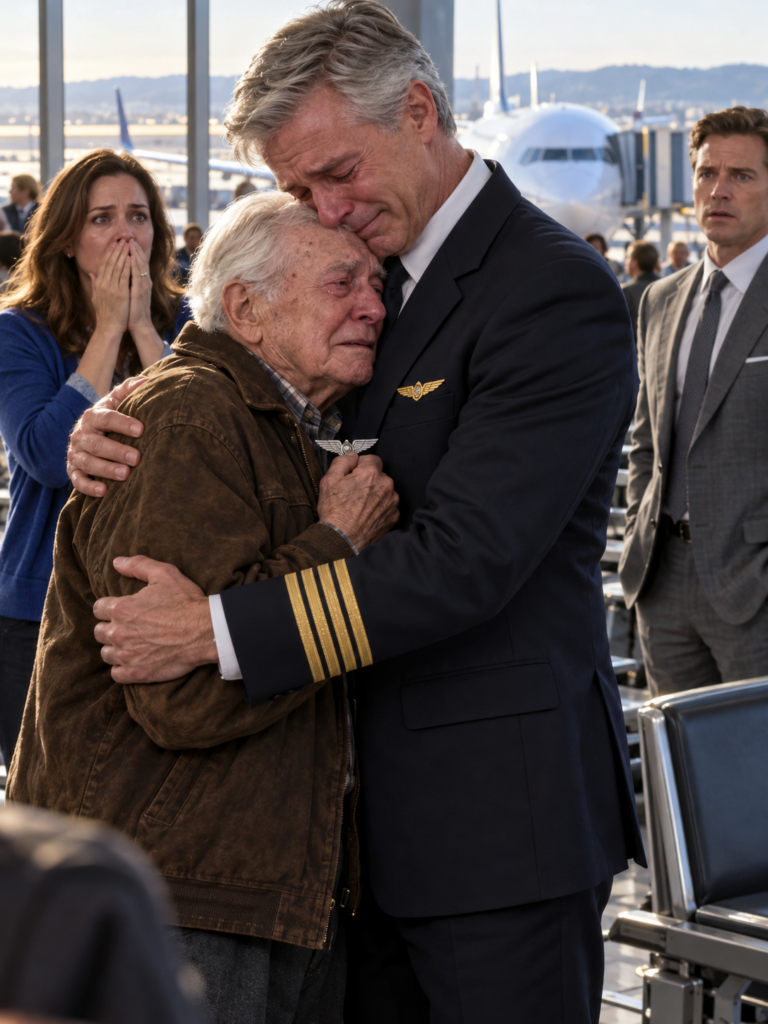
Dad’s hand caught my wrist just before I touched the phone.
Not hard.
Just enough to make me stop.
“Lauren,” he said, “there are things you don’t understand.”
“Then help me understand.”
Michael stood beside us, his eyes moving from Dad to the businessman.
The businessman was still holding his phone out.
The screen showed an old newspaper photograph.
I could make out a damaged aircraft lying in a snow-covered field.
Smoke rose from its broken fuselage.
In the foreground, a young man in a torn uniform carried a small boy wrapped in an oversized jacket.
Something about the man’s face felt familiar.
I leaned closer.
Then my breath caught.
“Dad?”
He closed his eyes.
I knew that face.
I’d seen it in our family photograph albums.
Younger. Dark-haired. Thin.
But unmistakably my father.
Above the picture was a headline about a winter aviation disaster.
Fifty-two survivors.
Flight 417.
I looked back at him.
“You were on this plane?”
Dad didn’t answer.
Michael stepped beside me.
“He wasn’t just aboard that aircraft,” he said quietly.
“He was the first officer.”
I stared at him.
“My father was a pilot?”
Michael nodded.
“And I was the boy he carried out.”
For several seconds, the ordinary noise of the airport seemed impossibly distant.
The announcements.
The luggage wheels.
The conversations.
All of it continued around us while I tried to understand the photograph.
My father had spent my entire childhood refusing to fly whenever he could avoid it.
He’d driven fourteen hours to visit our grandmother rather than buy plane tickets.
Mom used to tease him that he’d drive to the moon if somebody built a highway.
I thought he disliked flying because he preferred being in control.
He had never told Beth or me he’d once sat at the controls of an airliner.
“Why didn’t you tell us?”
Dad looked toward the aircraft.
“Because that part of my life ended a long time ago.”
Michael’s face tightened.
“It didn’t end for the people who came home because of you.”
Dad shook his head.
“Michael, please.”
I could hear something beneath those two words.
Not irritation.
Pain.
The captain lowered his voice.
“I’m sorry, Walt.”
The businessman moved toward Dad.
“Mr. Hayes, I—”
“Not now,” I said.
He stopped.
For once, he seemed to understand that he didn’t have the right to interrupt.
I turned back to my father.
“Did Mom know?”
“Yes.”
“Beth?”
“No.”
“So you both kept this from us?”
Dad’s eyes filled.
“We weren’t trying to hurt you.”
I looked again at the photograph.
A damaged airplane.
A child in his arms.
The expression of a man who looked as though he could barely remain standing.
“What happened out there?”
Dad looked at Michael.
The captain understood.
“We have to finish boarding,” he said. “But Walt, after we land, I want you to come to the cockpit.”
Dad hesitated.
“Michael—”
“Please. There’s something I need to show you.”
The gate agent approached, reminding us that the other passengers were waiting.
Michael nodded.
Then he turned to me.
“Your father saved my life, Lauren. But there are two people from that day he has never stopped grieving.”
Dad turned his face away.
I had another dozen questions, but the captain was already being called back to the aircraft.
Michael squeezed Dad’s shoulder.
“After we land.”
Dad finally nodded.
The businessman remained where he was standing.
For the first time since security, he looked uncertain about what to do with himself.
He opened his mouth.
Dad gently raised a hand.
“We should board.”
And we did.
I walked beside him down the jet bridge, carrying his small bag while he kept the silver wings hidden inside his fist.
At row fourteen, I gave him the window seat.
He fastened his belt without assistance.
Then he looked outside.
His face had gone strangely still.
I sat down beside him.
“Dad?”
“Yes, sweetheart?”
“I need you to tell me the truth.”
He didn’t look at me.
“I know.”
“Not because that captain recognized you. Not because that horrible man found your photograph.”
His fingers tightened around the keychain.
“Because I’m your daughter.”
That finally made him turn.
I didn’t raise my voice.
I didn’t accuse him of lying.
But I couldn’t pretend this was an ordinary family secret.
I had spent fifty years believing my father’s career began in a classroom.
Suddenly I was discovering that he’d once worn a pilot’s uniform and carried people out of a wrecked airplane.
And he had chosen not to tell his children.
“I don’t need you to be somebody extraordinary,” I said. “But I want to know who you are.”
Dad’s face softened.
“You already know who I am.”
“Then tell me who you were.”
He stared at the wings.
Finally, he nodded.
“When we’re in the air.”
During takeoff, I watched his hands.
He gripped the armrests.
His lips moved silently, as though he were counting.
When the wheels left the runway, he released a long breath.
I reached over and took his hand.
He held mine until the aircraft leveled out.
Then he began.
“January fourteenth, 1977. I was thirty-one.”
He spoke carefully, like a teacher walking a student through a difficult problem.
Flight 417 had departed Chicago for Pittsburgh during a severe winter storm.
Dad was the first officer.
His captain was Frank Dorsey, an experienced pilot with twenty-five years in aviation.
“He used to hum Sinatra during takeoff,” Dad remembered.
He smiled faintly.
“He said it helped him keep his nerves steady. Twenty-five years, and he still took every flight seriously.”
About forty minutes after departure, Frank mentioned discomfort in his chest.
He thought he’d eaten something that disagreed with him.
Five minutes later, he collapsed across the controls.
I sat straighter.
“What happened?”
“His heart gave out.”
Dad swallowed.
“Massive heart attack.”
The senior flight attendant, Ruth Ellison, came forward to help.
Together, they moved Frank out of the cockpit.
Ruth began CPR.
Dad returned to the controls.
Alone.
Through the cockpit window, there was almost nothing but snow.
He contacted air traffic control and requested an emergency diversion to Toledo.
The controllers cleared him to land.
Then the left engine failed.
I felt my own breathing change.
“Completely?”
Dad nodded.
“Enough that we couldn’t rely on it.”
Investigators later determined that contaminated fuel had allowed ice to form inside the fuel system.
The right engine began losing power soon afterward.
They were descending through a winter storm.
There wasn’t enough power to reach the airport.
He had to find somewhere else to put the aircraft.
“Where?”
“A cornfield.”
I looked at him.
“A cornfield?”
“Harvested. Covered in snow. Long enough, I hoped.”
He explained how he’d searched for the flattest open space he could find.
No trees.
No houses.
No power lines.
Then he lined up the aircraft and prepared to bring it down.
I knew he had survived.
I knew Michael had survived.
I knew fifty-two people had survived.
But as Dad described those final minutes, I understood that knowing the ending didn’t make the experience less terrifying.
“Were you afraid?”
“Of course.”
“Then how did you do it?”
He considered that.
“Because being afraid didn’t change what needed doing.”
The plane struck the field.
The front landing gear collapsed when it hit a drainage ditch.
The left wing broke away.
The fuselage split near the galley.
And for a moment, Dad fell silent.
I squeezed his hand.
“Dad?”
He looked down.
“Frank was already gone.”
I waited.
“Ruth didn’t make it either.”
His voice became so quiet I could barely hear him.
“She was twenty-four.”
The cabin around us suddenly felt smaller.
Dad wasn’t looking at me anymore.
His eyes were fixed somewhere far beyond the window.
“Ruth had stayed with Frank. She was trying to save him.”
He drew a slow breath.
“When the fuselage broke apart, she was near the galley.”
He didn’t finish.
He didn’t need to.
I had wanted a story about my father’s secret heroism.
Instead, I was hearing about two people whose deaths he had carried for nearly fifty years.
“Dad, you saved fifty-two people.”
“I know.”
He wiped his eyes.
“But for years, all I could think about were the two who never came home.”
Neither of us spoke for a while.
A flight attendant moved down the aisle offering drinks.
Dad declined.
Then he resumed.
After the aircraft stopped, smoke began filling the cabin.
Another flight attendant, Denise, had broken her leg.
Even injured, she managed to open the rear exit and guide passengers out.
Dad searched through the damaged cabin, helping people move toward safety.
He’d struck his head and broken two ribs, but he didn’t realize how badly he was hurt.
Then, when he believed everyone had escaped, he heard someone crying.
“A child?” I asked.
Dad nodded.
“Michael.”
He’d been traveling alone to visit his grandmother.
His seat belt had jammed.
Smoke was gathering around him.
Dad used his pocketknife to cut the strap.
Then he carried the boy out of the aircraft.
“He wouldn’t let go of my neck,” Dad whispered.
“He was so frightened.”
I looked at the newspaper image again in my memory.
That wasn’t a publicity photograph.
It was a man carrying a child out of a place neither of them should have survived.
“That’s how you got the picture?”
“A farmer’s son took it.”
The photograph was printed in newspapers the following morning.
People called Dad a hero.
Letters arrived.
Reporters asked questions.
Strangers wanted to shake his hand.
But Dad couldn’t stand the attention.
“Every time somebody praised me, I heard Ruth’s name in my head.”
Then came another blow.
The investigation.
Airline representatives and investigators began questioning his decisions.
Why that particular field?
Why hadn’t he made Toledo?
Could he have chosen differently?
Newspapers that had celebrated him began suggesting pilot error.
Dad was thirty-one.
A young first officer facing criticism while grieving two people he’d worked beside.
“The fuel supplier had influence,” Dad said. “And people wanted answers before the investigation was complete.”
I felt sick.
“Did they blame you?”
“Some did.”
“Were they right?”
“No.”
He said it firmly.
Then his expression changed.
“But at the time, I wasn’t certain of anything.”
That distinction hurt more than an accusation.
The investigation eventually established that contaminated fuel had compromised the aircraft.
Other planes had been affected.
The final findings cleared him and confirmed that his emergency decisions were appropriate.
Northline Airways offered him his job back.
Even a promotion.
I looked at him in disbelief.
“They offered to make you a captain?”
“Yes.”
“Why didn’t you take it?”
He stared at the seat in front of him.
“I tried to go back.”
He had put on his uniform.
Walked through an airport.
Climbed into a cockpit.
But when he sat down, his hands began shaking.
His breathing changed.
Everything he had buried came back.
So he walked away.
Not because he no longer loved flying.
Because he couldn’t bear what flying reminded him of.
He returned to school.
Studied to become a teacher.
Eventually, he met my mother, who taught English at the same high school.
“She knew?” I asked again.
“All of it.”
“Did she ever tell you to tell us?”
“Many times.”
“Why didn’t you listen?”
Dad was quiet.
Then he turned toward me.
“Because I wanted to be your father, Lauren. Not a newspaper story.”
My throat tightened.
“I wanted to help you and Beth with homework. Take you camping. Make pancakes on Sunday mornings.”
His voice cracked.
“I was afraid that if you knew about the crash, that would be all you saw when you looked at me.”
I pressed his hand between both of mine.
“Dad, nothing could change the father you were.”
He tried to smile.
But there was something he still hadn’t explained.
The wings.
The number.
The boy who had embraced him at the gate.
“Where did those come from?”
Dad opened his hand.
The little silver wings rested against his palm.
“A year after the investigation, the survivors organized a gathering.”
He ran his thumb across the metal.
“They had these made. They engraved the flight number on the back.”
“Michael gave them to you?”
“Yes. He was ten.”
Dad’s smile returned briefly.
“He told me that because I’d carried him out of the airplane, he wanted to carry the wings to me.”
I couldn’t speak.
“Michael wrote to me afterward,” Dad continued.
“Christmas cards. School reports. Letters about flight training.”
“Flight training?”
Dad nodded.
“He wanted to become a pilot.”
“And you knew?”
“I did.”
“Did you see him again?”
“I attended his graduation.”
That startled me.
“You did?”
“I sat in the back.”
“Did you talk to him?”
Dad shook his head.
“I left before he could find me.”
My heart sank.
“Why?”
“Because I was proud of him. And because I was still ashamed of myself.”
I wanted to tell him how unfair that was.
How impossible.
How cruel he’d been to himself.
But Dad wasn’t finished.
“Eventually I stopped answering his letters.”
“Why?”
“Every envelope brought me back to that field.”
He rubbed his eyes.
“I thought if I could put enough years between myself and the crash, I might finally stop hearing it.”
“And did you?”
Dad turned toward the window.
“No.”
A few minutes later, the captain’s voice came through the speakers.
We were about forty minutes from Columbus.
The weather was clear.
A smooth arrival was expected.
Then Michael paused.
“Before we begin our descent, I’d like to share something personal.”
Dad’s hand tightened around mine.
Michael began telling the passengers about a nine-year-old boy who’d survived an airplane crash nearly fifty years before.
He spoke of a young first officer who landed a failing aircraft in a snowy field.
Fifty-two people survived.
He was one of them.
Then Michael named the two who hadn’t.
Captain Frank Dorsey.
Flight attendant Ruth Ellison.
Dad covered his mouth.
I watched tears slide silently down his face.
Michael continued.
“The man who carried me out of that aircraft is aboard our flight today. He never wanted attention, so I won’t identify him.”
He paused.
“But I want him to know something.”
Dad closed his eyes.
“Because he helped me get home, I got to grow up. I became a husband, a father, and a pilot.”
Michael’s voice trembled.
“Today, I’ll do everything I can to bring my passengers home safely, just as he once brought me home.”
The announcement ended.
For a few moments, nobody spoke.
Then applause spread through the cabin.
My father sat with his head bowed.
His lips moved.
I leaned closer.
He was whispering two names.
“Frank. Ruth.”
Again and again.
Then someone stopped beside our row.
I looked up.
The businessman from security was standing in the aisle.
His gray tie was loosened.
His face was red.
His eyes were wet.
“Mr. Hayes,” he said quietly. “My name is Grant Whitaker.”
Dad lifted his head.
Grant swallowed.
“I need to tell you something about my mother.”
He looked at the silver wings.
“And about the person I was this morning.”
I felt my entire body tense.
Because whatever Grant had discovered on his phone, it had frightened him enough to come back.
And Dad, who had spent decades avoiding the past, was about to hear a name neither of us expected.
Grant lowered himself beside our seats.
“My mother’s name is Carol Whitaker.”
Dad went completely still.
Grant took a breath.
“She was on Flight 417.”
Dad’s silver wings stopped moving between his fingers.
“Carol?” he repeated.
Grant nodded.
“Carol Whitaker. She was twenty-six years old when the plane went down.”
Dad stared at him.
Then he asked a question that made Grant’s eyes widen.
“Was she wearing a blue coat?”
Grant put a hand over his mouth.
“Yes.”
Dad leaned back against the seat.
“Six C,” he whispered. “She was sitting in seat six C.”
Grant’s face crumpled.
“My mother told me you remembered everything about that day. I didn’t believe she meant everything.”
I looked from one man to the other.
“What happened to her?”
Grant answered before Dad could.
“She was seven months pregnant.”
For a second, I didn’t understand why that mattered.
Then Grant looked directly at my father.
“With me.”
I felt the meaning of those two words settle over us.
The man who had shoved my elderly father at security had been an unborn baby aboard the aircraft Dad brought down in a snowy field.
Grant spoke carefully.
“My mother always told me that after the crash, she couldn’t get out of her seat. She was terrified something had happened to the baby.”
Dad nodded.
“She kept asking whether her baby was going to be all right.”
“She said you helped her up.”
“I remember.”
“She said you promised she’d make it home.”
Dad lowered his eyes.
“I hoped she would.”
Grant wiped his face.
“She made it home. And six weeks later, I was born.”
I sat back, stunned.
This was no longer only a story about a cruel stranger discovering that he’d insulted someone famous.
This man had grown up because his mother survived Flight 417.
And now he was facing the person who had helped her escape.
Grant took out his phone, but he didn’t open it.
He seemed to be searching for a way to speak without turning the moment into another performance.
“My mother kept that newspaper picture in our hallway,” he said. “The one with the boy in your arms.”
Dad glanced at him.
“She talked about you all the time. Told me that whenever life felt hard, I should remember the young pilot who didn’t give up.”
Grant swallowed.
“And this morning, I saw an old man having trouble with his passport.”
His voice faltered.
“I didn’t see a person. I saw somebody slowing me down.”
I felt the anger I’d carried since security rise again.
“Not only that,” I said. “You pushed him.”
Grant nodded immediately.
“I know.”
“And you laughed about him on the phone.”
“I know.”
“And at the gate, you hit him with your suitcase.”
He looked at Dad.
“I did.”
There was no excuse.
No suggestion that we’d misunderstood.
He didn’t mention stress or his important meeting.
For the first time that morning, he seemed willing to describe his behavior exactly as it had happened.
“I owe you both an apology.”
Dad studied him.
Grant’s hands trembled.
“I’ve spent my whole life hearing about the man who saved my mother. I imagined meeting him someday.”
His voice broke.
“And when I finally did, I treated him like he didn’t matter.”
Dad said nothing.
Grant looked down.
“I don’t know how to make that right.”
For several seconds, nobody spoke.
Then Dad leaned forward and placed one hand on Grant’s shoulder.
“You didn’t know who I was.”
Grant nodded miserably.
“But that doesn’t excuse what you did.”
“No,” Dad said gently. “It doesn’t.”
He let that answer remain between them.
Then he continued.
“You shouldn’t have to discover that somebody did something important before you treat them with respect.”
Grant lifted his eyes.
Dad gestured faintly toward the cabin.
“Look around.”
Grant turned.
“A mother traveling with her child. An exhausted man trying to get home. A flight attendant who’s been working since before sunrise.”
Dad’s voice was steady.
“You don’t know what any of them has survived.”
Grant listened without moving.
“Some people have done extraordinary things. Some haven’t. They all deserve patience.”
I watched Dad carefully.
He wasn’t excusing Grant.
He wasn’t pretending the shove hadn’t happened.
He was explaining the very thing I’d been too angry to articulate.
Kindness couldn’t depend on the possibility that someone might turn out to be a hero.
A person shouldn’t have to prove their worth to receive ordinary decency.
Grant’s eyes filled again.
“I understand.”
Dad gave a small nod.
“I hope you do.”
Then Grant asked a question.
“Could I tell my mother I’ve found you?”
Dad’s expression changed.
For a moment, he looked almost frightened.
“She looked for you for years,” Grant explained. “She contacted the airline. She wrote to newspapers. She wanted to thank you.”
Dad glanced at me.
I knew he was thinking about Michael’s unanswered letters.
All the people who’d wanted to reach him.
All the years he’d spent hiding.
I didn’t tell him what to do.
I simply held his hand.
After a long moment, he nodded.
“You can tell her I’m glad she got home.”
Grant typed a message.
A reply appeared almost immediately.
He read it, and his expression softened.
Then he turned the screen toward us.
Mom had written that she could hardly believe it. She wanted to know whether Walter Hayes really was the man sitting on Grant’s plane.
And then she added something neither of us expected.
She had named her son after him.
Dad blinked.
“After me?”
Grant nodded.
“My middle name is Walter.”
For the first time, Grant managed a small, embarrassed smile.
“I hated it when I was a kid. Didn’t sound very exciting.”
Dad gave a startled laugh.
“Can’t say I blame you.”
Grant shook his head.
“My mother told me it belonged to somebody special. I just never imagined I’d meet him like this.”
Dad covered his face.
His shoulders began shaking.
I put my arm around him.
For a moment, eighty-one years of dignity, grief, and silence seemed to come apart beneath my hand.
He cried.
Not loudly.
Not dramatically.
Just with the exhaustion of someone who had held too much inside for far too long.
A flight attendant approached and gently reminded Grant that everyone needed to remain seated for landing.
He stood.
“May I see you after we arrive?”
Dad wiped his eyes.
“Michael asked me to come to the cockpit.”
Grant nodded.
“Then perhaps afterward?”
Dad looked at him.
“You said you had an important meeting.”
Grant lowered his head.
“I did.”
He paused.
“But I think I’ve been measuring important things the wrong way.”
He returned to his seat.
And Dad sat very quietly beside me.
I thought about how different that morning had become.
At security, Grant had acted as though his schedule made him more important than a stranger who moved slowly.
Now he knew that stranger had helped give him his life.
But the discovery didn’t erase the cruelty.
That was what made Dad’s response so powerful.
He hadn’t demanded gratitude.
He’d demanded something more ordinary.
Respect.
For everyone.
As our aircraft began its descent, Dad looked through the window.
I noticed that he was no longer gripping the armrest.
Instead, he held the silver wings lightly in his lap.
“Dad?”
He turned toward me.
“Are you glad he knows?”
Dad considered the question.
“I’m glad his mother survived.”
He paused.
“And I’m glad he apologized.”
“Do you forgive him?”
“Yes.”
I hesitated.
“That quickly?”
Dad looked at me.
“Forgiving him doesn’t mean I liked what he did.”
“I know.”
“And it doesn’t mean you have to feel the same way.”
That surprised me.
He reached for my hand.
“Lauren, I spent too many years carrying anger that couldn’t change what happened. I don’t want to carry another piece of it home.”
I looked at him.
“Did you forgive yourself for the crash?”
His expression changed.
For several seconds, he said nothing.
Then he turned toward the window.
“I’m still working on that.”
The landing was smooth.
Dad watched every movement, following the runway with an attention I now recognized as professional.
When the wheels touched down, he smiled.
“Beautiful landing.”
I laughed softly.
“You sound like a pilot.”
He glanced at me.
“Apparently, I used to be one.”
It was the first joke he’d made about his past.
And somehow it felt like a door opening.
We waited while other passengers collected their luggage and left.
Michael had asked us to remain aboard.
When the cabin finally emptied, a flight attendant guided us toward the cockpit.
Dad’s steps grew slower as we approached the front.
The doorway was open.
Michael stood waiting.
“Walt.”
Dad stopped.
I saw his hand tighten around the silver wings.
Michael noticed.
“You don’t have to do this.”
Dad stared through the doorway.
Inside were unfamiliar modern instruments, glowing displays, and two seats positioned before the controls.
Nothing like the cockpit he’d once known.
Yet something in his face changed as he studied them.
I remembered what he’d told me.
The last time he’d tried to sit in a cockpit, he couldn’t breathe.
He’d walked away from the career he’d loved.
Now, almost fifty years later, he was standing at another cockpit door.
And he was afraid.
“I don’t know if I can,” he admitted.
I moved closer.
“Then I’ll stay right here.”
Dad looked at me.
“You don’t mind?”
“Of course not.”
Michael stepped aside.
Dad placed one hand against the doorway.
Then, very slowly, he entered.
The first officer greeted him respectfully, and Michael offered him the right-hand seat.
Dad stared at it for a long moment.
Finally, he lowered himself into the chair.
His hands were shaking.
I stood in the doorway.
Michael sat beside him.
For nearly a minute, nobody spoke.
Then Dad rested his fingertips lightly on the controls.
“I thought coming back here would bring everything back,” he whispered.
Michael watched him.
“Does it?”
Dad closed his eyes.
I saw his chest rise and fall.
Once.
Twice.
Then he opened his eyes.
“No,” he said.
He looked toward the windshield.
“This time, I can see the people walking away from the airplane.”
Michael’s expression softened.
Dad continued.
“Not just the wreckage.”
His voice began to break.
“The people. Alive. Going home.”
Michael reached into his uniform pocket.
“I’ve wanted to give you something for a very long time.”
He opened his hand.
Resting in his palm was a small pair of plastic airplane wings.
They were faded and chipped.
One edge was worn almost smooth.
Dad stared at them.
“Michael?”
The captain nodded.
“Ruth gave me these when I boarded Flight 417.”
Dad’s lips parted.
“She gave them to you?”
Michael looked down.
“I was traveling alone. I told her I wanted to be a pilot someday.”
He smiled faintly.
“She said every pilot needed wings.”
He placed them on the console beside Dad’s silver keychain.
“I was holding them when you found me trapped under the seat.”
Dad touched the plastic.
Michael’s eyes filled.
“I’ve carried them on every flight I’ve flown for thirty-one years.”
“Every flight?”
“Every one.”
Michael swallowed.
“And every time I brought passengers home, I thought about the people who brought me home.”
Dad couldn’t speak.
The captain leaned closer.
“I know you remember Ruth and Frank. I know you always will.”
Dad nodded through tears.
“But Ruth was part of your crew, Walt. She helped care for us before the crash. And you finished what your crew started.”
Michael’s voice broke.
“You brought her passengers home.”
Dad bent forward.
He covered his face.
And for the first time since the story began, I heard my father sob.
Michael placed a hand on his back.
I stood beside them, crying too.
There was no applause.
No photographer.
No newspaper reporter.
Just two men and a daughter standing in a quiet cockpit, surrounded by memories of people who hadn’t survived.
And I finally understood something.
Dad hadn’t spent nearly fifty years hiding a great achievement because he was modest.
He’d been hiding from a grief he believed he had no right to set down.
When he could finally speak, he looked at the plastic wings.
“I don’t know what Ruth would think of me.”
Michael shook his head.
“I can’t speak for her.”
He placed the little wings in Dad’s palm.
“But I know she worked to save lives that day. And I know you did, too.”
Dad held both pairs of wings.
One silver.
One plastic.
Two ordinary objects carrying almost half a century of sorrow.
Then Michael said, “You don’t have to keep running from the people who are grateful you’re alive.”
Dad raised his eyes.
For a long moment, he looked at the captain as though he were seeing the nine-year-old boy inside the grown man.
Then he whispered, “I’m sorry I stopped answering.”
Michael’s eyes filled again.
“I missed you, Walt.”
Dad reached for him.
And they embraced once more.
When we finally left the aircraft, Grant was standing near the end of the jet bridge.
He had his briefcase beside him.
His phone was in his hand.
But he wasn’t talking on it.
He was waiting.
“I called my boss,” he explained. “Moved the presentation to tomorrow.”
I raised my eyebrows.
“I thought you couldn’t afford to be late.”
He accepted that without becoming defensive.
“I thought so too.”
Then he looked at Dad.
“My mother’s waiting for a video call. Only if you’re comfortable.”
Dad glanced at me.
I squeezed his hand.
He nodded.
“Let’s say hello.”
And in the airport baggage claim area, nearly fifty years after a snowy field changed their lives, my father saw Carol Whitaker’s face again.
She had silver hair now.
Fine lines surrounded her eyes.
But the moment she saw him, she started crying.
“Mr. Hayes?”
Dad held the phone with both hands.
“Carol?”
She laughed through tears.
“You remember me?”
Dad smiled.
“You had a blue coat.”
Carol covered her mouth.
“I still have it.”
“You do?”
“I couldn’t throw it away.”
Her voice trembled.
“I wore it the day you told me I was going to make it home.”
Dad looked down.
“I hoped that was true.”
“It was.”
Carol turned her phone toward a family photograph behind her.
“And because it was, I got to see my son grow up. Then I got to meet my grandchildren.”
Dad’s eyes filled.
“I’m glad, Carol.”
She shook her head.
“I’ve been trying to thank you for forty-nine years.”
Dad’s voice broke.
“You just did.”
They talked quietly for several more minutes.
I stepped aside with Grant.
He looked toward Dad.
“I’m sorry for how I treated him.”
“I know.”
“And I’m sorry I made you watch.”
That caught me off guard.
Most people apologize only to the person they hurt directly.
Grant understood that I’d spent the morning afraid my father might fall because a stranger couldn’t bear to wait five seconds.
“I appreciate you saying that,” I answered.
He nodded.
“I don’t expect you to forgive me today.”
I looked at him.
“Dad already has.”
Grant glanced over.
“And you?”
I thought about it.
“I’m not there yet.”
He accepted that.
No argument.
No pressure.
Then he did something small.
When Dad finished speaking with Carol, Grant offered to carry his bag.
Dad hesitated.
Grant didn’t insist.
He simply held out his hand.
After a moment, Dad passed it to him.
We walked toward baggage claim.
Grant matched Dad’s slower pace.
He didn’t rush ahead.
He didn’t sigh.
When people hurried around us, he quietly positioned himself where Dad had more room to walk.
It wasn’t a grand act of redemption.
But it was the first evidence that he understood what he’d done.
At the carousel, Grant retrieved our suitcase.
He helped us reach the parking garage.
Before leaving, he gave Dad his contact information and said Carol hoped they could meet in person someday.
Dad studied the phone number.
Then he put it in his pocket.
“I’d like that.”
Grant smiled.
“So would she.”
When we reached our car, I thought the emotional surprises were finally over.
Then Dad stopped beside the passenger door.
“Lauren?”
“Yes?”
“Before we drive home, I need to call Beth.”
I looked at him.
“Now?”
He nodded.
“I’ve let your sister live without this part of our family for long enough.”
I took out my phone.
Beth answered immediately.
“Did you land safely?”
“Yes,” I said. “We’re fine.”
“Is Dad okay?”
I looked at him.
He nodded.
“Put me on speaker, sweetheart.”
I did.
“Beth,” Dad said, “there’s something I should have told you and your sister a long time ago.”
My sister laughed nervously.
“Dad, you’re scaring me.”
“I used to be an airline pilot.”
Silence.
Then Beth said, “You used to be what?”
Dad looked at the two pairs of wings resting in his palm.
And for the first time in nearly fifty years, he began telling his story without somebody else forcing it into the open.
Beth didn’t interrupt for the first several minutes.
Dad told her about Northline Airways.
About the winter storm.
About Captain Frank Dorsey collapsing at the controls.
About Ruth Ellison trying to save him.
About the engines losing power.
And about the snowy cornfield where fifty-two people survived.
I sat beside him in the parked car, holding the phone steady.
Every so often, Beth would make a small sound.
A gasp.
A whispered “Oh, Dad.”
Once, when he described Ruth’s death, she began crying.
But she let him finish.
Dad told her about the investigation, the criticism, and the final report clearing him of wrongdoing.
He explained why he’d left aviation.
Why Mom had been the only person who knew everything.
Why he’d never answered our questions about the silver wings.
When he finished, there was a long silence.
Then Beth asked the same thing I had.
“Why didn’t you tell us?”
Dad stared through the windshield.
“Because I wanted you to have an ordinary father.”
Beth’s answer came immediately.
“Dad, you gave us everything we needed from a father.”
He lowered his head.
“You didn’t have to hide the rest.”
“I know that now.”
She began crying again.
“I wish Mom were here.”
Dad closed his eyes.
“So do I.”
That was the moment I felt her absence most sharply.
Mom had known.
For decades, she had loved a man who carried a terrible memory he couldn’t fully release.
She had watched him wake from dreams he refused to describe to us.
She had understood why he drove instead of flying.
She knew what the silver wings meant.
And she had repeatedly encouraged him to tell his daughters.
But she’d also respected his choice when he couldn’t.
Dad rubbed his thumb across the silver wings.
“Your mother always said you girls deserved the whole story.”
Beth sniffled.
“She was right.”
Dad gave a sad little laugh.
“She usually was.”
After we ended the call, I expected him to look exhausted.
Instead, he seemed strangely relieved.
He sat quietly for several minutes.
Then he said, “I should have done that years ago.”
I started the car.
“Maybe.”
He turned toward me.
“Are you angry?”
I thought carefully.
“I’m sad you felt you had to hide it.”
Dad nodded.
“But I’m glad you finally told us.”
He reached over and squeezed my hand.
That afternoon, driving home, we didn’t discuss the crash again.
We talked about groceries.
About Beth’s garden.
About a neighbor who kept parking too close to Dad’s driveway.
Ordinary things.
And I realized that telling us his extraordinary history hadn’t made him any less ordinary.
He was still the man who reminded me to check my tire pressure.
Still the man who saved coupons he rarely remembered to use.
Still the father who called every Sunday evening just to make sure I was eating properly.
Knowing what he’d done didn’t replace those memories.
It gave them more depth.
Two weeks later, Michael visited.
He brought his wife and grown daughters.
One of his daughters had become a pilot herself.
I watched Dad study her uniform with a mixture of pride and disbelief.
“You fly commercially?”
She nodded.
“Just like my father.”
Michael smiled.
“And I flew because of him.”
He gestured toward Dad.
My father looked embarrassed.
But he didn’t change the subject.
Not this time.
They spent the afternoon looking through photographs.
Michael brought pictures of his graduation, his first aircraft, and his family.
Dad admitted he’d attended the graduation but stayed hidden near the back.
Michael stared at him.
“You were there?”
Dad nodded.
“I was proud of you.”
Michael shook his head.
“I wish you’d told me.”
“I know.”
For a moment, neither spoke.
Then Michael placed a hand on his shoulder.
“You’re here now.”
The simplicity of those words seemed to reach Dad more deeply than any praise.
You’re here now.
Not back in the cockpit in 1977.
Not standing in the snow.
Not answering investigators’ questions.
Here.
Alive.
With the people who loved him.
Dad began answering Michael’s messages again.
Sometimes Michael called to ask his opinion about an aviation story.
Sometimes he simply called to talk.
They discussed airplanes, family, the weather, and how much flying had changed.
And sometimes they spoke about Frank and Ruth.
Dad no longer ended those conversations immediately.
He could say their names without shutting down.
That change didn’t happen overnight.
Some evenings, he still grew quiet.
Some memories still hurt.
But he stopped pretending that silence was the only way to live with them.
In November, Carol Whitaker came to visit.
She brought Grant, his wife, and their two sons.
And she brought the blue coat.
It was folded carefully inside a garment bag.
The fabric had faded with age.
The style belonged unmistakably to another decade.
But Dad recognized it before Carol finished unfolding it.
“That coat,” he whispered.
Carol smiled through tears.
“You remembered.”
“I remember you asking about your baby.”
She pressed the coat against her chest.
“I remember you telling me I was going home.”
Dad’s eyes filled.
“I didn’t know whether I could keep that promise.”
“But you did.”
Carol reached for his hand.
“And I spent the next forty-nine years getting to see what that promise meant.”
Grant’s sons were playing in the backyard.
His wife stood near the kitchen window watching them.
Carol gestured toward the children.
“Those boys are here because their grandmother got out of that airplane.”
Dad looked toward them.
He didn’t say anything for a long time.
Then he smiled.
It was a real smile.
The kind I hadn’t seen very often since Mom died.
Grant came to stand beside us.
He seemed more relaxed than he’d been at the airport.
He hadn’t lost his job.
His presentation had been rescheduled, and he’d eventually secured the account.
But when I asked him about it, he shrugged.
“It went well.”
“That’s good.”
He looked toward Dad, who was showing one of his sons how to throw a football.
“A few months ago, I would’ve told everybody that deal was the biggest thing happening in my life.”
“And now?”
Grant considered the question.
“Now I think about how I acted at security.”
I waited.
He continued.
“I used to tell myself I was just impatient. Busy. Under pressure.”
He shook his head.
“But there were people who suffered because I decided my time mattered more than theirs.”
I appreciated that he didn’t try to make his apology sound heroic.
He wasn’t asking me to congratulate him for understanding basic decency.
He was simply admitting the truth.
“Has it changed anything?” I asked.
“Yes.”
He glanced toward his sons.
“They’ve started noticing how I behave when we’re in a hurry.”
I looked at him.
“And?”
“I don’t want them growing up thinking it’s acceptable to push past people who can’t move as quickly as they can.”
He paused.
“I was ashamed of what I did to your father. But I would’ve been wrong even if he’d never been a pilot.”
That was the first time I felt ready to forgive him.
Not because of his tears on the airplane.
Not because he was grateful to Dad.
Because he finally understood that the stranger he’d shoved had deserved respect before anyone knew his name.
And he was trying to make sure his children understood that too.
That afternoon, I watched Grant walk beside Dad across the backyard.
Dad moved slowly.
Grant matched his pace.
Neither seemed uncomfortable.
They stopped beneath the maple tree, where the boys had abandoned their football.
Dad pointed toward the bare branches.
Grant listened.
I couldn’t hear what they were saying.
I didn’t need to.
The man who once couldn’t wait five seconds was choosing to spend an entire afternoon with the person he’d pushed aside.
That didn’t erase what happened.
But it meant something.
***
The following January, Dad asked me to drive him to northern Ohio.
It was January fourteenth.
The anniversary of Flight 417.
I knew immediately where he wanted to go, although he didn’t tell me until we were already on the road.
“I need to visit Ruth,” he said.
I glanced at him.
He was looking out the passenger window.
“Have you been to her grave before?”
“No.”
“Not once?”
He shook his head.
“I couldn’t.”
I wanted to ask why.
But I knew.
For decades, he’d believed he had failed the young flight attendant who stayed beside her dying captain.
The investigation had cleared him.
The survivors had thanked him.
Michael had embraced him.
Carol had introduced him to children and grandchildren who existed because their family had survived.
Yet Ruth’s absence remained.
It wasn’t something a newspaper headline could correct.
I kept driving.
The roads were clear, but snow lay across the fields.
Dad watched the countryside carefully.
At one point, we passed a wide stretch of farmland.
He went quiet.
I wondered what he saw when he looked at those open fields.
A winter morning?
The aircraft’s broken wing?
People stumbling through the snow?
I didn’t ask.
Some memories need room before they’re ready to be spoken.
We reached the cemetery shortly after noon.
Dad guided me along the narrow path between headstones.
The ground was covered in a thin layer of snow.
He walked slowly, leaning lightly on my arm.
Near an old oak tree, he stopped.
The stone was simple.
Ruth Anne Ellison.
1952–1977.
Beneath her name were three words.
SHE STAYED.
Fresh red carnations rested against the base.
Dad stared at them.
“Her sister still comes,” he said quietly. “Michael told me.”
I stood beside him.
He looked down at the grave.
“I kept thinking I should’ve done something different.”
I didn’t interrupt.
“I replayed every minute of that flight. Every decision.”
His voice trembled.
“If I’d turned sooner. If I’d found another field. If I’d reached the airport.”
“Dad, the investigation cleared you.”
“I know.”
He looked at me.
“I’ve known that for almost fifty years.”
Then he said something I’ll never forget.
“Knowing you did everything you could doesn’t always make it easier to live with the people you couldn’t save.”
I felt tears rise in my eyes.
He reached into his jacket.
For a moment, I thought he was taking out the silver wings.
Instead, he opened his hand.
Resting in his palm were the tiny plastic wings Michael had given him in the cockpit.
The wings Ruth had handed a frightened boy when he boarded the plane.
The wings Michael had carried for thirty-one years as a pilot.
Dad looked at them.
“Ruth gave these to a child because he wanted to fly.”
His mouth trembled.
“And he did.”
He carefully lowered himself into the snow.
I started to help him, but he gave me a small nod.
He could manage.
He placed the plastic wings beside the flowers.
For a long time, he didn’t speak.
Then he touched the edge of the headstone.
“You got them home, Ruth.”
His voice broke.
“You helped get them home.”
He bowed his head.
I stood behind him, looking at the tiny wings in the snow.
I thought about Michael.
About the life he’d built.
His wife.
His daughters.
His years in the sky.
Ruth had given him those wings before the accident.
Dad had carried him out afterward.
Michael had spent decades honoring them both.
Now, finally, Dad was allowing himself to see their work as something more than a tragedy.
He couldn’t bring Ruth back.
He couldn’t bring Frank back.
But he could remember them without believing that his survival was a betrayal.
After several minutes, Dad stood.
I steadied his arm.
He looked down at the grave one last time.
“Thank you,” he whispered.
Then he turned toward me.
“Come on, sweetheart.”
He smiled through tears.
“Let’s go home.”
***
The drive back was quieter.
But it wasn’t the heavy silence I remembered from earlier trips.
Dad watched the snowy fields pass beneath a pale winter sky.
Occasionally, he spoke about Michael.
Or Carol.
Or some small detail from his teaching days.
A few miles outside town, he reached into his jacket and removed the silver wings.
He turned them over in his hand.
I glanced at him.
“What are you thinking about?”
“Forty-nine years.”
He smiled faintly.
“That’s a long time to carry something.”
I kept my eyes on the road.
He studied the little number engraved on the back.
417.
For years, it had meant a secret I wasn’t allowed to understand.
Now it meant a flight.
A loss.
A rescue.
A family I never knew Dad had helped preserve.
I heard a small metallic click.
“Dad?”
He was reaching toward my car keys resting in the cupholder.
“What are you doing?”
“Keep driving.”
Another click.
When I glanced over, he’d attached the silver wings to my keyring.
“Dad, those are yours.”
“They’ve been mine long enough.”
“But Michael gave them to you.”
“And now I’m giving them to you.”
I swallowed.
“Why?”
Dad looked through the windshield.
“Because someone needs to remember what they mean.”
“The crash?”
He shook his head.
“No, Lauren. Not just the crash.”
He touched the wings lightly.
“Think about that morning at the airport.”
I did.
The long security line.
Dad fumbling with his passport.
Grant pushing past him.
My own anger.
Dad’s quiet insistence that we keep moving.
“You were furious,” Dad said.
“He could’ve hurt you.”
“Yes.”
“And he treated you like you didn’t matter.”
Dad nodded.
“He did.”
He let a few moments pass.
“But when you looked at him, what did you see?”
“A selfish man in a hurry.”
“And when he looked at me?”
I hesitated.
“An old man slowing him down.”
Dad smiled sadly.
“Exactly.”
He looked at the wings.
“Neither of you knew the other person’s whole story.”
I frowned.
“Dad, that’s not the same. He was cruel.”
“I know.”
He turned toward me.
“And he was wrong.”
His voice was firm.
“That’s why I told him he didn’t need to know who I was to treat me kindly.”
I nodded.
Dad continued.
“You’re going to meet people who frustrate you. People who move too slowly, ask the same question twice, or need help with things you find simple.”
I watched the road.
“And someday, Lauren, you might be the person holding up the line.”
I laughed through my tears.
“With my luck, absolutely.”
He smiled.
“Then I hope whoever’s behind you is patient.”
I looked down briefly at the silver wings.
Dad rested his hand over mine.
“Everybody is carrying something.”
He looked out at the fields.
“Some people carry it in their hands. Some carry it in their hearts. Most of the time, you can’t see it.”
His voice softened.
“So don’t wait until somebody proves they’re important before you treat them like they matter.”
I blinked away tears.
“I won’t.”
He leaned back in his seat.
“Good.”
We drove the rest of the way home with the little wings moving softly against my keys.
And for the first time, I understood why Dad had never wanted to be known as a hero.
He didn’t want kindness reserved for men in newspaper photographs.
He wanted it for the frightened child.
The exhausted passenger.
The elderly woman struggling with her luggage.
The young worker trying to get through a difficult day.
For people whose stories would never make a headline.
For everybody.
***
Dad turned eighty-two that year.
He still does crossword puzzles in pen.
He still beats Beth and me at cribbage.
He still checks the front door twice before going to bed.
But he’s different in ways that matter.
He talks about flying now.
Sometimes he tells us funny stories about Frank Dorsey humming Sinatra before takeoff.
Sometimes he remembers Ruth’s kindness.
Sometimes he grows quiet.
We don’t force him to speak when he isn’t ready.
And we don’t pretend the sadness has disappeared.
Michael visits when he can.
Carol still sends cards.
Grant calls occasionally, and his boys have become convinced that Dad knows everything there is to know about airplanes.
Dad finds that hilarious.
Last spring, he flew alone to visit Michael.
I was nervous about letting him travel without me.
He laughed when I admitted it.
“Lauren, I’ve been through an airport before.”
“Apparently a few.”
He called me from the gate after passing security.
“Made it through without any trouble,” he announced proudly.
“Did you tell anyone who you were?”
“No need.”
I smiled.
“Did you use the preboarding line?”
“Of course.”
Then he added, “I let a young fellow go ahead of me. He seemed to be in a hurry.”
I shook my head.
Of course he did.
The wings are still on my keyring.
Their silver edges are worn smooth.
The number is faint, but I can still read it.
417.
Every so often, someone notices them.
They ask whether I work for an airline.
I tell them no.
Sometimes I explain where they came from.
Sometimes I just smile.
But I always think about that morning at security.
The businessman who couldn’t spare five seconds.
The elderly man who wouldn’t argue.
The captain who recognized someone from his childhood.
And a small pair of silver wings that opened a door my father had kept closed for almost fifty years.
Once, in a grocery store, I found myself waiting behind an elderly woman who was struggling with a payment machine.
She kept pressing the wrong button.
The line grew longer.
Someone behind me sighed.
I felt the familiar urge to look at my watch.
Then my fingers brushed against the silver wings in my pocket.
I thought of my father.
Of the smoke-filled airplane.
Of a terrified boy beneath a broken seat.
Of a pregnant woman in a blue coat.
Of two crew members who never came home.
And of all the years Dad spent carrying their memory while the rest of the world knew him only as a quiet physics teacher.
The woman at the register apologized.
“I’m sorry, dear. I’m holding everybody up.”
I smiled.
“It’s all right. Take your time.”
She looked relieved.
The cashier helped her finish.
And a few moments later, she was on her way.
I didn’t learn her name.
I didn’t learn whether she’d once saved a life, raised a family, survived a tragedy, or spent decades caring for someone she loved.
I didn’t need to.
She was a person who deserved patience.
That was enough.
When my turn came, I took out my keys.
The little silver wings caught the light.
I thought about Dad sitting beside me in the car, finally able to speak about the life he’d hidden.
And I understood what he’d been teaching us all along.
The old man holding up a line might once have carried fifty-two people through a terrible winter night.
Or he might simply be an old man who needs a little more time.
Either way, he deserves to be treated with dignity.
I paid for my groceries, thanked the cashier, and walked outside.
Then I placed the keys in my hand.
For just a moment, I held the wings the way Dad used to.
And I waited patiently while someone ahead of me crossed the parking lot.
Not because I knew their story.
Because I didn’t have to.


