
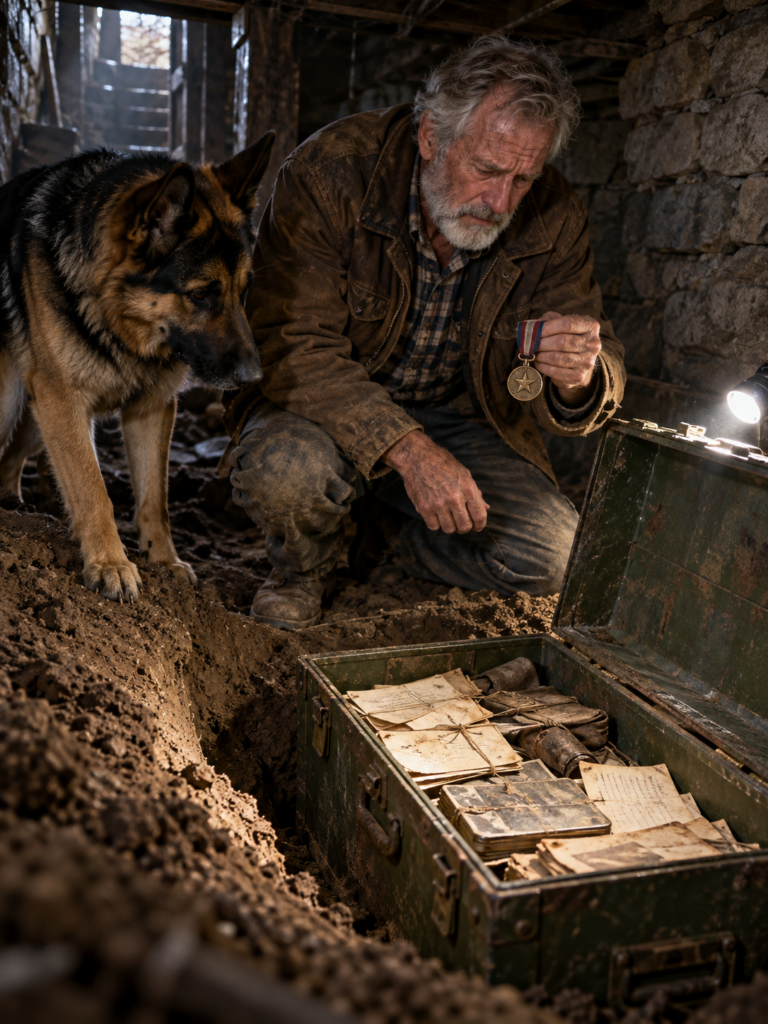
The flashlight beam settled across the opened letter, revealing lines of Margaret Walker’s careful handwriting.
Ethan read the first paragraph.
Then he read it again.
His grandmother had written about the church fund scandal—the one subject she had rarely discussed with him directly.
She knew how badly the accusations had damaged his life.
She also believed he had never been given the full truth.
Ethan’s throat tightened.
He sat back against the cold stone wall.
For thirty years, the official story had remained unchanged.
Money disappeared from the church’s community fund.
Pastor Raymond Caldwell discovered the shortage.
A withdrawal form supposedly carried Ethan’s signature.
And Caldwell identified Ethan as the man responsible.
Ethan had insisted the signature was not his.
He had been delivering supplies for a program assisting local veterans, not handling the church’s accounts.
But the congregation trusted Caldwell.
The pastor had been respected for years.
Ethan, meanwhile, was a recently returned soldier struggling with sleepless nights, anxiety, and memories of combat.
When Caldwell suggested that Ethan might have made a terrible mistake, people found it easier to believe the pastor.
Ethan remembered standing in the church office while council members avoided his eyes.
He remembered Caldwell placing the withdrawal form before him.
The writing looked similar to his.
Not identical.
But close enough that people dismissed his protests.
Eventually, Ethan stopped arguing.
He couldn’t make anyone listen.
Now Margaret’s letter suggested that someone else had questioned the records.
Ethan reached for the next envelope.
A different person had written it.
He recognized the signature at the bottom.
Clara Simmons.
The church secretary.
Ethan remembered her as a quiet woman who organized donation records and helped prepare church events.
She had left Pine Ridge Valley shortly after the scandal.
At the time, he hadn’t connected her departure to his accusation.
Her letter changed that.
Clara described overhearing Pastor Caldwell speaking with a bank employee about money moved out of the church fund.
According to her account, the missing money had not simply vanished.
It had been transferred.
She suspected Caldwell was concealing its destination.
Ethan stared at the page.
A letter describing an overheard conversation wasn’t proof of everything Clara believed.
But it directly contradicted the story Caldwell had told the congregation.
Ethan opened another envelope.
This one contained copies of church financial records.
Several transfers had been marked.
Beside them appeared Caldwell’s name.
Ethan compared the dates.
The suspicious activity began before the morning Caldwell claimed to have discovered the shortage.
That mattered.
If the transfers were genuine, the money trail had started earlier than the accusation against Ethan suggested.
“Lord Almighty,” Ethan whispered.
Atlas shifted closer.
Ethan laid the documents beside Margaret’s letter.
He forced himself to examine them carefully.
The record copies showed Caldwell’s authorization on transactions connected to the missing funds.
They didn’t yet establish who ultimately received the money.
But they weakened the explanation that Ethan alone had caused the shortage.
And they showed that Margaret hadn’t simply written down a suspicion.
She had preserved documents supporting it.
Ethan reached for the next paper.
An old newspaper clipping.
The headline concerned the local veteran accused in the church scandal.
He remembered seeing it thirty years earlier.
Margaret had circled a passage near the bottom.
It stated that Caldwell had discovered the shortage during an internal review and had gathered the information used against Ethan.
The same man now linked to suspicious transfers had controlled the initial explanation of the missing money.
Ethan’s hand tightened around the clipping.
For decades, he had thought an unfortunate misunderstanding ruined his name.
Now he had reason to consider something far more deliberate.
He picked up the remaining envelopes.
One was thicker than the others.
Its flap had been sealed with wax.
Across the front was a short instruction in Margaret’s handwriting.
It was intended to be opened if Ethan ever returned to the property.
He held it for a long moment.
Margaret had known her farmhouse might remain abandoned.
She had known Ethan might never find these papers.
Yet she had preserved them anyway.
He broke the wax carefully.
Inside was another letter.
Margaret acknowledged that she had remained silent partly because she feared Caldwell’s influence and what might happen if she challenged him.
She had never wanted Ethan to spend the rest of his life carrying an accusation she believed was false.
Ethan lowered the letter.
He felt anger.
But beneath it was a deeper hurt.
His grandmother had believed him.
She had gathered evidence.
And still, the truth had remained underground while he struggled alone.
Atlas placed his muzzle against Ethan’s knee.
Ethan rubbed the dog’s head, trying to steady himself.
Then he looked back toward the chest.
Something else lay beneath the cloth bundles.
A small leather notebook.
He opened it.
The pages contained dates, names, and notes in Margaret’s handwriting.
Again and again, one name appeared beside references to bank meetings and unexplained church transactions.
Raymond Caldwell.
Ethan turned another page.
An entry described Clara arriving at Margaret’s home, frightened by what she’d discovered.
The next entry mentioned a second account.
Ethan leaned closer.
The notebook pointed to evidence Margaret might have concealed separately.
And Atlas had already begun sniffing the dirt in another corner of the cellar.
Ethan closed the notebook, reached for the shovel, and followed the dog toward the second patch of disturbed ground.
Ethan pushed the shovel into the second patch of soil while Atlas stood close enough for his whiskers to brush the handle.
The first scoop brought up damp earth.
The next revealed looser dirt beneath.
Ethan stopped and examined it with his flashlight.
This section of the cellar floor had been disturbed at some point, then packed down again.
He dug more carefully.
The shovel struck wood.
Not the flat stones forming part of the old foundation.
Something rectangular.
He cleared the corners with his hands until he exposed a small wooden box.
It was much smaller than the military chest.
The lid had swollen slightly with age.
Ethan lifted it from the ground and set it beside the hole.
“All right, Atlas. Let’s see what Grandma was keeping separate.”
Inside lay a parcel wrapped in oilcloth.
The fabric had stiffened over the years, but it had protected the papers beneath.
Ethan unfolded the wrapping.
A bank transfer record lay on top.
He examined the date.
Thirty years earlier.
The period immediately surrounding the church scandal.
A second document carried a corresponding transaction.
Ethan compared the account information.
His breathing changed.
The first record showed money leaving the church fund.
The second identified the destination account.
The account holder was Raymond Caldwell.
Ethan read the name again.
He had been accused of taking money that the records now appeared to trace to the pastor who accused him.
“No,” he whispered.
He examined the dates, amounts, and authorizations.
Several transfers were connected.
The same account appeared repeatedly.
Caldwell’s name was attached to the receiving account and to the approvals.
This was stronger than Clara’s recollection.
Stronger than Margaret’s suspicion.
The documents formed a direct financial connection between the missing church funds and Caldwell himself.
Ethan reached for the next page.
Another transfer.
Another matching account.
He sat back slowly.
The basement seemed smaller now.
He remembered thirty years of people lowering their voices when he entered a store.
Thirty years of being passed over for work.
Thirty years of Daniel looking at him with an uncertainty that sometimes hurt more than open accusation.
He had lost his standing in Pine Ridge Valley long before the bank took his home.
And now an aging bank record suggested that the man everyone trusted had been responsible for the missing money.
Ethan felt no immediate triumph.
Only exhaustion.
“Grandma knew,” he murmured.
Atlas rested a paw near Ethan’s knee.
Ethan looked at Margaret’s notes again.
She had recorded conversations with Clara, references to Caldwell’s meetings with the bank, and her belief that Ethan had been chosen as a convenient person to blame.
One entry described Clara’s fear after questioning the pastor.
Another described Caldwell warning her against discussing the accounts.
Ethan couldn’t independently verify every conversation from what he held.
But the documents supported Clara’s central concern.
The money had moved into an account associated with Caldwell.
He gathered the bank records and placed them beside the first letter.
Then he compared the signatures with the old church withdrawal form described in the scandal.
Caldwell had claimed Ethan authorized the missing withdrawal.
Ethan remembered insisting that the signature was not his.
The documents now gave him a reason to believe the form had been part of a deliberate effort to conceal the actual transfers.
He could not prove every step from the cellar alone.
But he finally had something he’d never possessed when he was younger.
Evidence other people could examine.
For a long time, he remained on the dirt floor.
Atlas eventually settled beside him.
Outside, darkness had fallen over the ruined farmhouse.
The old cellar was cold.
Ethan’s knees ached.
He hadn’t eaten properly since leaving his house.
Still, he couldn’t bring himself to put the papers away.
He looked at the old Army medal.
Margaret had preserved that, too.
He remembered returning home from Iraq with more difficulty than he’d anticipated.
People praised his military service, but many struggled to understand what came afterward.
He could handle physical pain.
He knew how to follow orders.
What he hadn’t known was how to explain the fear that arrived without warning, or the fatigue of waking repeatedly from memories of explosions.
Volunteering at the church had given him a purpose.
He delivered supplies.
He helped organize assistance for struggling families.
He had wanted to remain useful.
Then Caldwell accused him of stealing from that very program.
The humiliation had been almost impossible to describe.
And gradually, Ethan had begun to wonder whether something about him made people unwilling to believe his word.
Margaret had apparently refused to accept that explanation.
She had continued searching for the truth.
That knowledge comforted him.
It also hurt.
He wished she’d trusted him enough to share what she had found.
He wished he could ask her why she buried the evidence instead.
But the letters gave him part of the answer.
She feared Caldwell.
She feared his influence over the church and the town.
And, after the farmhouse was destroyed, the evidence remained concealed in the surviving cellar.
Ethan couldn’t undo her silence.
He could decide what to do with the records.
He laid the papers in order and read each date once more.
Then he placed them carefully back into the military chest.
The leather notebook followed.
The bank records went between layers of cloth to protect their brittle edges.
Finally, he placed the bronze medal on top.
He closed the lid.
“Tomorrow,” he told Atlas, “we’re taking this into town.”
The dog wagged his tail.
Ethan spread his blanket on the cellar floor.
He had nowhere else to sleep.
For one night, the basement beneath his grandmother’s burned-down house would have to serve as shelter.
He leaned against the stone wall with Atlas beside him.
The cold gradually settled through his jacket.
His eyes closed.
Then a memory came.
A convoy road in Iraq.
Dust sweeping across the desert.
The thudding of helicopter blades.
A sudden explosion.
Ethan jerked awake, breathing hard.
The flashlight lay nearby, its beam pointing toward the ceiling.
Atlas was already pressing against him.
The dog leaned his weight gently into Ethan’s body.
Ethan placed both hands against the thick fur.
He focused on the cellar.
The stone wall.
The cold air.
The familiar pressure of Atlas resting beside him.
Gradually, the memory loosened.
“Good boy,” Ethan whispered.
Atlas remained there until his breathing steadied.
Eventually, Ethan slept again.
When morning came, a narrow band of sunlight entered through the cellar doors.
Ethan woke stiff and cold.
He drank the remaining water from his canteen and checked the chest.
Everything was where he’d left it.
He gathered his belongings.
Carrying the chest was awkward, but he refused to leave the papers unattended.
Atlas followed him up the steps.
For a moment, Ethan stood among the ruins.
He looked down at the cellar entrance.
The place Margaret had once called home was now little more than a stone foundation and blackened wood.
Yet it had held the strongest defense of his innocence for three decades.
He lowered the cellar doors behind him.
Then he started toward Pine Ridge Valley.
The walk back was slow.
The chest grew heavier with every mile.
Several times, Ethan stopped to rest.
Atlas waited beside him.
By the time the first buildings appeared beyond the trees, Ethan’s hands ached.
He could see the church steeple rising above the rooftops.
Sunday morning.
Cars were gathering for services.
The same congregation that had once accepted Caldwell’s accusations would soon be standing outside the church.
Ethan considered going somewhere private first.
He could have taken the records to the authorities without confronting the town.
That might have been easier.
But he remembered the day Caldwell accused him.
The pastor had presented his case before the church council.
The accusation had spread openly.
The shame had become public.
Ethan wanted the evidence heard by the same community that had accepted the story without allowing him a fair defense.
He continued down the main street.
People recognized him.
A woman outside the bakery stopped speaking.
A man beside a pickup watched him pass.
Ethan knew those expressions.
He’d seen them for thirty years.
But he didn’t lower his head.
Atlas walked beside him.
Near the church entrance, Pastor Raymond Caldwell was greeting the congregation.
Time had whitened the pastor’s hair.
His face had become lined.
But his manner remained assured.
He smiled at families, shook hands, and spoke with the practiced warmth Ethan remembered.
When Caldwell noticed him, the smile changed.
Only briefly.
Then the pastor approached.
“Ethan Walker. It’s been quite some time.”
Ethan set the military chest on the gravel.
“I need to speak to you.”
Caldwell glanced at the people nearby.
“Perhaps we should arrange another day.”
“No.”
Ethan’s answer was quiet.
“This concerns what happened to the church money thirty years ago.”
The pastor’s expression stiffened.
“That matter was settled long ago.”
“It was never settled for me.”
Several people stopped to listen.
Caldwell lowered his voice.
“Ethan, I understand you’ve been experiencing difficulties. We can discuss how the church might help.”
Ethan looked at him.
He recognized the tactic.
Thirty years earlier, Caldwell had made his accusations sound like concern for someone who had lost his way.
He was doing it again.
Ethan knelt and opened the chest.
Inside lay the letters and records Margaret had protected.
He lifted the first financial document.
“This shows where the church money went.”
Caldwell’s eyes dropped toward the paper.
Ethan saw his expression tighten.
“This isn’t the place,” the pastor said.
Ethan stood.
“It’s where you accused me.”
More congregants gathered.
The entrance became crowded.
Ethan held the document carefully so the nearest people could see it.
“The missing funds were transferred into an account connected to Raymond Caldwell.”
A murmur moved through the gathering.
Caldwell straightened.
“Old papers don’t establish anything without proper examination.”
“Then they should be examined,” Ethan replied.
He removed Clara Simmons’s letter.
“And so should this.”
At the mention of Clara’s name, several older residents looked toward him.
They remembered the secretary.
They remembered how suddenly she left town.
Ethan explained that she’d questioned the missing money and described Caldwell discussing transfers with a bank representative.
Then he opened Margaret’s notebook.
His grandmother had recorded the dates of relevant meetings and conversations.
The financial records supported the existence of transfers she had been investigating.
Caldwell’s face grew pale.
He challenged the reliability of the letters.
He suggested that old memories were easily distorted.
Then he referred to Ethan’s struggles after military service.
A familiar humiliation rose in Ethan’s chest.
For a moment, he was back in the church office thirty years earlier.
The same man.
The same carefully measured tone.
The same suggestion that Ethan’s difficulties made his account unreliable.
But this time, Ethan didn’t leave.
He took out the record identifying Caldwell’s account.
He held it beside the transfer information.
“Did the church money go into this account?”
Caldwell stared at the page.
Ethan continued.
“Was that account yours?”
The pastor looked toward the congregation.
For the first time, his reassuring smile had disappeared.
Ethan placed the documents on top of the chest.
He would not let Caldwell turn the question into a discussion of his military injuries.
He would not allow the conversation to become an argument about whether he was emotionally stable enough to remember the past.
There were numbers.
Dates.
Transfers.
And an account holder.
He looked directly at the pastor.
“Raymond, did you move that money and let everyone believe I stole it?”
The congregation fell silent.
Caldwell’s hands tightened.
And for the first time in thirty years, he could not answer Ethan by pointing to the withdrawal form.
Pastor Raymond Caldwell stared at Ethan Walker without speaking.
The silence lasted long enough for people near the church doors to begin exchanging uneasy glances.
Ethan stood beside the opened military chest.
Atlas remained close, alert but quiet.
Caldwell finally straightened his shoulders.
“These are serious allegations.”
Ethan nodded.
“They were serious when you made them against me.”
The pastor looked toward the gathered congregation.
“Documents from thirty years ago can be misunderstood.”
“Then explain them.”
Ethan lifted the record again.
He indicated the account information.
“Tell everyone why the missing church funds went into an account bearing your name.”
Caldwell’s mouth opened.
No answer came.
Ethan reached for Margaret’s notebook.
“My grandmother kept records of her conversations with Clara Simmons. Clara believed you were moving money and preparing to blame someone else.”
The pastor’s expression tightened.
“You cannot prove what someone thought three decades ago.”
“No,” Ethan said. “A letter alone can’t prove every conversation. That’s why I’m showing you the bank records.”
An older man near the church steps moved closer.
Others followed.
Ethan let them examine the documents without surrendering his hold on the chest.
He had spent the night reading them repeatedly.
He knew the difference between Margaret’s suspicions and the transfer records.
The first explained why she investigated.
The second provided something capable of being checked.
Caldwell watched the papers pass from one person’s view to another.
The people of Pine Ridge Valley had trusted him for decades.
Some had attended his church since childhood.
Others had asked him to perform weddings or funerals.
The idea that he might have deliberately accused an innocent man disturbed more than their understanding of an old financial scandal.
It challenged their judgment.
A woman near the front spoke.
“Raymond, is that your account?”
Caldwell looked at her.
He hesitated.
Ethan waited.
Then he opened one of Clara’s additional letters.
The document described her efforts to challenge the pastor after learning that the funds were being redirected.
She had written that Caldwell warned her against revealing the arrangement.
Ethan explained what the letter said.
He didn’t raise his voice.
He didn’t need to.
Clara’s account, Margaret’s notes, and the transfer records pointed toward the same explanation.
The missing money had been moved by someone with access and authority.
And Caldwell had used Ethan’s volunteer work to redirect suspicion.
The pastor tried one final objection.
“Ethan has spent years blaming me for what happened to his life.”
Ethan felt his face grow hot.
For thirty years, people had described his anger as evidence that he couldn’t be trusted.
Now the man responsible was using that history against him again.
Ethan looked toward the church building.
He remembered carrying boxes of donated supplies through those doors.
He remembered wanting to help veterans who were struggling to return to ordinary life.
And he remembered Caldwell calling him into the office after the missing funds were discovered.
The pastor had spread a withdrawal form across the desk.
A signature resembling Ethan’s appeared near the bottom.
Ethan had insisted it wasn’t his.
Caldwell told him the evidence was difficult to dispute.
The church council listened to the pastor.
Within days, people stopped speaking to Ethan.
The accusation became the version of events everyone repeated.
Now, standing outside the same church, Ethan understood the cruel simplicity of the plan.
Caldwell had moved church funds into an account under his control.
When questions arose, he pointed toward a volunteer whose signature could be imitated and whose personal struggles made him easier to discredit.
The town accepted the explanation.
And Ethan paid for it.
He returned his attention to Caldwell.
“You told them I stole from people I was trying to help.”
The pastor looked down.
Ethan continued.
“I lost work because of that accusation. I lost friends. My son grew up wondering whether his own father was telling the truth.”
His voice weakened briefly.
Atlas leaned against his leg.
Ethan rested one hand on the dog’s back.
Then he asked again.
“Did you knowingly blame me?”
Caldwell’s shoulders sank.
For the first time, he looked older than his years.
“When the shortage became impossible to explain,” he began, “I was afraid.”
Nobody interrupted.
“The church was struggling financially. I moved money I had no right to move.”
A low murmur spread through the congregation.
Caldwell closed his eyes for a moment.
“When people began asking questions, I needed an explanation.”
Ethan remained motionless.
The pastor finally looked at him.
“You were helping with the donation program. People knew you had access to the building.”
He swallowed.
“I allowed them to believe you were responsible.”
The confession fell over the churchyard with terrible quietness.
An elderly woman covered her mouth.
Someone near the back whispered in disbelief.
Ethan had imagined that moment countless times.
He’d pictured shouting.
Demanding an apology.
Listing every job he lost and every person who turned away.
But when Caldwell finally admitted what he’d done, Ethan felt something unexpected.
He was tired.
Not defeated.
Not helpless.
Simply tired of carrying a lie that should never have belonged to him.
“Why me?” he asked.
Caldwell’s eyes lowered.
“You were already struggling after your service. People found it easier to believe you had made a mistake.”
Ethan looked at the crowd.
He recognized several faces.
People who had watched him leave the church thirty years earlier.
People who had never asked whether he had been given an opportunity to defend himself.
They looked uncomfortable now.
Some appeared ashamed.
But Ethan understood that their shame did not restore the lost years.
A deputy named Cole Harris stepped forward from near the road.
He had been present as the gathering expanded.
After speaking briefly with Caldwell, he asked the pastor to accompany him to the station so the matter could be investigated formally.
Caldwell did not resist.
The deputy guided him toward the patrol vehicle.
Ethan watched them leave.
For thirty years, the pastor had stood at the entrance of that church as a trusted figure.
Now he was leaving beneath the gaze of the same people who had believed him.
But the sight brought Ethan no pleasure.
He looked down at the chest.
Margaret’s letters remained inside.
Clara’s warning.
The bank records.
The notebook documenting a grandmother’s attempts to protect her grandson.
The truth had been there for years.
Waiting beneath the cellar floor.
A woman approached cautiously.
Ethan recognized Mrs. Langley, who owned the town grocery store.
Her eyes were wet.
“I remember when they accused you,” she said.
Ethan nodded.
“I remember too.”
She lowered her head.
“We should have listened.”
Behind her, an older rancher removed his hat.
“I’m sorry, Ethan.”
Others began speaking.
Some offered apologies.
Some asked to examine the records.
A few stood silently, unable to meet his eyes.
Ethan listened.
He appreciated the words.
But he couldn’t pretend they erased the past.
He had lost friendships.
Opportunities.
His standing in the community.
And, over time, much of the closeness he’d once shared with his son.
An apology was not a replacement for those things.
Still, it mattered that people were finally questioning what they had accepted.
Ethan closed the chest.
As he bent to lift it, someone called from behind the gathering.
“Mr. Walker?”
A woman carrying a leather briefcase approached.
She introduced herself as Laura Bennett, an attorney from Denver.
A video of the confrontation had begun circulating, and she had come after learning what was happening.
She asked to speak with Ethan about the evidence.
Ethan regarded her cautiously.
He had spent decades feeling that official institutions were places where other people made decisions about his life.
Lawyers were not automatically comforting.
Laura noticed his hesitation.
“I’m not asking you to trust me immediately,” she said. “But these records deserve careful examination.”
Ethan looked at the chest.
“They ruined my name.”
“I understand that’s what you’re saying. The documents and testimony will need to be reviewed. But what happened here raises serious questions.”
Ethan thought of Margaret.
He wished she could have seen someone taking her work seriously.
Laura offered to help him pursue the matter through the legal system.
Before Ethan could answer, an angry voice interrupted.
A man pushed through the crowd.
Tommy Briggs, a local mechanic, approached unsteadily.
He had clearly been drinking.
He pointed toward Ethan.
“You think you can come back here and make everybody look bad?”
Several people urged Tommy to stop.
He continued toward Ethan.
“People have enough problems without you dragging up old trouble.”
Ethan stood still.
He had no desire for another confrontation.
“Go home, Tommy.”
Tommy stepped closer.
Atlas moved between them.
The German Shepherd’s posture changed.
His body became rigid.
A low warning growl sounded in his throat.
Ethan reached toward the collar.
“Easy, Atlas.”
But Tommy suddenly lunged forward.
Atlas reacted.
The dog jumped between the men, knocking Tommy backward.
Tommy fell onto the gravel.
Atlas landed awkwardly beside him.
Ethan heard a sharp yelp.
He immediately dropped to his knees.
Blood appeared along the German Shepherd’s front leg.
A jagged stone had cut him as he landed.
“Atlas.”
Ethan carefully examined the injury.
The cut was painful, but it did not appear deep.
Atlas remained still while Ethan applied pressure with a clean cloth offered by someone nearby.
The gathered people watched quietly.
The dog had placed himself between Ethan and another threat.
Just as he had done so many times before.
Ethan felt his throat tighten.
For years, Atlas had been the companion who never turned away when he struggled.
When sleep became difficult.
When memories returned.
When the world outside his house seemed hostile.
And now, on the very morning his innocence was finally acknowledged, the dog had been injured protecting him again.
Ethan rested his forehead gently against Atlas’s.
“You’re okay. I’ve got you.”
Atlas nudged his hand.
The tension in the churchyard changed.
The crowd’s attention moved away from Tommy and toward the veteran kneeling beside his dog.
Some people had known Ethan when he was young.
Some remembered the soldier who came home hoping to rebuild his life.
Others knew only the version of him described by the old accusation.
Now they watched him care for Atlas with quiet concentration.
There was nothing threatening about the man before them.
Nothing that justified the contempt he’d endured.
Mrs. Langley knelt nearby.
“Can we help?”
Ethan looked up.
For a moment, he didn’t know how to answer.
He had become accustomed to handling everything alone.
Then he nodded.
“Help me get him somewhere his leg can be checked.”
The offer was accepted immediately.
And for the first time in years, Ethan allowed people from Pine Ridge Valley to help him without assuming they would turn away.
The events of that Sunday led to months of investigation and legal proceedings.
Laura Bennett worked with Ethan to organize Margaret’s records, Clara Simmons’s correspondence, and the financial documents recovered from the cellar.
The bank transfers were examined.
Caldwell’s actions were investigated.
His confession became part of the larger body of evidence.
The original withdrawal documents were reconsidered in light of the records Margaret had preserved.
Eventually, the court determined that Raymond Caldwell had taken church funds and knowingly directed blame toward Ethan Walker.
The accusations that had haunted Ethan for thirty years were formally discredited.
News of the case spread beyond Pine Ridge Valley.
The town that once whispered about him began speaking his name differently.
But Ethan discovered that public vindication didn’t instantly repair private damage.
He still woke some nights with memories of Iraq.
He still experienced the familiar exhaustion of days when everything seemed difficult.
He still remembered the people who had ignored him when he needed help.
The court’s decision could correct a legal record.
It couldn’t give back thirty years.
Nor could it erase the hurt between him and Daniel.
That relationship would require something different.
Patience.
Conversation.
And a willingness to acknowledge what had been lost.
The resulting settlement helped Ethan secure a modest home.
He chose a small cabin on a hillside overlooking Pine Ridge Valley.
It belonged to an older rancher before him.
There was nothing extravagant about it.
The porch faced west.
A narrow driveway climbed toward the front steps.
From the rocking chair outside, Ethan could see the church steeple, the distant mountains, and the valley spreading between them.
It was quiet.
Warm.
And most importantly, it belonged to him.
Atlas recovered from the cut on his leg.
A faint scar remained beneath his thick fur, but he regained his strength.
Most mornings, he ran across the hillside before returning to sit beside Ethan.
Six months after Caldwell’s confession, Daniel came to visit.
He arrived without the clipped, impatient manner Ethan remembered from the day of the eviction.
For a while, father and son stood awkwardly on the porch.
Then Daniel spoke.
“I should’ve believed you.”
Ethan looked out across the valley.
He had imagined hearing those words for years.
But now they seemed too small to contain everything that had happened.
“You could’ve asked me,” Ethan said.
Daniel nodded.
“I know.”
Silence followed.
Then Daniel admitted that he had allowed the town’s judgment to influence his own.
He had seen his father’s difficulties after military service and confused those struggles with unreliability.
He had let the old accusation become an explanation for things he didn’t understand.
Ethan listened.
He wanted to forgive his son.
He also wanted Daniel to understand that trust could not simply return because the truth had become public.
“I didn’t need you to fix everything,” Ethan said. “I needed you to believe I wasn’t lying.”
Daniel lowered his head.
“I’m sorry.”
Ethan didn’t offer an immediate promise that everything would be as it had been.
Instead, he asked his son to sit.
They talked about ordinary things.
The weather.
The old pickup.
Daniel’s work.
And Lily, Ethan’s granddaughter.
It wasn’t a dramatic reconciliation.
It was a beginning.
Over the following months, Daniel returned.
Sometimes he stayed for coffee.
Sometimes he helped with small repairs around the cabin.
Gradually, the conversations became easier.
And eventually, Lily began visiting too.
One evening, nearly a year after Atlas uncovered the Army chest, Ethan sat on his porch watching the sunset.
The valley below glowed gold.
The last of the day’s warmth lingered on the wooden boards.
Atlas lay beside the rocking chair, his muzzle resting on his paws.
Ethan leaned forward and scratched behind the dog’s ears.
“Not a bad place we ended up with, is it?”
Atlas opened one eye.
His tail struck the porch once.
Ethan smiled.
He remembered the day the bank representatives stood outside his former house.
He remembered the expression on Daniel’s face.
The broken-down pickup.
The long walk through the mountains.
And the first glimpse of Margaret’s old farmhouse ruins.
At the time, he had believed he was walking toward the only shelter he could find.
He hadn’t expected to discover the evidence that would restore his name.
But what stayed with him most wasn’t the court decision.
It was the moment he lifted his lost military medal from the chest.
Margaret had preserved it.
While the town believed the worst about him, she had kept proof of the person he had been before the accusation.
And while he struggled through years of shame, she had tried to protect the truth, even if fear prevented her from revealing it during her lifetime.
Ethan understood her silence better now.
He still wished she’d trusted him with the documents sooner.
But he no longer doubted that she had believed him.
The screen door opened.
“Grandpa?”
Ethan turned.
Lily stood in the doorway holding a small wooden box.
She approached with an excited smile.
“I finished something.”
Ethan moved his coffee aside.
“Let’s see.”
She opened the box.
Inside was a little cloth pouch she’d sewn herself.
The stitches weren’t perfectly even.
One side was slightly crooked.
But she’d clearly worked hard on it.
“My teacher showed us how people used to make these,” Lily explained.
Ethan picked it up carefully.
“Your great-grandmother Margaret used to sew pouches like this.”
Lily’s eyes widened.
“Really?”
“She taught me when I wasn’t much older than you.”
Atlas rose and approached the box.
He sniffed the pouch.
Lily giggled.
“He has to inspect everything.”
Ethan laughed softly.
“That’s his job.”
Atlas settled beside her chair.
For several minutes, the three sat together watching evening spread across Pine Ridge Valley.
Then Lily looked toward her grandfather.
“Dad told me Atlas found the papers that proved you didn’t steal anything.”
Ethan nodded.
“He helped me find them.”
“Were they really buried under the floor?”
“Yes.”
“Why?”
Ethan thought about the question.
He could have explained Caldwell.
The church.
The bank records.
The decades of accusations.
But Lily was young, and he wanted her to understand the part that mattered most.
“Your great-grandmother knew something wasn’t right,” he said. “She kept the papers because she believed the truth was important.”
Lily looked at Atlas.
“And he found them?”
“He found where she’d hidden them.”
She wrapped her arms gently around the German Shepherd’s neck.
Atlas accepted the embrace with quiet patience.
Ethan watched them.
Thirty years earlier, he’d lost the trust of people he considered family.
A year earlier, he’d lost his home.
Now his granddaughter sat beside him, learning about a woman who had refused to forget the truth.
That mattered more than the settlement money.
More than the headlines.
More than finally seeing Caldwell held accountable.
Ethan had feared that the accusation would be the only thing people remembered about him.
But Lily knew him as Grandpa.
The man who told stories.
The man who taught her small things.
The man whose dog always inspected anything new she brought to the porch.
He looked toward the mountains.
Somewhere beyond the ridge lay Margaret’s ruined farmhouse.
Its cellar was no longer the hiding place of a secret.
The letters and records had been brought into the light.
The old Army medal had returned to Ethan.
And the accusations that once defined him had finally been disproved.
He reached down and rested his hand on Atlas’s head.
The dog looked up.
Ethan smiled.
“Thirty years is a long time to carry something that doesn’t belong to you.”
Lily looked at him.
“Are you happy now, Grandpa?”
Ethan considered the question.
He still missed people.
Still remembered difficult years.
Still had nights when sleep came slowly.
But the home behind him was his.
His son was trying to rebuild their relationship.
His granddaughter was laughing beside his old dog.
And for the first time in decades, he no longer felt compelled to defend himself whenever someone mentioned his name.
“Yes, sweetheart,” he answered. “I think I am.”
The wind chime beside the door sounded softly.
Atlas rested his head across Ethan’s boots.
And as the sun disappeared behind the Colorado mountains, Ethan Walker finally sat in the kind of peace his grandmother had always wanted him to find.
Not because the past had disappeared.
Because the truth had finally been allowed to stand in its place.


