
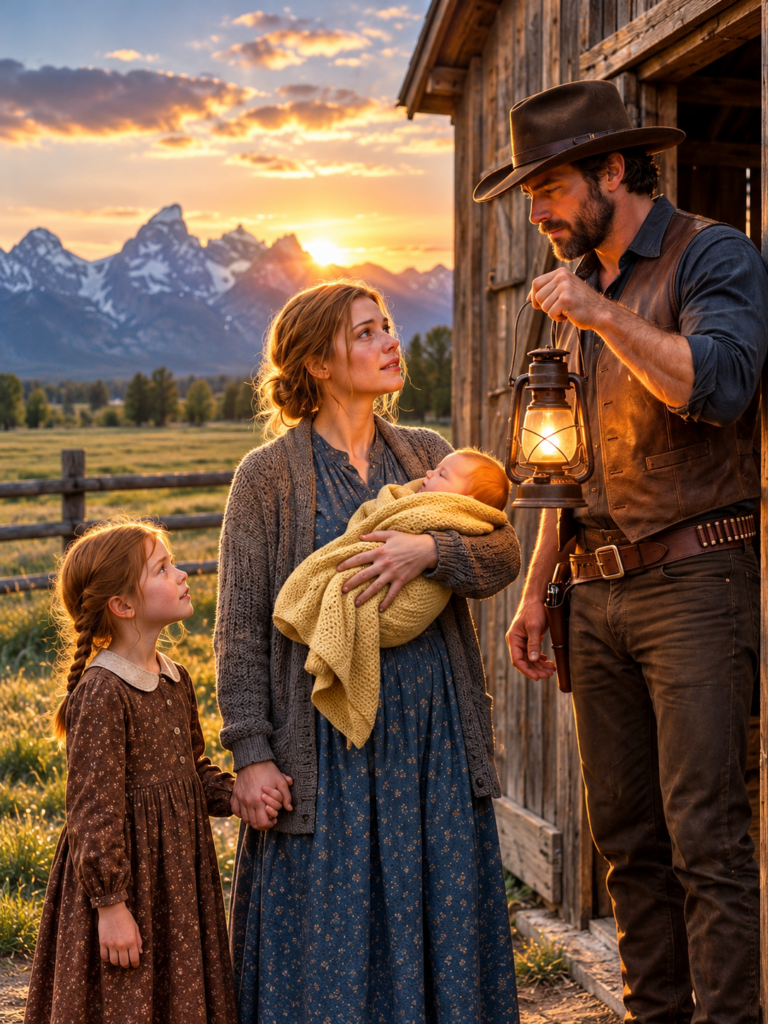
“May We Sleep in Your Barn?” the Widow Begged — He Said, “No, Ma’am…
“May we sleep in your barn, mister? Just till the rain stops.”
“No, ma’am. You’ll sleep in the house.”
“Does he bite, Mama?”
“Only on Sundays.”
“Five hundred dollars for the boy.”
“And the woman?”
“The woman doesn’t matter.”
Wade Harlan had not opened his door to anyone in three years.
That night he opened it to a stranger, a little girl, and a baby—and to the three men already on her trail.
Ellie Price had left Leadville four days earlier, in the back of a freight wagon, under a tarp that smelled of coal oil and wet canvas.
She had sixty-one cents, a Bible, a small pocket pistol that had belonged to her husband, and two children who had never once asked her where they were going.
On the fourth day, the teamster turned south and put them down at the crossroads.
After that, they walked.
The house had been quiet for three years. Quiet enough that Wade could hear the clock in the hall, and every board that creaked under a woman’s weight, and the small, wet breathing of a baby who had cried himself to sleep.
“There’s a bed upstairs. Clean sheets.”
“We’ll be gone before light, mister.”
“Harlan. And you’ll be gone when the rain’s gone. Not before.”
“Is this your house all by yourself?”
“It is now.”
She slept sitting up, between her children and the door.
Wade knew that kind of sleep. He had slept like that himself, a long time ago, in a country where the next knock on the door could be the last.
In Cedar Bluff, they said Wade Harlan had buried his heart on the hill behind his house.
He came to town once a month for flour and coffee and nails, paid in cash, tipped his hat to the ladies, and said nothing at all.
The ladies said he was rude.
The men said he was dangerous.
The children said he was a ghost.
None of them had ever been inside his gate.
“You didn’t have to do that. I don’t take charity, Mr. Harlan. I pay with what I have.”
“Then you’re a rich woman. Nobody’s cooked in that kitchen in three years.”
“Mister! There’s a baby bed up here! Whose is it?”
“Leave it be, Molly. Please.”
Her name had been Anna.
The boy had been called Daniel, after Wade’s father.
The fever came in the spring of ’78 and took them both in a single week.
Wade carved the cradle himself, the winter before the boy was born.
After the funeral, he carried it up to the loft, covered it with a feed sack, and never climbed that ladder again.
“She must have been very loved. Your wife.”
“Anna. She’d have had you dry and fed before you got through the door.”
“You didn’t make me ask.”
“I made you stand in the rain long enough to ask.”
“My husband would have liked you, Mr. Harlan.”
“Wade.”
Henry Vance had been nothing like his father.
He had married a schoolteacher’s daughter against the old man’s orders and worked his own shifts in his father’s mine to prove he could.
He wrote poems on the backs of assay slips and was teaching Molly her letters and was going to buy a little farm in the valley when the boy was old enough to ride.
Then, one Tuesday morning, a beam gave way four hundred feet underground.
The rain came and went for days, one storm after another rolling over the ridge.
And somewhere in those days, the house began to sound different.
A spoon against a pot.
A little girl’s boots on the stairs.
A baby who laughed when the rooster crowed.
Wade found his shirts mended without being asked, and the clock in the hall wound again, and a jar of wildflowers on a table where nothing had stood for three years.
“How come you never smile, Mister Wade?”
“Forgot how, I guess.”
“That’s all right. I’ll show you. It’s easy.”
He taught her to milk the brown cow and to tell a hawk from a buzzard by the way it held its wings.
She taught him the names of all four of her dolls, three of which she had left behind in Leadville.
He never asked why they had left in such a hurry.
Some questions, Wade knew, you only ask when you are ready to hear the answer.
On the fourth day, Wade hitched the wagon and drove them into Cedar Bluff.
The girl needed shoes.
The baby needed milk.
And Wade needed to know who sends three men through a storm after a widow with a baby.
“The small boots, please. I can pay half now, and the rest…”
“No credit to strangers, ma’am. Cash or nothing.”
“A widow, sleeping under a widower’s roof. In my day, we had a word for women like that.”
“Boots for the girl. A sack of flour. And whatever else the lady needs.”
“In my day, Mrs. Whitcomb, we had a word for women who walk forty miles through a storm to keep their children. We called them mothers.”
“Mama… he does bite.”
“Lily’s outgrown these. And don’t mind Edna Whitcomb. She said worse about me.”
They drove home with the sun going down behind the ridge.
Molly fell asleep in the back of the wagon with the new boots in her arms, still in their paper.
Ellie didn’t say a word for three miles.
Then, without looking at him, she said, “Nobody has stood up for me in a very long time, Wade.”
He didn’t answer.
He didn’t know how.
But he drove a little slower the rest of the way.
Five days earlier and two hundred miles away, in a study that smelled of cigars and silver polish, a man who had never in his life been told no was hearing it for the first time.
“She took the boy in the night, sir. And the girl.”
“Then send Pike. Bring me the boy. What happens to the woman is no concern of mine.”
“Wade. This came from Leadville yesterday. They say she stole her own son?”
“Papers say the court gave the boy to the old man. Papers say she’s unfit.”
“I’ve never seen papers that could tell me who a mother is, Wade.”
Lucius Vance owned half the silver in Leadville and every judge who mattered.
His only son, Henry, had died under a fallen beam in a shaft his father refused to brace.
Henry left behind a wife the old man never wanted, a daughter he never visited, and a son.
A boy was something Lucius Vance could use.
“Woman with a baby. Red hair. Little girl. Came through in the rain.”
“Lot of folks come through in the rain, mister.”
“Five hundred dollars says somebody remembers.”
“Try the Harlan place. The one with the lamp in the window.”
Edna Whitcomb would tell herself afterwards that she had only been doing her Christian duty.
Nobody in Cedar Bluff ever quite believed her.
“Henry Vance. Your husband.”
“His father wants Sam. Not me. Not Molly. He had a doctor sign a paper that says I’m not right in the head. There’s a place in Denver for women like that. They don’t come out.”
“So you walked. Forty miles.”
“Molly carried the bag the last ten.”
“You’re not walking out into the rain again, Ellie.”
“They’ll burn your house down to get him.”
“Then they’ll have to come through the gate first.”
He didn’t tell her what he had been before he was a rancher.
He didn’t tell her about the badge in the bottom of his trunk, or the name men in Texas still said quietly.
He only took the lantern from her hand and walked her back to the house.
Before Colorado, there had been Texas.
Eleven years with Company D of the Frontier Battalion, from the Rio Grande to the Staked Plains.
He had ridden after cattle thieves and murderers and men who burned homesteads for sport, and he had brought most of them back.
When Anna married him, she asked for one thing: that he put the badge away for good.
He had kept that promise for nine years.
He looked at it a long time that night.
Then he loaded the Colt and put the badge back in the trunk.
“And God bless Mama, and Sam, and Mister Wade, even though he doesn’t smile much. And please make the rain stop. But not too fast.”
The rain did not stop.
It came back harder the next afternoon, black clouds rolling over the ridge from the west.
And with it, down the valley road, came a closed buggy and three riders in long slickers.
Wade knew the man in the black hat by reputation.
In Texas, they called him Deacon because he liked to quote scripture.
Wade had put his younger brother in Huntsville prison in the summer of ’72.
A man like Deacon Pike did not forget a thing like that.
Neither did Wade.
Nobody in the Harlan house slept much that night.
Ellie sat by the window with the baby, watching the road.
Molly slept in her new boots because she said they might need to run.
And Wade sat on the porch with a rifle across his knees, the way he had sat outside a hundred camps on the Staked Plains, listening to the rain and waiting for morning.
“Thaddeus Greer, attorney for Mr. Lucius Vance. I have a court order for the child.”
“Harlan. Captain Wade Harlan. Company D. Texas Rangers.”
“That was a long time ago.”
“You sent my brother to Huntsville. He died there.”
“Then you know how this ends, Deacon.”
“Take Sam up to the loft. Don’t come down. Whatever you hear.”
“Drop it, Pike!”
“Signed April ninth. Judge Kittredge was buried April second. I was at the funeral.”
“Henry wrote this the night before he went down that shaft. He knew. My children are to remain with their mother. My father is not to raise them as he raised me.”
Within the month, Thaddeus Greer was disbarred in three states.
Deacon Pike went to Cañon City for twelve years.
And Lucius Vance, who had bought every judge in Lake County, found that a dead son’s letter was the one thing his money could not buy back.
In Cedar Bluff, the story went around the way stories do.
By Sunday, half the town had heard that Wade Harlan stood at his gate in the rain against three hired guns.
The other half had heard about the boots.
Mr. Hobbs sent a sack of sugar out to the ranch with his compliments and did not send a bill.
The storm blew itself out a little after midnight.
When the last rider was gone and the house was quiet again, Ellie fell asleep at the kitchen table, still holding Henry’s letter.
Wade put his coat around her shoulders and sat across from her until the window turned gray.
For the first time in three years, he did not want the night to end too fast.
“Wade… you don’t have to.”
“It’s waited long enough.”
“Mister Wade? Can we stay till the rain stops?”
“Rain’s stopped, Molly.”
“Stay anyway.”
They were married in June, in the little white church on Main Street, with Molly in her new boots throwing wildflowers at everyone, including the preacher.
Mrs. Whitcomb was not invited.
Nobody missed her.
And on stormy nights, from then on, the lamp in the Harlan window stayed lit till morning, in case anyone else came knocking.
Sam Harlan—he took Wade’s name the year he turned six—grew up to wear a silver star of his own.
People who knew him said he never once turned away a stranger at the door.
When they asked him why, he said his father had taught him.
And that his father had learned it one stormy night in the spring of 1881, from a woman, a little girl, and a baby who only asked to sleep in the barn.

