
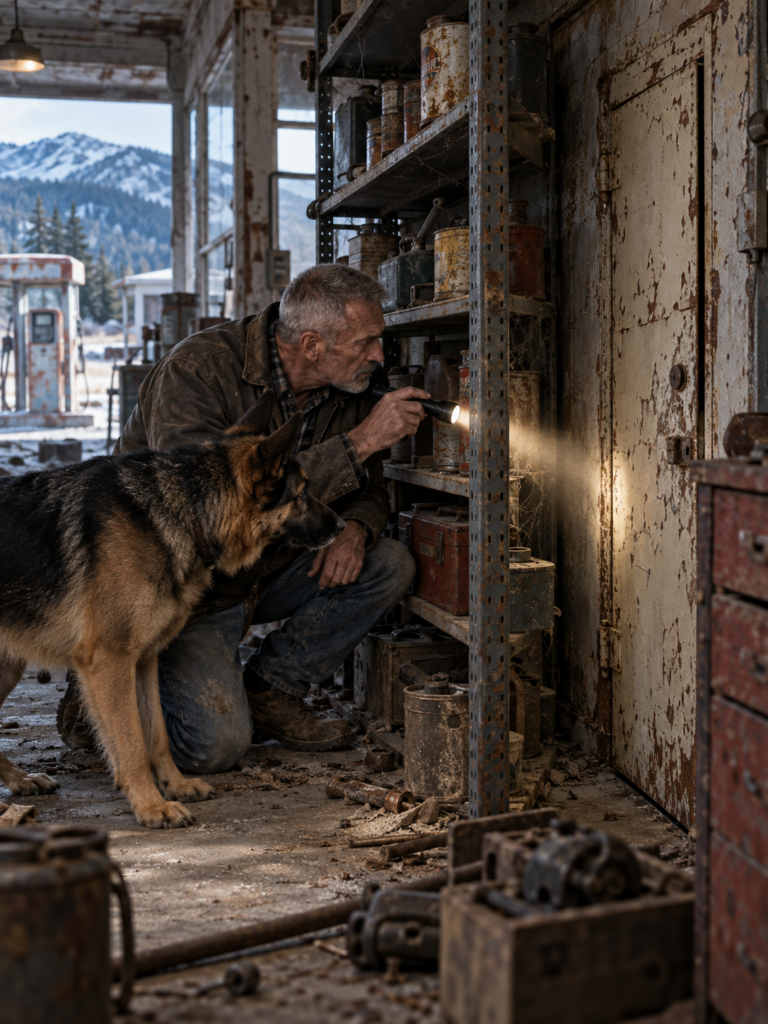
The oldest notebook opened across Dan’s knees, its pages stiff and yellowed beneath the flashlight.
Raymond’s handwriting filled the first entries.
Short sentences.
Dates.
Locations.
Descriptions of people who had needed help along the mountain roads.
Dan turned a page.
A family stranded by an alternator failure had spent the night at the station.
Another entry concerned a snowmobile accident near Granite Pass.
A third described a wildfire evacuation during which nine people and two dogs sheltered inside the building.
Dan looked up.
The gray blankets stacked along the wall suddenly seemed different.
So did the emergency food.
And the chair facing the hidden entrance.
His father hadn’t been storing supplies for himself.
He had been preparing for people who might arrive without warning.
Dan examined the keys hanging beside the map.
Miller.
Hayes.
Bennett.
Foster.
Reed.
Some names appeared in the notebooks.
Others didn’t.
He couldn’t tell whether the keys had opened homes, cabins, storage buildings, or equipment.
But the organization suggested Raymond had maintained a private system for assisting people throughout the valley.
Scout entered quietly and rested his muzzle against Dan’s knee.
Dan rubbed the dog’s head.
“Looks like your grandfather had another business.”
He opened a cardboard box beneath the desk.
Inside were receipts.
Fuel.
Batteries.
Vehicle repairs.
Groceries.
Some invoices were marked paid.
Others had amounts crossed out.
One concerned a costly transmission repair for a man who had recently lost his mill job.
Raymond’s handwritten note indicated he didn’t expect repayment.
Another recorded heating fuel delivered during bitter winter weather.
No charge.
Dan remembered arguing with his father as a teenager.
Raymond’s truck was always in need of repair.
The station never had enough money for improvements.
Dan had believed his father was a poor businessman.
Now he wondered whether Raymond had deliberately sacrificed profit to help people survive.
He placed the receipts beside the notebooks.
Then Scout sniffed another box.
Dan pulled it toward him and cut through the brittle packing tape.
A white envelope lay on top.
The return address was military.
Dan recognized his own handwriting.
He stopped.
It was a letter he’d sent from Afghanistan.
He remembered writing it beneath a dim lamp before another deployment movement.
He’d told Raymond not to worry if several weeks passed without contact.
Dan lifted the envelope.
Beneath it were more letters.
Fort Hood.
Germany.
Iraq.
Afghanistan.
Christmas cards.
Photographs.
Newspaper clippings.
His father had kept almost everything.
Dan sat motionless.
For years, he’d believed Raymond disapproved of his military career.
Their telephone conversations had been painfully ordinary.
His father never asked about missions.
Never asked about the fighting.
Never pressed Dan to describe the things he had witnessed.
Dan had interpreted that silence as indifference.
He opened a photograph showing himself in dress uniform.
Something was written on the back.
Raymond had wondered why Dan repeatedly returned to military service.
But he’d also written that he understood more than his son realized.
Dan read the note again.
The words didn’t erase the distance between them.
But they weakened a belief he’d carried for decades.
Perhaps Raymond hadn’t been unwilling to understand.
Perhaps he’d been afraid of asking questions that would cause Dan pain.
A low rumble of thunder crossed the mountains.
Dan’s muscles tightened.
For an instant, his mind returned to a battlefield.
Bright flashes.
Radio static.
A violent concussion.
He gripped the photograph.
Scout pushed his muzzle beneath Dan’s hand.
Dan focused on the dog’s fur.
The room slowly returned.
He set the photograph on the desk and flattened its bent corner.
“Thanks, buddy.”
He searched the box again.
Beneath the photographs lay a smaller notebook without a year on its cover.
Most entries concerned ordinary station maintenance.
Then Dan found his name.
Raymond had written about receiving a telephone call from his son.
Dan sounded exhausted, the entry said, although he insisted he was fine.
His father had wanted to ask what he’d experienced overseas.
He had hesitated because he didn’t know how to ask without making Dan relive it.
Dan closed the notebook.
He’d spent years angry at Raymond for never asking.
Now he had evidence that the silence came from uncertainty and concern.
Scout lay across his boots.
Dan looked around the room.
The blankets.
The radio.
The keys.
The emergency ledgers.
The letters.
This wasn’t a room created to conceal wrongdoing.
It was a place where Raymond had preserved the work he performed when the road became dangerous.
A place where he could monitor emergencies, store supplies, and shelter people without making them feel indebted.
Dan reached for another ledger.
One entry documented help provided to a family named Hayes during a winter rescue.
The same surname appeared on a key hanging near the map.
That connection was worth investigating.
He had arrived planning to sell the station.
Now he wanted to know whether the people named in these notebooks remembered Raymond’s work.
And whether the service his father provided could still matter.
He returned the notebooks to their shelf, carried one to the front counter, and opened Raymond’s yellow legal pad.
The building needed a roof.
Water.
Reliable electricity.
A usable repair bay.
And a road that could be kept accessible during storms.
Dan wrote down the repairs.
Then he reached for his father’s old wrench set.
He would give the station thirty days before deciding whether to sell it.
He picked up the first wrench and started toward the repair bay.
Dan carried the wrench into the repair bay and stopped beneath the damaged section of roof.
Rain had entered through a gap near the rear corner.
The concrete was stained.
An old workbench stood beneath the leak.
Raymond would have hated the condition of the place.
Dan studied the roofline and began working out what could be repaired with the tools and materials already available.
He gave himself thirty days.
Not a lifetime commitment.
Not a promise to become his father.
Just thirty days to determine whether Carter’s Mountain Service still had a purpose.
The first week hurt.
Dan hadn’t worked this hard with tools in years.
His knuckles split.
His back ached.
Old muscles complained whenever he climbed the ladder.
But the repairs progressed.
He patched the worst roof leaks, restored water to the upstairs apartment, cleaned the electrical connections, and cleared the drainage ditch behind the station.
Scout followed him everywhere.
When Dan worked on the roof, the dog watched from below.
When he repaired the plumbing, Scout settled outside the bathroom doorway.
Every evening, Dan returned the tools to their outlined places on Raymond’s pegboard.
The small ritual became unexpectedly comforting.
On the eighth morning, a county ambulance turned into the lot.
Dan was repairing a gutter.
Scout noticed the vehicle before he did.
A woman wearing a paramedic jacket stepped out.
She introduced herself as Maggie Hayes.
The surname was familiar.
Dan had seen it in Raymond’s notebooks.
And on a key hanging in the hidden room.
“You’re Raymond Carter’s son,” she said.
“Dan.”
Maggie looked toward the station.
“I wondered whether someone would ever reopen this place.”
Dan climbed down from the ladder.
“You knew my father?”
“Everybody in emergency services around here knew Raymond.”
She explained that his father had maintained radio equipment capable of receiving communications that sometimes failed to reach dispatch centers in poor mountain conditions.
During storms, he relayed information.
When travelers broke down, he helped them.
When emergencies developed near remote logging roads, he sometimes provided the only reliable connection between stranded people and rescuers.
Maggie remembered a snowmobile accident years earlier.
Raymond had kept relaying information when normal communications became unreliable.
Dan remembered the corresponding ledger entry.
He had assumed the writing described an occasional favor.
Maggie’s account established something more.
His father had been a dependable part of the region’s informal emergency network.
Before leaving, she gave Dan an old county radio-frequency list.
Winter was approaching.
The roads would become difficult again.
Dan said he wasn’t planning to operate an emergency station.
Maggie looked at the repair bay.
“Neither was your father, at least officially.”
Two days later, an aging blue pickup entered the lot trailing steam.
Its young driver opened the hood and examined the engine.
Dan approached.
The man suspected a failed water pump.
His name was Luke Bennett.
He’d recently lost his maintenance job when the ranch employing him was sold for redevelopment.
Dan let him use the repair bay.
Luke handled the tools carefully.
He asked sensible questions and didn’t pretend to know more than he did.
By afternoon, they’d removed the failed pump.
Raymond’s old parts inventory contained a compatible replacement.
Luke asked what he owed.
Dan glanced toward the second bay, still cluttered with old tires and rusted equipment.
“Help me clear that tomorrow.”
Luke stared at him.
“That’ll take longer than this repair.”
“Probably.”
Luke returned the next morning.
And the morning after that.
By the fourth day, Dan offered him part-time work.
The arrangement was modest.
The station couldn’t guarantee him a long-term salary.
But Luke accepted.
Together, they restored the second bay.
Repairs began coming in.
A rancher needed a tire patched.
Another driver had a battery problem.
Maggie stopped with emergency supplies.
An older couple brought food because Raymond had once helped them during a snowstorm.
Dan began to notice something peculiar.
People weren’t merely interested in the reopened station.
They remembered his father.
And some were determined to repay kindnesses Raymond had never recorded as debts.
Late one afternoon, Dan and Luke repaired the roadside sign.
They replaced its rotten support and repaired the electrical connection.
When the warm light finally illuminated Carter’s Mountain Service, Dan stood quietly in the gravel.
For years, that sign had guided travelers toward fuel, repairs, shelter, and help.
Now it was visible from the road again.
Scout walked beside him.
Then the dog stopped.
His ears turned toward the rear of the property.
Dan followed him to the drainage ditch.
A fresh orange survey stake stood near a young pine.
Farther into the trees, more orange markers continued toward an old logging road.
Dan frowned.
He hadn’t authorized a survey.
And the markers didn’t appear to follow his property boundary.
He checked with the relevant county offices.
Neither reported an active survey associated with his station.
Dan kept the stake and documented the locations.
He wasn’t ready to accuse anyone of wrongdoing.
But he wanted to know who had been working behind his building.
Before he could find out, a winter storm struck the valley.
Snow moved sideways across Route 82.
Visibility collapsed.
Maggie’s ambulance arrived carrying news that a seventeen-year-old hunter had become separated from his uncle above Granite Pass.
Search teams were preparing to enter the area.
Radio communication was poor.
The station’s position on the ridge offered an important advantage.
Within minutes, maps covered Raymond’s old counter.
Volunteers arrived with equipment.
The radio began carrying location reports.
Dan initially concentrated on practical tasks.
Coffee.
Vehicle checks.
Tire chains.
Anything that let him help without joining the search itself.
Then Maggie pointed toward the missing teenager’s last reported position.
Dan studied the contours.
A steep drainage descended from the trail into sheltered timber.
If the teenager had tried moving away from the wind, he might have followed that natural route downhill.
Maggie considered the map.
Then she asked Dan to accompany the search party.
Dan hesitated.
The radios, darkness, and moving lights reminded him too strongly of Afghanistan.
But Scout was already standing beside the door.
Eventually, Dan agreed.
They climbed into the storm with Maggie and two volunteers.
Scout worked on a long lead.
He repeatedly stopped to examine scent along the trail.
The search moved toward the drainage Dan had identified.
Then, near a steep slope, Scout suddenly lunged sideways.
His shoulder struck Dan’s knees.
Dan fell backward.
The ground where he’d been about to step collapsed.
Snow and loose shale poured into a ravine.
Scout slipped over the edge.
Dan caught the lead.
The strain nearly dragged him forward.
Maggie and another rescuer helped secure him.
Scout had landed against a root below.
His right foreleg was bleeding.
Dan descended carefully and examined the injury.
A sharp rock had cut the leg deeply.
He applied pressure and wrapped it.
Then he noticed Scout staring downhill.
Near a cedar lay an orange hunting glove.
The searchers followed the remaining tracks into a protected hollow.
There, beneath a fallen tree, they found the missing teenager.
He was alive.
Cold.
Barely conscious.
His ankle was trapped among branches.
Maggie immediately began treating him.
Dan remained beside Scout.
The dog’s injured leg trembled when he tried to stand.
For a moment, Dan remembered Eric Morales, a young soldier he had lost overseas.
Another damaged vehicle.
Another desperate effort to reach someone before it was too late.
He looked toward the rescued teenager.
This time, they had reached him.
Dan lifted Scout into his arms.
The nearly eighty-pound dog rested his head against his shoulder as Dan carried him uphill.
At the veterinary clinic in Enterprise, Scout received eleven stitches.
The injury had missed bone and tendon.
He would recover, but he needed rest.
Dan carried him upstairs when they returned to the station.
For three days, he focused on medication, clean bandages, and keeping the dog from trying to resume patrols.
Scout disliked the protective cone fitted around his neck.
Dan found the dog’s offended expression almost enough to make him laugh.
With physical work temporarily limited, he returned to Raymond’s notebooks.
He discovered entries that went far beyond roadside assistance.
His father had helped families with heating bills.
Repaired vehicles without charging.
Delivered supplies.
And sometimes quietly paid expenses people were too proud to accept as charity.
One entry concerned a woman named Clara Bennett.
Raymond had anonymously contributed $3,200 toward a heart-valve operation in 1994.
Dan stared at the name.
When Luke arrived with breakfast, he asked whether Bennett was a common surname in the valley.
Luke read the ledger entry.
Then he stopped.
Clara Bennett had been his grandmother.
She underwent heart surgery when Luke’s mother was nine.
The family had never known who paid the money insurance wouldn’t cover.
Luke sat silently.
He remembered his grandmother speaking about the unexpected assistance years afterward.
Raymond had kept his involvement secret.
Dan watched Luke return to the repair bay.
The young man stood before Raymond’s pegboard, looking at the tools he’d been using for weeks.
Neither of them had known the connection when Luke arrived with his broken truck.
Raymond’s kindness had reached forward through decades.
It had helped preserve a family.
And now a younger member of that family was helping restore Raymond’s station.
Dan looked around the hidden room with a changed understanding.
It wasn’t simply an emergency storage space.
It was a record of the lives his father had affected.
The realization made selling the property more difficult to imagine.
Then a black SUV entered the lot.
Its driver introduced himself as Grant Holloway of Summit Crest Development.
He wanted to purchase Carter’s Mountain Service.
The amount offered was far above what Dan believed the deteriorating commercial property was worth.
Holloway described plans for a luxury wilderness development.
Dan asked which part of his fourteen acres interested the company.
Holloway’s attention moved almost involuntarily toward the logging road behind the station.
Dan noticed.
So did Scout.
Dan refused the offer.
Four days later, a certified environmental notice arrived.
It raised concerns about historical petroleum contamination and possible buried storage tanks.
The estimated cleanup costs threatened to overwhelm Dan financially.
He studied the map accompanying the complaint.
Two suspected tank locations were near the abandoned pumps.
A third lay behind the repair bay.
That location bothered him.
As a teenager, he’d helped Raymond install the drainage system there.
He remembered the excavation.
He remembered the gravel.
He remembered the perforated pipe.
He didn’t remember a fuel tank.
Dan put three objects on the counter.
Holloway’s purchase offer.
The environmental complaint.
The orange survey stake.
The timing was suspicious.
But timing wasn’t proof.
He began documenting what he could establish.
The survey markers led toward the upper valley.
The development company had offered an unusually high price.
The complaint relied on information that might be outdated or incomplete.
And the disputed location appeared to contain drainage infrastructure rather than an underground tank.
Then one night, Scout woke him.
Someone was moving downstairs.
Dan descended cautiously.
A flashlight beam moved through the repair bay.
He found a masked intruder searching Raymond’s hidden room.
The man fled.
During the escape, a heavy shelving unit began falling toward Dan.
Scout knocked him aside.
The steel crashed down.
Then the intruder kicked the German Shepherd hard enough to leave him struggling for breath.
Dan reached the rear door.
He could have pursued the man.
Instead, he heard Scout behind him.
He turned back.
He chose the dog.
The intruder escaped with an old survey tube and a property ledger.
Scout required emergency veterinary treatment for bruised ribs and severe soft-tissue trauma.
The sheriff began investigating.
Dan returned to the station shaken.
For the first time, he considered accepting Holloway’s offer simply to escape the danger.
Then Scout, still recovering, began sniffing beneath an old steel cabinet in Raymond’s hidden room.
Dan noticed a rectangular seam in the concrete.
With Luke’s help, he moved the cabinet.
A recessed hatch lay beneath it.
The opening led to a shallow utility crawl space.
Inside, a waterproof construction box rested near the foundation.
Dan opened it.
There were inspection records.
Removal photographs.
Environmental reports.
A survey map.
And documents establishing a permanent public emergency access easement across the property.
Dan examined the records.
Two gasoline tanks and one diesel tank had been removed under permit in 1997.
The excavation was documented.
The county had acknowledged the closure.
Photographs showed the rear drainage trench where the complaint suggested another tank might exist.
No tank appeared there.
Dan unfolded the old survey.
A line crossed the property from the highway to the logging road and continued toward the upper valley.
It matched the route indicated by the orange survey stakes.
The documents showed that the Carter family had granted public emergency access along that corridor decades earlier.
Holloway’s development plan depended on a route that could not simply be converted into exclusive private resort access without addressing the existing easement.
Dan looked at Luke.
Now they understood why the road mattered.
The gas station was not the real prize.
The access corridor was.
And Raymond had preserved the documents that could establish its history.
Dan carefully gathered the records, made copies, and began preparing to challenge the environmental allegations and protect the access route.
The old hidden room had revealed his father’s private acts of service.
The box beneath its floor had revealed how that service had become part of the property’s legal history.
But the strongest test of Raymond’s legacy was still ahead.
Someone with money and influence wanted the road.
Dan had evidence.
What he needed now was people qualified to examine it and stand beside him.
Dan spread the recovered records across Raymond’s old counter and studied the problem as he had once studied bridge inspections and heavy-equipment reports.
What did the documents establish?
What remained uncertain?
And which conclusions could survive independent scrutiny?
He refused to treat the environmental complaint as fraudulent merely because its arrival followed Holloway’s failed purchase offer.
He also refused to accept its claims simply because they arrived on official paper.
The first task was to determine whether Raymond’s tank-closure records were genuine and whether the ground still presented an environmental concern.
The second was to verify the public access easement.
The third was to understand whether the break-in related to the documents the intruder had taken.
Dan couldn’t do all three alone.
Fortunately, Raymond’s notebooks offered more than a record of old emergencies.
They gave Dan names of people who remembered the station.
And some of those people possessed exactly the expertise he needed.
Susan Parker was an environmental specialist whose family had once received help from Raymond.
Years earlier, her younger brother had experienced a medical emergency during a blizzard.
Raymond had driven through dangerous conditions to assist them.
Susan remembered.
When Dan showed her the old closure reports and the new contamination complaint, she examined the dates carefully.
The complaint appeared to rely on information predating Raymond’s documented tank removal.
That didn’t automatically prove the property was free of contamination.
But it meant the current allegations required additional verification.
Susan offered to inspect the property.
Dan told her he couldn’t afford much.
She reminded him that his father had never sent her family a bill.
Susan’s investigation examined the historical records, mapped locations, and available soil conditions.
Her findings supported the earlier closure documentation.
She found no petroleum contamination above the relevant screening levels in the areas identified by the complaint.
The location behind the repair bay was consistent with the drainage system Dan remembered, not an undocumented fuel tank.
That evidence mattered.
It directly challenged the factual basis for the proposed cleanup requirements.
The next person Dan contacted was Thomas Reed, a semi-retired property attorney.
Thomas’s father had operated a logging business.
A wildfire years earlier had damaged equipment and threatened the company’s survival.
Raymond had continued supplying fuel on credit when the business couldn’t pay.
Thomas had never understood the full extent of that help.
Dan showed him the corresponding ledger entry.
Thomas sat quietly for a moment.
Then he examined the recovered deed and access documents.
The easement language was important.
It described public emergency access along a route crossing Carter land toward isolated properties and forest roads.
The agreement had existed long before Summit Crest Development began acquiring property in the upper valley.
Dan asked whether Holloway could simply purchase the station and close the route.
Thomas explained that acquisition would not, by itself, eliminate a valid recorded easement.
Its precise legal effect required review, but the old documents gave them a strong basis for protecting public access.
Dan looked at the attorney.
“How much is this going to cost me?”
Thomas closed his file.
He considered Raymond’s years of helping his father’s business.
Then he offered to assist without charging Dan.
For once, Dan had no quick response.
He had arrived in Oregon believing his father left him a worthless station.
Now people he’d never met were offering help because Raymond had once helped them.
Dan was beginning to understand why so many receipts in the hidden room contained crossed-out amounts.
Raymond hadn’t been careless about money.
He had understood that some needs mattered more than immediate payment.
He had also understood that helping someone privately could preserve their dignity.
Those decisions had cost him.
The station had never become prosperous.
The building deteriorated.
Raymond’s own truck often needed repairs.
Dan had watched all of it as a younger man and mistaken sacrifice for incompetence.
Now that interpretation seemed painfully incomplete.
He thought of his father standing behind the counter.
How many people had passed through without Dan knowing their stories?
How many nights had Raymond remained awake beside the radio?
How often had he supplied fuel or shelter without asking for recognition?
And why had he never told his son?
Dan returned to the hidden room one evening and sat in the worn chair.
Scout lay beside him.
The dog was recovering, though he still moved carefully because of his bruised ribs and the earlier injury to his foreleg.
Dan looked toward the concealed doorway.
He understood the room’s physical purpose.
The space stored supplies, protected records, and provided a place for organizing emergency responses.
But Raymond’s secrecy had also been personal.
He hadn’t wanted everyone who received assistance to feel they owed him.
That explained the private ledgers.
It explained the anonymous medical contribution.
And it explained why he had never boasted about the people he helped.
Dan remembered their arguments.
He remembered insisting that Raymond should charge customers properly.
He remembered suggesting that the old station was a failed business.
His father rarely argued.
Sometimes he merely returned to work.
Dan leaned forward and rested his hands against the desk.
“I didn’t understand, Dad.”
Scout raised his head.
Dan looked down.
“Guess that’s becoming a habit.”
The dog moved closer.
Outside, a truck passed on the mountain road.
Its headlights traveled across the front windows.
Dan watched the light disappear.
For the first time, he wondered whether Raymond had been waiting in that chair for people who needed help rather than simply waiting for someone to enter the hidden room.
The orientation of the chair had bothered him since the discovery.
It faced the concealed door.
Now the arrangement made sense.
From there, Raymond could hear activity inside the station while remaining near the radios and supplies.
He had kept himself ready.
Not for enemies.
For emergencies.
The discovery gave Dan a different understanding of his father’s silence.
Raymond had spent years watching mountain roads.
Perhaps he had recognized something similar in his son’s military service.
Both men had chosen work that required them to remain alert for other people’s needs.
Both had learned that some nights demanded action without warning.
But neither had known how to explain that experience to the other.
Dan wished he could ask Raymond about it now.
He couldn’t.
He could only decide what to do with the station.
As the preparations for the county hearing continued, Dan received another unexpected visitor.
His daughter, Rachel Carter, arrived after months of limited contact.
She stepped from her SUV looking concerned.
Laura had told her that Dan was living in an abandoned gas station, barely sleeping, and involved in a dispute with a development company.
Rachel had also heard about the break-in and Scout’s injuries.
Dan couldn’t deny those facts.
But the picture they created was incomplete.
He brought her inside.
The station was warm.
Coffee stood beside the register.
Luke was working on a ranch truck.
A couple sat near the window.
The repair bay was active.
Scout lay beneath the counter.
Rachel looked around.
“This is the abandoned gas station?”
“It was.”
She noticed the hidden room.
Dan showed her the shelves, radios, notebooks, and the records Raymond had preserved.
Then he explained the development dispute.
Rachel listened.
At first, she appeared uncertain.
She knew her father’s difficulties after military service.
She understood that sudden noises still troubled him.
She also knew how much the divorce had hurt.
But as Dan spoke, she saw the difference between a man struggling and a man incapable of making decisions.
He was tired.
He was anxious at times.
He sometimes slept badly.
He was also rebuilding a business, helping maintain mountain access, and carefully documenting a property dispute.
When Rachel asked whether he was having a breakdown, Dan answered without pretending everything was perfect.
He still had difficult nights.
Sometimes he checked the doors repeatedly.
But he had also hired Luke, helped rescue a teenager, and organized expert assistance to challenge the environmental complaint.
Rachel studied him.
Then she looked at the maps.
She compared Holloway’s proposed development route with Raymond’s easement survey.
After several minutes, she removed her coat.
“Where do you need me?”
Dan looked at her.
For months, he’d assumed she would keep her distance.
Now she was offering to help.
He felt an emotion he hadn’t expected.
Relief.
Rachel joined the preparation.
Susan continued organizing environmental evidence.
Thomas assembled the property documents.
Maggie prepared an account of the winter rescue and the practical importance of the access corridor.
Luke maintained the station and preserved the photographs and camera information connected to the suspicious survey activity.
Dan reviewed everything.
He wanted the hearing to focus on facts.
The environmental allegations.
The tank closures.
The access easement.
The actual use of the route.
He couldn’t prove Holloway personally ordered the break-in.
He wouldn’t make that claim without evidence.
But the attempted theft remained under investigation, and the documents taken were directly relevant to the dispute.
On the morning of the hearing, Dan arrived with Rachel, Thomas, and Scout.
The German Shepherd’s injury had improved enough for him to accompany Dan quietly.
The county hearing room was full.
Holloway sat with attorneys and a consultant.
Dan chose a seat near the aisle.
He noticed that he preferred having a wall behind him and a clear view of the entrance.
Old habits.
Rachel noticed too.
Neither mentioned it.
Thomas leaned toward Dan.
He reminded him that they didn’t need to prove every possible motive.
They needed to establish the records and address the county’s decision.
Dan nodded.
He understood that.
The hearing began with arguments about the station’s condition.
Holloway’s representatives described it as a long-abandoned fuel facility with unresolved environmental concerns.
Then one attorney referred to Dan’s military history and his difficulties adjusting after service.
Rachel stiffened.
Dan felt his jaw tighten.
The implication was familiar.
He had spent years watching people confuse combat-related symptoms with incompetence.
Thomas objected.
Dan’s military history did not determine whether underground fuel tanks existed.
The county officials agreed that the focus should remain on relevant evidence.
Susan presented the historical tank-closure records.
The photographs showed two gasoline tanks and one diesel tank removed in 1997.
The reports documented inspection and closure.
The disputed area behind the repair bay appeared in photographs as a drainage installation.
Susan’s modern sampling results found no petroleum contamination above applicable screening levels in the areas identified by the complaint.
The distinction was clear.
The environmental notice relied on suspected conditions.
The older records and modern examination supplied evidence directly addressing those suspicions.
Next came the property documents.
Thomas placed the old Carter deed beside the recorded easement information.
The route ran from the highway, past the station, and toward the upper valley.
It had been established for public emergency access.
Summit Crest’s proposed acquisition plans overlapped with that corridor.
The maps were presented together.
Dan watched county officials study them.
For weeks, he’d been looking at orange survey stakes and wondering why a developer wanted a deteriorating gas station so badly.
Now the route’s importance was visible.
Maggie testified about the winter rescue.
She described the communication difficulties during the storm.
The missing teenager.
The station’s role as a command point.
The volunteers and equipment that passed through.
And the access road used during the operation.
The easement wasn’t merely a historical technicality.
The route still served an actual emergency purpose.
Dan listened.
He remembered carrying Scout down the mountain after the dog was injured.
He remembered the teenager alive beneath the fallen tree.
He remembered Raymond’s old radio and the maps covering the counter.
Everything connected.
The station’s history and its present use were not separate stories.
They were different chapters of the same purpose.
Then a binder fell from a clerk’s table.
It struck the floor with a sharp report.
Dan’s body reacted instantly.
His hand moved beneath the table.
His shoulders tightened.
For a fraction of a second, the hearing room seemed distant.
A battlefield memory returned.
Scout pressed his muzzle against Dan’s leg.
Dan reached down and felt the familiar collar.
He focused on the dog’s breathing.
The chair beneath him.
The floor.
The fluorescent lights.
Rachel watched quietly.
She did not interrupt.
After several seconds, Dan straightened.
Across the room, Holloway had noticed.
Dan met his eyes.
He remained seated.
The hearing continued.
Shortly afterward, a sheriff’s investigator entered and spoke privately with Thomas.
A vehicle connected to the break-in investigation had been recovered.
Investigators identified a subcontractor associated with work performed for a company hired by Summit Crest.
Electronic records and other evidence connected the suspected intruder to the acquisition project.
The information strengthened the investigation.
But it did not establish that Holloway had personally ordered the crime.
Dan appreciated that distinction.
He wanted the truth.
Not a convenient accusation.
When the hearing resumed, Thomas informed the county that law enforcement was investigating the theft of property and environmental records relevant to the dispute.
The officials considered the evidence.
Dan waited with Scout beside his chair.
Rachel sat nearby.
Luke and Maggie remained in the room.
For years, Dan had believed he needed to handle difficult things alone.
Now he looked around and saw the people who had come because they cared about the station.
Some had known Raymond.
Some had only recently met Dan.
All understood that the road mattered.
Eventually, the county officials returned.
Their findings addressed the immediate dispute.
The remediation order was rejected pending any new credible environmental evidence.
Raymond’s tank-closure records were accepted into the property file.
The public emergency access easement remained valid.
And Summit Crest could not proceed with its proposed action affecting the corridor without the required county review.
The requested action was denied.
Dan didn’t cheer.
He simply rested his hand on Scout’s back.
The station was not threatened by the immediate claims.
The public route remained protected.
And his father’s records had played a decisive part in establishing the facts.
Holloway gathered his documents and left.
The investigation into the break-in remained a separate matter.
Dan made no claim that all questions had been answered.
But the central threat to the property had been resolved.
Outside, reporters approached the attorneys and specialists.
Rachel embraced Luke.
Maggie stood nearby, watching the gathering disperse.
Dan stayed seated until the room grew quiet.
He looked down at Scout.
The dog lifted his head.
Dan rubbed the scarred edge of his ear.
“You did good.”
Scout leaned against his leg.
Dan thought about the falling shelf.
The intruder.
The veterinary clinic.
And the moment he’d chosen to turn back rather than chase the man escaping with Raymond’s documents.
He had spent much of his adult life believing that leaving a task unfinished meant failure.
That night, he’d learned something different.
Protecting Scout had mattered more than catching the intruder himself.
He hadn’t abandoned his responsibilities.
He had chosen the most important one.
The drive back to the mountains was quiet.
Rachel rode with them part of the way before continuing in her own vehicle.
As Dan approached Carter’s Mountain Service, the old roadside sign appeared through the trees.
It was illuminated.
Luke had left the light on.
Dan slowed the truck.
For the first time since returning to Oregon, he didn’t see a failed gas station.
He saw a place with work to be done.
And people who depended on its existence.
He turned into the gravel lot.
Scout lifted his head from the passenger seat.
Dan parked beneath the sign.
“We’re home.”
Spring came slowly to the Wallowa country.
Snow melted into the drainage ditches.
The trees brightened.
The mountain roads reopened.
Carter’s Mountain Service became a modest but functioning business.
Luke handled most of the repairs.
His name appeared on the business license alongside Carter’s.
Dan had offered him a lasting place in the operation.
Maggie used the former hidden room to store emergency equipment and maintain readiness for difficult conditions.
The old radios were updated where necessary.
The maps remained.
So did Raymond’s notebooks.
Rachel began visiting regularly.
Sometimes she brought paperwork.
Sometimes groceries.
Sometimes she simply stayed for coffee.
Their relationship was not instantly restored to an earlier version.
But it grew easier.
Dan stopped expecting every conversation to become an argument about the divorce.
Rachel saw how much the station meant to him.
He saw that she was trying to understand the life he’d chosen.
Scout recovered.
The fur gradually covered the injuries along his side.
A thin scar remained on his right foreleg.
Some mornings he moved stiffly.
Dan always noticed.
Scout always behaved as though nothing was wrong.
The station didn’t make Dan wealthy.
It covered expenses, created useful work, and gave him an ordinary daily routine.
That was enough.
Travelers stopped for repairs.
Ranchers brought trucks.
Hikers asked about road conditions.
Search-and-rescue volunteers occasionally used the radio equipment.
People who remembered Raymond returned with stories.
Dan listened.
He learned about emergencies his father had never mentioned.
A family sheltered during a wildfire.
A driver pulled from a snowbank.
A struggling household given enough fuel to get through winter.
Raymond’s notebooks became easier to understand.
They were not ledgers of unpaid debts.
They were reminders of needs his father had noticed.
Dan decided to keep a notebook of his own.
But he didn’t record what anyone owed him.
He wrote down practical concerns.
A ranch family’s generator needed attention before winter.
An older woman’s tires were wearing thin.
A volunteer rescue vehicle had a weak battery.
Then, when he could, he did something about those things.
He discovered that he didn’t need to document the help afterward.
Raymond had never needed applause.
Dan was beginning to understand why.
One night, a helicopter crossed the valley after midnight.
The sound woke him immediately.
His hand tightened around the edge of the mattress.
For several seconds, the years fell away.
He remembered dust and a landing zone overseas.
He remembered men moving through darkness.
A name from the war returned.
Dan sat upright, breathing hard.
Then Scout touched his hand with a cold nose.
Dan reached down.
He felt the dog’s collar.
Warm fur.
The familiar weight beside the bed.
The helicopter sound faded west.
Dan remained seated for several minutes.
Then he lay down again.
Scout settled beside him.
They didn’t fall asleep immediately.
But eventually they slept.
Dan regarded that as progress.
The nightmares hadn’t disappeared.
The old memories still came.
But his life contained more than those memories now.
And, increasingly, he had reasons to look forward to morning.
When winter returned, the station was ready.
The roof held.
The water worked.
The repair bays were active.
Emergency blankets filled the shelves.
The road remained accessible.
Late one evening, snowfall thickened across the mountain pass.
A family arrived in a car that had begun overheating.
Two children sat in the back seat.
Their mother looked exhausted and embarrassed.
She apologized repeatedly for arriving so late.
Dan brought them inside.
Luke checked the vehicle.
Scout approached the children carefully.
The youngest girl noticed the scar on his foreleg.
“Did he get hurt?” she asked.
Dan nodded.
“A couple of times.”
“Was he scared?”
Dan looked at Scout.
“Probably.”
The girl considered that.
“But he still helped?”
Dan smiled.
“He did.”
The mother accepted hot coffee.
The children received blankets.
Luke reported that the car would need more time before it could safely continue.
Dan told them there was no rush.
The storm had made the road dangerous.
They could stay until conditions improved.
Later, when the family was warm and the children had fallen asleep, Dan walked outside.
Snow moved softly across the lot.
The abandoned survey stakes remained near the far edge of the property, almost hidden beneath the new accumulation.
Dan looked toward the logging road.
For months, developers had seen an opportunity for private access.
The county had seen an easement.
Raymond had seen a way for emergency vehicles to reach people beyond the ridge.
Dan now understood why those perspectives mattered.
The legal record protected the route.
The station helped make it useful.
And the people who traveled the mountains depended on both.
He walked toward the roadside breaker box.
Behind him, the station windows glowed warmly.
Scout emerged onto the porch and followed.
The German Shepherd moved slowly across the snow.
Dan rested his hand on the switch.
He remembered the day he arrived.
Fifty-eight years old.
Divorced.
Unemployed.
A pickup, an Army duffel, and one dog.
He had believed Raymond left him an obsolete business nobody wanted.
Then Scout discovered a wall that didn’t fit the building.
Behind it lay decades of evidence revealing how Raymond had quietly protected people.
Later, another compartment preserved records that helped defend the property and the emergency road.
But the hidden rooms hadn’t contained the entire meaning of Raymond’s life.
The documents had only made his choices visible.
His real legacy was already spread across the valley.
In families who had survived bad winters.
In workers who could keep their vehicles running.
In people who remembered help they had never been expected to repay.
In Luke, whose grandmother had received an anonymous gift decades before the young mechanic walked through Carter’s repair bay.
And now, in the warm station behind Dan, where another stranded family was sleeping safely through a storm.
Dan looked down at Scout.
“You found the right place, didn’t you?”
The dog leaned against his leg.
Dan flipped the switch.
The weathered roadside sign illuminated the snow.
Carter’s Mountain Service.
Warm light reached across the gravel and toward the highway.
Far beyond the bend, someone else would eventually need a tire repaired, a battery replaced, a safe place to rest, or simply a reason to believe help was nearby.
Dan no longer thought of service as something that ended when he took off his uniform.
His father had shown him another way to continue.
A man could stand watch behind a counter.
With a wrench.
A pot of coffee.
An emergency radio.
And a light visible through a mountain storm.
Scout settled beside him as snow collected around their boots and paws.
Dan looked toward the road one final time.
Then he turned back toward the station where the family slept, the repair bay waited, and his father’s old chair still faced the doorway.
This time, he knew exactly why the chair had been placed there.
Someone had always been ready to answer when help was needed.
And now it was Dan’s turn to keep the light on.

