
Part 1
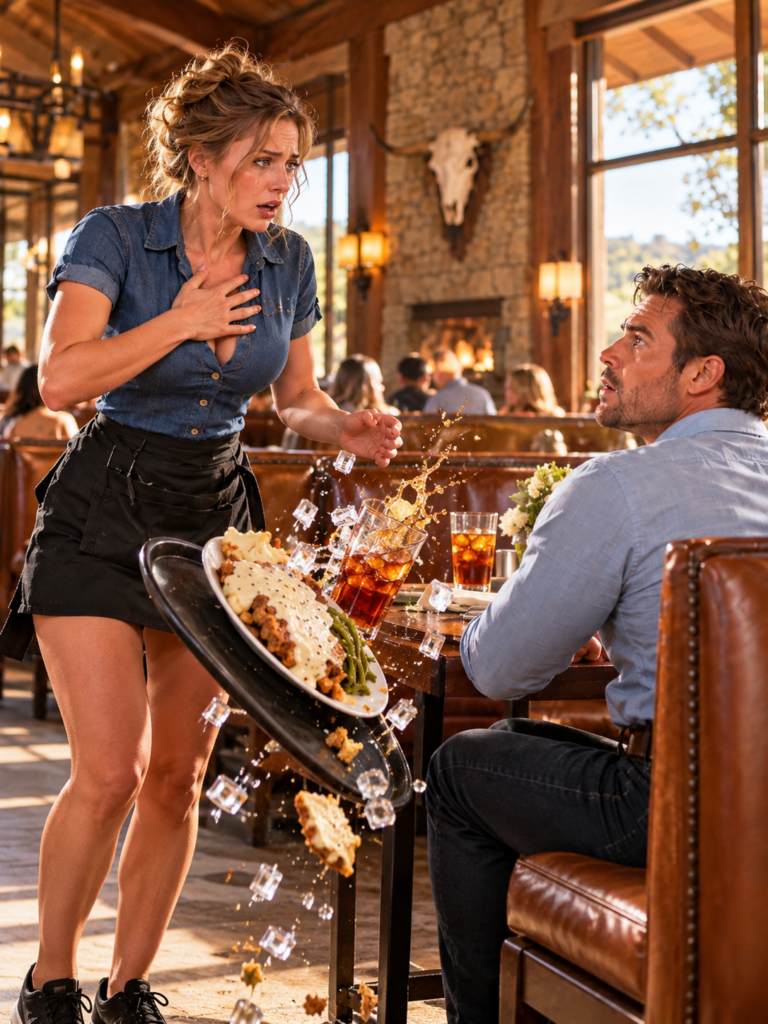
The tray hit the floor behind me with a crash so loud that every conversation in the Cedar Post Steakhouse stopped.
A plate of chicken-fried steak shattered against the tile. Mashed potatoes slid beneath a nearby table. A glass of iced tea rolled across the floor, spilling everywhere.
Someone near the bar swore.
I turned around, expecting to see an embarrassed waitress scrambling to clean up the mess.
Instead, I saw a woman standing completely still.
She was probably thirty-five, with dark blonde hair twisted into a loose bun and tired blue eyes that looked as though they’d seen too many sleepless nights. Her faded name tag read AMANDA.
But she wasn’t looking at the broken dishes.
She was staring directly at me.
“Say that again,” she whispered.
I frowned. “Ma’am?”
“What you just said.” Her hands trembled at her sides. “To that little girl. Please. Say it again.”
I glanced toward the family sitting in the booth beside mine.
Two minutes earlier, their three-year-old daughter had accidentally knocked over a glass of water. The little girl had burst into tears, frightened more by the noise than anything else. Her exhausted mother was holding a baby and trying unsuccessfully to calm both children.
I’d gotten down on one knee beside the toddler.
“Hey, sweetheart,” I’d said gently. “Look at me. Not the water. Look at me. I’ve got you.”
The girl had sniffled, looked into my eyes, and stopped crying.
It was nothing unusual.
After seventeen years working as a sheriff’s deputy in Gillespie County, Texas, I’d learned that frightened people often needed something simple to focus on.
A steady voice.
A familiar face.
A reason to believe someone was taking care of them.
Now, looking at the waitress’s pale face, I repeated the words.
“Look at me. Not the water. I’ve got you.”
The woman grabbed the edge of my table.
Her knees seemed to buckle.
“Oh, my God,” she whispered.
“Ma’am, are you all right?”
She covered her mouth.
Then she said five words that turned my entire world upside down.
“She lived. My daughter lived.”
For several seconds, I couldn’t understand what she meant.
My name is Jason Bailey. I was forty-one years old, unmarried, and three weeks away from leaving the sheriff’s department for a security job in Midland.
I’d come to the restaurant because my older sister, Donna, had insisted I needed to start dating again.
She’d arranged for me to meet a woman named Kristen, who worked at her bank.
Kristen was supposed to arrive at seven.
It was now seven fifty-two.
I’d been sitting alone long enough for the ice in my tea to melt, and I’d already decided this would be the last blind date of my life.
Then a waitress dropped her tray.
And seven years of memories I’d spent trying to bury came roaring back.
“Where?” I asked quietly.
Amanda swallowed.
“Grape Creek.”
My heart stopped.
“The low-water crossing east of town,” she continued. “Seven years ago. Last week of April. There was a storm. A white Honda got trapped in the creek.”
I stared at her.
She touched a small, pale scar on the inside of her wrist.
“There was a little girl in the back seat,” she whispered. “She was three.”
Suddenly, I wasn’t sitting in a steakhouse anymore.
I was standing in freezing brown water beneath a black Texas sky, fighting a current strong enough to drag a grown man off his feet.
And I could hear a child crying.
Seven years earlier, I’d been working the night shift when the storm rolled through Gillespie County.
It started as heavy rain.
Then the sky opened.
By one in the morning, the county roads were disappearing beneath rushing water. Dispatch was receiving calls about fallen trees, stranded vehicles, and flooded crossings.
At 2:07 a.m., a frightened woman’s voice came over the radio.
“Vehicle in the water. Grape Creek crossing. Possible child inside.”
I was six minutes away.
I still remember the sound of my windshield wipers slapping against the glass as I accelerated along the narrow road.
When I reached the crossing, my headlights caught a white Honda pinned sideways against two guardrail posts.
Water poured over the hood.
The car was rocking.
A woman was screaming from somewhere inside.
I called for backup, grabbed a tow strap from my patrol vehicle, and secured one end to the front push bar.
Then I wrapped the other around my waist.
I knew the danger.
I’d received the training. I’d seen the warnings. I’d pulled people out of flooded vehicles before.
But the car was moving, and there was a child inside.
I couldn’t stand on dry ground and watch.
The water struck my legs like a freight train.
I took one step.
Then another.
Twice, the current nearly swept my feet out from beneath me.
By the time I reached the Honda, the driver’s window was submerged and the rear window was the only possible way inside.
I smashed it with my flashlight.
Glass scattered into the water.
Through the broken opening, I saw a young mother crouched across the back seat, clutching a car seat above the rising flood.
Her face was streaked with rain and tears.
“Help us!” she screamed.
“I’m here!”
“My baby! Please!”
“Look at me!”
She kept screaming.
I reached through the window and caught her arm.
“Ma’am, listen to my voice. Look at me. Not the water. Look at me.”
Her eyes finally met mine.
“I’ve got you,” I said. “I’m not letting go.”
Inside the car seat was a little girl with wet blonde hair plastered against her cheeks.
Her eyes were closed.
“What’s her name?” I shouted.
“Chloe!”
“Okay. Chloe’s going to come out with us. But you have to help me.”
For the next nineteen minutes, we fought to keep that car seat above the water.
Nineteen minutes sounds short when you’re sitting somewhere warm.
In a flooded creek, with your muscles burning and the current pulling at everything you love, nineteen minutes can feel like a lifetime.
At one point, the car shifted.
The woman screamed.
I tightened my grip until pain shot through my shoulder.
“I’m not letting go!” I shouted.
Eventually, firefighters reached us with a rescue rope.
They secured the woman first.
Then the child.
When they lifted the little girl from her seat, she was limp.
Her lips were gray.
She wasn’t breathing.
I remember climbing onto the bank and collapsing beside my patrol car.
I remember a firefighter kneeling over the child on the tailgate of a rescue truck.
I remember the helicopter landing in a muddy hayfield.
And I remember watching them carry that little girl away beneath a silver emergency blanket.
Nobody told me whether she survived.
Three days later, I saw a small newspaper article stating that a three-year-old girl had been flown to a children’s hospital in San Antonio in critical condition.
I never read another article.
I went into Sergeant Ron Hughes’s office, shut the door, and told him I couldn’t do it anymore.
“Couldn’t do what?” he’d asked.
“Find out.”
He studied me.
“Jason—”
“Every call, Ron. Every accident. Every kid we pull out of something. I don’t want to know what happens afterward.”
He sat back in his chair.
“That’s not going to make the job easier.”
“Maybe not. But I can’t keep carrying them home.”
He was quiet for a long time.
Then he nodded.
For the next seven years, I worked my shifts, answered my calls, and avoided asking questions about what happened after the ambulance left.
And somewhere deep inside me, I carried the certainty that a little girl named Chloe had died that night.
“She’s alive?”
My voice barely worked.
Amanda nodded, tears spilling down her cheeks.
“She’s ten now.”
I gripped the edge of the booth.
“Ten?”
“She has freckles. She talks too much. She loves horses, even though she’s never actually ridden one.” Amanda laughed through her tears. “And she’s on the city swim team.”
I closed my eyes.
A swimmer.
The child I’d watched being carried away without breathing was now swimming.
“How?” I whispered.
“Eleven days in the hospital. Four in intensive care. They didn’t know whether she’d wake up properly. They warned me about possible brain damage.”
Amanda wiped her cheeks with the back of her hand.
“On the fourth morning, she opened her eyes and asked for a grape popsicle.”
Something inside my chest broke open.
I stood so abruptly that my knees struck the table.
“I need some air.”
“Wait—”
But I was already moving.
I left two twenty-dollar bills beside my untouched iced tea, walked past the hostess stand, and pushed through the front door.
Outside, the evening air was warm and smelled of cut grass and gasoline.
I made it halfway across the gravel parking lot before I stopped.
My hands were shaking.
I leaned against my truck.
For seven years, I’d believed that child was dead.
I’d imagined her mother sitting beside a small white coffin.
I’d imagined a tiny headstone somewhere outside San Antonio.
I’d told myself there was nothing I could have done differently.
But that wasn’t enough to stop the nightmares.
And now—
“Jason!”
I turned.
Amanda was hurrying across the parking lot, still wearing her apron.
She stopped in front of me, breathless.
“No,” she said.
I stared at her.
“No what?”
“You don’t get to disappear again.”
“Amanda—”
“Seven years ago, the firefighters took you away before I could say thank you. I called the sheriff’s office afterward. Nobody would give me your name.”
“Because I asked them not to.”
She blinked.
“What?”
“I didn’t want to know how the call ended.”
Her expression changed.
She looked at me as if she’d finally found the missing piece of a puzzle she’d been carrying for years.
“You never knew?”
I shook my head.
“Jason, Chloe has written you a letter every year.”
I stared at her.
“What?”
“Every April. Around the anniversary of the flood. We send a letter to the sheriff’s office, addressed to the deputy who went into the creek.”
She pressed her lips together.
“Seven letters.”
I couldn’t speak.
“At first, I helped her write them. Then she started doing it herself. She drew pictures. Told you about school. Her birthday. Her friends.”
Amanda looked away.
“I thought you received them and simply didn’t want to answer.”
My throat tightened.
“Nobody ever gave them to me.”
“Why not?”
I looked down at my boots.
“Because I told my sergeant not to.”
Neither of us spoke.
Somewhere behind us, a pickup truck pulled onto Highway 87.
The restaurant’s neon sign hummed overhead.
Finally, Amanda asked, “Why would you do that?”
I could have given her several explanations.
Because of the accidents.
Because of the people I couldn’t save.
Because of the families whose lives changed forever while I stood helplessly beside them.
Instead, I told her the truth.
“Because I thought your daughter died. And I couldn’t bear to find out for sure.”
Amanda’s face softened.
For a long moment, she just looked at me.
Then she said, “She spent seven years wanting to thank you.”
I swallowed.
“And I spent seven years being afraid of her.”
Amanda’s life hadn’t become easier simply because Chloe survived.
I learned that in the parking lot, too.
After the flood, she’d moved to San Antonio, where she’d spent years juggling hospital appointments, restaurant shifts, and the exhausting responsibilities of raising a child mostly on her own.
Her marriage had ended shortly before the accident.
Her ex-husband, Travis, sent birthday cards and occasional child-support payments, but he wasn’t involved in their daily lives.
Amanda had returned to Fredericksburg in January after inheriting her grandmother’s little house on the east side of town.
It wasn’t much.
The roof needed repairs. The old air-conditioning system rattled through the night. And the property taxes were a constant worry.
But the mortgage was paid off, Chloe finally had a backyard, and Amanda could work at the Cedar Post while her daughter attended the local elementary school.
“She’s happy here,” Amanda said. “That’s what matters.”
She twisted the corner of her apron between her fingers.
“I work most evenings, and Peggy lets me pick up extra lunch shifts when she can. Chloe stays with our neighbor, Mrs. Alvarez, if I’m late.”
“Peggy?”
“The woman who owns this place.”
I nodded.
I’d known Peggy for years.
She was sixty-eight, sharp-tongued, and capable of remembering everyone’s order while simultaneously criticizing their life choices.
“She’s a good woman,” I said.
Amanda smiled faintly.
“She is. Though she’d deny it.”
My phone buzzed.
A message from Donna.
Kristen got nervous and stayed home. I’m so sorry, Jay. Please don’t hate me.
I almost laughed.
My sister had spent weeks convincing me to meet someone new.
And the woman I was supposed to meet had never arrived.
Yet somehow, that had led me to a person I’d never expected to see again.
“You were waiting for somebody?” Amanda asked.
“A blind date.”
“Oh.”
“She didn’t show.”
Amanda gave a small, sympathetic grimace.
“That’s rough.”
“Not the worst thing that’s happened tonight.”
She looked surprised.
I realized how that sounded.
“I mean—”
“No,” she said quickly. “I know what you mean.”
A moment passed.
Then she reached into her apron pocket, pulled out an order pad, and scribbled a phone number.
She tore off the paper and handed it to me.
“Chloe’s going to want to meet you.”
My fingers closed around the little yellow slip.
“I don’t know if that’s a good idea.”
Amanda’s face fell slightly.
“Why?”
“Because I’m leaving town.”
She went still.
“When?”
“Three weeks. I accepted a security job in Midland.”
“Oh.”
“I’ve already turned in my resignation.”
She nodded, but her disappointment was unmistakable.
“Well,” she said, forcing a smile, “three weeks is still three weeks.”
Then she looked toward the restaurant.
“I should get back. Peggy’s probably wondering if I fell into the grease trap.”
“Amanda?”
She turned.
“Thank you for telling me.”
She studied me for a moment.
“Jason, you shouldn’t have had to wait seven years to hear it.”
Then she walked back inside.
I sat in my truck for forty minutes afterward, holding the telephone number like it was something fragile.
For the first time in years, I wanted to know what happened next.
But wanting something and knowing how to reach for it were two very different things.
The following morning, I arrived at the sheriff’s office two hours before my shift.
Sergeant Ron Hughes was drinking coffee behind his desk.
He took one look at my face and sighed.
“You finally found out.”
I stood in the doorway.
“You knew?”
He removed his reading glasses.
“Sit down, Jason.”
“Ron.”
“Sit.”
I sat.
He opened the bottom drawer of his desk and pulled out an old cardboard boot box.
The edges were worn.
A strip of faded tape held one corner together.
He placed it between us.
“What is that?”
“Something I’ve been keeping.”
He lifted the lid.
Inside were letters.
Dozens of them.
Some were written on stationery.
Others on construction paper.
Several contained crayon drawings.
There were thank-you cards, envelopes with crooked handwriting, and photographs.
I stared.
“What the hell, Ron?”
He folded his hands.
“Seven years ago, you walked in here and told me never to tell you how your calls turned out.”
“You could have said something.”
“I tried. More than once.”
He leaned forward.
“You remember Mrs. Collins?”
I frowned.
“The rollover on Highway 290?”
“Her son drew you a picture after he got out of the hospital. I tried to give it to you. You told me to throw it away.”
My stomach dropped.
“So I kept it.”
Ron touched the box.
“After that, I kept everything. Figured one day you might want it.”
I reached inside.
The first envelope contained a note from a woman in Harper whose husband had suffered a heart attack beside the road.
I’d held his hand until the ambulance arrived.
He hadn’t survived.
For six years, I’d considered him another failure.
But his wife had written:
Thank you for staying with my husband when I couldn’t be there. Knowing he wasn’t alone has given me more comfort than you could imagine.
I read the note twice.
Then a third time.
My eyes blurred.
Ron looked down at his coffee.
“Not every ending is a bad one, Jason.”
I reached for another envelope.
A child’s drawing showed a police car beside something that looked like a blue mountain.
At the bottom, written in purple crayon, were the words:
Thank you, Deputy.
Ron nodded toward a stack tied together with a rubber band.
“Those are hers.”
I picked them up.
Seven letters.
Seven years.
The first was addressed simply to The Deputy in the Creek.
Inside was a drawing of a little girl holding hands with a tall man.
Beneath it, Amanda had written:
Chloe is four now. She says this is a picture of you and her. We are home, and she is doing wonderfully. Thank you for giving us another chance.
I covered my mouth.
The second letter included a drawing of a horse.
The third was written in huge, uneven letters.
Dear Deputy,
I lost two teeth. Mommy says you are very tall. I hope you are happy.
Love, Chloe.
The fourth described a class trip.
The fifth explained that she’d gotten a goldfish and named it Deputy.
The sixth informed me that the first Deputy had died, but she’d named the replacement Deputy as well.
And the seventh—
The seventh was different.
It had arrived only three weeks earlier.
The handwriting was neat, carefully practiced cursive.
Dear Deputy in the Creek,
Mom says you probably don’t want to be found. I don’t understand that because if I saved somebody I would want to know they were okay.
I’m ten now. I can swim all the way across the pool without stopping. I’m not scared of the water anymore.
My first real swim meet is the second Saturday in June. I’m going to be in lane four.
Mom says you’re probably busy, but if you wanted to come, you could sit anywhere.
I hope you do.
Love, Chloe.
P.S. Deputy the goldfish is still alive.
I lowered the letter.
The second Saturday in June.
The day after my final shift.
The day before I was supposed to leave for Midland.
Ron watched me quietly.
“She’s been asking about you every year.”
I ran my hand over my face.
“I thought she was dead.”
“I know.”
“All this time—”
“I know, son.”
I looked through the remaining letters, the cards, the photographs.
The cardboard box had become heavier than anything I’d ever carried.
Finally, Ron spoke again.
“You’ve saved lives, Jason. You’ve changed lives. And you’ve spent seventeen years pretending none of that matters because you’re afraid of the ones you couldn’t help.”
I couldn’t look at him.
“Sometimes it’s easier not knowing.”
“Maybe.” He paused. “But easy isn’t always the same as living.”
I sat there for a long time.
Then I took Chloe’s final letter and put it carefully inside my shirt pocket.
That afternoon, I sent Amanda a text.
This is Jason. I got the letters. All seven.
Her answer arrived less than a minute later.
Practice is tomorrow at six. City pool.
Then another message appeared.
I’ll be in the green Subaru. I probably won’t get out of the car.
I stared at those words.
I didn’t yet understand why a mother who had fought so hard to save her daughter couldn’t bring herself to watch her swim.
But I was beginning to understand that Amanda had her own ghosts.
And somehow, ours had been waiting for each other for seven years.
Part 2
Amanda had been awake since five that morning.
Not because she wanted to be.
The air conditioner had stopped cooling properly during the night, and the house was already uncomfortable by sunrise.
She stood in the kitchen wearing an old T-shirt and a pair of faded shorts, staring at three envelopes spread across the counter.
Electric bill.
Property tax notice.
Car insurance.
Beside them was a handwritten list of everything Chloe needed before the swim meet.
New goggles.
Team T-shirt.
Registration fee.
Amanda picked up her phone and checked her bank balance.
Four hundred and eighteen dollars.
Her next paycheck wasn’t due until Friday.
She sighed, set the phone down, and crossed the team T-shirt off the list.
Chloe could wear last year’s.
“Mom?”
Amanda turned.
Her daughter stood in the doorway wearing pajamas covered in cartoon horses.
“Did he text?”
Amanda smiled.
“Good morning to you, too.”
“Mom.”
“Yes, he texted.”
Chloe’s eyes widened.
“What did he say?”
“He got your letters.”
“All of them?”
“Every single one.”
Chloe pressed both hands against her cheeks.
“Even the horse?”
“Apparently.”
“That was a dog!”
Amanda laughed.
“I know, sweetheart.”
Chloe hurried to the kitchen table.
“Is he coming today?”
“He said he’d try.”
“You said he said yes.”
“I said he knows where practice is.”
Chloe considered this.
Then she nodded with the seriousness only a ten-year-old could manage.
“Okay. That’s basically yes.”
Amanda watched her daughter wander toward the refrigerator.
Seven years earlier, she’d been told Chloe might never speak normally again.
Now the girl could talk nonstop for an entire car ride.
The doctors had warned that she might have problems walking.
Now she swam three evenings a week.
And somehow, Amanda still couldn’t look at the pool.
She could drive Chloe there.
She could help her change into her swimsuit.
She could braid her hair and check that she’d remembered her goggles.
But once Chloe climbed into the water, Amanda retreated to her car.
Every splash sounded like breaking glass.
Every whistle made her heart race.
She knew the pool was safe.
She knew the lifeguards were watching.
She knew Chloe was a strong swimmer for her age.
But trauma didn’t care what a person knew.
It cared what they remembered.
And Amanda remembered everything.
I arrived at the Fredericksburg city pool at five fifty-three the next evening.
The parking lot was crowded with parents unloading lawn chairs and children carrying colorful swim bags.
I spotted the green Subaru near the far fence.
Amanda was sitting inside.
Both hands were wrapped around the steering wheel.
She wasn’t looking at the pool.
I parked beside her but didn’t approach immediately.
Instead, I walked toward the chain-link fence.
The smell of chlorine hit me first.
Then the noise.
Children laughing.
Coaches calling instructions.
Water splashing against concrete.
I scanned the pool until I spotted a skinny girl in a blue swim cap climbing out near the shallow end.
She had freckles scattered across her nose and knees that looked permanently scraped.
She turned.
Saw me.
And marched straight across the wet pavement.
“Are you the creek guy?”
I blinked.
“Depends who’s asking.”
“I’m Chloe.”
“Then I guess I’m the creek guy.”
She studied me from head to toe.
“You’re not that tall.”
I nearly laughed.
“Sorry to disappoint you.”
“Mom said you were a giant.”
“Your mom was having a pretty rough night.”
Chloe considered that.
“That’s true.”
She crossed her arms.
“Did you read my letters?”
“Every one.”
“Even the horse?”
I smiled.
“I especially liked the horse.”
“It was a dog.”
“Well, now I like it even more.”
She grinned.
Behind us, someone laughed.
I turned.
Amanda had rolled down her car window.
For the first time since the steakhouse, she looked genuinely amused.
Chloe stepped closer to the fence.
“Can I ask you something?”
“Sure.”
“Do you remember me crying?”
The question caught me off guard.
“A little.”
“I don’t remember any of it.”
“That’s okay.”
“Mom says I was really scared. But I don’t remember being scared. I don’t remember you, either.”
Her smile faded.
“Is that bad?”
I crouched so we were eye level.
“No, sweetheart.”
“But you remember me.”
“I do.”
“Doesn’t that make you sad?”
I thought about the newspaper article I’d carried folded inside my glove compartment for years.
I thought about the nightmares.
The empty space where an answer should have been.
Then I looked at this little girl who was standing on strong legs beneath the Texas sunshine.
“Chloe, that’s about the best news you could have given me.”
She blinked.
“Really?”
“Really.”
The coach blew her whistle.
“Chloe! Back in the water!”
Chloe looked over her shoulder.
“That’s Coach Maria. She’s nice unless you forget to kick.”
“Then you’d better kick.”
She started running, stopped, and turned back.
“Are you coming to my meet?”
I hesitated.
The hopeful look on her face made my chest hurt.
“I’ll do my best.”
She studied me.
“Adults say that when they don’t want to promise.”
I laughed despite myself.
“You’re pretty smart.”
“I know.”
Then she ran toward the pool.
I watched her jump in feetfirst.
The splash was enormous.
I felt something inside me loosen.
Seven years earlier, I’d watched rescuers lift her motionless body from a flooded car.
Now she was swimming across a pool, kicking badly, splashing too much, and ignoring her coach.
It was the most beautiful thing I’d ever seen.
Amanda was still sitting in her Subaru when I approached.
She glanced up as I opened the passenger door.
“Is this seat taken?”
She gave me a nervous smile.
“No.”
I climbed in.
The car smelled faintly of vanilla air freshener and French fries.
A stack of restaurant schedules sat on the dashboard beside a library book and a half-empty package of crackers.
Amanda looked straight ahead.
“She’s in the water, isn’t she?”
“Yep.”
Her fingers tightened around the steering wheel.
“Which lane?”
“Third from the left.”
“Is she okay?”
“She’s doing great.”
I watched Chloe push off the wall.
“Well, actually, she’s swimming sideways.”
Amanda frowned.
“Sideways?”
“She’s drifting toward the lane rope.”
“Oh, Lord.”
“Coach is yelling at her.”
“That sounds right.”
“She’s ignoring Coach.”
“That sounds even more right.”
Amanda laughed.
I kept watching.
“Now she’s kicking harder. She’s catching up to the girl beside her.”
Amanda released one finger from the steering wheel.
Then another.
“She made it to the wall,” I said. “Now she’s talking to another girl instead of listening.”
Amanda smiled.
“That’s my Chloe.”
We sat there for nearly an hour.
I described every lap.
Every crooked turn.
Every time Chloe forgot to kick.
And every time she waved toward her mother’s car.
By the end of practice, Amanda’s hands were resting in her lap.
She still hadn’t looked toward the water.
But when Chloe climbed out, Amanda opened the car door before I could say anything.
“Mom!” Chloe shouted from the fence.
Amanda waved.
Her smile trembled.
“How’d I do?” Chloe called.
“You did great, baby!”
Chloe narrowed her eyes.
“Did you actually watch?”
Amanda froze.
I stepped beside her.
“I gave your mom the full play-by-play.”
Chloe considered that.
“Like football?”
“Exactly.”
She shrugged.
“Okay. That’s acceptable.”
Then she disappeared toward the changing room.
Amanda exhaled.
“I don’t know how to thank you.”
“You don’t have to.”
She looked at me.
“Do you always say that?”
“What?”
“That people don’t have to thank you.”
I thought about Ron’s cardboard box.
“Apparently.”
Amanda studied me for another moment.
Then she said softly, “Maybe you should let them sometimes.”
For the next eleven days, I became a regular fixture in the passenger seat of Amanda’s Subaru.
Monday.
Wednesday.
Friday.
Six o’clock.
I would park my truck beside her car and climb in, usually carrying two iced teas from the convenience store down the road.
She always tried to pay me back.
I always refused.
Eventually, we compromised.
I bought the tea.
She brought cookies from the restaurant.
Chloe began waving after every lap.
Sometimes she waved so much that Coach Maria threatened to make her swim extra laps.
Amanda and I developed a system.
“Wave number four,” I’d announce.
“She’s supposed to be practicing.”
“She’s doing both badly.”
Amanda would laugh.
Then we’d sit quietly until the next lap.
At first, our conversations stayed simple.
The weather.
The restaurant.
My work.
Chloe’s school.
But little by little, Amanda began telling me about her life.
She’d grown up outside Johnson City.
Her father had worked construction until a back injury forced him to retire.
Her mother had cleaned motel rooms.
When Amanda was nineteen, she’d taken a waitress job to help pay for community college.
She’d intended to become a nurse.
Then she met Travis.
At twenty-four, she got married.
At twenty-five, she had Chloe.
And by twenty-eight, she was raising her daughter mostly alone.
“I kept thinking I’d go back to school,” she told me one evening. “But something always happened.”
“Like what?”
She laughed without much humor.
“Car repairs. Hospital bills. Rent. Life.”
I looked at her hands.
There was a small burn mark near her thumb.
Her nails were short and unpainted.
She wore a plain silver ring on her right hand that had belonged to her grandmother.
“You still want to be a nurse?”
“Some days.”
“What’s stopping you?”
She gave me a sideways look.
“Would you like the list alphabetically or by how much each problem costs?”
I smiled.
“Fair enough.”
She looked down at her lap.
“I don’t mind working hard, Jason. I just get tired of doing the math.”
“What math?”
“Every month, I figure out which bill can wait, what Chloe needs, how many extra shifts I can take. Sometimes I get everything paid, and then the car makes a new noise.”
She shrugged.
“That’s life, I guess.”
I wanted to tell her she deserved more.
But I had a feeling she’d heard that before.
So I said, “What’s the car doing?”
“Making a noise.”
“Very helpful.”
“A clicking noise.”
“When?”
“When I need it not to.”
I laughed.
And for a few minutes, the world felt strangely ordinary.
That Friday, Chloe’s swim goggles broke.
One strap snapped during practice.
She climbed out of the water holding the pieces.
“Mom, I need new ones.”
Amanda took the goggles.
“Maybe we can fix them.”
“Coach says I need better ones for the meet.”
Amanda glanced at me.
It was quick.
Almost invisible.
But I recognized the expression.
I’d seen it on parents standing beside wrecked cars.
On elderly people trying to explain why they couldn’t pay an ambulance bill.
On hardworking people who hated having their struggles witnessed.
“I’ll get them,” I offered.
Amanda’s expression changed immediately.
“No.”
“They’re goggles.”
“I know what they are.”
“Then let me buy a pair.”
“Jason.”
There was a warning in her voice.
Chloe looked between us.
I lowered my voice.
“I’m not trying to insult you.”
“I know.”
“Then what’s the problem?”
Amanda took a breath.
“The problem is that you’ve already done something for us I can never repay. I don’t want Chloe growing up thinking she has to accept things because someone feels sorry for her.”
I stared at her.
The words stung more than I expected.
“I don’t feel sorry for her.”
“I know you don’t.”
“Then—”
“I’m trying to explain something badly.”
She pressed her fingers against her forehead.
“I’m grateful you’re here. More than you know. But I need to be her mother. I need to figure things out.”
I looked at Chloe.
She was pretending not to listen.
“Okay,” I said.
Amanda blinked.
“Okay?”
“Okay.”
I turned toward Chloe.
“Can I show you something?”
She nodded.
I took the broken goggles and examined the strap.
“Looks like the plastic clip snapped.”
“Can you fix it?”
“Maybe temporarily.”
I reached into my truck and found a small emergency repair kit I kept behind the seat.
Ten minutes later, I’d secured the strap with a narrow replacement clip and checked that it held.
Chloe pulled the goggles onto her face.
“Awesome!”
“Don’t pull too hard,” I warned. “It still needs replacing.”
She nodded solemnly.
Then she hugged me.
It happened so fast I barely had time to react.
Small arms wrapped around my waist.
“Thanks, Creek Guy.”
I looked over her head at Amanda.
She was watching us with an expression I couldn’t read.
That night, I realized something important.
Amanda didn’t need me to rescue her from her life.
She needed somebody willing to stand beside her while she lived it.
There was a difference.
And I was only beginning to understand it.
The following Tuesday, I stopped by the Cedar Post to pick up dinner before my night shift.
Amanda wasn’t working.
Peggy stood behind the counter counting receipts.
She was a short woman with silver hair, reading glasses hanging from a chain, and the permanent expression of someone who’d been disappointed by humanity but still intended to feed it.
“Brisket plate?” she asked without looking up.
“You know me too well.”
“I know you haven’t ordered a vegetable voluntarily since 2014.”
“Potatoes are vegetables.”
“French fries aren’t a personality, Jason.”
She rang up my order.
Then she handed me the bag but kept my change.
“Something I want to ask you.”
I sighed.
“That sounds dangerous.”
“You leaving town?”
“That’s the plan.”
“Midland?”
“Yep.”
She clicked her tongue.
“Terrible place to run away to.”
“I’m not running away.”
“Of course not.”
She opened the register, counted out my change, and placed the bills on the counter.
Then she said something unexpected.
“That girl has been hiding from you for months.”
I frowned.
“What girl?”
Peggy rolled her eyes.
“Don’t play dumb with me. Amanda.”
My stomach tightened.
“What do you mean, hiding?”
“Since February, you’ve come in here three times to pick up your brisket.”
“Probably more.”
“Three times when she was working.”
Peggy leaned forward.
“Every single time, she heard your voice at the counter and disappeared into my walk-in cooler.”
I stared at her.
“Why?”
“First time, I thought she was sick. Second time, I thought she was avoiding some old boyfriend.”
Peggy paused.
“Third time, I found her standing between the milk and the lettuce, crying so hard she could barely speak.”
I swallowed.
“She knew who I was?”
“Not exactly. Said your voice reminded her of somebody.”
Peggy studied my face.
“After that night with the broken dishes, I finally understood.”
I looked toward the empty dining room.
For days, I’d imagined Amanda had spent seven years searching for me.
But the truth was more complicated.
She’d recognized something in my voice months earlier.
And she’d hidden.
Peggy lowered her voice.
“That woman’s been through plenty, Jason. She gets up before daylight, works every extra shift I can give her, and still shows up at every school event that little girl has.”
“She seems strong.”
“She is strong.”
Peggy’s expression softened.
“But strong people get tired, too.”
She finally handed me my change.
“And if you’re planning to make that child get attached to you before you vanish into the oil fields, you’d better think real hard about what you’re doing.”
I didn’t answer.
Because for the first time, I wasn’t sure I could.
The next evening, I climbed into Amanda’s Subaru and found her staring at the steering wheel.
“Peggy told me something.”
Amanda closed her eyes.
“Oh, no.”
“She said you used to hide in the cooler when I came in.”
Amanda sighed.
“Of course she did.”
“Why?”
She didn’t answer immediately.
Outside, Chloe splashed toward the far wall.
Amanda opened the glove compartment.
Inside was an old envelope.
It had been folded so many times that the paper looked almost transparent along the creases.
She handed it to me.
“What’s this?”
“A letter I wrote seven years ago.”
“To me?”
She nodded.
“Why didn’t you send it?”
Amanda stared at the dashboard.
“Because I was ashamed.”
I looked at her.
“Of what?”
For a long time, the only sound was the muffled whistle from the pool.
Then Amanda began talking.
“The night of the accident, Travis and I had a terrible fight.”
Her hands tightened in her lap.
“Our marriage had been falling apart for months. He was angry. I was exhausted. Chloe had been sick, and we’d been arguing about money.”
She swallowed.
“That night, he told me he wanted a divorce.”
I stayed quiet.
“I packed a bag and decided to drive to my mother’s house in Johnson City. It was after one in the morning. Chloe was half asleep.”
Her voice began trembling.
“I was crying so hard I could barely see the road.”
I remembered the storm.
The flooded crossing.
The white Honda.
“There was a warning sign,” Amanda whispered.
My chest tightened.
“I saw it. Turn Around, Don’t Drown.”
She looked at me.
“And I kept driving.”
The words hung between us.
“I thought the water was shallow. I thought if I drove slowly, I could make it across.”
Tears filled her eyes.
“Then the car started sliding. The engine died. Water came through the doors. Chloe started screaming.”
Amanda covered her face.
“I put my daughter in that car, Jason. I drove past a warning sign. I almost killed her because I was angry and crying and too stubborn to stop.”
I reached toward her but hesitated.
She looked at me.
“That’s why I hid in the cooler. Every time I heard your voice, I remembered what I’d done.”
“Amanda—”
“I thought if you ever recognized me, you’d hate me.”
I felt something twist inside my chest.
She had spent seven years blaming herself.
Just as I’d spent seven years believing I’d failed.
“Amanda, look at me.”
She shook her head.
“Please.”
Slowly, she turned.
“You made a terrible mistake,” I said.
She flinched.
I continued gently.
“You should have turned around. You know that better than anybody.”
She nodded, tears spilling down her cheeks.
“But making a mistake isn’t the same as wanting your daughter hurt.”
“I know.”
“You’ve spent seven years taking care of her.”
“Because I almost lost her.”
“Because you love her.”
Her face crumpled.
I reached across the center console and took her hand.
“You don’t have to pretend that night was okay. It wasn’t.”
She held my hand tightly.
“But it doesn’t get to be the only thing that defines you.”
Amanda cried then.
Not loudly.
She simply bent forward and let the tears fall.
I sat beside her until she could breathe normally again.
Outside, Chloe was standing near the pool fence, waving both arms.
I noticed first.
“She’s waving,” I said.
Amanda wiped her cheeks.
“Again?”
“Like she’s trying to land an airplane.”
Amanda laughed weakly.
“Tell me where she is.”
“Right by the fence.”
Amanda looked toward the water.
Not all the way.
Just enough to see the bright blue cap above the railing.
Then she lifted her hand.
And waved back.
That evening, I drove home with Amanda’s unopened letter in my shirt pocket.
I should have felt hopeful.
Instead, I felt frightened.
Because the more I cared about Amanda and Chloe, the harder it became to pretend leaving was a simple decision.
My security job in Midland would pay nearly twenty thousand dollars more a year.
No emergency calls.
No highway crashes.
No children trapped in cars.
Just gates, cameras, equipment, and a predictable schedule.
I’d convinced myself it was the life I wanted.
Then Amanda arrived.
And suddenly the thought of leaving Fredericksburg felt less like a fresh start and more like abandoning something important.
At home, I sat at the kitchen table and unfolded her letter.
Dear Officer,
I don’t know your name. I don’t know whether I’ll ever find you.
I need you to know that I made a terrible mistake that night. I saw the flood warning, and I drove into the water anyway.
My daughter almost died because of me.
You didn’t ask why we were there. You didn’t ask what kind of mother would put her child in danger.
You just came.
I can still hear you telling me to look at you. I can still feel your hand holding mine through that broken window.
I don’t think I’ll ever forget those nineteen minutes.
Thank you for staying.
Thank you for saving Chloe.
I wish I could tell you this in person.
Amanda.
Then, at the bottom, written in smaller letters, was one final sentence.
Every time I close my eyes, I’m back in that car, and the only thing I can hear is your voice.
I read that sentence again.
Then again.
And an awful thought settled over me.
Maybe my voice wasn’t comforting to Amanda.
Maybe it was a reminder of the worst night of her life.
Every time I climbed into her car, perhaps I dragged her back to that flooded crossing.
Perhaps she only tolerated my presence because she felt indebted to me.
Maybe leaving would be the kindest thing I could do.
I knew how to leave.
I’d been doing it for seventeen years.
Clear the scene.
Hand the people over to someone else.
Drive away.
So that Friday, half an hour before Chloe’s practice, I sent Amanda a message.
I’ve been thinking. Maybe it’s better for you and Chloe if I step back. You don’t owe me anything. You never did. I think you both need a chance to move forward without me.
I stared at the screen.
No answer.
At six fifteen, I checked again.
Nothing.
At six forty, my phone rang.
Amanda’s number.
I answered.
“Hello?”
A small voice said, “You didn’t come.”
I sat up.
“Chloe?”
“I looked for your truck.”
My throat tightened.
“I’m sorry, sweetheart.”
“Mom sat in the car the whole time.”
I closed my eyes.
“I know.”
“No, you don’t.”
Her voice was quiet.
Not angry.
That made it worse.
“I waved nine times.”
“Chloe—”
“Nine. I counted.”
I rubbed my forehead.
“Your mom needs some space right now.”
There was a pause.
Then Chloe said, “She cried.”
I didn’t answer.
“She thinks I don’t know when she cries in the car.”
My chest hurt.
“But I always know.”
“Sweetheart, I—”
“She was happy when you came.”
The sentence landed harder than anything else she’d said.
“She was happier than she’s been in a long time. And now she isn’t.”
I swallowed.
“Chloe, sometimes grown-ups make things complicated.”
“That’s dumb.”
I almost laughed.
“Yeah,” I whispered. “Sometimes it is.”
She was quiet for a moment.
Then she asked, “Are you still coming to my meet?”
I looked at the packed boxes sitting beside my front door.
“I don’t know.”
Another silence.
“Okay.”
Then she hung up.
I sat there with the phone against my ear long after the call ended.
The next day, Amanda had a double shift at the Cedar Post.
Saturday lunch ran late.
One server called in sick.
A family of twelve arrived without a reservation.
By four o’clock, Amanda’s feet ached, her back hurt, and she’d spilled coffee down the front of her uniform.
Peggy caught her standing in the pantry staring at nothing.
“You sick?”
“No.”
“You’ve been moving like somebody tied bricks to your shoes.”
“Just tired.”
Peggy folded her arms.
“That deputy?”
Amanda looked away.
“I don’t want to talk about it.”
“Then don’t.”
Peggy turned toward the door.
But before she left, she said, “For what it’s worth, I don’t think he’s trying to hurt you.”
Amanda swallowed.
“Neither do I.”
“Then what’s the trouble?”
Amanda looked down at her hands.
“He thinks leaving will make everything easier.”
Peggy snorted.
“Men have a remarkable talent for making terrible decisions and calling them noble.”
Despite herself, Amanda smiled.
Peggy stepped closer.
“Sweetheart, if you want him to stay, tell him.”
“I don’t want him staying because he feels guilty.”
“Then tell him that, too.”
Amanda was quiet.
Peggy reached over and squeezed her shoulder.
“You’re allowed to want things, Amanda. Even when you can’t afford them. Even when they scare you.”
That evening, Amanda left work, picked Chloe up from Mrs. Alvarez’s house, and drove home.
She cooked spaghetti.
Helped Chloe finish a school assignment.
Washed the dishes.
Then, after her daughter fell asleep, she took her car keys from the hook beside the kitchen door.
There was one place she hadn’t visited in seven years.
One place she’d avoided for so long that she’d almost convinced herself it no longer existed.
Grape Creek.
At eight forty-five that night, my phone buzzed.
A photograph appeared.
The crossing.
The same narrow concrete road.
The same guardrail posts.
The same yellow flood warning sign.
But the water was shallow.
Clear.
Only a few inches deep.
At the bottom of the photograph, I could see Amanda’s shoes standing in the creek.
Then came her message.
I drove out here tonight.
I sat upright.
Another message followed.
First time in seven years.
I stared at the screen.
I stood in the water for ten minutes. I was shaking so badly I thought I might fall over.
Then:
But nothing happened.
It was just a creek, Jason.
I read the words slowly.
Then another message arrived.
You misunderstood my letter.
My heart began pounding.
When I said your voice was the only thing I could hear, I didn’t mean it was the worst part.
Your voice was the moment I knew someone had come for us.
I pressed my hand against my mouth.
It was the only part of that night that made me feel safe.
I stared at the message until the letters blurred.
Then my phone buzzed one final time.
Chloe’s meet is next Saturday at nine. Lane four.
I’m going to stand beside that pool and watch my daughter swim. I’m going to try, even if I’m terrified.
You can come or not. That’s your decision.
But don’t ever decide what I need without asking me.
I sat in the darkness for a long time.
For seventeen years, I’d been convinced that avoiding the truth protected me.
But Ron’s box had shown me something different.
The people I’d imagined losing had sometimes survived.
The people I believed I’d failed had sometimes remembered me with gratitude.
And the woman whose life I thought I was making harder had just told me that my presence made her feel safe.
I’d been writing endings in my head without bothering to learn what actually happened.
Now, with only one week left before I moved to Midland, I had to make a decision.
For the first time, I couldn’t pretend it was an easy one.
Part 3
My last Friday with the Gillespie County Sheriff’s Department arrived under a cloudless June sky.
I reported for duty at six that morning.
Same uniform.
Same badge.
Same patrol car I’d driven for years.
The dispatcher greeted me over the radio, and I answered automatically.
Nothing about the day seemed different.
Yet every familiar road felt like somewhere I was seeing for the last time.
I passed the gas station where I bought coffee before night shifts.
The elementary school where I’d helped direct traffic during the annual Christmas parade.
The intersection where I’d once spent three hours comforting a frightened teenage driver after her first accident.
Everywhere I looked, I saw pieces of a life I’d decided to leave.
At eleven, dispatch sent me to check on an elderly man whose neighbors hadn’t seen him in several days.
His name was Walter Benson.
He was eighty-three, lived alone, and had forgotten to charge his phone.
When I knocked, he opened the door wearing slippers and holding a half-eaten sandwich.
“You folks sure make a fuss,” he grumbled.
“Your neighbor was worried.”
“Well, she’s been worried about me since my wife died. That’s three years of worrying.”
I smiled.
“Can I come in?”
He stepped aside.
His house smelled of coffee, old books, and furniture polish.
We talked for twenty minutes.
He told me about his late wife.
About the garden she used to keep.
About the tomatoes he still planted every spring, though he couldn’t bend down far enough to pull the weeds anymore.
When I finally stood to leave, he caught my sleeve.
“Deputy?”
“Yes, sir?”
“You coming back around?”
The question was simple.
I could have said someone else would check on him.
I could have explained that my last shift was almost over.
Instead, I looked at his tired face.
“I think I might,” I said.
He nodded.
“Good. Bring coffee next time.”
As I drove away, I realized something that made me grip the steering wheel.
I wasn’t tired of helping people.
I was tired of believing that helping people meant I had to carry all their pain alone.
Those were two very different things.
At five forty-five, I returned my patrol car to the county lot.
Ron Hughes was waiting beside the building.
He held two paper cups of coffee.
“Figured you could use one.”
I took it.
“Thanks.”
We stood together beneath the fading afternoon sun.
Seventeen years.
That’s how long I’d worked beside Ron.
He’d taught me how to speak gently to frightened children, how to recognize trouble before it turned dangerous, and how to keep my head when everyone around me was losing theirs.
He’d also spent seventeen years telling me I was too stubborn for my own good.
“You all packed?” he asked.
“Mostly.”
“Midland job starts Monday?”
“That’s what they told me.”
Ron sipped his coffee.
“Good money.”
“Yeah.”
“Better hours.”
“Probably.”
“Less excitement.”
“Definitely.”
He nodded.
Then he looked at me.
“You sound miserable.”
I laughed.
“Thanks, Ron.”
“Just making an observation.”
He reached into his pocket and pulled out a folded sheet of paper.
“One more thing.”
I took it.
It was a copy of my resignation paperwork.
Across the bottom, someone had written a note.
Position to remain unfilled until June 30.
I looked at him.
“What’s this?”
“Your badge number is staying open until the end of the month.”
“Why?”
Ron shrugged.
“County’s short on experienced deputies.”
“Ron.”
He looked toward the parking lot.
“Sheriff said if you come to your senses, we’d rather have you back than spend six months training your replacement.”
I shook my head.
“You planned this?”
“Son, I’m sixty-three. I plan everything. I don’t have enough years left to waste them being subtle.”
We stood quietly.
Then he said, “You know, when you gave me that order seven years ago, I thought I was helping you by keeping those letters.”
“You were.”
“Maybe. But I wish I’d pushed harder.”
I looked at him.
“Why?”
“Because you spent a lot of years being afraid of the wrong things.”
He placed a hand on my shoulder.
“Whatever you decide, Jason, make sure you’re choosing a life. Not just a place to hide.”
I nodded.
“Thanks, Ron.”
He squeezed my shoulder.
Then he turned and walked inside.
I watched him disappear through the door.
For the first time since accepting the Midland position, I wondered whether leaving my badge behind was actually what I wanted.
That night, I couldn’t sleep.
My house was almost empty.
Boxes filled the living room.
The kitchen cabinets were bare except for coffee mugs and a few plates.
My clothes were packed into duffel bags.
Everything was ready.
All I had to do was leave.
At midnight, Donna called.
“You awake?”
“Unfortunately.”
She sighed.
“Thinking about tomorrow?”
“Something like that.”
“Are you going to Chloe’s meet?”
I looked at the invitation sitting on my kitchen table.
Lane four.
Nine o’clock.
“I don’t know.”
Donna was silent for a moment.
Then she asked, “Did I ever tell you why I set you up with Kristen?”
“Because you enjoy embarrassing me?”
“Besides that.”
I smiled faintly.
“No.”
“Because I was worried about you.”
I leaned against the counter.
“Donna—”
“Listen.”
Her voice softened.
“After Dad died, you barely spoke for six months. Then you got buried in work. Every time I asked you to come for dinner, you were busy. Every holiday, you picked up an extra shift.”
“I was helping people.”
“I know you were.”
She paused.
“But somewhere along the way, you stopped letting anybody help you.”
I rubbed my face.
Donna continued.
“When Kristen said she was interested in meeting you, I thought maybe you’d finally let somebody into your life again.”
“She didn’t show up.”
“No,” Donna said.
“She didn’t.”
Then she laughed softly.
“But it sounds like somebody else did.”
I stared at the kitchen table.
“You’ve been talking to Peggy.”
“Peggy talks to everybody.”
I couldn’t argue with that.
Donna grew serious.
“Jason, you can go to Midland. You can stay here. You can do anything you want.”
“I know.”
“But don’t leave because you’re afraid of wanting something that might not work out.”
I closed my eyes.
“What if I mess it up?”
“Then you apologize. You learn. You try again.”
“And if it hurts?”
“Then it hurts.”
I heard her take a breath.
“But that’s not the same thing as dying, little brother.”
After we hung up, I sat at the table for almost an hour.
Then I took Chloe’s seven letters from the cardboard box.
I read them again.
Not because I needed to.
Because I wanted to.
I wanted to remember the little girl who’d grown up while I was hiding from her.
I wanted to remember that life kept moving after terrible things happened.
And somewhere around two in the morning, I finally understood what I had to do.
Saturday morning arrived hot and bright.
My truck was packed.
Two duffel bags sat behind the seats.
The rest of my belongings were secured beneath a blue tarp in the bed.
The highway toward Midland stretched west.
The city pool lay east.
I sat behind the wheel with the engine running.
For a moment, I imagined simply turning west.
Four hours of driving.
A new town.
A new job.
A small apartment where nobody knew me.
No difficult conversations.
No frightened mother at a swimming pool.
No little girl asking whether I’d keep my promises.
Then I looked at Chloe’s final letter on the passenger seat.
You can sit anywhere.
I put the truck in gear.
And drove east.
But I didn’t go straight to the pool.
There was somewhere I needed to stop first.
Grape Creek.
Seven years had passed since I’d stood at that crossing.
Seven years of taking the longer road.
Seven years of pretending the detour was just easier on my truck.
As I approached, my hands tightened around the steering wheel.
The road curved between two fields.
Then I saw it.
The concrete crossing.
The yellow warning sign.
The guardrail posts.
I pulled onto the shoulder and shut off the engine.
For a long time, I simply sat there.
The creek looked almost ridiculous in the morning sunshine.
A narrow ribbon of clear water moved over the concrete.
Small fish darted between rocks.
On the far side, round hay bales sat in a field where a medical helicopter had once landed in a storm.
Everything looked peaceful.
Ordinary.
I got out of the truck.
The air was warm.
Grasshoppers jumped through the roadside weeds.
I walked toward the crossing.
Every step brought another memory.
The rain.
The headlights.
The screaming.
The car rocking against the posts.
A child’s limp body beneath a silver blanket.
I stopped at the water’s edge.
My breath had become shallow.
For a moment, I considered turning around.
Then I heard Amanda’s words in my head.
It was just a creek, Jason.
I stepped into the water.
It was barely deep enough to cover my boots.
I stood there, staring down at my feet.
The current tugged gently at my pant legs.
Nothing like the force I’d fought seven years earlier.
And suddenly, I remembered something different about that night.
Something I’d almost forgotten.
When the firefighters finally secured the rescue rope, Amanda had grabbed my wrist.
She’d been terrified.
So had I.
But she’d looked directly into my eyes and said, “Please don’t let go of her.”
And I’d answered, “I won’t.”
I remembered her reaching for the child.
I remembered how hard she’d fought.
And I realized that for seven years, I’d been carrying only the terror of that night.
Not the courage.
Not the determination.
Not the fact that we’d kept fighting until help arrived.
Most importantly, not the truth that the little girl had survived.
I looked toward the hayfield.
“She’s alive,” I whispered.
The words sounded strange aloud.
“She’s alive.”
I laughed once.
Then I wiped my eyes.
For the first time in seven years, I stood at Grape Creek without feeling as though I was standing beside a grave.
I stayed for several minutes.
Then I got back into my truck, my socks soaked through, and drove toward the city pool.
Amanda had arrived at eight fifteen.
She’d barely slept.
Before leaving the house, she’d checked Chloe’s swim bag four times.
Goggles.
Towel.
Water bottle.
Team shirt.
Everything was there.
Chloe, meanwhile, had eaten two pieces of toast and spent most of breakfast talking about lane four.
“Coach says I need to remember my turns.”
“Then remember your turns.”
“And I need to kick harder.”
“Then kick harder.”
“And I can’t wave at you during the race.”
Amanda smiled.
“That’s probably a good rule.”
Chloe looked at her carefully.
“Are you really going to watch?”
Amanda felt her stomach tighten.
“I’m going to try.”
“From outside the car?”
“From outside the car.”
Chloe grinned.
“Okay.”
Then, after a moment, she asked, “Do you think Jason’s coming?”
Amanda looked down at the kitchen table.
“I don’t know, baby.”
“He said he’d try.”
“I know.”
Chloe was quiet.
Then she picked up her swim bag.
“Maybe grown-ups have to practice being brave, too.”
Amanda looked at her daughter.
“Maybe they do.”
At the pool, Amanda parked in her usual spot.
For several minutes, she sat with both hands on the steering wheel.
Then she opened the door.
One foot touched the pavement.
Then the other.
She stood.
The sounds of the pool washed over her.
Whistles.
Splashes.
Children shouting.
Her heart raced.
But she kept walking.
When she reached the chain-link fence, she gripped it with both hands.
On the other side of the water, six girls were lining up for the ten-and-under race.
Chloe was in lane four.
Amanda could see her blue swim cap.
Her freckles.
Her nervous bouncing.
Then the pool seemed to tilt.
The smell of chlorine vanished.
For a terrible moment, Amanda smelled muddy creek water.
She saw headlights disappearing beneath a brown current.
She heard Chloe screaming from the back seat.
Her eyes snapped shut.
She couldn’t breathe.
Not again.
Her fingers tightened around the fence.
Please, not again.
Then she heard footsteps beside her.
Slow.
Familiar.
And a voice she’d recognized long before she’d known the man who owned it.
“Hey, Amanda.”
She froze.
“Jason?”
“I’m here.”
She didn’t open her eyes.
“You’re late.”
“Had to make a stop.”
“Where?”
“Grape Creek.”
Her fingers loosened slightly.
She turned toward his voice.
“You went there?”
“First time in seven years.”
Amanda swallowed.
“How was it?”
He looked toward the pool.
“Smaller than I remembered.”
She gave a shaky laugh.
Then she whispered, “I can’t do it.”
He glanced at her.
“Can’t do what?”
“Open my eyes.”
She shook her head.
“I drove to that crossing. I stood in the water. I thought I was ready.”
Her voice cracked.
“But I can hear all these kids splashing, and all I can think about is Chloe in that car.”
Jason moved closer.
He didn’t touch her.
Didn’t tell her everything was fine.
Didn’t promise nothing bad would ever happen again.
He simply stood beside her.
Then he said, “Amanda.”
She turned toward his voice.
“Remember what I told you that night?”
Her breathing caught.
“I remember every word.”
“Look at me.”
Slowly, she turned her face toward him.
Her eyes remained closed.
“I’ve got you,” he said.
She took a trembling breath.
Then he leaned slightly closer.
And changed the words that had haunted both of them for seven years.
“Look at her. Not the water. Look at her.”
Amanda opened her eyes.
Across the pool, Chloe stood on the starting block in lane four.
Her daughter.
Ten years old.
Alive.
Healthy.
Nervous.
Waiting for the horn.
Amanda stared.
For a moment, the past tried to drag her backward.
But then Chloe looked toward the fence.
She saw her mother.
Standing outside the car.
Watching.
Chloe’s mouth opened.
Her entire face lit up.
“Mom!” she shouted.
Amanda lifted one trembling hand.
“I’m here, baby!”
The starting official called the swimmers into position.
Chloe bent forward.
The horn sounded.
Six girls dove into the water.
Chloe’s dive was terrible.
She hit the surface almost flat.
A huge splash erupted around her.
“Oh, Lord!” Amanda cried.
Jason laughed.
“That’s our girl.”
Chloe surfaced behind the other swimmers.
Then she began kicking furiously.
Her arms windmilled.
Her legs splashed.
She drifted toward the lane rope, corrected herself, and kept going.
Amanda watched every movement.
Every stroke.
Every breath.
Her heart pounded.
But she didn’t look away.
“Come on, baby!” she shouted.
Chloe reached the far wall.
Made a clumsy turn.
Pushed off.
Amanda grabbed Jason’s arm.
“She’s coming back!”
“She sure is.”
“Come on, Chloe!”
Parents around them were shouting for their own children.
A whistle blew.
Someone clapped.
But Amanda heard only her daughter’s name coming from her own mouth.
“GO, CHLOE!”
By the time Chloe touched the finish, Amanda was screaming so loudly that three parents turned to look.
Chloe came in fifth.
Out of six.
She’d beaten exactly one girl.
But when she climbed from the water, she raised both fists above her head as though she’d won an Olympic gold medal.
Amanda burst into laughter.
Jason laughed beside her.
Then Chloe turned toward the fence.
She saw him.
For a moment, she stood completely still.
Then she pointed.
“I KNEW IT!”
Every nearby parent looked over.
“I TOLD YOU HE’D COME!”
Chloe ran toward the fence, ignoring Coach Maria’s calls to slow down.
She stopped in front of them, breathing hard.
“You came!”
I bent down.
“Couldn’t miss lane four.”
She looked at my jeans.
“Why are your boots wet?”
I smiled.
“Long story.”
Then she looked at Amanda.
“Mom! You watched!”
Amanda pressed her hands against the fence.
“I watched every second, sweetheart.”
“Did you see my turn?”
“I did.”
“It was bad.”
“It was wonderful.”
Chloe frowned.
“Coach says I need to work on it.”
“Then we’ll work on it.”
The word we’ll seemed to surprise Amanda.
She touched her mouth.
Then she smiled.
Chloe looked between us.
“Are you two crying?”
“No,” I said.
Amanda laughed.
“Maybe a little.”
Chloe rolled her eyes.
“Grown-ups are weird.”
Then she hurried away to collect her towel.
For a moment, Amanda and I stood quietly together.
The noise of the pool continued around us.
Children splashing.
Parents cheering.
Coaches blowing whistles.
But something between us had changed.
Amanda turned toward me.
“You came.”
“I did.”
“After everything you said?”
I nodded.
“I was wrong.”
She waited.
I looked at her.
“I thought leaving would protect you.”
“Protect me from what?”
“From remembering. From being grateful to somebody you didn’t want around. From getting hurt when I left.”
Amanda studied my face.
“Did you ever consider asking me what I wanted?”
“Not enough.”
She nodded slowly.
Then she asked, “What do you want, Jason?”
I looked toward Chloe, who was laughing with another girl near the bleachers.
For seventeen years, I’d known how to answer questions about what needed to be done.
Where the danger was.
Who needed help.
What came next.
But nobody had asked me what I wanted in a long time.
And I’d almost forgotten that I was allowed to have an answer.
“I want to stay,” I said.
Amanda’s expression changed.
“Here?”
“Here.”
“What about Midland?”
“I haven’t called them yet.”
She looked down.
“Jason, I don’t want you giving up a better-paying job because you feel responsible for me.”
“I’m not.”
“Or because Chloe got attached.”
“I’m not doing it because of that, either.”
“Then why?”
I took a breath.
“Because I spent seventeen years leaving before I could find out whether something good might happen.”
She stared at me.
“And now?”
“Now I want to find out.”
Her eyes filled.
I continued.
“I want to be at the next meet. And the one after that. I want to take you to dinner without either of us having to serve the food. I want to learn what makes Chloe laugh when she isn’t making fun of my height.”
Amanda laughed through her tears.
“I want to know what kind of coffee you drink when you’re not working a double shift. I want to hear about your nursing-school plans. I want to help you fix that air conditioner when it breaks without making you feel like you owe me.”
I swallowed.
“And if we have a fight, I want to stay long enough to work it out.”
Amanda covered her mouth.
I stepped closer.
“I’m not promising I can fix everything. I can’t.”
“I know.”
“But I’d like the chance to build something with you.”
She looked at me for a long moment.
“Jason Bailey, that is the first thing you’ve said in two weeks that makes any sense.”
I smiled.
“Is that a yes?”
“To dinner?”
“To dinner.”
She moved closer.
“Yes.”
Then she kissed me.
Right there beside the chain-link fence.
In front of forty parents, six coaches, and one ten-year-old girl who immediately began screaming.
“I KNEW IT!”
Amanda pulled away, laughing.
Chloe stood twenty feet away, pointing at us.
“COACH MARIA! MY MOM KISSED THE CREEK GUY!”
The entire pool erupted in laughter.
I shook my head.
“I’m never going to live that down.”
Amanda slipped her hand into mine.
“No,” she said. “Probably not.”
And for once, that sounded like a wonderful thing.
I called the security company in Midland that afternoon.
The manager was disappointed.
He asked whether I’d changed my mind about the salary.
I told him the offer had been generous.
The job sounded good.
But something important had come up at home.
He wished me luck.
Then I called Donna.
“You’re not going to believe this.”
She didn’t let me finish.
“Peggy already called.”
I sighed.
“Of course she did.”
“Apparently there was kissing at a public swimming pool?”
“Donna.”
“Should I buy a hat for the wedding?”
“Goodbye, Donna.”
She laughed so hard I could hear her through the phone as I hung up.
On Monday morning, I walked into Ron Hughes’s office.
He didn’t look surprised.
In fact, he didn’t even look up from his paperwork.
“Morning, Jason.”
“Morning.”
He opened his desk drawer.
Reached inside.
And slid my badge across the desk.
I stared at it.
“How’d you know?”
Ron finally looked up.
“Because Peggy called me Saturday afternoon.”
I closed my eyes.
“Does nobody in this town mind their own business?”
“Nope.”
He leaned back.
“Also, I had twenty dollars riding on you coming back before Wednesday.”
I laughed.
“You were betting on me?”
“Deputies have to find entertainment somewhere.”
I picked up my badge.
The familiar metal felt different in my hand.
Not heavier.
Lighter.
Ron studied me.
“You sure about this?”
I nodded.
“Yeah.”
“Then welcome back.”
I hesitated.
“Ron?”
“Yeah?”
“I think I need some help.”
He set down his pen.
“With what?”
I looked at the cardboard box still sitting on the corner of his desk.
“All of it. The calls. The nightmares. The stuff I’ve been carrying.”
Ron’s expression softened.
He nodded.
“Department has a counselor who works with first responders. Good one, too.”
“I think I’d like to talk to her.”
Ron stood.
Walked around the desk.
And shook my hand.
“About damn time, son.”
That Friday night, I took Amanda to dinner at the Cedar Post.
It was supposed to be just the two of us.
Chloe had other ideas.
“I should come,” she announced while Amanda was getting ready.
“Why?” Amanda asked.
“Because I introduced you.”
Amanda laughed.
“You did not introduce us.”
“I wrote the letters.”
“That’s true.”
“And I invited him to the pool.”
“Also true.”
Chloe folded her arms.
“So basically, this is my date.”
When Amanda told me about the argument, I surrendered.
“Bring her.”
“Are you sure?”
“Absolutely.”
“She eats a lot.”
“I’ve noticed.”
“She’ll talk through the whole meal.”
“I’ve noticed that, too.”
Amanda laughed.
So all three of us arrived at the Cedar Post just after seven.
Peggy met us at the door.
She looked at Amanda.
Then at me.
Then at Chloe.
“Well, well.”
“Don’t start,” Amanda warned.
Peggy grinned.
“Wouldn’t dream of it.”
She led us to the same booth where I’d sat alone weeks earlier.
The booth where a stranger had stood me up.
The booth where a waitress had dropped her tray.
The booth where I’d learned that a little girl I’d mourned for seven years was alive.
Chloe immediately climbed into the seat across from me.
“I want the biggest chicken-fried steak.”
Amanda sighed.
“Sweetheart—”
“It’s a special occasion.”
Peggy folded her arms.
“The child has a point.”
I opened the menu.
“Biggest chicken-fried steak it is.”
Chloe grinned triumphantly.
Peggy leaned toward me.
“Should I bring extra napkins?”
“Probably.”
“And maybe move the glasses away from the edge of the table?”
I shook my head.
“You’re never going to let me forget that tray, are you?”
Peggy smiled.
“Not a chance.”
Then she walked away.
Amanda sat beside me.
For a few minutes, we simply watched Chloe chatter about swim practice.
She wanted to improve her turns.
She wanted new goggles.
She wanted to join the advanced group next summer.
She had a list of things she intended to accomplish before school started.
And somewhere between dessert and Chloe’s detailed explanation of why goldfish were misunderstood pets, Amanda slipped her hand beneath the table and took mine.
I looked at her.
She smiled.
Nothing dramatic happened.
No thunder.
No sudden revelation.
No grand speech.
Just a tired waitress, an aging deputy, and a little girl eating far too much fried food.
But I’d never felt more grateful to be sitting somewhere.
Life didn’t suddenly become perfect.
Amanda’s air conditioner still needed repairs.
Her Subaru still made an irritating clicking noise.
The Cedar Post still got busy on Friday nights, and Chloe still occasionally forgot her homework on the kitchen table.
My job still had difficult days.
There were accidents I couldn’t prevent.
People I couldn’t save.
Calls that left me awake long after my shift ended.
But things were different now.
I started meeting regularly with the department counselor.
At first, I hated it.
I wasn’t good at talking about feelings.
I preferred practical problems.
Broken equipment.
Flat tires.
Road closures.
Things you could identify, repair, and move past.
Grief wasn’t like that.
Neither was trauma.
But slowly, I learned how to stop treating every painful memory as a personal failure.
Amanda began seeing a counselor, too.
She still couldn’t watch every swim practice.
Some days, the sound of splashing water made her hands shake.
But she no longer sat alone in the Subaru with the windows rolled up.
Sometimes she joined me on the bleachers.
Sometimes she watched only the final ten minutes.
Once, she managed an entire practice.
We didn’t celebrate with speeches.
We went out for ice cream.
Chloe ordered a ridiculous amount of sprinkles.
That was celebration enough.
As summer turned into fall, Amanda enrolled in an evening prerequisite course at the local community college.
It was only one class.
She worried about the cost.
She worried about finding time to study.
She worried about being older than most of the other students.
But she registered anyway.
On the first night, I stayed with Chloe while Amanda attended class.
We made spaghetti.
Badly.
Chloe informed me that I’d used too much salt.
I informed her that she was welcome to cook next time.
She told me that was a terrible idea because she was ten.
When Amanda came home, she found us sitting at the kitchen table surrounded by worksheets, dirty dishes, and the remains of a failed garlic-bread experiment.
She looked around.
“What happened?”
“Educational evening,” I said.
Chloe nodded.
“Jason learned not to cook.”
Amanda laughed so hard she had to sit down.
That was the sound I was beginning to love most.
Not the laughter of someone who had forgotten all her troubles.
The laughter of someone who knew her troubles were still there but could enjoy a good moment anyway.
That November, a heavy storm rolled through Fredericksburg.
The kind that turned the sky black by late afternoon.
Rain hammered the roof of Amanda’s little house.
Water rushed along the gutters.
Thunder shook the windows.
Chloe sat on the couch reading a book.
Amanda stood beside the kitchen window, watching the rain.
I could see the tension in her shoulders.
“Hey,” I said.
She turned.
“Hey.”
“You okay?”
She gave me a small smile.
“Getting there.”
I walked toward her.
Outside, the rain continued falling.
For a moment, she watched it silently.
Then she said, “I used to think I’d never be able to hear a storm without remembering that night.”
I nodded.
“And now?”
She looked toward the living room.
Chloe had fallen asleep with her book open against her chest.
“Now I still remember,” Amanda said. “But I remember what came afterward, too.”
I slipped my arm around her shoulders.
She leaned against me.
Neither of us said anything for a while.
Eventually, she looked up.
“Jason?”
“Yeah?”
“I’m glad you stayed.”
I kissed her forehead.
“Me too.”
The following April, almost a year after the night at the Cedar Post, Chloe came downstairs carrying a sheet of lined paper.
She’d turned eleven two weeks earlier.
Her freckles seemed to multiply every summer.
She’d grown nearly three inches.
And she still talked more than anyone I’d ever met.
“Jason?”
I looked up from my coffee.
“What’s up?”
She held out the paper.
“It’s time.”
I frowned.
“Time for what?”
She rolled her eyes.
“My letter.”
I stared at her.
She placed it on the table.
For the first time in eight years, the letter wasn’t addressed to The Deputy in the Creek.
It was addressed simply to:
Jason.
I unfolded it.
Dear Jason,
This year I turned eleven.
I got better at swimming, but Coach Maria says I still need to work on my turns.
Deputy the goldfish is still alive, which I think is impressive.
Mom laughs more now.
She says she’s going to take another college class next semester.
You are still not as tall as she said you were.
Thank you for coming to my swim meet.
Thank you for helping me fix my goggles.
Thank you for teaching me how to change a tire, even though I probably won’t need to do it for a long time.
Mostly, thank you for staying.
Love, Chloe.
P.S. Please don’t leave this letter in a box for seven years.
I stared at the page.
The words blurred.
Chloe leaned over the table.
“Are you crying?”
“No.”
She frowned.
“Your eyes are wet.”
“Allergies.”
“To paper?”
“Very serious condition.”
She laughed.
Then she climbed into the chair beside me.
“Did you like it?”
I folded the letter carefully.
“Sweetheart, I loved it.”
She smiled.
“Good.”
Then she hesitated.
“Can I ask something?”
“Anything.”
“Are you going to keep coming to my meets?”
I looked at her.
For a moment, I remembered the first time I’d seen her.
Three years old.
Wet blonde hair.
Tiny body in a car seat.
A storm raging around us.
Then I remembered the second time.
Ten years old.
Blue swimming cap.
Freckles.
Hands gripping a chain-link fence.
And now here she was.
Eleven.
Alive.
Growing.
Still asking questions I wanted to spend the rest of my life answering.
“As long as you want me there,” I said.
She considered that.
“Even if I come in last?”
“Especially if you come in last.”
She nodded.
“Okay.”
Then she hugged me.
I held her close.
From the kitchen doorway, Amanda watched us.
She was smiling.
I smiled back.
And suddenly, I understood something I’d spent nearly half my life trying to learn.
Not every story ends the moment the ambulance leaves.
Not every goodbye is permanent.
Not every terrible night becomes a tragedy.
Sometimes, the person you think you failed is still out there, living a beautiful, ordinary life.
Sometimes, a child you believed was gone grows up to write you letters.
Sometimes, the woman you meet because your blind date never showed up turns out to be the person who teaches you how to stay.
And sometimes, the bravest thing a man can do isn’t running into a flooded creek.
It’s allowing himself to love the people waiting safely on the other side.
That afternoon, we went to Chloe’s swim practice together.
Amanda sat beside me on the bleachers.
The sun warmed the concrete.
The water glittered beneath a clear Texas sky.
Chloe climbed onto the starting block, turned toward us, and waved.
Amanda waved back.
So did I.
Then Chloe jumped.
For a moment, she disappeared beneath the water.
Amanda’s hand found mine.
I held it.
A second later, Chloe surfaced, laughing, and began swimming toward the far wall.
Amanda squeezed my fingers.
“Look at her,” she whispered.
I smiled.
“Yeah.”
We watched our girl swim.
And this time, neither of us looked away.
The End.

