
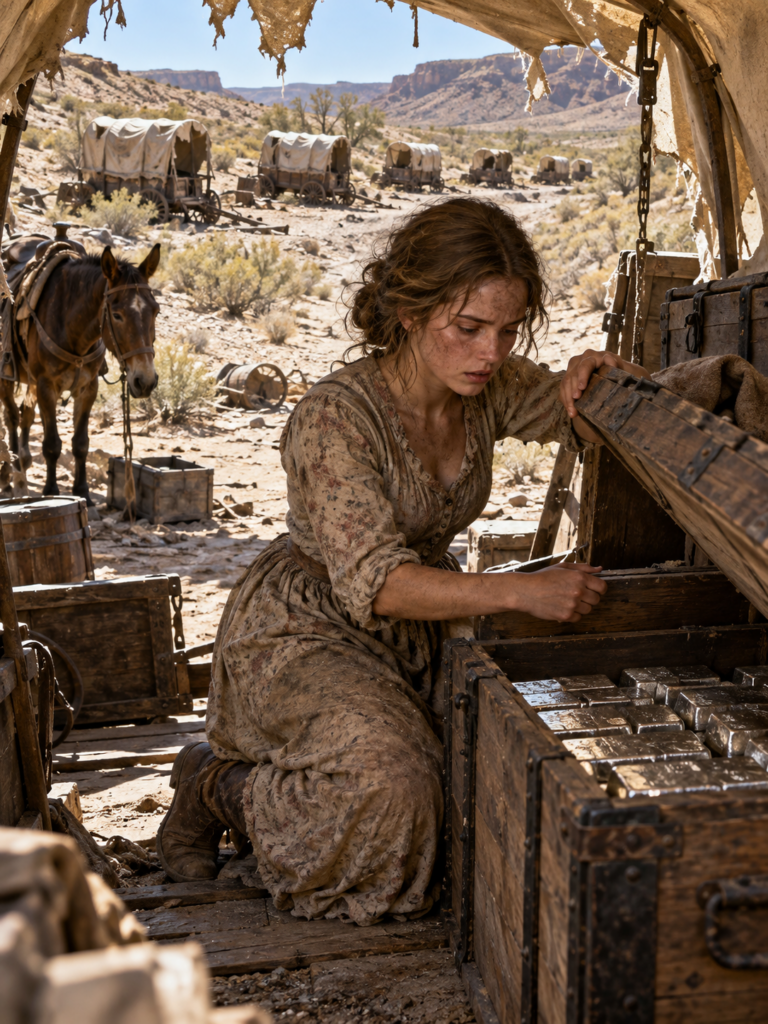
Josephine read the paragraph a second time, following each line with her finger.
Barnaby Threll wrote that he had once worked alongside Nathaniel Ainsworth and Nathaniel’s older brother, Ezekiel.
He remembered them as honest freight men.
If any member of their family was still living in the territory, Barnaby hoped the finder might seek their assistance.
Josephine sat very still.
The man who had written these words could not have known that Nathaniel’s daughter would discover his wagons.
He had not addressed the letter to her.
Yet she was holding it.
For the first time since leaving Halverson’s Bend, she felt her father close enough to remember without struggling to picture his face.
She had been eleven when he died.
Seven years had made his voice less distinct.
But here was another man’s testimony that Nathaniel had been respected and remembered.
She turned back to the beginning of the letter.
Barnaby had written it during the convoy’s journey from Fort Purgatory.
He described an enormous shipment of silver bullion transported for influential men associated with the territorial government at Prescott.
According to his account, the silver was being moved through private arrangements, away from the attention of federal auditors.
No legitimate owner, he believed, would willingly acknowledge the cargo.
Josephine glanced toward the open crate.
That explained the hidden placement behind the supplies.
It did not explain exactly how the men died.
The broken axle, missing teams, and empty canteen suggested disaster during the journey.
But the evidence did not establish a single complete sequence.
She returned to the letter.
Barnaby described the broker who had arranged the shipment.
He did not provide a name.
He did provide a location.
A lawyer’s office on the plaza in Santa Fe.
Josephine felt a small change in her breathing.
Silas Merryweather had come from Santa Fe.
And the attorney’s card he had given her carried an address on the plaza.
She reached into her belt pouch.
The card was still there.
She placed it beside the letter.
The same city.
The same plaza.
But that alone proved very little.
Several lawyers might have worked in the same district.
She refused to treat an uncomfortable coincidence as proof of a connection.
Then she continued reading.
The gold in the tin box, Barnaby explained, was different from the silver.
It represented his personal savings.
He had accumulated it over eleven years for his eight-year-old niece, Hattie, who lived at Fort Cottonwood with the aunt caring for her.
He had intended to leave the freight roads and provide the child with greater security.
A proper stove.
A milk cow.
A chance to attend school.
Now the money lay beneath Josephine’s hand.
Barnaby had asked whoever found it to take it to his longtime friend Cornelius Ashby, an assayer in Requa Springs.
He also permitted the finder to take only a reasonable amount of silver for necessary expenses.
Josephine read that instruction carefully.
She was nearly penniless.
Her water was gone.
The mule was exhausted.
And nobody knew she was in the wash.
She could take the gold and disappear.
She could load the mule with silver until it could carry no more.
But somewhere a child was waiting for support that would never arrive unless someone acted.
Josephine folded that page back.
There was one more object she had not examined.
The small leather-bound ledger.
She opened its brass clasp.
Inside were columns of dates, places, initials, and abbreviated entries.
Some pages appeared to record ordinary transactions.
Others contained repeated combinations of letters she could not understand.
She turned back to the first page.
Seven sets of initials were listed there.
The final entry included a short location notation.
Santa Fe Plaza office.
And beside it were the initials E.C.
Josephine took up Silas’s card again.
Emmett Crowley.
E.C.
She placed the card directly alongside the ledger.
The matching initials did not establish Crowley’s involvement by themselves.
But Barnaby’s description of the broker, the office location, and the ledger entry now pointed in the same direction.
Josephine remembered how Silas had pressed the card into her hand as she left the property.
She had thought it was an insincere attempt at kindness.
Now she wondered whether it had served another purpose.
Perhaps Silas and Crowley were connected only through an ordinary legal arrangement.
Perhaps Silas knew more.
She could not tell.
But she had enough reason to preserve both the card and the ledger.
Outside, her mule shifted in the shade.
Josephine looked from the gold to the silver and then to the letter.
The answer to one question was clear.
The gold belonged to Barnaby’s intended beneficiary, not to the finder.
The larger silver shipment had a far more troubling history.
And the evidence connecting that shipment to a Santa Fe office might also bear upon the man who had taken her home.
Josephine closed the ledger.
She placed Crowley’s card between its pages.
Then she began wrapping the documents in oilcloth, making a decision that could carry her into far greater danger than the desert had already presented.
She would take the evidence to Cornelius Ashby.
But first she had to decide exactly what to remove from the six wagons—and how to leave enough behind for honest witnesses to verify what she had found.
Josephine tightened the oilcloth around the ledger and secured it with a length of cord.
Then she returned to the open silver crate.
The decision before her was no longer whether the metal was valuable.
She knew it was.
The question was how much she could justifiably carry away without taking possession of a shipment that had never belonged to her.
Barnaby’s letter permitted a reasonable finder’s wage.
But Josephine had no way of knowing the proper value of a silver bar.
Nor could she know how a territorial official might interpret her possession of the metal.
She thought of Ezekiel counting wagon loads at Halverson’s Bend.
Her uncle never accepted a driver’s estimate when he could make his own calculation.
If a load was disputed, he wanted weights, tallies, witnesses, and marks that could be checked.
Josephine took four silver ingots.
No more.
She wrapped them separately in a strip of damaged canvas, then fastened the bundle securely.
She carefully replaced the remaining bars, folded the oiled covering back into the crate, and fitted the lid where it belonged.
The nails she had collected in her hat went back into their holes.
When she finished, the iron bands rested against the wood much as they had before she touched them.
She stood looking at the crate.
The shipment was still there.
Anyone who examined the wagons would have the opportunity to verify her account.
She returned to the lead wagon and collected Barnaby’s tin box.
The gold coins remained in their original rolls.
The letter, waybill, ledger, and pocketknife went into the satchel.
She had already counted the contents.
Now she intended to keep them together.
Outside, the afternoon was slipping toward evening.
She went to the three dead men.
One at a time, she covered them with pieces of canvas taken from the damaged wagons.
She used stones to hold the fabric in place.
Then she stood quietly beside each body.
She remembered the words Ruth Ainsworth had once spoken at a burial in Thistlewood Crossing.
Her mother had believed that nobody should leave the world without some acknowledgment of having lived in it.
Josephine spoke softly.
There was no one there to hear except the mule.
When she finished, she looked toward the dead man beside the lead wagon.
She believed he was Barnaby Threll.
The location of the tin box and letter supported that identification, although she could not yet confirm it independently.
He had left behind much more than money.
He had left a record.
And Josephine had to make sure it reached someone able to understand it.
She fastened the gold and silver behind the saddle, checked the mule’s cinch, and secured the oilcloth satchel where she could keep one hand against it while riding.
Then she took out Ezekiel’s compass.
The brass case felt familiar in her palm.
She opened it.
The needle settled.
Requa Springs lay beyond the dry country to the northwest.
She led the mule up the sloping wall of the wash.
At the rim, she stopped once to look back.
Six wagons remained in the afternoon shadow.
From that distance, their broken outlines seemed almost ordinary.
Without knowing what they carried, a traveler might have mistaken them for the remnants of another unsuccessful freight journey.
Josephine turned away.
She had enough water left for only a few cautious swallows.
The mule was old.
The road was uncertain.
And the weight on its saddle was now far more consequential than the eleven dollars hidden inside her coat.
That night she camped among low piñon trees.
There was little food remaining.
She ate a portion of hardtack and lay beneath her blanket, keeping Barnaby’s satchel close.
Sleep came slowly.
She thought about Hattie Threll.
An eight-year-old girl who had already lost her parents.
Josephine remembered being eleven and watching two graves close over the only home she had known.
She remembered how desperately she had wanted someone to tell her what would happen next.
Ezekiel had given her a place to sleep, food, work, and skills.
He had never been able to speak easily about love.
Yet he had made sure she knew how to survive.
Barnaby had wanted something similar for Hattie.
He had saved his wages because he believed an orphaned child should have more possibilities than the world had provided.
Josephine touched the tin box.
She could not undo the man’s death.
But she could carry out the responsibility he had entrusted to an unknown finder.
By the next morning, the mountain notch above Requa Springs was visible.
She kept the mule at a steady walk.
Its age concerned her more than the remaining distance.
When it stopped, she let it recover.
When the ground became uneven, she dismounted and led it.
She had learned that a broken animal in empty country could become a fatal mistake.
As the settlement drew closer, she began rehearsing what she would tell Cornelius Ashby.
Not the suspicions first.
The facts.
The six wagons.
The broken axle.
The three bodies.
The unusual freight.
The private documents.
The gold.
The letter.
Then the possible connection to Crowley’s office.
She would not accuse a man of wrongdoing merely because his initials appeared in a book.
But neither would she conceal what she had found.
When she finally reached Requa Springs, the main street was dusty and quiet.
Josephine led the mule past the livery and stopped before a small assay office with a tin awning.
She gathered the packages from the saddle.
The mule turned its head toward her as though asking whether the journey had finally ended.
“I hope so,” she whispered.
She opened the office door.
A brass bell sounded above her.
Behind the counter sat a gray-haired man with spectacles and ink-stained fingers.
He looked up from his work.
“Can I help you?”
“Are you Cornelius Ashby?”
“I am.”
Josephine placed the tin box on the counter.
Then the four ingots.
Finally, she opened the satchel and unfolded Barnaby’s letter.
“I believe these belonged to a friend of yours.”
Ashby did not immediately touch the papers.
His attention settled first on the worn pocketknife she placed beside them.
He examined it for several seconds.
Then he read the letter.
He read every page.
When he finished, he began again.
Josephine watched his expression become increasingly grave.
At last he laid the papers down.
“Where did you find him?”
She described the wash.
The wagons.
The three men.
Ashby listened without interruption.
Then he asked how much freight she had removed.
“Four silver bars. Every coin from the tin.”
“And the rest?”
“Still there.”
He studied her.
“Why didn’t you take more?”
“Because I don’t know who owns it.”
She touched the gold box.
“And that belongs to the little girl.”
For the first time, Ashby’s expression softened.
He asked her name.
“Josephine Ainsworth.”
He repeated the surname.
Then he asked about her father.
“Nathaniel. He died seven years ago.”
“And your uncle?”
“Ezekiel Ainsworth.”
Ashby leaned back.
He remembered both men.
He had encountered Nathaniel during his freight years and knew of Ezekiel’s work on the southern roads.
For Josephine, hearing another living person speak about her father was nearly as unsettling as finding his name in Barnaby’s letter.
She had expected to arrive as a stranger.
Instead, she had entered a room containing pieces of her family’s past.
Ashby took the documents into his back office.
He opened a fresh page in his business ledger.
The first task, he said, was to count the gold properly.
They broke open the paper rolls and arranged the coins in groups.
Fifteen rolls of twenty.
Eleven additional coins.
Three hundred eleven double eagles.
Their face value was exactly $6,220.
Ashby wrote down the amount.
Then he passed Josephine the pen.
She signed beneath his entry as a witness.
The simple act affected her more than she expected.
A week earlier, Silas Merryweather had presented papers that stripped her of the only home she knew.
Now she was signing a record intended to protect someone else’s property.
Ashby examined the silver next.
He weighed each bar on his assay scale and tested a sample against a black stone.
He studied the stamped markings.
He had worked with silver for decades.
Yet he did not recognize the die.
That did not prove every allegation in Barnaby’s letter.
But it reinforced the need for an official investigation into the shipment’s origin.
Josephine brought out the leather-bound ledger.
Then she removed Crowley’s card from between its pages.
She placed both on the table.
Ashby read the card.
He examined the initials in Barnaby’s book.
“Where did you get this?”
Josephine told him about Silas Merryweather.
How the man arrived after Ezekiel’s death.
How he claimed the property.
How he produced documents and gave her eleven dollars.
And how he handed over Crowley’s card before she rode away.
Ashby asked her to repeat the exact sequence.
She did.
Then he asked whether she had seen Silas communicate with Crowley.
“No.”
Had Silas mentioned the silver shipment?
“No.”
Had Josephine ever seen the ledger before finding it in the wagon?
“Never.”
Ashby was quiet for a long time.
The matching initials and office address were significant leads, he said, but a complete explanation would require more evidence.
Josephine felt strangely relieved by his caution.
She did not need someone to tell her that every suspicion was true.
She needed someone willing to find out.
Ashby suggested they speak to the local deputy, Delroy.
Josephine hesitated.
Barnaby had warned the finder not to take his papers directly to officials in Prescott.
Ashby understood.
They would begin locally, document the discovery, and make careful decisions about who received the sensitive ledger.
In the deputy’s office, Josephine described the abandoned wagons once more.
Delroy took notes.
He asked about the location, the number of bodies, the visible damage to the convoy, and the material she had removed.
She answered in the same order each time.
When he asked whether she would accompany a recovery party, she agreed.
The men deserved burial.
And the silver required an inventory.
The next morning, Josephine rode back toward the wash with the deputy and a small party of men.
The journey was difficult, but the wagons stood where she had left them.
The party documented the scene.
They recovered the three bodies.
They brought the silver crates back under supervision.
The dead men were buried near Requa Springs beneath simple markers.
Josephine attended each burial.
The original discovery had been hers.
But the responsibility for what followed now belonged to more than one person.
Back in town, Ashby and Delroy began the work of securing the shipment and preserving the records.
Josephine did not surrender the meaning of Barnaby’s letter to the rumors that began spreading through the settlement.
Some people wanted to know the value of the silver.
Others wanted to know whether she would become rich.
She answered cautiously.
A man had died leaving instructions for his niece.
Those instructions came first.
As for the silver, its legal ownership and final destination had not yet been determined.
The facts had to be established before anyone made claims.
Then, several days after the burials, an unfamiliar gentleman arrived in Requa Springs.
He wore polished boots, a black frock coat, and small round spectacles.
He carried a leather portfolio and a silver-headed cane.
Josephine saw him enter Dorcas Vandermir’s boarding house.
The landlady addressed him as Mr. Crowley.
Josephine stopped in the hallway.
She knew that name.
The man who had been only a printed card in her pocket was now standing a few yards away.
And she realized that the evidence from the wash had already begun drawing attention from the people it might expose.
Josephine stood in the boarding house hallway until Emmett Crowley disappeared into his room.
Then she went downstairs.
Dorcas Vandermir was setting supper dishes along the long table.
“That gentleman,” Josephine said quietly. “Did he say how long he was staying?”
“Only a short visit, so far as I know.”
Josephine nodded.
She did not explain.
She had spent enough time among freight men to understand that people sometimes revealed more when they believed nobody was especially interested in them.
Crowley had arrived from Santa Fe.
That was established.
He had the same name as the lawyer on Silas Merryweather’s card.
That was established too.
But his presence did not prove he had personally arranged the silver shipment or known about the dispossession of Josephine’s home.
She needed to keep those distinctions clear.
At supper, Crowley was placed near the far end of the table.
Josephine ate in her usual seat.
He spoke to several guests before directing a question toward her.
Had she traveled far to reach Requa Springs?
“From the east.”
Was she staying permanently?
“I’m working with Mr. Ashby at present.”
Crowley smiled politely.
He made a pleasant remark about the town and returned to his meal.
Nothing he said was openly threatening.
That troubled Josephine less than the possibility that he had come to determine what she knew.
She did not discuss the wagons.
She did not mention the ledger.
She answered only the questions put to her.
The following morning, Crowley left on the southbound stage.
Josephine watched the coach roll away.
Then she went directly to the assay office.
Ashby listened to her account.
He did not seem surprised.
The leather-bound ledger had already been entrusted through a carefully arranged private channel for examination by federal authorities.
The silver remained under documented supervision.
And the gold was being handled separately according to Barnaby’s written wishes.
Josephine asked whether Crowley’s visit meant the inquiry was compromised.
“It may mean he is concerned,” Ashby answered. “But concern isn’t proof of what he knows.”
She accepted that.
For years she had watched Ezekiel refuse to make accusations without evidence.
A bad reputation might attach itself to a person in an afternoon.
Removing it could take a lifetime.
She would not turn Barnaby’s account into a collection of unsupported claims.
Four days after Crowley’s departure, a rider arrived from Prescott.
He was United States Marshal Whitfield Renick.
He met privately with Ashby, Deputy Delroy, and Josephine.
The marshal had received the leather-bound ledger.
Its entries were being examined alongside information gathered during an investigation that had already occupied him for years.
He knew of allegations concerning unlicensed silver and the movement of bullion through private commercial arrangements.
What he had lacked was a durable set of records connecting names, dates, shipments, and transactions.
Barnaby’s ledger offered that possibility.
Renick asked Josephine to describe the day Silas came to Halverson’s Bend.
She told him about Ezekiel’s death.
The unexpected claim of half-brotherhood.
The legal paper.
The eleven dollars.
The card.
The marshal listened carefully.
Then he asked again.
He wanted to know the order in which Silas had presented the documents and whether anyone else had been present.
Josephine answered.
He asked a third time about the card.
Had Silas merely offered it?
Or had he instructed her to contact Crowley?
Josephine described the conversation as accurately as she remembered it.
She would not invent a stronger statement merely because a stronger statement might help the investigation.
When she finished, Renick closed his notebook.
The documents associated with Silas’s claim, he explained, would need to be examined separately.
Their legal validity could not be established from Josephine’s memory alone.
But the circumstances warranted attention.
Josephine asked one question.
“If those papers are wrong, what happens to the house?”
Renick explained that a court could examine the transfer and decide whether it should stand.
He could not promise her a particular result.
Nor could he promise that every person implicated in the bullion arrangements would face criminal punishment.
The evidence would have to survive scrutiny.
Josephine considered his answer.
Then she surprised him.
“I don’t want to go back.”
The marshal looked up.
She thought of the plank house.
Ezekiel’s chair beside the stove.
The tin cups on the table.
The room she had slept in for seven years.
She remembered Silas sitting across from her, drinking coffee she had prepared while informing her that her home belonged to him.
For days after leaving, she had imagined returning to that kitchen.
She had pictured forcing him to leave exactly as he had forced her to leave.
But somewhere between the dry wash and Requa Springs, that desire had changed.
“I want the papers examined,” she said. “And if they were obtained improperly, I want them set aside.”
Renick waited.
“Then what?”
Josephine folded her hands.
“I want the next person to have a better chance than I did.”
She had learned that losing a home could take less time than proving one had a right to remain.
If the same practices had been used against others, correcting her own loss was not enough.
The marshal wrote down her answer.
The inquiry continued through the winter.
Records were obtained and compared.
Witnesses were questioned.
The documents associated with Silas’s claim were scrutinized alongside other property transfers involving vulnerable owners.
Investigators established a pattern of questionable transactions connected with the same notarial arrangements.
In February, the district court at Prescott set aside the deed to the Halverson’s Bend property.
The decision did not mean Silas Merryweather was convicted of a crime.
He was not indicted.
But the paper that had displaced Josephine no longer stood.
Other transfers associated with the same questionable practices were also brought under scrutiny.
The house was eventually sold at auction.
Josephine did not attend.
She had no wish to see the porch again.
Her relief came from knowing that the document used against her had been challenged and invalidated.
Crowley’s firm in Santa Fe later dissolved.
The investigation into the silver continued.
A privately operated mill associated with the suspect bullion was eventually located and dismantled.
Yet Josephine never received a simple account in which every powerful man confessed, every allegation became a conviction, and every wrong was answered by punishment.
The law moved unevenly.
Some people escaped charges.
Some questions remained difficult to prove.
She came to understand that exposing a dishonest system did not guarantee that every participant would face the same consequences.
But the records Barnaby had preserved made concealment harder.
His handwritten book had supplied something investigators could examine independently of rumor or frightened testimony.
The discovery of the six wagons had become more than a tale about lost treasure.
It had uncovered evidence of a hidden commercial operation.
And the trail of that evidence had reached the legal machinery that once appeared unassailable to Josephine.
Meanwhile, the gold was being handled according to an entirely different obligation.
Ashby counted it publicly in Josephine’s presence before entering it into the records of the arrangement for Hattie Threll.
The total remained $6,220.
Every coin was accounted for.
Josephine had never regarded the money as hers.
But she wanted to see that Barnaby’s intentions were honored as closely as possible.
She wrote to Hattie at Fort Cottonwood.
The letter was short.
Josephine explained that Hattie’s uncle had saved money for her over many years.
That he had thought carefully about her future.
And that arrangements were being made for the household caring for her.
She did not describe the dead men in the wash.
She did not explain the covert silver shipment.
Barnaby himself had hoped the child could receive the benefit of his savings without carrying the burden of the dangerous circumstances surrounding them.
Josephine respected that wish.
Ashby later traveled to Fort Cottonwood with the first portion of the gold.
He remained several days to help arrange the promised support.
A stove.
A milk cow.
Schooling.
When he returned, he brought Josephine a reply.
It was written in a child’s painstaking hand.
Josephine read it slowly.
Hattie thanked her for helping carry out her uncle’s wishes.
Josephine folded the letter and placed it beside Barnaby’s original pages.
For the first time, the oilcloth satchel held an answer.
Barnaby had written in fear that his convoy might never complete the journey.
He had entrusted his savings and his words to whoever discovered the wagons.
And now a child who had never met Josephine knew that her uncle had not forgotten her.
That mattered more to Josephine than the silver’s enormous value.
The bullion itself had a different fate.
The recovered shipment was inventoried under official supervision.
One hundred sixty crates were counted.
Together they contained 3,200 silver bars.
The inventory was conducted openly in Requa Springs, with officials and townspeople serving as witnesses.
The metal was later transferred under federal seal to a territorial vault in Prescott.
Its disposition was not immediately decided.
The government still had to determine what could legally be done with property whose original arrangements had been concealed and whose alleged owners were unwilling to claim it openly.
Two years later, according to the account, legislation directed the proceeds toward widows and orphans from the mining districts.
The outcome carried a particular meaning for Josephine.
The silver had been concealed on behalf of men who already possessed influence and wealth.
Eventually, its value was directed toward people whose circumstances resembled her own childhood.
Families who had lost wage earners.
Children whose prospects had narrowed with a death.
Women left responsible for households they could scarcely support.
She knew that money could not undo those losses.
It could, however, purchase food, tools, shelter, and schooling.
Her mother had taught her how important those ordinary things were.
Barnaby had understood it as well.
So had Ezekiel, though he had expressed his understanding through work rather than affection.
Josephine began to see a connection among the three people who had shaped her life.
Ruth had taught her to read.
Nathaniel had taught her to count freight and understand its value.
Ezekiel had taught her to judge the integrity of both wagons and men.
Those lessons had brought her into the wash.
They had allowed her to recognize the concealed shipment, calculate the gold, preserve the documents, and resist the temptation to treat found property as something she could take without consequence.
She had not arrived there because a dead man had somehow arranged for her to discover it.
Barnaby could not have known she would come.
She had followed a smell she had misidentified, suffered the loss of her water, and reached a place she had never intended to visit.
The coincidence was extraordinary.
But the meaning she gave it came from what she chose to do afterward.
And that choice began changing her life.
Dorcas Vandermir gave Josephine a place at her boarding-house table.
Wendel Kirkpatrick, the local smith, examined the exhausted mule and replaced its worn shoes.
He refused payment.
The animal had carried her through dangerous country, he said, and deserved sound footing for its remaining years.
Josephine found herself surrounded by people who offered help without first calculating what they could take from her.
At first she did not know how to accept it.
After years with Ezekiel, who provided care through instruction and practical work, she had grown accustomed to affection being hidden beneath usefulness.
The people of Requa Springs sometimes offered help simply because they wanted her to remain.
Ashby offered her work in the assay office.
He taught her to operate the beam scale accurately, examine metal, and maintain careful records.
Josephine learned quickly.
She had already spent seven years around freight and tools.
The discipline of the assay office felt familiar.
Each weight had to be checked.
Each amount recorded.
A small error could become a large dispute if allowed to pass uncorrected.
Within weeks she was helping maintain the office ledgers.
Later she was trusted to sign receipts under Ashby’s authority.
She began earning wages that belonged to her.
She rented a small room above the feed store.
Its window faced east, toward the country she had crossed after leaving Halverson’s Bend.
Some mornings she stood there with Ezekiel’s compass in her hand.
She opened the scratched brass case and watched the needle settle.
It still pointed north.
There had been a time when that instrument represented the only direction left to her.
Now it reminded her how far she had traveled.
In the following spring, a group of men from Requa Springs rode to Halverson’s Bend to bring Ezekiel’s remains to the cemetery near town.
Josephine had considered the matter carefully.
She did not want the old property back.
But she wanted her uncle remembered among people who respected the life he had lived.
The men returned with a plain pine coffin.
Ezekiel was buried near the three freight drivers recovered from the wash.
Josephine stood before his grave.
She thought about the years when she had waited for him to say he was proud of her.
He never had.
For a long time, she had interpreted that silence as the measure of what he felt.
But the compass in her pocket told a different story.
He had trusted her with something valuable.
He had taught her skills that required patience and judgment.
He had prepared her to travel through a world where he would not always be present.
Standing beside his grave, Josephine allowed herself to understand that his care had been imperfect but real.
She did not excuse his emotional distance.
She simply stopped treating it as evidence that she had meant nothing to him.
She touched the compass through her coat.
Then she stepped away.
Her life in Requa Springs continued.
The town became less a place of temporary refuge and more the home she was choosing for herself.
She knew the people who worked along the street.
She knew the sound of the assay-office bell.
She knew which boards on the boarding-house porch creaked after rain.
She knew the rhythm of the mule’s hooves when she led it back from the corral.
These were small things.
But after losing her parents, her uncle, and the place where she had grown up, small things had become precious.
The world no longer seemed divided only between people who possessed property and people who could be driven away from it.
She had seen an entire town help protect an orphan’s inheritance.
She had watched officials recover and document a shipment that powerful men had intended to keep out of sight.
She had seen a dishonest property transfer challenged successfully.
And she had found work that depended on her ability rather than her willingness to surrender.
Not every uncertainty disappeared.
She could never know exactly what happened during the final hours of Barnaby’s convoy.
The broken axle and abandoned teams offered clues, but not a complete account of every man’s last decision.
She could not establish precisely what Silas knew about the bullion operation when he handed her Crowley’s card.
The suspicious connection mattered.
The legal investigation uncovered a larger pattern.
But the evidence did not allow her to invent thoughts or private agreements she had never witnessed.
Josephine learned to live with those limits.
The truth was not weakened by admitting what remained unknown.
In some ways, it became stronger.
She kept Barnaby’s letter.
She kept Hattie’s reply.
And she kept the compass.
Those objects were smaller than the smallest silver crate in the wash.
Together, they carried the part of the story she valued most.
A dead freighter’s care for his niece.
A child’s gratitude.
And an old wagon master’s effort to prepare his orphaned niece for the road ahead.
Years passed.
Josephine became known in Requa Springs not merely as the girl who discovered the silver but as a capable woman who understood freight, accounts, and the difficult work of maintaining trust.
She had occasion to explain the discovery many times.
People liked to begin with the fortune.
Six abandoned wagons.
Thousands of silver bars.
More than six thousand dollars in gold.
They liked to imagine how easily she might have vanished with enough wealth to live comfortably.
Josephine never pretended the possibility had not occurred to her.
She had been eighteen, thirsty, and penniless.
The temptation was real.
But she had also seen the three dead men.
She had read Barnaby’s instructions.
She had learned that the gold had an intended recipient.
And she had found evidence suggesting the larger silver shipment was connected to concealed transactions.
Taking everything would have been a choice.
It would not have been an innocent accident.
Once, when someone asked whether she regretted leaving most of the silver behind, Josephine considered the question.
Then she answered that she had taken away what she needed.
Not merely the four ingots permitted as a finder’s wage.
The information.
The documents.
The means to see that Hattie received her inheritance.
And the knowledge that the man who had taken her home could be challenged.
What she had gained was not simply money.
It was the ability to make a decision without allowing poverty, fear, or resentment to make it for her.
She had ridden away from Halverson’s Bend believing her life had been reduced to eleven dollars.
That amount was real.
But it had not measured everything she possessed.
She still had her mother’s education.
Her father’s familiarity with the freight roads.
Ezekiel’s practical knowledge.
The old mule.
And the compass.
She had arrived at the wash with very little property, but with enough understanding to recognize what she had found.
And enough judgment to decide what should happen next.
On quiet evenings, she sometimes took Barnaby’s letter from its oilcloth wrapping.
She did not need to read all four pages anymore.
She knew their contents.
Her attention usually settled on the passage where Barnaby mentioned Nathaniel and Ezekiel.
Two names written by a man who had remembered them long after their paths separated.
Josephine could not recover her father.
Nor could she make her uncle speak the words he never learned to say.
But she could preserve the evidence that they had lived honestly enough to be remembered by someone else.
And she could carry their lessons forward.
When she finally closed the letter, she returned it to its wrapping beside Hattie’s reply.
Then she opened the compass.
Its chipped glass caught the lamplight.
The needle moved briefly before becoming still.
Years earlier, Ezekiel had placed that instrument in her hands because he believed she would someday need to know where she was going.
He could not have imagined six abandoned wagons, a dead friend’s letter, or the fortune hidden beneath ordinary freight.
He could not have known that a lawyer’s card would connect the loss of her home to a much larger inquiry.
And he could not have promised that the child he raised would find people willing to welcome her when she arrived at the end of the road.
But he had given her the means to continue.
Josephine closed the compass and placed it safely away.
Outside, the evening settled over Requa Springs.
The office accounts were balanced.
The mule was fed.
The door to her room was hers to close.
And the eleven dollars that once seemed to represent the whole of her future had become the beginning of a story about something far more valuable than the fortune in the wash.
The gold had reached the child for whom it was saved.
The silver had been recovered and accounted for.
The hidden records had been exposed to investigation.
And Josephine Ainsworth, who had been sent away with almost nothing, had found a place where her worth was no longer decided by another person’s claim to what she owned.
For the first time since she buried her parents, she no longer needed to wonder where she belonged.
She had made a home.
And nobody had given it to her as a favor.
She had found her way there.


