
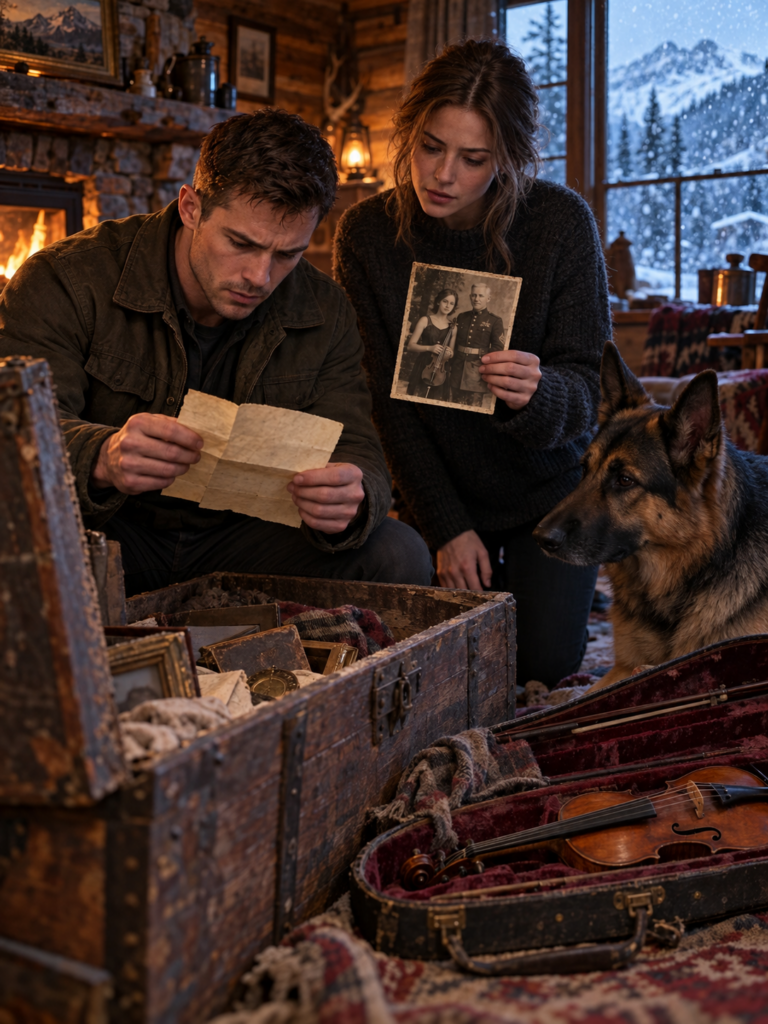
The cassette mechanism clicked, and a low hiss filled the living room.
Declan adjusted the volume.
For several seconds, only static emerged.
Then a man’s voice came through.
His grandfather’s voice.
Younger than Declan remembered, but unmistakable.
“She can’t go home.”
The recording crackled.
A few words disappeared beneath the damaged audio.
Then Wesley spoke again.
“If anyone asks, I never saw her.”
Declan pressed stop.
Camille remained completely still.
Vesper raised his head from the rug.
“That doesn’t sound good,” Declan said.
Camille looked at the photograph of Evelyn Harland.
“It doesn’t tell us why he said it.”
Declan glanced toward the newspaper clipping.
Evelyn had been twenty when she disappeared.
Wesley had known her.
He had kept her violin.
And now there was a recording suggesting he intended to deny seeing her.
For the first time in his life, Declan wondered whether the grandfather who taught him to keep promises had been keeping one at someone else’s expense.
He disliked the thought immediately.
“My grandfather wasn’t the kind of man who would hurt somebody.”
“I haven’t said he was.”
“But you’re thinking it.”
Camille answered carefully.
“I’m thinking we have a fragment of a conversation. We need the rest.”
Declan looked at the recorder.
She was right.
He rewound the tape and pressed play again.
This time, he let the damaged section pass.
Wesley’s voice returned, explaining why Evelyn had needed help.
She had received an opportunity to pursue music studies outside Colorado.
Her father refused to let her go.
He controlled her money, transportation, and correspondence.
According to Wesley, Evelyn had tried repeatedly to leave, only to face tighter restrictions.
Eventually, she stopped asking anyone to convince her father.
She wanted to leave without his permission.
And she asked Wesley to help.
Declan leaned toward the recorder.
On the tape, Wesley described their arrangement.
He would meet Evelyn at 11:40 on South Road.
He would drive her away from Durango.
And he would not tell her family where she had gone.
The handwritten note was not evidence of a threatening meeting.
It was a plan for an escape.
Wesley drove Evelyn south and left her at a bus station in New Mexico.
She deliberately refused to tell him her final destination.
That way, if someone questioned him, he could truthfully say he did not know.
Camille looked toward the violin.
“Why did she leave it?”
The recording answered.
The instrument had been damaged before Evelyn departed.
Traveling with it also risked making her easier to identify.
So she entrusted it to Wesley.
She told him she would retrieve it someday, when she felt safe.
The tape ended.
For a long moment, nobody moved.
Declan looked at the newspaper clipping.
The article had not been false about Evelyn’s disappearance.
Her family genuinely did not know where she had gone.
But the assumption that she had vanished through some unknown misfortune was incomplete.
Wesley knew she had left deliberately.
And he had protected her decision.
“She wasn’t missing to everyone,” Camille said.
“No,” Declan replied.
He looked at his grandfather’s photograph.
The same image that had disturbed him minutes earlier now carried a different meaning.
Wesley had not necessarily been concealing wrongdoing.
He had been protecting someone’s freedom.
Yet another question remained.
If Evelyn planned to reclaim her violin, why had Wesley still been responsible for it decades later?
Had she never returned?
Had something prevented her?
Or had she chosen to leave the instrument behind permanently?
Declan began replacing the concert programs and photographs.
He lifted the shallow wooden tray holding the tapes.
Then his fingers paused.
The interior depth of the chest felt wrong.
He checked the exterior.
The bottom should have been several inches lower.
“Camille.”
She leaned closer.
Declan pressed along the tray supports.
A thin strip of wood shifted.
Beneath it was a false bottom.
He lifted the panel.
There was no money.
No additional photographs.
Only a single envelope.
The postmark read 2008.
On the back, written in a woman’s handwriting, was one name.
Evelyn.
Declan held it carefully.
Nineteen years after her disappearance, Evelyn Harland had apparently written to his grandfather.
If this was truly her letter, Wesley had received news of her long after helping her escape.
But what kind of news?
Camille watched as Declan slipped one finger beneath the envelope flap and began opening it.
Declan opened the envelope without tearing the fragile paper inside.
The letter had been folded twice.
He unfolded it carefully.
The first line made him stop.
“Wesley, I don’t know if you still have my violin, but I’m finally writing because I’m safe.”
He read it again.
Then he handed it to Camille.
She sat beside the fireplace and continued reading.
Evelyn Harland had survived.
Nineteen years after leaving Colorado, she had written to the man who helped her escape.
She described building a life under a different surname.
She had married.
She had children.
And she had lived for years beyond the control of the family she left behind.
The letter did not provide every detail of her life.
It wasn’t intended to.
She thanked Wesley for honoring his promise.
He had not searched for her.
Had not tried to discover where she lived.
Had not revealed her destination to anyone.
Even when he must have wondered whether she was safe, he had respected the boundaries she established.
Near the bottom, Evelyn wrote one more request.
“Please keep the violin a little longer. Someday I may be brave enough to hear it again.”
Camille read the sentence twice.
Then she lowered the page.
“She was alive in 2008.”
Declan nodded.
“And she wanted him to keep it.”
That explained the hidden chest.
Or at least part of it.
The concert programs, photograph, newspaper clipping, and tapes had been preserved around a promise Wesley refused to break.
He had kept the story private because Evelyn had asked him to.
And he had kept the violin because she had not yet asked for it back.
But another question had emerged.
If Evelyn wanted Wesley to keep the instrument in 2008, why had he eventually sent it to Emmett Ashford for restoration?
Something must have changed.
Camille glanced toward the work order.
“Your grandfather wrote that it had to be returned in person.”
Declan examined the document.
The instruction was clear.
Personal return only. Do not ship.
“That suggests he expected somebody to receive it.”
“Maybe,” Camille replied. “But we shouldn’t assume more than the papers tell us.”
Declan looked at her.
“You sound like your father.”
She smiled faintly.
“He was very particular about what could be proved.”
Outside, snow slid from the workshop roof.
The road to Durango was open.
Camille had already packed her suitcase.
But she looked at the violin, then at the chest.
“I can stay another hour.”
That hour became the afternoon.
They examined the remaining papers carefully, separating what Wesley had documented from what they were merely guessing.
There was no evidence that Evelyn had died.
No evidence that Wesley had harmed her.
No proof that the violin’s restoration meant she intended to return to Colorado.
But the work order established that Wesley had entrusted the instrument to Emmett.
And the note from Wesley established that he wanted it kept safe until its intended recipient requested it.
Camille understood that responsibility immediately.
Her father had spent decades restoring instruments associated with difficult family histories.
Some owners wanted to preserve a sound they remembered.
Others wanted an object repaired but couldn’t bear to see it.
An instrument could be structurally restored.
The life associated with it was more complicated.
“A restored violin doesn’t restore someone’s past,” she told Declan.
He looked toward the photograph of Evelyn.
“No.”
The discussion stayed with him.
So did Camille.
Over the next several days, they continued reviewing Wesley’s belongings.
Declan worked on the old workshop roof while Camille inspected the violin beneath the building’s north-facing windows.
The light was steady there.
It allowed her to examine the finish without harsh reflections.
Vesper often slept between them.
Declan began noticing things about Camille he had overlooked during their first conversation.
She never hurried delicate work.
She could study a seam for minutes before deciding whether it needed adjustment.
When he repeatedly measured a cedar board before cutting it, she glanced up.
“Do you always measure everything three times?”
“Only things I’d prefer not to ruin.”
“Interesting.”
“What’s interesting?”
She looked toward the violin.
“That’s what I say.”
It was the first time they laughed together in the workshop.
The sound changed the place.
Until then, Declan had regarded the building as another problem left behind by his grandfather.
A deteriorating roof.
Damaged boards.
Unused space.
Now there were tools beneath the windows, an instrument on the bench, and another person who understood the satisfaction of careful work.
The workshop no longer felt entirely abandoned.
One afternoon, Camille admitted she was considering selling her father’s business in Santa Fe.
Declan looked surprised.
“I thought restoration was what you wanted.”
“It might be.”
“Then why sell?”
She ran her thumb along the violin case.
“Because everybody assumes I’ll take over. Customers have already started treating the shop as mine. Nobody asks whether I want to run it the same way he did.”
“You love the work.”
“Yes. But loving something doesn’t mean every decision about it should already have been made.”
Declan understood.
Wesley’s cabin had become his responsibility before he had decided what place it should hold in his future.
He loved his grandfather.
He valued the property.
But those feelings didn’t automatically tell him what kind of life he wanted to build there.
For the first time, he recognized that Camille’s uncertainty was not a lack of gratitude.
It was the need to make a choice that belonged to her.
That understanding should have guided his next decision.
Instead, his curiosity about Evelyn got the better of him.
While reviewing Wesley’s papers, Declan found an old reference to another surname associated with Evelyn.
He wondered whether it might help explain the violin’s later restoration.
He searched public records.
Then he contacted a local archive to verify an old listing.
The information was incomplete.
But it suggested a possible connection to a woman whose age matched that of Evelyn’s adult daughter.
By late afternoon, Declan had written a name and telephone number on a legal pad.
He hadn’t called.
Not yet.
The workshop door opened.
Camille entered carrying her tools.
She noticed the name beside his laptop.
“Who’s that?”
Declan hesitated.
Her eyes moved toward the open records.
“You went looking for Evelyn.”
“I was checking public information.”
“That’s still looking.”
“I haven’t contacted anyone.”
“Declan.”
He closed the laptop.
“I’m trying to find out why Wesley sent the violin for restoration.”
“We can look for that in the records he left.”
“And if he didn’t leave anything?”
“Then we may have to accept that we don’t know.”
Declan felt irritation rise.
“We’re close to finding someone who might know whether Evelyn is still alive.”
“And then what?”
He looked at her.
“We ask.”
“Ask whom? A woman who has never met us? Whether she’ll tell us where her mother lives?”
“I just want to finish what my grandfather started.”
Camille folded her arms.
“How do you know that’s what he wanted?”
“Because he kept the violin.”
“He also kept his promise not to look for her.”
Declan had no immediate answer.
Camille’s voice softened.
“Your grandfather respected Evelyn’s right to decide whether she wanted contact. Finding her doesn’t give us the right to make that decision for her.”
He looked toward the closed violin case.
“We could solve this.”
“Not every closed door belongs to us to open.”
The words stopped him.
He had spent years repairing physical things because every broken board seemed to demand action.
But people were not damaged roofs.
And a mystery was not necessarily permission to interfere in someone’s life.
Camille gathered her tools.
She didn’t shout.
That made the disagreement more painful.
The following morning, her suitcase stood beside the front door.
The road was clear.
Vesper sat in the hallway watching them.
Declan came from the kitchen carrying the legal pad.
“I deleted the number,” he said.
Camille looked at him.
“And I won’t contact her.”
She waited.
“I thought I was protecting Wesley’s memory. But I was ignoring the part of him that mattered most.”
He placed the pad on the table.
“He respected Evelyn’s decision. I should, too.”
Camille studied him.
There was no attempt to turn the apology into a request for her to stay.
No argument hidden beneath it.
She lifted the violin case and set it beside Wesley’s letter.
“This stays here,” she said. “It’s never been mine.”
Then she collected her suitcase.
Declan walked her to the door.
Vesper followed them onto the porch but did not move toward the gate.
Camille returned to Durango.
She intended to leave for Santa Fe the following morning.
That evening, Declan sat alone beside the fireplace.
The violin case rested across the room.
For three years, he had believed the cabin’s silence was something he preferred.
Now it felt different.
Someone had been there, asking questions, filling the workshop with quiet sounds, challenging assumptions he didn’t know he held.
And now she was gone.
He did not reopen the public records.
He did not recover the number.
Instead, he began returning Wesley’s belongings to the storage room.
The photographs went into the chest.
Then the concert programs.
Then the three cassette tapes.
Vesper followed him to the doorway and settled on the floor.
Declan reached behind the chest for an old cassette recorder.
He remembered seeing it earlier but hadn’t examined it.
The plastic casing was scratched and yellowed.
Its weight felt unusual.
He opened the tape compartment.
A cassette was inside.
Across the label, written in Wesley’s unmistakable handwriting, were two words.
For Evelyn.
Declan stood motionless.
The play button rested beneath his thumb.
Yesterday, he would have pressed it without hesitation.
Now he looked toward Vesper.
The dog lay quietly outside the room.
Declan removed the tape.
He carried it into the living room, set it beside the violin case, and picked up his phone.
Camille answered on the fourth ring.
“Declan?”
“I found another recording.”
Silence.
“Did you listen?”
“No.”
“Why not?”
He looked at the label.
“Because you were right. Just because I can open something doesn’t mean I should decide alone.”
Camille said nothing for several seconds.
Then she asked, “What does it say?”
“For Evelyn.”
Another pause.
“I can come back,” she said.
That evening, Camille returned from Durango.
Declan took her coat.
Neither mentioned their argument immediately.
They sat beside the fireplace.
Vesper crossed the room and settled beside Camille’s chair.
Declan placed the cassette in the recorder.
He looked at her.
She nodded.
He pressed play.
Wesley’s voice emerged through the hiss.
And within the first few sentences, both realized the recording contained the missing explanation.
In 2018, Evelyn had contacted Wesley again.
This time, she was ready to reclaim her violin.
But the instrument had deteriorated during decades of storage.
Wesley had spent years searching for someone who could restore it without destroying the qualities Evelyn remembered.
Eventually, he found Emmett Ashford.
In 2021, Emmett accepted the commission.
The restoration continued even after Wesley died in 2023.
Then Emmett died in 2026, leaving the final work unfinished.
Camille had unknowingly completed the last stage of a promise that began thirty-seven years earlier.
The tape stopped.
Declan looked at the old work order.
Personal return only. Do not ship.
Now the instruction made sense.
Wesley had wanted the violin returned according to Evelyn’s wishes, not sent carelessly to an address that might no longer be hers.
And the person who had unexpectedly carried the instrument to his cabin was the daughter of the restorer Wesley had trusted.
Camille reached for the old envelope from 2008.
The address on it was years out of date.
They could try to find Evelyn.
They could also respect the boundaries she had established.
After a long discussion, they chose the only approach that allowed Evelyn to decide.
They would send one letter to the address she had previously provided.
No demands.
No request for her location.
No questions about her past.
Only news that the violin had been restored and was safe.
If she wanted it, she could contact them.
Declan placed a blank sheet of paper on Wesley’s desk.
Camille sat beside him.
Together, they began writing.
The first sentence was simple.
“Your violin has been restored.”
Declan read it aloud.
Camille nodded.
They continued carefully, using only information they knew was true.
The instrument was safe at Wesley Rourke’s cabin.
It had been restored through the work begun by Emmett Ashford and completed by Camille after his death.
If Evelyn still wished to receive it, she could contact them.
They included a return address.
They did not ask where she lived.
They did not request an explanation for the years of silence.
And they did not tell her they had searched for information about her life.
When the letter was finished, Declan read it again.
“Is that enough?”
Camille looked at the envelope.
“It’s enough for her to decide.”
The next morning, they mailed it.
Then they returned to the cabin.
Nothing happened immediately.
There was no sudden telephone call.
No message waiting when they arrived.
The violin remained in its case.
Wesley’s papers stayed where Declan had placed them.
And Camille, with work waiting in Santa Fe, eventually returned home.
Nine days passed.
Declan continued repairing the property.
He finished the workshop roof and replaced the remaining damaged boards.
The north-facing windows were still dusty.
The broad workbench Camille had used remained beneath them.
Vesper sometimes wandered into the room, sniffed the bench, and lay down for a few minutes.
Declan found himself looking toward the empty place where Camille had worked.
He missed her.
That was no longer something he could disguise as curiosity about the violin.
He missed the quiet concentration.
The arguments over small details.
The sound of her laugh when he measured a board more times than necessary.
But he had no intention of using the unfinished mystery to keep her there.
She had a life of her own.
And the argument between them had taught him what happened when someone confused caring with deciding for another person.
On the tenth afternoon, Camille called.
“How’s the violin?”
Declan looked toward the case.
“Still here.”
“Have you checked the humidity?”
He glanced at the room.
“Not today.”
Camille sighed.
“Declan.”
“What?”
“It’s a recently restored instrument. Colorado winter isn’t exactly forgiving.”
She explained that changes in temperature and humidity could affect the repaired seams and stabilized wood.
The violin needed a more controlled environment.
If Evelyn never responded, leaving it in the cabin indefinitely would risk undoing part of the restoration.
“I should come get it,” Camille said.
Declan looked toward the workshop.
“That makes sense.”
“I can keep it safely in Santa Fe. If Evelyn contacts us, I’ll make arrangements.”
He agreed.
Camille returned the next morning.
Only thin patches of snow remained beneath the pines.
She stepped inside carrying the same small suitcase that had stood outside the cedar gate weeks earlier.
Before unpacking, she opened the violin case.
Her hands moved carefully over the instrument.
She examined the seams.
Checked the bridge.
Inspected the finish.
Everything was stable.
Declan watched from the kitchen doorway.
“So?”
“It’s fine.”
“You worried for nothing.”
Camille glanced at him.
“I was professionally concerned.”
“Of course.”
“Different thing entirely.”
He smiled.
For a brief moment, the cabin felt as it had before their disagreement.
Then Vesper raised his head.
He had been stretched across the porch in a patch of weak sunlight.
Now his ears stood forward.
He rose and stared toward the cedar gate.
Declan noticed the movement.
“Vesper?”
The dog did not bark.
He walked to the top of the porch steps and waited.
Camille joined Declan at the window.
Several seconds passed.
Then they heard an engine.
A dark car moved slowly between the pines.
It approached the gate and stopped.
At first, nobody got out.
Declan and Camille watched from the porch.
The driver’s door opened.
A woman in her thirties stepped onto the snow-damp ground.
She had dark hair gathered loosely behind her head.
She paused beside the car, then looked toward the passenger seat.
The second door opened.
An older woman stepped out.
She was slender, dressed in a charcoal wool coat, with dark hair now threaded heavily with silver.
Her face was lined by time.
But her serious eyes were unmistakable.
Declan had seen them in a photograph taken in 1989.
The older woman looked toward the cabin.
Then the workshop.
Then the windows.
Her expression was difficult to read.
She appeared to be studying a place she had not expected to see again.
Finally, her gaze moved toward the violin case visible through the glass.
Her composure shifted.
Just slightly.
But enough.
Camille turned toward Declan.
Neither spoke.
They knew who she was.
Thirty-seven years after leaving Colorado, Evelyn Harland had come back.
And this time, nobody had brought her against her wishes.
She had chosen to return.
***
Declan opened the cedar gate.
Vesper stood beside him, alert but quiet.
The younger woman introduced herself as Anna, Evelyn’s daughter.
She explained only what was necessary.
The letter Declan and Camille mailed to Evelyn’s old address had reached Anna because the property was still hers.
She had delivered it to her mother without opening it.
Evelyn had read it.
Then she asked Anna to drive her to Colorado.
That was all.
Declan did not question where Evelyn had been living.
He did not ask why she had waited.
He did not ask whether she had ever considered contacting her family.
The answers belonged to her.
He stepped aside.
“Please come in.”
Evelyn entered the cabin slowly.
Her gaze traveled across the stone hearth, the furniture, and the hallway.
She stopped when she saw the violin case on the table.
For several seconds, she did not approach.
Declan remained near the door.
Camille stood beside the instrument.
Anna stayed close to her mother without touching her.
Finally, Evelyn looked at Declan.
“Wesley was your grandfather?”
“Yes.”
“He was a good man.”
Declan felt something tighten in his chest.
“He kept his promise to you.”
Evelyn lowered her eyes.
“I know.”
Her voice was quiet.
Then she looked toward the case.
“May I?”
Camille stepped back.
“Of course.”
Evelyn approached the table.
She placed one hand on the case.
The other moved toward the latches.
Her fingers hesitated.
Then she opened it.
Inside lay the violin she had left behind in November 1989.
The wood had been stabilized.
Damaged seams repaired.
The bridge adjusted.
The varnish carefully preserved.
Camille had followed her father’s approach, avoiding unnecessary alterations that would erase the instrument’s history.
Evelyn examined it without speaking.
Her fingers moved over the polished fittings.
Then they stopped near the tailpiece.
A small scratch remained in the wood.
She looked at Camille.
“You left this.”
Camille leaned closer.
“Yes. It wasn’t causing any structural problem.”
Evelyn’s expression softened.
“I was seventeen.”
Anna looked at her mother.
“What happened?”
Evelyn touched the scratch lightly.
“My first real performance. I played the entire piece without making a mistake.”
She smiled faintly.
“Then I walked backstage and dropped the violin.”
Anna laughed softly.
Evelyn continued looking at the mark.
“I cried harder over this than I did over anything that happened onstage.”
Camille listened.
She was relieved she hadn’t attempted to remove it.
The scratch had seemed like an ordinary trace of use.
Now she understood it was a memory Evelyn recognized immediately.
The small imperfection connected the restored instrument to the person who had once held it.
“Your father did beautiful work,” Evelyn told her.
Camille swallowed.
“Thank you.”
“And you finished it.”
Camille glanced at the violin.
“I tried to keep it as close to what you remembered as possible.”
Evelyn nodded.
Then she reached beneath the neck and lifted the instrument.
It settled into her hands with an old familiarity.
She turned it slightly.
Examined its shape.
Touched the strings.
For the first time since entering the cabin, she seemed less occupied with the room around her.
The violin held her attention completely.
Camille offered the bow.
Evelyn accepted it.
She placed the instrument beneath her chin.
Her posture changed almost automatically.
Years of training remained somewhere in the muscles of her shoulders and arms.
For a brief moment, Declan could imagine the young woman in Wesley’s photograph standing in exactly that position.
Then Evelyn’s bow hand began to tremble.
She attempted to steady it.
The movement continued.
She lowered the bow.
A long silence followed.
“I thought coming back might make me twenty again,” she said.
Nobody contradicted her.
Anna stayed close.
Camille did not reach for the violin.
Declan remained by the table.
Beside the hearth, Vesper lowered his head onto his paws.
The room was still.
Evelyn closed her eyes.
She had spent much of her life becoming someone other than the frightened young woman who left Colorado.
She had built a family.
Raised children.
Made decisions that were hers alone.
And somewhere along the way, the violin had become connected to the part of her past she was not ready to revisit.
Coming back did not undo those years.
It did not return the possibilities she had once imagined.
It did not erase what leaving had cost her.
But neither did it mean she had made the wrong choice.
She opened her eyes.
Then slowly raised the bow again.
It touched the strings.
One note sounded through the cabin.
It was not a melody.
It was not perfectly centered.
The sound wavered slightly before settling.
But it was real.
And it came from her.
Vesper lifted his head.
The note faded.
Evelyn began to cry.
Not loudly.
Not uncontrollably.
Tears moved down her cheeks while she continued holding the violin.
Anna stepped closer only when her mother reached for her.
They stood together beside the table.
Camille turned slightly away, giving them privacy.
Declan looked toward his grandfather’s photograph.
For thirty-seven years, Wesley had protected a decision Evelyn made at twenty.
He had not tried to restore the life she left behind.
He had simply ensured that if she ever wanted the violin again, the possibility would remain.
And now that possibility had become a choice.
Hers.
***
Later, after Evelyn had rested, she spoke briefly about Wesley.
Declan listened without pressing for more.
“He believed me,” she said.
She looked toward the old photograph.
“When I told him I needed to leave, he didn’t ask me to prove I was frightened enough.”
Her expression tightened.
“He didn’t tell me to be patient. He didn’t say I should be grateful for what I had.”
She glanced toward Anna.
“He just asked what I needed.”
Declan nodded.
“He drove you to New Mexico.”
“Yes.”
“And you didn’t tell him where you were going.”
“I couldn’t.”
Evelyn paused.
“I needed to know the decision was mine. Completely mine.”
Declan understood.
For weeks, he had been tempted to treat the unanswered parts of Evelyn’s history as a problem requiring investigation.
But the mystery existed partly because Wesley had respected a boundary other people might have crossed.
He had accepted uncertainty.
He had allowed Evelyn to remain beyond his reach.
His secrecy was not evidence that he had done something terrible.
It was evidence that he had taken his promise seriously.
Evelyn looked toward the violin.
“After I left, I told myself I would come back for it someday.”
She paused.
“Then I built a life. And every year that passed made the thought of reopening the past more difficult.”
When she finally wrote in 2008, she wasn’t ready to receive the instrument.
She wanted to know it was still safe.
Wesley continued keeping it.
In 2018, she contacted him again.
This time, she asked for its return.
Wesley discovered that restoring the instrument safely would require specialized work.
He refused to rush the process.
Eventually, he found Emmett Ashford.
The violin reached Emmett’s workshop in 2021.
Then time intervened.
Wesley died in 2023.
Emmett continued the restoration.
When he died in 2026, the commission was still unfinished.
Camille completed the remaining work.
What had seemed at first like an inexplicable chain of old papers, hidden objects, and cryptic instructions now had a coherent history.
The chest preserved Evelyn’s story.
The tapes documented Wesley’s understanding of her wishes.
The letter confirmed she survived and later chose to contact him.
The restoration records explained how the violin reached Santa Fe.
And Wesley’s instruction to return it personally ensured that the instrument would not simply be shipped somewhere without regard for Evelyn’s decision.
There was no hidden crime to uncover.
No secret romance.
No fortune concealed in the chest.
There had been a young woman seeking control over her own future.
An older man who helped her leave.
And an instrument held safely until she was ready to reclaim it.
Declan looked at Evelyn.
“I’m sorry I didn’t know any of this when you first arrived.”
She smiled faintly.
“You weren’t supposed to.”
He considered that.
It was a better answer than he expected.
***
Before leaving, Evelyn stopped beside Camille.
“Your father saved my violin.”
Camille looked down.
“He started the restoration.”
Evelyn gently touched her arm.
“And you finished it.”
Those words stayed with Camille long after the car disappeared beyond the cedar gate.
She had spent months wondering whether completing her father’s unfinished commissions meant accepting the entire future people had planned for her.
Now she understood something she hadn’t been able to articulate.
Finishing his work was an act of love.
It did not require surrendering her own choices.
The following morning, Camille’s suitcase stood beside the cabin door.
Evelyn had her violin.
The last unfinished promise connected to Emmett’s restoration was complete.
Nothing required Camille to remain in Colorado.
Declan carried her suitcase outside.
Vesper followed them across the yard.
They reached the workshop.
Declan stopped.
Camille looked toward the north-facing windows.
The roof was finished.
The damaged boards had been replaced.
The workbench stood beneath the steady light she had come to appreciate.
Declan remembered the question she asked on her first evening.
“What are you turning it into?”
At the time, he had no answer.
Now he looked at her.
“How long would it take to build a violin from scratch?”
Camille blinked.
“Six months. Sometimes a year.”
He nodded toward the workshop.
“Do you think the light in there would be good enough?”
She turned toward the windows.
Then back to him.
He didn’t ask her to sell the Santa Fe workshop.
He didn’t ask her to move to Colorado.
He didn’t ask her to give up the life she had spent years building.
He simply offered a possibility.
One she could choose.
Camille smiled.
“Maybe.”
Vesper walked toward the workshop door and sat.
Camille laughed.
“Your dog has terrible boundaries.”
Declan looked at him.
“I’m starting to think that’s why I keep him around.”
She returned to Santa Fe.
And this time, leaving didn’t feel like an ending.
***
Four months later, the last winter snow was melting around the mountains north of Durango.
Water dripped steadily from the workshop roof.
Inside, morning light spread across the broad workbench beneath the northern windows.
An unfinished violin rested there.
It was not Evelyn’s.
It was not an instrument left behind by Emmett.
And it was not part of any promise Wesley had made.
Camille had designed it herself.
Every measurement.
Every curve.
Every decision about its shape and construction.
She had kept her father’s workshop in Santa Fe.
She still accepted restoration projects.
But now she chose which work belonged to her.
She declined commissions she would once have accepted simply because they were associated with her father’s reputation.
And for part of each month, she traveled north to Colorado.
The arrangement was neither a sacrifice nor a rescue.
It was something she and Declan were choosing together.
Declan opened the workshop door carrying two cups of coffee.
Vesper followed behind him.
Camille glanced up from the violin.
“You know, I haven’t finished the neck yet.”
Declan set one cup beside her.
“I didn’t say anything.”
“You were thinking it.”
He smiled.
“I was wondering whether you’d measured it three times.”
Camille laughed.
“Four.”
Vesper lowered himself onto the floor between them.
Outside, meltwater fell from the roof in a slow, steady rhythm.
Declan looked around the workshop.
Months earlier, he had been repairing it without knowing what purpose it might serve.
Now it was a place where Camille could create something that belonged entirely to her.
And the cabin beside it no longer felt like a monument to the past.
It was a home with room for another person’s choices.
On a nearby shelf rested a photograph of Wesley.
Declan no longer looked at it with the uncertainty that had followed the discovery of Evelyn’s chest.
He knew more about his grandfather now.
Not every detail.
Not every thought Wesley had held during those thirty-seven years.
But enough.
He understood why the chest had been kept.
Why the violin had remained untouched.
Why the instructions had been so careful.
And why his grandfather had refused to tell anyone where Evelyn went.
The central secret had never been about hiding what Wesley had done.
It had been about protecting what Evelyn had chosen.
Declan looked toward Camille.
She was examining the curve of the unfinished violin.
Her father’s work had brought her to the cabin.
Wesley’s promise had brought them together.
But the violin now resting on her bench belonged to neither man’s unfinished business.
It was hers.
Camille reached for a pencil and marked a small adjustment.
Then she paused, considering the line.
Declan did not tell her where to cut.
He waited.
She decided.
Outside, Vesper lifted his head at the sound of a distant vehicle, then settled again.
No visitor appeared at the gate.
No hidden clue waited in the storage room.
There was nothing left that demanded an answer.
Evelyn had received her violin.
Wesley’s promise had been honored.
Emmett’s final commission was complete.
And Declan had learned that preserving someone’s freedom could be more important than solving every mystery.
Camille returned to her work.
Declan picked up his coffee.
Vesper slept between them.
For thirty-seven years, an old violin had been waiting for someone to choose when it could come home.
Now, beneath the clear northern light, another violin was taking shape.
This one wasn’t waiting for the past to release it.
It was being made for a future its maker had finally chosen for herself.


