
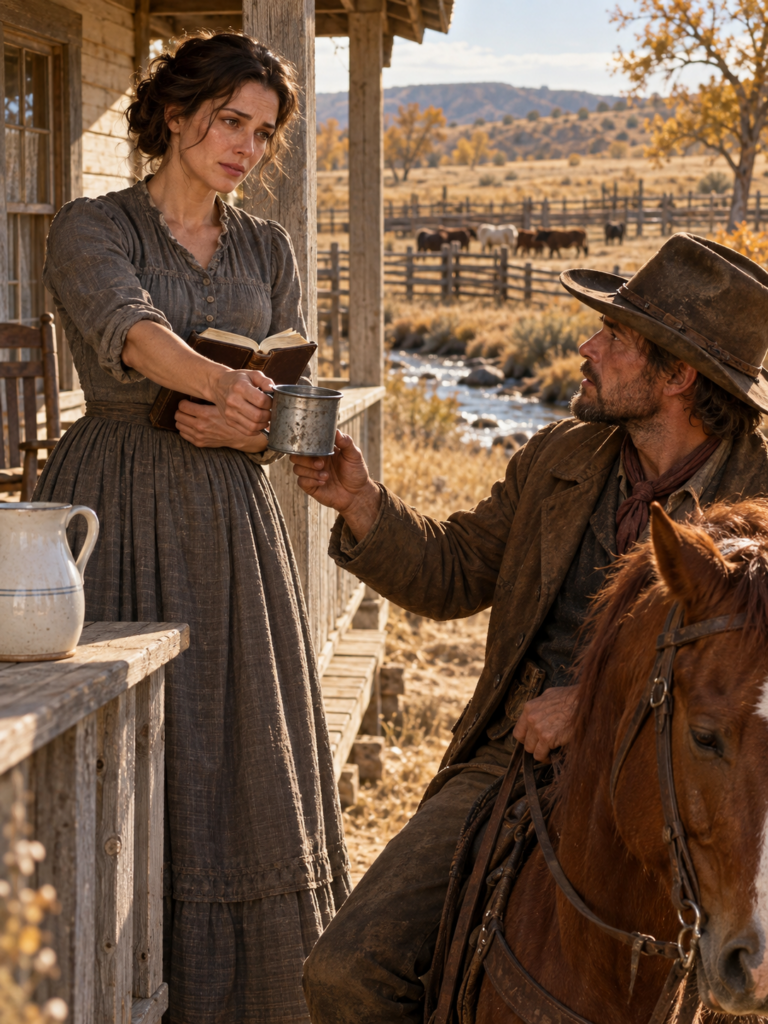
Abigail’s finger pressed against the date on the bank’s letter, and Eli stepped closer to see how little time remained.
The first Monday in December.
Barely five weeks away.
“That’s the day the note comes due,” she said.
Eli studied the paper without touching it.
“Can you meet the amount?”
“Not yet.”
“Have you spoken to the banker?”
“Three times.”
“And Vance?”
“He’s been here twice to offer for the ranch. He’s also taken an interest in who holds the water rights.”
Eli looked toward the creek.
“That’s what he wants.”
“Yes.”
“Not the house. Not the cattle.”
“The spring.”
She folded the letter.
“And he knows I won’t sell it willingly.”
Eli had worked enough dry country to understand.
Cattle could be moved.
Fences could be rebuilt.
But a dependable spring in drought-stricken country was worth more than an impressive house.
“Has he filed anything against your water rights?”
“Nothing I’ve received official notice of. But a surveyor has been marking my eastern boundary.”
“Did he have permission?”
“No.”
Eli’s jaw tightened.
Abigail noticed.
“I don’t want a man who goes looking for a fight on my behalf.”
He looked at her.
“Neither do I, ma’am.”
“Good.”
“I’d rather have the facts.”
That answer surprised her.
Most men who heard about Vance either dismissed her concerns or volunteered to threaten him.
Eli did neither.
He simply asked where the property records were kept.
“In my study.”
“Then we ought to compare them with those boundary stakes before anybody moves another post.”
Abigail felt some of the tightness in her chest ease.
She had offered him wages.
He had answered with judgment rather than promises.
“Will you stay the week?” she asked.
“I gave my word.”
“That doesn’t mean you must involve yourself in all of this.”
“I reckon the fence is involved. That’s what you’ve hired me to mend.”
For the first time that afternoon, she laughed.
It was a small sound.
But Eli heard it.
And he found himself wanting to hear it again.
They walked toward the bunkhouse.
Abigail showed him the stove, washstand, narrow bed, and shelf where previous hired men had left their things.
“The room is yours while you’re employed here.”
“More than adequate.”
“Dinner is at six. You can eat at the kitchen table if you prefer.”
“Much obliged.”
She hesitated.
“There is one rule about the house.”
“Yes, ma’am?”
“My husband’s belongings are not to be moved without asking me.”
Eli looked toward the farmhouse.
“Understood.”
“I know some of it seems foolish. His coat is still by the door, and his chair—”
“You needn’t explain.”
Her throat tightened unexpectedly.
He did not offer pity.
Did not tell her it was time to move on.
He merely accepted the boundary.
“Anything else?” he asked.
She shook her head.
Eli set his saddle down.
Then he followed her toward the barn to inspect the damaged equipment.
The wire had sagged badly along the eastern line.
Several posts had loosened where dry soil had pulled away from their bases.
But the work could be done.
Eli tested one post, then stepped back.
“Won’t be quick, but it isn’t beyond repair.”
“How many days?”
“Depends how many sound posts you’ve got stored.”
“Not enough.”
“Then we’ll make a count before buying anything.”
Abigail glanced at him.
“You’re not going to tell me I need a whole new fence?”
“Not unless I find a reason.”
She looked away before he could see her smile.
By supper, Eli had inspected the worst section, watered Samson, and carried his tools into the bunkhouse.
Abigail placed two plates at the kitchen table.
Then she hesitated beside the third chair.
Josiah’s chair.
Eli noticed.
“I can sit at the far end, ma’am.”
She nodded gratefully.
They ate beef stew and bread while the lamp burned between them.
Afterward, Abigail opened her account book.
Eli glanced at the columns.
“Would you mind if I looked at the feed figures?”
She lifted her eyes.
“Why?”
“If I’m moving cattle between pastures, I’d like to know how much winter feed we’re trying to save.”
She passed him the book.
He read slowly.
Then he pointed to a figure.
“You kept that creek meadow out of grazing through August?”
“Yes.”
“Smart decision.”
“It didn’t feel smart when the northern pasture went short.”
“But you’ve got grass standing now that your neighbor hasn’t.”
Abigail looked toward the dark window.
A man had finally noticed the work she had done before he arrived.
And he had not tried to claim it.
Then Eli reached the page showing the mortgage.
His expression changed.
“Mrs. Ross.”
She looked up.
“This isn’t just a matter of getting the ranch through winter.”
“No.”
“If the note isn’t extended, Vance may be able to purchase your loss for less than the land is worth.”
“I know.”
Eli slowly closed the ledger.
Abigail’s voice trembled despite her effort to steady it.
“I’ve asked God for help. But I won’t marry a stranger just to keep my property.”
He looked at her across the lamplight.
“Then don’t.”
“Even if I lose everything?”
“Even then.”
She stared.
He continued quietly.
“A husband ought to be someone you choose when you’re free to say no.”
Abigail lowered her eyes.
For eleven weeks she had prayed for someone who understood that very thing.
Now Eli rose, carried his plate to the washbasin, and reached for his hat.
“Good night, Mrs. Ross.”
At the kitchen door he stopped.
“Tomorrow we’ll start with the eastern fence.”
“And after that?”
“We’ll deal with what comes next.”
He opened the door.
Cold October air entered the room.
And as Abigail watched him walk toward the bunkhouse, she made a decision she had been afraid to make for months.
In the morning, she would take her original property records from Josiah’s locked desk and let Eli help her examine the boundary dispute—knowing that the papers might reveal exactly how close Vance already was to taking her spring.
The following morning, Abigail unlocked Josiah’s desk.
She had avoided opening the bottom drawer for months.
His handwriting still appeared on nearly every folded document.
There were receipts for fence wire, descriptions of cattle purchases, and sketches showing the planned route of a pipe from the upper spring to the barn.
Eli stood beside the window.
He did not touch anything until she handed him the property records.
“Josiah’s father filed these papers,” she explained. “The spring diversion was recorded in 1881.”
Eli studied the description.
“Has Vance shown you an earlier claim?”
“No. Only threatened to find one.”
“Then we shouldn’t treat his threat as proof.”
Abigail nodded.
He spread the map carefully across the desk.
She pointed out the eastern boundary and the approximate location of the surveyor’s stakes.
After comparing the description with the landmarks, Eli frowned.
“We ought to check this on the ground.”
“Will it change anything?”
“Not by itself. But we’ll know whether those stakes match your recorded line.”
They spent the morning riding the boundary.
Abigail carried the map.
Eli used his experience with terrain and fence placement to help identify the old markers.
Neither pretended that a day’s inspection could settle a legal dispute.
But when they finished, Abigail understood the problem more clearly.
Some of the recent stakes were positioned in places that deserved a proper surveyor’s attention.
She made careful notes for the county office.
Eli returned to repairing the fence.
And the week Abigail had offered began to lengthen.
First into two weeks.
Then three.
By mid-November, eighty-one fence posts had been reset or replaced.
The damaged wire was tightened.
Eli rebuilt the crossing barrier near the creek, using a movable section designed to reduce damage when spring runoff rose.
The work was steady and tiring.
Some afternoons, the two of them returned to the house with their faces covered in dust and their hands stiff from cold.
Abigail was accustomed to making every decision alone.
Eli was accustomed to taking instructions from foremen who rarely explained their reasoning.
Both had adjustments to make.
One afternoon, Abigail ordered cattle moved into a pasture Eli believed should be rested longer.
He disagreed.
She reminded him that she knew the ranch.
He accepted her decision.
Two days later, they discovered the grass would not support the animals as long as she had hoped.
Eli helped move them again without saying anything about his earlier warning.
At supper, Abigail set down her fork.
“You were right.”
He looked up.
“About what?”
“The south pasture.”
He shrugged.
“Easy enough mistake.”
“You knew it was a mistake before we made it.”
“I thought it might be.”
“And you didn’t tell me strongly enough.”
“You’d made your decision.”
She studied him.
“Mr. Davenport, I didn’t hire you to agree with me. I hired you because you know things I don’t.”
He considered that.
“All right.”
“Next time, argue your case.”
A small smile appeared beneath his mustache.
“Even if you don’t like hearing it?”
“Especially then.”
From that day forward, their work acquired a different rhythm.
He brought his knowledge.
She brought hers.
They disagreed when necessary.
And the ranch benefited.
Eli learned that Abigail could estimate winter feed requirements more accurately than most foremen he had known.
He watched her inspect cattle, compare hay costs, and bargain with a buyer who initially tried to address every question to him.
When the buyer asked Eli what price they would accept, he tipped his hat toward Abigail.
“You’ll need to ask Mrs. Ross. They’re her cattle.”
The man looked uncomfortable.
Abigail named her price.
And she did not lower it.
That evening, Eli found an extra slice of pie beside his plate.
He looked at it.
“What’s this for?”
“Speaking good sense when someone else forgot his manners.”
“I only told him who owned the stock.”
“Sometimes that’s a good deal more than most men manage.”
Eli did not know what to say.
So he ate the pie.
It was the best he’d ever tasted.
The matter of Josiah’s belongings remained delicate.
One afternoon, Eli discovered a leather harness strap that had been repaired by hand.
He examined the stitching.
Whoever had mended it knew how to distribute tension without weakening the leather.
At supper he mentioned it.
“That’s fine work on the brown harness.”
Abigail paused.
“Josiah made that repair.”
Eli nodded.
“He knew his trade.”
There was no awkward expression of sympathy.
No suggestion that a new man should replace the old.
Just honest respect.
Abigail looked down at her plate.
She had not realized how badly she needed to hear someone speak well of her husband without treating his memory as an obstacle.
By the last week of November, Eli had begun helping with the unfinished spring pipe.
The undertaking was difficult because the supply materials had to be stretched carefully.
They had no money to waste.
He examined Josiah’s original sketches and offered several practical adjustments.
Abigail approved the revised plan.
Together they worked to get the line ready before the hardest freezing weather.
But the approaching mortgage overshadowed every improvement.
On the first Monday of December, they rode into Willow Creek.
Abigail carried her ledgers and bank correspondence in a leather satchel.
Eli accompanied her because he understood the work that had been completed and the condition of the cattle.
The bank manager, Harlan Quill, welcomed them into his office.
He looked at Abigail with genuine concern.
“I wish I had better news.”
She laid the ledger upon his desk.
“Then perhaps we can make some.”
Quill examined the figures.
The ranch’s financial position remained difficult.
But the cattle numbers, feed arrangements, and repairs showed evidence of careful management.
He questioned Eli about the herd.
Eli answered precisely.
Then Quill remarked, “You seem to have taken charge of things out there.”
“No, sir,” Eli replied. “Mrs. Ross has been managing that place since before I arrived.”
Quill looked surprised.
Eli continued.
“She kept the creek meadow out of grazing when it would have been easier to use it. She reduced her herd before winter to protect the remaining stock. And she’s kept records good enough that I can tell you what the place needs without guessing.”
He placed his hat on his knee.
“I’ve helped with the work. That’s all.”
Abigail remained very still.
She had spent months defending her competence.
Now a man was doing so without pretending that her achievements belonged to him.
After a long discussion, Quill offered a sixty-day extension.
Interest would continue.
The debt remained.
But they had until early February to find a solution.
On the ride home, Abigail was quiet.
Eli mistook her silence for disappointment.
“Sixty days isn’t much,” he said.
“No.”
“But it’s something.”
“Yes.”
She turned toward him.
“Thank you.”
“For what?”
“For telling Mr. Quill the truth.”
Eli frowned.
“Wouldn’t have been much use telling him anything else.”
She smiled.
“That’s what I mean.”
The weeks before Christmas brought colder weather.
Snow fell across the valley.
The water line to the barn was completed in December, and Abigail watched the first steady flow reach the stone trough.
Eli stood beside her.
Josiah had planned that pipe.
For a long time, Abigail had believed the unfinished work would remain a monument to everything they had lost.
Now water ran through it.
She touched the rim of the trough.
“He would have liked this.”
Eli kept his eyes on the moving water.
“I expect he would.”
“I used to think finishing it would mean leaving him behind.”
“Does it?”
She considered the question.
“No. I don’t believe it does.”
Eli nodded.
“Then I’m glad we finished it.”
That evening, they sat on the porch steps with their coats buttoned against the cold.
For the first time, Abigail spoke openly about the future she had imagined with Josiah.
She told Eli about their plans to grow old together.
About the improvements they had hoped to make.
About the children they had once expected they might have.
And about the terrible emptiness of discovering that all those plans could vanish in an ordinary morning.
Eli listened.
When she finished, he spoke about his own childhood.
He had lived with three different families between the ages of eleven and fourteen.
None had deliberately mistreated him.
But he had always been an extra mouth.
Someone whose place depended upon the amount of work available.
When the work ended, he moved on.
“I got good at leaving,” he said.
“Did you ever want to stay?”
He considered the question.
“Every time.”
Abigail turned toward him.
“Then why didn’t you?”
“Seemed better to go while folks still thought well of me.”
She watched his hands.
“And when you rode away?”
He gave a quiet, humorless laugh.
“I always looked back from the first hill.”
“What did you hope to see?”
“Somebody watching.”
The confession settled between them.
Abigail had a home and feared sharing it again.
Eli had spent his life avoiding a home because he feared losing one.
Neither spoke for a long time.
Then Abigail said, “I don’t know what God meant when you came to my gate.”
Eli looked toward the creek.
“Neither do I.”
“But I’m glad you stopped.”
“So am I.”
January brought a darker turn.
On the eighth, Quill sent word that the bank had sold the Ross mortgage to outside investors.
Abigail rode into town immediately.
Quill could not identify every person behind the purchasing group.
But he admitted that two men previously interested in the loan had associations with Thaddeus Vance.
Abigail returned home troubled.
Then came a notice regarding a claimed prior diversion of water from the spring.
The claim referred to an alleged record dating from 1878, earlier than the Ross family’s filing.
A hearing was scheduled for February 11.
Ten days after the extended mortgage deadline.
Eli examined the notice at the kitchen table.
“He doesn’t need to win the water case immediately,” he said.
Abigail looked at him.
“What do you mean?”
“If lenders believe your water is disputed, they may refuse to advance money against the land. You could lose the property before the hearing is settled.”
Abigail pressed her fingers against her forehead.
“That’s what he’s counting on.”
“I believe so.”
“Can we prove the old claim is false?”
“Not from what we have here.”
She looked toward Josiah’s empty chair.
For the first time in weeks, the ranch felt impossible to save.
A few days later, Vance appeared in his carriage.
He wore a good coat and carried himself with the confidence of a man who expected to win.
His offer for the ranch was lower than before.
He spoke gently of Abigail’s difficulties.
He expressed regret that a widow should have so much trouble.
Then he mentioned that people in town had begun talking about her unmarried hired man living on the property.
Abigail’s face hardened.
“My employee occupies the bunkhouse.”
“Of course,” Vance said pleasantly. “But people may misunderstand.”
“Then they can learn the truth.”
Vance smiled.
“You ought to consider what is best for your reputation.”
Abigail stepped off the porch.
“My reputation is not for sale, Mr. Vance. Neither is my ranch at the price you’re offering.”
His expression cooled.
“You may regret refusing a reasonable arrangement.”
“Leave my property.”
Vance departed.
Eli had watched from the barn.
He had not interrupted.
That evening, Abigail found him sitting alone with his small leather money pouch.
He closed it when she entered.
She noticed but did not ask.
Three days later, Eli rode into town before dawn.
He returned at midday looking tired.
Abigail assumed he had gone to purchase supplies.
He said only that he had attended to some business.
Then, on January 29, smoke appeared beyond the eastern boundary.
The fire had begun in a dry hollow.
A hard wind drove it toward the winter grass.
Abigail saw the smoke from her kitchen window.
She did not wait for Eli.
She hurried to the barn, harnessed the workhorses, and brought the plow toward a narrow stretch of pasture where the soil could be turned ahead of the approaching flames.
Her decision was immediate.
If the fire crossed that neck of land, the hay meadow and barn could be endangered.
She had to make an attempt to stop it there.
Eli returned from the northern pasture and saw her working.
He did not order her away.
He took a shovel and wet sacks, then approached the eastern end of the line.
They labored for hours, keeping back from the hottest flames and retreating whenever the wind made a position unsafe.
Smoke burned their eyes.
The horses strained.
The turned earth slowed the fire in places, but gusts continued carrying sparks across the grass.
At one point, Eli dropped to one knee and prayed aloud.
Not a grand prayer.
Only a weary plea that the wind might ease before they lost everything.
Late in the afternoon, the wind shifted.
The fire’s advance weakened.
By evening, the danger to the main meadow had passed.
Forty acres of winter grass were burned.
A quarter-mile of fencing was damaged.
But the barn, house, and most of the feed remained.
Abigail and Eli walked the horses back through the darkening pasture.
Their faces were black with smoke.
At the corral gate, Eli looked back toward the scorched land.
“We held it,” he said.
Then he stopped.
He had said we.
Not you.
Not Mrs. Ross’s ranch.
We.
Abigail heard it too.
Neither corrected him.
That night, Eli returned to the bunkhouse and opened his money pouch.
He had already made a decision.
The savings of eleven years were gone.
So was the small tract of distant land he had held as his security against old age.
He had arranged its sale in haste.
And that very morning, before the fire, he had delivered the proceeds to Harlan Quill with instructions concerning the mortgage.
He had not told Abigail.
She believed they were still facing foreclosure.
Eli knew the debt had been paid.
He also knew that telling her might place her under an obligation she had never agreed to accept.
He wanted to explain himself.
But he could not yet discover a way to do so without making the gift sound like a claim.
So he sat with the truth.
The fire had shown him how deeply he cared for the ranch.
The secret payment had shown him how deeply he cared for its owner.
Yet he could not assume that saving her property gave him any right to her affection.
He lay awake until morning.
And when February arrived, he accompanied Abigail toward the county hearing, knowing that before the day was over she would learn he had surrendered nearly everything he owned—and knowing she might never forgive him for making such a sacrifice without first telling her.
Abigail climbed down from the wagon outside the Willow Creek courthouse while Eli secured the horses.
She had slept poorly.
The mortgage deadline had passed without a payment she knew anything about.
The water hearing would determine whether the spring that had sustained the ranch for years was now subject to another man’s claim.
And Thaddeus Vance was already waiting at the courthouse entrance.
He greeted her with a polite inclination of his head.
“Mrs. Ross.”
“Mr. Vance.”
“I trust you’ve reconsidered my offer.”
“No.”
His smile did not change.
“An unfortunate answer.”
Abigail walked past him.
Eli followed several paces behind.
Inside, the room was crowded.
Water meant cattle.
Cattle meant money.
And in country where three dry years had tested every rancher, a reliable spring could be worth more than acres of pasture.
Vance sat beside a lawyer from Guthrie.
He had brought surveys and copies of documents describing a supposed water diversion dating to 1878.
Abigail had her own records.
Josiah’s father’s filing from 1881.
Years of ranch accounts.
Descriptions of the spring and the improvements made around it.
She intended to contest every claim she could.
But the hearing began with Vance’s representative arguing that the earlier diversion should take precedence.
Then, as though the subject were incidental, the lawyer mentioned the Ross mortgage.
The extended payment deadline had passed.
The holders of the note, he explained, intended to pursue their remedies.
Abigail felt her stomach tighten.
Vance turned toward her.
“I did offer to prevent this embarrassment.”
She held his gaze.
“I remember your offer.”
He gave a small shrug.
“Some people insist upon learning difficult lessons themselves.”
At the back of the room, a chair scraped against the floor.
Harlan Quill stood.
“Before this matter proceeds any further,” he said, “there is an error concerning the Ross mortgage.”
The room quieted.
Vance looked irritated.
“What error?”
“The note has been satisfied.”
Abigail turned.
Quill held up the recorded acknowledgment of payment.
“The outstanding principal, interest, and associated charges were paid in full on January twenty-ninth.”
For several seconds nobody spoke.
Abigail stared at him.
“That isn’t possible.”
Quill looked directly at her.
“It is paid, Mrs. Ross.”
“By whom?”
The banker hesitated.
Then a quiet voice came from the back of the room.
“By me.”
Eli Davenport rose.
He stood with his hat in his hands.
The knuckles were still cracked from the work of fighting the fire.
Abigail turned slowly toward him.
“Eli?”
He met her eyes.
“I paid it.”
Vance leaned forward.
“And what did you receive in return?”
Eli looked toward him.
“Nothing.”
Vance laughed.
“Come now. Men don’t spend that kind of money without acquiring something.”
Quill cleared his throat.
“Mr. Davenport instructed me in writing that the payment was to discharge Mrs. Ross’s debt without transferring title, taking security against the ranch, or granting him any financial interest.”
A murmur passed through the room.
The banker continued.
“I questioned him carefully. He understood what he was doing.”
Abigail remained motionless.
She could barely hear the voices around her.
For months she had imagined losing Josiah’s ranch.
Now she was discovering that the man who had come asking for water had given away the savings of nearly his entire working life to preserve it.
Vance stood.
“So that’s your arrangement, is it? You’ve purchased yourself a comfortable home.”
Eli’s expression did not change.
“No, sir.”
“You expect me to believe you’ve paid that mortgage from generosity?”
“You can believe what you please.”
“Then why do it?”
Eli drew a breath.
“Because Mrs. Ross was being pressed to sell something she didn’t wish to sell. And I had the means to help.”
“You think she’ll marry you out of gratitude?”
Eli’s voice became firmer.
“I don’t expect her to marry me at all.”
The room fell quiet again.
He looked toward Abigail.
“She owes me nothing. Not her land. Not a place in her house. Not another day’s work. Nothing.”
Abigail’s eyes filled.
Eli turned back toward Vance.
“I did not pay that debt to become another man she couldn’t refuse.”
Vance’s face reddened.
But Eli was not finished.
“She owned that ranch before I came along. She knew the cattle, kept the books, and worked the place when there wasn’t anybody left to help her.”
His voice remained steady.
“She doesn’t need a man to make her worthy of owning it.”
Then he said the words Abigail would remember for the rest of her life.
“I spent what I had so she’d have the freedom to say no to you—and to me.”
Vance sat down.
For once, he had nothing useful to say.
The hearing proceeded.
The commissioners examined the competing records.
They did not settle the dispute that morning.
But four days later, after reviewing the evidence presented, they rejected the asserted earlier claim.
The Ross family’s recorded use remained undisturbed.
Vance had failed to acquire the spring.
And Abigail still owned her home.
Yet the greatest difficulty of her life had not ended in the courthouse.
It began afterward.
That evening, she found Eli in the bunkhouse, cleaning his boots.
He rose when she entered.
“Mrs. Ross.”
She closed the door.
“Tell me everything.”
He placed the boots aside.
“What would you like to know?”
“How much?”
He looked at her.
“How much money did you spend?”
He named the sum.
Abigail pressed her hand against her mouth.
“And where did it come from?”
“Eleven years of savings. And a piece of land I sold.”
“What land?”
“A tract I acquired in lieu of wages some years back. Never did much with it.”
“You were keeping it.”
“Yes.”
“For what?”
He hesitated.
“Something to live on when I got too old to hire out.”
Abigail closed her eyes.
“You gave away your old age.”
“I paid off a note.”
“Eli.”
He fell silent.
She crossed the room.
“Why didn’t you tell me?”
“Because I knew you’d refuse.”
“That should have mattered.”
His face tightened.
“It did.”
“Then why?”
He looked toward the little stove.
“I could see the bank and Vance closing in on you. I knew what my money could do, and I was afraid that if I waited, there wouldn’t be time.”
Abigail took a breath.
“I needed help, Eli. But I needed the right to decide what happened to my life.”
“I know.”
“Do you?”
He nodded slowly.
“I thought refusing any claim against the land would make it right.”
“It made a great difference.”
“But not all the difference.”
“No.”
They faced one another in the small room.
At last Eli said, “I should have told you what I intended. I’m sorry.”
Abigail looked at him.
He did not defend himself by claiming divine instructions.
He did not say she ought to be grateful.
He acknowledged the mistake plainly.
And somehow that mattered more than a perfect explanation.
“I cannot repay you,” she whispered.
“I wasn’t asking.”
“That doesn’t make it easier.”
“I know.”
She sat in the chair beside the stove.
For several moments she could not speak.
Then she asked, “Did you think giving me all that money would make me love you?”
Eli looked startled.
“No, ma’am.”
“Not even a little?”
He took his time.
“I hoped you might think well of me. I’d be lying if I said your opinion didn’t matter.”
He lowered his eyes.
“But no. I didn’t reckon a woman could be bought with kindness any more than she could be bought with threats.”
Abigail’s tears slipped down her cheeks.
Eli stayed where he was.
He did not move closer without an invitation.
“Why did you do it?” she asked again.
He looked at her for a long time.
“Because when I rode into this place, you gave water to a stranger. Then you gave him honest work, and you didn’t ask him to become something he wasn’t.”
He swallowed.
“People have been kind to me before. But this was the first place where I started feeling sorry at the thought of leaving.”
Abigail covered her face.
For nineteen months she had feared losing the life Josiah had helped her build.
Now she was frightened by the possibility of wanting another life.
Not instead of the first.
After it.
She finally rose.
“I need time.”
Eli nodded.
“You have it.”
“And I need you to understand that I may never be able to feel what you hope.”
“I understand.”
She opened the door.
Then paused.
“Eli?”
“Yes, ma’am?”
“Thank you for saving the ranch.”
He shook his head.
“You’d already done the work of keeping it worth saving.”
She left before he could see how hard she was crying.
Seven weeks passed.
No wedding followed the courthouse hearing.
No sudden declaration.
No romantic celebration designed to convince the people of Willow Creek that Abigail Ross had acquired another husband.
Life returned to ordinary labor.
The mortgage was gone.
The water claim was settled.
The spring continued to feed the creek.
Eli continued working for his agreed wages.
And Abigail paid him every month.
Sometimes she tried to imagine a means of restoring his savings.
He told her that he had made the payment freely and asked her not to turn their every conversation into an account between debtor and creditor.
She understood the request.
Still, the weight of his sacrifice troubled her.
He had never owned much.
And now he owned less.
Yet he rose each morning before daylight, worked through the day, and treated her with the same respect as before.
He did not mention the money.
He did not claim a greater voice over the ranch.
He did not move his belongings into the farmhouse.
And he did not ask for affection.
Spring arrived gradually.
New calves appeared in the pastures.
The damaged fence was repaired.
The spring ran clear.
The cattle regained condition as the grass improved.
With each passing week, Abigail felt the truth settle more deeply.
She no longer needed Eli Davenport to prevent financial ruin.
She could hire seasonal labor when the ranch required it.
She could maintain her own accounts.
And she could make decisions without Vance’s threats hanging over her.
The freedom Eli had given her was real.
Which made the question she now faced both simpler and more frightening.
If she asked him to remain, would it be because she needed him?
Or because she wanted him?
One evening, she opened her Bible to the Book of Ruth.
She had read the same passage through months of grief.
She remembered praying for someone who would stay.
But Reverend Amos Teague had once warned her against treating an apparent answer to prayer as an obligation.
He had said that providence might bring two people to the same door, but neither owed the other a lifetime merely because they had met there.
Abigail had understood the wisdom of those words.
Now she began to understand their difficulty.
She had to choose.
And she was afraid.
She still loved Josiah.
She knew she always would.
His chair remained at the table.
His coat still hung near the door.
His grave stood on the hill above the creek.
Eli had never asked her to put those things away.
He had never behaved as though her grief diminished whatever affection she might someday give him.
And that, perhaps more than the money, was what had brought her heart close to his.
On April ninth, she rose early and walked toward the barn.
The last of the spring calves had arrived.
The major fence work was finished.
There were ordinary chores ahead, but nothing that demanded a permanent hired hand.
She saw Samson standing saddled beside the barn.
Eli was tightening a strap.
His bedroll lay ready.
For a moment, the sight struck her with the force of an old nightmare.
Another man preparing to ride away.
Another empty place.
Another future disappearing before she had learned how to speak of it.
She walked toward him.
“Going somewhere?”
Eli turned.
“Morning, Mrs. Ross.”
“Morning.”
He looked at the saddle.
“The work’s caught up. You won’t need a full-time hand through the summer.”
She said nothing.
“I thought I’d head south and see what’s available.”
Abigail felt a terrible calm.
She had prayed for a man who would stay.
And here he stood, doing exactly what he had done for twenty-two years.
Preparing to leave before anyone could ask him not to.
“You’ve decided already?” she asked.
“I didn’t want to take wages you didn’t need to spend.”
“Have I asked you to leave?”
“No.”
“Then why didn’t you speak to me before saddling your horse?”
Eli looked away.
“Didn’t know how.”
She stepped nearer.
“Eli, look at me.”
He did.
“Do you want to go?”
His face changed.
“No.”
“Then why are you leaving?”
He searched for words.
“Because there’s no work left that calls for me to stay.”
Abigail looked toward the barn.
Then back at him.
“There’s something you should know.”
He waited.
“I don’t need you to save the ranch anymore.”
He nodded once.
“I know.”
“I don’t need you to argue with bankers or stand between me and Mr. Vance.”
“I know that too.”
“And if you leave, I’ll manage.”
He looked at the ground.
“Yes, ma’am.”
Abigail took another step.
“That’s why I can finally tell you the truth.”
He raised his eyes.
“I want you to stay.”
Eli stared.
She continued before fear could stop her.
“Not because you paid the mortgage. Not because I prayed and you happened to appear. And not because I’m frightened of being alone.”
Her voice trembled.
“I want you because you’ve become my friend. Because you listen. Because you disagree with me honestly. Because you work beside me instead of trying to command me.”
A tear slipped down her cheek.
“Because you respect Josiah’s memory. Because you notice the things other people overlook. And because when something good happens, you’re the person I want to tell.”
Eli’s hand tightened around the reins.
“Abigail.”
It was the first time he had spoken her name without the formal address.
The sound almost broke her.
“I want you at my table,” she whispered. “Not as a hired man forever. As someone who has a place there because I want him there.”
He looked toward the farmhouse.
The white porch stood in the morning light.
Beyond it, the creek moved through the grass.
“I don’t know how to do that,” he said.
“Do what?”
“Belong somewhere.”
Abigail reached for his hand.
“Neither do I. Not this way.”
His fingers closed carefully around hers.
“I’ve spent most of my life leaving before anybody could decide they didn’t want me.”
“I know.”
“And if I stay—”
She waited.
He swallowed.
“If I stay, I’ll have something to lose.”
Abigail nodded.
“Yes.”
He looked into her eyes.
“So will you.”
“Yes.”
The admission hung between them.
Then Abigail said, “But I think some things are worth the risk.”
Eli stood absolutely still.
She glanced at Samson.
“Would you mind taking the saddle off that horse?”
He gave a shaky laugh.
“Are you offering me another job?”
“No.”
“What, then?”
“A place.”
His eyes filled.
For a moment he seemed unable to move.
Then he turned to Samson.
He loosened the girth.
Lifted the saddle free.
And placed it across the wooden rail.
He stood with his hand resting against the horse’s shoulder, looking toward the open barn door.
Abigail waited.
When he finally faced her, tears marked his weathered cheeks.
“I always looked back,” he said.
“What?”
“When I left a place. I’d ride to the first hill and turn around.”
His voice broke.
“I used to tell myself I was checking the road. But I was looking to see whether somebody wished I’d stayed.”
Abigail reached for him.
He stepped into her embrace.
For the first time in twenty-two years, Eli Davenport had nowhere he needed to go.
And somewhere he wanted to remain.
Their courtship began that spring.
It was not hurried.
Eli continued living in the bunkhouse while they considered what a shared life would mean.
They spoke openly about Josiah.
About ownership.
About the ranch’s finances.
About whether Eli could be content building a future on land that remained Abigail’s.
He told her the truth.
“I don’t need the deed in my name.”
“Even after all you’ve done?”
“Especially then. I never paid that note to acquire the place.”
She smiled.
“And if we disagree about the cattle?”
“We’ll argue until one of us makes sense.”
“And if neither does?”
“Then perhaps Reverend Teague can settle it.”
She laughed.
They worked out the practical details with care.
Abigail would retain her ownership of the Ross ranch.
Eli would contribute his labor and skill as a partner, with financial arrangements properly recorded so that neither had to depend upon vague promises.
They would make decisions together.
And neither would pretend that love could replace the need for honest accounts.
In May, Eli came into the kitchen one evening after washing at the pump.
He hung his hat on the nail beside the door.
Abigail was seated at the table.
The Bible lay open before her.
Beside it stood the same white pitcher she had carried to the porch on the day he arrived.
Two tin cups rested nearby.
Eli sat opposite her.
“I’ve been trying to find the right words for some time.”
Abigail smiled.
“That’s an unusual difficulty for a man who can argue about fencing for an hour.”
He laughed softly.
“This is harder than fencing.”
She closed the Bible.
“Then take your time.”
He looked at his hands.
“When I came here, I owned a horse, a saddle, some savings, and a little land I had never seen.”
“I remember.”
“I don’t have much of that left.”
“Eli—”
“Let me finish.”
She nodded.
“I can’t offer you a fortune. I can’t promise that the ranch will never have another bad year. And I can’t promise I’ll always know the right thing to say.”
He met her eyes.
“But I’d like to spend my life learning how to be the man who stays.”
Abigail’s eyes filled.
He reached across the table but stopped before touching her hand.
“Would you marry me?”
For a moment, she could not answer.
Not because she was uncertain.
But because the question had returned something she believed had died with Josiah.
The possibility of a future she had not planned.
She placed her hand over his.
“Yes.”
Eli’s breath caught.
“Yes?”
“Yes, Eli Davenport.”
He laughed through his tears.
Then she opened the Bible.
“There’s something I want you to read.”
He looked down.
It was the Book of Ruth.
The passage she had read at four in the morning when the house felt too empty to bear.
He recognized the familiar promise of remaining beside another person through an uncertain future.
Abigail listened while he read.
When he finished, she touched the page.
“People often hear that passage at weddings,” she said. “But Ruth wasn’t making a marriage proposal. She was choosing loyalty when leaving would have been easier.”
Eli looked at her.
“That sounds like a good beginning.”
“It does.”
He covered her hand with his.
“And we’ll keep choosing?”
“Every day.”
They married on June twenty-first.
Reverend Amos Teague conducted the ceremony on the hill overlooking Willow Creek.
The neighbors came.
Some brought flowers.
Some brought food.
Harlan Quill attended and shook Eli’s hand with particular warmth.
The old preacher stood carefully upon his aching hip and spoke about the difference between taking responsibility for another person and claiming ownership of that person’s life.
Abigail looked at Eli as she promised to share her future with him.
He looked back with the expression of a man who still could scarcely believe he had been invited to remain.
They returned from the ceremony to the farmhouse.
Josiah’s chair stayed where it had always stood.
Eli did not ask to occupy it.
One evening, Abigail moved it gently beside the window and placed another chair at the table.
A change made by her own hands.
Josiah had not been erased.
Neither had her grief.
But the household had room for a new life.
Over the years that followed, the ranch grew steadier.
There were difficult seasons.
Repairs that cost too much.
Cattle prices that disappointed them.
Arguments over pasture rotation.
And mornings when both were too tired to speak kindly until after breakfast.
They learned to apologize.
They learned to laugh.
They learned that a shared life did not mean two people would always agree.
It meant they would continue the conversation.
Eli became known throughout Willow Creek as a dependable rancher, though he remained careful to acknowledge Abigail’s ownership and experience.
Abigail found that partnership did not diminish her authority.
It gave her someone willing to carry responsibility beside her.
And the spring continued running.
In time, their household welcomed a daughter.
Her arrival was a joy they had chosen and hoped for, not the reason their marriage mattered.
The promises Eli and Abigail had made were already being kept in the work of each ordinary day.
One evening in late October, nearly a year after Eli had first entered the yard, Abigail stood beside the kitchen stove.
The lamp was lit.
Their little daughter slept in a basket near the warmth.
The Bible rested upon the table.
Beside it stood the white pitcher and two tin cups.
Outside, the last daylight faded across the pasture.
Then the kitchen door opened.
Eli came in smelling of cold air, horses, and hay.
He stamped the dust from his boots.
Removed his hat.
And hung it upon the familiar nail beside the door.
Abigail filled a cup with water.
He accepted it.
Their eyes met.
Neither spoke for a moment.
Then she smiled.
“Thirsty?”
“A little.”
She handed him the cup.
He drank.
And she remembered the exhausted stranger who had stood at her gate with an empty canteen, insisting that he had stopped for nothing more than water.
She remembered her prayers.
Her fear.
The bank letters.
The courthouse.
The morning he had taken the saddle off Samson and decided to stay.
Eli set down the empty cup.
“What are you thinking about?”
Abigail looked toward the porch.
“The first day you came here.”
He smiled.
“I remember being awfully thirsty.”
“You told me you were only stopping for water.”
“I was.”
“And now?”
He glanced at the sleeping child, then at the table where his place waited.
“Now,” he said softly, “I know where home is.”
Abigail slipped her hand into his.
She had once prayed for a man who would save her ranch.
What she had received was a man who loved her enough to leave the ranch entirely hers to choose.
And Eli, who had spent twenty-two years leaving before anyone could ask him to stay, had finally learned that belonging was not a chain.
It was a promise freely made.
Outside, Willow Creek continued flowing through the dark.
Inside, the lamp burned above two cups.
And the man who had once asked a stranger for water no longer needed to wonder whether someone would be watching when he returned.
He had a home.
He had a family.
And every morning, he chose to stay.


