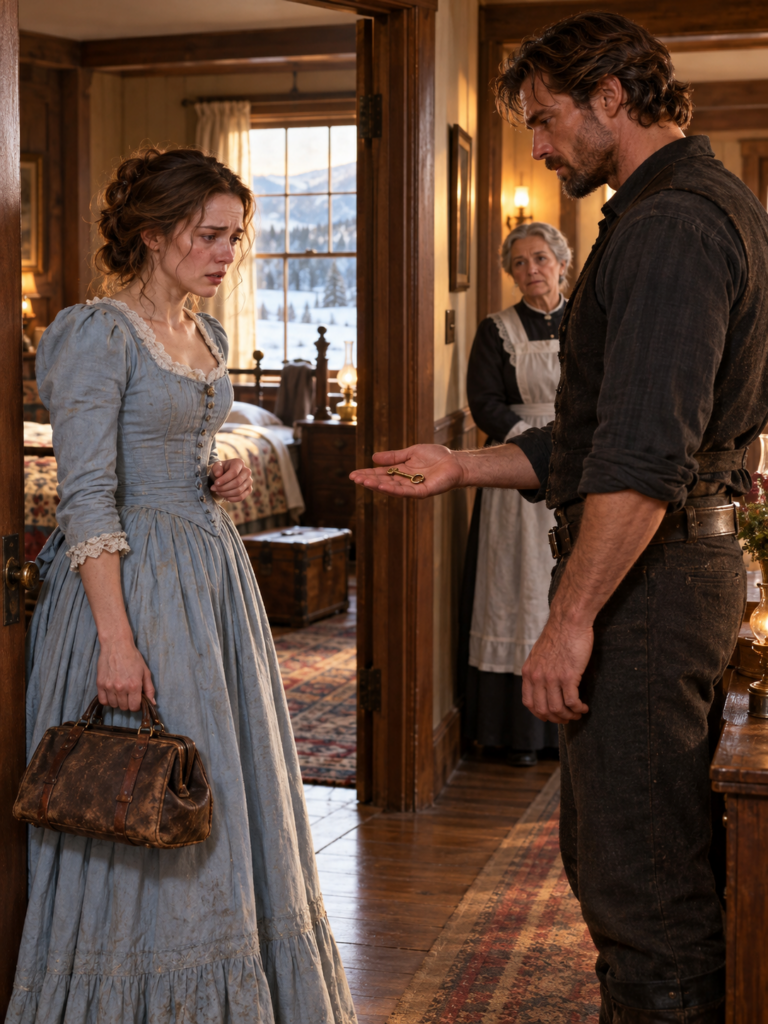
“Clara.”
She stopped with one hand resting against the stair rail.
Nathan had turned back toward her.
“I should tell you something before supper.”
She looked from his face to the closed door.
“About that room?”
His expression changed almost imperceptibly.
“Not tonight.”
He paused.
“About your brothers.”
Clara stepped down from the last stair.
“What about them?”
“I’ve asked someone I trust to inquire after their situation in Willow Creek.”
“Without telling me?”
“Before you arrived.”
Her pulse quickened.
“Why would you do that?”
Nathan took a moment before answering.
“Because I wanted to know whether Walter Hayes had told me the truth.”
Clara’s hand tightened around the stair rail.
“And had he?”
“No.”
The answer struck her harder than she expected.
She thought of her uncle’s pleasant voice, his careful papers, and the way he had described her marriage as a kindness.
“What did he tell you?”
Nathan glanced toward the dining room, where Mrs. Garrett was setting the table.
“Come sit down. I’ll explain what I can.”
Clara remained where she was.
“No. Please tell me here.”
Nathan accepted the refusal without argument.
“Walter claimed you were seeking a marriage that would secure your brothers’ future. He said you understood the arrangement and had consented to it.”
Clara felt her cheeks grow hot.
“He told you I wanted this?”
“He suggested you had agreed freely.”
She gave a small, humorless laugh.
“Did he also tell you I was grateful?”
Nathan’s jaw tightened.
“He spoke of your circumstances as though they were an opportunity.”
Clara looked away.
For years, Walter had decided what the family needed, what they could afford, whom they could trust, and what Clara should sacrifice.
She had believed marrying Nathan was the final decision Walter would make for her.
But Nathan’s words suggested that her uncle had been telling different stories to different people.
“When did you learn the truth?” she asked.
Nathan did not answer immediately.
That hesitation frightened her.
“Mr. Caldwell?”
“Before today.”
“Before the ceremony?”
“Yes.”
Clara took a step backward.
He had known.
He had known she was being threatened, yet he had stood beside her and signed the certificate.
For a moment, the generous bedroom and its brass key seemed like another kind of arrangement.
“You could have refused,” she whispered.
“I could have.”
“But you didn’t.”
“No.”
“Then why?”
Nathan looked toward the windows where the afternoon light was fading.
“Because Walter had already placed you in a dangerous position. I believed I could protect you from some of the consequences while finding a way to challenge what he’d done.”
Clara shook her head.
“You should have told me before I signed.”
“You’re right.”
His answer stopped her.
Walter would have argued.
Walter would have blamed her.
Nathan merely accepted what she said.
“I should have found a way to speak with you privately,” he continued. “I was concerned that Walter would retaliate against your brothers if he learned the arrangement had failed. But that doesn’t excuse keeping you ignorant.”
Clara swallowed.
“Do you need this marriage to keep your ranch?”
“There is an inheritance condition.”
“So he told the truth about that.”
“About that part.”
“Then you benefit from this too.”
Nathan’s face remained solemn.
“Yes.”
Clara studied him.
For the first time, she began to see how two things could be true together.
Nathan might genuinely wish to protect her.
And he might still have allowed her to enter an arrangement that served his interests.
She would not pretend one canceled the other.
“I need you to promise me something,” she said.
“If I can.”
“Never make another decision about my brothers without telling me first.”
Nathan nodded.
“Agreed.”
“And I want to know every arrangement you’ve made with Walter.”
“You will.”
“Not just the parts you think I can bear.”
“Every part.”
Clara looked down at the key in her palm.
Then she slipped it back into her pocket.
“One more thing.”
Nathan waited.
“If I decide I cannot remain here, you mustn’t use my brothers to persuade me.”
His answer came immediately.
“I won’t.”
Silence settled between them.
Clara wanted to believe him.
But wanting was dangerous.
She remembered the closed door behind them and the look that had crossed his face.
“What happened in that room?” she asked softly.
Nathan’s eyes moved toward it.
For several seconds, he said nothing.
Then he spoke with an effort that made the words sound painful.
“Something I haven’t learned how to speak about.”
Clara recognized that kind of sorrow.
She lowered her gaze.
“Then I won’t ask again tonight.”
Nathan inclined his head.
“Thank you.”
He went into the dining room.
Clara followed more slowly.
At supper, Nathan asked about Noah and Eli. Clara answered cautiously, then found herself telling him how Noah tried to mend everything that broke and how Eli loved horses despite having scarcely ridden one.
Nathan listened closely.
And when she mentioned that Eli’s boots were wearing through, he made a quiet note to himself.
After the meal, Clara returned upstairs.
She could hear the faint movement of dishes below.
Her new room stood ready.
Her key fitted the lock exactly.
She turned it once.
The bolt slid into place.
Then she sat beside the window, removed her mother’s ring, and held it in her palm.
There was safety in this house, perhaps.
But there were also secrets.
And outside its walls, Walter still controlled the two people she loved most.
Clara unfolded the small sheet of paper on which she had written her brothers’ names before leaving home.
She placed it beside the key.
Then she reached for her traveling bag and began taking out the family letters she had brought with her.
She would not surrender the truth of her family’s affairs to another man.
Not even one who had offered her a door she could lock.
The first letter Clara drew from her bag was written in her mother’s narrow, careful handwriting.
She smoothed its creases across the bedspread.
It concerned money Walter Hayes had promised to manage.
Nothing in it seemed extraordinary at first glance. Her mother had asked about an account, referred to a payment, and expressed relief that Walter had agreed to handle the matter.
Clara had read those lines before.
Now, married because of debts her uncle claimed she owed, she read them differently.
She set the letter aside and took out another.
By the time Mrs. Garrett knocked to ask whether she needed more coal for her fireplace, Clara had arranged half a dozen papers across the quilt.
“Are you settling in, dear?”
“I’m trying to remember something.”
Mrs. Garrett glanced at the papers but did not approach.
“Would you prefer I came back?”
Clara looked up.
“No. Please come in.”
The older woman carried the coal scuttle inside.
She had worked for Nathan Caldwell eleven years and appeared accustomed to making herself useful without asking unnecessary questions.
“Do you know my uncle?” Clara asked.
“Only by reputation.”
“What reputation?”
Mrs. Garrett considered her.
“A man who talks pleasantly enough. A man who takes care to know other people’s business.”
Clara gave a weary smile.
“That sounds like Walter.”
Mrs. Garrett tended the fire.
Then she said, “Mr. Caldwell isn’t much inclined to discuss his own affairs. But he’s not one to make promises lightly.”
Clara touched the brass key on the bedside table.
“He made several tonight.”
“Then I expect you’ll see whether he keeps them.”
The next morning, Clara went downstairs before breakfast.
Mrs. Garrett was already working in the kitchen.
Clara offered to help with the bread, and the older woman gave her a task without making her feel obliged to earn her place.
Through the window, Clara watched Nathan kneel beside a ranch hand’s horse.
The animal had gone lame, and Nathan examined its hoof while the young man held the reins.
Nathan did not appear concerned about getting dirt on his coat.
When he rose, he spoke to the hand, gestured toward the stable, and returned to the work himself.
Clara found the sight unexpectedly reassuring.
Her uncle would never have performed a task another man could be ordered to do.
Over the following days, she learned that Nathan’s money had not made him careless.
He checked his ledgers after supper.
He knew which families near Willow Creek struggled through winter.
He sent provisions when the Hennessy household lost much of its stored food.
And he treated Mrs. Garrett’s judgment as something worth listening to.
None of this proved he had been right to marry Clara without telling her what he knew.
But it showed that his conduct was not merely courteous when she happened to be watching.
Twelve days after her arrival, Clara found an eight-year-old girl sitting at the breakfast table.
The girl regarded her with open suspicion.
“You’re Clara.”
“That’s right.”
“I’m Lily.”
Clara smiled.
“I’ve heard about you.”
Lily frowned.
“From whom?”
“Your uncle.”
Lily looked toward Nathan.
“You talked about me?”
Nathan lowered his cup.
“Occasionally.”
Lily appeared satisfied with that answer.
She was his niece, the daughter of his younger sister, and had been living in his care for six months.
She examined Clara’s pale-blue dress and neatly pinned hair.
“Can you make braids that stay in?”
“I can try.”
“Uncle Nathan can’t.”
Nathan looked resigned.
“She’s correct.”
Clara nearly laughed.
Lily considered this new adult for another moment.
“Then you may braid mine after breakfast.”
“Would you like that?”
“Yes.”
It was the beginning of their friendship.
Lily did not ask for affection.
She asked practical questions, followed Clara through the kitchen, and gradually began bringing her small troubles that had previously remained unspoken.
Clara understood the child’s caution.
She recognized it in Noah.
And sometimes, when she looked in the mirror, in herself.
One evening, Nathan found Clara sitting outside with a notebook on her lap.
She had begun planning a vegetable garden on the south side of the house.
The beds were unused through winter, but she could already imagine what they might produce in spring.
“Mrs. Garrett says you’ve been studying the planting seasons.”
Clara looked up.
“I hope you don’t mind.”
“Why would I?”
“It’s your land.”
Nathan glanced at the notebook.
“You’re the one putting thought into it.”
Clara handed him the page.
She had sketched the beds, marked their exposure to sunlight, and listed vegetables and herbs that might be useful in the kitchen.
Nathan examined the drawing with genuine interest.
“There’s a good deal more sense in this than in the way we’ve been managing that patch.”
Clara felt herself straighten.
“Then you approve?”
“I do. If you’d like the work, we’ll see what supplies are needed.”
He returned the notebook.
She noticed that he did not say he would take over the planning.
For the first time, the coming spring seemed worth imagining.
But that hope weakened three weeks after the marriage when Walter Hayes came to Caldwell Ranch.
Clara saw his wagon approaching while she stood in the empty garden.
Nathan was away inspecting fencing with two ranch hands.
Walter arrived smiling.
“My dear niece. You look comfortable.”
“What brings you here?”
“I thought I’d pay my respects.”
“To whom?”
“Your husband, naturally.”
“He’s away.”
Walter glanced toward the house.
“Then I’ll wait inside.”
Clara stepped into his path.
“No.”
His smile thinned.
“What did you say?”
“You may leave a message. I won’t invite you in.”
“Remember who arranged this pleasant life for you.”
Clara felt the familiar tremor beginning in her hands.
She held them against her skirts.
“I remember exactly what you arranged.”
Walter’s eyes narrowed.
“You’ve grown rather sure of yourself.”
“I’ve grown tired of being frightened.”
For a moment, he looked as though he might answer sharply.
Instead, he inclined his head.
“Then perhaps you should remember who still has responsibility for the boys.”
The words struck where he intended.
Clara did not move.
“Are they well?”
“For now.”
“Have you provided for them as you promised?”
“Of course.”
“I want to see them.”
Walter’s expression grew guarded.
“We’ll discuss that when you learn some gratitude.”
Clara stepped closer.
“I will not discuss my brothers as though they’re part of a business agreement.”
Walter looked at her for a long moment.
Then he climbed back into his wagon.
“We shall see how long this new confidence lasts.”
Clara waited until he was out of sight.
Only then did she go inside and tell Mrs. Garrett what had happened.
When Nathan returned, she described the visit in exact detail.
He listened without interruption.
Afterward, he sat across from her at the kitchen table.
“I should have made arrangements for your brothers sooner,” he said.
“I don’t need apologies. I need to know they’re safe.”
“Then I’ll send someone to inquire. And if you wish, we can arrange for them to come here.”
Clara stared at him.
“You mean to visit?”
“Or to stay, if that becomes possible and you want it.”
Her voice almost failed.
“Both of them?”
“Certainly both.”
For weeks, she had been fighting the fear that marrying Nathan meant losing her brothers.
Now he spoke of bringing them into the same house.
She looked down before he could see her tears.
“Thank you.”
Nathan rose.
“You don’t need to thank me for taking their welfare seriously.”
The following morning, he sent a rider to Willow Creek.
The man returned with news that Noah and Eli were well, though Eli needed new boots.
Nathan arranged for boots to be sent and a Saturday visit to be planned.
Clara read the rider’s note three times.
On Saturday, Eli ran through Caldwell’s front door and threw himself against her.
Noah followed more carefully, but when Clara held out her arm, he came into the embrace.
For a long minute, none of them spoke.
Then Clara checked their faces and clothing, looking for signs they had suffered in her absence.
Eli proudly showed her his new boots.
“Mr. Caldwell sent them.”
Clara turned.
Nathan stood a respectful distance away.
“He needed a pair,” he said.
Noah examined him with the serious concentration Clara knew so well.
“Is it true you have a gray horse?”
“I do.”
“Is he fast?”
“He believes so.”
Noah’s mouth twitched.
Nathan offered to show both boys the stables after lunch.
Lily immediately announced that she was coming too.
Watching them leave, Clara felt something unfamiliar settle inside her.
For a few hours, the people she loved were together.
And the man she had expected to fear was making room for all of them.
But Walter had not abandoned his plans.
In Willow Creek, he was telling anyone willing to listen that his niece had married Nathan for his fortune.
He suggested that the marriage had been arranged to satisfy an inheritance condition.
He offered just enough truth to make the lies surrounding it plausible.
Clara discovered the gossip on a trip to town.
Margaret Hollis, the wife of a local lawyer, stopped her outside a shop and spoke with delicate, pointed curiosity.
“Your marriage has certainly been discussed, Mrs. Caldwell.”
Clara held her parcel against her chest.
“I imagine most marriages are.”
“Not when the gentleman’s property depends upon it.”
Clara looked at her sharply.
Margaret lowered her voice.
“Your uncle has been rather forthcoming about the arrangement.”
By the time Clara reached her wagon, she understood.
Walter was preparing the town to believe his version of the marriage before anyone could challenge it.
She returned to the ranch and went straight to Nathan’s study.
He listened as she repeated Margaret’s words.
When she finished, he closed the ledger before him.
“The inheritance condition is real,” he said.
Clara remained standing.
“Then tell me everything.”
Nathan drew a slow breath.
“My grandfather left a provision concerning the ranch. The property was meant to remain with a married head of the family. My father satisfied it. I satisfied it during my first marriage.”
Clara went still.
“Your first marriage?”
Nathan’s gaze shifted toward the window.
“My wife was Eleanor.”
She waited.
“Six years ago, I lost her. And our son.”
The silence that followed was so complete that Clara could hear the clock in the hallway.
“The room downstairs,” she whispered.
Nathan looked at her.
“James’s room.”
Clara remembered the closed door.
The expression on his face.
The sorrow he had never explained.
“I’m sorry,” she said.
He nodded, unable for a moment to reply.
Then he continued.
“After their deaths, the inheritance provision became a problem. My lawyers argued that the ranch should remain with me. They delayed any transfer, but the question was never entirely settled.”
“And Walter knew?”
“He learned enough to make an offer.”
Clara felt sick.
“He knew I needed to protect my brothers. He knew you needed a wife.”
“Yes.”
“He made use of us both.”
Nathan looked directly at her.
“Yes.”
She sat down.
For several moments, she examined the grain of the desk.
Then she asked the question that mattered more than all the others.
“When did you discover he’d been threatening me?”
“Before the wedding.”
Clara closed her eyes.
She had suspected the answer.
Hearing it still hurt.
“You should have come to me.”
“I should have.”
“You might have helped without marrying me.”
“I might have. I was afraid Walter would turn on the boys before we could prevent him.”
“Fear doesn’t make every decision right.”
“No.”
Nathan’s quiet acceptance left her with no easy argument to make.
She looked at him.
“Then we must make sure he never has that power again.”
Nathan leaned forward.
“What do you propose?”
Clara thought of the letters in her bedroom.
She thought of the family accounts Walter had presented and the payments her mother had once questioned.
“Walter keeps records,” she said. “He likes having proof of what people owe him. He may have kept proof of things they never owed at all.”
Nathan listened.
“I have letters from my mother. Some concern money he managed. I’ve been afraid to examine them too closely.”
“Would you like Arthur Greer to look at them?”
“Your lawyer?”
“Yes.”
Clara considered the offer.
Then she nodded.
“But I want to be present for every discussion.”
“You will.”
“And I want the evidence used to protect my brothers, not merely to embarrass Walter.”
Nathan’s expression softened.
“That seems a sound place to begin.”
He rose and extended his hand.
Clara remembered the first time he had offered it outside the ranch house.
Then she had been a frightened woman meeting a stranger chosen for her.
Now she understood some of his faults and some of his sorrows.
She accepted his hand.
“We do this together,” she said.
“Together.”
Two days later, Arthur Greer arrived at Caldwell Ranch.
Clara placed her mother’s letters on Nathan’s desk.
Greer read them carefully, examined the debt papers, and compared dates and amounts.
At first, he said little.
Then he looked up.
“Mrs. Caldwell, I believe your uncle has concealed important information about your family’s accounts.”
Clara felt Nathan go still beside her.
“What information?”
Greer placed one of the letters in front of her.
“Your mother questioned money that appears to have been transferred without a satisfactory explanation. There may have been considerably more in your parents’ estate than you were led to believe.”
Clara stared at her mother’s handwriting.
For four years, she had worked until her fingers ached, believing the family had simply fallen into poverty.
Now she had reason to suspect that someone had been stealing from them long before her parents died.
“Can you prove it?” she asked.
“Not yet.”
“What would it take?”
Greer glanced at Nathan.
Then back at Clara.
“More records. Independent examination. And patience.”
Clara gathered her mother’s letters into a neat stack.
“Then that’s what we’ll give you.”
Greer hesitated.
“Your uncle may become dangerous to your plans if he learns what we’re examining.”
Clara looked toward the window.
Beyond it lay the road to Willow Creek.
And in Willow Creek were Noah and Eli, still under Walter’s legal authority.
She turned back to the lawyer.
“Then before Walter learns how much we know, I want to begin proceedings to have my brothers placed in my care.”
Arthur Greer laid down his pen.
“Then their guardianship must become our first concern.”
Clara remained standing beside Nathan’s desk.
For a moment, the room seemed filled with all the things that had brought her here: Walter’s threats, the debts, the marriage certificate, the distance between herself and her brothers.
Then she pulled out a chair and sat.
“Tell me what I must do.”
Greer explained that recovering the family’s money and challenging Walter’s authority over the boys were related matters, but not identical ones.
They would need evidence.
They would need proper proceedings.
And Walter would have an opportunity to answer the accusations.
Clara accepted all of that.
What she would no longer accept was doing nothing while her uncle controlled the truth.
During the following weeks, Greer investigated the accounts. He obtained financial records, examined land transfers, and compared the signatures on documents Walter had handled.
Clara worked beside him whenever the inquiries brought him to the ranch.
She knew her mother’s handwriting.
She remembered dates and conversations that had seemed unimportant when she was younger.
She recognized the difference between expenses her parents would have approved and transactions they had never mentioned.
Nathan helped provide access to legal advice and records, but the investigation increasingly depended upon Clara’s own knowledge.
One afternoon, Greer placed a deed before her.
It appeared to transfer a small parcel of property once associated with her mother’s family.
The stated consideration was one dollar.
Clara frowned.
“My mother would never have agreed to that.”
“Are you certain?”
“She spoke of that land often. It came from her father. She considered it part of what she hoped to leave us.”
Greer turned the paper toward the window.
“The signature requires examination.”
“You think Walter may have written it himself?”
“I think we must establish whether your mother signed it.”
Clara looked at the inked name.
She remembered her mother washing clothes until her knuckles cracked.
She remembered the little sums of money folded into a kitchen tin.
Her mother had blamed herself whenever the family lacked enough.
If Walter had been taking money all along, then years of that shame had belonged to him.
Not to her parents.
Clara placed one finger beside the signature.
“Please find out.”
The inquiry widened.
A specialist examined questioned signatures.
Additional financial records showed payments moving into accounts connected with Walter.
Greer also discovered evidence that another family had suffered through arrangements resembling those made with the Whitmores.
Mary Pierce had retained records of money her household had entrusted to Walter over the years.
When Greer approached her, she agreed to cooperate.
Clara met Mrs. Pierce and listened as the woman described her husband’s growing distress over debts he could never seem to reduce.
It was painfully familiar.
“My mother thought Walter was helping us,” Clara said.
“Mine thought he was honest,” Mrs. Pierce answered.
They sat together for a while without speaking.
Then Mary pushed a packet of receipts across the table.
“I want him stopped as much as you do.”
Clara accepted the papers.
“Then we’ll make certain your family is heard too.”
Meanwhile, life continued at Caldwell Ranch.
Lily still appeared at Clara’s bedroom door asking for help with her hair.
Mrs. Garrett still expected the morning bread to be ready.
Nathan still returned from the pastures with dust on his coat and work waiting on his desk.
And Clara continued making plans for the spring garden.
She found the ordinary work comforting, not because it distracted her from Walter, but because it reminded her that her future contained more than a struggle against him.
One evening, she discovered Nathan standing before the closed room in the lower hallway.
He had not seen her approach.
His hand rested near the doorknob.
Clara stopped.
“I can come back.”
Nathan looked toward her.
“No. It’s all right.”
She hesitated.
“I know about James. But I don’t know much about him.”
Nathan was silent.
Then he opened the door.
The room was small and carefully kept.
A child’s bed stood against one wall beneath a faded quilt. A wooden rocking horse occupied a corner, its damaged ear a small, ordinary reminder of play.
Books remained arranged on a low shelf.
Clara stayed at the threshold.
“May I come in?”
Nathan nodded.
She entered quietly.
He touched the rocking horse.
“James loved this thing. He wore the floorboards with it.”
A faint smile crossed his face.
“He was certain he could ride it clear across the county.”
Clara looked at the little horse.
“Sounds like a determined boy.”
“He was.”
Nathan stood silent for a time.
Then he told her about Eleanor.
He spoke of their life before the accident, the plans they had made, and the terrible emptiness that followed losing both his wife and their four-year-old son.
He did not describe every detail of the accident.
He did not need to.
The loss was plain enough.
“I shut this door because I couldn’t bear seeing the room,” he said. “After a while, leaving it closed became easier than deciding what to do.”
Clara looked at him.
“You don’t have to decide today.”
“I know.”
“Or ever, if keeping it this way is what you want.”
Nathan glanced around the room.
“For years, I thought letting anything change meant losing what little I still had of them.”
Clara touched the quilt gently.
“James was your son. Nothing can change that.”
Nathan drew a careful breath.
“I’ve been afraid of having a family again.”
Clara looked at him.
“Lily needs you whether you’re afraid or not.”
He gave a quiet laugh.
“She certainly makes that clear.”
“And Noah and Eli have already begun trusting you.”
“I know.”
He looked toward the door.
“I didn’t expect that to happen.”
“Neither did I.”
For the first time, Clara saw the full shape of his loneliness.
It was not the loneliness of a wealthy man who wanted another person to fill an empty house.
It was the loneliness of someone who had loved deeply, lost terribly, and learned to expect loss wherever affection appeared.
She understood some of that fear.
And because she understood it, she refused to mistake it for a reason they should remain apart.
“Nathan,” she said, “I don’t want to spend my whole life preparing for the worst thing that might happen.”
He looked at her.
“Neither do I.”
She smiled.
“Then perhaps we ought to practice expecting something good.”
He took her hand.
Neither made a grand declaration.
They stood together in James’s room while the evening light fell across the small bed.
And when they left, Nathan closed the door gently.
He did not lock it.
***
The next difficulty arrived by letter.
Greer warned that Walter might have learned of the investigation.
Some money was being moved between accounts.
Questions directed toward former associates were beginning to reach the people they concerned.
Clara read the warning at the kitchen table.
Nathan watched her fold the letter.
“What do you want to do?”
“I want to see Noah and Eli.”
Nathan nodded.
“I’ll take you.”
They traveled the familiar road to Willow Creek.
Along the way, Clara spoke about her mother.
“She trusted Walter. Even when there wasn’t enough money for food, she believed he’d helped us as much as he could.”
Nathan kept the horses at a steady pace.
“I’m sorry.”
“I wish she had known.”
He looked toward her.
“Then we make certain the truth isn’t lost now.”
Clara held her mother’s garnet ring between her fingers.
“Yes.”
The boys were delighted to see her.
Eli talked almost without stopping.
Noah asked careful questions about the ranch, the horses, and when they might visit again.
Clara could see that both were growing tired of temporary assurances.
As she prepared to leave, Noah walked with her toward the wagon.
“Are we ever going to live with you again?”
She stopped.
The question was almost unbearable.
“I am working to make that happen.”
“Uncle Walter says things are complicated.”
“They are.”
Noah looked down.
“Does Mr. Caldwell want us there?”
Clara glanced toward Nathan, who was helping Eli examine a harness.
“Why don’t you ask him?”
Noah hesitated, then approached the rancher.
Clara watched them speak quietly.
Nathan crouched slightly to hear the boy.
Then Noah nodded.
When he returned, his face had changed.
“What did he say?” Clara asked.
“He said there’s room for us, if you want us there.”
She knelt and straightened his collar.
“I want you there more than anything.”
Noah embraced her.
This time, he made no effort to hide it.
***
Greer’s investigation eventually produced enough evidence to request a formal examination of Walter’s conduct and challenge his guardianship.
Clara participated in preparing the statements.
She insisted that the account be precise.
She wanted no accusation that could not be supported.
Walter had built his influence by bending the meaning of facts.
She would not defeat him by imitating him.
The meeting took place in Sheriff Alderman’s office in Willow Creek.
The room was crowded.
Arthur Greer attended with his documents.
Mary Pierce came with her records.
Walter appeared with his own lawyer and the satisfied expression Clara remembered from the morning of her wedding.
When he saw Clara, he smiled.
“My dear niece. Surely we might have settled this privately.”
Clara looked directly at him.
“You’ve had years to settle matters honestly.”
His smile faded.
The sheriff called the meeting to order.
Greer presented the evidence in a careful sequence.
Accounts showed money transferred without adequate authorization.
Letters from Clara’s mother revealed inquiries that Walter had never satisfactorily answered.
The questioned land document raised serious concerns about the validity of a signature.
And Mrs. Pierce’s records supported a pattern of similar misconduct.
When Clara was asked to speak, she stood with her mother’s letters in her hands.
She had once been too frightened to meet strangers’ eyes.
Now she looked across the room at the man who had controlled her family for years.
“My uncle told me our debts were the result of my parents’ failures,” she said.
“He said those debts would take our home and separate my brothers from me unless I agreed to marry Nathan Caldwell.”
Walter shifted in his chair.
Clara continued.
“I believed him because he controlled the records. He had been trusted to manage our affairs. My mother trusted him. My father trusted him.”
She placed the letters before the sheriff.
“These records show why that trust must now be questioned.”
Walter began protesting.
His lawyer urged him to remain quiet.
Clara did not raise her voice.
“I am asking that my brothers’ guardianship be reviewed and transferred into my care. I am also asking that the evidence of financial misconduct be investigated properly.”
Then she sat.
Nathan reached toward her beneath the table.
She took his hand.
Mary Pierce stood and explained how her family had suffered.
The sheriff examined the documents and requested further review through the appropriate authorities.
Walter was not permitted to explain everything away with one pleasant speech.
But Clara understood that an investigation was not the same as a verdict.
There would still be work to do.
Outside the office, Nathan joined her on the porch.
“You did well.”
“I told the truth.”
“That was the difficult part.”
Clara looked toward the street.
“For years I thought being quiet kept my brothers safe.”
Nathan waited.
“Today I found out that speaking can protect them too.”
He took her hand.
“Yes.”
***
The legal matters did not end in a single afternoon.
Records had to be examined and claims answered.
The guardianship question required further action.
Greer continued working with the authorities, and Nathan made certain Clara had access to every development.
Walter’s control over the Whitmore family weakened as the evidence accumulated.
At last, Clara received the document she had scarcely dared imagine.
Arrangements had been approved for Eli and Noah to come into her care at Caldwell Ranch.
She read the document twice.
Then once more.
Nathan stood beside the kitchen table.
“Is it settled?”
Clara looked up.
“For the boys. Yes.”
Her voice broke on the final word.
She pressed a hand over her mouth.
Nathan waited.
Then Clara lowered the paper.
“I want to go get them.”
“The wagon’s ready.”
She looked toward the window.
He had already made the preparations.
For once, she did not question his intention.
She put on her coat.
“Then let’s bring them home.”
When the wagon reached the old Whitmore house, Eli came running into the yard.
“Clara!”
She climbed down just in time to catch him.
“Is it true?”
“It’s true.”
“We get to stay?”
“With me.”
Eli buried his face against her coat.
Noah emerged carrying a packed bag.
He approached more slowly.
“Is Walter going to make us come back?”
Clara knelt before him.
“He no longer has the authority to decide where you live. The arrangements have been made.”
Noah studied her face.
“You’re certain?”
“I am.”
His shoulders lowered.
For the first time in months, he looked like a boy rather than someone trying to carry a grown man’s worries.
Nathan helped load their belongings.
Before leaving, Clara looked back at the little house.
It had been her mother’s home.
It had sheltered their family through good years and difficult ones.
But it had also become the place where Walter brought his demands, where every knock at the door carried the possibility of another threat.
Clara knew she could remember her parents without remaining under the shadow of that fear.
She climbed into the wagon beside her brothers.
Nathan gathered the reins.
“Everyone ready?”
Noah nodded.
Eli grinned.
Clara looked at the road ahead.
“Take us home.”
***
Lily greeted the boys with the enthusiasm of someone who had spent days preparing for their arrival.
She showed Eli the upstairs room with the large window.
Noah asked immediately about the horses.
Mrs. Garrett had prepared supper enough for everyone.
That first evening, the dining table was crowded with dishes and conversation.
Eli talked about his new room.
Noah wanted to know when Nathan might show him more about the gray horse.
Lily insisted that the boys would need to learn the household rules, though she seemed to invent several while speaking.
Nathan listened with amusement.
Clara watched him across the table.
He looked different.
Not transformed into someone who had never suffered.
Simply less alone.
Later, when the children had gone upstairs, she found him on the porch.
The evening was clear and cold.
“Are you certain this is what you want?” she asked.
Nathan looked at her.
“The boys?”
“All of it. The noise. The work. The changes.”
He considered the house behind them.
“Six years ago, I couldn’t imagine hearing children in these rooms again.”
Clara waited.
“Now I find myself listening for them.”
She moved closer.
“And the marriage?”
He turned fully toward her.
“That’s a question I owe you.”
Clara felt her heart quicken.
Nathan took off his hat.
“When Walter first came to me, I believed marriage might help preserve the ranch. I also believed his account of your wishes more than I should have.”
He paused.
“Once I learned how he’d threatened you, I should have found another course before the ceremony. Instead, I persuaded myself I could make the arrangement safe afterward.”
“I know.”
“I don’t ask you to overlook that.”
“I haven’t.”
Nathan nodded.
“Good.”
Clara studied him.
“Then what are you asking?”
He reached for her hand but waited until she offered it.
“I’d like us to remain married because we both want to. Not because of Walter. Not because of the inheritance. And not because you have nowhere else to go.”
Clara looked at the house.
At the upstairs windows where her brothers would sleep.
At the kitchen she had come to know.
At the garden beds waiting for spring.
She had entered this marriage under a threat.
Now the threat was being taken away.
The choice stood before her with a clarity she had never expected to possess.
“Nathan, I need something from you.”
“Tell me.”
“I want a say in this home. In the work we do. In decisions affecting my brothers. I want my own money and a chance to help build something that belongs to our future, not merely to your past.”
“You should have all of that.”
“And when we disagree, I want us to speak plainly. Even when it’s unpleasant.”
A small smile touched his mouth.
“I suspect you’re capable of that.”
Clara laughed.
Then she became serious again.
“I also want you to understand that I don’t expect you to forget Eleanor or James.”
Nathan’s expression softened.
“I couldn’t.”
“I wouldn’t ask you to.”
He looked down at their joined hands.
“And I don’t expect you to forget what Walter put you through.”
“I won’t.”
She stepped closer.
“But I don’t want him deciding the meaning of our marriage for the rest of our lives.”
Nathan lifted his eyes.
“Neither do I.”
Clara held his gaze.
“Then I’m choosing to stay.”
He stood very still.
“Because you want to?”
“Because I want to.”
She smiled through sudden tears.
“And because I love you.”
For a moment, Nathan could not answer.
Then he drew a breath.
“I love you too, Clara.”
He did not pull her toward him.
He waited until she moved into his arms.
Then he held her gently beneath the wide porch roof while the house behind them settled into the sounds of a family at peace.
***
Spring arrived slowly.
The frozen garden earth softened, and Clara’s carefully drawn plans became rows of newly turned soil.
Nathan came out one morning carrying a spade.
“Where do you want me?”
Clara looked up from her notebook.
She studied his boots, his rolled sleeves, and the determined expression he wore when facing difficult ranch work.
“You’re offering to dig?”
“If you’ll tell me where.”
She pointed toward the south bed.
“Start there. But mind the edges. I measured them.”
Nathan glanced at the lines she had marked.
“I wouldn’t dream of changing your measurements.”
“You’d better not.”
He smiled and drove the spade into the ground.
Noah helped prepare the beds.
Eli carried water.
Lily demanded responsibility for choosing which herbs would grow nearest the kitchen.
Mrs. Garrett observed that the household had become considerably noisier and that she had no complaint about it.
The garden grew.
So did the children’s confidence.
Noah began learning practical ranch skills from Nathan, who insisted he continue his schooling and not mistake adulthood for something he had to rush toward.
Eli stopped asking whether he would have to leave again.
Lily discovered that having two boys in the house gave her more people to instruct.
And Clara found that she could spend an ordinary afternoon reading or planning without feeling guilty for not working every minute.
There were still legal questions surrounding the money Walter had taken.
Greer continued to pursue recovery and accountability through the appropriate channels.
The investigation made Walter’s conduct public.
The false story he had spread about Clara’s marriage lost its power as the evidence became known.
Some townspeople apologized.
Others quietly avoided the subject.
Clara did not require universal approval.
She had learned the worth of her own voice.
In time, the financial wrongs against the Whitmore family were formally recognized, and the recovery efforts brought a measure of restitution.
Clara knew money could never return the years her parents had lost.
But it could restore something Walter had tried to destroy: proof that their suffering had not been caused by their own failure.
When she visited her parents’ resting place, she brought the news quietly.
She wore her mother’s garnet ring.
“I know the truth now,” she whispered.
Then she returned to the family waiting for her.
***
One evening, much later, Nathan received a letter from Edmund, the distant cousin who might once have inherited Caldwell Ranch.
Edmund had heard of the family’s difficulties and the good Nathan had done with the property.
He wrote that the ranch had remained with the man best suited to care for it.
Nathan read the letter to Clara on the porch.
She listened, then looked toward the fields.
“He’s right.”
Nathan folded the paper.
“About the ranch?”
“About where things belong.”
He smiled.
Clara rested her hand over his.
Inside the house, Eli was laughing at something Lily had said.
Noah’s boots sounded on the stairs.
From the kitchen came the familiar clatter of Mrs. Garrett finishing the evening dishes.
And at the end of the lower hallway, James’s room remained part of the home.
Nathan no longer avoided its door.
Sometimes he entered to tend the things kept there.
Sometimes he told Clara a memory.
The room was neither forgotten nor required to become something else.
It belonged to the family’s history, just as Eleanor and James would always belong to Nathan’s heart.
There was room for remembering.
And there was room for living.
Clara thought of her wedding day.
Of the trembling signature.
Of the little brass key.
She had believed the ceremony marked the loss of her freedom.
Instead, the years that followed had taught her how to reclaim it.
Not because a wealthy rancher had rescued her from every difficulty.
But because Nathan had learned to stand beside her rather than decide everything for her.
Because she had challenged the man who harmed her family.
Because her brothers were safe.
Because she could now choose the life she wanted.
Nathan touched her hand.
“What are you thinking?”
Clara smiled.
“About that first afternoon.”
“The day you arrived?”
“Yes.”
He looked rueful.
“I didn’t give you much reason to trust me.”
“You gave me a key.”
“That wasn’t enough.”
“No,” she agreed gently. “It wasn’t.”
She looked into his eyes.
“But it was a beginning.”
Nathan leaned back in his chair.
“And now?”
Clara glanced toward the warm windows, the garden beyond the porch, and the fields where tomorrow’s work awaited.
“Now we have a home.”
He squeezed her hand.
They remained outside until the last light faded.
For years, Clara Whitmore had believed love meant giving up whatever she wanted so the people she cared for could survive.
Nathan Caldwell had believed that loving again meant risking a grief he could not endure twice.
Both had been mistaken.
The woman who once trembled before a stranger now sat beside the man she had freely chosen.
And the rancher who once lived behind locked doors had learned that opening his life to others did not dishonor those he had lost.
The house was no longer a place where two wounded people merely endured their pasts.
It was a place where three children could sleep without fear.
Where ordinary work mattered.
Where promises were followed by action.
Where sorrow could be remembered without closing every door.
And where a quiet woman who had once possessed nothing but her mother’s ring and the courage to protect her brothers could finally look toward tomorrow without wondering what sacrifice it would demand.
Clara leaned against Nathan’s shoulder.
From inside came Eli’s voice calling goodnight.
She answered him.
Then she looked toward the garden she had planted and the man who had helped her turn the soil.
She had come to Caldwell Ranch because she believed she had no other choice.
She stayed because, at last, the choice was hers.