
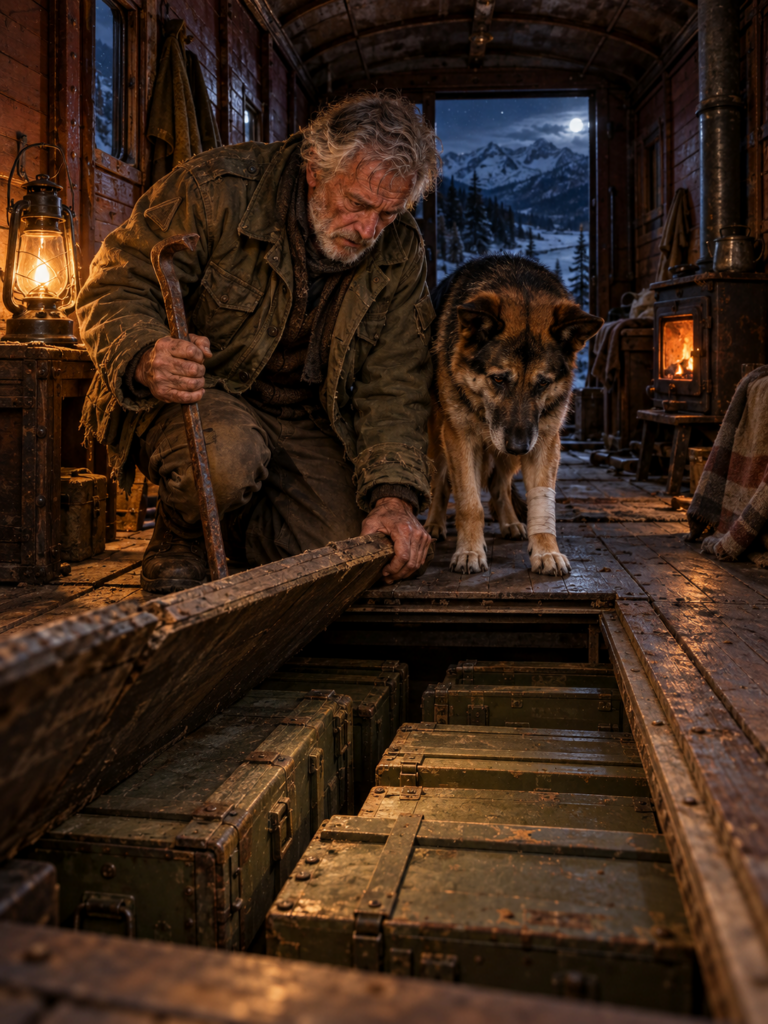
The wooden lid lifted only a fraction before catching against an old nail.
Ethan adjusted his grip and pulled again.
The wood gave way with a dry crack.
Inside lay bundles of paper.
Not weapons.
Not gold.
Not the valuable scrap metal the auction workers had joked about.
Documents.
Hundreds of pages wrapped carefully and placed inside protective bundles.
Ethan lowered the lantern.
A leather-bound journal rested near the top.
He lifted it gently.
The cover was cracked, but the pages appeared largely intact.
Inside, neat handwriting filled line after line.
Measurements.
Transportation schedules.
Engineering sketches.
Military supply calculations.
Near the opening pages was a name.
Captain Sarah Whitmore.
Ethan read it twice.
He knew the Transportation Corps had played an enormous role during World War II, moving troops, supplies, vehicles, equipment, and the materials armies needed to function.
But he’d never heard of Sarah Whitmore.
He turned several pages.
One diagram outlined a rail-loading procedure.
Another compared transportation delays along different supply routes.
Several entries included performance figures and proposed improvements.
Ethan leaned closer.
For years after his military service, he’d worked around railroads.
He understood enough to recognize that these weren’t casual notes.
Whoever had prepared them understood transportation systems in extraordinary detail.
“Sarah Whitmore,” he murmured.
Duke lifted his head.
Ethan glanced toward the other crates.
If they contained more of the same material, the hidden space might be an entire private archive.
But why place such records beneath the floor of an abandoned military rail car?
Why not keep them in an ordinary file room?
He turned another page.
A date near the top placed the writing in the final year of World War II.
The journal described a transportation proposal.
Then another entry referred to the proposal being presented under someone else’s name.
Ethan stopped.
He read the passage again.
Sarah’s notes indicated that a senior officer had claimed credit for her work.
That alone didn’t establish exactly what happened.
A private journal was evidence of what its writer believed and recorded.
It wasn’t independent proof of every accusation.
But it changed the meaning of the crates.
They might not have been abandoned records.
They might have been deliberately preserved records.
Ethan closed the journal.
He looked toward the opening.
Someone had hidden all of this carefully enough that decades had passed without discovery.
He wondered who had sealed the compartment.
Whether Sarah herself had arranged it.
And whether anyone else knew the records existed.
The wind struck the rail car.
Ethan glanced toward Duke’s wrapped paw.
The dog needed rest.
The storm was getting worse.
He decided not to open another crate that night.
Instead, he placed the journal carefully inside, lowered the panel without fastening the bolts, and covered the opening with loose boards.
By morning, fresh snow covered the railyard.
Ethan stepped outside to inspect the car.
Near its rear wheels, he noticed bootprints.
They weren’t his.
The impressions followed the side of the car, paused near the disconnected tracks, and continued toward the access road.
Someone had been there.
That wasn’t proof anyone knew about the crates.
The railyard wasn’t isolated enough for every footprint to be suspicious.
Still, Ethan hadn’t heard a visitor.
He looked toward the distant road.
Nothing moved.
Two days later, a black pickup slowed near the property.
Its windows were dark.
The driver didn’t get out.
Ethan watched it disappear.
That evening, he discovered another cigarette butt near the rail car door.
When Noah Briggs visited the following morning, Ethan showed it to him.
Noah’s expression tightened.
“Victor Cain smokes those.”
“Who’s Victor Cain?”
“Runs a salvage business outside Missoula. Deals in old military equipment and railroad parts.”
“Does he come around here?”
“Sometimes.”
Ethan hesitated.
“Would he have any reason to care about a car everyone thought was worthless?”
Noah studied him.
“Depends what he thinks is inside.”
The answer bothered Ethan more than he wanted to admit.
He had no proof Victor had approached the car.
No proof the truck belonged to him.
And certainly no proof he knew about Sarah Whitmore.
But there was now enough uncertainty that Ethan didn’t want to leave the documents exposed.
He looked toward Duke, sleeping beside the stove.
Then toward the covered floor.
For the first time since buying the rail car, he wasn’t thinking about finding shelter.
He was thinking about protecting what someone else had left behind.
He brought Noah inside, shut the sliding door against the wind, and slowly pulled the loose floorboards aside so the old railroad worker could see what was underneath.
Noah Briggs leaned over the opening, his breath catching when he saw the faded military crates.
For several seconds, he said nothing.
Then he crouched carefully beside Ethan.
“Those were under the floor?”
“All of them.”
“How many?”
“Several. I’ve only opened one.”
Noah examined the hidden panel without touching the documents.
“Somebody spent a lot of effort making sure these wouldn’t be found.”
Ethan nodded.
“That’s what I thought.”
He handed Noah the journal.
The retired rail worker turned several pages.
His face grew serious.
“Sarah Whitmore.”
“You recognize the name?”
“No.”
That answer disappointed Ethan.
Noah studied one of the engineering diagrams.
“But I recognize this kind of work.”
He traced a finger just above the paper.
“Rail-loading calculations. Military transport planning. This was important to somebody.”
Ethan told him about the journal entry indicating that another officer had presented Sarah’s work as his own.
Noah read the passage.
“Could be an accusation,” he said.
“Could be.”
“Doesn’t mean it isn’t true.”
“No.”
The two men remained beside the open compartment while cold daylight filtered through the rail car walls.
At last Noah closed the journal.
“You need someone who understands historical records.”
Ethan stared at the paper.
“I don’t exactly have historians lining up outside.”
Noah smiled faintly.
“Grace knows everybody in the valley.”
***
Grace Turner examined the journal that afternoon behind the counter of her general store.
She read the name on the inside cover.
Then studied several dated entries.
“This came out of that old train car?”
Ethan nodded.
“Beneath the floor.”
Grace looked toward Duke, who sat patiently near the door with his injured paw carefully bandaged.
“He found it?”
“He kept showing me where to look.”
Grace returned her attention to the journal.
“I know a retired teacher named Harold Jensen. He’s spent years studying local and military history.”
Ethan looked at the fragile paper.
“Think he’d be interested?”
Grace gave him a look.
“Ethan, I think you’ll have trouble getting him to leave.”
She was right.
Harold Jensen arrived the following morning carrying notebooks and an enthusiasm Ethan hadn’t seen in years.
He introduced himself, greeted Duke, and immediately began examining the documents.
For four hours, the old teacher barely moved from the table.
He reviewed dates.
Compared maps.
Copied references into his notebook.
At one point he stood and paced the length of the rail car before returning to the journal.
Finally, Ethan asked, “Well?”
Harold removed his glasses.
“This is extraordinary.”
“Because?”
“Because I’ve studied wartime railroad operations and military transportation for decades.”
He placed a hand on Sarah Whitmore’s journal.
“And I’ve never encountered her name in any of the accounts I know.”
Ethan frowned.
“Could she have been a minor officer nobody bothered to record?”
“Possibly.”
Harold tapped a diagram.
“But the work here doesn’t look minor.”
He showed Ethan a sequence of entries describing improvements to supply movement and loading efficiency.
The figures were detailed.
The proposals had been tested.
The writer recorded outcomes, not merely ideas.
“Whoever prepared these notes knew what she was doing,” Harold said.
Ethan looked toward the hidden compartment.
“And somebody buried her work.”
“We don’t yet know who concealed it. Or why.”
The distinction mattered.
Ethan had spent enough of his life watching people make confident claims from incomplete information.
He wanted to understand Sarah Whitmore’s story.
Not turn her into whatever story other people preferred.
***
That evening, after Harold left, Ethan continued reading.
One entry dated January 14, 1945, caught his attention.
Sarah described a transportation proposal being reviewed.
She wrote that an officer identified as Colonel R had presented her work under his own authority.
No objection had been raised.
A later entry described another recommendation being attributed to someone else.
Ethan turned through the pages.
The pattern repeated.
Not every entry accused someone of wrongdoing.
Many were ordinary technical observations, calculations, and work schedules.
That made the accusations feel more consequential.
They weren’t the only subject of the journals.
They emerged from an otherwise detailed record of professional work.
Ethan sat back.
He thought of military service.
Of work performed far from public attention.
Of achievements credited to commanders whose names appeared in reports while those who carried out the work remained unknown.
Then he thought of Sarah Whitmore, preparing calculations and field recommendations during the war, apparently watching other people receive recognition.
He opened another journal.
The entries continued.
And near the back, a later note described her decision to preserve copies of the work elsewhere because she feared the record would not credit her accurately.
Ethan read that passage slowly.
It didn’t explain who had hidden the crates.
But it suggested that preserving independent copies had been deliberate.
The rail car’s hidden compartment suddenly made a different kind of sense.
Someone had wanted these documents to survive beyond the offices where the official records were kept.
***
Over the next several weeks, the discovery gradually reached people with the expertise to investigate it.
Grace and Harold helped make initial contacts.
Eventually, Dr. Melissa Grant, a university historian specializing in military transportation, visited the railyard.
She arrived carrying research materials, a laptop, and a camera.
At first, her questions were cautious.
Where had the journals been found?
Had the crates been disturbed before Ethan opened them?
Were the documents arranged in any particular order?
Had he removed anything?
Ethan answered as accurately as he could.
He showed her the steel compartment.
The covered access panel.
The crate markings.
The journals he’d examined.
Dr. Grant photographed the materials and documented their condition.
Then she began reading.
Within an hour, her expression changed.
“May I see the other engineering notebooks?”
Ethan carefully brought them over.
She compared several diagrams.
“These resemble wartime transportation solutions I’ve encountered in official reports.”
“That sounds promising.”
“It is. But resemblance isn’t enough.”
She opened her laptop.
“I want to compare specific measurements, dates, and drawings.”
For the next several hours, she worked almost without speaking.
Duke slept near the stove.
Ethan made coffee.
Outside, fresh snow settled across the disconnected tracks.
At last, Dr. Grant turned the laptop toward him.
An official transportation report appeared on the screen.
She placed Sarah Whitmore’s journal beside it.
The diagrams were strikingly similar.
Then she showed him another example.
And another.
In several cases, the technical approach, measurements, and sequence of recommendations matched.
But the names attached to the official reports were different.
Ethan looked from one document to the other.
“That’s her work?”
“It may be,” Dr. Grant said. “The correspondence is too significant to dismiss. We need to establish the chronology and determine whether her original notes predate the official reports.”
“And if they do?”
“Then we may have evidence that her contributions were credited to other officers.”
Ethan looked toward Sarah’s handwriting.
The mystery was becoming less about what the crates contained.
It was becoming a question of who had been allowed to write the official history.
***
The investigation expanded.
Researchers examined the journals, maps, technical calculations, and correspondence.
They compared Sarah Whitmore’s work against official wartime reports.
Dates were checked.
Designs were reviewed.
Where possible, the researchers traced how particular recommendations had moved through military channels.
Gradually, the evidence supported a disturbing conclusion.
Sarah Whitmore had made significant contributions to transportation planning during the final year of World War II.
Several innovations recorded in her notebooks appeared in later official documents under other names.
The archive did not prove that every person credited with those reports had knowingly stolen her work.
But it strongly supported that her own contributions had been overlooked or misattributed.
Dr. Grant returned to the rail car one afternoon with copies of official reports.
She placed them in front of Ethan.
“Look at the dates.”
He compared them.
Sarah’s journal entries came first.
The official reports followed.
The matching technical details were unusually specific.
For Ethan, the connection was difficult to ignore.
“She knew they were taking credit.”
“Her writings suggest she believed that,” Dr. Grant answered.
“And she kept copies.”
“Yes.”
Ethan looked toward the compartment.
The hidden crates were no longer simply old military property.
They represented an effort to preserve an account of the work that had been done.
A second record.
One that might survive even if the official documents told a different story.
***
Word of the discovery eventually spread beyond the valley.
Historical researchers arrived.
Photographers documented the archive.
Regional news outlets covered the story.
For a man who had recently been sleeping behind buildings to escape the cold, the sudden attention was overwhelming.
Ethan didn’t enjoy being interviewed.
He disliked cameras.
And he couldn’t understand why reporters wanted so many photographs of him standing beside the rail car.
“Sarah did the work,” he reminded them.
“We’re trying to tell her story.”
Dr. Grant agreed.
But she also told him something he had not expected.
“Your decision to preserve the records matters. You could have thrown them away, damaged them, or sold them separately. Instead, you protected their context.”
Ethan glanced toward Duke.
“He found them.”
Dr. Grant smiled.
“Then both of you deserve some credit.”
Duke seemed perfectly satisfied with a scratch behind the ears.
***
Not everyone welcomed the attention.
The earlier incidents around the rail car remained troubling.
Ethan still remembered the unfamiliar footprints.
The black pickup.
The cigarette butt Noah associated with Victor Cain.
And the night an intruder had approached the rail car.
That incident had become impossible to forget.
After Ethan began protecting the compartment, he had set up simple noise alarms around the entrance.
One night, a chain rattled.
Then the tin cups by the door fell.
Duke moved toward the sound.
Ethan opened the sliding door and saw a hooded man retreating.
The intruder swung a jagged piece of scrap metal, cutting Duke’s front leg.
The shepherd still placed himself between Ethan and the stranger.
Then the man fled toward a black pickup.
Ethan caught only a brief glimpse of his face.
It resembled Victor Cain, the salvage dealer Noah had mentioned.
But Ethan couldn’t claim certainty from that glimpse alone.
He knew only that someone had tried to enter the rail car at night.
And that Duke had been hurt protecting it.
Noah lent Ethan his pickup so he could take Duke to a veterinarian.
The wound was deep enough to require treatment, but there was no broken bone.
Duke recovered gradually.
The limp remained noticeable.
Ethan never forgot the sight of blood against the snow.
It had taught him something about the cost of guarding a discovery before he even knew what it meant.
***
As winter gave way to spring, Sarah Whitmore’s story became increasingly clear.
The official record had failed to recognize much of her work.
Her surviving documents helped establish what she had contributed.
But one question remained.
What had ultimately happened to Sarah herself?
Her journals explained her frustration.
They showed her technical ability.
They documented her effort to preserve independent copies.
Yet they didn’t provide a complete account of her later life.
Nor did they establish with certainty how the crates had come to be sealed beneath the rail car.
Dr. Grant was careful about that uncertainty.
History, she reminded Ethan, was not always generous enough to answer every question.
Sometimes the most important discovery was not a complete biography.
Sometimes it was enough evidence to restore a person to a record that had excluded them.
One evening, Ethan returned to the earliest journal.
He read Sarah’s name again.
Captain Sarah Whitmore.
Months earlier, he hadn’t known the name.
Now researchers across the country were discussing her contributions.
He thought about the men who had laughed at him for spending ten dollars on the rail car.
He thought about his children, who had helped sell the ranch he expected to live on for the rest of his life.
Then he looked at Duke.
The aging shepherd rested near the stove, his injured leg stretched in front of him.
“Guess we both found something worth keeping,” Ethan whispered.
But the most difficult part of Ethan’s own story had not yet been resolved.
And when a silver SUV appeared at the railyard several weeks later, he recognized its passengers before they even stepped onto the gravel.
His son Michael.
And his daughter Clare.
Michael stepped out of the silver SUV first.
He stood beside the open door, looking toward the rail car.
Clare followed.
Neither moved immediately.
Ethan remained beside the fence he had been repairing.
Duke stood at his side.
For several seconds, father and children looked at one another across the gravel yard.
The last time Ethan had seen them, he had still owned his ranch.
Or at least, he had believed it was still his home.
Three months before the auction, Michael and Clare had visited unexpectedly.
They had arrived together, carrying paperwork.
Ethan remembered the meeting with painful clarity.
He remembered Michael speaking about his age.
Clare expressing concern that he couldn’t keep maintaining the property alone.
The folder containing documents relating to the ranch.
And the discovery that his children had already found a buyer.
Years earlier, after his wife Rachel died from cancer, Ethan had allowed their names to be added to certain ownership documents.
At the time, he’d believed it was sensible family planning.
He had trusted them.
Now, that earlier decision had left him vulnerable when they decided the property should be sold.
Three weeks after the meeting, the ranch belonged to someone else.
Ethan left with his belongings and Duke.
The old farmhouse, the pastures, and the land he’d spent years caring for were no longer part of his life.
He had no stable place to go.
His truck lasted less than two weeks before financial trouble forced him to sell it.
Then came the nights outdoors.
The church breakfast.
The bus shelters.
The frozen picnic shelter.
The county auction.
The ten-dollar rail car.
Every step of that journey was still clear in his mind.
Now Michael and Clare were standing in front of him again.
And Ethan wasn’t sure what they expected.
***
“Hi, Dad,” Michael said.
Ethan nodded.
“Michael.”
Clare moved a little closer.
“Hi.”
He looked at her.
“Clare.”
She glanced at the rail car.
“We saw the news.”
Ethan said nothing.
“The articles,” Michael added. “The television story. The historians.”
“I figured.”
Clare clasped her hands.
“We should have come earlier.”
Ethan rested one hand on Duke’s back.
“Yes,” he said quietly. “You should have.”
Neither child argued.
That surprised him.
He had expected explanations.
Excuses.
Something about how difficult the situation had been for everyone.
Instead, Michael looked down at the gravel.
“We didn’t know what happened to you after you left.”
Ethan studied him.
“You had my number.”
Michael’s face tightened.
“I know.”
“You knew I didn’t have much money.”
“Yes.”
“You knew I didn’t have anywhere lined up to live.”
Michael opened his mouth, then closed it.
Clare wiped a hand across her cheek.
“Dad, we thought you’d arrange something.”
Ethan looked toward the rail car.
A wooden ramp now led up to the sliding entrance.
Visitors had been coming for weeks.
Inside, researchers were working to organize and preserve the archive.
A display board explained the preliminary findings about Sarah Whitmore.
The place was beginning to look less like abandoned equipment and more like a historical site.
But none of that changed what had happened when Ethan first arrived.
“I arranged this,” he said.
Michael followed his gaze.
“The train car?”
“Ten dollars.”
Clare stared at him.
“What?”
“That’s what I paid for it. Ten dollars.”
Her expression changed.
“You were living in there?”
“Yes.”
“During winter?”
“Yes.”
She turned toward Michael.
He looked away.
Ethan didn’t take pleasure in their discomfort.
He had once spent years making excuses for himself, too.
Excuses for why a sudden noise could make him feel as though he were back in combat.
Excuses for why certain crowded places left him exhausted.
Excuses for why he sometimes needed hours of silence before he could speak to anyone.
He understood the appeal of an explanation that made difficult things easier to accept.
But understanding it didn’t make it true.
***
Michael noticed Duke’s limp.
“What happened to him?”
Ethan looked down.
The shepherd was standing carefully, keeping a little weight off his injured front leg.
“He got hurt protecting this place.”
Clare stepped forward.
“Is he all right?”
“He’s recovering.”
“What happened?”
Ethan could have given them the short version.
He could have said the dog cut himself on old metal.
It would have been easier.
Instead, he told them about the hidden compartment.
About the crates.
About the strangers who appeared near the railyard.
About the man who tried to enter the car at night.
And about Duke standing between the intruder and the doorway even after the metal cut his leg.
When Ethan finished, Michael looked shaken.
“You were dealing with all that by yourself?”
“Not completely.”
He glanced toward the general store across the road.
“Grace helped.”
He nodded toward the workshop.
“Noah helped.”
Then toward the small church visible beyond the trees.
“Pastor Reed helped.”
Clare lowered her eyes.
The point didn’t need explaining.
People who had barely known Ethan had offered food, blankets, work, tools, and companionship.
His own children had been absent.
Finally Michael said, “We were wrong.”
Ethan looked at him.
Michael continued.
“We thought we were making things easier.”
“No,” Ethan answered gently. “You were making a decision you wanted made.”
His son swallowed.
Clare spoke next.
“We should have listened to you.”
“Yes.”
“We should have asked what you wanted.”
“Yes.”
The words were simple.
Ethan didn’t raise his voice.
He didn’t need to.
For months, he’d carried the memory of leaving his ranch with the feeling that his children had stopped seeing him as a person capable of directing his own life.
Instead, he’d become a problem to solve.
An obligation to manage.
A responsibility to transfer.
Now they were finally acknowledging that something had gone wrong.
But acknowledgement wasn’t repair.
***
Michael looked toward the rail car.
“We’d like to help.”
Ethan waited.
“With this place,” Michael clarified. “Or anything you need.”
Clare nodded.
“We don’t expect everything to be normal.”
Ethan glanced at Duke.
The old dog was watching the three of them calmly.
Michael had always liked Duke.
Clare, too.
The shepherd had lived through the period when Ethan’s family still gathered around the same kitchen table.
He had watched the children grow older.
Watched Rachel’s place at the table become empty.
Watched Ethan struggle with retirement and memories of the war.
And when everyone else left, Duke remained.
Ethan looked back at his children.
“The dog stayed,” he said.
Neither moved.
“You didn’t.”
Clare’s eyes filled.
Michael lowered his head.
For several seconds, the only sounds were the wind moving through the pines and distant voices from the visitors near the rail car.
Then Ethan continued.
“If we’re going to rebuild anything, it won’t happen because you saw me on television.”
Michael nodded.
“It won’t happen because somebody wrote an article about this place.”
“I understand.”
“It has to happen because we tell the truth about what happened.”
Clare wiped her eyes.
“We will.”
Ethan wanted to believe her.
More than he wanted to admit.
But he had learned something during those months on the road.
Trust wasn’t restored by a single conversation.
And forgiveness didn’t require pretending that an injury had never happened.
He could love his children without immediately giving them the same access to his life that they had once held.
He could allow a relationship to grow without surrendering his independence again.
Michael took a cautious step closer.
Ethan didn’t move away.
It wasn’t reconciliation.
Not yet.
But it was a beginning.
***
As spring settled across the Bitterroot Valley, the historical investigation continued.
Dr. Melissa Grant and her colleagues worked carefully through the remaining journals, maps, engineering drawings, and military files.
Some documents provided clear dates and signatures.
Others required comparison with archived records.
The researchers established that Sarah Whitmore had contributed to wartime transportation planning in ways that had received little or no recognition.
Several of her proposals appeared in later reports credited to senior officers.
The notebooks demonstrated that she had recorded important technical details before those reports were issued.
The evidence was significant.
It also had limits.
The records did not reveal every conversation between Sarah and her superiors.
They did not establish the motives of every officer whose name appeared on an official report.
And they did not completely explain her later life.
But they were strong enough to change the historical account.
For the first time in decades, her name began appearing in publications discussing the work she had performed.
Dr. Grant was careful to describe the findings accurately.
Rather than claiming Sarah had single-handedly transformed military logistics, she demonstrated specific contributions supported by the surviving documents.
Ethan appreciated that.
He didn’t want Sarah Whitmore turned into a legend that couldn’t withstand careful examination.
He wanted her work acknowledged.
The real work.
The work she had done.
***
The railyard began to change.
Not overnight.
And not because one person suddenly became wealthy.
The story attracted historical interest, community support, and people willing to help preserve the site.
A modest visitor area was created beside the train car.
The old interior was stabilized.
The concealed steel compartment was documented.
Selected items were prepared for protected display, while fragile originals were handled under appropriate archival conditions.
A gravel parking area made the site easier to reach.
Students began visiting.
So did veterans.
Some were interested in Sarah Whitmore’s contribution to wartime transportation.
Others wanted to meet the old soldier and the German Shepherd who had found the archive.
Ethan wasn’t entirely comfortable with the attention.
He preferred working quietly.
Repairing things.
Keeping the walkways clear.
Making sure the displays were in order.
But he understood the responsibility that came with the discovery.
The rail car had given him shelter when he needed it most.
Now he had the chance to make sure the history it contained remained accessible.
He began opening the site each morning.
Duke accompanied him.
The shepherd’s muzzle had grown noticeably gray.
His gait was slower.
Some days the old injury bothered him more than others.
But he still inspected the rail car as though it were an assigned post.
Ethan often found him sitting near the rear corner.
The place where he’d scratched at the floor.
The place where everything had begun.
***
Michael and Clare visited again.
Then again.
Their relationship with Ethan changed gradually.
Sometimes the conversations were awkward.
Sometimes the old disagreements returned.
There were questions about the ranch sale that couldn’t be settled with a few apologies.
Ethan insisted that his future decisions remain his own.
His children learned to ask before offering solutions.
Some visits ended pleasantly.
Others left everyone tired.
But they kept talking.
That mattered more to Ethan than any public celebration of the archive.
The historical discovery had brought strangers to his door.
It had not automatically repaired his family.
That work required something much less dramatic.
Patience.
Honesty.
Respect.
Time.
He was willing to offer those things.
But he no longer intended to carry the entire burden alone.
***
One year after the auction, the rail car stood at the center of a small but growing historical site.
Visitors moved quietly through the preserved interior.
Displays explained the Transportation Corps’ work during World War II and Sarah Whitmore’s documented contributions.
Photographs showed the hidden steel compartment as Ethan had found it.
Reproductions of engineering diagrams allowed visitors to examine the details without damaging the originals.
A section described the discovery.
Ethan Walker.
Retired veteran.
Duke.
German Shepherd.
Ten-dollar auction purchase.
Ethan still found that part faintly embarrassing.
He’d never imagined his name would appear in an exhibit.
His goal had been to survive the winter.
Nothing more.
Yet something about the display pleased him.
Not because it made him famous.
Because it connected two stories that might otherwise never have been told.
An overlooked wartime officer whose work had been misattributed.
And an older veteran who had been treated as though his life no longer belonged to him.
The two stories weren’t identical.
Their hardships weren’t interchangeable.
But both involved the painful consequences of being overlooked.
***
Early one autumn afternoon, Dr. Grant arrived carrying a small archival box.
Ethan was working near the rail car entrance.
He noticed her expression immediately.
“You found something.”
She nodded.
“Inside one of the remaining crates.”
He put down his tools.
“What kind of something?”
“A letter.”
They went inside.
Duke followed and settled near a display case.
Sunlight came through the old wooden walls.
Dr. Grant placed the box on a table.
She opened it carefully.
Inside was a yellowed envelope.
The paper looked fragile.
She explained that the letter had been discovered behind a false inner section of one of the crates during cataloging.
It was another deliberate layer of concealment.
Ethan studied the handwriting.
He recognized it.
Sarah Whitmore.
Dr. Grant showed him the preserved document.
It was addressed to whoever eventually discovered the records.
Ethan read slowly.
Sarah wrote about watching important work appear under other people’s names.
About the frustration of having responsibility without recognition.
About understanding that she could not control how her superiors described events, but could preserve an account of what had actually happened.
She expressed the hope that someone, eventually, would find the documents.
She didn’t know who that person would be.
A researcher.
A soldier.
Perhaps someone who understood what it meant to be overlooked.
The letter’s central message was simple.
Being forgotten by others did not erase the value of a person’s work.
And preserving the truth mattered even when recognition might never arrive.
Ethan lowered his eyes.
For a moment he found himself unable to speak.
He had spent months examining Sarah’s technical journals.
He had learned about her calculations, proposals, and professional frustrations.
But this letter was different.
It was written for an unknown future reader.
Someone who might exist long after she was gone.
She had protected the records not because she knew they would make her famous.
She had protected them because she believed the truth deserved the chance to survive.
Ethan glanced toward Duke.
The dog was sleeping peacefully.
He remembered the night they had found the steel panel.
The bloody paw.
The rusty bolts.
The concealed crates.
He remembered how close he had come to abandoning the rail car before Noah helped him open it.
And how easily he could have dismissed Duke’s fixation on that section of floor.
He looked back at the letter.
“She never knew if anyone would find it.”
Dr. Grant shook her head.
“No.”
“But she kept it anyway.”
“Yes.”
Ethan sat quietly.
Something about that mattered more than all the newspaper coverage.
Sarah Whitmore had not controlled the way the military recorded her work.
She couldn’t ensure that future historians would recognize her.
But she could save the evidence.
And she had.
***
The remaining months brought further archival work.
The newly discovered letter helped clarify Sarah’s intention to preserve records that she believed were being misattributed.
It did not prove every suspected wrongdoing.
Nor did it provide a complete account of her personal future.
But it answered one important question.
Why would someone go to such lengths to protect copies of technical documents?
Because the official story did not reliably preserve her contributions.
She wanted another version of the record to survive.
The precise circumstances by which the crates came to rest beneath the rail car remained uncertain.
Ethan accepted that.
He had once thought every mystery should end with a complete explanation.
Now he understood that evidence could correct an injustice without answering every question.
Sarah’s work could be recognized even if some details about her life remained lost.
The truth didn’t need to be made larger than the records supported.
It only needed to be heard.
***
One evening, after the visitors had gone, Ethan carried a folding chair outside.
The valley was quiet.
The last sunlight touched the highest peaks of the Bitterroot Mountains.
Duke followed him slowly.
The shepherd lowered himself onto the grass beside the chair and gave a long, comfortable sigh.
Ethan smiled.
“Long day, partner?”
Duke closed his eyes.
For a while, they listened to the wind moving through the pine trees.
A distant freight train sounded its horn.
The note traveled across the valley.
Long.
Low.
Familiar.
Years earlier, a sudden mechanical sound could have sent Ethan’s mind racing toward memories he didn’t want to revisit.
The war had followed him home in ways he still struggled to explain.
Sometimes it surfaced in crowded rooms.
Sometimes in the middle of the night.
Sometimes without warning.
He still had difficult days.
He wasn’t cured by finding a train car.
Duke wasn’t a miracle.
But they had found stability.
Routine.
Friendship.
Work that mattered.
And Ethan had begun to understand that accepting support didn’t make him weak.
Grace’s kindness had mattered.
Noah’s tools and practical help had mattered.
Pastor Reed’s blankets had mattered.
The historians’ patience had mattered.
Even the difficult conversations with Michael and Clare were beginning to matter.
The people who helped him didn’t erase the suffering of those winter nights.
They gave him something with which to build a life afterward.
He rested one hand on Duke’s back.
The shepherd’s breathing was slow and steady.
Ethan glanced toward the old rail car.
It looked different now.
The rust had been stabilized.
The roof repaired.
The entrance secured.
Visitors came to see what had once been hidden beneath its floor.
But beneath the repairs, it was still the same car.
The same wooden walls.
The same steel framework.
The same place that had protected him from the snow when he had nowhere else to go.
He remembered the auctioneer’s voice.
Ten dollars.
No other bidders.
The laughter.
The jokes about buying useless scrap.
He had handed over his last money without knowing whether the rail car would even keep out the wind.
And now, a year later, it was his home in a way the ranch had stopped being long before he left.
Not because it was worth more.
Because it represented a life he had begun choosing for himself.
***
As the evening deepened, Michael’s truck appeared briefly along the access road.
His son had come to help repair a section of fencing the following morning.
He parked near the visitor area, waved from a distance, and walked toward the small building where he would spend the night.
Ethan raised a hand in return.
It wasn’t the same relationship they once had.
It might never be.
But his son was coming back.
Not to take over.
Not to make decisions.
To help with work Ethan had asked him to do.
That difference meant something.
Duke opened one eye, noticed Michael, then settled again.
Ethan laughed softly.
“Good enough for you?”
The dog’s tail moved against the grass.
The veteran leaned back in his chair.
Across the valley, shadows gathered beneath the trees.
He thought of Sarah Whitmore’s letter, now preserved with the rest of her archive.
A letter written without knowing when, or whether, someone might read it.
For decades, her work had remained inside sealed crates beneath an abandoned rail car.
The people who had used her ideas might have received recognition.
The people who preserved the official records might have overlooked her.
But the documents survived.
And when Ethan found them, he had the chance to make sure they weren’t forgotten again.
He looked down at Duke.
“You know something?”
The shepherd’s ear twitched.
“I thought we were buying a place to sleep.”
Duke lifted his head slightly.
Ethan smiled.
“Turns out we found somebody else’s story.”
He scratched behind the dog’s ear.
“And maybe a little of our own.”
The sun disappeared behind the mountains.
The valley cooled.
Ethan remained in his chair, listening to the distant sounds of the countryside.
He no longer needed to move every few nights.
He no longer carried everything he owned in a backpack.
He no longer woke wondering where he and Duke would shelter from the next storm.
That security mattered more than any unexpected fortune.
And the extraordinary records beneath the floor had brought him a kind of responsibility he had never anticipated.
To preserve.
To remember.
To tell the truth.
He thought of the words that had stayed with him since reading Sarah’s letter.
Someone’s value could remain real even when other people refused to recognize it.
For most of his life, Ethan had understood value through service.
Through work.
Through sacrifice.
Through providing for a family.
Losing the ranch had made him question whether any of those years still counted.
But the old train car had taught him something he hadn’t expected.
His history couldn’t be erased by someone else’s decision.
Neither could Sarah Whitmore’s.
And Duke had never needed any proof at all.
The shepherd had followed him from their former home into uncertainty.
Through cold nights and empty roads.
Through hunger.
Through fear.
Through the railyard where nobody wanted the old train car.
The dog had stayed.
Not because Ethan owned a ranch.
Not because he had money.
Not because he was respected by strangers.
He had stayed because Ethan was his person.
Ethan looked toward the mountains one final time.
Then he closed his eyes.
The evening was peaceful.
Not perfectly silent.
Not free from memory.
But peaceful.
Beside him, Duke rested his head across his paws.
The train car stood behind them, preserving the work of a woman who had refused to let her contributions disappear completely.
And the man sitting outside it had found a way to preserve something of himself, too.
Two lives separated by generations.
One hidden record.
One extraordinary dog.
And a ten-dollar purchase that had given a forgotten piece of history the chance to be remembered.
Ethan reached down and rested his hand on Duke’s shoulder.
“Home, buddy,” he whispered.
The dog’s tail moved once.
Above the Bitterroot Mountains, the first stars appeared.
And for the first time in a long while, Ethan had nowhere else he needed to be.

