
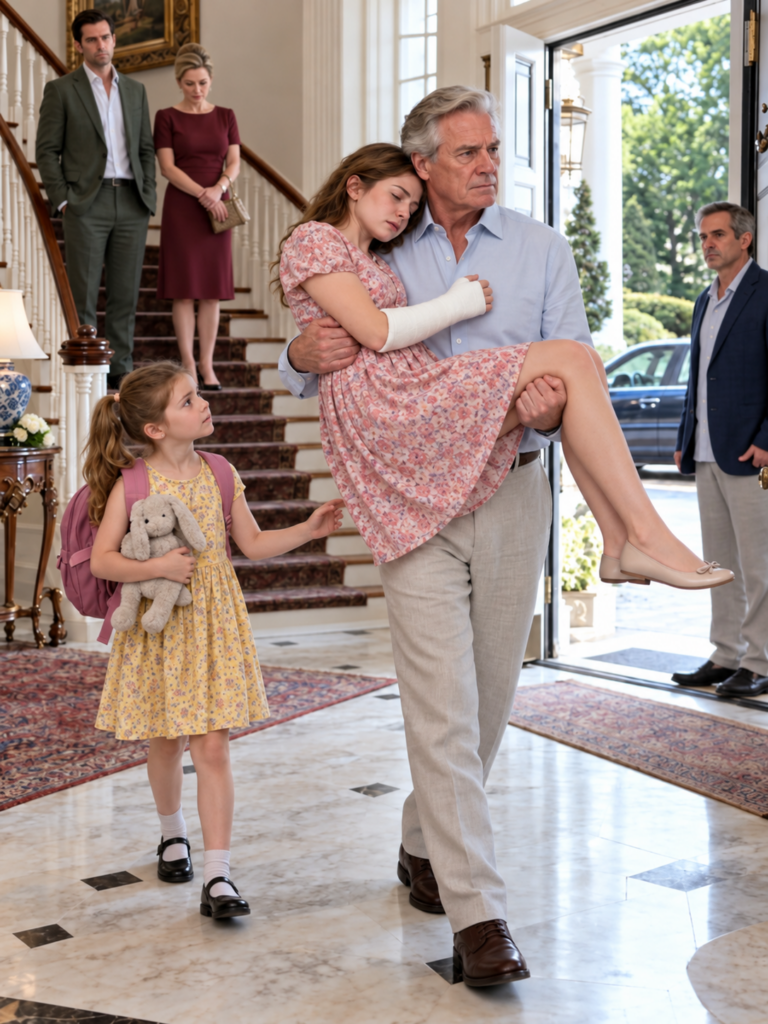
Part 1
The first thing I remember clearly is the sound of my daughter screaming my name.
The second is my husband’s face.
Daniel Harwood stood halfway down the staircase, one hand gripping the polished wooden railing, staring at me as though I had done something terribly inconvenient.
He wasn’t running toward me.
He wasn’t calling for help.
He was looking at the blue folder lying open beside my shoulder.
Three sheets of paper had slipped out when I fell. One rested against the leg of an antique hallway table. Another had landed facedown near the front door. The third was trapped beneath my left arm, which hurt so badly I couldn’t move it.
Daniel took one step toward the papers.
“Don’t,” I whispered.
He stopped.
For a moment, something passed across his face that I might once have mistaken for regret.
Then his mother appeared.
Vivian Harwood descended the stairs in a cream silk blouse, her pearl earrings swinging slightly as she surveyed the scene.
“Oh, for heaven’s sake,” she said.
Her eyes moved from my twisted body to the scattered documents.
“Daniel, pick those up.”
“Mom, she’s hurt.”
“Then call someone. But don’t leave those papers lying around.”
That was the moment I understood what mattered most to them.
Not my breathing.
Not my injuries.
Not whether their seven-year-old granddaughter had just watched her mother tumble down a staircase.
The papers.
I tried to push myself onto my right elbow. A terrible pain shot through my ribs, and my breath caught.
Vivian looked at me with irritation.
“Claire, please stop moving. You’re making everything worse.”
I had heard versions of that sentence for almost nine years.
You’re too emotional, Claire.
You’re misunderstanding, Claire.
You’re making things difficult again.
But I hadn’t misunderstood what had happened on the staircase.
I remembered every second.
Daniel had cornered me on the upper landing after finding out I’d spoken to someone from his family’s accounting department.
He demanded the folder.
I refused.
He caught my wrist so tightly that his wedding ring pressed into my skin.
“Give it to me,” he said.
“No. I’m taking it to an attorney.”
His expression changed.
“You have no idea what you’re interfering with.”
“Then explain it to me.”
He reached for the folder. I pulled away and backed toward the stairs.
“Daniel, let go.”
He grabbed my shoulder with his other hand.
I remember his face being inches from mine.
I remember saying his name one final time.
Then he shoved me.
Not an accidental bump.
Not a desperate attempt to catch me.
Both hands pressed against my shoulders, and he pushed hard enough to send me backward.
My heel found empty space.
The folder flew out of my hand.
And the staircase rose toward me in a blur of white marble and dark wooden railings.
Now Daniel stood near my feet, holding the very papers he’d been willing to hurt me to obtain.
Vivian had already taken out her phone.
“Arthur,” she said when my father answered. “You need to come get your daughter.”
I shut my eyes.
My father lived in a modest house outside Salisbury, North Carolina, nearly an hour from the Harwood estate.
He was seventy-one years old, drove a twelve-year-old Honda, and spent most Saturday mornings repairing things that would have been cheaper to replace.
He had never liked Daniel’s family.
But he had always respected my insistence that I could manage my own marriage.
“Claire has had another episode,” Vivian continued. “She’s been making accusations and rummaging through private documents. Now she’s fallen down our stairs, and frankly, we’re finished dealing with her.”
I tried to speak.
Only a small, painful sound came out.
Vivian glanced down at me.
“Come collect your daughter, Arthur. She’s more trouble than she’s worth.”
There was a pause.
Then she laughed.
“Don’t be ridiculous. These things happen when people become hysterical.”
Another pause.
Her smile disappeared for a fraction of a second.
“Are you threatening me?”
She switched the call to speakerphone, apparently wanting Daniel to hear whatever my father had said.
His voice came through clearly.
“Vivian, listen carefully. Don’t touch anything else in that hallway. Don’t move the documents, and don’t tell anyone what happened until you’ve decided whether you’re prepared to say it under oath.”
Vivian gave an amused little snort.
“You sound like a policeman.”
“No,” Dad answered quietly. “I’m telling you to preserve the evidence.”
She ended the call.
“Your father has always had an exaggerated opinion of himself.”
Daniel said nothing.
Somewhere upstairs, my daughter cried again.
“Mommy!”
I turned my head toward the staircase.
“Sophie,” I tried to call.
Pain cut the word in half.
That was when I heard a third adult voice.
“An ambulance is coming, Mrs. Harwood.”
Marisol Vega, the housekeeper, stood near the dining-room doorway with her cellphone in one hand.
She had worked for the Harwoods for twelve years. Usually she moved through the house so quietly that Vivian barely acknowledged her.
Now her face was pale.
Vivian turned sharply.
“I told you I would handle it.”
Marisol looked past her at me.
“She couldn’t breathe properly. I called.”
For the first time, I felt something close to hope.
I heard the faint wail of a siren several minutes later.
When the paramedics entered, Vivian was waiting near the front door.
“My daughter-in-law lost her balance,” she explained. “She’s been very distressed lately.”
Daniel stood beside her, nodding.
One paramedic knelt next to me. She was a woman in her forties with short dark hair and a calm voice.
“I’m Denise. Can you tell me your name?”
“Claire.”
“Claire, I’m going to examine you. Do you know what happened?”
I could see Vivian over Denise’s shoulder.
She was watching me.
Daniel was watching too.
Nine years of marriage had taught me to consider the consequences before contradicting either of them.
This time, I looked directly at Denise.
“My husband pushed me.”
The hallway fell silent.
Denise didn’t turn around. She kept her eyes on mine.
“Can you repeat that?”
I took the smallest breath I could manage.
“Daniel pushed me down the stairs. I didn’t fall.”
Behind her, Vivian made a sharp, disbelieving sound.
“That is absolutely untrue.”
Denise spoke into her radio, then returned her attention to me.
“Thank you for telling me, Claire.”
Those six words mattered more than she could possibly have known.
For once, someone had heard me without immediately explaining why I was wrong.
I’d married Daniel when I was twenty-eight.
He was charming, attentive, and wonderfully confident in situations that left me feeling awkward. At our first dinner together, he’d remembered that I disliked mushrooms and quietly asked the waiter to change my order before it arrived.
I took that as thoughtfulness.
It was, at first.
There were many good memories from our early years, and I would later spend a long time trying to understand how those memories could exist alongside what he became.
Daniel worked for Harwood Development, a regional property company his father had built from a handful of shopping centers into a business with office buildings, residential developments, and commercial leases across three states.
I worked as a reading intervention specialist at an elementary school.
My students came from families that couldn’t always afford tutors, extra books, or private evaluations. I loved watching a child who had struggled for months suddenly read a full paragraph without assistance.
Daniel said my job was admirable.
Vivian called it “a sweet little occupation.”
When Sophie was born, I reduced my hours. Daniel suggested combining our finances to simplify the mortgage, insurance, and household expenses.
Eventually, he took control of almost everything.
He paid the bills.
He managed our savings.
He dealt with the bank.
If I asked a question, he always had an answer.
But the answers gradually became shorter.
Then impatient.
Then insulting.
“Claire, you teach second graders to read. Let the people who understand business handle business.”
I hated that sentence.
Yet I heard it so frequently that I began asking fewer questions.
Three years before my fall, Daniel convinced me to move into the renovated guest wing of his parents’ estate while we supposedly searched for a permanent home.
The guest wing had its own entrance, kitchen, and living room.
But it was still their property.
Vivian came in without knocking.
She criticized the food I prepared.
She corrected Sophie when the child called me instead of her father for help.
And she had a way of turning ordinary family disagreements into conversations about gratitude.
“Some women would give anything for the life you have, Claire.”
I heard that whenever I mentioned wanting our own house.
I heard it when I returned to work after maternity leave.
And I heard it on the morning I discovered a financial agreement bearing a signature I had never written.
That discovery began eleven days before Daniel pushed me down the stairs.
It was a Tuesday afternoon when I received the call.
I was sitting in my car outside Sophie’s school, waiting for the pickup line to move.
The woman introduced herself as Nora Bell.
She said she worked in financial records for Harwood Development.
“I apologize for calling your personal number,” she began. “I need to verify something before I finish a report.”
Her voice sounded nervous.
“Are you familiar with an entity called Brookfield Commercial Holdings?”
“No.”
“Have you ever agreed to serve as a personal guarantor for a commercial construction loan?”
I laughed because the question seemed so absurd.
“Absolutely not.”
She went quiet.
Then she asked, “Would you be willing to meet privately?”
I hesitated.
“Why?”
“Because your name is on a document that says otherwise.”
I nearly ended the call.
Daniel had warned me about people who approached family members looking for confidential information.
But there was something different about Nora.
She wasn’t asking for money.
She wasn’t flattering me.
She sounded frightened.
We met two days later at a diner outside Greensboro.
Nora was in her late forties, with auburn hair pulled into a loose knot. She ordered coffee but barely touched it.
After checking that nobody was seated at the neighboring booth, she slipped a photocopied page across the table.
My name appeared beneath a paragraph guaranteeing a $1.8 million obligation.
I stared at the signature.
It was close.
Very close.
But whoever had written it had formed the final loop of my surname differently.
And the date troubled me even more.
According to the document, I’d signed it at a corporate office on March 18.
March 18 was Sophie’s birthday.
I remembered that day vividly because she’d come down with a fever during her party and I’d spent the afternoon sitting beside her bed, reading the same picture book four times.
I’d never visited the corporate office.
Nora watched my face.
“That’s what I thought,” she whispered.
“What do you mean?”
She opened a second folder.
There were other documents.
A loan amendment.
An authorization form.
A notarized acknowledgment.
My name appeared repeatedly.
Some signatures looked convincing.
Others were obvious imitations.
I felt physically sick.
“Does Daniel know?”
Nora’s expression gave me the answer before she spoke.
“I believe he approved some of the submissions.”
I pushed the papers away.
“No. There has to be another explanation.”
Nora folded her hands.
“I’ve worked there for thirteen years, Claire. I know how they handle paperwork. These documents weren’t supposed to pass through my department. Someone routed them there by mistake.”
“Then why come to me?”
“Because I found three other guarantors who say they never signed anything either.”
I sat back.
Outside, a truck pulled into the parking lot. Its headlights passed across the booth, briefly illuminating the papers between us.
Nora lowered her voice.
“The company has a serious cash-flow problem. Several developments are behind schedule, and some of the money being moved between subsidiaries doesn’t match the contracts. I think certain people are using guarantees they don’t actually have to make the accounts look stronger.”
I stared at her.
“Who?”
She didn’t answer directly.
Instead, she pointed to initials handwritten in the margin of one page.
V.H.
Vivian Harwood.
My mother-in-law.
I had always assumed Vivian’s role in the business was social. She hosted charity dinners, entertained potential investors, and took credit for her husband’s success.
Daniel called her the company’s unofficial ambassador.
Apparently, her involvement went much further.
Nora explained that Vivian had access to certain corporate accounts and frequently instructed staff to prepare or replace confidential documents.
Then she slid one final sheet across the table.
It was an internal note.
My eyes went immediately to one sentence.
If Claire questions the guarantee, Daniel will deal with her.
I read it three times.
A strange coldness settled over me.
Nora reached across the table.
“Claire, you need a lawyer. Not someone connected to the Harwoods. Someone who works for you.”
I nodded.
But I didn’t tell her that my husband had recently asked me to sign a document granting him broader authority over our joint finances.
Or that when I refused, he’d stopped speaking to me for nearly a week.
I took the copies and drove home.
For the first time in years, I didn’t call Daniel to tell him where I’d been.
I hid the documents inside an old purple backpack that Sophie had used in kindergarten.
It was tucked at the bottom of a hall closet among winter scarves and outgrown shoes.
The following evening, I telephoned my father.
“Dad, can I ask you something about signatures?”
“Of course.”
“If somebody signs your name without permission, what should you do?”
He didn’t answer immediately.
“Is this hypothetical?”
I looked toward the kitchen, where Daniel was pouring himself a glass of wine.
“Maybe.”
Dad’s voice changed.
“Claire, don’t sign anything else until you’ve spoken to an independent attorney. And if you have documents, keep copies somewhere safe.”
“You’re making it sound serious.”
“It might be. I don’t know enough yet.”
I could hear him set down something metallic, probably the old wrench he’d been using to repair his lawn mower.
“Sweetheart, are you safe?”
The question startled me.
“Of course.”
“Then tell me why you whispered that.”
I looked down at the phone.
“I have to go.”
“Claire—”
I ended the call.
An hour later, Daniel asked whether I’d spoken to my father.
I told him we had discussed Sophie’s upcoming school concert.
He held my gaze longer than usual.
Then he smiled.
“Good. Your father worries too much.”
I barely slept that night.
The next morning, I made a second set of copies at a print shop.
I placed them in a plain envelope and drove to my father’s house while Daniel was at work.
Dad wasn’t home, so I left the envelope inside a tin box we used for spare keys and old photographs, with a note asking him to keep it safe.
I didn’t explain what it contained.
I still hoped there was a misunderstanding.
That hope survived until Saturday morning.
Daniel found the blue folder.
At the hospital, the emergency physician told me I had two fractured ribs, a badly injured shoulder, extensive bruising, and a concussion that required observation.
A police officer arrived to take my statement.
I explained the argument.
The folder.
The grip on my wrist.
The shove.
I showed him the bruises beginning to darken around my arm.
He wrote everything down.
“Did anyone else see it happen?” he asked.
“I don’t know. The housekeeper was near the dining room.”
“Do you know her name?”
“Marisol Vega.”
He nodded and wrote that down too.
Then he asked whether Daniel had ever hurt me before.
I wanted to say no.
Because he’d never pushed me down a staircase before.
He’d never punched me or left me with an obvious injury.
But I remembered the night he’d blocked the bedroom door when I tried to leave an argument.
I remembered him twisting my wrist to take my phone.
I remembered the time he’d grabbed my upper arm hard enough to leave a bruise and apologized the next morning with flowers.
“He has grabbed me,” I said finally. “And he’s frightened me.”
The officer waited.
I swallowed.
“I don’t think I understood how frightened I was until today.”
After he left, I cried for the first time.
Not because my ribs hurt.
Because I’d finally said the words aloud.
A nurse brought me ice water and adjusted my pillows.
Then she smiled toward the doorway.
“There’s someone here to see you.”
My father entered carrying his old brown jacket over one arm.
Behind him stood a woman in a navy suit holding a leather briefcase.
Dad crossed the room without looking at the monitors or the bruises.
He bent down and kissed my forehead.
“Hello, sweetheart.”
I tried to smile.
Instead, I began crying again.
He took my hand.
For a long moment, he said nothing.
Then he pulled up a chair.
“I believe you, Claire.”
I gripped his fingers.
“I didn’t know he was going to do that.”
“I know.”
“I should have left before.”
“We can talk about the past another time. Right now, I need to know whether Sophie is safe.”
My stomach tightened.
“She’s still at the house.”
Dad nodded toward the woman by the door.
“This is Elena Brooks. She’s an attorney I’ve worked with before.”
Elena stepped closer.
“Claire, we’re arranging the safest lawful way to get Sophie out of that house. Your father has already contacted the appropriate people.”
I stared at her.
“How does he know what to do?”
She glanced at Dad.
He looked uncomfortable.
For as long as I could remember, Dad had described his government career as administrative work.
He’d never worn an impressive uniform.
He’d never talked about important meetings.
His retirement party had been small, with grocery-store cake and a dozen former colleagues.
Now Elena explained that he’d spent nearly thirty years working in federal oversight and investigations, much of that time as a senior supervisory attorney handling complex financial fraud, contractor misconduct, and cases involving people with considerable political and business influence.
Dad cleared his throat.
“That doesn’t make me a detective now, Claire. I’m retired. It just means I know when someone needs good legal help.”
“But you never told me.”
“You never seemed particularly interested in hearing an old man talk about accounting records.”
I almost laughed.
Even then, lying injured in a hospital bed, I nearly laughed.
Then Elena opened her briefcase.
“There’s something else.”
She took out a document.
Daniel’s attorneys had sent notice that his family intended to seek emergency custody of Sophie.
The petition alleged that I had become emotionally unstable, behaved irrationally around the child, and suffered injuries during what it described as a domestic disturbance that I had initiated.
It also suggested that my poor financial judgment might threaten Sophie’s welfare.
I read the first page twice.
“They’re saying I’m unfit?”
Elena nodded carefully.
“That’s the position they’re preparing to argue.”
“But he pushed me.”
“I know.”
“He’s the one who hurt me.”
“Claire,” she said gently, “that’s why we need to establish the facts carefully.”
Dad stood beside the window, looking down at the hospital parking lot.
I had never seen him so still.
Finally, he turned around.
“Elena, tell her what you found.”
She hesitated.
“Arthur, perhaps we should—”
“She deserves to know.”
Elena sat beside my bed.
“The envelope you left at your father’s house contains documents related to the Harwood business. We had a qualified attorney examine the copies. Some of the transactions could involve serious fraud.”
I looked at Dad.
“You opened it?”
“After I learned you’d been injured, yes. I thought it might explain why.”
Elena continued.
“Claire, the documents also contain something your husband may not realize you’ve seen.”
She placed a photocopy on my blanket.
It was an email written by Vivian Harwood to Daniel.
The subject line read:
Contingency Plan.
The message was dated two days before my fall.
I read the first paragraph slowly.
Then the second.
My hands began trembling.
Vivian hadn’t simply been angry with me.
She had already asked the family’s attorney to prepare material questioning my judgment as a parent.
And one sentence explained why.
If Claire proceeds with her accusations, we need to establish that she cannot be relied upon as a witness.
I looked up at my father.
“They planned this?”
Dad didn’t answer immediately.
“The documents show they were preparing to discredit you,” he said. “We still have to establish everything that happened on the stairs.”
I stared at the email.
All those years, I’d thought Vivian wanted me to be grateful.
Now I understood something much uglier.
She wanted me obedient.
And when I stopped obeying, she was prepared to take away the person I loved most.
My daughter.
Part 2
Sophie came to the hospital the next afternoon wearing her yellow raincoat.
Dad had collected her after I signed an authorization allowing him to take her into his care during my hospitalization. Daniel had initially objected, but after the police contacted him about my statement, his attorney agreed to a temporary arrangement while the court considered the dispute.
Sophie walked through the hospital doorway clutching a stuffed rabbit.
She stopped when she saw my shoulder brace.
“Mommy?”
I opened my good arm.
“Come here, sweetheart.”
She approached slowly, as though I might break if she moved too quickly.
“Does it hurt?”
“A little.”
“Did you cry?”
I smiled.
“Yes, I did.”
She considered that seriously.
“I cried too.”
Something inside me gave way.
She leaned against the uninjured side of my body, and I held her as tightly as I safely could.
For several minutes, neither of us spoke.
Then she pulled back.
“Grandma said you fell because you were being difficult.”
I felt Dad stiffen beside the window.
I kept my voice steady.
“Grandma shouldn’t have said that to you.”
“Did you do something bad?”
“No, honey.”
“Then why was Daddy so angry?”
I didn’t know how to answer without putting more fear into her seven-year-old heart.
So I told her the part I knew she could understand.
“Sometimes grown-ups make bad choices when they’re angry. But their choices are their responsibility, not yours.”
She stared at the blanket.
“Are you coming home?”
That word nearly broke me.
Home.
What did it mean to her now?
A beautiful estate where she had her own bedroom, a garden, a swimming pool, and a grandmother who bought her expensive dresses?
Or a place where her father could hurt her mother and then demand that everyone pretend it hadn’t happened?
“I’m coming to Grandpa’s house when the doctors say I can leave,” I answered.
“Can I stay there too?”
“Yes.”
She let out a small breath.
Then she opened her rabbit’s fabric pouch and removed a folded picture.
It showed a house with crooked walls, a red roof, and bright blue windows.
“That’s ours,” she said.
I studied it.
There were only two people standing outside.
Sophie and me.
“Where’s Grandpa?” I asked.
“He’s inside making pancakes.”
I laughed, and immediately regretted it when pain shot through my ribs.
Sophie looked alarmed.
“I’m sorry!”
“No, sweetheart. Laughing is good. I just have to be careful.”
She touched the corner of the drawing.
“I made the windows blue because I don’t want any dark rooms.”
I kissed the top of her head.
I wanted to promise her we’d never be afraid again.
But I had already made too many promises based on things I couldn’t control.
So I told her something smaller.
“We’ll find a place where we can feel safe.”
She nodded.
For that afternoon, it was enough.
Three days after my fall, I received a text message from Daniel.
I need you to understand that I never meant for you to get hurt.
I stared at the screen.
Then another message appeared.
You pulled away from me. Everything happened so fast.
A third followed.
If we can agree this was an accident, my parents are willing to help you financially while you recover.
I read those messages with the strange sensation of hearing an old song played in a new key.
Daniel wasn’t denying he’d touched me.
He was changing what his actions meant.
For years, that had been the foundation of our arguments.
If he insulted me, he’d been joking.
If he shouted, I’d provoked him.
If he frightened me, I’d misunderstood his intentions.
Now he had pushed me down a staircase, and I was being asked to agree that the real cause was my reaction.
I showed the messages to Elena.
She read them carefully.
“Don’t respond without speaking to me. Keep the originals, and preserve the entire conversation.”
“Do they prove he pushed me?”
“They may help establish what happened. But the context matters, and we shouldn’t pretend a text message answers every question.”
I took back my phone.
For the first time, I wasn’t disappointed that someone refused to offer me a simple answer.
I wanted the truth established properly.
I didn’t want to trade one convenient story for another.
The Harwoods began applying pressure almost immediately.
First came the telephone calls.
Daniel’s aunt Patricia left a voicemail explaining that every marriage had difficult moments and that taking private disagreements to the police would embarrass Sophie someday.
A woman from Vivian’s charity committee called to ask whether I was receiving appropriate mental-health treatment.
Then one of our neighbors sent a sympathetic message that contained a detail I hadn’t told anyone outside the hospital.
I heard you were searching through Daniel’s business records before the accident. I hope you’re feeling more like yourself.
More like myself.
As though asking why my signature appeared on a million-dollar loan was evidence that I’d lost my mind.
By the end of the week, somebody had circulated the claim that I’d stopped taking prescribed medication.
It was completely false.
But gossip doesn’t require evidence to become exhausting.
One evening, after listening to another voicemail, I turned off my phone and told Dad I wanted to stop fighting.
We were sitting in his kitchen.
I’d been discharged from the hospital that morning, and every movement still required careful planning. Dad had converted his study into a temporary bedroom for me, bringing in a narrow bed and moving decades of old books into cardboard boxes.
He was making chicken soup.
I sat at the kitchen table wearing an oversized sweater, watching the rain slide down the window.
“Maybe they’re right about one thing,” I said.
Dad turned down the stove.
“Which thing?”
“That Sophie needs stability.”
“She does.”
“And all of this is going to make her life harder.”
He placed the wooden spoon on a saucer.
“Claire, do you think going back would make her safe?”
I couldn’t answer.
Dad pulled out the chair across from me.
“Tell me what you’re afraid of.”
I stared into my cup.
“That Daniel will take her. That everyone will believe him. That I’ll spend everything I have on lawyers and still lose.”
“Those are real things to worry about.”
I looked up, surprised.
He continued.
“You’re not unreasonable for being afraid. But fear isn’t evidence that the other side is right.”
I swallowed.
“I lived there nine years, Dad. Nine years. How did I not see what was happening?”
He considered the question.
“Did Daniel treat you like this when you first married him?”
“No.”
“Then you weren’t deciding to marry the man who pushed you down the stairs. You were trying to understand how the man you married had become someone you couldn’t trust.”
Tears filled my eyes.
“I kept making excuses.”
“Yes,” he said gently. “Sometimes you did.”
He didn’t pretend otherwise.
That honesty comforted me more than reassurance would have.
“But the responsibility for hurting you belongs to the person who hurt you.”
I pressed my palms against the table.
“Why did you never tell me what you really did for a living?”
Dad smiled faintly.
“You knew I worked for the government.”
“You made it sound like you checked receipts.”
“Sometimes I did check receipts.”
“Dad.”
He leaned back.
“Most of my career was spent examining what happened when organizations assumed nobody would question their records. Contractors overbilling public agencies. Executives hiding losses. People moving money through companies with names that sounded legitimate.”
“And you caught them?”
“Sometimes. More often, a whole team did. Accountants, investigators, attorneys, witnesses. The truth usually came from ordinary people willing to say something wasn’t right.”
He looked at me.
“That’s why I don’t want you believing this is about who I used to be.”
“But Vivian laughed at you.”
“Vivian has spent a long time measuring people by their cars and their houses. She didn’t know me because she never considered it worth finding out.”
He returned to the stove.
“What matters is what can be proved, Claire. And what you choose to do with it.”
That evening, I sent Nora Bell a message asking whether we could speak again.
Nora had resigned from Harwood Development the Monday after my fall.
She arrived at Dad’s house wearing jeans and a gray cardigan, looking more tired than she had at the diner.
Elena was there too.
We sat around the dining-room table while Sophie worked on a school project upstairs with Dad.
Nora spread several organized sets of documents in front of us.
“I’ve been trying to understand why they used you,” she said.
I stared at her.
“Why wouldn’t they?”
“Because you weren’t involved in the business. You didn’t have a senior position or substantial independent assets. On paper, you were a terrible candidate to guarantee that much money.”
“Then why put my name on it?”
“That was the question I kept asking.”
She opened a binder.
Inside were copies of internal correspondence, accounting schedules, and loan-supporting documents she’d encountered during her employment.
Elena had already advised her to preserve the originals and work through the appropriate legal process rather than accessing systems she no longer had authority to use.
Nora pointed to a column of names.
Mine appeared between two people I recognized.
One was the former wife of a Harwood executive.
The other was a retired office manager who’d left the business several years earlier.
“Those people don’t have significant assets either,” Nora explained. “But they all had personal relationships with senior company officers.”
Elena leaned forward.
“Meaning their identities were accessible to people inside the company.”
“Exactly.”
Nora turned another page.
“Harwood Development had been transferring money between subsidiaries to conceal problems with several failing projects. Some lenders requested additional guarantees. Instead of disclosing the financial condition honestly, someone submitted documents carrying these people’s names.”
“Who authorized it?”
Nora tapped a printed email.
“Several instructions came through Vivian’s office.”
I looked at the message.
Vivian had requested a revised guarantor schedule and instructed a staff member to use “the most recent household authorization documents.”
Household.
The word struck me.
I remembered Daniel asking me to sign life-insurance renewals, tax papers, account updates, and forms he described as routine.
Sometimes he gave me only the signature page.
Once, when I asked for the full document, he’d rolled his eyes and left the room.
A week later, he’d returned with a much shorter version.
“Could they have copied my signature from something real?” I asked.
Nora nodded.
“That’s one possibility. A forensic document examiner would need to look at the underlying files and original records.”
My stomach tightened.
“And if the company fails?”
Elena answered.
“A fraudulent guarantee doesn’t automatically become enforceable just because someone submitted it. But you could still face demands, credit problems, or litigation before the matter is resolved. That’s why challenging the documents matters.”
Nora hesitated.
“There’s another reason I came.”
She reached into her bag and removed a photograph.
It showed an old blue account book with a brass clasp.
I recognized it immediately.
I’d seen it in Vivian’s private sitting room the previous Christmas.
“She kept that beside her writing desk.”
Nora nodded.
“It wasn’t part of the official bookkeeping system. Vivian used it to track transactions she didn’t want appearing together in regular reports.”
“How do you know?”
“I had to reconcile figures from it once when the controller was away.”
Nora pointed to the photograph.
“These numbers match entries in the documents you copied. I think it may identify who approved the disputed guarantees.”
“Where is it now?”
“I don’t know. The last time I saw it, Vivian was putting it in a locked cabinet.”
We fell silent.
Then Nora said something that made me feel colder.
“Claire, I don’t think Daniel started all of this. I think his mother did.”
For nine years, Vivian had presented herself as the guardian of family tradition.
She arranged Sunday dinners.
She sent handwritten thank-you cards.
She chaired fundraising committees and spoke grandly about integrity.
Now I looked at the photograph of her private record book and wondered how many people she’d harmed while sitting beneath the family portraits in that beautiful house.
Two days later, Elena arranged for me to meet with a specialist attorney handling the financial issues.
We went through the documents one by one.
The signatures.
The dates.
The notarial acknowledgments.
The corporate correspondence.
He explained the difference between what looked suspicious and what could actually be demonstrated through reliable evidence.
I found the process exhausting.
Sometimes I wanted him to stop asking questions and simply agree that the Harwoods were guilty of everything.
But I remembered what Dad had said.
The truth needed more than my outrage.
During the meeting, we discovered something important.
The disputed guarantee had supposedly been signed on March 18 at 2:30 in the afternoon.
I repeated what I’d told Nora.
“That was Sophie’s birthday. She was sick.”
The attorney asked whether I had any records.
I thought about it.
Then I remembered.
Sophie had been taken to an urgent-care clinic that afternoon after her fever rose.
The visit would be in the patient portal.
There might also be pharmacy receipts and messages arranging to cancel her party.
The attorney made a note.
“Get the records through the proper channels. Dates and times could be important.”
For the first time since my fall, I felt myself participating in my own defense rather than simply being carried through it.
I could remember.
I could question.
I could find things.
I didn’t need to be the daughter of a former federal investigator to do that.
But the most difficult visit came from Marisol.
She arrived at Dad’s front door on a cold Thursday morning.
I was sitting on the porch beneath a blanket, trying to enjoy ten minutes of fresh air.
When I saw her, I nearly dropped my tea.
Marisol held a grocery bag filled with food containers.
“I made some soup,” she said.
It was such an ordinary gesture that I almost cried.
“Thank you.”
She sat beside me.
For a while, we talked about Sophie, the weather, and whether my shoulder was improving.
Then I asked the question I’d been carrying since the ambulance ride.
“Marisol, did you see what Daniel did?”
She looked down at her hands.
“I was bringing clean napkins into the dining room.”
“Could you see the staircase?”
She nodded.
“Through the open doorway.”
I waited.
Her voice dropped.
“I saw him hold you. I heard you tell him to let go.”
My heart began pounding.
“Then what?”
She shut her eyes.
“I saw his arms move forward. You fell backward. I didn’t see your foot slip before he pushed.”
I put my cup down.
“Have you told the police?”
“An officer called me. I said I saw you fall.”
I stared at her.
“Marisol—”
“I know.”
Tears formed in her eyes.
“I know what I should have said.”
She explained that Vivian had called her into the office shortly after the ambulance left.
Vivian told her the family would be facing difficult accusations.
She reminded Marisol that her wages helped support her husband, whose health problems had kept him from working.
Then she mentioned that the Harwoods had paid a portion of his medical expenses the previous year.
“She said nobody wanted to see good people suffer because of a family misunderstanding.”
I felt anger rising.
Not at Marisol.
At the precision of Vivian’s cruelty.
She knew exactly which fear to touch.
Marisol wiped her cheeks.
“I have worked in that house for twelve years. I knew your little girl when she was a baby. And when you were lying on that floor, I was afraid for my job.”
“You called the ambulance.”
“That wasn’t enough.”
“It mattered.”
She reached for my hand.
“I want to tell the truth. I just don’t know how to survive what happens afterward.”
I gave her Elena’s number.
I didn’t ask for a promise.
I couldn’t bear the thought of becoming another person who demanded that Marisol risk everything for my benefit without considering what it might cost her.
But after she left, I called Elena.
“Marisol saw him push me.”
Elena listened carefully.
“Did she say she’s willing to speak formally?”
“She’s frightened.”
“Then we’ll handle that appropriately. She must make her own statement, without pressure from us.”
I looked toward the empty driveway.
“I hope she does.”
“So do I.”
The emergency custody hearing was scheduled for the following week.
By then, I could walk short distances without assistance, though I still needed medication and couldn’t lift anything heavy.
Sophie was attending school from Dad’s address under the temporary arrangements.
Her teacher, Mrs. Whitaker, called one afternoon to tell me she’d been quiet but was managing her assignments.
“She’s a thoughtful little girl,” Mrs. Whitaker said. “She’s been drawing houses during free time.”
I smiled sadly.
“Yes. She’s been doing that at home too.”
After a pause, her teacher added, “Claire, I want you to know that your involvement in Sophie’s education has always been clear to us.”
My throat tightened.
“Thank you.”
“If the school receives an appropriate request for records, we’ll respond accurately.”
Those words became important sooner than either of us expected.
The Harwoods’ attorneys submitted additional material alleging I’d repeatedly forgotten school pickups, ignored academic concerns, and failed to attend scheduled conferences.
Some entries appeared to come from school records.
I looked at them in disbelief.
One alleged missed conference occurred on a day I’d actually helped Mrs. Whitaker organize a classroom reading event.
Another listed a pickup delay during a week when school had been closed because of severe weather.
Elena requested the original records directly from the school district.
The district confirmed that several entries in the Harwoods’ submission did not match the official information.
“Why would they do something so easy to check?” I asked.
Elena placed the documents into separate folders.
“Perhaps they assumed you wouldn’t check. Or that you wouldn’t have the resources to challenge them quickly.”
The more we examined their accusations, the more familiar the pattern became.
Vivian wasn’t inventing an entirely imaginary woman.
She was using pieces of my actual life and arranging them to create someone unrecognizable.
I had once paid a utility bill late because Daniel had transferred money from our joint checking account without telling me.
Now that incident appeared as evidence of financial irresponsibility.
I’d cried at Sophie’s parent-teacher conference after learning she’d been struggling with anxiety.
Now I was described as emotionally unstable.
I’d worked part-time so I could collect my daughter from school.
Now I was portrayed as underemployed and dependent.
Every ordinary imperfection became an accusation.
I began to understand why Daniel had spent years encouraging me to doubt my own judgment.
A person who doesn’t trust her memory is easier to silence.
The evening before the hearing, Elena received a new filing.
It contained a sworn declaration from a notary who claimed to have witnessed me sign the disputed financial agreement in person.
The declaration stated that I had appeared at the Harwood corporate office, presented identification, and signed voluntarily.
There was even a photocopy of my driver’s license attached.
I stared at it.
“That didn’t happen.”
“I believe you,” Elena said.
“But it looks official.”
“That’s why we’re going to challenge it with records rather than assumptions.”
She continued reading.
Then her expression changed.
“What is it?” I asked.
She handed me another page.
Marisol had notified Daniel’s lawyers that she did not wish to provide a statement about the staircase incident.
My stomach sank.
I couldn’t blame her.
But I knew what it meant.
The person who had seen Daniel push me was no longer prepared to say so.
The Harwoods now had a sworn declaration claiming I had signed the financial papers, and they were continuing to challenge my ability to care for Sophie.
Their legal team had also submitted a statement suggesting that my accusations were an attempt to hide my own involvement in the company’s financial arrangements.
I looked at Elena.
“They’re going to say I helped them.”
“That’s part of their argument.”
“And if the judge believes it?”
Elena didn’t give me false comfort.
“We’ll present the evidence we have. The financial allegations are separate from the immediate parenting issues, but credibility matters.”
After she left, I sat in Dad’s study with the disputed guarantee on my lap.
The signature looked so much like mine.
The photograph of my driver’s license was real.
The notary had sworn I’d been there.
And Daniel had already demonstrated how convincingly he could turn my own memories into something I was supposed to apologize for.
For one terrible moment, I understood exactly what Vivian had intended.
She wanted me to feel that the truth was useless unless someone powerful agreed to recognize it.
Then I heard Sophie laughing in the kitchen.
Dad had apparently burned a pancake, and she was explaining why people who couldn’t flip pancakes properly should not be allowed to cook unsupervised.
I looked down again at the date.
March 18.
My daughter’s birthday.
And suddenly I remembered something I’d overlooked.
At the urgent-care clinic, Sophie had been given a pink paper bracelet printed with her name and the time she checked in.
I’d kept it.
Not because I expected to need evidence against my husband.
Because it was part of a little memory box where I saved her birthday cards, school pictures, and notes.
I went to the doorway.
“Dad?”
He looked up from the kitchen.
“Yes?”
“Where did you put the envelope from my memory box?”
“The one you brought over last Christmas?”
“Yes.”
“In the closet upstairs, I think. Why?”
I reached for the doorframe to steady myself.
“Because I think I can prove I was somewhere else when that notary says I signed.”
Dad set down his spatula.
And for the first time in weeks, I saw him smile with something more than reassurance.
“Then let’s find it.”
Part 3
We found the bracelet at eleven forty that night.
It was tucked inside a white envelope beneath a birthday card decorated with purple butterflies.
Sophie had written her name across the card in large, uneven letters.
Inside was the pink hospital bracelet, two photographs from her birthday, and a folded receipt from the urgent-care clinic.
The bracelet showed her admission time.
2:11 p.m.
The receipt showed the time we paid for her medication.
4:06 p.m.
According to the notary’s declaration, I had appeared at the Harwood corporate office at 2:30 p.m.
The clinic and the corporate office were more than thirty minutes apart.
I stood in Dad’s study holding that little strip of pink paper.
For years, Daniel had told me that I forgot things, exaggerated problems, and worried unnecessarily.
Now a piece of paper I’d saved because I loved my daughter might help prove that I wasn’t the dishonest person his family described.
Dad watched me from the doorway.
“You remembered,” he said.
I nodded.
“I remembered.”
We didn’t celebrate.
There were still too many things that could go wrong.
But I slept better that night than I had since leaving the hospital.
The courthouse was smaller than I’d expected.
After years of hearing the Harwoods discuss expensive attorneys and influential acquaintances, I’d imagined a grand courtroom filled with people who already knew their names.
Instead, we sat in an ordinary county courthouse with fluorescent lighting, wooden benches, and a clerk patiently explaining where people should stand.
Daniel arrived with Vivian and his father, Richard.
I hadn’t seen Richard since the morning of my fall.
He was a tall, silver-haired man who had always seemed tired of his wife’s opinions but unwilling to challenge them.
He looked older now.
Daniel wore a charcoal suit.
He glanced at my shoulder brace, then quickly looked away.
Vivian’s eyes moved immediately to Dad.
She smiled.
“Arthur. I see you’ve brought an audience.”
Dad nodded politely.
“Good morning, Vivian.”
“Quite the performance your daughter is putting on.”
I felt my stomach tighten.
Dad didn’t respond.
Vivian continued.
“You must understand that Sophie needs a stable environment. Daniel has always been a devoted father.”
My father looked at her.
“Then he should welcome a careful examination of the facts.”
She smiled again.
“Still pretending you know more than the attorneys?”
Dad adjusted the cuff of his jacket.
“No. That’s why Claire has attorneys.”
Vivian frowned.
She was accustomed to people becoming defensive when she insulted them.
Dad didn’t offer her that satisfaction.
Elena touched my elbow.
“We’re ready.”
As we entered the courtroom, I glanced back once.
Vivian was still watching my father, trying to understand why he wasn’t intimidated.
The hearing lasted much of the morning.
Daniel’s attorneys argued that Sophie needed to return to her father’s household while I recovered.
They emphasized the estate’s amenities, Daniel’s income, and my temporary medical limitations.
They presented the late utility payment.
The disputed school records.
Statements from relatives describing me as difficult and anxious.
The supposedly notarized financial agreement.
Listening to the accusations felt like hearing my life described by people who had watched me through a distorted window.
Every ordinary weakness became a character flaw.
Every act of independence became evidence of instability.
When Elena questioned the school records, however, their story began to weaken.
The official attendance and conference records did not match several entries submitted by the Harwoods.
Mrs. Whitaker had provided a statement confirming my regular participation in Sophie’s education.
My employer had verified my work schedule and income.
The judge reviewed the materials carefully.
Then Elena addressed the disputed financial agreement.
She explained that a separate investigation would be necessary to determine whether the guarantees were authentic.
But she also presented records relevant to the claim that I’d knowingly signed them.
The notary’s declaration said I’d appeared at the corporate office at 2:30 p.m. on March 18.
Elena introduced the urgent-care records, authenticated through the clinic, showing that Sophie had been registered, examined, and discharged during the period in question.
She also presented the pharmacy receipt and the preserved birthday materials.
Daniel’s attorney stood.
“Your Honor, the clinic’s records do not conclusively establish Mrs. Harwood’s whereabouts throughout the entire afternoon.”
The judge nodded.
“That may be true. But they raise a substantial question about the declaration you’ve submitted.”
I looked down at my hands.
It wasn’t a dramatic courtroom victory.
No one gasped.
No one stood up and pointed an accusing finger.
But the judge had noticed the contradiction.
And that mattered.
Elena then presented my original statement to the police, the medical records documenting my injuries, and the paramedics’ notes recording my immediate disclosure that Daniel had pushed me.
Daniel’s attorney described the incident as an unfortunate accident during a marital disagreement.
The judge asked whether a separate investigation was underway.
Elena confirmed that it was.
She did not attempt to prove every allegation at the custody hearing.
Instead, she focused on something simpler.
I had been Sophie’s primary caregiver for years.
My temporary physical injuries did not establish neglect.
Reliable records contradicted several accusations against me.
And credible concerns about violence in the household required careful consideration before Sophie could safely return there.
When I was asked to speak, my throat went dry.
I looked toward the judge.
“My daughter doesn’t need a mansion,” I said. “She needs people who will keep her safe and tell her the truth.”
I paused.
“I have never claimed to be a perfect mother. I get tired. I make mistakes. Sometimes I worry too much. But I have cared for Sophie every day of her life, and I will continue doing that.”
My voice shook.
“I didn’t leave because I stopped caring about my family. I left because I was hurt, and I was afraid of what would happen if I stayed.”
I heard Vivian shift in her seat.
For once, I didn’t look at her.
I kept my eyes on the judge.
The emergency custody petition was denied.
The judge did not resolve the financial fraud allegations or determine criminal responsibility for my fall.
Those issues would proceed separately.
But the court found no sufficient basis for removing Sophie from my care under the existing safe temporary arrangement.
Sophie could continue living with me at Dad’s house while I recovered.
Daniel’s parenting time would be subject to temporary protective conditions and further review.
Any longer-term custody arrangements would be decided after additional proceedings.
I listened to the ruling with my hands pressed together.
Elena leaned close.
“Are you all right?”
I nodded.
Then I covered my face.
I had spent weeks imagining someone taking Sophie away.
Now, for the first time, I could begin imagining what our future might look like without the Harwoods controlling every decision.
Dad squeezed my shoulder gently.
“We have work left to do,” he said.
“I know.”
“But today was important.”
I nodded again.
“It was.”
Outside the courtroom, Daniel approached me.
Vivian followed several steps behind.
“Claire,” he said.
I stopped.
He glanced at my father.
“Can we speak privately?”
“No.”
He swallowed.
“I just want to explain.”
I looked at the man I had married.
For years, I’d hoped there was an explanation that would return him to the person I remembered.
Now I was standing in a courthouse hallway because he’d deliberately hurt me and helped his family undermine my credibility.
“You can speak through the attorneys,” I said.
His expression hardened.
“You know this isn’t what I wanted.”
I held his gaze.
“You pushed me.”
He looked away.
“I didn’t think you’d fall that far.”
The words came quietly.
So quietly that I almost missed them.
I felt my entire body go still.
Daniel seemed to realize what he’d said.
He glanced toward Elena, who was standing a few feet behind me.
“I mean—”
“Don’t,” I said.
My voice surprised me.
It was steady.
“Don’t explain it away again.”
Vivian stepped forward.
“This has gone far enough.”
I turned toward her.
She looked immaculate, as always.
The pearl earrings.
The expensive coat.
The expression of a woman who believed public embarrassment was a greater offense than private cruelty.
“Your father has made you feel very brave,” she said.
I looked at Dad.
He didn’t move.
Then I looked back at Vivian.
“My father believed me. That’s all he did.”
Her lips tightened.
“You’re destroying a respectable family.”
I thought about the forged signatures.
The custody petition.
Marisol’s fear.
The years of being told that asking questions was disloyal.
“No, Vivian,” I answered. “Your family’s actions brought us here.”
I walked away before she could respond.
For the first time in nine years, I didn’t feel compelled to remain in the room until she’d finished speaking.
Marisol contacted the police again two weeks later.
Elena telephoned me that evening.
“She gave a fuller statement,” she said.
I sat down at Dad’s kitchen table.
“Did she tell them what she saw?”
“Yes.”
According to Elena, Marisol had explained that she’d witnessed Daniel grip my shoulders and shove me backward.
She described the position of his hands.
The movement of my body.
The sound of my head striking a step.
She also told investigators about Vivian’s conversation with her afterward and the pressure she felt to describe the incident as an accident.
“Why did she change her mind?” I asked.
“She says she couldn’t live with what she’d left out.”
I closed my eyes.
Marisol hadn’t suddenly become fearless.
She was still worried about employment and her husband’s medical expenses.
But she’d decided that keeping her job couldn’t require denying what she’d witnessed.
Later, she told me that her adult son had encouraged her to seek independent advice and speak truthfully.
“He said I raised him to do the right thing,” she explained when we spoke by telephone. “And now I had to decide whether those words meant anything.”
I thanked her.
She began crying.
“I should have told them immediately.”
“I wish you had,” I said gently.
There was a pause.
Then I added, “But I’m grateful you’re telling them now.”
I didn’t pretend her delay hadn’t mattered.
And she didn’t ask me to.
That made our conversation more honest than many I’d had with my husband’s family.
The financial investigation moved more slowly.
Nora continued cooperating with the appropriate investigators, who examined the records and followed the transactions through the company’s various subsidiaries.
The original blue account book eventually became part of that investigation.
Investigators recovered it from a secured storage location after obtaining the necessary legal authority.
The entries helped connect several questionable transactions to instructions issued through Vivian’s office.
The contents did not answer every question immediately.
They required comparison with bank records, communications, document histories, and statements from people who had handled the agreements.
But the pattern was increasingly difficult to dismiss.
My signature had been used on multiple documents without my authorization.
Other individuals made similar complaints.
Several records contained alterations that hadn’t been properly disclosed to the supposed signers.
And the loan files included documents submitted as authentic even though their origins were questionable.
A document examiner later identified significant evidence of signature reproduction and manipulation in the files associated with my name.
The notary’s declaration also became a subject of inquiry.
By then, Vivian’s social confidence was beginning to look very different from the control she once enjoyed.
She had depended on silence.
Silence from employees who needed their salaries.
Silence from family members afraid of losing their privileges.
Silence from a daughter-in-law who had been taught that questioning her husband’s decisions meant betraying the marriage.
But silence had finally become impossible to maintain.
One afternoon, several months after the hearing, Dad and I sat on his back porch.
Sophie was in the yard, planting flowers in a row of old terracotta pots.
Dad held a cup of coffee.
“Elena tells me they’re making progress.”
I nodded.
“Slowly.”
“That’s how these things usually go.”
I looked at him.
“Did you ever investigate someone like Vivian?”
He considered the question.
“Different people. Similar attitudes.”
“Did they all think they were untouchable?”
“Not all. Some convinced themselves their behavior was justified because losing their money or reputation would hurt innocent people around them.”
“That sounds familiar.”
He smiled sadly.
“People can become very good at making their own interests sound like everybody else’s welfare.”
I watched Sophie pat soil around a small marigold plant.
“Dad, did you know how bad my marriage was?”
He didn’t answer immediately.
“I knew you weren’t happy.”
“Why didn’t you push harder?”
He looked out across the yard.
“Because every time I raised the subject, you defended Daniel. I worried that if I kept pressing, you’d stop talking to me altogether.”
I remembered those conversations.
The Sunday afternoons when Dad gently asked whether Daniel was treating me well.
The holidays when he noticed I wasn’t allowed to make decisions about our plans.
The way I always insisted that everything was fine.
“I thought you didn’t understand our life.”
“I know.”
“I’m sorry.”
He turned toward me.
“Claire, you don’t owe me an apology for wanting your marriage to work.”
I swallowed.
“I wasted so much time.”
“No,” he said. “You spent years trying to hold together something that mattered to you. Now you know more about what was happening, and you can choose differently.”
We sat quietly.
Then he added, “I wish I’d found a better way to help you sooner.”
That surprised me.
I’d been so occupied with my own regrets that I hadn’t considered his.
“You helped me when I needed you.”
“I did what a father should do.”
I leaned my head against the back of the chair.
For the first time, I understood what Elena had meant when she said Dad’s experience was useful.
His career hadn’t given him magical power.
It hadn’t frightened the Harwoods into confessing.
It hadn’t allowed him to bypass judges or investigators.
It had simply taught him something I was learning much later.
When someone powerful controls the story, you preserve the facts.
You find people willing to examine them.
And you don’t confuse a person’s confidence with their honesty.
My divorce took almost a year.
There were arguments over property, financial obligations, parenting arrangements, and the legal consequences of the disputed documents.
Nothing happened as quickly as I wanted.
Some weeks, the paperwork seemed endless.
Other weeks, I felt as though the entire process had stopped moving.
I returned to work gradually after my shoulder improved.
At first, I could manage only short days.
My students were wonderfully unconcerned with the legal details of my life.
They wanted to know whether I’d brought new books.
Whether they could choose their reading partners.
Whether the classroom fish had been fed.
Their ordinary questions became a comfort.
I began counseling too.
I learned how much of my marriage had been shaped by trying to prevent Daniel’s anger.
I had become skilled at recognizing changes in his breathing, the way he placed his keys on the counter, and the particular silence that meant he wanted everyone else to feel uncomfortable.
It took time to stop treating those signals as my responsibility.
Sophie also received age-appropriate support.
She sometimes worried about whether her father was angry with her.
I reminded her that adult disagreements were never a child’s fault.
She was allowed to love her father while also understanding that he’d made choices that hurt people.
I wouldn’t ask her to carry my anger.
And I wouldn’t teach her that loving someone meant pretending their actions didn’t matter.
Over time, the temporary parenting arrangements were reviewed and adjusted with Sophie’s safety and needs in mind.
That process was sometimes painful.
But it was no longer controlled solely by what Daniel or Vivian wanted.
The financial proceedings eventually led to formal charges against several people associated with Harwood Development.
Evidence gathered during the investigation established that false documentation had been used in connection with certain financial transactions.
Daniel acknowledged his role in submitting disputed records and admitted that he’d known questions existed about their authenticity.
Vivian’s involvement in directing the preparation and handling of those documents became a major part of the case against her.
The consequences unfolded over many additional months.
Some people cooperated with investigators.
Others contested the allegations.
Certain financial claims had to be corrected, and affected individuals spent considerable time protecting their records and interests.
It wasn’t the swift, spectacular collapse that people sometimes imagine when they hear about a powerful family being exposed.
Real accountability was slower and less theatrical.
But it happened.
I wasn’t required to become wealthy because someone else had committed fraud.
I didn’t inherit the Harwood business.
Dad didn’t use his old professional connections to arrange an extraordinary settlement.
I kept what I was legally entitled to, resolved the obligations connected to the false documents through the appropriate proceedings, and rebuilt my finances gradually.
That was enough.
More than enough, eventually.
The following spring, Sophie and I moved into a small rented townhouse near her school.
It had two bedrooms, a narrow kitchen, and a little fenced backyard.
The living-room carpet was worn near the front window.
One kitchen drawer stuck unless you lifted it slightly.
The bathroom mirror had a tiny chip in the corner.
Vivian would have hated everything about it.
Sophie loved it immediately.
She ran from room to room, opening closets and announcing what we could keep inside them.
When she discovered the backyard, she turned to me with shining eyes.
“Mommy, can we plant flowers?”
“Of course.”
“Marigolds?”
I smiled.
“Especially marigolds.”
Dad helped us move.
He insisted on carrying boxes even though I told him repeatedly that he was too old to haul furniture upstairs.
“I’m seventy-two,” he informed me. “Not made of glass.”
Sophie supervised him with great seriousness.
“Grandpa, the books go in Mommy’s room.”
“Yes, ma’am.”
“And don’t put the lamp there. That’s where the flowers will go.”
“Understood.”
I stood in the kitchen doorway watching them.
There was no marble staircase.
No impressive chandelier.
No portrait of the Harwood family looking down from the wall.
Just a little house filled with half-unpacked boxes and two people arguing cheerfully about the proper location for a lamp.
I had never felt more at home.
That evening, after Dad left, Sophie asked whether we could hang her drawing above the couch.
It was the one she’d made while I was hospitalized.
The crooked house.
The red roof.
The blue windows.
I helped her choose a frame.
Then we hung it beside a small handwritten note I’d written to myself during the weeks after my fall.
I am allowed to ask questions. I am allowed to say no. I am allowed to believe what I saw.
For a long moment, Sophie studied both pictures.
“Mommy?”
“Yes?”
“Are we going to stay here?”
I looked around.
At the little kitchen.
The mismatched furniture.
The boxes we still needed to unpack.
“I hope so, sweetheart.”
She seemed satisfied.
Then she asked, “Can Grandma Vivian come here whenever she wants?”
I knelt beside her.
“No. This is our home. Visitors need permission.”
She thought about that.
“Even grown-ups?”
“Even grown-ups.”
A smile spread across her face.
“Good.”
Then she ran to her room to find her favorite blanket.
I remained on the living-room floor for several minutes.
It was such a small conversation.
But I knew exactly what it meant.
In the Harwood house, Sophie had grown accustomed to adults entering rooms without knocking, changing plans without asking, and expecting obedience simply because they were older or wealthier.
Here, she was learning something different.
That boundaries could exist without anger.
That questions could be answered without punishment.
That a home could belong to the people living in it, even if they didn’t own expensive things.
On the first anniversary of the morning Daniel pushed me down the stairs, Dad came over for dinner.
He brought a small chocolate cake from the bakery near his house.
Sophie insisted on lighting one candle.
“It’s not anybody’s birthday,” I reminded her.
“I know.”
“Then what’s the candle for?”
She thought for a moment.
“Because we’re happy.”
Dad laughed.
“That sounds like a fine reason.”
After dinner, Sophie made us stand beside the living-room window while she showed off the flowers growing outside.
Six marigolds had opened that week.
She counted each one aloud.
Then she announced that the blue windows in her old drawing were still her favorite part.
Dad tilted his head.
“Why blue?”
She looked at him as though the answer were obvious.
“Because blue is peaceful.”
He nodded thoughtfully.
“That’s a good reason.”
“And because you can see through windows,” she added. “You don’t have to guess what’s outside.”
Dad glanced at me.
I felt tears gather in my eyes.
Later, after Sophie went to bed, he and I sat on the little back patio with our tea.
The evening air smelled of damp earth and the marigolds we’d watered after dinner.
For a while, we said nothing.
Then I looked at him.
“Do you remember what Vivian said when she called you?”
Dad sighed.
“I remember.”
“She thought you were nobody.”
He smiled faintly.
“She was entitled to her opinion.”
“She had no idea what you used to do.”
“No.”
I turned my cup between my hands.
“When Elena told me about your career, I thought that was going to be what saved us.”
Dad looked at me.
“Your experience. The investigations. Knowing how to deal with people like the Harwoods.”
“It helped me understand where to start,” he said.
“But that wasn’t the most important thing.”
He waited.
I glanced through the patio door.
Sophie’s drawing hung above the couch, next to my handwritten note.
“You believed me,” I said. “Before Marisol came forward. Before anyone examined those signatures. Before we found the clinic records.”
Dad lowered his teacup.
“Claire, I believed you because I know you.”
I looked down.
“I wish I’d believed myself sooner.”
He was quiet for a moment.
Then he reached across the table and took my hand.
“You do now.”
I thought about Daniel standing halfway down the stairs, watching his mother gather the papers.
I remembered how helpless I’d felt on that cold marble floor.
I’d once believed the greatest danger was losing the comfortable life I’d built.
The house.
The money.
The marriage.
The respected family name.
But I’d nearly lost something much more important.
The ability to recognize what was happening to me and say it aloud without shame.
Now I had a daughter who could ask questions freely.
A father who never demanded that I pretend.
Friends who had chosen honesty even when it was difficult.
And a small house where I could hear Sophie laughing from another room without wondering whether someone would tell her to be quiet.
The staircase had not been an accident.
Daniel had pushed me.
Vivian had tried to turn his violence into my disgrace.
And for a little while, I’d feared their version of events would become the only version anyone believed.
But the truth had survived.
Not because my father was more powerful than the Harwoods.
Not because every person had been brave from the beginning.
It survived because I had spoken, because evidence had been preserved, and because enough people eventually decided that their fear mattered less than telling the truth.
Dad squeezed my hand once more before standing to collect our cups.
Inside, the hall light glowed softly beneath Sophie’s bedroom door.
I followed him into the kitchen, where a few dishes still waited in the sink.
Tomorrow, I’d return to work.
Sophie would go to school.
Dad would probably telephone to remind me about some small repair he’d noticed.
There would be bills to pay, lunches to pack, and ordinary problems to solve.
And I was grateful for every one of them.
Because I finally understood that a beautiful house could still be a place where people lived in fear.
And a modest home, with chipped mirrors, stubborn drawers, and six bright marigolds in the backyard, could hold everything a family truly needed.
For the first time in years, I didn’t have to ask permission to feel safe.
I simply turned on the kitchen light, looked through our clear windows, and knew that Sophie and I were home.

