
The Mountain Man Refused His Plus-Size Bride—Until the Woman He Rejected Became His Only Chance to Survive
Three days into the deadliest blizzard of the Montana winter, Adelaide Miller found her husband unconscious beneath a fallen pine tree.
By the time she dragged Gidrick Cole through waist-deep snow and got him back inside their cabin, his skin was burning with fever.
And suddenly, the woman he had refused the moment he saw her was the only person standing between him and death.
Months earlier, Gidrick had taken one look at Adelaide on the freezing station platform and decided the matchmaking agent had cheated him.
She stood beside a massive trunk, clutching a frayed green ribbon.
Adelaide was heavily built, soft and broad—the opposite of the lean frontier woman Gidrick had specifically requested.
“You’re the Miller woman?”
“Yes.”
“Where is the woman Finch promised me?”
Her hopeful expression vanished.
“I asked for someone who could haul water uphill through three feet of snow,” Gidrick said.
“Someone who could survive my ridge.”
His gaze moved over her.
“I’m not signing the marriage registry.”
Adelaide went pale.
She had spent her last money reaching Montana.
Her uncle was dead, and there was no home waiting for her in Missouri.
“If you send me away,” she said quietly, “I’ll be begging in the streets by nightfall.”
Then she straightened.
“Give me the winter.”
Gidrick frowned.
“If I become the burden you think I am, I’ll leave when the snow melts.”
Against his judgment, he agreed.
They would marry because appearances required it, but Gidrick made his position painfully clear.
“You’ll sleep by the stove.
I don’t want you.”
For the next month, Adelaide answered him with work instead of arguments.
She hauled water uphill, split wood, fed livestock, cleaned the cabin, and cooked their meals.
Her hands cracked and bled, yet she never complained.
Still, Gidrick kept his distance.
Then a neighboring trapper visited.
The man looked Adelaide over and laughed.
“Looks like you bought yourself a winter hog instead of a wife.”
Adelaide froze.
She looked at Gidrick, waiting for him to defend her.
He said nothing.
His silence hurt more than the insult.
Adelaide fled into the snowy woods and finally broke down beneath a cedar tree.
That was where she saw the grave.
A rough wooden cross stood beneath the snow.
**Abigail Cole.**
Gidrick’s first wife.
**The mountain took her.**
Suddenly, Adelaide understood something she had missed.
Gidrick’s obsession with whether she could survive the ridge was not simply cruelty.
He had already buried one wife there.
And somewhere beneath all his coldness was a man terrified of digging another grave.
Adelaide returned to the cabin differently.
She stopped begging for his approval.
Instead, she opened the enormous trunk Gidrick had mocked when she arrived.
There were hardly any dresses inside.
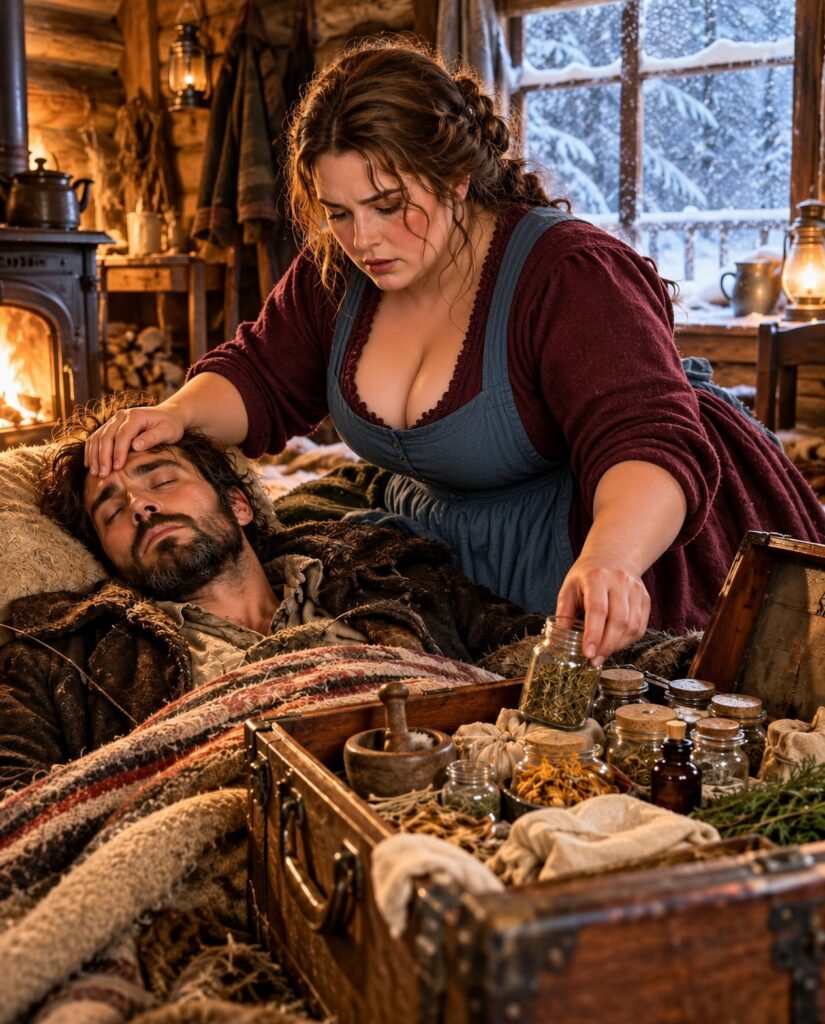
The trunk held glass jars, medicinal roots, dried herbs, willow bark, and a mortar and pestle.
Adelaide had grown up in an apothecary.
Then the worst blizzard of winter struck.
Three days into the storm, Gidrick went outside to save the barn roof.
He never returned.
Adelaide tied a rope around her waist and stepped into thirty-below winds.
Fighting through waist-deep snow, she eventually found him unconscious beneath a fallen pine branch.
Somehow, she freed him.
Somehow, she dragged his nearly two-hundred-pound body back toward the cabin.
By nightfall, Gidrick lay beside the stove trembling beneath blankets.
Then the fever came.
Adelaide touched his burning forehead before turning toward the trunk he had once ridiculed.
She opened it.
For the first time since she arrived on his mountain, Gidrick Cole’s survival depended entirely on the bride he had believed would never survive there.

PART 2 — The Wife He Never Truly Saw
The first thing Adelaide Miller noticed was the smell.
Not the smell of smoke from the fireplace or the wet wool blankets drying beside the stove.
It was the sharp, unpleasant odor coming from Gidrick’s clothing.
She knelt beside him and carefully removed his coat.
His shirt was soaked with melted snow.
A deep cut stretched across his forehead, and his left shoulder had swollen beneath the fabric.
His breathing was shallow, and every few moments his body jerked with another violent shiver.
Adelaide pressed two fingers against his neck.
His pulse was fast.
Too fast.
“Stay with me, Gidrick.”
He didn’t respond.
She had seen fever before.
Growing up in her uncle’s apothecary in Missouri, she had watched people arrive with burns, infections, broken bones, and illnesses that frightened entire families.
She had also learned that panic never helped anyone.
Adelaide brought a kettle of water to the fire.
Then she opened the trunk.
Inside were carefully wrapped bundles of dried herbs, glass bottles, linen strips, a small brass scale, and several handwritten notebooks.
She had packed those things before leaving Missouri.
Her uncle had taught her to recognize plants, prepare poultices, and understand the difference between an ordinary fever and one that required immediate attention.
But Gidrick’s condition frightened her.
She cleaned the wound on his forehead with boiled water after allowing it to cool, then covered it with clean linen.
She checked his shoulder.
It wasn’t obviously broken, but the swelling suggested a serious injury.
She prepared warm broth and tried to get a little into his mouth.
Most of it spilled.
“Gidrick, you have to swallow.”
His lips moved.
“What?”
Adelaide leaned closer.
“Don’t…”
“Don’t what?”
His eyelids fluttered.
“Don’t… let her…”
Then his head turned away.
Adelaide stopped.
Her heart tightened.
Abigail.
Even unconscious, he was calling for the woman whose grave stood beneath the cedar tree.
For a moment, jealousy threatened to rise inside her.
Then she looked at his face.
There was no room for jealousy in a man who might not survive the night.
She adjusted his blankets.
“I’m not Abigail,” she whispered.
“But I’m here.”
Outside, the wind struck the cabin so violently that the shutters rattled.
Adelaide looked toward the door.
The blizzard had buried the path.
There was no help coming.
She was alone with a wounded man, a dwindling supply of firewood, and a mountain that seemed determined to swallow everything in its way.
She took a deep breath.
Then she returned to work.
By midnight, Gidrick’s fever had worsened.
His skin was burning, but his hands were cold.
Adelaide placed another log on the fire and carefully monitored his breathing.
She had no way of knowing whether the fever came from the head injury, the wound, or another complication.
She could only keep him warm, clean the visible injuries, provide fluids when he was alert enough to swallow safely, and watch for signs that his condition was deteriorating.
She wished desperately for a doctor.
But the nearest settlement was nearly twenty miles away.
Twenty miles through a Montana blizzard.
No horse could travel it.
No wagon could cross the drifts.
Even a healthy man would struggle to walk that distance.
Adelaide looked at the window.
Snow pressed against the glass.
Then she heard something.
A faint scratching.
She turned.
It came from the other side of the cabin door.
She approached carefully and lifted the latch.
A small brown dog stumbled inside.
It was Gidrick’s old sheepdog, Buck.
The animal shook snow from its coat and immediately went to Gidrick’s side.
Adelaide knelt.
“Where have you been, you foolish creature?”
Buck whined.
She examined him.
His paws were bleeding.
He had clearly been searching for his master.
Adelaide cleaned the wounds and gave him water.
Then she noticed something attached to his collar.
A strip of leather.
It had been tied there recently.
She untied it.
There were three words scratched into the leather.
SOUTH BARN ROOF.
Adelaide stared at it.
She remembered Gidrick leaving the cabin.
He had said the barn roof was beginning to collapse under the weight of the snow.
He must have been trying to reach the animals when the tree came down.
Adelaide looked toward the window.
The barn was somewhere beyond the white darkness.
If the roof had collapsed, the animals might be trapped.
She turned toward Gidrick.
For several seconds, she considered going outside.
But she couldn’t leave him alone in his condition.
Instead, she wrapped herself in a blanket and waited until dawn.
The fourth morning arrived without sunlight.
The storm had weakened, but the temperature remained brutally cold.
Adelaide stepped outside long enough to inspect the barn.
The snow reached her waist.
The roof had partially collapsed.
One corner of the structure was buried.
She could hear the horses moving inside.
Thank God.
She dug a narrow path toward the entrance, working until her arms trembled.
Inside, she found two horses and a pair of goats.
One horse had a bleeding leg.
The other was frightened but standing.
The goats had survived.
Adelaide checked their water and feed.
There was enough hay for several days.
Then she returned to the cabin.
Gidrick had opened his eyes.
For the first time since she had dragged him home, he seemed aware of his surroundings.
He looked at the ceiling.
Then at the stove.
Then at Adelaide.
His expression changed.
“You’re…”
“Alive?
Yes.”
He tried to sit up.
Pain crossed his face.
“Don’t move.”
“The barn…”
“Still standing.
Mostly.”
“The horses?”
“Alive.”
He closed his eyes.
Then opened them again.
“How long?”
“Three days.”
His gaze shifted toward her hands.
They were swollen and raw.
There was blood beneath several fingernails.
“What happened?”
Adelaide stared at him.
“You don’t remember?”
He shook his head.
She sat beside him.
“You went outside during the storm.
A tree came down.
I found you beneath it.”
He looked confused.
“You found me?”
“Yes.”
“How?”
Adelaide almost laughed.
“With considerable difficulty.”
His eyes moved over her face.
Then he noticed the bruises on her arms.
“You dragged me?”
“Unless you believe the mountain carried you home.”
For several moments, he said nothing.
Then he whispered:
“Why?”
Adelaide frowned.
“Why what?”
“Why did you come looking?”
She looked at him as if he had asked something ridiculous.
“Because you were missing.”
“After what I did to you?”
Adelaide’s expression hardened.
“You’re my husband, Gidrick.”
He looked away.
“Not the kind you wanted.”
“No.”
She stood.
“Not the kind I wanted either.”
The words landed between them.
Gidrick closed his eyes.
And for the first time, he seemed to understand that the woman standing beside him had feelings he had never bothered to consider.
The fever broke two days later.
Gidrick slept for almost fourteen hours.
When he finally woke, Adelaide was sitting beside the window, repairing one of his torn shirts.
The cabin was quiet.
Snow had stopped falling.
For the first time in nearly a week, sunlight entered through the glass.
He watched her for a long time.
Then he spoke.
“Adelaide.”
She looked up.
“Yes?”
“Come here.”
She placed the shirt aside.
“What is it?”
He struggled to find the words.
“Thank you.”
She nodded.
“You’re welcome.”
He looked at her hands.
“Those wounds…”
“They’ll heal.”
“You shouldn’t have had to do that.”
“No.”
She returned to her chair.
Silence settled.
Then Gidrick said something she hadn’t expected.
“I saw you at the station and decided you couldn’t survive here.”
Adelaide kept her eyes on the sewing.
“I remember.”
“I thought I needed someone strong.”
She looked up.
“And you decided I wasn’t.”
He swallowed.
“Yes.”
Adelaide waited.
“I was wrong.”
She didn’t answer immediately.
Outside, a raven landed on the fence.
After a moment, she said:
“You weren’t wrong because I’m strong, Gidrick.
You were wrong because you decided what I could do before you ever gave me a chance.”
He looked down.
She continued.
“You saw my body and imagined my limitations.
You never asked what I knew, what I could do, or what I had survived before arriving here.”
His jaw tightened.
“I know.”
“No, I don’t think you do.”
She picked up the shirt again.
“You wanted a wife who could haul water uphill.
I hauled it.
You wanted someone who could split wood.
I split it.
You wanted someone who could survive a mountain winter.”
She paused.
“And when the mountain nearly killed you, I brought you home.”
Gidrick stared at the blanket.
“I owe you more than I can repay.”
Adelaide looked at him.
“Then start by learning my name without thinking of me as a mistake.”
The following week brought a visitor.
His name was Silas Mercer.
He lived in a small cabin three miles down the ridge and trapped beaver during the warmer months.
He arrived with a sack of flour, a small jar of honey, and news from the settlement.
“Road’s still blocked,” he told Gidrick.
“Won’t be clear for another week.”
Gidrick sat near the stove, his injured shoulder supported by a sling.
“How bad?”
“Bad enough.
Two cabins lost their roofs.
The old mill’s damaged.”
Silas looked at Adelaide.
Then at Gidrick.
“I heard you went under a tree.”
“Almost.”
“Your wife dragged you back?”
Gidrick nodded.
Silas whistled.
“That’s quite a woman you’ve got there.”
Gidrick glanced at Adelaide.
“Yes.”
The single word surprised her.
Silas noticed.
He grinned.
“Well, I’ll leave you two to your peace.”
After he left, Gidrick remained quiet.
Adelaide returned to preparing supper.
Finally, he said:
“Silas is right.”
She stirred the pot.
“About what?”
“You’re quite a woman.”
Adelaide looked at him.
For a moment, she almost smiled.
Then she remembered the trapper’s insult.
The winter hog.
And Gidrick’s silence.
She turned away.
“Words are easy.”
He nodded.
“I know.”
Spring arrived slowly.
The snow melted first around the cabin.
Then along the southern slope.
Then beside the creek.
The mountain began to reveal what winter had taken.
Broken branches.
Damaged fences.
A section of the barn roof.
But the worst discovery came when Adelaide walked beneath the cedar tree.
Abigail’s grave was partially exposed.
The wooden cross had fallen.
Adelaide stood over it.
She had been thinking about the grave since the day she found it.
She understood now why Gidrick had been so determined to test her.
But understanding his pain did not excuse the way he had treated her.
She knelt and straightened the cross.
Then she noticed something beneath the snow.
A small metal box.
It was rusted, but still intact.
Adelaide opened it carefully.
Inside was a folded letter.
The handwriting was delicate.
She recognized the name immediately.
Abigail Cole.
Adelaide hesitated.
Reading another woman’s private letter felt wrong.
But the envelope had been left beneath the grave marker, protected from the weather.
It was addressed to Gidrick.
She unfolded the paper.
The letter was dated nearly three years earlier.
My dearest Gidrick,
If you are reading this, I hope you have finally forgiven yourself.
You have spent so much time believing the mountain took me because you couldn’t protect me.
But you must understand something.
I chose to come here.
I knew the winters would be difficult.
I knew the ridge was dangerous.
I loved you, and I wanted the life we dreamed of.
If anything happens to me, please do not spend the rest of your life punishing yourself.
And please, when the time comes, let yourself love again.
Do not choose another woman because she can survive the cold.
Choose someone because you can be warm beside her.
Love, Abigail.
Adelaide read the final line twice.
Then she folded the letter.
For a long time, she stood beneath the cedar tree.
She finally understood that Gidrick had not simply been looking for a wife.
He had been looking for someone who could guarantee he would never experience that loss again.
And no woman could promise him that.
Not even Adelaide.
She placed the letter back in the box and carried it to the cabin.
Gidrick was repairing a chair when she entered.
He looked up.
“Where have you been?”
“The grave.”
His hands stopped moving.
“What about it?”
“I found something.”
She placed the metal box on the table.
Gidrick stared at it.
Then he recognized it.
His face changed.
“Where?”
“Beneath the cross.”
He opened the box.
When he saw the letter, his fingers began to tremble.
He read it once.
Then again.
By the time he reached the final sentence, his eyes were wet.
Adelaide stood quietly.
Finally, he lowered the paper.
“She wrote this before she died.”
“I know.”
“I never found it.”
“She wanted you to.”
He looked at her.
“I thought I killed her.”
Adelaide pulled out a chair and sat opposite him.
“Tell me.”
Gidrick looked toward the window.
Then he began.
Three winters earlier, Abigail had become ill.
The nearest doctor was far away.
Gidrick had ridden through a snowstorm to fetch him.
But the storm had blocked the mountain pass.
By the time Gidrick returned, Abigail’s fever had worsened.
He had spent the night beside her.
By morning, she was gone.
He had blamed himself ever since.
“If I’d gone sooner…”
Adelaide shook her head.
“You cannot know that.”
“I should have been able to save her.”
“You loved her.
That doesn’t mean you controlled the weather, the road, or her illness.”
He looked at the letter.
“She wanted me to move on.”
“Perhaps.”
“I didn’t.”
“I noticed.”
A faint, sorrowful smile crossed his face.
Then Adelaide said:
“But Gidrick, I cannot spend the rest of my life competing with a woman who is buried beneath your tree.”
His expression changed.
“I’m not asking you to.”
“You haven’t asked me for anything.”
He fell silent.
Adelaide stood.
“I came here because I needed a home.
I stayed because I gave my word.
But I won’t spend another winter being treated like a burden.”
She walked toward the stove.
“Once the roads open, I want us to discuss what happens next.”
Gidrick looked at her.
“You’re leaving?”
“I haven’t decided.”
“Adelaide…”
She turned.
“I need you to understand that saving your life doesn’t mean you own mine.”
He nodded slowly.
For once, he didn’t argue.
The roads opened in April.
A stagecoach arrived from the settlement.
It carried mail, supplies, and a new doctor.
The doctor examined Gidrick’s shoulder and advised him to rest and begin gentle movement as it healed.
He also examined Adelaide’s hands.
“They’re badly cracked,” he said.
“You need to protect them.”
Gidrick looked uncomfortable.
He knew why they were injured.
He knew she had spent days doing work that should never have fallen entirely on her.
That evening, he placed a small package on the table.
Adelaide opened it.
Inside was a pair of thick leather gloves.
Beside them lay a new green ribbon.
Her old ribbon had been torn during the rescue.
She looked at him.
“What’s this?”
“The gloves are for the work.”
“And the ribbon?”
Gidrick rubbed the back of his neck.
“I remembered you holding one at the station.”
Adelaide touched the ribbon.
For several seconds, she couldn’t speak.
Then she placed it carefully inside her sewing basket.
“Thank you.”
He nodded.
But he didn’t ask her to forgive him.
That mattered more than the gift.
In May, Gidrick made another change.
He cleared a room for Adelaide.
It had been Abigail’s sewing room.
He removed the old furniture, repaired the window, and built shelves.
When Adelaide saw it, she stopped in the doorway.
“What is this?”
“Your room.”
She looked at him.
“Why?”
“Because you deserve a place of your own.”
He hesitated.
“I thought you might want to keep your herbs here.”
Adelaide stepped inside.
The shelves were sturdy.
The window faced east.
Morning sunlight would fill the room.
It was the first space in the cabin that had been prepared specifically for her.
She ran her fingers over the wooden shelf.
“Did you build this?”
“Yes.”
“Your shoulder?”
“Mostly with one arm.”
She laughed softly.
Then she turned toward him.
“Thank you, Gidrick.”
He nodded.
And for the first time, he smiled at her without embarrassment.
Summer transformed the ridge.
The creek ran clear.
Wildflowers appeared beside the trails.
The livestock grew stronger.
Adelaide planted a garden behind the cabin.
She grew potatoes, onions, carrots, and medicinal herbs.
Gidrick repaired the barn.
He built a proper path between the cabin and the spring.
And he began doing something that surprised everyone who knew him.
He asked questions.
“How do you know which leaves to use?”
“Why do you dry that root in the shade?”
“How long does that preparation last?”
Adelaide answered patiently.
One afternoon, he found her crushing willow bark.
“Your uncle taught you all this?”
“Yes.”
“What happened to him?”
Adelaide became quiet.
“He died the winter before I left Missouri.”
Gidrick lowered himself onto a stool.
“I’m sorry.”
She nodded.
“He owned an apothecary.
I helped him from the time I was little.”
“Why didn’t you tell me?”
Adelaide looked at him.
“You never asked.”
He accepted that answer.
Then he noticed a small book beside her.
“What are you writing?”
“Everything I know.”
“Why?”
“So I don’t forget.”
Gidrick looked at her hands.
Then at the shelves.
“Perhaps someone else will need to know it someday.”
Adelaide smiled.
“Perhaps.”
By August, something unexpected happened.
A young woman from the settlement arrived at the cabin.
Her name was Clara Bennett.
She was twenty years old and traveling with her younger brother.
Their mother had died during childbirth, and their father had been injured in a logging accident.
Clara had heard about Adelaide’s knowledge of herbs.
Her little brother had been suffering from a persistent cough.
Adelaide examined him.
She discovered that the boy was exhausted, dehydrated, and struggling with a respiratory illness.
She explained that he needed medical attention and arranged for the settlement doctor to examine him.
She also helped Clara prepare food and keep the child comfortable.
Gidrick watched from the doorway.
He had never seen Adelaide in this way.
Not as the woman he had rejected.
Not as the wife he had neglected.
But as someone people trusted.
Someone who made frightened people feel less alone.
When Clara left, she hugged Adelaide.
“Thank you.”
Adelaide smiled.
“Take care of him.”
After the wagon disappeared down the trail, Gidrick spoke.
“You should do this more often.”
Adelaide looked at him.
“Do what?”
“Help people.”
“I do.”
“I mean properly.
With a room, supplies, and everything you need.”
She laughed.
“You want me to open an apothecary on a mountain?”
“Why not?”
“Because there are hardly any people here.”
“Then perhaps they need one more than most.”
Adelaide stared at him.
He was serious.
For the first time, he wasn’t simply tolerating her presence.
He was imagining a future that included her ambitions.
The turning point came in October.
A messenger arrived from the settlement carrying a letter.
It was addressed to Adelaide.
The handwriting belonged to Finch, the matchmaking agent.
She opened it.
The letter explained that the original marriage agreement had been filed incorrectly.
Because Gidrick had initially refused to complete the marriage registry, certain legal details had never been finalized.
The matter could be corrected at the county office.
Adelaide read the letter twice.
Then she placed it on the table.
Gidrick looked up.
“What is it?”
She explained.
He listened without interrupting.
When she finished, he looked at her.
“That means you could leave.”
“Yes.”
He stared at the letter.
For a long moment, the only sound was the fire.
Then he said:
“If you want to go, I’ll help you.”
Adelaide’s heart tightened.
“Just like that?”
He nodded.
“You deserve to choose where you live.”
“And if I stay?”
His eyes met hers.
“Then I would be grateful.”
She looked at him carefully.
“Because you need someone to cook and keep the cabin?”
“No.”
“Because you need someone to care for the animals?”
“No.”
“Then why?”
Gidrick stood.
He walked toward the window.
For a moment, she thought he wouldn’t answer.
Then he turned.
“Because the cabin is different when you’re in it.”
Adelaide said nothing.
“Because I look for you when I come back from the barn.”
He swallowed.
“Because I hear you laughing with Buck and realize I’ve been waiting all day to hear it.”
His voice became quieter.
“And because I want to know what you think before I make decisions.”
Adelaide’s eyes filled.
Gidrick took a breath.
“I don’t expect you to love me.”
She looked down.
“But I would like the chance to become a man you could love.”
The next morning, Adelaide went to the cedar tree.
She carried fresh flowers.
She placed them beside Abigail’s grave.
Then she sat in the snowless grass and looked at the wooden cross.
“I don’t want to take your place,” she whispered.
“I don’t think he wants that either.”
She touched the edge of the grave marker.
“Thank you for leaving him a reason to keep living.”
When she returned to the cabin, Gidrick was waiting.
He didn’t ask where she had been.
He simply opened the door.
And she stepped inside.
Winter returned in November.
But this time, the mountain did not feel like an enemy.
The barn roof had been reinforced.
The woodpile was larger.
The spring had been protected.
The pantry was full.
Adelaide’s medicines were organized in glass jars.
Gidrick had even built a second stove for the room she used as an apothecary.
On the first evening of the first heavy snowfall, they sat together beside the fire.
Buck slept near the hearth.
Gidrick was reading a book.
Adelaide was writing in her notebook.
After a while, he reached across the small table.
His hand rested beside hers.
She looked at him.
He didn’t pull away.
“May I ask you something?”
“Yes.”
“Would you consider beginning again?”
Adelaide smiled faintly.
“Beginning what?”
“Our marriage.”
She studied his face.
“Not the marriage we agreed to at the station?”
“No.”
He shook his head.
“The one we choose.”
Adelaide was quiet.
Then she placed her hand over his.
“Yes.”
Gidrick closed his eyes.
For a moment, he looked like a man who had been carrying something heavy for years and had finally been allowed to set it down.
He leaned toward her.
Then stopped.
“May I?”
Adelaide smiled.
“Yes, Gidrick.”
He kissed her gently.
It was not a dramatic kiss.
There were no promises of forever.
No declarations shouted into the storm.
Just two people sitting beside a fire, choosing each other for the first time.
And somehow, that made it more meaningful.
The following spring, Adelaide opened a small mountain apothecary.
Travelers came for salves, herbal preparations, and practical advice.
She never pretended to be a doctor.
She referred serious illnesses and injuries to trained physicians, but she helped families understand how to care for themselves between visits.
Gidrick expanded the cabin.
He built another room and a proper waiting area.
He also built a large wooden sign and placed it beside the trail.
ADELAIDE COLE
MOUNTAIN HERBAL SUPPLIES
She stared at it when he finished.
“You used my name.”
He smiled.
“Would you prefer Miller?”
She shook her head.
“No.”
She touched the lettering.
“Adelaide Cole.”
Gidrick stood beside her.
“Does it suit you?”
She looked at him.
“It does.”
Then she kissed his cheek.
Two years later, a young woman arrived at the mountain cabin.
She was carrying a small suitcase.
Her clothes were worn.
Her eyes were frightened.
Gidrick opened the door.
“Can I help you?”
The woman swallowed.
“I’m looking for Adelaide Cole.”
Adelaide came from the apothecary room.
“That’s me.”
The young woman looked at her.
Then at the warm cabin.
Then back at Adelaide.
“I heard you might have work.”
Adelaide smiled.
“What kind of work?”
“Anything.
I can cook.
I can clean.
I can help with the animals.”
Gidrick glanced at his wife.
Adelaide approached the woman.
“Come inside.
It’s cold.”
The young woman hesitated.
“I’m not very strong.”
Adelaide gently took her suitcase.
“Then we’ll find work that suits you.”
She led her toward the fire.
Gidrick watched them.
He remembered another station platform.
Another woman standing beside a massive trunk.
A frayed green ribbon in her hands.
A woman he had judged before he knew her name.
And he understood, perhaps more clearly than ever, how close he had come to losing the greatest gift of his life.
That evening, after the visitor had gone to bed, Gidrick found Adelaide standing beside the old trunk.
It was still there.
The same trunk he had once mocked.
The same trunk that had carried the herbs and knowledge that helped save his life.
He placed his arms around her.
“Do you remember what I said when I first saw you?”
Adelaide smiled.
“Unfortunately.”
“I asked where the woman Finch promised me was.”
“You did.”
He lowered his head.
“I was an idiot.”
She laughed.
“That is certainly one way to describe it.”
He kissed her forehead.
“Thank you for staying.”
Adelaide turned in his arms.
“I didn’t stay because you needed saving.”
“I know.”
“I stayed because you finally learned to see me.”
Gidrick nodded.
Then she touched his cheek.
“And because I wanted to.”
Outside, snow began falling softly over the Montana ridge.
But inside the cabin, the fire was warm.
The pantry was full.
The animals were safe.
And the woman who had once been told she wasn’t strong enough to survive the mountain had built a life there that neither of them could have imagined.
Gidrick had once believed a strong wife was someone who could haul water uphill, split wood, and endure the cold.
He had learned that strength could look different.
It could be the patience to care for a frightened man who had hurt you.
It could be the courage to demand respect.
It could be the knowledge to recognize danger when everyone else was afraid.
It could be the willingness to save someone without surrendering yourself.
And sometimes, the strongest person in the room was the one everyone had underestimated.
Adelaide had never needed to become smaller to fit into Gidrick Cole’s world.
He had needed to become a better man to deserve a place in hers.
And that was how the mountain man who had once refused his plus-size bride discovered that the woman he believed could never survive his world was the very person who taught him how to live in it.
THE END.


